brake light AUDI S4 2013 Owner's Manual
[x] Cancel search | Manufacturer: AUDI, Model Year: 2013, Model line: S4, Model: AUDI S4 2013Pages: 302, PDF Size: 75.61 MB
Page 125 of 302

Homelink®
Universal remote
control
Description
Applies to vehicles: with Home link
The HomeLink universal remote control con
be programmed with the remote control for
devices that ore already present.
With Home Link, you can control devices such
as the garage door, secu rity systems, ho use
lights , etc. comfortably from the inside of you
vehicle .
H omelink makes it poss ible for you to rep lace
three different remote controls from dev ices
i n your home with one universal remo te. Th is
featu re works for most garage door and exte
rior door motor signals. Programming the in
d ividual remote control for your remote con
trol takes p lace near the center of the radiator
grille. There is a control module attached at
this location .
A one-t ime programm ing of the sensor must
be performed before you are able to use sys
tems with Homelink. If the system does not activate after performing the one-t ime pro
gramming, check whether the system uses a rolling code ¢
page 126 for vehicles without
the MMI*.
,& WARNING
-
-Never use the Homelink ® transmi tter
with any garage door opener that does have not the sa fety stop and reverse fea
ture as requ ired by federa l safety stand
ards. Th is includes any garage door open
er mode l manufactured before April 1,
1982.
- A garage door opener which cannot de
tect an object, signaling the door to stop
and reverse does not meet current feder
al safety standards . Us ing
a garage door
opener without these features increases
risk of serious injury or death.
Homelink ® 123
-For safety reasons never re lease the
parking brake or start the eng ine while
anyone is standing in front of the vehicle .
- A garage door or an estate gate may
sometimes be set in motion when the Homelink ® remote control is being pro
grammed. If the device is repeatedly ac
tivated, th is can overstrain motor and
damage its e lectrical components -an
overheated mo to r i s
a fire hazard!
- To avoid possib le injuries or property
damage, please always make abso lutely
certain that no person s or objects are lo
cated in the range of motion of any
equ ipment being operated .
(D Tips
-If you would like more information on
Homelink ®, where to purchase the
Home link ® compatib le products, or
would like to purchase the Homelink ®
Home Lighting Package, please ca ll toll
free: l-800-355-3515.
- For Declaration of Compliance to United
States FCC and Industry Canada reg ula
tions¢
page 283.
- For security reasons, we recommend that
you clear the programmed b uttons be
fore selling the veh icle.
Operation
App lies to vehicles : with Homeli nk
~~''' r ·O : O ·) 1111
~
®
Fig . 1 36 Head li ner: controls
Req uirement : The buttons must be program-
med
<:!)page 124 or ¢page 125. ..,_
Page 187 of 302
Intelligent technology Notice about data
recorded by vehicle
control modules
Your vehicle is not equipped with an Event Da
ta Recorder (EDR), installed by some manu
facturers for the express purpose of capturing
data for retrieval after an accident or crash
event. EDR's are sometimes called "crash re
corders".
Some state laws restrict the retr ieval or down
loading of data stored by EDR's that were in
stalled in a vehicle for the express purpose of
retrieving data after an accident or crash
event without the owner's consent.
Although your vehicle is not equipped with an
EDR, it is equipped with a number of electron
ic control modules for various vehicle systems
such as, for examp le, engine function, emis
sion control, as well as for the airbags and
safety belts.
These electronic control modules also record
vehicle-related data during norma l vehicle op
eration for diagnostic and repair purposes.
The recording capacity of the electronic con
trol modules is limited to data (no sound is re
corded) and only a small amount of data is ac
tually recorded over a very limited period of
time and stored when a system fault or other
condition is sensed by a control unit. Some of
the data then stored may relate to vehicle
speed, direction, braking as we ll as restraint
system use and performance in the event of a
crash or other condition. Stored data can only be read and downloaded with special equip
ment.
Electronic Stabilization
Control (ESC)
Description
ESC helps to improve road holding and vehicle
dynamics to help reduce the probability of
skidding and loss of veh icle control. It works
only when the engine is running. ESC detects
Intelligent technology 185
certain difficult driving situations, including
when the vehicle is beginning to spin (yaw)
out of control and helps you to get the veh icle
back under control by se lectively braking the
wheels, and/or reducing engine power and
providing steering ass istance to help hold the
vehicle on the driver's intended course. The in
dicator light
JjJ in the instrument cluster
blinks when ESC is taking action to help you
control the vehicle.
ESC has limitations .
It is important to remem
ber that ESC cannot overcome the laws of
physics.
It will not always be able to help out
under all conditions you may come up against.
For example, ESC may not always be able to
help you master situations where there is a
sudden change in the coefficient of friction of
the road surface. When there is a section of dry road that is suddenly covered with water,
slush or snow, ESC cannot perform the same
way it would on the dry surface. If the vehicle
hydroplanes (rides on a cushion of water in
stead of the road surface), ESC will not be
able to help you steer the vehicle because con
tact with the pavement has been interrupted
and the vehicle cannot be braked or steered .
During fast cornering, particularly on winding
roads, ESC cannot always deal as effectively
with difficult driving situations than at lower
speeds. When towing a trailer, ESC is not able
to help you regain control as it would if you
were not tow ing a trailer.
A lways adjust your speed and driving style to
road, traffic and weather conditions. ESC can
not override the vehicle's physical limits, in
crease the available traction, or keep a vehicle
on the road if road departure is a result of
driver inattention. Instead, ESC improves the
poss ibility of keeping the vehicle under con
trol and on the road dur ing extreme maneu
vers by using the driver's steering inputs to
help keep the vehicle going in the intended di
rection. If you are traveling at a speed that
causes you to run off the road before ESC can
provide any assistance, you may not experi
ence the benefits of ESC.
•
•
Page 190 of 302
188 Intelligent technology
allroad: Switching on /off
ESC turns on automatically when you start
the engine .
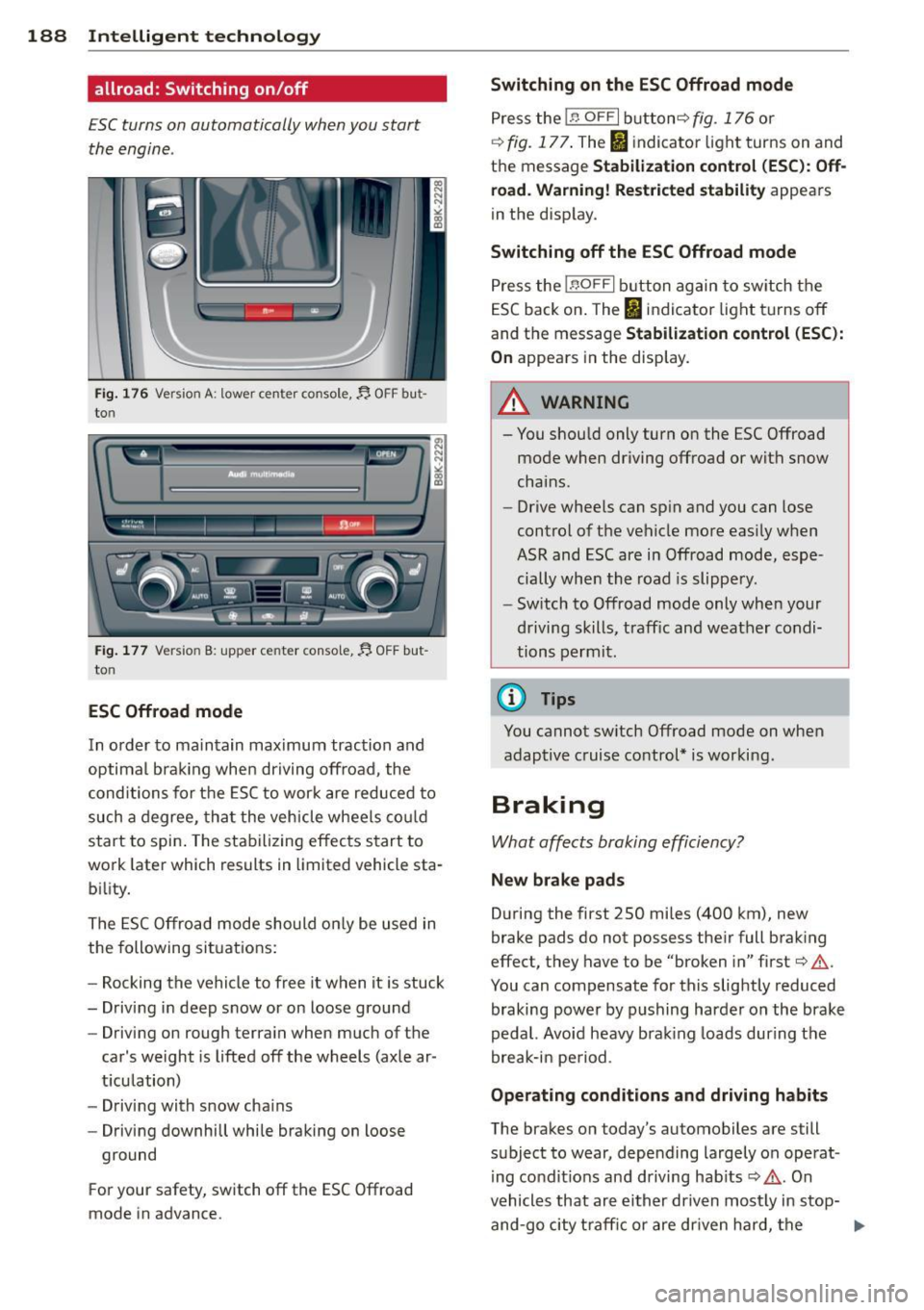
Fig. 176 Version A: lower ce nter console,~ OFF but
to n
...... [ I I n-I _,,. .,., -------' -"~ __..,
Fig. 177 Versio n B: upper ce nter conso le,~ OFF but
to n
ESC Offroad mode
In order to maintain maximum traction and
optima l brak ing when driving offroad , the
conditions for the ESC to work are reduced to
such a degree, tha t the vehicle whee ls co uld
start to spin . The stabilizing effects start to
work later wh ich results in limited vehicle sta
b ili ty.
The ESC Offroad mode should on ly be used in
the following situations:
- Rocking the vehicle to free it when it is stuck
- Driving in deep snow or on loose ground
- Driving on rough terra in when much of the
car's weight is lifted off the wheels (axle ar
t icu lation)
- Driving with snow cha ins
- Driving downhill while braking on loose
ground
F or your safety, switch off the ESC Offroad
mode in advance.
Switching on th e ES C Offroad mode
Press the In OF FI button ¢ fig. 176 or
¢ fig. 177 . The I indicator light turns on and
the message
St abilization cont ro l ( ES C): Off
ro ad. Wa rning! Rest ricted stability
appears
in the disp lay.
Swit ching off th e ESC Offroad mode
Press the !.$ O FF I button again to sw itch the
ESC back on . The
IJ indicator light turns off
and the message
Stabil ization contro l (ESC ):
On
appears in the display.
_& WARNING
- You shou ld only turn on the ESC Offroad
mode when driving offroad or with snow
chains.
- Drive whee ls can sp in and you can lose
control of the vehicle more easi ly when
ASR and ESC are in Offroad mode, espe
cially whe n the road is slippery.
- Switch to Offroad mode only whe n your
driving skills, traff ic and weather condi
tions permit .
(D Tips
You cannot sw itch Offroad mode on when
adaptive cruise control* is working.
Braking
What affects braking efficiency?
New brake pad s
During the first 250 mi les (400 km), new
brake pads do not possess the ir full brak ing
effect, they have to be "broken in" first¢ .&,.
You can compensate for this slightly reduced
braking power by p ushing harde r on the brake
pedal. Avoid heavy brak ing loads dur ing the
break-in pe riod.
Oper ating cond ition s and driving habit s
The brakes on today's automobiles are still
subject to wear, depending largely on operat
ing co nd it ions and driving hab its
¢ .&, . On
vehicles that are either driven most ly in stop-
and-go city traff ic or are dr iven hard, the
lilJ,,
Page 192 of 302
190 Intelligent technology
to brake. This may cause the brakes to
overheat, premature wear and increased
stopp ing distance.
- Under certain climatic and operating
condit ions such as passing through wa
ter, driving in heavy ra in or after wash ing
the vehicle, the effect iveness of the
brakes can be reduced . In winter, ice can
accumulate on the brake pads, linings,
discs and drums. Carefully apply brakes
f or a test . B rakes will dry a nd ice coat
ings will be cleaned off after a few ca re
ful brake applications.
- Driv ing for an extended pe riod of time on
salt -covered roads without using you r
brakes can also affect braking efficiency.
Clean off accumulated salt coating from
brake discs and pads w ith a few careful
brake applicat ions.
- If you damage the front spoiler, or if you
install a different spoiler, be sure the air
flow to the front brakes is not obstruct
ed . O therwise the brake system could
overheat reducing the effectiveness of
the ent ire brake system.
- Failure of one brake c ircuit will impair
the braking capability resulting in an in creased stopp ing distance. Avoid driv ing
the vehicle and have it towed to t he near
est author ized Audi dealer or qualif ied
workshop.
- Never let the vehicle roll to a stop w ith
the engine shut off.
- If the brake booster is not working, for
example when towing your ve hicle, or
because the b rake booste r has somehow
been damaged, the brake pedal must be
pressed considerab ly harder to make up
for the lack of booster assistance.
Electro-mechanical
power assist, dynamic
steering
The electro-mechanical power assist helps
the driver when steering.
Power steer ing adapts electronically based on
the veh icle speed.
Indicator lights and messages
• Ste ering d efe ct ive ! Do not d rive vehicle!
If this indicator light turns on and stays on
a nd this message appears, the power steering
may have failed .
Do
not continue driving. See your authorized
Audi dealer or other qualified repair facility
for assistance.
'Tij D ynamic steer ing: Sy stem f au lt! You c an
cont inue d riving
If the indicator l ight turns on and the mes
sage appears, the stee ring may be more diffi
c ul t to move o r more sensitive than usua l. The
steering wheel may a lso be at an ang le when
driv ing straight.
Drive slowly to your authorized Audi dea ler or
qualified workshop to have the ma lf u nction
corrected.
'Tij Dynamic stee rin g: initializing
If this driver message appears and the indica
tor light is flashing on the instrument panel, dynamic steer ing* is being re initia lized . On ce
you start the engine after t his is finished, the
steering wheel will be easy to move . Re-initi
alizat ion might be necessary if the steering
whee l was moved hard to the left and right
whi le the vehicle was not moving. The display
goes out as soon as initiali zation is complete.
A WARNING
-Have the dynamic steering* system mal
function repa ired as soon as possible by an
authorized Audi dealer or any qualified
workshop - r is k of accident!
-
Page 198 of 302
196 Driving and en vironm ent
@ For the sa ke of the environment
Even when the Emission Contro l System is
operating properly, the exhaust gas can
have a sulfur-like exhaust gas smell under
some operating states. This depends on
the sulfur content of the fue l being used .
Using a different brand of fuel may help,
or filling the tank w ith lead-free super
grade gasoline.
Operate your vehicle
economically and minimize pollution
General
Your personal style of driving will determine
t he economy of your vehicle, as well as ex
haust and noise levels.
Fue l economy, environmental impact , and
wear on you r engine, bra kes and t ires la rgely
depend on th ree factors:
= yo ur personal dr iv ing sty le
- operating conditions
- technical lim itations
If yo u anticipate what you need to do next and
drive economically, you can easi ly cut your
fue l consumption by 10-15 percent. This sec
tion will give you some t ips on how you ca n
he lp the environmen t and your pocketbook.
(D Tips
The consumpt ion estimates as published
by ENVIRONMENTAL PROTECTION AGENCY
(EPA) and Transport Canada may not co rre
spond to your actual consumption on the
road, wh ich will vary depending upon vehi
cle load an d speed, road and weather con
ditions, tr ip le ngth, etc.
Drive smoothly and keep a lookout
ahead
Vehicles use the most fuel when they are ac
celerating .
.,. Avoid unnecessa ry accelerating and braking. Vehicles use the most fuel when they are ac
ce le rating. If you anticipate what is going to
happen next, you will need to brake less and,
th us, acce lerate less. Let the vehicle coast
whenever possible -for example when you see
that the next traff ic light is red .
· Avoid full throttle
Driving at moderate speeds saves fuel and
improves your mileage.
.. Try and keep well below your car's maxi-
m um speed .
Acce lerat ing gently red uces fue l cons ump
tion, engine wear, and does not disturb the
environment.
F uel consumpt ion, exhaust emissions a nd en
gine noise inc rease disproportionate ly at high
speeds . If yo u drive at approximately th ree
quarters of top speed, fuel consumption w ill
be reduced by one half. Never drive faster
than the posted speed limit and weathe r con
ditions pe rm it.
Reducing unnecessary idling
Even when your car is jus t idling it burns up
fuel.
.. Shut the eng ine off when you are not driv
ing the vehicle .
.. Do not warm up the vehicle by letti ng the
eng ine run at idle .
It makes sense to shut off the engine in traffic
jams, when wa it ing for tra ins to pass at rail
r oad crossings, or at traffic lig hts that have
long wai ts on red . Tu rn ing the eng ine off for
j ust 30-40 seconds saves more fuel tha n is
burned start ing t he e ngine aga in.
It takes a long t ime for the engine to warm up
fully when it is ru nning at id le. However, wea r
and noxious emissions a re espec ia lly high
whe n the eng ine is wa rm ing up. So you s hou ld
dr ive away as soon as yo u start the engine and
avo id running at high rpms whi le the engine is
still warming up.
ll-
Page 200 of 302
198 Driving and en vironm ent
s uit able for the vehicl e, or w hic h ex ceed s
y ou r dr iving sk ill s. N eve r tak e an y unnec es
s a ry risks!
After driv ing offro ad
- After driving offroad, remove branches and
other debris from the rad iator grille, under
body, and whee ls. Look especia lly for objects
(stones) that have been caught in the tire
tread .
- Clean t he body and the vehicle underbody
and inspect the vehicle for possible damag
es.
- Clean off the dirty windows, headlights, tail
lights and the license plate.
- Perform a brake test (especially after driving
through water) .
A WARNING
- Be especially aware and attentive when
dr iv ing under d iff icult conditions. Dam
ages to the vehicle and injuries may oc
cur when driving at an excess ively high
speed or with incorrect driv ing maneu
vers.
- Always adjust your speed and handling
to the roads, terra in, traffic and weather
condit ions. Drive especially slow if off
road with low v is ibility.
- Please note that the wheels can spin and
the vehicle can brea k away when the ESC
Offroad Mode is switched off, espec ially
whentheroadisslipper~
- Driv ing stab ility is red uced in the ESC
Offroad mode.
@) For the sake of the environment
Avo id harming the environment and take
nature into conside rat ion.
@ Tips
Only drive where it is allowed and always
stay on the provided roads and paths.
Driver messages
App lies to veh icles : all road
There is only one right way to drive in difficult
conditions: slowly and with caution!
When driving offroad, observe the follow ing :
.. Never drive the vehicle in terrain which is
not suitab le for the vehicle, or which ex
ceeds your driving ski lls. Never take any un
necessary risks!
.. Drive slowly and caut iously!
.. Pay attention to the
ground clearanc e of
your veh icle! This may vary depending on
the load and composition of the ground and
t he environment. The d river is therefore re
sponsib le for deciding whether a veh icle can
handle a specific situation .
.. Activate the
ESC-Offroad-Mode r::;, page 187
as needed .
Difficult terrain
Never drive in areas that are not fam iliar to
you and d rive slowly when offroad and be p re
pared and expect the unexpected (e .g. pot
holes, boulders , tree stumps, etc.)
T o p reven t the veh icle from bottoming and
avo id damage to the unde rbody, yo u should
drive straight across severe bumps in the
ground with only one side of the ve hicle so
that only two of your whee ls cross the bumps.
Drive quickly th rough sandy or marshy offroad
sections and do not stop, if at all possible.
Driving through water on roads
Read the information on r::::> page 194 .
Page 201 of 302
Trailer towing Driving with a trailer
General information
Your Audi was designed primarily for passen
ger transportation .
If you plan to tow a tra iler, p lease remember
that the addit ional load will affect durab ility,
economy and performance .
T railer towing not on ly places more stress on
the vehicle, it also calls for more concentra
tion from the driver.
F or this reason, a lways fo llow the operating
and driving instructions provided and use
common sense.
Technical requirements
Traile r hitch
Use a weight-carrying hitch conforming to the
gross trailer we ight. The hitch must be suita
b le for your veh icle and trailer and must be
mounted secure ly on t he veh icle's chassis at a
technically sound location . Use only a t railer
h itch w ith a removab le ball moun t. A lways
check with the tr ailer hitch man ufac tur er to
make sure that you are using the correct
hitch.
Do not use a bumper hitch.
T he hitc h must be installed in such a way that
it does not inte rfe re with the impac t-absorb
i ng b umper syst em. No modifica tions should
be made to the vehicle exhaus t and b rake sys
tems . From t ime to time, check that a ll hitch
mo unt ing bolt s remain securely fas tened.
W hen you are not tow ing a trailer, remove the
trai le r hi tch ball moun t. T h is prevents the
hi tch from causing damage sho uld your ve hi
cle be str uck from be hind
¢ &. .
Trailer brakes
If yo ur tra iler is equ ipped w it h a braking sys
tem, check to be su re that it conforms to a ll
r eg ulat io ns.
Trailer towin g 199
The trailer hyd ra ulic bra ke system must not be
direct ly connected to the vehicle's hydraulic
brake system
¢ &. .
Safety chains
Alw ays use s afety chains between your ve hicle
and t he tra ile r.
Trailer lights
Tra ile r lights m ust meet all reg ulations . Be
su re to check w ith your authorized Audi dealer
fo r c orrec t w iri ng, sw itches, and relays.
Mirrors
If you a re unable to see the traffic behind you
u sing the regula r outside m irrors, then you
must insta ll ext ended mir ro rs. It is important
t h at you
always have clea r vis io n to the rear .
.8, WARNING
- If a trai ler has elec trica l br ake s plea se
no te th at t hese bra kes are not activat ed
by the fa ctory -fit ted control unit -risk of
accident!
- After removing the t railer hi tch, do no t
s to re it in yo ur vehicle . In case of sudden
brak ing, the hitch could fly fo rward and
in ju re you or yo ur passenge rs .
Operating instructions
Maximum traile r we ight
-
A trai ler fo r you r vehicle is limited to a typical
class 1 or class 2 tra iler.
Trailer load distribution
B e sure the lo ad in the tra iler is h eld secure ly
i n p lace to p reven t it from shifting fo rward,
backward or sideways.
Never allow a passenger to ride in a trailer
¢ &. in Driving instru ctions on page 200.
Engine cooling system
T owing a t railer ma kes t he engine wor k hard
er . It is impo rta nt that the cooling system's
perfo rman ce is up to the additional load.
Make sure tha t the coo ling sys tem h as enough
f lu id . .,..
•
•
Page 202 of 302
200 Trailer towing
Tire pressure
When towing a trai le r, inflate the tir es of your
vehicle to the cold tire pressure listed under
"Full load" on the label located on the driver 's
side B-pillar (visible when the door is open).
Inflate trailer tires to trailer and tire manufac
turers' specifications.
Lights
The headlight settings should be checked with
the trailer attached before dr iving off. Check
to make sure both vehicle and tra iler lights
are working properly.
Safety chains
Be sure trailer safe ty cha ins are properly con
nected from the trailer to the hitch on the ve
hicle. Leave eno ugh slack in the chains to per
mit turning corners. When you install safety
cha ins, make sure they w ill not drag on the
road when you are driving.
The chains shou ld cross under the trai ler
tongue to prevent it from dropping in case of
separation from the hitch.
Driving instructions
Driving with a trailer always requires extra
care and consideration.
To obtain the best possible handling of vehicle
and trai ler, p lease note the following:
.,. Do not tow a loaded trailer when your car it
self is not loaded .
.,. Be especia lly careful when passing other
vehicles .
.,. Observe speed limits .
.,. Do not drive at the maximum permissible
speed.
.,. Always apply brakes early.
.,. Monitor the temperature gauge.
Weight distribution
Towing a loaded trai ler with an empty car re
sults in a highly unstable distribution of
weight . If this cannot be avo ided, drive at very
low speeds only to avoid the risk of losing
steering control. A "ba
lanced'' rig is easier to operate and con
trol. This means that the tow vehicle should be loaded to the extent possible and permissi
ble, while keep ing the trailer as light as possi
ble under the c ircumstances. Whenever poss i
ble, transfer some cargo to the luggage com
partment of the tow veh icle while obse rving
tongue load requ irements and vehicle load ing
considerations.
Speed
The higher the speed, the more d iff icu lt it be
comes for the driver to control the rig. Do not
drive at the maximum permissible speed. Re
duce your speed even more if load, weather or
wind conditions are unfavorable -pa rticularly
whe n going downhill.
Reduce veh icle speed
immediately if the trail
er shows the slightest s ign of sway ing.
Do not
try to stop the swaying by accelerating.
Observe speed limits. In some areas, speeds
for vehicles tow ing trailers are lower than for
regular vehicles .
Always apply brakes early. When driving
downh ill, shift into a lower gear to use the en
gine braking effect to slow the vehicle . Use of
the brakes alone can cause them to overheat
and fail.
Coolant temperature
The coolant temperature gauge c> page 10
must be observed carefully . If the needle
moves close to the upper end of the scale, re
duce speed immediately and/or turn off the
air conditioner.
If the coolant temperature warning light •
in the in strument cluster starts flashing, pull
off the road, stop and let the engine
idle for
abo ut two minutes to prevent heat build-up .
_& WARNING
Anyone not properly restrained in a mov
in g vehicle is at a much greater risk in an
accident. Never let anyone ride in your car
who is not p roperly wea ring the restraints
provided by Audi.
-
Page 204 of 302
202 Cleaning and protection
Cleaning and protect ion
General information
Regular core preserves vehicle value .
Any automobile is exposed to industrial
fumes, corrosive road salt, etc. A well cared
for Audi can look like new many years after
purchase . Regular and correct care w ill con
tr ibute to maintaining the beauty and value of
your Aud i.
Furthermore, good care may be a condition
for substantiating a warranty claim should
corrosion damage or paint defects occur.
Your author ized Audi dealer has a variety of
dedicated vehicle-care products and can ad
vise which ones to use for cleaning the exter i
or and interior of your vehicle .
Whether you use products recommended by
Audi or other commercially available clean ing
agents, please make sure you apply them cor
rectly .
A WARNING
-Cleaning agents may be poisonous. Keep
them out of the reach of children.
- Heed all caut ion labels.
- Always read directions on the container
before using any product . Follow the di
rect ions carefu lly.
- Most chemical cleaners are concentrated
and have to be diluted.
- Use spot removing fluids only in well
ventilated areas.
- Do not use gasoline, kerosene, d iesel
fuel, nail pol ish remover or other volatile
fluids. They may be toxic, flammable or
hazardous in other ways. Do not wash,
wax or dry the vehicle with the ignit ion
on or the engine running.
- Do not clean the undersides of chassis,
fenders, wheel covers, etc. without pro
tecting your hands and arms. You may cut yourself on sharp-edged metal parts. -
Moisture and ice on brakes may impair
brak ing eff ic iency
c::> page 188. Test the
brakes carefully each time you wash the
veh icle.
@ For the sake of the environment
Select on ly environ mentally friendly clean
ing products. Leftover cleaning products
should not disposed of in the household
waste .
Care of exterior
Washing
Frequent washing protects the vehicle .
The best p rotection against environmental in
fluences is
frequent washing and waxing . How
often this is required depends on:
- How much the veh icle is used
- Where the vehicle is parked (garage, in the
open under trees, etc.)
- The seasona l and weather conditions
- Environmental influences
T he longer b ird droppings, insects, tree resin,
road and industria l gr ime, tar, soot, road salt
and other materials remain on the vehicle body, the more lasting their destructive ef
fects will be . High temperatures caused by ex
posure to intense sunlight intensify the corro
sive effect, particularly when humidity is high as well.
Under certain circumstances,
weekly washing
may be necessary. Under other conditions, a
monthly washing and waxing may be ade
quate .
After the winter, the underside of the vehicle
should be thoroughly washed, preferably in a
professional car wash.
Vehicles with matte finish paint
c::> page 204.
A WARNING
-A lways read and heed all WARNINGS and
other information
c::> page 202.
Page 210 of 302
208 Clea ning and protec tio n
- Damage or ma lfunction of electrical
components due to water damage or any
other outside influence is not covered by
the Aud i New Vehicle Limited Warranty.
See your Warranty
& Maintenance book
l et for additional details about your war
ranty.
Cast (light) alloy wheels
Cast (light) alloy wheels require special care.
.. Wash the whee ls with a sponge or hose
brush every other week.
.. For deep cleaning afterwards, use only a
dedicated
aci d-fr ee cast alloy wheel cleaner.
.. Rub a coat of
liqui d wax onto the r ims every
three month . Be sure to reach and treat a ll
parts of the rim.
To preserve the decorat ive appearance of the
cast alloy wheels, some specia l care is neces
sary. In addit ion to road d irt and sa lt , brake
dust is a lso cor ros ive.
If l eft on for too long,
brake dus t can cause pitting.
Use only specia l
acid-free cleaners formulated
for a lloy rims. Safe p roducts are available at
your author ized Audi dealer. Never leave the
cleane r on the rims longer than specified on
the label. If not rinsed
off promptly, the acid
contained in some cleaners can attack the
threads on the whee l bolts.
Never use ab ras ive or metal polishing clean
ing agents. If the protective coating has been
chipped, e .g. by kicked up road dirt, touch it
up as soon as possible .
.&, WARNING
-Moisture and ice on brakes may affect
braking efficiency¢
page 188. Test the
brakes carefully each time you wash the
vehicle .
- Always read and heed all WARNINGS and
other information
¢ page 202.
Body cavity sealing
The body cavity sealing does not need to be
checked .
All body cav ities which could be affected by
corros ion have been thoroughly protected at
the factory .
This sealing does not require any inspection or additional treatment. If any wax should seep
out of the cavity when the ambient tempera
ture is high, it can be removed with a plastic scraper and a suitable solvent .
.&, WARNING '"-'--
Solvents can be dangerous .
- Benz ine is flammable and toxic. If you
use benz ine for removing the wax, keep
spa rks, flame and lighted cigarettes
away. Never dump benz ine on the
g round, into open streams or down sew
age drains .
- Be s ure to observe all safety and environ
mental regulations. Follow all instruc
tions on the container.
- Always read and heed all WARNINGS and
other information ¢
page 202.
Chassis
Have the undercoating checked for damage
from time to time.
The lower body shell of your Aud i is also thor
oughly p rotected against corros ion.
Any damage to the undercoat ing caused by
road hazards should be repaired promptly .
.&, WARNING
Too much undercoating in the wrong p la
ces can cause a fire.
- Do not app ly additional undercoating or
r u stp roofing on or nea r the exhaust
manifold, exhaust pipes, catalyti c con
ver ter or heat shields. While driving, the
substance used for undercoating could
overheat and cause a fire.