brake AUDI S4 2013 Workshop Manual
[x] Cancel search | Manufacturer: AUDI, Model Year: 2013, Model line: S4, Model: AUDI S4 2013Pages: 302, PDF Size: 75.61 MB
Page 221 of 302
Checking and filling Engine hood
Releasing and opening the engine hood
The engine hood is released from inside the
vehicle .
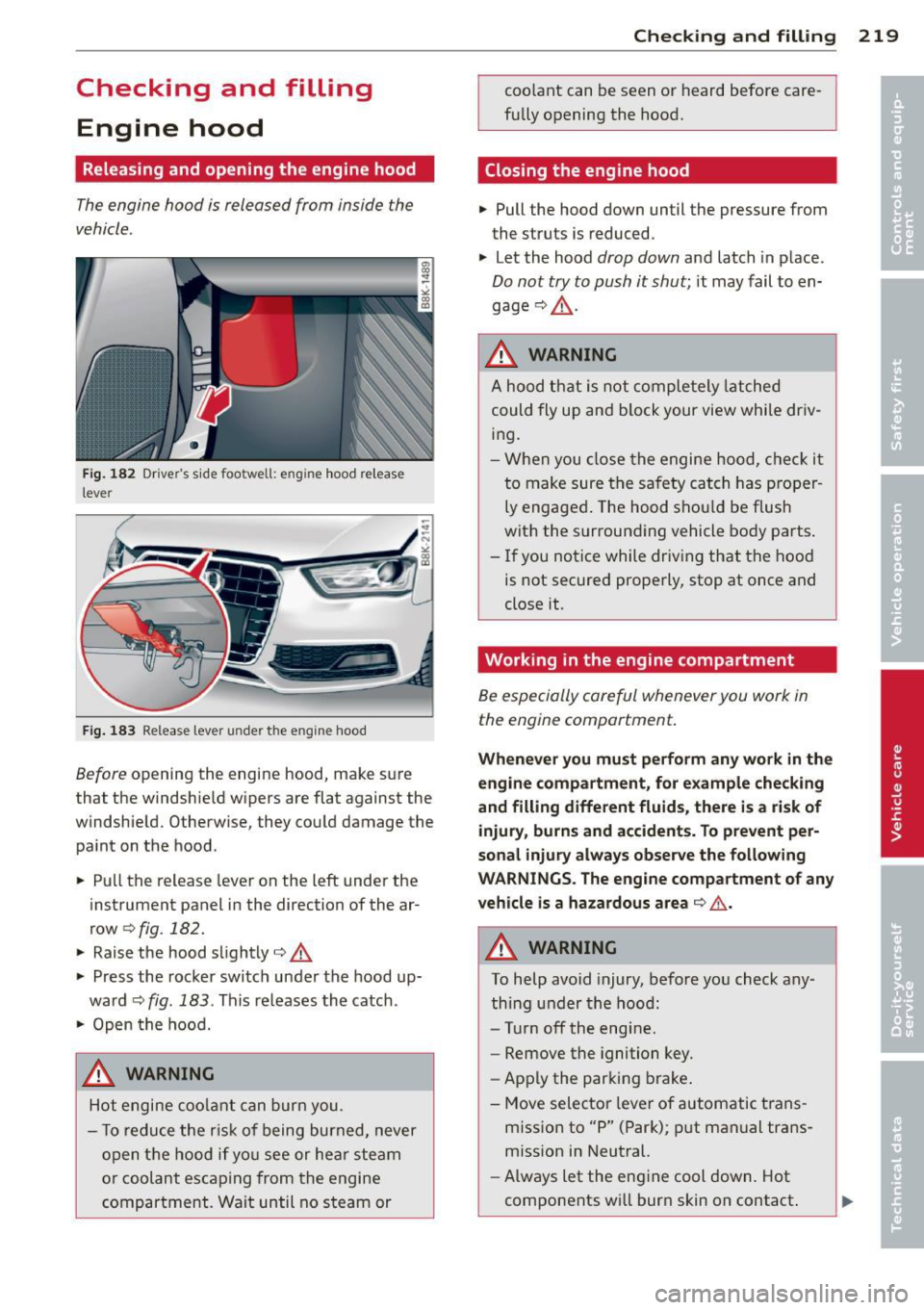
Fig . 182 Dr iver's side footwell: eng ine hood release
lever
... ~ - ---
F ig . 183 Re lease lever un der the engine hood
Before opening the engine hood, make sure
that the windshield w ipers are flat against the
windshield. Otherwise, they could damage the
paint on the hood.
.. Pull the release lever on the left under the
instrument panel in the direction of the ar
row
Q fig. 182.
.. Raise the hood slightly QA
.. Press the rocker switch under the hood up
ward
c::> fig . 183 . This re leases the catch .
.,. Open the hood.
& WARNING
Hot engine coo lant can burn you.
- To redu ce the r isk of being burned, never
open the hood if yo u see or hear steam
or coolant escaping from the engine
compartment. Wait until no steam or Checkin
g and fillin g 219
coolant can be seen or heard before care
fully opening the hood.
Closing the engine hood
.. Pull the hood down until the pressure from
the struts is reduced .
.. Let the hood
drop down and latch in place.
Do not try to push it shut; it may fail to en
gage
c::> .&, .
_&. WARNING
-
A hood that is not comple tely latched
could fly up and b lock your view while dr iv
ing.
- When you close the engine hood, chec k it
to make sure the safety catch has p ro pe r
ly engaged . The hood sho uld be flush
with the surrounding vehicle body parts .
-If you notice while driv ing that the hood
is not secured prope rly, stop at once and
close it.
Working in the engine compartment
Be especially careful whenever you work in the engine compartment .
Whenever yo u mu st p erform an y w or k in th e
eng in e compa rtment, for example checking
and filling differ ent fluid s, there i s a ri sk of
injury , burns and accidents. To prevent per
sonal injury always obser ve the following
WARNINGS . The eng ine compa rtment of any
v ehicle is a hazardous are a
QA .
_&. WARNING
To help avoid injury, before you check any
thing under the hood:
- Turn off the engine.
- Remove the ignition key.
- Apply the parking brake .
- Move selector lever of automatic trans -
mission to "P" (Park); p ut manual trans
miss ion in Neutral.
- Always let the engine cool down. Hot
components w ill burn skin on contact .
Page 222 of 302
220 Checking and filling
-To reduce the risk of being burned, never
open the hood if you see or hear steam
or coolant escaping from the engine
compartment . Wait until no steam or
coolant can be seen or heard before care
fully opening the hood .
- Keep children away from the engine com
partment .
- Never spill fluids on hot engine compo
nents. They can cause a fire.
- Never touch the radiator fan. The auxili
ary electric fan is temperature controlled
and can switch on suddenly.
- Never open the coolant reservoir cap
when the engine is still warm. The cool
ant system is pressurized and hot cool
ant could spray out.
- Protect your face, hands and arm from
steam or hot engine coolant by placing a
thick rag over the cap when you open the
coolant reservoir .
- Do not remove the engine cover under
any circumstances. This increases the
risk of burns.
- If work on the fuel system or the electri
cal system is necessary:
- Always disconnect the battery.
- Never smoke or work near heaters or
open flames. Fluids in the engine com partment could start a fire.
- Keep an approved fire extinguisher im
mediately available.
- To avoid electrical shock and personal in
jury while the engine is running or being
started, never touch:
- Ignition cables
- Other components of the high voltage
electronic ignition system.
- If you must perform a check or repair
with the engine running:
- First, fully apply the parking brake,
move selector lever of automatic trans- mission to
"P" (Park); put manual
transmission in Neutral.
- Always use extreme caution to prevent
clothing, jewelry, or long hair from get
ting caught in the radiator fan, V-belts
or other moving parts, or from contact ing hot parts . Tie back hair before
starting, and do not wear clothing that
will hang or droop into the engine .
- Minimize exposure to emission and
chemical hazards
~ /1. .
A WARNING
=
California Proposition 65 Warning:
- Engine exhaust, some of its constituents,
and certain vehicle components contain
or emit chemicals known to the State of
California to cause cancer and birth de
fects and reproductive harm. In addition,
certain fluids contained in vehicles and
certain products of component wear con
tain or emit chemicals known to the
State of California to cause cancer and
birth defects or other reproductive harm.
- Battery posts, terminals and related ac
cessories contain lead and lead com
pounds, chemicals known to the State of
California to cause cancer and reproduc
tive harms. Wash hands after handling.
(D Note
When adding fluids, always make sure that
they are poured into the proper container
or filler opening, otherwise serious dam
age to vehicle systems will occur.
@) For the sake of the environment
To detect leaks in time, inspect the vehicle
floor pan from underneath regularly. If
you see spots from oil or other vehicle flu ids, have your vehicle inspected by an au
thorized Audi dealer.
Page 223 of 302
Checking and fillin g 221
Engine compartment
Engine compartment
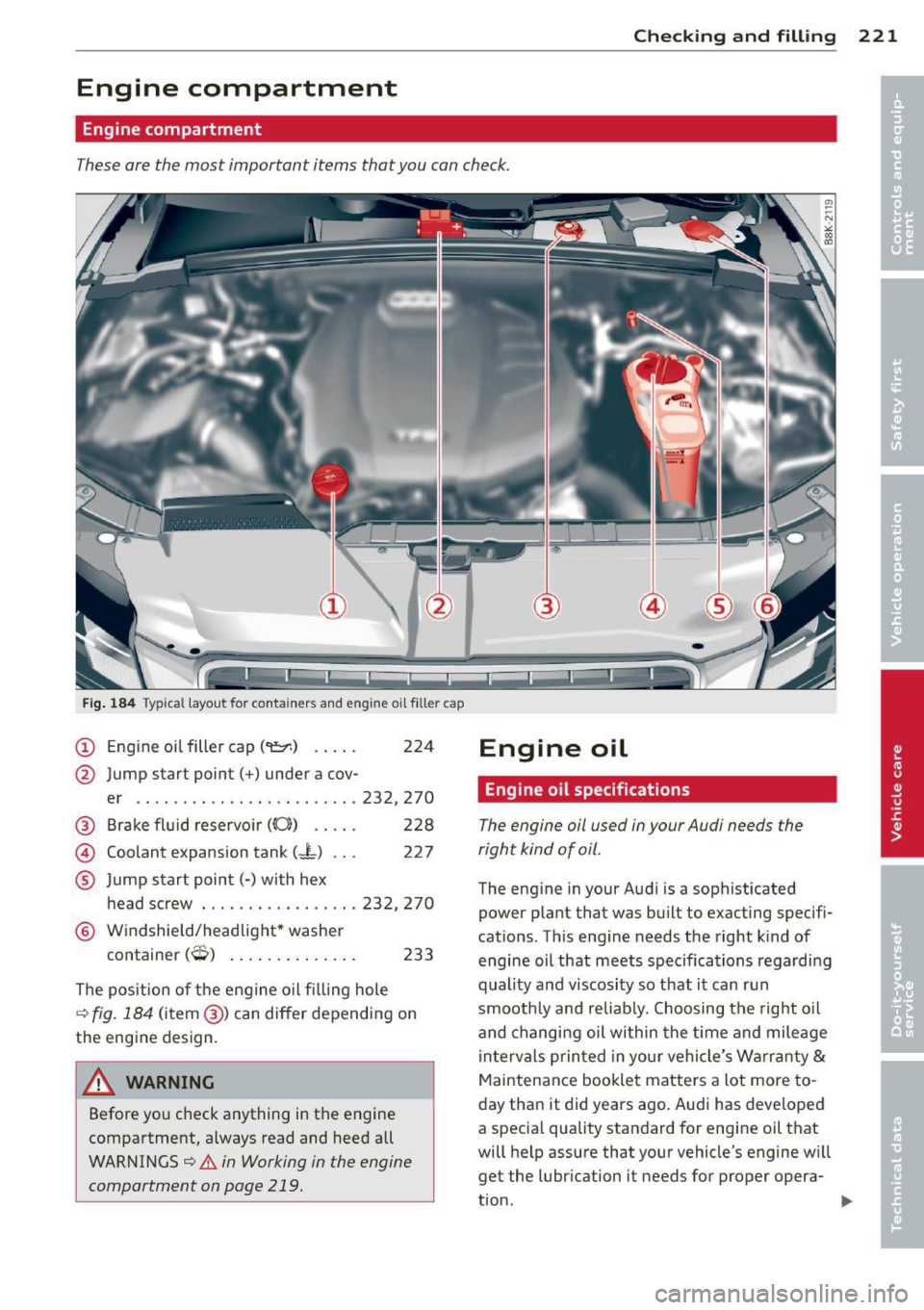
These are the most important items that you can check.
Fig. 184 Typical layout for containers and engine oil filler cap
(D Eng ine oi l filler cap (
er .. .. ... ....... ........ .. 232, 270
@ Brake fl uid reservo ir
((0)) . . . . . 228
@ Coolant expansion tank (J-) . . . 227
® Jump start point(-) with hex
head screw ..... .......... .. 232, 270
® Windshie ld/headlight* washer
container
(0) . . . . . . . . . . . . . . 233
The pos ition of the engine o il fi lling hole
¢ fig . 184 (item @) can differ depending on
the engine design.
A WARNING
-
Before you check anything in the engine
compartment, always read and heed all
WARNINGS¢ &. in Working in the engine
compartment on page 219.
Engine oil
Engine oil specifications
The engine oil used in your Audi needs the
right kind of oil .
The eng ine in your Audi is a sophisticated
power p lant that was bu ilt to exacting specifi
cations . This eng ine needs the right k ind of
engine oil that meets specifications regarding
quality and viscosity so that it can run
smooth ly and reliab ly. Choosing the rig ht o il
and changi ng oil within the t ime and mileage
i n tervals printed in you r vehicle's Warranty
&
Maintenance booklet matters a lot more to
day than it did years ago . Audi has developed
a specia l quality standard for engine oil that
will help assure that your vehicle's engine w ill
get the lubr ication it needs for proper opera-
tion. .,..
Page 230 of 302
228 Check ing and filling
scalding from hot coolant by following
these steps .
- Turn off the eng ine and allow it to cool
down.
- Protect your face, hands and arms from escaping flu id and steam by cover ing
the cap with a large, thick rag .
- Turn the cap slowly and very carefully
i n a counter-clockwise direction while
apply ing l ight, downwa rd press ure on
the top of the cap .
- To avo id being burned, do not spi ll an
tifreeze or coolant on the exhaust sys
tem or hot engine parts . Under certain
conditions, the ethylene glyco l in en
gine coolant can catch f ire .
- Antifreeze is poisonous . Always store an
tifreeze in its or iginal container and we ll
out of the reach of children.
- If you drain the coolant, it must be
caught and safely stored in a proper con
tainer clear ly marked "poison".
@ Note
- Coolant po llutes the env ironment and
could cause an engine fire . Excess coo l
ant will be forced out through the pres
sure re lief valve in the cap when the en
gine becomes hot.
- If, in an emergency, only water can be
added, the correct ratio between water
and antifreeze
c::> page 226 must be re
stored as soon as possible .
@ For the sake of the environment
Drained coolant should not be re used. Al
ways dispose of used coolant while observ
ing all environmental regulat ions .
Radiator fan
The radiator fan switches on automatically by
itself
T he radiator fan is driven by the engine via the
V-be lt . The viscous clutch regulates the speed
of the fan accord ing to the temperature of the
coolant. An a
uxiliary electric radiator fan* switches on
and off depend ing on coolant temperature
and other vehicle operat ing condit ions .
After yo u sw itch the engine off, the aux iliary
f an can continue running for up to 10 minutes
- eve n wit h the ignit ion off. It can even switc h
on again later by itself
c::> &. , if
- t he tempe rature of the engine coo lant rises
due to the heat build -up from the engine in
the engine compartment, or
- the engine compa rtment heats up because
the vehicle is parked in i ntense sunlight.
_& WARNING
- To reduce the risk of personal injury nev
er touch the radiator fan.
- The auxiliary electric fan is temperat ure
controlled and can sw itch on suddenly
even when the engine is not running.
- The a uxiliary radiator fan sw itches on au
tomatically when the engine coo lant
reaches a certai n temperature and will
continue to run until the coolant temper
ature drops .
Brake fluid
Checking brake fluid level
The brake fluid level can be checked with a
quick glance.
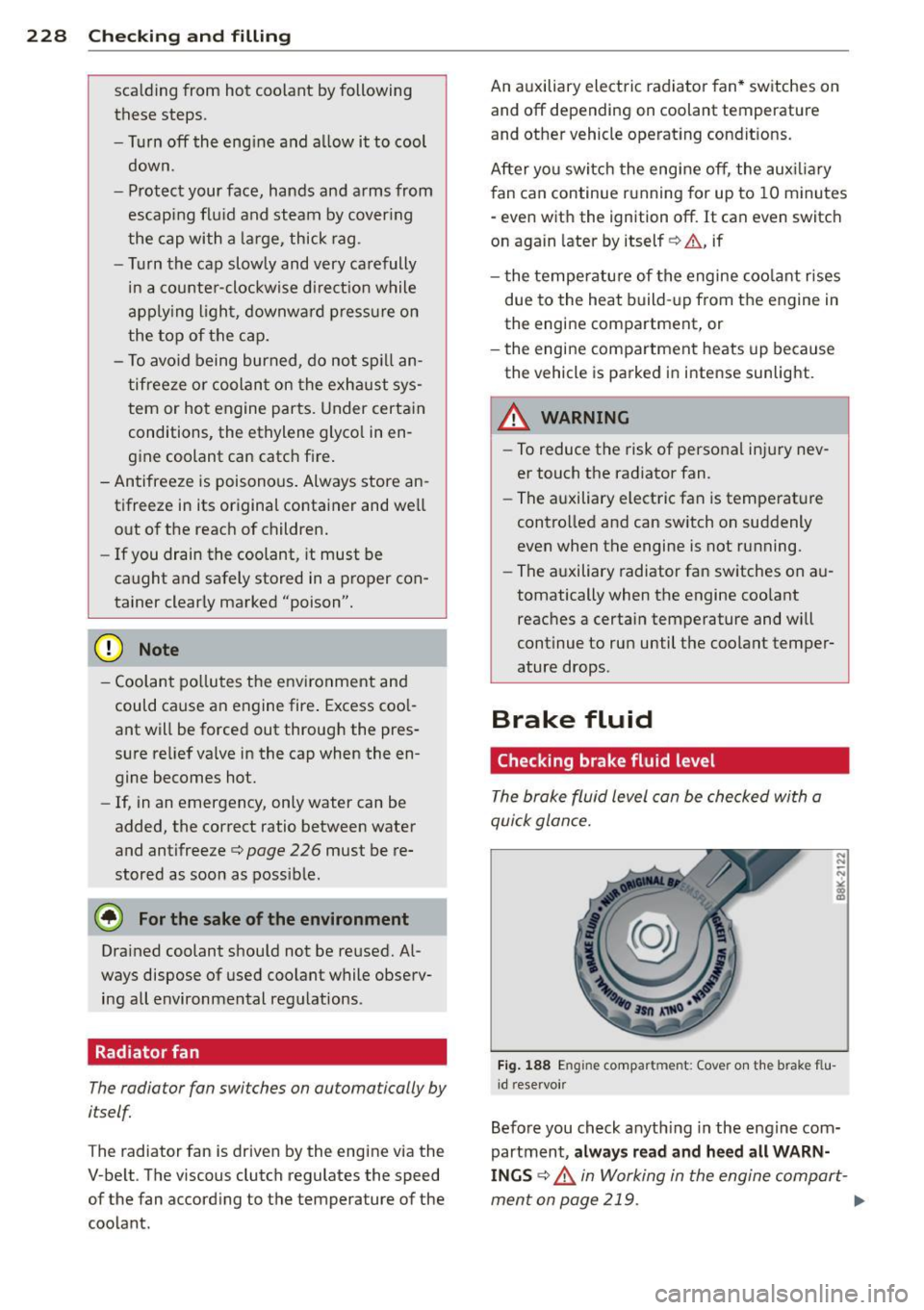
F ig . 1 88 Engin e compart men t: Cover on the b rak e flu
i d reservo ir
Before you check a nyth ing in the engine com
partment,
always read and hee d all WARN
INGS c::> .&. in Working in the engine compart-
ment on page 219 . .,..
Page 231 of 302
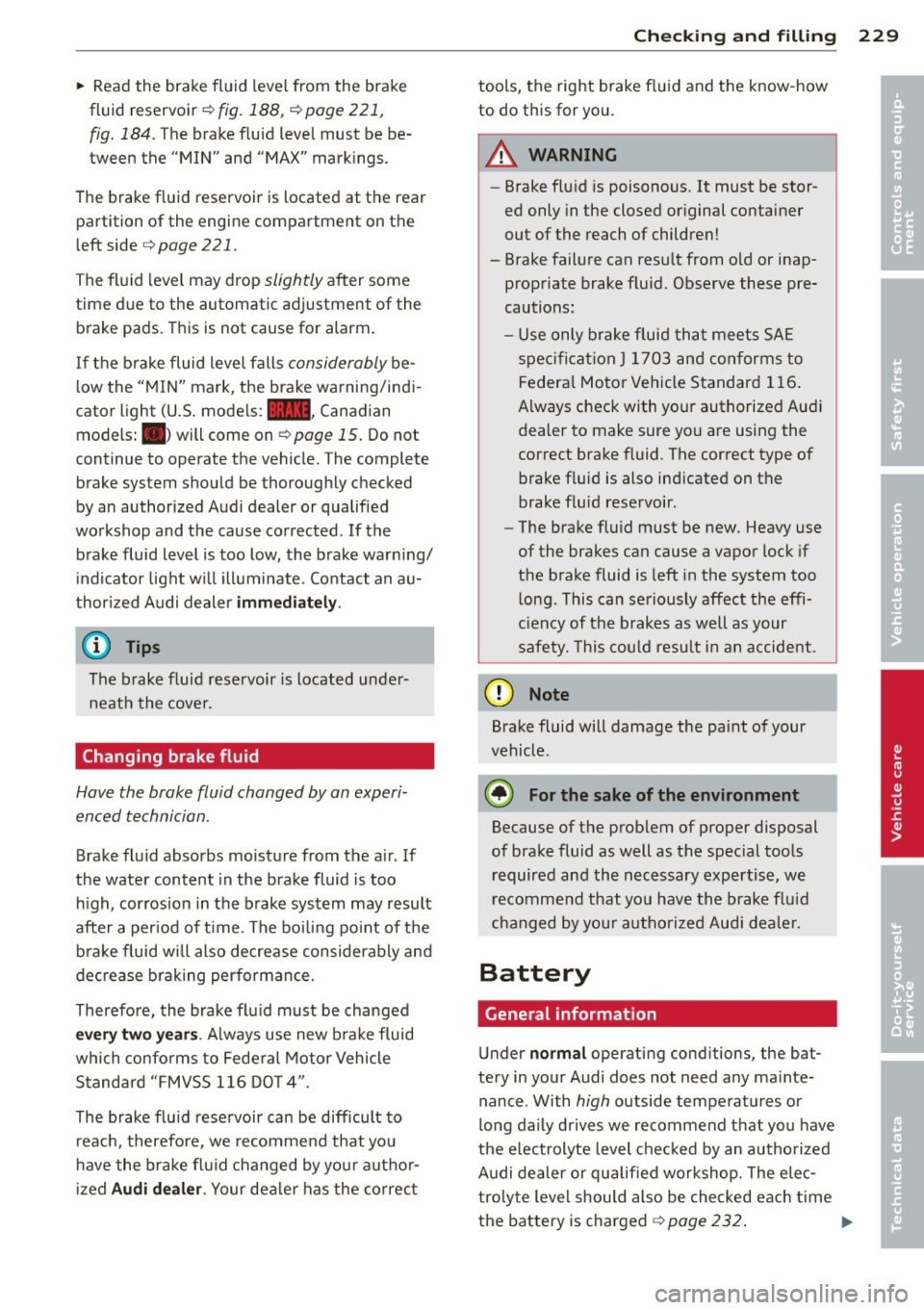
~ Read the brake fluid level from the brake
fluid reservoir ~
fig. 188, ¢ page 221,
fig . 184.
T he brake fluid level must be be
tween the "MIN" and "MAX" markings.
The brake f luid reservoir is located at the rear
partition of the engine compartment on the
l eft side
¢ page 221 .
The fluid level may drop slightly after some
time due to the automatic adjustment of the brake pads . This is not cause for alarm .
If the brake fluid level falls considerably be
l ow the "M IN" mark, the bra ke wa rning/ind i
cator light (U .S . mode ls:
1111 , Canadian
models: .) will come on
¢ page 15. Do not
continue to operate the vehicle. The complete
brake system shou ld be thoroughly checked
by an authorized Audi dealer or qualified
workshop and the cause co rrected . If the
b rake fluid level is too low, the b rake wa rn ing/
i nd icator lig ht w ill illuminate . Co ntact an a u
thor ized Audi dealer immediately.
@ Tips
The brake f luid rese rvoir is located unde r
neath the cove r.
Changing brake fluid
Have the brake fluid changed by an experi
enc ed technician .
Brake fluid ab sorbs moisture from the a ir. If
the water content in the brake fluid is too
hi gh, corrosion in the b rake system may result
after a per iod of t ime . The bo iling po int of t he
b ra ke fluid w ill also decrease con siderab ly and
d ec rease brak ing per forman ce.
Therefore, the brake flu id must be changed
every two year s. Always use new b ra ke fluid
which confo rms to Fede ral Motor Vehicle
S tand ard "FMVSS 1 16 DOT 4".
The brake flu id rese rvoir can be difficult to
r eac h, therefo re , we recommend that yo u
have the brake fl uid changed by yo ur aut ho r
iz ed Audi dealer. Your dealer has the correc t
Checking and fillin g 229
tools, the right brake fl uid and t he know -how
to do this for you .
A WARNING
- Brake fl uid is poisonous. It must be stor
ed only in the closed or iginal container
out of the reach of children!
- Brake failure can res ult from o ld or inap
propriate brake f lu id. Observe these pre
cautions:
- Use only brake fluid th at mee ts SA E
spe cificat ion
J 17 03 and conforms to
Fe dera l Mo to r Ve hicl e Standard 1 16.
Always check with yo ur autho rized Au di
dealer to make sure yo u are using the
correct brake fluid. The c orrect type of
brake f luid is also ind icated on t he
brake f luid reservoir .
- The bra ke fl uid must be new. Heavy use
of the brakes ca n cause a vapor lock if
the b rake fluid is left i n the system too
long. This can se riously affect the effi
c iency of the b rakes as well as your
safety , T his could result in an accide nt.
(!) Note
Brake fluid will damage the pai nt of your
vehicle.
@) For the sake of the environment
Because of the prob lem of proper disposal
of brake fluid as well as the spec ial too ls
r equired an d th e nec essary exper tise, w e
r ecomme nd that yo u have th e brake flu id
c hanged by yo ur aut ho rize d Aud i dea le r.
Battery
General information
U nder normal operating cond itions, the bat
te ry in your Audi does not need any ma inte
nance . With
high outside temperat ures or
lo ng da ily drives we recommend that you have
t h e e lectrolyte leve l che cked by an autho riz ed
A udi de aler or qu alified workshop. The elec
tro lyte leve l should also be checked e ach time
the battery is charged
¢ page 232 . 1J1>
•
•
Page 237 of 302
-Never mount used tires on yo ur vehicle if
yo u are not sure of their "previous histo
ry." Old used tires may have been dam
aged even though the damage cannot be
seen that can lead to sudden tire failure
and loss of vehicle control.
- If you notice unusual vibration or if the
vehicle pulls to one side when d riving, al
ways stop as soon as it is safe to do so
and check the wheels and tires for dam
age .
(D Note
Please note that summe r and wi nte r tires
are designed for the cond itions that are
Glossary of tire and loading terminology
Accessory weight means the comb ined weight (in excess of
those sta ndard items which may be rep laced)
of au toma tic transmission, power steer ing ,
power brakes, power windows, power seats,
radio, and heater, to the extent that these
items are availab le as factory-installed equip
ment (whether installed or not) .
Aspect ratio
means the rat io o f the height to the w idth of
the tire in percent . Numbers of 55 or lower in
dicate a low sidewall for improved steering re
sponse and better overa ll handling on dry
pavement .
Bead
means the part of the t ire t hat is made o f
steel wires, wrapped or reinforced by ply cords
and that is shaped to fit the r im.
Bead separation
means a b reakdown of the bond between
components in the bead .
Cord means the strands forming the plies in the
tire.
Tire s an d wheel s 235
typica l in those seasons . Aud i recommends
using winter tires during the winter
months . Low temperatures signif icant ly
dec rease the e lasticity of summer t ires,
which affects tract ion and brak ing ability.
If summer t ires are used i n very co ld tem
peratures, cracks ca n form o n the tread
bars , res ulting in perma nen t tire damage
that can cause loud driving noise and un
bala nced ti re s. Audi i s not respon sible for
th is type of damage .
Cold tire inflation pressure
means the t ire p ress ure recommended by t he
vehicle manufacture r fo r a tire o f a des ignated
s ize t hat has not bee n driven for more than a
coup le o f miles (k ilometers) at low speeds in
the three hour period before the tire press ure
is m easured or adjusted.
Curb weight
me ans the we ight of a motor ve hicle with
st andard equipmen t incl ud ing the max imum
capacity of fuel, oi l, and coolant, air condi
tioning and additional weig ht of optiona l
equipment.
Extra load tire
means a t ire design to oper ate a t higher load s
and at higher inflation pressures than the cor
responding standa rd tire . Extra load tires may
be identified as "XL", "x l", "EXTRA LOAD", o r
"RF" on the sidewal l.
Gross Axle Weight Rating ("GAWR")
me ans the load-ca rry ing capac ity of a single
axle system , measured at the tire -ground in
te rfaces.
Gross Vehicle Weight Rating ( "GVWR ")
mea ns the maximum total loaded we ight of
the ve hicl e. .,..
•
•
Page 238 of 302
236 Tires and wheels
Groove
means the sp ace between two ad jacent tread
ribs .
Load rating (code )
means the maximum load that a tire is rated
to carry fo r a g iven inflat ion pressu re. You
may not find this in fo rmat io n on all t ires be
c a use i t is no t re quir ed by law.
Maximum load rating
means the load rating for a t ire at the max i
mum permissible inflation pressure for that
tire.
Maximum loaded vehicle weight
means t he sum of:
(a) Curb weig ht
(b) Accessory weight
( c ) Vehicle c apa city we ight, and
(d) Prod uction opt ions we ight
Maximum (permissible) inflation pressure
means t he maximum co ld inflation pressure
to which a tire may be inflated . Also called
"maxim um infla tion p ressu re ."
Normal occupant weight
means 150 lbs. (68 k ilog rams) times the
n umber of occupants seated in the vehicle up
to the tota l seating capacity of yo ur vehicle .
Occupant distribution
means dist ribution o f occ upants in a veh icle.
Outer diameter
means t he overa ll diamete r of a n inflated new
tire.
Overall w idth
means the linea r distance between the exter i
ors of the sidewalls of an inflated tire, includ
ing e levations due to labeli ng, decorations, or
p rotectiv e bands o r ribs .
Ply
means a layer of rubber-coated para llel cords.
Production options weight
me ans the com bine d we igh t of tho se ins tall ed
regular prod uction opt ions we ighing over 5
lb s. (2 .3 kg) in excess of those stan da rd item s
which they replace, not previously considered
in curb weight or accessory we ight, including
heavy duty brakes, ride levelers , roof rack ,
heavy duty battery, and special tr im .
Radial ply tire
means a pneumat ic tire in wh ich the ply cords
t h at exte nd t o the beads are laid at substa n
t ia lly 90 deg rees to the center line of the
tread .
Recommended inflation pressure
see<=> page 235, Cold tire inflation pressure.
Reinforced tire
means a t ire des ign to operat e at h igher loads
and a t higher in flation pressures than t he cor
re spondi ng s tand ard tire. Reinfor ce d tires
may be iden tifie d as "X L" "xl" "E X TRA LOAD"
' ' '
or "RF " on the sidewa ll.
Rim
means a metal s upport for a ti re or a tire and
tube assembly upon whi ch t he tire bea ds are
sea ted.
Rim diameter
means nom inal d iameter of the bead seat. If
you change your wh eel s ize, you wi ll have to
purchase new ti res to match the new r im di
ameter.
Rim size designation
means r im diameter and width .
Rim width
means nominal distance between rim fla nges .
Sidewall
means tha t p ort ion of a tire betwee n the
t rea d and be ad.
Page 242 of 302
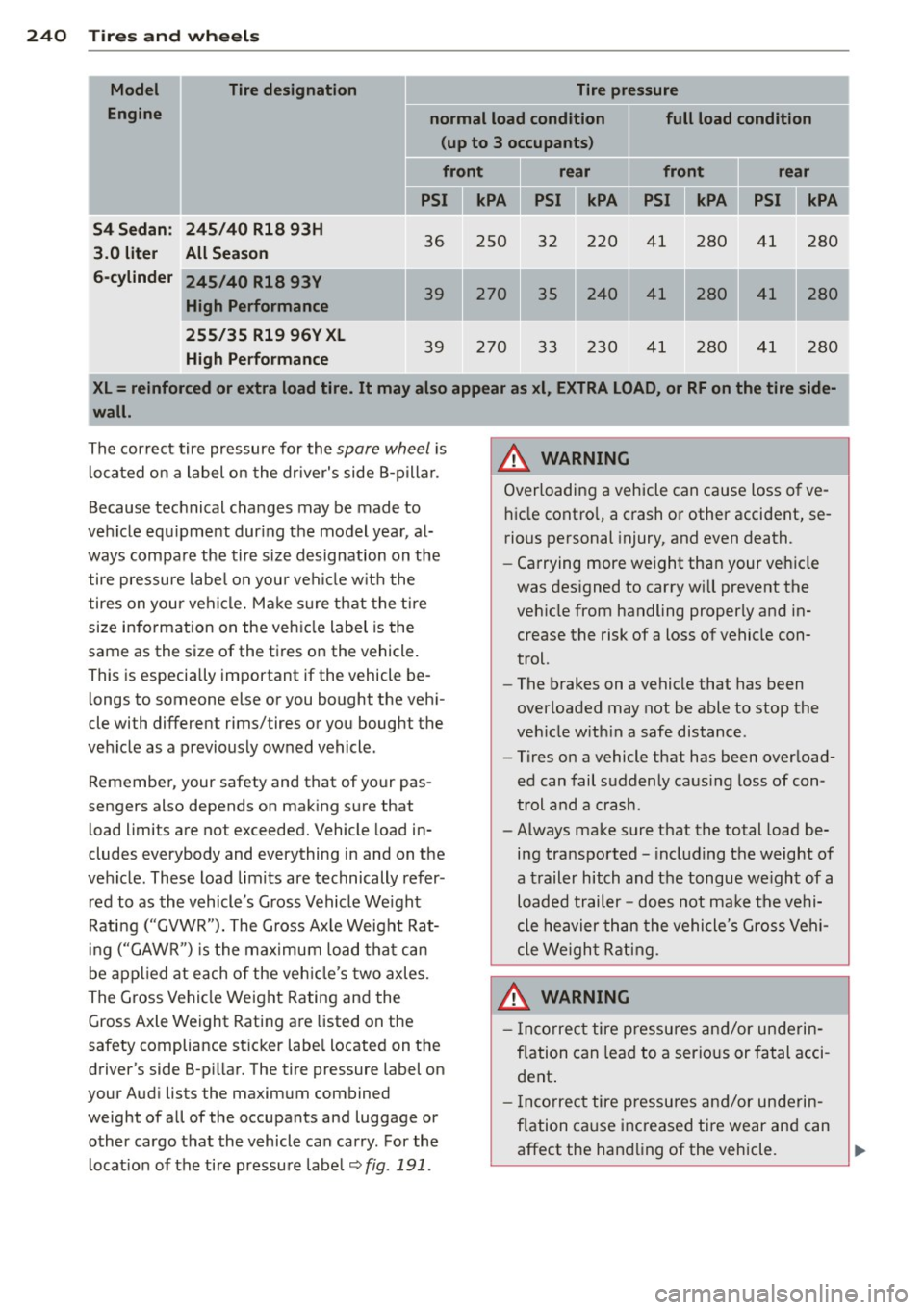
240 Tires and wheels Model Tire designation Tire pressure
Engine normal load condition full load condition
(up to 3 occupants )
front rear front rear
I
PSI II kPA PSI II kPA PSI II kPA PSI II kPA :
S4 Sedan : 245 /40 Rl8 93H
3 .0 liter All Season
36 250 32 220 41 280 41
280
6-cylinder
24S/40 Rl8 93V
I High Performance
39 270 35 240 41 280 41 280
255/35 Rl9 96V XL
High Performance
39 270 33 230 41 280 41 280
XL= reinforced or extra load tire. It may also appear as xl
, EXTRA LOAD, or RF on the tire side
wall.
The correct tire pressure for the spare wheel i s
l o cated on a label on the dr ive r's side B-p illa r.
Because tec hnical cha nges may be made to
ve hicle equ ipment dur ing the model yea r, a l
ways compa re the tire siz e designation on the
tire pressure labe l o n you r vehi cle w it h the
tires on your vehicle. M ake s ure that the t ire
size info rmation on the veh icle label is the
same as the size of the t ire s on the vehicle.
This is especially important if the vehicle be
l ongs to someone else or you bought the veh i
cle with different rims/tires or you boug ht the
ve hicle as a p reviously owned vehicle.
Remembe r, your safety and that of your pas
sengers also depends on mak ing s ure that
load limits are not exceeded. Vehicle load in
cludes everybody and everything in and on t he
ve hicle . These load lim its are technically refer
red to as th e vehicle's G ross Vehicle We ight
Rati ng ("GVWR"). The G ross Ax le Weight Rat
i ng ( "GA WR ") is the ma ximum load tha t can
be applied at each o f the veh icle 's two axles.
T he G ross Vehicle We ig ht Rating and the
Gross Axle Weight Rating a re listed on the
safety compliance st ic k er labe l located on the
driver's side B-p illar. The tire pressure label on
your Aud i lists the maximum combined
A WARNING
Overloadin g a vehicle can cause loss of ve
h icle cont ro l, a c rash or other accident, se
rious pe rsonal injury, and even death.
- Ca rrying more we ight tha n your veh icle
was des igned to carry will prevent the
veh icle from handling properly and in
crease the risk of a loss of vehicle con
trol.
- The brakes on a vehicle that has been
overloaded may not be able to stop the
veh icle w ith in a safe distanc e.
- Tires on a vehicle that has been overload
ed can fail s uddenly ca us ing loss of con
trol and a crash.
- Always make sure that the total load be
i n g transported - including the weight of
a trailer hitch and t he tongue we igh t of a
loaded tr ail er -does not ma ke t he ve hi
cle he avier th an the vehicle' s Gro ss V ehi
cle Weigh t Ra tin g.
.&_ WARNING
- In cor rect tire pressure s and /or u nderin
fl ation can lead to a serio us or fatal acci
dent .
- I nco rrec t tire pressures an d/or un derin
fla tion ca use increased ti re wear an d can
'
I
weight of all of the occupants and luggage or
other cargo tha t the vehicl e can carry . For the
l ocat io n of the ti re pressu re labe l~
fig . 191 .
affect the handling of the vehicle. ..,_
Page 245 of 302
not exceeded . Vehicle load includes everybody
and everything in and on the vehicle. These
l oad limits are techn ica lly referred to as the
ve hicle's
Gross Veh icle Weight Rat ing
("GVWR").
The "GVWR" includes the weight of the basic
veh icle, all factory insta lled accessories, a full
tank of fu el, oil, coolant and other fluids plus
maximum load. The maximum load includes
the number of passengers that the vehicle is
in tended to carry ("seating capacity") w ith a n
assumed weight of 150 lbs . (68 kg) for each
passenger at a des igna ted sea ting pos ition
and the tota l we ight of any l uggage in the ve
h icle. If you tow a trailer, the weig ht o f the
trailer hitch and the tong ue weight of the
l oaded trailer must be included as part of the
veh icle load.
The
Gro ss A xle Weight Rating ("GAWR") is
the maximum load that can be applied at each
of the vehicle's two ax les.
The G ross Vehicle We ight Rating and the
Gross Axle Weight Rating are listed on the
safety compliance sticker labe l located on the
driver's side B -pi llar .Your Audi has 5 seating
positions, 2 in the front and 3 in the rear for
tota l seating capacity of 5. Each seating posi
tion has a seat belt¢
page 137, Safety belts.
The fact that there is an upper limit to your
veh icle's Gross Vehicle Weight Rating means
that the tota l weight of whatever is being car
ried in the vehicle (including the weight of a
trailer hitch and the tongue weight of the
loaded trailer) is limited. The more passen
ge rs in the veh icle or passengers who are
h eav ier than the standa rd weights assumed
mean that less weight can be ca rr ied as l ug
gage.
The tire pressure labe l on you r Audi also lists
the maximum combined we ight of all of the
oc cu pants and luggage o r othe r ca rgo that
the vehicle can carry . For the location o f the
l abe l
¢page 238, fig. 191.
Tires an d wheel s 243
A WARNING
Overloading a vehicle can cause loss of ve
h icle contro l, a crash or other accident, se
rious pe rsonal injury, and even death.
- Carrying more we ight than your veh icle
was des igned to carry will prevent the
veh icle from handling properly and in
crease the risk of the loss of vehicle con
trol.
- The brakes on a vehicle that has been
overloaded may not be able to stop the
veh icle w ith in a safe distance.
- Tires on a vehicle that has been overload
ed can fail suddenly, incl uding a blowout
and sudden defla tion, causing loss of
contro l and a crash.
- Always ma ke sure that the total load be
ing transpor ted - incl uding the weight of
a trailer hitch and the tongue weight of a loaded trailer -does not ma ke the vehi
cle heavier than the vehicle's Gross Vehi
cle We ight Rating.
Determining correct load limit
U se th e example below to ca l
culate the total weight of the
pa ssengers and lu ggage or oth
e r thing s that you pl an t o tran s
po rt so that you can make sur e
that your vehicle will not b e
o verloaded.
Steps for Determining
Correct Load Limit
1 . Lo cate th e statement "THE
C OMBINED WEIGHT OF O C
CUPANTS AND CARGO
SHOULD NE VER E XCEED XXX
KG OR XXX LBS"on your vehi-
c le 's pla card (tire inflation ..,
•
•
Page 247 of 302
symbols) indicate the positions of the tread
wear indicators. Worn tires must be replaced.
Different fig ures may apply in other co untries
c:> .&. .
Tir e pres sure
Incorrect tire pressure causes premature wear
and can cause sudden tire blow -out. For this
reason, tire pressure must be checked at least
once a month
c:> page 241.
Driving sty le
Driving fast around curves , heavy acceleration
and hard braking increase tire wear .
Rotating tires for mo re even wear
For all four t ires on your vehicle to have the
same se rvice life, we recommend that the
fro nt and rea r tires are rotated according to
the t ire manufacture r's suggested tire rota
tion intervals. Please remember the follow
ing:
- T ire rotat ion inte rva ls may differ from the
vehicle service intervals outlined in your
Maintenance and Wa rranty Booklet .
- T he longer one tire is used in one location
on the vehicle, the more it wears at certa in
points; therefore, we recommend that you
fo llow the t ire manufacturer's suggested
t ire rotation intervals .
- Vehicles with front -wheel drive experience
more tread wear on the front wheels com
pared to all whee l drive (quattro ®).
- Please rotate tires as shown
c:> fig. 194.
-Extra care must be taken when rotating di-
rection-specific tires
c:> page 263 .
Wheel balancing
The wheels on new vehicles are balanced .
H oweve r, va rio us situations d uring eve ryday
driving can cause them to be come unbal
anced, resu lting in vibrations you can us ually
feel through the steering wheel.
Unba lanced wheels must be rebalanced to
avoid excessive wea r on s teer ing , suspens ion
and tires. A wheel must a lso be rebalanced
when a new tire is installed.
Tire s an d wheel s 245
Incorrect wheel alignment
Incor rect wheel alignment can cause exces
sive tire wear, impairing the sa fety of the vehi
cle . If tires show excessive wear, have the
whee l alignment checked by an a uthorized
Audi dealer or qualified workshop.
All wheel drive
Vehicles wi th quattro ® must a lways have tires
of the same size, construction and tread type. For details see
<=:> page 191.
_8 WARNING
Sudden tire fa ilure can lead to loss of con
trol, a crash and serious personal injury!
- Never drive a vehicle when the tread on
any tire is worn down to the wear indica
tors.
- Worn ti res are a safety hazard, they do
not grip well on wet roads and increase
your r isk of "hydroplaning" and loss of
control.
- Always keep chemicals that can cause
tire damage, such as grease, o il, gasoline
and brake fluid away from tires .
- Tires age even if they are not being used
and can fail sudden ly, especially at high
speeds. T ires that are more than 6 years
old can only be used in an emergency
and then w ith special care and at lower
speeds.
- Never mount used tires on your veh icle if
you are not sure of the ir "previous histo
ry ." O ld used tires may have been dam
aged even though the damage cannot be
seen that can lead to sudden tire fai lure
and loss of vehicle control. •
•