brake AUDI S4 2013 Repair Manual
[x] Cancel search | Manufacturer: AUDI, Model Year: 2013, Model line: S4, Model: AUDI S4 2013Pages: 302, PDF Size: 75.61 MB
Page 250 of 302
248 Tire s and whee ls
Tir e pl y c ompo sit ion and materi als used
The numbe r of plies ind icates the number of
l ayers of rubber -coated fabric in the tire. In
general, the greater the number of p lies, the
more weight a tire can support . Tire manufac
turers also must indicate the materials in the
tire, wh ich include steel, nylon, polyester, and
others .
Max imum Load R ating
This number indicates the maximum load in
kilograms and pounds that can be carried by
the tire .
Tire quality grading for treadw ear ,
tr act ion, a nd t emper ature re sis tan ce
Tread wear, traction and temperature grades
c:> page249.
Max imum Permiss ibl e Inflation Pressur e
This numbe r is the greatest amo unt of air
p ressure that should ever be put in the ti re
under normal driving conditions .
A WARNING
-Using incorrect or unmatched tires and/
or wheels or improper tire and wheel
combinations can lead to loss of contro l,
collision and serious persona l injury .
- Always use tires, rims and wheel bo lts
that meet the specifications of orig inal
factory-installed t ires or other combina
t ions that have been spec ifically ap
proved by the vehicle manufacturer.
- Tires age even if they are not be ing used
and can fail suddenly, especially at high
speeds. Tir es that are more than 6 years
o ld can only be used in an emergency
and then with special care and at lower
speeds.
- Never mount used ti res on yo ur vehicle if
yo u are not su re of their "previous histo
ry ." Old used tires may have been dam
aged even though the damage cannot be
seen that can lead to sudden tire failure and loss of vehicle control.
- All four wheels must be fitted with radia l
t ires of the same type, size (roll ing c ir- cumference) and the same tread pattern
.
Driving with different tires reduces vehi
cle handling and can lead to a loss of
control.
- If the spare tire is not the same as the
tires that are mounted on the vehicle -
for example with winter tires -only use
the spare t ire fo r a short period of time
and drive with extra care . Refit the nor
mal road wheel as soon as safely poss i
b le.
- Never drive faster than the max imum
speed for which the tires on you r vehicle
are rated because tires that are dr iven
faster than their rated speed can fai l
suddenly .
- Overloading tires cause heat build-up,
sudden tire fa ilure, including a blowout
and sudden deflation and loss of contro l.
- Temperature grades apply to tires that are properly inflated and not over or un
derinf lated .
- For technica l reasons it is not always
possible to use whee ls from other
veh icles -in some cases not even wheels
from the same veh icle model.
- If you install wheel trim discs on the ve
hicle wheels, make sure that the a ir flow
to the brakes is not blocked. Reduced air
f low to the brakes can them to overheat,
increas ing stopp ing distances and caus
ing a co llision.
- Run flat tires may only be used on veh icles that were equipped with them
at the factory. The veh icle must have a
chassis designed for run flat tires and a
f a ctory -insta lled tire pressure monitor
ing system* that indicates a loss of tire
pressu re . I ncorrect use of run flat tires
can lead to vehicle damage or accidents.
Check with an authorized Audi dealer or
tire specialist to see if your vehicle can be
equ ipped w ith run flat t ires. If run flat
tires are used, they must be installed on
all fou r wheels . Mix ing tire types is not
pe rm itted.
Page 253 of 302
Snow chains
Snow chains may be fitted only to the front
wheels, and only to certain tire sizes. Ask your
authorized Audi dealer on which tire sizes
snow chains can be used.
The snow chains must have low-profile links
and must not be thicker than 0.53 inch
(13.5 mm), including the lock .
Remove wheel center covers and trim discs
before putting snow chains on your vehicle
~ 0. For safety reasons cover caps must then
be fitted over the wheel bolts. These are avail
able from authorized Audi dealers.
~ WARNING
Using the wrong snow chains for your vehi
cle or installing them incorrectly can in
crease the risk of loss of control leading to
serious personal injury.
- Snow chains are available in different sizes. Always make sure to follow the in
structions provided by the snow chain
manufacturer .
- When driving with snow chains never
drive faster than the speed permitted for
your specific snow chains.
- Always observe local regulations.
(D Note
- Remove snow chains before driving on
roads not covered with snow to avoid
damaging tires and wearing the snow
chains down unnecessarily.
- Snow chains, which come into direct con
tact with the wheel rim, can scratch or
damage it . Therefore, make sure that the
snow chains are suitably covered . Check
the position of the snow chains after
driving a few yards and correct if neces
sary. Follow the instructions from the
snow chain manufacturer when doing so.
(j) Tips
Where snow chains are mandatory oncer
tain roads, this normally also applies to
vehicles with all wheel drive.
Tires and wheels 251
Wheel bolts
Wheel bolts must always be tightened to the
correct torque.
The design of wheel bolts is ma tched to the
factory inst alled rims. If diffe ren t rims are fit
ted, the correct wheel bolts with the right length and correctly shaped bolt heads must
be used. This ensures that wheels are fitted
securely and that the brake system functions
correctly.
In certain circumstances, you may not use
wheel bolts from a different vehicle -even if it
is the same model~
page 282 .
&_ WARNING
Improperly tightened or maintained wheel
bolts can become loose causing loss of
control , a collision and serious personal in
jury.
- Always keep the wheel bolts and the threads in the wheel hubs clean so the
wheel bolts can turn easily and be prop
erly tightened.
- Never grease or oil the wheel bolts and
the threads in the wheel hubs. They can become loose while driving if greased or
oiled, even if tightened to the specified
torque .
- Only use wheel bolts that belong to the
rim being installed .
- Never use different wheels bolts on your
vehicle.
-Always maintain the correct tightening torque for the wheel bolts to reduce the risk of a wheel loss. If the tightening tor
que of the wheel bolts is too low, they
can loosen and come out when the vehi
cle is moving.
If the tightening torque is
too high, the wheel bolts and threads
can be damaged and the wheel can be
come loose.
(I} Note
The specified torque for the wheel bolts is
90 ft lbs. (120 Nm) with a tolerance of
± 7,4 ft lbs. (± 10 Nm). Torque wheel bolts .,.. •
•
Page 261 of 302
~ Unscrew the valve stem from the spare tire.
~ Screw the tire filler hose from the compres
sor firmly onto the valve of the spare tire.
~ Insert the plug from the compressor into a
socket of the vehicle¢
page 64.
~ Switch the compressor on .
~ Let the compressor run until the value
specified on the tire pressure label is
reached
¢ page 238, fig. 192. Switch the
compressor off after running for 12 minutes
at the most -danger of overheating!
A WARNING
The compressor and the tire filler hose can
become extremely hot while they are run
ning -danger of burns!
(D Note
Switch the compressor off after running
for 12 minutes at the most -danger of
overheating! Allow the compressor to cool
down for a few minutes before you use it
again.
Changing a wheel
Before changing a wheel
Observe the following precautions for your
own and your passenger's safety when chang
ing a wheel .
~ After you experience a tire failure, pull the
car well away from moving traffic and try to
reach
level ground before you stop¢ L!)..
~ All passengers should leave the car and
move to a safe location (for instance, behind
the guardrail) ¢
A.
~ Engage the parking brake to prevent your
vehicle from rolling unintentionally ¢
A.
~ Shift into 1st gear on vehicles with manual
transmission, or move the
selector lever to
the P position
on vehicles with automatic
transmission .
~ If you are towing a trailer: unhitch the trail
er from your vehicle.
~ Take the jack¢ page 256 and the spare tire
¢ page 257 out of the luggage compart
ment.
What do I do now? 259
A WARNING
You or your passengers could be injured
while changing a wheel if you do not fol
low these safety precautions:
- If you have a flat tire, move a safe dis
tance off the road. Turn off the engine,
turn the emergency flashers on and use
other warning devices to alert other mo
torists.
- Make sure that passengers wait in a safe
place away from the vehicle and well
away from the road and traffic.
- To help prevent the vehicle from moving
suddenly and possibly slipping off the
jack, always fully set the parking brake
and block the wheel diagonally opposite
the wheel being changed with the fold
ing chocks or other objects. When one
front wheel is lifted off the ground, plac ing the Automatic Transmission in "P"
(Park) will
not prevent the vehicle from
moving .
- Before you change a wheel, be sure the
ground is level and firm. If necessary,
use a sturdy board under the jack.
- Always store the vehicle tool kit, the
jack* and the replaced tire in the luggage compartment
¢page 133.
(D Note
If you are changing the wheel on a steep
incline, use a rock or similar object to
block the opposite wheel to prevent the
vehicle from moving.
(D Tips
Obey all laws.
Changing a wheel
When you change a wheel , follow these
quence described below step-by-step and in
exactly that order.
l. Remove the decorative wheel cover* or
-
the wheel bolt caps*. For more details see..,.
•
•
Page 265 of 302

Removing the wheel
"' Remove the topmos t wheel bo lt completely
with the
he xagonal socket in t he screwdriv
er hand le (vehicle tool kit) ¢
fig. 207 and
set it aside on a
clean surface.
"' Screw the threaded end of the
alignment
pin
from the tool k it hand-tight into the
empty bolt hole ¢
fig. 208.
"' Then remove the o ther wheel bo lts as de
scribed above .
"' Take off the wheel leav ing the alignment
pin in the bo lt ho le
~ CD .
Putting on the spare tire
"' all road : Inflate the inflatable spare tire
~ page258
"' Push the spare tire over the a lignment pi n.
"' Screw o n the whee l bolts and tighten them
slightly using the hexagonal socket .
"' Remove the alignment pin and insert an d
t ighten the remaining whee l bo lt s light ly
li ke the rest .
"' Turn the jack handle counter-clockw ise to
lower the vehicle unt il the jack is f ully re
l eased .
"' Use the whee l bolt wrench to t ighten a ll
wheel bolts firmly ¢
page 261. Tighten
them
in a crisscross pattern, from one bo lt
to the (approx imately) opposi te o ne, to keep
t h e whee l cen te red .
"' Perform the steps requ ired after cha nging
the wheel ~
page 260 , After changing a
wheel .
The hex agonal so cket m akes it easier to re
move the w heel bo lts from the r im . Care
should be taken when removing the reversible
b lade .
@ Note
When removing or ins tall ing the wheel,
the rim could hit the brake rotor an d dam
age the rotor . Wor k carefully and have a
second person to he lp you .
@ Tips
-When mounting tires with unidirectional
tread design
ma ke s ure the tread pat-
What do I do now? 263
'
tern is po inted the righ t way
¢ page 263.
- The w heel bolts shou ld be clean an d easy
to t urn . Check fo r dirt an d corrosion on
the mating surfaces of both the w heel
and the hub. Remove all d irt from these
surfaces before remounting the whee l.
- Do not use the hexagonal socket in the
sc rewd river handle to loosen or t ighten
the whee l bolts.
Tires with unidirectional tread design
Tires with unidirectional tread design must be
mounted with their tread pattern pointed in the right direction.
Us ing a spa re tire with a tread pattern
intended for use in a specific di rection
When using a spare t ire with a tread patter n
intended for use in a spec ific d irection, please
note the following :
- The d irect ion of rotation is marked by an
ar
row on the side of the t ire .
-If the spare tire has to be insta lled in the in
correct d irect ion, use the spare tire only
temporarily s ince the tire will not be able to
achieve its optimum performance cha racte r
istics w it h regard to aquap la ni ng, no ise and
wear .
- We recommend that you pay part icu lar at
t en tion to th is fact during we t weather and
that you adjust your speed to match road
condi tions.
- Replace the flat t ire wi th a new one a nd
have it insta lled o n you r vehicle as soo n as
pos sible to res to re the hand ling advant ages
o f a u nidirec tional tire.
Notes on wheel changing
Please read t he info rmation ~ page 24 6, New
tires and replacing tires and wheels
if yo u a re
going to use a spare tire wh ich is different
from the tires on your vehicle.
After yo u change a tire:
IJI,-
•
•
Page 267 of 302

Fuses and bulbs
Fuses
Replacing a fuse
Fuses that have blown will have metal strips
that have burned through.
Fig. 20 9 Left cockp it : fuse panel cover
The fuses are located at the front left and
r igh t of the cockpit and behi nd the trim on
the right side of the luggage compartment .
.. Turn off the ign it ion a nd the affected elec-
t rical consumers .
.. Check the following table to see which fuse
belongs to the consume r .
.. Remove the appropriate cover¢
fig. 209 or
¢page 218, fig. 180 .
.. To remove the purple plastic cl ip if necessa
ry
ll, hold onto it at the small s ide and pull
it out of the fuse panel¢
page 265,
fig. 210 .
.. Remove the clamp from the rear side of the
fuse cover ¢
fig. 209 .
.. Remove the fuse using the clamp and re
pla ce the blown fuse w ith an identical new
one.
& WARNING , -
Do not repair f uses and never replace a
blown fuse w ith one that has a higher amp
rating. This can cause damage to the e lec
trical system and a fire.
11 You can dis pos e of the plastic clip after removing it.
Fu se s and bulb s 265
(D Note
If a new fuse burns out again after short ly
have you have insta lled it, have the electri
ca l system checked by your authorized
Audi dealer .
{!) Tips
-The following table does not list fuse lo
cat ions that are not used .
- Some of the equipment items listed are
opt ional or only available on certa in
mode l configurations.
Left cockpit fuse assignment
Fi g. 21 0 Left cockpit: fuse panel wit h plastic clip
No. Consumer
Amps
Fuse panel @(black)
1 Dynamic steering 5
2 ES C control module 5
A/C system pressure sensor,
electromechanical parking
3
brake, Homelink, automatic
5 dimming interior rear view
mirror, air quality/outside
ai r sensor, ESC button
Page 268 of 302

266 Fuses and bulbs
No.
5 Sound actuator/exhaust
sound tuning
6 Headlight
range control sys-
tern/cornering light
7 Headlight (cornering light)
Control modules (electro-
mechanical parking brake,
8 shock absorber, quattro
I
sport, trailer hitch), DCDC
converter
9 Adaptive cruise control
10 Shift gate
11 Side assist
12 Headlight range control,
parking system
13 Airbag
14 Rear wiper (allroad)
15 Auxiliary fuse (instrument
panel)
16 Auxiliary fuse
terminal 15
(engine area)
Fuse panel @ (brown)
2 Brake light sensor
3 Fuel pump
4
5 Left seat heating with/with-
out seat ventilation
6 E5C
7 Horn
-Front left door (window reg·
8 ulator, central locking, mir-
ror, switch, lighting)
9 Wiper motor
10 ESC
Two-door models: rear left
window regulator, Four-door
11 models: rear left door (win-
dow regulator, central
lock-
ing, switch, lighting)
12 Rain and light sensor
Fuse panel © (red)
3 Lumbar support
Amps
5/15
5/7,5 7,5
5
5
5
5
5
5
15
10
40
5
25
5
15/30
5
15
30
30
25
30
5
10
No. Consumer
4 Dynamic steering
6
7
8
9
Interior lighting (Cabriolet)
Windshield washer system ,
headlight washer system
Vehicle electrical system
control module 1
Vehicle electrical system
control module 1 Left rear window regulator
motor (Cabriolet)/sunroof
10 Vehicle electrical system
control module 1
11 Right rear window regulator
(Cabriolet)/sun shade motor
12 Anti-theft
alarm warning
system
Right cockpit fuse assignment Amps
35
5
35
20
30
7,5/20
30
7,5/20
5
Fig. 211 R ight cockpi t: fuse pane l wit h plastic cl ip
No. Consumer Amps
Fuse panel @ (black)
5 Steering column switch
5
module
7 Terminal 15 diagnostic
con-
nector 5
•
....
Page 269 of 302
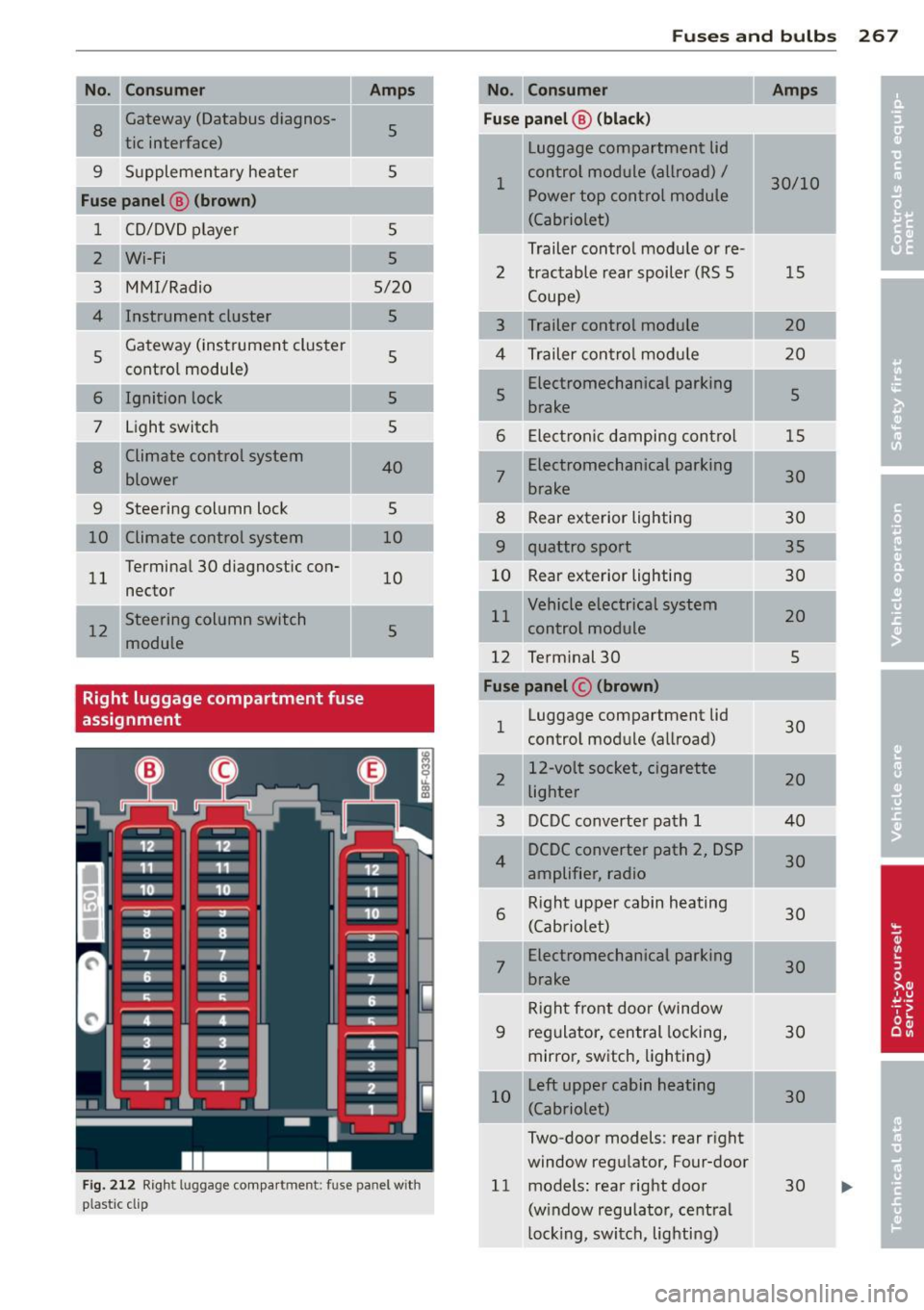
--No. Consumer Amps
I a
Gateway (Databus diagnos-
5 tic interface)
I
9 Supplementary heater
Fuse panel ® (brown )
1 CD/DVD playe r
2
Wi-Fi
3 MMI/Radio
4 Instrument cluster
5 Gateway (instrument cluster
control module)
6 Ignition lock
7 Light switch
8
Climate cont
rol system
blower
9 Steering column lock
10 Climate control system
11 Termina
l 30 diagnostic con-
nector
-
12 Steering column switch
module
Right luggage compartment fuse
assignment
5
5
5
5/20
5
5
5
5
40
5
10
10
5
F ig . 2 12 R igh t lu ggage compar tmen t: fu se pan el w ith
pla stic cl ip
-
Fu se s and bulb s 267
No . Consumer Amps
Fuse panel @ (blac k)
Luggage compartment lid
1 control module (all
road) /
30/10
Power top control module
(Cabriolet)
Trailer con trol modu le or re-
2 tractable rear spoiler (RS 5 15
Coupe)
3 Trailer control module 20
4 Trailer contro l modu le 20
5 Electromechanical parking
5
brake
6 E lectron ic damping con trol 15
7
Electromechanical parking
30
brake
8 R ear exterior lighting 30
9 quattro sport
35
10 Rear exterior lighting
30
11 Vehicle electrical system
20
con trol module
12 Term inal 30
5
Fuse panel © (brown )
1 Luggage compartment lid
30
control module (allroad)
-.
2 12-volt
socket, cigarette
20
lighter
3 DCDC converte
r path 1 40
4 DCDC converter path
2, DSP
30
amplifie r, radio
6
Right upper cabin heating
30
(Cabriolet)
7
Electromechanical parking
30
brake
R ig ht front door (window
9 regulator, central locking,
30
mirror, switch, lighting)
10 L
eft upper cabin heating
30
(Cabriole t)
Two-door models : rear r ight
window regu lator, Four-door
11 models : rear right door
30
(w indow regulato r, ce ntra l
l ock ing, switch , lighti ng)
Page 272 of 302
2 70 Emergency situations
@ Tips
The discharged battery must be properly
connected to the vehicle's electrical sys
tem. When jump starting or charging the
battery, never connect the negative
ground cable to the battery negative post
because the batte ry manager system must
be able to detect the battery 's state of
charge. Always connect the negative
ground cab le to the negative ground post
of the battery manager control unit.
Use of jumper cables
Make sure to connect the jumper cable
clamps in exactly the order described below!
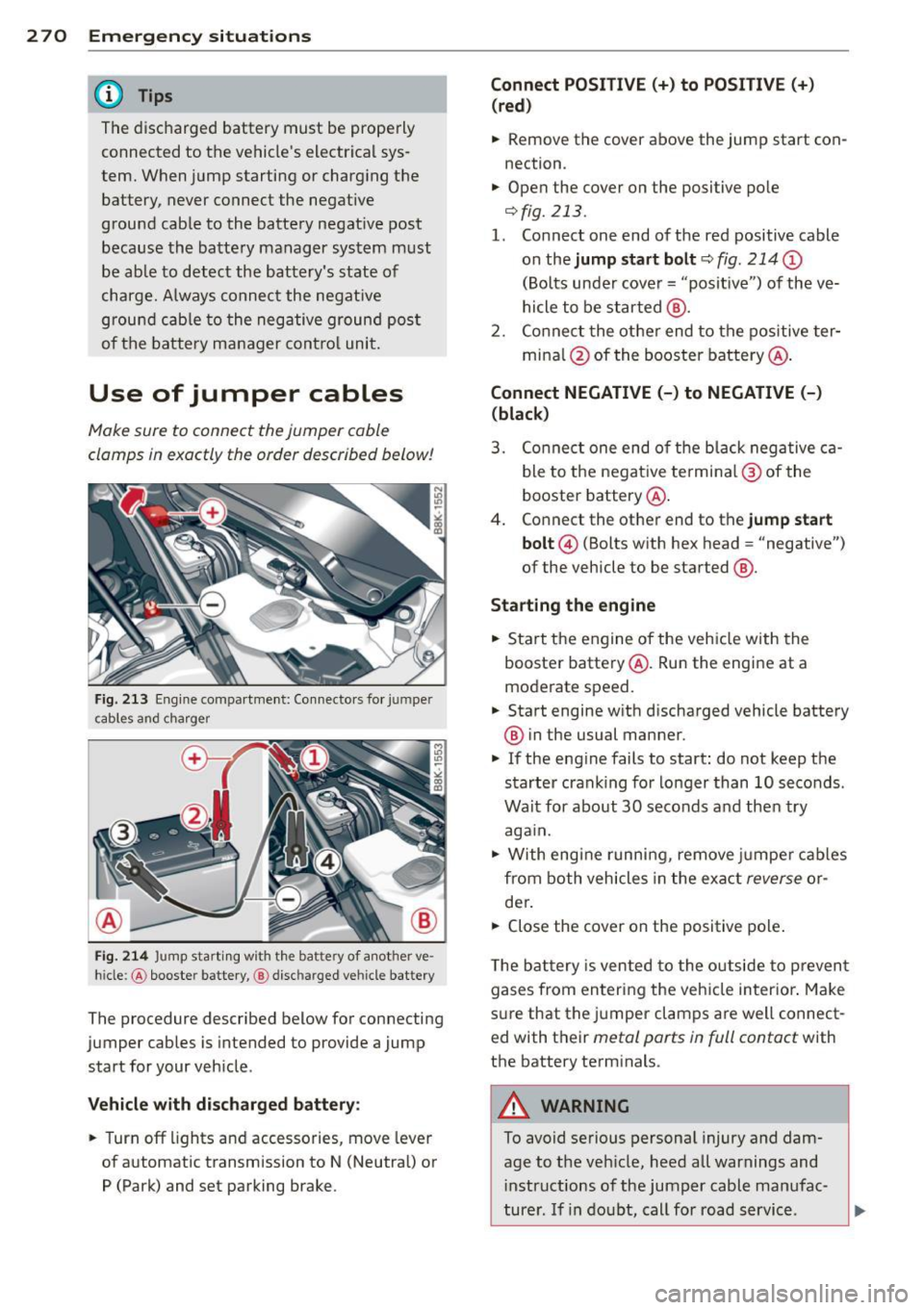
Fig. 213 Engine compartment: Connecto rs fo r jum per
cables and charger
Fig. 214 Jump sta rting wi th the battery of anot her ve ·
h ide :@ booster battery, @ disc harged vehicle battery
The procedure described below for connecting
jumper cables is intended to provide a jump
start for your vehicle .
Vehicle with discharged battery:
.. Turn off lights and accessories, move lever
of automatic transmission to N (Neutral) or
P (Park) and set parking brake .
Connect POSITIVE(+) to POSITIVE(+)
(red)
.. Remove the cover above the jump start con
nection .
.. Open the
cover on the positive pole
¢fig. 213 .
1. Connect one end of the red positive cable
on the
jump start bolt c::> fig. 214 @
(Bolts under cover= "positive") of the ve
hicle to be started @.
2. Connect the other end to the positive ter-
minal @of the booster battery@.
Connect NEGATIVE (-) to NEGATIVE (-)
(black)
3. Connect one end of the b lack negative ca
ble to the negative terminal @of the
booster battery @.
4. Connect the other end to the
jump start
bolt @
(Bolts with hex head= "negative")
of the vehicle to be started @.
Starting the engine
.. Sta rt the engine of the vehicle with the
booster battery@. Run the engine at a
moderate speed.
.. Start engine with discharged vehicle battery
@ in the usual manner .
.. If the eng ine fails to start: do not keep the
starter cranking for longer than 10 seconds .
Wait for about 30 seconds and then try
again .
.. With engine running, remove jumper cables
from both vehicles in the exact
reverse or
der .
.. Close the
cover on the positive pole .
T he battery is vented to the outside to prevent
gases from entering the vehicle interior . Make
sure that the jumper clamps are well connect
ed with their
metal parts in full contact with
the battery terminals.
A WARNING
--
To avoid serious personal injury and dam
age to the veh icle, heed all warnings and
i nstructions of the jumper cable manufac-
turer . If in doubt, call for road service . ..,.
Page 273 of 302
-Jumper cables must be long enough so
that the vehicles do not touch.
- When connecting jumper cables, make
sure that they cannot get caught in any
moving parts in the engine compart
ment.
- Do not bend over the batteries - danger
of chemical burns!
- The battery cell locking screws must be
tightened securely .
- Before you check anything in the engine
compartment, always read and heed all
WARNINGS
¢pag e 213, Engine com
partment .
(D Note
Improper hook -up of jumper cables can ru
in the generator.
- Always connect POSITIVE( +) to POSI
TIVE(+), and NEGATIVE( -) to NEGATIVE
( - ) ground post of the battery manager
control unit.
- Check that a ll screw plugs on the battery
cells are screwed in firmly. If not, tighten
plugs prior to connecting clamp on nega
tive battery terminal.
- Please note that the procedure for con
necting a jumper cable as described
above applies spec ifically to the case of
your vehicle be ing jump started. When
you are giving a jump start to another ve
hicle, do
not connect the negative(-) ca
ble to the negative( -) terminal on the
discharged battery@¢
fig. 214. In
stead, securely connect the negative(-)
cable to either a solid metal component
that is firmly bolted to the engine block
or to the engine block itse lf. If the bat
tery that is being charged does not vent
to the outside, escaping battery gas
could ignite and explode!
Emergency situations 2 71
Emergency towing
with commercial tow
truck
General hints
Your Audi requires special handling for tow
ing.
T he following information is to be used by
commercial tow truck operators who know
how to operate their equipment safely.
- Never tow your Audi, towing will cause
damage to the engine and transmission.
- Never wrap the safety chains or winch ca
ble s around the brake lines .
- To prevent unnecessary damage, your Audi
must be transported with a flat bed truck.
- To load the vehicle on to the flat bed , use
the towing loop found in the vehicle tools
and attach to the front or rear anchorage
r=:>page 272 and ¢page 272.
A WARNING
A vehicle being towed is not safe for pas
sengers. Never allow anyone to ride in a
vehicle be ing towed, for any reason.
-
•
•
Page 284 of 302
28 2 Con sum er Inf ormation
-Always make sure the transmission se
lector lever (automatic transmiss ion) is
in "P" (Park position) or Neutral (manual
transmission) and the park brake is firm
ly applied.
@) For the s ake of the environment
-Changing the engine settings will ad
versely affect emission levels. This is det
rimental to the environment and increas
es fuel consumption .
- Always observe environmental regula
tions when disposing of old engine oil,
used brake fluid, dirty engine coolant,
spent batteries or worn out tires.
- Undeployed airbag modules and preten
s ioners might be classified as Perchlo
rate Material -spec ial handling may ap
ply, see www.dtsc.ca .gov/hazardous
waste/perch lorate. When the veh icle or
parts of the restraint system including
airbag modules safety belts with preten
sioners are scrapped, all app licable laws
and regulations must be observed . Your
authorized Audi dealer is familiar with
these requirements and we recommend
that you have your dealer perform this
serv ice for you .
Additional accessories,
modifications and
parts replacement
Additional accessories and parts
replacement
Always consult on authorized Audi dealer be
fore purchasing accessories.
Your veh icle inco rporates the latest safety de
sign featu res ensuring a high standard of ac
tive and passive safety.
This safety could be compromised by non-ap
proved changes to the veh icle. For this reason ,
if pa rts have to be replaced , please observe
the following points when installing addition
a l accessories: Approved Audi accessories and genuine Audi
parts are available from authorized Audi deal
ers.
T hese dea lers a lso have the necessary facili
ties, tools and trained specialists to install the parts and acc essories proper ly.
A WARNING
-Using the wrong spare parts or using non-
approved accessories can cause damage to
the veh icle and ser ious personal injury.
- Use on ly accessories expressly approved
by Audi and genuine Audi spare parts
- These parts and accessories have been
specially designed to be used on your ve
h icle .
- Never install accessories such as tele
phone crad les or beverage ho lders on a ir
bag covers or within the airbag deploy
ment zones . Do ing so will increase the
risk of injury if a irbags are triggered in an
accident!
- Before you check anything in the engine
compa rtment, always read and heed a ll
WARNINGS
9 page 213 .
(D Note
-If items other than genu ine Audi spare
parts, add-on equipment and accessory
items are used or if repair work is not
performed accord ing to specified meth
ods, this can resu lt in seve re damage to
your vehicle's eng ine and body (such as
corrosion) and adversely affect yo ur vehi
cle's warranty .
- If emergency repairs must be performed
elsewhere, have the vehicle examined by
an authorized Audi dealer as soon as
possible .
- The manufacturer cannot be held liable
for damage wh ich occ urs due to failure
to comply with these stipu lations.