warning AUDI S4 2014 Owners Manual
[x] Cancel search | Manufacturer: AUDI, Model Year: 2014, Model line: S4, Model: AUDI S4 2014Pages: 296, PDF Size: 73.56 MB
Page 185 of 296
.. Pull on the connector attachments to make
sure they are properly attached to the LATCH
lower anchorage .
.. Pull straps tight following the child restraint
manufacturer's instructions.
R elea sin g
.. Loosen the tension on the straps following
the chi ld restraint manufacturer's instr uc
tions .
.,. Depress the spring catches to release the
anchorage hooks from the lower anchorag
es .
Remember: Use tether straps to help keep the
child restraint firmly in place.
A WARNING
Improper use of the LATC H system can in
crease the risk of ser ious personal injury
and death in an acc ident.
- These anchors were developed only for child safety seats us ing the "LATCH" sys
tem.
- Never attach other child safety seats,
belts or othe r objects to these anchors.
- Always make sure that you hea r a click
when latching the seat in place. If you do not hea r a click the seat is not secure and
c ou ld fly forward and h it the inte rior of
the vehicle, or be ejected from the vehi
cl e.
A WARNING
Improper installation of chi ld restraints
w ill increase the risk of in jury in an acci
dent.
- Always fo llow the child rest raint system
manufacturer's instr uctions for proper
installation o f the child restraint system
and proper use of tether straps as we ll as
the lower anchorages or safety belts in
your vehicle.
-Always read and heed the important in
format io n and WARNINGS about child
safety and the installation of child re
st raint systems~
page 167, Child Safe
ty.
-
Child S afety 183
Tether anchors and tether straps
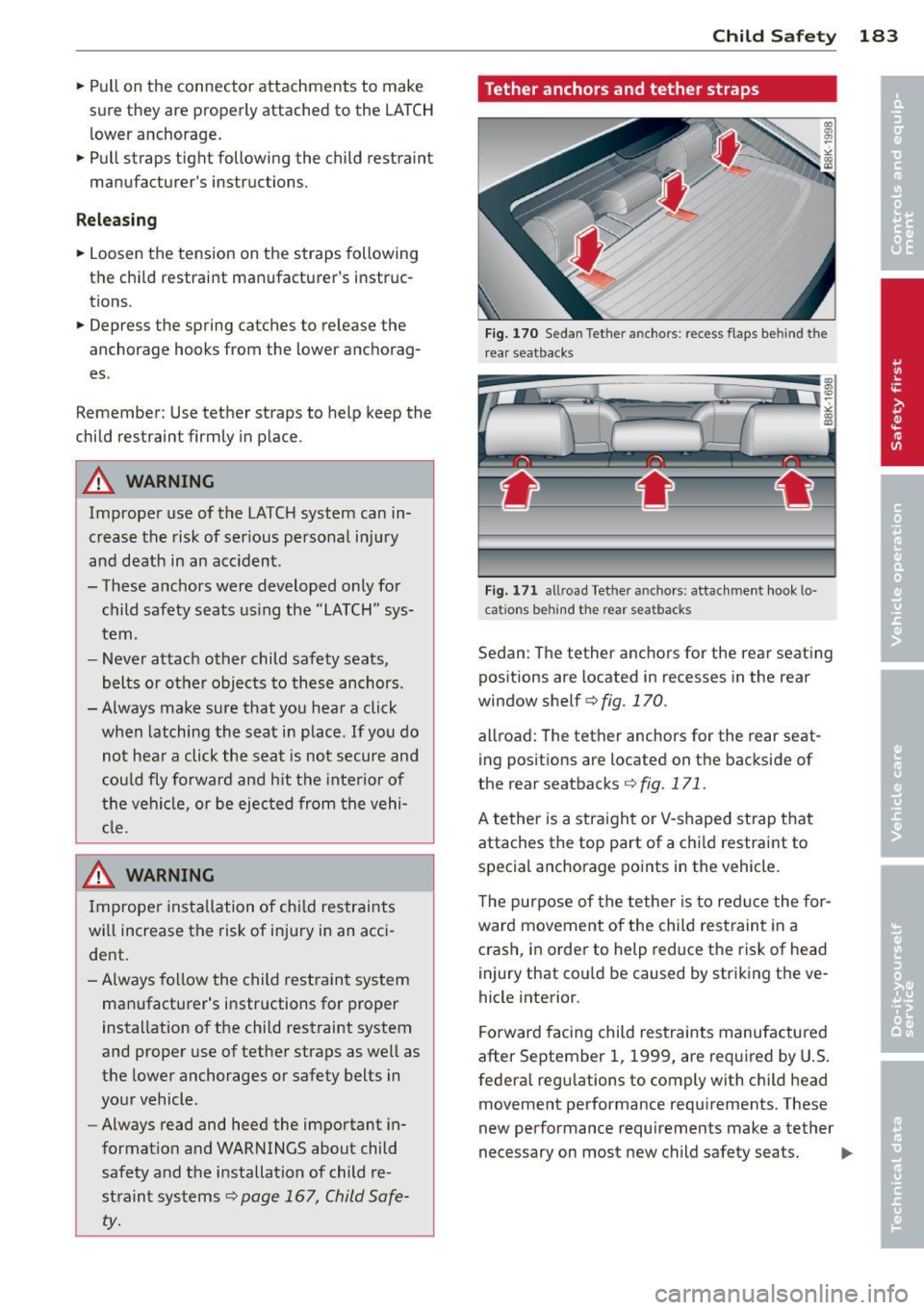
Fig. 170 Sedan Tether anchors: recess flaps behind the
r ea r seatbacks
Fig. 171 allroad Tether anchors: attac hme nt hook lo
cat io ns be hind the rear seatbacks
Sedan: The tether ancho rs for the rear seating
pos itions are located in recesses in the rear
window shelf
c> fig. 170.
allroad : The tether anchors for the rear seat
ing pos it ions are located on the backside of
the rear seatbacks
c>fig. 171.
A tether is a straight or V-shaped strap t hat
attaches the top part of a ch ild restraint to
special anchorage po ints in the vehicle .
T he purpose of the tethe r is to re duce the for
ward movement of the child rest raint in a
crash, in orde r to help reduce the risk of head
injury that cou ld be caused by striking the ve
hicle interior.
Forward facing child restraints manufactured
after September 1, 1999, are requ ired by U .S .
federal regulations to comply with c hild head
movement performance requirements. These
new performance requirements make a tether
necessary on most new child safety seats. ...,
Page 186 of 296
184 Child Safet y
& WARNING
Improper insta llation of child restraints
will increase the risk of injury and death in a crash.
- Always follow the instructions provided
by the manufacturer of the ch ild re
straint you intend to install in your Audi.
- Improper use of child restra int anchors
(including tether anchors) can lead to in
jury in a co llision. The anchors are de
signed to withstand on ly those loads im
posed by correctly fi tted ch ild restraints.
- Never mount two ch ild restraint systems
on one LA TCH lower anchor po int.
- Never attach two child rest ra int systems
to one tethe r strap or tether anchorage.
- Never attach a tether strap to a tie-down
hook in the luggage compartment.
- Never use ch ild restra int te ther ancho
rages to secure safety belts o r other
kinds of oc cupant rest ra ints.
- Never secure o r attach any luggage or
other items to the LATC H lowe r ancho
rages o r to the tethe r ancho rs.
- If a tether or other strap is used to at
tac h a child res traint to the front passen
ger seat, make su re that it is not so
t igh t, that it causes the weight-sensing
mat to measure more weight than is ac
t u ally on the seat.
- T he heav ier weight reg iste red can make
the Advanced Airbag System work as
though an adult were on the seat and de
ploy the Advanced Airbag when it must
be suppressed causing serious or even
fatal injury to the child.
- If you must install a rearward facing
child safety seat on the front passenger
seat because of exceptional circumstan
ces and the
PA SSENGER AIR BAG OFF
light does not come on and stay on, im
med iately install the rea r-facing child
s afety seat in a rear seating posi tion a nd
have the a irbag sys tem inspec ted by yo ur
authorized Audi dealer.
Installing the upper tether strap on the
anchorage
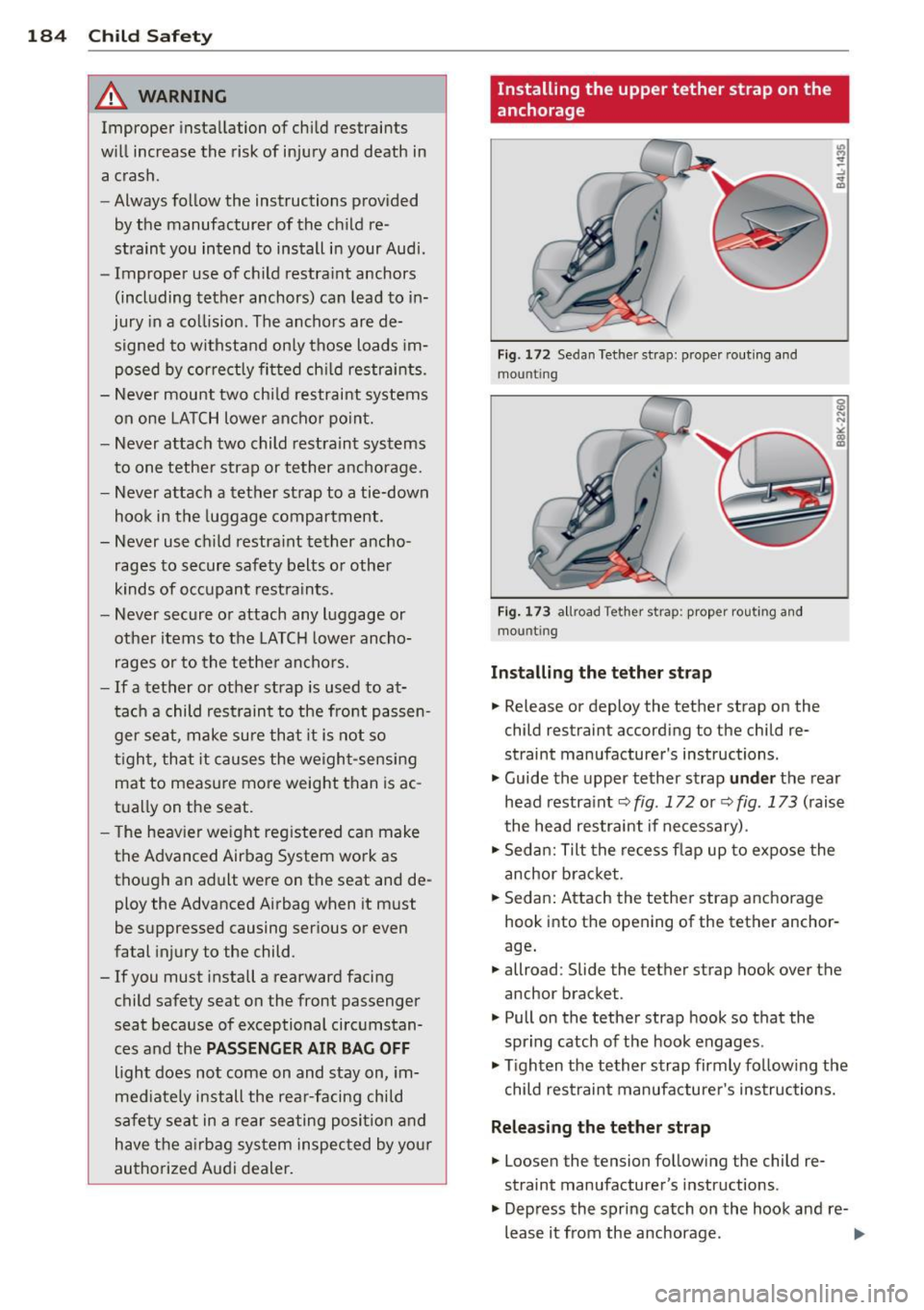
Fig. 172 Sedan Tether strap: prope r ro ut ing and
mount ing
F ig . 1 73 allroad Tether strap: proper routing and
mount ing
Installing the tether st rap
.,. Release or deploy the tether strap on the
child restraint according to the child re
straint manufacturer's instructions .
.,. Guide the upper tether strap
under the rear
head restra int
~fig.172 or¢fig .173 (raise
the head restraint if necessary).
.,. Seda n: Tilt the re cess fl ap up to expose the
a nchor b rac ket.
.,. Sedan: Attach the tethe r strap anchorage
hook into the opening of the tether anchor
age .
.,. allroad : Slide the tether strap hook over the
anchor bracket.
.,. Pull on the tether strap hook so that the
spr ing catch of the hook engages .
.,. Tighten the tether strap firmly fo llow ing the
child res traint manufacture r's ins tructions.
Releasing the tether strap
.,. Loosen the tension follow ing the child re
straint manufacturer's instructions .
.,. Dep ress the spring catch on the hook and re-
lease it from the anchorage. ..,.
Page 187 of 296
(D Note
If you leave the child restraint with the
tether strap firmly installed for severa l
days, this cou ld leave a mark on the up
holstery on the seat cushion and backrest
in the area where the tether strap was in
s t alled. The upho lstery would a lso be per
manently stretched around the tethe r
s tr ap. This applies especially to leat her
seats.
Using tether straps on rearward-facing
child restraints
Currently, few rearward-facing child restraint
systems come with a tether. Please read and h eed the child restraint system manufactur
er's instructions carefully to determ ine how to
p roperly install the tethe r.
A WARNING
-
A ch ild i n a rearward-facing child safety
s ea t insta lled on the front passenger sea t
w ill be seriously injured and can be killed if
t he fron t air bag inflates -even with an Ad
vanced Airbag System .
- T he inflating a irbag w ill hit the chi ld
sa fety seat or infa nt carrier w it h great
force and wi ll smash the ch ild safety seat
and child against the backrest, center
armrest, or door.
- A tight tether or other strap on a rear
ward-fac ing c hild restra int attached to
the front passenger seat can put too much pressure on the weight-mat in the
sea t and regis ter a heavier we igh t in the
Advanced Airbag System. The heav ie r
we ight registe red ca n make the system
wor k as th ough an adul t were on t he seat
and dep loy the A dvanced Airbag when i t
must be supp ressed ca using serious or
even fatal injury to the child.
- If you mus t insta ll a rearward facing
child safety seat o n the front passenger
seat beca use of exceptional circ umstan
ces and the
PASSENGER AIR BAG OFF
light does not come on and stay on, im-
Child Sa fet y 185
mediately insta ll th e rearward-fac ing
child safety seat in a rear seating posi
tion and have the airbag system inspect
ed by your authorized Audi dealer .
Additional Information
Sources of information about child
restraints and their use
There are a number of sources of additional
information about child restraint se lection, in
stallation and use:
NH TSA advises that the best chi ld safety seat
is the one that fits your chi ld and fits in your
vehicle, and that you w ill use correct ly and
consistently.
T ry before yo u buy!
U .S National Highway Traffi c Safety Admin
istration
Tel.: 1 -888 -3 27- 42 36 (TIY: 1-800 -42 4-9153)
www.n htsa.gov
National SAFE KIDS Campaign
Tel.: (2 02) 662- 0600
www.safe kids.o rg
Safety BeltSafe U .S .A
T el.: (8 00) 7 45-SAF E (English)
T el.: (8 00) 747 -SANO (Span ish)
www.carseat.org
Transport Canada Information C entr e
Tel.: 1 -800 -333-0371 or c all
1-6 13-99 8-8616 if yo u are in the Ottawa area
http://www.tc.gc.ca/eng/ roadsa fety/
menu .htm
Audi Cu stomer Relation s
Tel.: (800) 822-2834
•
•
Page 189 of 296
ESC includes and/or works together with the
anti-lock brake system (ABS), brake assist sys
tem, anti -slip regulation (ASR) , e lectronic dif
ferential lock (EDL), dynamic steering* and electronic i nteraxle differential lock* /selective
wheel torque control* . ESC is switched on all
the t ime. I n certain s ituations when you need
less traction, you can switch
off ASR by press
i ng the button~~
page 188, fig. 174 or
~ page 188, fig. 175. Be sure to sw itch ASR
on again when you no longer need less trac
tion.
Anti-lock b ra king s ystem (ABS)
ABS prevents the wheels from locking up
when braking. The vehicle can still be steered
even d uring hard brak ing . Apply ste ady p res
sure to the brake pedal. Do not pump the ped
a l. A pulsing in the brake peda l indicates t hat
the system is he lping you to brake the vehicle .
Brake assist system
The brake assist system can decrease bra king
d istance. It increases braking power when the
d river presses the brake pedal quick ly in eme r
gency situations . You must press and hold the
brake peda l until the situation is over. In
veh icles w ith adaptive cru ise contro l*, the
brake assist system is more sensit ive if the
d istance detected to the veh icle ahead is too
small.
Anti- slip regulati on (ASR)
ASR reduces engine power when the drive
wheels begin to spin and adapts the force to
the road condit ions. This makes it eas ier to
start, accelerate and drive up hills.
Elect ronic diffe renti al lo ck (EDL )
The ED L brakes wheels that are spinning and
transfers the drive power to the other drive
wheel or wheels if the vehicle is equipped with
all-wheel drive*. This function is available up
to about 60 mph (100 km/h) .
In extreme cases, EDL automatica lly switches
off to help keep the brake on the braked whee l
from overheating. EDL w ill switch on again au-
Intellig ent technolog y 187
tomat ica lly when conditions have returned to
norma l.
Dynamic steering*
On vehicles with dynam ic steering*, ESC helps
stab il ize the s teer ing in crit ica l sit uat io ns.
Electronic interaxle differential lock* /
selective wheel torque control*
T he electronic i nteraxle differential lock (front
whee l dr ive) or the se lective whee l to rque
control (all-whee l dr ive) opera tes when dr iv
ing thro ugh curves. The front wheel on the in
side of the c urve or both whee ls on the inside
of the curve are braked selectively as needed .
This min imizes sliding in the front wheels and
allows for more precise driving through
cu rves . The applicable system may not acti
vate when dr iv ing in wet or snowy conditions.
A WARNING
- ESC, ABS , ASR, EDL dynam ic steering*
a nd the elect ronic interaxle differential
loc k* /se lective wheel torque control*
cannot overcome the laws of physics .
This is especially important on slippery
or wet roads. If the systems begin acting
to stabilize your veh icle, yo u should im
mediately change your speed to match
the road and traff ic conditions. Do not
let the increased safety provided by
these systems tempt you to take r isks.
Doing so will increase the risk of a loss of
veh icle contro l, col lision and ser ious per
sonal injuries.
- Always adapt your speed to road, traffi c
and wea ther conditions. The risk of los
ing con tro l of the vehicle increases when
driving too fast, espec ially through
curves and on slippery or wet roads, and
when dr iv ing too close to vehicles up
ahead. ESC, ABS, the brake ass ist sys
tem, ASR, EDL dynam ic steering* and the
electronic interaxle differentia l lock*/se
lective whee l torque control* cannot p re-
vent co llisions . ..,.
•
•
Page 191 of 296
Intelligent technology 189
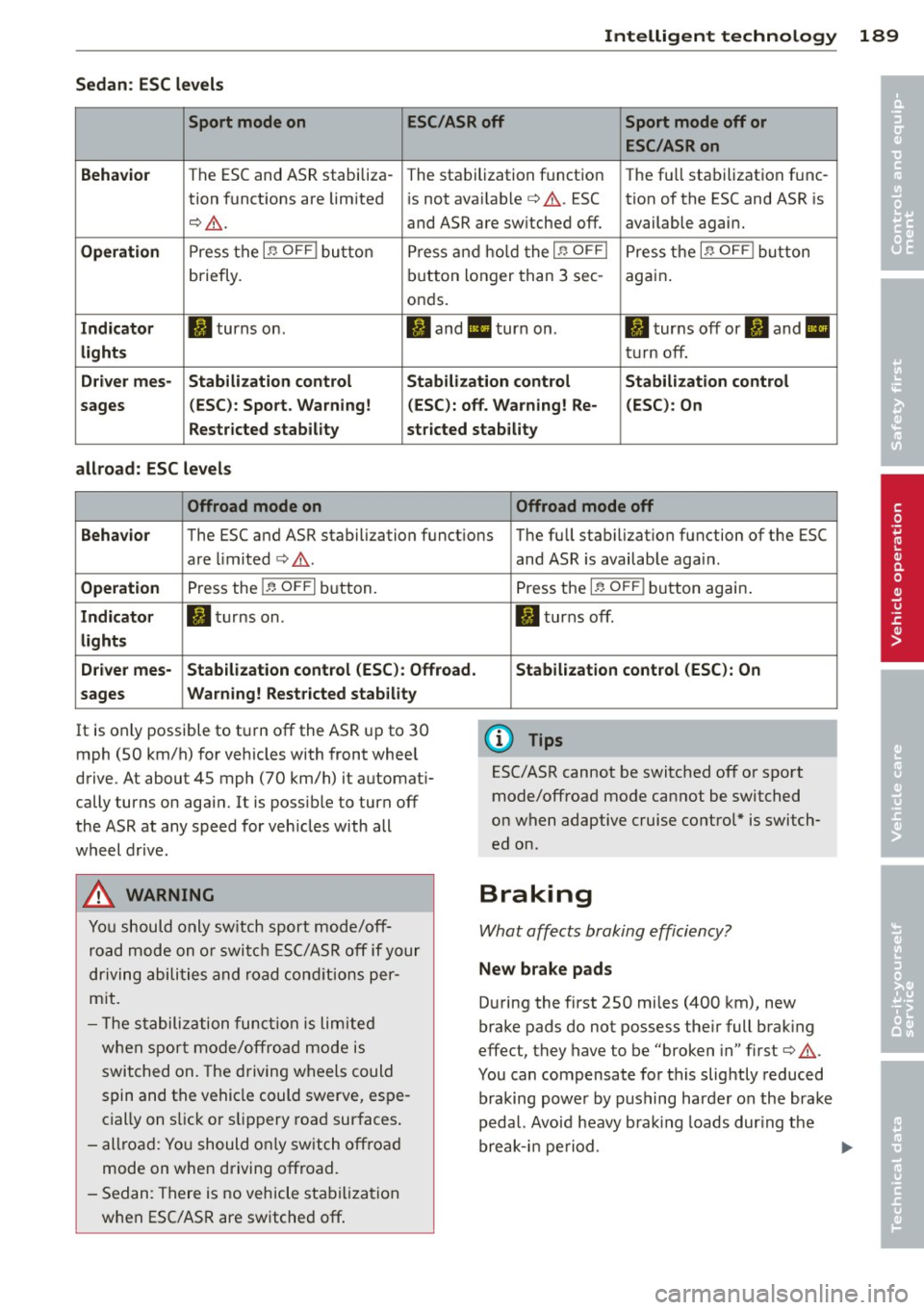
Sedan: ESC levels
Sport mode on ESC/ASR off Sport mode off or
ESC /ASR on
Behavior
The ESC and ASR stabiliza- The stalbilization f unct ion The fu ll sta bilization f unc-
tion funct ions are lim ited is not ava ilable
c:> A . ESC tion of the ESC and ASR is
c:, A . and ASR are sw itched off. available agai n.
Operation Press t he I~ OFF I button Pre ss and h old t he I~ OFFI Press t he i.i, OF FI bu tton
briefly. bu
tton longer than 3 sec -
aga in .
o nd s.
Indicator II turns on. II an d II turn on . II turns off or fl and II
lights tur n off.
Driv er mes· Stabilization control Stabilization control Stabilization control
sages (
ESC) : Sport . Warning! (ESC): off . Warning! Re- (ESC) : On
Restricted stability stricted stability
allroad: ESC level s
Offroad mode on Offroad mode off
Behavior
The ESC and ASR stabilization funct ions T he full stab ilizat ion function of the ESC
are limited
c:> A .
Operation Press the I~ OFFI bu tton.
Indicator II tur ns on.
light s
D river mes- Stabilization control (ESC ): Offroad.
sages Warning! Rest
ricted stability
It is on ly possible to t urn off the AS R up to 30
mph (SO km/h) f or veh icles with front whee l
drive. At about
45 mph (70 km/h) it a utomat i
cally turns on aga in. It is poss ible to turn off
the ASR at any speed for veh icles with all
wheel dr ive .
A WARNING
-
Yo u should o nly sw itch sport mode/off
r oa d m ode on or swi tch E SC/A SR off if your
d rivi ng abili ties a nd ro ad con ditio ns per
m it .
- T he stabili zation fu nction is limited
w he n sp ort m od e/off road mode is
switched on . The driving w heels could
s p in and t he vehicle c ould swerve, es pe
c ia lly on s lick or slipp ery roa d sur faces .
- all road: Yo u should o nly sw itc h off roa d
mode on when driving offroad .
- S edan: There is no vehicle sta biliz atio n
w hen ESC/AS R are switched off . and ASR
is availab le aga in.
Press t he
I~ OFF I button again .
II turns off.
Stabilization control (ESC ): On
(D Tips
ESC/ASR cannot be switched off o r sp o rt
mode/offroad mode ca nnot be switched
on when adaptive cruise control * is switch
ed o n.
Braking
What affects braking effic iency?
New brake pads
D uring the first 250 mi les (4 00 km), new
brake pads do not possess the ir full brak ing
effect, they have t o be "broken in" first
c:> A .
You can compensate for this slightly reduce d
braking powe r by pushing har der on the brake
p edal. Avo id heavy b ra ki ng loa ds dur ing t he
break-i n pe riod.
•
•
Page 192 of 296
190 Intelligent technology
Operating conditions and d riving hab it s
The brakes on today 's automob iles are st ill
subject to wear, depending largely on operat
ing conditions and driving habits
c::> ,& . On
vehicles that are either driven mostly in stop
and-go city traffic or are driven hard, the
brake pads should be checked by your author
ized Audi dealer more often than specified in
the
W arranty & M ainte nance booklet . Failure
to have your brake pads inspected can result
in reduced b rake pe rformance.
On steep slopes, you should use the brak ing
effect of the eng ine . This way, you prevent un
necessa ry wear on the brake system. If you
must use you r brakes, do not hold the brakes
down continuously . P u mp the b rakes at inter
va ls.
Operating nois e
Noises may occur when braking depending on
the speed, braking force and outside condi
tions such as temperature and humidity .
Effect of w ater and ro ad sa lt
In certain situat ions, for example after driving
through wate r, in heavy ra in, after overn ight
condensation or after washing your car, the brak ing effect can be reduced by moistu re or
i ce on the bra ke roto rs and b rake pads . The
b rakes must be dried fi rst with a few ca ref ul
brake app lications .
At h igher speeds and with the w indshie ld w ip
e rs turned on, the brake pads press agains t
the bra ke rotors for a short amount of time.
This occurs a t regular intervals without the
driver noticing and provides for better brake response time under wet conditions.
The effectiveness of the brakes can be reduced
when the vehicle is driven on a salt-covered
road and the brakes are not used. Likewise,
you clean off accumulated sa lt coating from
brake discs and pads with a few caut ious ap
plications of the brake
c::> ,& .
Cor rosion
There may be a tendency for dirt to bui ld up
on the brake pads and corrosion to form on the d
iscs if the car is not driven regu larly or
o n Ly for short trips with litt le use of the
brakes.
If t he brakes a re not used frequently, o r if cor
r os ion has formed on the discs, it is adv isable
to clean off the pads and discs by braking
firmly a few times from a moderately h igh
speed
c::> .&. .
Fault s in the brak e syst em
If you shou ld notice a sudden increase in
brake pedal trave l, then one of the two brake
circuits may have fai led
c::> .& .
Low br ake fluid lev el
Malfunctions ca n occu r in the b ra ke system if
t h e b rake fluid level is too low. The brake flu id
l evel is monitored electronica lly.
Brake booster
The brake booster inc reases the pressure that
you generate with the b rake peda l. It works
o n ly when the engine is runn ing
.c::> .&
Brake lining wear status
Brake lining wear may be checked by visual in
spect io n of the condition of the brake pads
th rough the open ings in the wheel. If neces
sary, the wheel may be removed fo r thi s i n
spe ct ion
c::> page 255, Changing a wheel.
.&, WARNING
- New b rake pads don' t have the bes t stop
ping power and m ust be "bro ken -in" dur
ing the initial 100 to 150 miles (150 to
200 kilometers) of normal c ity driving.
You can compensate for this by pressing the brake pedal more firmly. Th is also
applies later when new pads are instal
led.
- You shou ld perform braking maneuvers
for the purpose of cleaning the brake
system only if road conditions permit.
Othe r road use rs must no t be put at risk -
you may ca use an accident!
- Before descend ing a steep grade, reduce
speed and sh ift transmission into a lower
gear or lower dr iving range. Do not ride
~
Page 193 of 296
th e brakes or hold the pedal down too
long or too ofte n. This cou ld cause the
brakes t o get hot and dimi nish b raking
efficiency .
- Do not "r ide t he b rakes" by resting your
foot on the pedal when you do n ot intend
t o brake . Th is may cause the brakes to
overheat, premature wear and increased
stopp ing distance.
- Under certa in climat ic and operating
condit ions such as passing through wa
ter, driving i n heavy rai n or after wash ing
the vehicle, the effe ct iveness of the
brakes can be re duced. In winter, ice can
acc umulate on the brake pads, linings,
discs and drums. Carefully apply brakes
f or a test. Brakes will dry and ice coat
ings will be cleaned off after a few care
ful brake app lications.
- Driv ing for an extended period of time on
salt-covered roads w ithout using your
brakes can also affect braking efficiency .
Clean off accumulated salt coating from
brake discs and pads w ith a few caref ul
brake applicat io ns.
- If you damage the front spo iler, or if you
install a diff ere nt spoiler, be sure the air
flow to t he front b ra kes is not obstr uct
ed . Otherwise the br ake sys tem co uld
overheat red ucing the effectiveness of
the ent ire brake sys tem.
- F ailure of one br ake circui t will im pair
the brakin g capability res ulting in an in
creased stop ping distance . Avoid driving
the vehicle and have it towed to t he near
est author ized Audi dealer or qualified
workshop.
- Never let the vehicle ro ll to a stop w ith
the engine shut off.
- If the brake booster is not work ing, the
brake pedal must be pressed considera
bly harder to make up for the lack of
booster assistance.
Int ellig ent technolog y 191
Electro-mechanical
power assist, dynamic
steering
The electro-mechanical power assist helps
t he driver when steering.
Power steer ing adap ts electronically based on
t he ve hicl e spee d.
Indicator lights and messages
• Steering defect ive! Do not drive vehicle!
If this indicator light turns on and stays on
and t his message appears, the power steer ing
may have failed.
Do
not continue driving. See your authorized
Audi dealer or a qualified repair facility for as
s istance.
':rij Dynamic steering: Sy stem fault! You can
continue dr iving
If the indic ator ligh t turns on and the mes
sage appears, the steering may be more diffi
cu lt to move o r more sensitive tha n usual. The
steering wheel may a lso be at an ang le when
driv ing straight.
Drive slowly to your a uth orized Audi dea ler or
qualified workshop to have the ma lf u nction
corrected.
(;rij Dynamic ste ering : initializing
If this drive r message appea rs and the indica
tor light is flas hing on the instrument panel,
dynam ic steer ing* i s being rein itia lized. After
sta rting the engine, the stee ring w heel will
move s light ly . Re- initializa tion might be nec
essary if the stee ring wheel was moved hard
to the left and right whi le the vehicle was not
moving. The display goes out as soon as initi
alization is complete .
A WARNING
-Have the dy namic stee ring* system mal
f u nction repa ired as soon as possible by an
authorized Audi dealer or qualified work
shop - risk of acc ident!
-
•
•
Page 194 of 296
192 Intelligent technology
(D Tips
-If the . or 'Tj indicator light only stays
on for a short time, you may continue
driving.
- The dynamic steering* stability systems
are not available in the event of a system
malfunction.
- For additional information on dynamic
steering*, refer to
c:> page 113.
Driving with your
quattro
App lies to vehicles: with a ll-wheel drive
With all-wheel drive, all four wheels are driv
en .
General information
With all-wheel drive, power is distributed to
all four wheels . This happens automatically
depending on your driving style and the road
conditions at the time . See also
c:> page 186.
A center differential distributes the driving
power variably to the front and rear axle .
It
works together with selective wheel torque
control , which activates when driving through
curves
c:> page 187. With the sport differen
tial*, power distribution to the rear wheels is
variable and can be adjusted with drive select
c:>page 113.
The all-wheel drive concept is designed for
high engine power . Your vehicle is exception
ally powerful and has excellent driving charac
teristics both under normal driving conditions
and on snow and ice. Always read and follow
safety precautions
c:> & .
Winter tires
When driving in the winter , your vehicle with
all-wheel drive has an advantage, even with regular tires. In winter road conditions it may
be advisable to mount winter tires (or all-sea
son tires) for improved driveability and brak
ing: these tires must be mounted on
all four
wheels .
See also c:> page 246, Winter tires .
Tire chains
Where tire chains are mandatory on certain
roads, this normally also applies to vehicles
with all-wheel drive
c:> page 247, Snow
chains.
Replacing wheels/tires
Vehicles with all-wheel drive must always have tires of the same size. Also avoid tires
with different tread depths. For details see
page
c:> page 242, New tires and replacing
tires and wheels.
Off-Road driving?
Your Audi does not have enough ground clear
ance to be used as an off-road vehicle.
It is
therefore best to avoid rough tracks and un even terrain as much as possible. Also refer to
c:> page 195.
A WARNING
-
Always adjust your driving to road and traf-
fic conditions. Do not let the extra safety
afforded by all-wheel drive tempt you into
taking extra risks.
- Although the all-wheel drive is very ef
fective, always remember that braking
capacity is limited by tire traction . You
should therefore not drive at excessive
speeds on icy or slippery road surfaces.
- On wet road surfaces, be careful not to
drive too fast because the front wheels
could begin to slide on top of the water
(aquaplaning). If this should occur, you
will have no warning from a sudden in crease in engine speed as with a front
wheel drive vehicle. Always drive at
speeds which are suited to the road con
ditions -risk of crash.
Page 195 of 296
Energy management
Starting ability is optimized
Energy management controls the distribution
of electrical energy and thus optimizes the
availability of electrical energy for starting the engine .
If a vehicle with a conventional energy system
is not driven for a long period of time , the bat
tery is discharged by idling current consumers
(e.g. immobilizer). In ce rtain c ircumstances it
can result in there being insuff icient ene rgy
avai lab le to start the engine .
Intell igent energy management in your vehi
cle hand les the d istribution of electrical ener
gy. Starting ab il ity is markedly improved and
the life of the battery is extended.
Basically, energy management consists of
batt ery di agno sis, idlin g current man ag e
m ent
and dyn ami c en ergy m anage ment .
Batter y diagnosis
Battery diagnosis continuously determines
the state of the battery . Sensors determ ine
battery vo ltage, battery current and battery
temperature. This dete rm ines the current
state of charge and the powe r of the battery.
Idling curr ent man agement
Idling current management reduces ene rgy
consumption while the vehicle is stand ing .
W ith the ignition switched off, it cont ro ls the
energy supply to the va rious electr ical compo
nents . Data from battery diagnosis is consid
ered.
Depending on the battery's state of charge,
i nd ividua l consumers are gradual ly t urned off
to prevent excess ive d ischarge of the bat tery
and thus maintain starting capability .
Dynamic en ergy management
While the vehicle is being driven, dynamic en
e rgy management dist ributes the energy gen
e rated according to the needs of the individu
a l components.
It reg ulates cons umption, so
that more electrical energy is not being used
Int ellig ent technolog y 193
than is being generated and ensures an opti
mal state of charge for the battery.
(0 Tips
- But even energy management canno t
negate the limits of physics . Consider
that the power and life of a battery are
limited .
- If starting ability is threatened, the indi
cator light (•)
;:i ppears ~ page 17.
What you should know
The highest priority is given to maintaining
starting capability.
T he bat tery is severe ly taxed in short-distance
driving, in city traffic and during the cold time
of year. Ab undant electrical energy is re
quired, but on ly a little is generated .
It is also
critica l if the engine is not running and electri
ca l components are turned on . In this in
stance energy is be ing consumed but none is
being generated .
It is in precisely these situations that you will
notice energy management active ly regulat
ing the d istribution of energy.
V ehicle stand s for an ex tend ed peri od
If you do not drive your vehicle over a period
of severa l days or weeks, e lectrica l compo
nents are gradually cut back or switched off.
This reduces energy consumption and ma in
ta ins start ing capability over a longer period .
Some of the convenience functions may not
operate, such as the interior l ights or the
power seat adjustme nt. The convenience
funct ions w ill be available again when you
swi tch on the ignition and sta rt the eng ine .
With the eng in e turn ed off
If you listen to the radio, for example, w ith
the engine tu rned off or use other MMI func
tions, the battery is be ing d ischarged.
If starting capability is jeopardized due to en
ergy consumption, the following warning ap- pears in the MM I display: ..,.
•
•
Page 196 of 296
194 Intelligent technology
Plea se start the engin e soon or th e system
w ill be tu rned off.
The warning ind icates that the system will be
turned off automa tic ally after 3 m inu tes. If
you wish to continue using the functions , you
have to start the engine .
With the engine running
Although electrical e nergy is generated when
the vehicle is be ing driven , the battery can be
come d ischarged. This happens most ly when
little energy is being generated and a great
deal consumed and the battery 's state of
charge is not optimal.
To br ing the energy balance back into equili
brium, consumers which require especia lly
large amounts of energy are temporarily c ut
back or switched off. Heating systems in par·
ticular requ ire a great deal of energy. If you
notice, for example, that the heated seats* or
the heated rear window are not heating, they have been temporar ily cut back or switched
off. These systems will be ava ilable again as
soon as the energy ba lance has been restored.
You will also notice that engine idle speed has been increased slightly . This is norma l and not
a cause fo r concern . By increas ing engine idle
speed the add itiona l ene rgy required is gener
ated and the batte ry is charged.