warning AUDI S4 2014 Owners Manual
[x] Cancel search | Manufacturer: AUDI, Model Year: 2014, Model line: S4, Model: AUDI S4 2014Pages: 296, PDF Size: 73.56 MB
Page 214 of 296
212 Fuel su ppl y and filli ng your fu el t ank
Refuelling
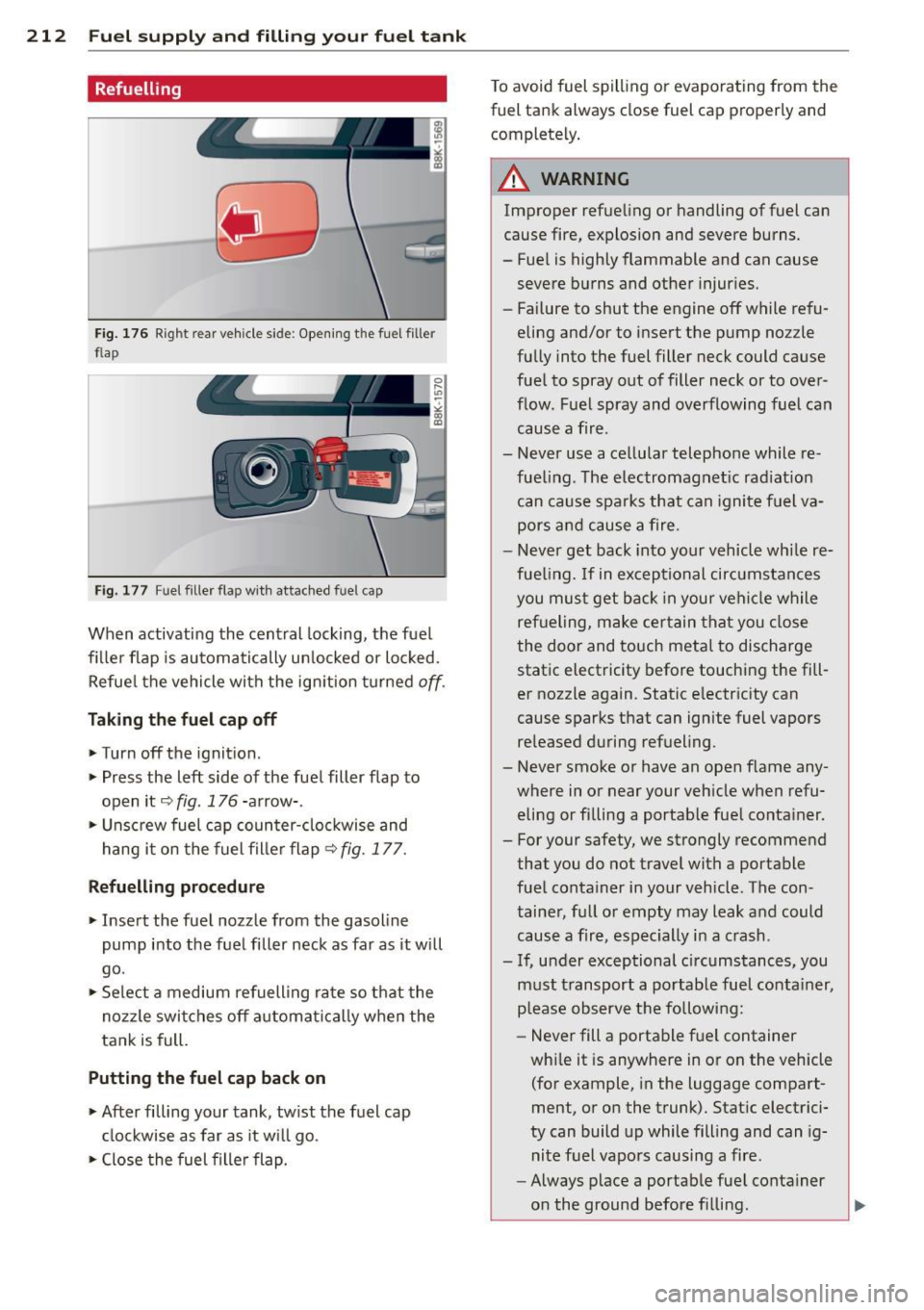
Fig. 176 R ig ht rear veh icle s ide: Open ing t he fuel fille r
fl ap
F ig. 177 F uel fi ller flap w ith atta ched fuel c ap
When activating the central lock ing, the fuel
fi ller flap is automatically un locked or loc ked.
Refuel the vehicle with the ig nition turned
off .
Tak ing th e fuel cap off
~ Turnoff the ignition .
~ Press the left side of the fuel filler flap to
open it
c::> fig. 176 -arrow- .
~ Unscrew fuel cap counter-clockwise and
hang it on the fuel filler flap
~ fig . 177.
Refu elling proc edure
~ Insert the fuel no zzle from the gasoline
pump into the fuel filler nec k as far as it will
go .
~ Select a medium refuelling rate so that the
nozzle switches off a utomatica lly when the
tank is full.
Putting the fuel cap back on
~ After filling your tank , tw ist the fuel cap
clockwise as far as it w ill go .
~ Close the fuel fille r flap. T
o avoid fuel spill ing or evaporating from th e
fuel tank always close fuel cap properly and
completely .
A WARNING
-Im proper refueling or handling of fuel can
cause fire, explosion and severe burns.
- Fuel is highly flammable and can cause
severe burns and other injur ies.
- Failure to shut the engine off while refu
eling and/or to insert the pump no zzle
fully into the fuel filler neck could cause fuel to spray out of filler neck or to over
flow . Fuel spray and overflowing fuel can
cause a fire .
- Never use a cellular telephone while re
fueling . The electromagnet ic rad iat io n
can cause sparks that can ignite fuel va
pors a nd cause a fire .
- Never get back into your vehicle whi le re
fue ling.
If in exceptional circumstances
you must get back in your vehi cle while
ref ueling, make ce rtain that you close
the door and touch metal to discharge
static electricity before touching the fill
er nozzle again . Static e lectricity can
cause sparks that can ignite fuel vapors re leased during refueling .
- Never smoke or have an open flame any
where in or near your veh icle when refu
eling or filling a portable fuel conta iner .
- For your safety, we strongly recommend
that you do not travel with a portable
fue l conta iner in your vehicle . The con
tainer, full or empty may leak and could
cause a fire, especially in a crash .
- If, u nder exceptional c ircumstances, you
must transport a portable fuel conta iner,
p lease observe the following:
- Never f ill a portable f uel container
whi le it is anywhere in or on the vehicle
(for example, in the luggage compart
ment, or on the trunk). Static electrici
ty can build up while filling and can ig
nite fuel vapors causing a fire .
- Always place a portable fue l conta iner
on the ground before fi lling.
Page 216 of 296
214 Checking and filling
Checking and filling
Engine hood
Releasing and opening the engine hood
The engine hood is released from inside the
vehicle .
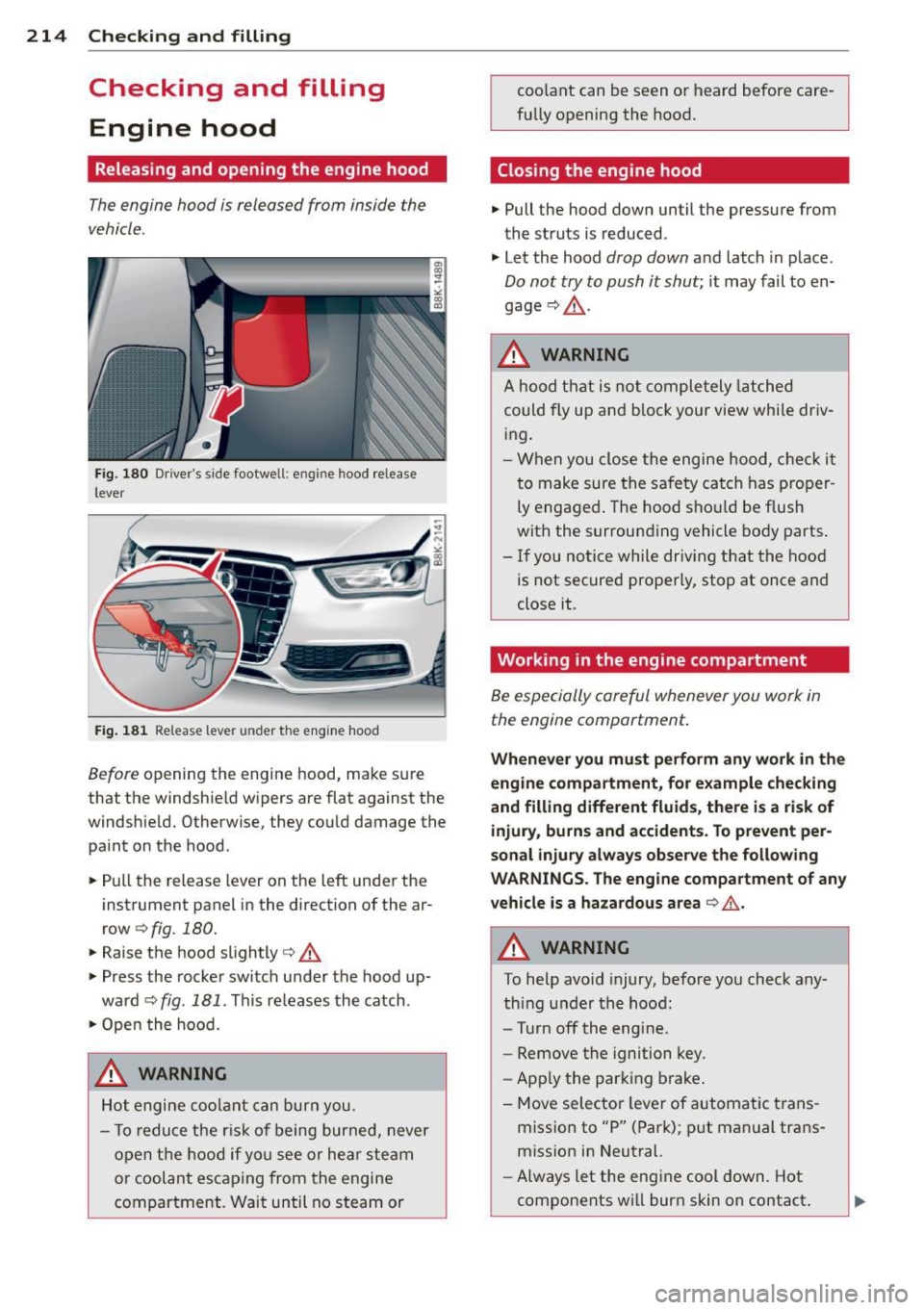
Fig. 180 Driver's side footwe ll: e ngin e hood release
lever
... -- - -=-
Fig. 181 Release lever u nde r the engine hood
Before opening the engine hood, make sure
that the windshield wipers are flat against the
windshield. Otherwise, they could damage the
pa int on the hood.
... Pull the release lever on the left under the
instrument panel in the direction of the ar
row
c;, fig . 180.
... Raise the hood slightly r::;, .&,
... Press the rocker switch under the hood up
ward
c;, fig . 181 . This releases the catch.
... Open the hood.
A WARNING
Hot engine coo lant can burn you.
- T o reduce the risk of being burned, never
open the hood if you see or hear steam
or coolant escaping from the engine
compartment. Wait until no steam or coo
lant can be seen or heard before care
fully opening the hood.
Closing the engine hood
... Pull the hood down until the pressure from
the struts is reduced .
... Let the hood
drop down and latch in place.
Do not try to push it shut; it may fail to en
gage
r::;, .&, .
A WARNING
-
A hood that is not completely latched
could fly up and b lock your view while driv
ing.
- When you close the engine hood, check it
to make sure the safety catch has proper
ly engaged . The hood shou ld be flush
with the surrounding vehicle body parts.
-If you notice while driving that the hood
is not secured properly, stop at once and
close it.
Working in the engine compartment
Be especially careful whenever you work in
the engine compartment.
Whenever you must perform any work in the
engine compartment, for example checking
and filling different fluids , there is a risk of
injury , burns and accidents. To prevent per
sonal injury always observe the following
WARNINGS. The engine compartment of any
vehicle is a hazardous area
r::;, ,&..
A WARNING
-To help avoid injury, before you check any-
thing under the hood:
- Turn off the engine.
- Remove the ignition key.
- Apply the parking brake.
- Move selector lever of automatic trans-
mission to "P" (Park); put manual trans
mission in Neutral.
- Always let the engine cool down. Hot
components will burn skin on contact .
Page 217 of 296
-To reduce the r isk of being burned, never
open the hood if you see or hear steam
or coolant escaping from the engine
compartment . Wait until no steam or
coolant can be seen or heard before ca re
fully opening the hood .
- Keep children away from the engine com
partment.
- Never spill flu ids on hot engine compo
nents. They can cause a fire .
- Never touch the radiator fan. The aux ili
ary e lectr ic fan is temperature controlled
and can switch on suddenly .
- Never open the coolant reservoir cap
when the eng ine is still warm . The cool
ant system is pressur ized and hot coo l
ant could spray out.
- Protect your face, hands and arm from
steam or hot eng ine coolant by placing a
thic k rag over the cap when you open the
coolant reservoir.
- Do not remove the engine cover under
any c ircumstances. Th is increases the
risk of bu rns.
- If wo rk on the fuel system or the electri
cal sys tem is ne cessary:
- Always disconnect the battery.
- Never smoke or work near heaters or
open flames . Fluids in the engine com
partment co uld start a fire.
- Keep an approved fire extinguisher im
mediately ava ilable.
- To avoid electrical s hock and persona l in
jury while the engine is running or being
started, never touch:
- Ignition cables
- Other components of the high voltage
electronic ignition system.
- If you must perform a check or repa ir
with the engine running:
- Fir st, fully apply the parking brake,
move se lector lever of a utomatic trans-
Checkin g and fillin g 215
mission to "P" (Park); put manual
transmission in Neutral.
- Always use extreme caution to prevent
clothing, jewe lry, or long hair from get
ting caught in the radiator fan, V-be lts
or other moving parts, or from contact i ng hot parts . Tie back hair before
starting, and do not wear clothing that
will hang o r droop into the engine .
- Minimize exposure to emission and
chemical hazards~&. .
A WARNING
California Proposition 65 Warning:
- Engine exhaust, some of its const ituents,
a nd certain vehicle components contain
or emit chemicals known to the State of
Ca lifornia to cause cance r and birth de
fects and reproductive harm. In addition, certain fl uids contained in veh icles and
certain products of component wear con
tain or emit chemica ls known to the
State of California to cause cancer and
birth defects or other reproductive harm.
- Battery posts, terminals and related ac
cessories conta in lead and lead com
pounds, chemicals known to the State of
California to cause cancer and reproduc
tive harms. Wash hands afte r handling.
Q) Note
When adding f lu ids, always make sure that
they are poured into the proper conta iner
or f iller opening, otherwise serious dam
age to vehicle systems w ill occur .
@ For the sake of the environment
To detect leaks in time, inspect the vehicle
floor pan from underneath regular ly . If
you see spots from oil or other veh icle flu
i ds, have your vehicle inspected by an au
thorized Audi dealer. •
•
Page 218 of 296
216 Checking and filling
Engine compartment
Engine compartment
These are the most important items that you can check.
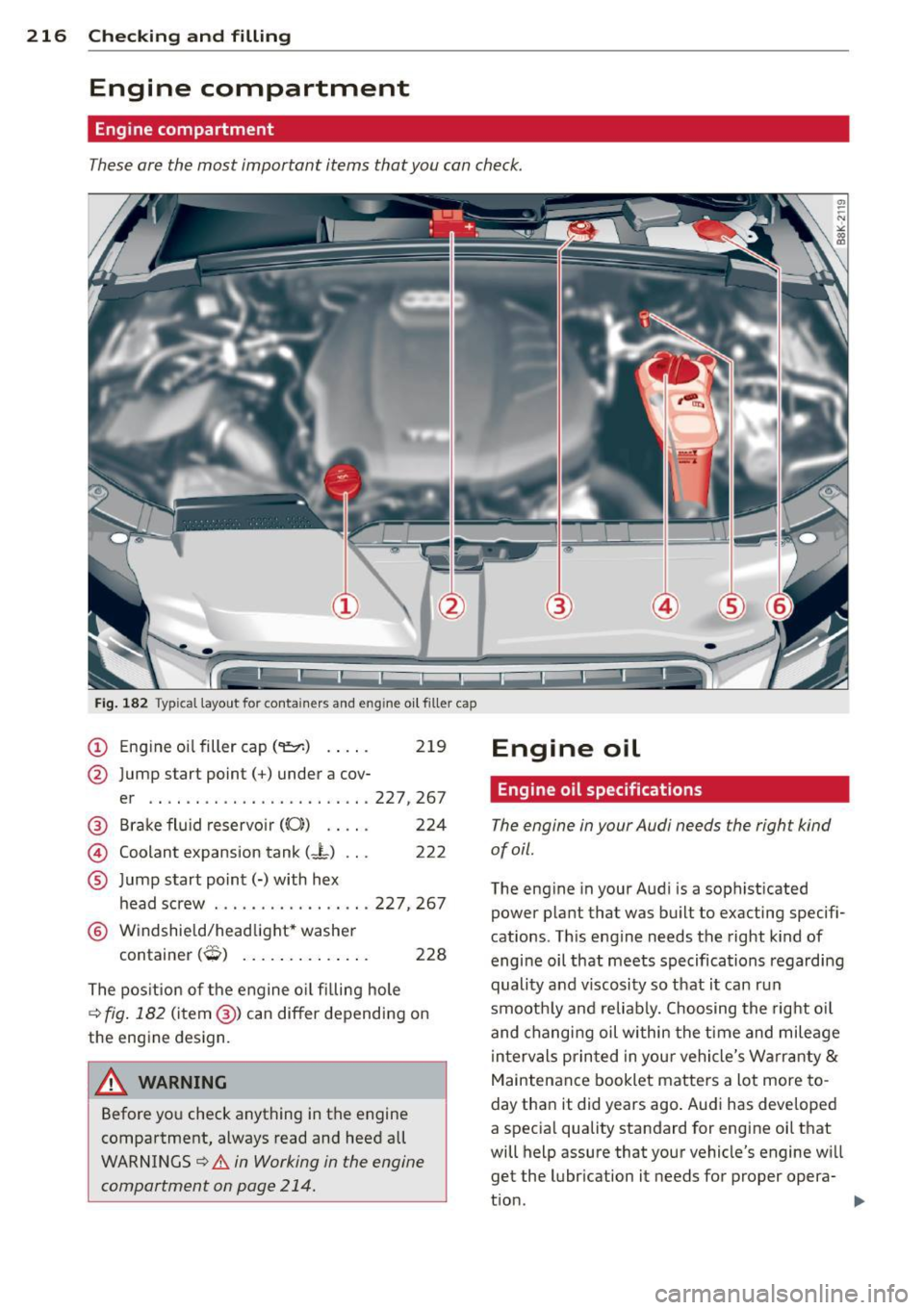
Fig. 182 Typical layout for containers and eng ine o il filler cap
(D Eng ine o il filler cap ("1::::r.) . . . . . 219
@ Jump start point(+) under a cov-
er .. .. .... ... ....... .... ..
227,267
@ Bra ke fluid reservo ir (0)) . . . . . 224
@ Coolant expansion tank (-L) . . . 222
® Jump start point(-) with hex
head sc rew ..... .......... ..
227, 267
® W indshield/headlight* washer
. (" ') container o ....... . ... .. . 228
The pos ition o f the engine o il fi lling hole
¢ fig . 182 (item @) can differ depending on
the eng ine design.
A WARNING
Before yo u check anything in the engine
compartment, always read and heed all
WARNINGS ¢.&. in Working in the engine
compartment on page 214.
-
Engine oil
· Engine oil specifications
The engine in your Audi needs the right kind
of oil.
The eng ine in your Audi is a sophist icated
power plant that was b uilt to exacting specifi
cations . Th is engine needs the right k ind of
engi ne oil that meets specifica tions regard ing
quality a nd v iscosity so that it can run
smooth ly and reliab ly. Choosing the rig ht o il
and changing oil within the t ime and mile age
i n tervals prin ted in you r vehicle's Warr anty
&
Maintenance booklet matters a lot more to
day tha n it did years ago . Aud i has deve loped
a spec ia l quality standard for engine oil that
will help assure that your vehicle 's engine w ill
get the lubr ication it needs for proper opera-
t ion . ..,_
Page 220 of 296
218 Checking and filling
temperatures stay below freezing point for long periods.
Detergent additives in the oil w il l make fresh
oil look dark after the eng ine has been run
ning for a short time . This is norma l and is not
a reason to change the oi l more often than
recommended.
Damage or malfun ctions due to lack of
maintenance
It is essential that you change your oil at the
recommended intervals using only engine o il
that complies with Audi oi l standard
VW 502 00. Your Limited New Vehicle War
ranty does not cover damage or malfunctions
due to fail ure to fo llow recommended mainte
nance and use requ irements as set forth in
the Audi Owner's Manual and Warranty
&
Maintenance booklet . Your dealer will have to
deny warranty coverage unless you present to
the dea ler proof in the form of Service or Re
pa ir Orders that all scheduled ma intenance
was performed in a timely manner.
Eng ine oil consumption
The engine in your vehicle depends on an ade
quate amount of oil to lubricate and cool all
of its moving parts.
In order to provide effective lubrication and
cool ing of internal engine components, all in
ternal combustion eng ines consume a certain
amount of oil. O il consumption varies from
engine to engine and may change significantly
over the life of the engine. Typically, engines
with a specif ied break-in period (see
¢
page 195) consume more oil during the
break-in period than they consume after oil
consumption has stabilized.
Under normal conditions, the rate of oil con
sumption depends on the quality and viscosity
of the oil, the RPM (revolutions per minute) at
which the engine is operated, the ambient
temperature and road condit ions . Further fac
tors are the amount of oil d ilution from water
condensat ion or fuel residue and the oxida
tion level of the oil. As any engine is subject to wear as mi
leage builds up, the oil consump
tion may increase over time until replacement
of worn components may become necessary.
With all these variab les coming into play, no
standard rate of oil consumption can be es
tablished or specified. There is no alternative
to regu lar and frequent check ing of the o il lev
el, see
Note .
If the yellow engine oil leve l warning symbo l
Ill in the instrument cluster lights up, you
shou ld check the oil leve l as soon as possib le
¢
page 219. Top off the oil at your earliest
convenience ¢
page 219.
A WARNING '"---
Before you check anythi ng in the engine
compartment, always read and heed all
WARNINGS¢
A in Working in the engine
compartment on page 214.
(D Note
Driving w ith an insufficient o il level is like
ly to cause severe damage to the engine .
(D Tips
-The oil pressure warning display. is
not an indicator of the oil level. Do not
rely on it. Instead, check the oil level in
your engine at regular intervals, pref erably each time you refuel, and always
before going on a long trip.
- If you have the impression your engine
consumes excessive amounts of oil, we
recommend that you consult an author
ized Audi dealer to have the cause of
your concern properly diagnosed. Keep in
m ind that the accurate measurement of
oil consumption requ ires great care and
may take some time. An authorized Aud i
dea ler has instructions about how to
measure oil consumption accurately.
-
Page 221 of 296
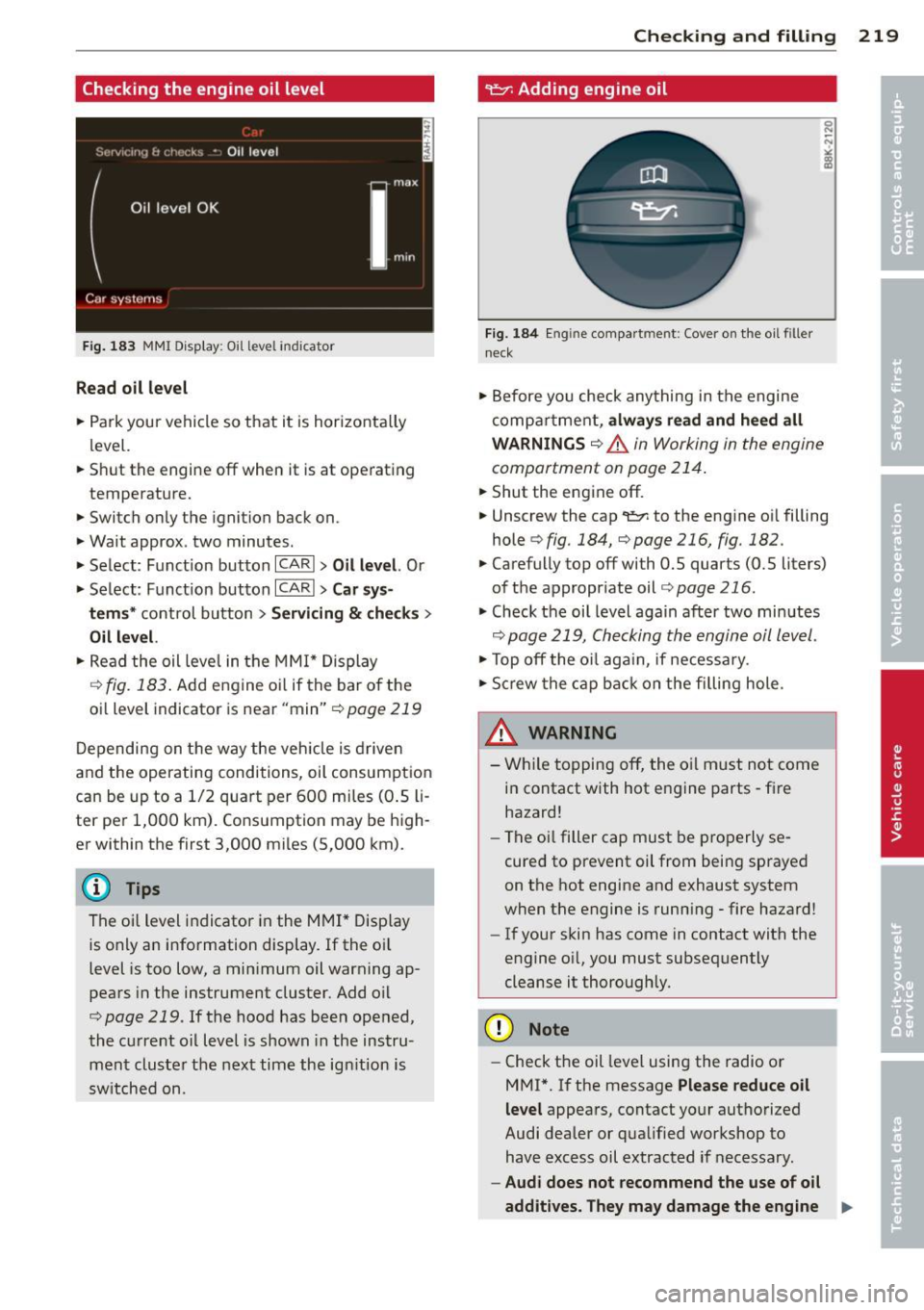
Checking the engine oil level
Fig . 183 MMI Disp lay: Oil l eve l ind icator
Re ad oil le vel
.,. Park your vehicle so that it is horizonta lly
level.
.,. Shut the engine off when it is at operating
temperature .
.,. Switch only the ignition back on .
.,. Wait approx . two minutes .
.,. Select: Function button
ICARI > Oil l evel. Or
.,. Se lect: Funct ion button
ICARI > C ar sys-
tem s*
cont rol button > S ervicing & ch e ck s >
Oil level.
.,. Read the oil leve l in the MMI* Display
¢
fig . 183 . Add engine oi l if the bar o f the
oi l level ind icator is near "min"
c::> page 219
Depending on the way the veh icle is driven
and the operating conditions, oil consumption
can be up to a 1/2 quart per 600 miles (0 .5
li
ter per 1,000 km) . Consumption may be high
er within the first 3,000 m iles (S,000 km).
@ Tips
The oil level indicator in the MMI* Disp lay
is only an information display.
If the oi l
level is too low, a min imum oil warning ap
pears in the instrument cluster. Add oil
c::> page 219 . If the hood has been opened,
the current oil level is shown in the instru
ment cluster the next time the ign ition is
sw itched on.
Checkin g and fillin g 219
~ Adding engine oil
Fig. 184 Eng in e compart men t: Cove r on the oil filler
n eck
.,. Before yo u check anything in the engine
compa rtment,
alwa ys rea d and h eed all
WARNING S ¢.&. in Working in the engine
compartment on page 214 .
.,. Shut the engine off.
.,. Unscrew the cap~ to the engine oi l filling
hole
r:!> fig. 184, r:!>page 216, fig. 182 .
.,. Carefully top off with 0.5 quarts (0.5 liters)
of the appropriate oil¢
page 216.
"' Check the oil level again after two minutes
¢ page 219 , Checking the engine oil level .
"'Top off the o il aga in, if necessary .
"' Screw the cap back on the filling hole .
_&. WARNING
- While topping off, the oil must not come
in contact with hot e ngine parts -fir e
hazard!
- The oil filler cap must be properly se
cured to prevent oil from being sprayed
on the hot engine and exhaust system
when the engine is runn ing -fire hazard!
- If your skin has come in contact with the
engine o il, you must subsequently
cleanse it thoroughly.
(D Note
- Check the oil level using the radio or
M MI*. If the message
Plea se redu ce oil
le vel
appears, contact yo ur authorized
Audi dealer or qua lified workshop to
have excess oil extracted if necessary .
-Audi does not recommend the u se of o il
additiv es. They m ay damage the engine .,.
Page 222 of 296
220 Check ing and filling
and ad versely a ffect yo ur New Vehicl e
W arr ant y.
@) For the sake of the environment
- Under no circumstances can the oil come
in contact with the sewage network o r
the soil.
- Observe and follow lega l regu lations
when disposing of empty oil containers .
Changing the engine oil
We recommend that have your oil changed by
an authorized Audi dealer or a qualified serv
ice station.
Before you check anything in the engine com
partment,
a lw ays rea d an d h eed all WARN
INGS c::> .& in Working in the engine compart
ment on page 214.
The engine oil must be changed accord ing to
the intervals specified in your Warranty
&
Maintenance book let. This is very important
because the lubricating properties of oil di
minish gradua lly during normal vehicle use .
Under some ci rcumstances the engine oi l
should be changed more frequently. Change
oil more often if you drive most ly short dis
tances, operate the vehicle in dusty areas or under predominantly stop-and-go traffic con
ditions, or have your vehicle where tempera
tures remain below freezing for extended pe
riods .
Detergent addit ives in the oil w ill make fresh
oil look dark after the engine has been run n ing for a short time. This is normal and is not
a reason to change the oil more often than recommended.
Because of the problem of proper disposal,
along w ith the special tools and necessary ex
pertise required , we strongly recommend that
you have your o il changed by an authorized
Audi de ale r or a qual ified servi ce station.
If you choo se to c hang e y our oi l y our self,
please note the followi ng important informa
tion :
A WARNING
To reduce the risk of personal injury if you
must change the eng ine oil in your vehicle
yourself:
- Wear eye protect ion.
- To reduce the risk of burns from hot en- gine oil, let the engine cool down to the
touch.
- When removing the o il dra in plug with
your fingers, stay as far away as possible.
Always keep your forearm parallel to the
ground to help prevent hot oil from runn ing down you r arm.
- Dra in the oil into a container designed
for this purpose, one large enough to
hold at least the total amount of oil in
your engine.
- Engine oil is poisonous. Keep it we ll out
of the rea ch of childre n.
- Continuous contact with used eng ine o il
is harmfu l to your sk in. Always protect
your skin by washing oil off tho roughly
with soap and wate r.
@ Note
Never mix oil additives with your engine
oi l. These additives can damage your en
g ine and adversely affect you r A ud i Limit
ed New Veh icle War ranty.
@ For the sake of the environment
- Before changing your oil, first make su re
you know where you can prope rly dispose
o f the used oil.
- Always dispose of used eng ine oi l proper
ly. Do not dump it on garden soil, wood
ed areas, into open streams or down
sewage drains.
- Recycle used engi ne oil by taking it to a
used engine oil collection facility in you r
area, or contact a service station.
Page 223 of 296
Engine cooling system
Coolant
The engine coolant performs two functions: it
keeps the engine from overheating and it pro
tects the engine from freezing in the winter .
The cooling system is sealed and generally re
qu ires little attention .
The cooling system has been filled at the fac
tory with a permanent coolant which does not need to be changed. The coolant consists of a
mixture of specially conditioned water and the
manufacturer's glycol-based coolant addi-
tive G13 antifreeze with anticorros ion addi
tives (50% for USA models; 60% for Canadian
models) . This mixture both assures the neces
sary frost protection and protects metal com
ponents in the engine's cooling system from
corrosion and scaling.
It also raises the boil
ing point of the coolant.
Do not reduce the concentration of the coo l
ant in the summer by adding plain water .
The
proportion of coolant additive must be at
least 50% but not more than 60%
to main
tain antifree ze protection and cooling efficien
cy. If the coolant frost protection is too low,
the coolant could freeze and damage the vehi
cle heating and eng ine cooling system .
For year-round driving, antifree ze is added at
the factory for temperatures down to:
- -31°F(-35°C)USA
- -40 ° F ( - 40 °C) Canada.
I f you must add coo lant, use a mixture of wa
ter and coolant addit ive. Mixing the coolant
additive with distilled water is recommended.
& WARNING
Before you check anything in the engine
compartment, always read and heed all
WARNINGS
c::;, .&. in Working in the engine
compartment on page 214.
(D Note
- Before winter sets in, have the coolant
checked to see if the coolant additive in
Checkin g and fillin g 221
your vehicle is sufficient to meet the cli
mate conditions. This is especia lly impor
tant if you live in a region where the win
ter is extremely co ld. If necessary, in
crease the proportion of coolant additive
to 60% .
- When adding coolant additive to your
cooling system, remember :
- We recommend using only coolant ad
ditive G12++ or G13 for your vehicle .
This coolant additive is available at au
thorized Audi dealers. Other types of
antifreeze can significantly reduce cor
rosion protection. The resulting corro
sion can cause a loss of coolant and se rious engine damage.
- Do not add any type of radiator leak seal
ant to your vehicle's engine coolant.
Adding radiator repair fluid may adverse
ly affect the function and performance of
your cooling system and could result in
damage not covered by your New Veh icle
Limited Warranty.
Checking the engine coolant level
The engine coolant level can be checked with
a quick glance.
Fig. 185 En gin e compar tment: Cover on the coo la n t
expansio n tan k
"' Before you check anything in the engine
compa rtme nt,
always read and heed all
WARNINGS c::;, .&, in Working in the engine
compartment on page 214.
"'Park your vehicle on a level su rface .
.,. Turn off the ignition .
.,. Read the engine coolant level from the cool
ant expansion tank
i=> fig . 185, c::;, page 216,
fig . 182. With a cold engine, the coolant Iii>
Page 224 of 296
222 Check ing and filling
level should be between the "MIN" and
"MAX" markings. When the engine is warm,
the leve l may be slightly above the "MAX"
marking .
The location of the coolant expansion tank
can be seen in the engine compartment illus
tration
c:> page 216.
To obtain an accurate reading, the engine must be switched
off.
The expansion tank in you r vehicle is equipped
with an e lectric coolant level sensor.
When the coolant level is too low, the warning light in the Auto-Check System
c:> page 17will
b link until you add coo lant and the level has
been restored to no rma l. Even though there is
an electric coolant level sensor, we still rec
ommend you check the coolant leve l from
time to time.
Coolant loss
Coolant loss may indicate a leak in the cool ing
system. In the event of coolant loss, the cool
ing system should be inspected immediately
by your authorized A udi dealer.
It is not
enough merely to add coolant.
I n a sealed system, losses can occur only if
the boiling point of the coolant is exceeded as
a result of overheat ing.
A WARNING
The cooling system is unde r pressure and
can get very hot. Reduce the risk of scald
ing from hot coolant by following these
steps .
- Turn
off the engine and allow it to cool
dow n.
- Protect yo ur face, hands and arms from
escaping fluid and steam by covering the
cap with a large, thick rag .
- Turn the cap slowly and very carefully in
a counter-clockwise direction wh ile ap
plying light, downward pressure on the
top of the cap .
- To avoid be ing burned, do not spill ant i
freeze or coolant on the exhaust system
'
or hot engine parts. Under certa in cond i
tions, the ethylene glycol in engine coo l
ant can catch fire.
(D Note
Do not a dd any type of radiator leak sea l
ant to your veh icle's engine coolant. Add
i ng radiator repa ir fl uid may adverse ly af
fect the funct ion and performance of your
cooling system and could result in damage
not covered by your New Veh icle L imited
War ranty .
Adding coolant
Be very careful when adding engine coolant.
Before you check anyth ing in the eng ine com
partment, always read and heed all WARN
INGS
c:> A in Working in the engine compart
ment on page 214 .
Requirement: There m ust be a res idual
amount of coo lant in the expans ion tank
c:> (]) .
.,.. Turn off the eng ine .
.,.. Let the engin e cool down.
.,.. Place a thick rag over the coo lant expansion
tank
c:> page 221 , fig. 185 and carefully turn
the cap counter-clockwise
c:> .&_ .
.,.. Add coo lant m ixed in the correct rat io
c:> page 221, Coolant up to the MAX ma rk
ing.
.,.. Mak e s ure t hat the fl uid leve l remains sta-
b le. Add more coo lant if necessary.
.,.. Twist the cap on again
tightly .
Replacement engine coo lant must confo rm to
ex act spec ific at ions
c:> page 221, Coolant.
We recommend using only coolant add it ive
G12 ++, G13 or i n an emergency G 12+. Do
not
use a different add it ive. In an emergen cy use
plain wa ter until yo u can ge t the correct addi
tive and can restore t he correct ratio. This
sho uld be done as soon as possib le .
If you have los t a cons iderab le amount o f
coolant, the n you sho uld add cold ant ifree ze
and co ld wate r on ly when the engine is cold.
Always use
n ew engine coo la nt w hen refilling . .,.
Page 225 of 296
Do not fill coolant above the "MAX" mark. Ex
cess coolant will be forced out through the pressure relief valve in the cap when the en
gine becomes hot .
_& WARNING
-The cooling system is under pressure and
can get very hot. Reduce the risk of
scalding from hot coolant by following
these steps .
- Turn
off the engine and allow itto cool
down.
- Protect your face, hands and arms from escaping fluid and steam by covering
the cap with a large, thick rag.
- Turn the cap slowly and very carefully in a counter-clockwise direction while
applying light, downward pressure on
the top of the cap .
- To avoid being burned, do not spill an
tifreeze or coolant on the exhaust sys
tem or hot engine parts . Under certain
conditions, the ethylene glycol in en
gine coolant can catch fire.
- Antifreeze is poisonous. Always store an
tifreeze in its original container and well
out of the reach of children.
- If you drain the coolant, it must be
caught and safely stored in a proper con
tainer clearly marked "poison".
(D Note
- Do not add coolant if the expansion tank
is empty. Air could enter the cooling sys
tem and damage the engine. If this is
the case, do not continue driving . Seek
professional assistance.
- Coolant pollutes the environment and
could cause an engine fire . Excess cool
ant will be forced out through the pres
sure relief valve in the cap when the en
gine becomes hot.
- If, in an emergency, only water can be
added, the correct ratio between water
and antifreeze ¢
page 221 must be re
stored as soon as possible.
Checking and filling 223
'
@) For the sake of the environment
Drained coolant should not be reused. Al
ways dispose of used coolant while observ
ing all environmental regulations.
Radiator fan
The radiator fan switches on automatically by
itself .
The radiator fan is driven by the engine via the
V-belt. The viscous clutch regulates the speed
of the fan according to the temperature of the coolant.
An auxiliary electric radiator fan* switches on
and
off depending on coolant temperature
and other vehicle operating conditions.
After you switch the engine
off, the auxiliary
fan can continue running for up to 10 minutes
- even with the ignition
off. It can even switch
on again later by itself ¢.&. , if
- the temperature of the engine coolant rises
du e to the h eat build-up from th e engin e in
the engine compartment, or
- the engine compartment heats up because
the vehicle is parked in intense sunlight.
_& WARNING ~
-To reduce the risk of personal injury nev-
er touch the radiator fan .
- The auxiliary electric fan is temperature
controlled and can switch on suddenly
even when the engine is not running.
- The auxiliary radiator fan switches on au
tomatically when the engine coolant reaches a certain temperature and will
continue to run until the coolant temper
ature drops. •
•