flat tire AUDI S4 2014 User Guide
[x] Cancel search | Manufacturer: AUDI, Model Year: 2014, Model line: S4, Model: AUDI S4 2014Pages: 296, PDF Size: 73.56 MB
Page 239 of 296
-Incorrect tire pressures and/or underin
flation can also lead to sudden tire fa il
ure, including a blowout and sudden de
flation, causing loss of vehicle control.
Checking tire pressure
The correct tire pressure for the tires original
ly installed on your vehicle is listed on the tire
pressure label located on driver's side 8-pil lar .
The recommended t ire pressures are on the
tire pressure label and in the table
c:> page 234, Cold tire inflation pressure . This
means that the pressure must be checked and
adjusted when the tire has not been driven for
mo re tha n a couple of m iles (k ilome ters) at
l ow speeds during t he p revious three hours.
A ir in the tires expands when the ti re heats up
as a result of inte rna l friction as it flexes in
use. The tire press ure is higher when the tire
has warmed up than when it is "cold."
It is the i nflat ion p ressu re in a "cold" tire that
counts . Therefore, you shou ld never let air ou t
of a warm tire to match "Cold tire inflation pressure" recommendations
c:> page 234. The
tires would then be under inflated and could
fa il suddenly.
The tire press ure labe l on yo ur Audi lists the
recommended cold t ire inflat ion pressures at
maximum capacity for the new, origina l
equ ipment tires that were on your vehicle at
the time it was manufactured. For the loca
tion of the label
<=> page 234, fig . 189 .
Most tires lose a ir naturally over time. They
can also lose some a ir if you drive
over a pot
hole or hit a curb while parking. It is usually
not possible to see whether the radial t ires
used today are underi nflated just by looking
at them.
Therefore, be sure to check tire pressures at
least o nce a month and always before going
on a long tr ip . Make sure to take the number
of people and the amount of luggage into ac
coun t when adjusting tire pressure for a t rip -
even one that you would not consider to be
Tire s an d wheel s 237
"long." See c:> page 2 38, Tires and vehicle
load limits
for more important information.
A lways use an acc ura te tire pressu re ga uge
when checking and ad justing infla tion pres
s ur es . Check all o f the tires and be sure not to
forget the spare tire. If the pressure in any t ire
is too h igh when the tire is "cold", let a ir o ut
of the t ire s low ly w ith the edge of the tire
gauge and keep checking the pressure until
you reach the pressure that is correct for the load (passengers and luggage) and k ind of
driv ing you plan to do.
If the pressure in any tire is too low, note the
difference between the pressure in the co ld
t ire a nd the pressure you need and add the air
that you need to reach the correct pressure for
t h e ve hicl e load (passenge rs and luggage) for
the tires on you r veh icle as l isted on the on
yo ur vehicle and in this ma nual and the kind
of driving you plan to do.
Never exc eed the maximum inflation pr es
sure li ste d on the tire sidewall for any re a
s o n.
Remember that the vehicl e manufacture r, not
t h e tire manufact urer, de termines t he cor re ct
t ir e p ress ure fo r th e tires on your ve hicl e.
It is important to check the t ire p ressu re whe n
the tires are co ld.
- Read the required tire pressure from the t ire
pressure labe l. The t ire pressure label is lo
cated o n the dr iver's side 8-pillar. The tire
pressure labe l lists the recommended co ld
tire infla tion pressures for t he vehi cle at its
maxim um capacity weigh t and t he tires that
were on your ve hicle a t the time i t was man
ufactured . For recommende d tire pressures
for normal load conditions, p lease see chap
ter
c:> page 2 34.
- Tu rn the va lve stem cap counter -clockwise
to remove it from the tire
va lve .
-Place t he ai r pressure gauge on the va lve.
- The tire pressu res should o nly be checked
and ad justed when the tires are co ld . The
slightly raised pressures of warm tires must
not be red uced.
Ill>-
•
•
Page 240 of 296
238 Tire s and whee ls
- Adjust the tire pressure to the load you are
carrying.
- Reinsta ll the va lve stem cap on the valve .
When should I ch eck the tire pres sur e?
The correct tire pressure is especially impor
tant at high speeds. The pressure should
therefore be checked at least once a month
and a lways before starting a journey. Do not
forget to check the tire pressure for the spare
wheel.
When should I adj ust the tire p re ss ures?
Adjust the tire pressure to the load you are
carry ing . After changing a wheel
o r replacing
wheels you have to adjust the tire pressures
on all wheels . In addition, you must then initi
alize the new tire pressures in the tire pres
sure monitoring system*~
page 249.
A WARNING
Incorrect tire pressures and/or underinf la
tion can lead sudden tire failure, loss of
control, collision, ser ious personal injury
or even death.
- When the
RI] warning symbol appears in
the instrument cluster, stop and inspect
the tires .
- Incorrect tire pressure and/or underinfla
t ion can cause increased t ire wear and
can affect the handling of the veh icle and
stopp ing ability.
- Incorrect tire pressures and/or underin
flation can also lead to sudden tire fa il
ure, including a blowout and sudden de
flation, causing loss of vehicle control.
- The driver is responsible for the correct
t ire pressures fo r all tires on the vehicle .
T he applicable p ressure va lues are locat
ed on a sticker on the driver's side B-pil
lar.
- Only when a ll ti res on the vehicle are fi l
led to the correct pressure, the tire pres
sure monitoring system* can work cor
rect ly.
- The use of incorrect tire pressure values
can lead to accidents or other damage.
Therefore it is essential that the driver observe the specified t
ire pressure values
for the tires and the correct pressures for
the function of the ti re pressure monitoring system*.
- Always inflate tires to the recommended
and correct t ire pressure before dr iv ing
off.
- Driving with underinflated tires bend
more, letting them get too hot resulting
in tread separation, sudden tire failure
and loss of control.
- Excessive speed and/overloading can
cause heat build-up, sudden tire failure
and loss of cont rol.
- If the tire pressure is too low or too high,
the t ires will wear prematurely and the
veh icle w ill not handle well.
- If the tire is not flat and you do not have
to change a wh eel immediately, drive at
reduced speed to the nearest service sta
tion to check the t ire p ressure and add
air as required.
Q) Note
D riving without valve stem caps can cause
damage to the tire valves. To prevent this,
a lways make sure tha t factory insta lled
valve stem caps on all whee ls are sec urely
mounted on the valve.
@ For the sake of the environment
U nderinflated tires w ill also incre ase the
fuel consumption .
Tires and vehicle load limits
There are limits to the amount of load or
weight that any veh icle and any tire can carry.
A vehicle that is over loaded will not handle
well and is more d iff icult to stop. Overloading
can not only lead to loss of vehicle control,
but can also damage important parts of the
vehicle and can lead to sudden tire fa ilure, in
clud ing a b lowout and sudden deflation tha t
can cause the vehicle to crash.
Your safety and that of your passengers also depends on making sure that load limits are .,..
Page 241 of 296
not exceeded . Vehicle load includes everybody
and everything in and on the vehicle. These
l oad limits are techn ica lly referred to as the
ve hicle's
Gross Veh icle We ight Rat ing
("GVWR").
The "GVWR" includes the weight of the basic
veh icle, all factory insta lled accessories, a full
tank of fu el, oil, coolant and other fluids plus
maximum load. The maximum load includes
the number of passengers that the vehicle is
i n tended to carry ("seating capacity") with a n
assumed weight of 150 lbs . (68 kg) for each
passenger at a des igna ted sea ting pos ition
and the tota l we ight of any l uggage in the ve
h icle. If you tow a trailer, the weight o f the
trailer hitch and the tong ue weight of the
l oaded trailer must be included as part of the
veh icle load.
The
Gro ss A xle Weight Rating ("GAWR") is
the maximum load that can be applied at each
of the vehicle's two ax les.
The G ross Vehicle We ight Rating and the
Gross Axle Weight Rating are listed on the
safety compliance sticker labe l located on the
driver's side B -pi llar . Your Audi has 5 seating
positions, 2 in the front and 3 in the rear for
tota l seating capacity of 5. Each seating posi
tion has a seat belt¢
page 138, Safety belts.
The fact that there is an upper limit to your
veh icle's Gross Vehicle Weight Rating means
that the tota l weight of whatever is being car
ried in the vehicle (including the weight of a
trailer hitch and the tongue weight of the
loaded trailer) is limited. The more passen
ge rs in the veh icle or passengers who are
h eav ier than the standa rd weights assumed
mean that less weight can be ca rr ied as l ug
gage.
The tire pressure labe l on you r Audi also lists
the maximum combined we ight of all of the
oc cu pants and luggage o r othe r ca rgo that
the vehicle can carry . For the location o f the
l abe l
¢page 234, fig. 189.
Tires an d wheel s 239
A WARNING
Overloading a vehicle can cause loss of ve
h icle contro l, a crash or other accident, se
rious pe rsonal injury, and even death.
- Carrying more we ight than your veh icle
was des igned to carry will prevent the
veh icle from handling properly and in
crease the risk of the loss of vehicle con
trol.
- The brakes on a vehicle that has been
overloaded may not be able to stop the
veh icle w ith in a safe distance.
- Tires on a vehicle that has been overload
ed can fail suddenly, incl uding a blowout
and sudden defla tion, causing loss of
contro l and a crash.
- Always ma ke sure that the total load be
ing transpor ted - incl uding the weight of
a trailer hitch and the tongue weight of a loaded trailer -does not ma ke the vehi
cle heavier than the vehicle's Gross Vehi
cle We ight Rating.
Determining correct load limit
U se th e example below to ca l
culate the total weight of the
pa ssengers and lu ggage or oth
e r thing s that you pl an t o tran s
po rt so that you can make sur e
that your vehicle will not be
o verloaded.
Steps for Determining
Correct Load Limit
1 . Lo cate th e statement "THE
COMBINED WEIGHT OF O C
CUPANTS AND CARGO
SHOULD NE VER E XCE ED XXX
KG OR XXX LBS"on your vehi-
c le 's pla card (tire inflation ..,
•
•
Page 244 of 296
242 Tires and wheels
New tires and replacing tires and wheels
New tires and wheels have to be broken in .
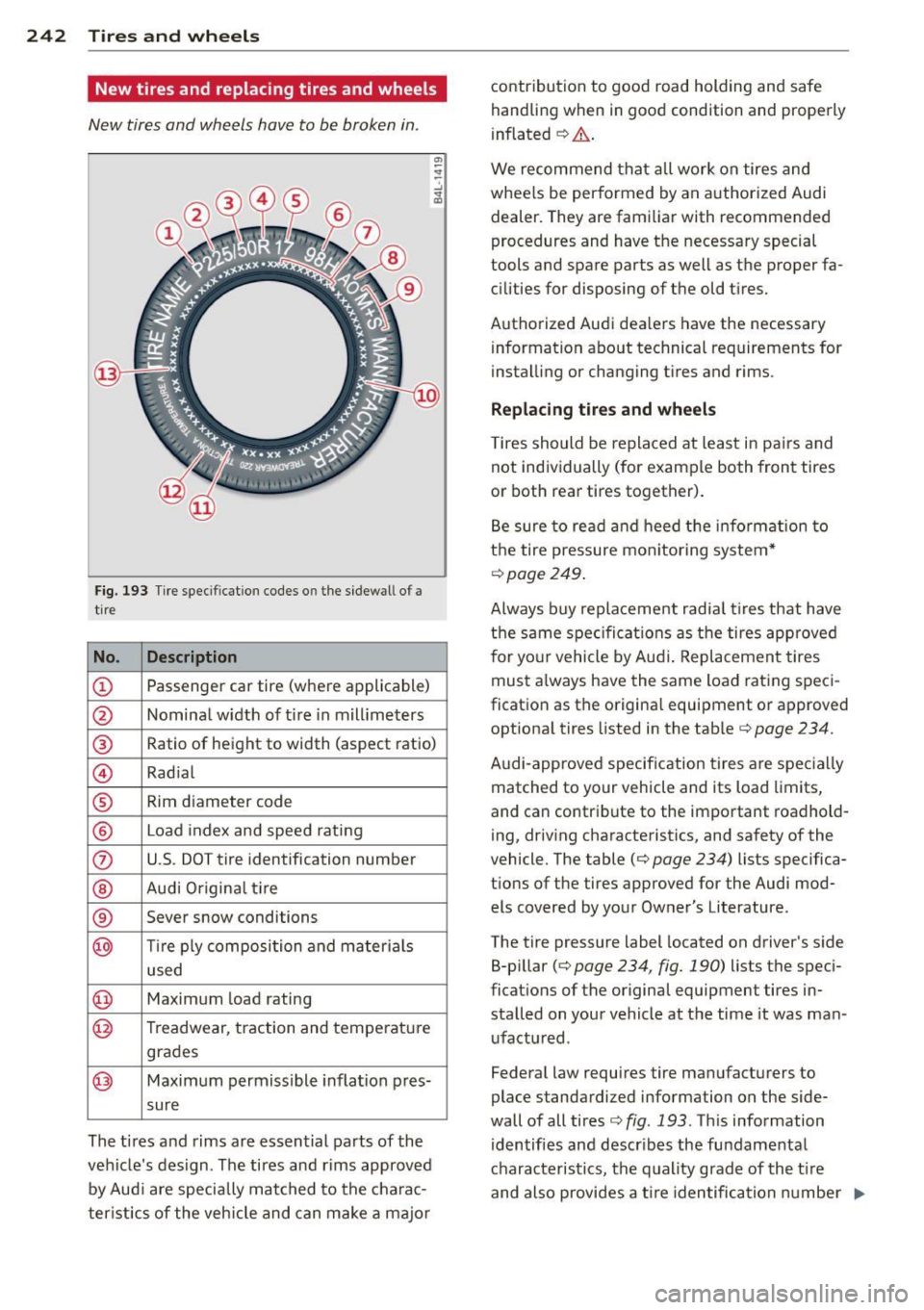
Fig. 193 Tire speci fication codes o n the s idewal l of a
t ir e
No. Description
CD Passenger car tire (where applicable)
@ Nominal width of tire in millimeters
® Ratio of height to width (aspect ratio)
@ Radial
® Rim diameter code
® Load index and speed rating
0 U.S. DOT tire identification number
® Audi Original tire
® Sever snow conditions
@ Tire ply composition and materials
used
@ Maximum load rating
@ Treadwear, traction and temperature
grades
@ Maximum permissible inflation pres-
sure
The tires and rims are essential parts of the
vehicle's design . The tires and rims approved
by Audi are specially matched to the charac
ter istics of the vehicle and can make a major contribution to good road holding and safe
handling when in good condition and properly
inflated
¢
&..
We recommend that all work on tires and
whee ls be performed by an authorized Audi
dealer. They are familiar with recommended
procedures and have the necessary special
tools and spare parts as well as the proper fa
cilities for disposing of the old tires.
Authorized Audi dea lers have the necessary
information about technical requirements for
installing or changing tires and rims .
Replacing tires and wheels
Tires should be replaced at least in pairs and
not individually (for example both front tires
or both rear tires together).
Be sure to read and heed the information to
the tire pressure mon itor ing system *
co page 249 .
Always buy replacement radia l tires that have
the same spec ifications as the tires approved
for your vehicle by Audi. Replacement tires
must a lways have the same load rating speci
fication as the origina l equipment or approved
optiona l tires listed in the table¢
page 234 .
Audi-approved specification tires are specia lly
matched to your vehicle and its load limits,
and can contribute to the important roadhold
ing, driving characteristics, and safety of the
vehicle. The table
(c;, page 234) lists specifica
tions of the tires approved for the Audi mod els covered by your Owner's Literature .
The tire pressure label located on driver's side
B-pillar
(c;, page 234, fig. 190) lists the speci
ficat ions of the original equipment tires in
stalled on your vehicle at the time it was man
ufactured .
Federal law requires tire manufacturers to
place standardized information on the side
wall of all tires
co fig . 193. Th is information
identifies and descr ibes the fundamenta l
characteristics, the quality grade of the tir e
and also provides a tire identification number
II>-
Page 246 of 296
24 4 T ire s and wheel s
Tire pl y compo sit ion and materi als used
The numbe r of plies ind icates the n umber of
l ayers of rubber -coated fabric in the tire. In
general, the greater the number of p lies, the
more weight a tire can support . Tire manufac
turers also must indicate the materials in the
tire, wh ic h include steel, nylon, polyester, and
others.
M ax imum Load R ating
This number indicates the maximum load in
kilograms and pounds that can be carried by
the tire .
Tire quality grading for treadw ear ,
tr act ion, a nd t emper ature re sis tan ce
Tread wear, traction and temperature grades
c:> page245.
Max imum Permiss ibl e Inflation Pressur e
This numbe r is the greates t amo unt of air
p ress ure that sho uld ever be put in the ti re
under normal driving conditions .
A WARNING
-Us ing incorrect or unmatched tires and/
or wheels or improper tire and wheel
combinations can lead to loss of contro l,
co llision and serious persona l injury .
- Always use tires, rims and wheel bo lts
that meet the specifications of orig inal
factory-installed t ires or other combina
t ions that have been spec ifically ap
proved by the vehicle manufacturer.
- Tires age even if they are not be ing used
and can fail suddenly, especially at high
speeds. Tir es that are more than 6 years
o ld can only be used in an emergency
and then with special care and at lower
speeds.
- Never mount used ti res on yo ur vehicle if
yo u are not su re of their "previous histo
ry ." Old used tires may have been dam
aged even though the damage cannot be
seen that can lead to sudden tire failure and loss of vehicle control.
- All four wheels must be fitted with radia l
t ires of the same type, size (roll ing c ir- cumference) and the same tread pattern
.
Driving with different tires reduces vehi
cle handling and can lead to a loss of
control.
- If the spare tire is not the same as the
tires that are mounted on the vehicle -
for example with winter tires - only use
the spare t ire fo r a short pe riod of time
and d rive with extra care . Refit the nor
mal road wheel as soon as safely poss i
b le.
- Never d rive faster than the max imum
speed for which the tires on you r vehicle
are rated because tires that are dr iven
faster than their rated speed can fai l
suddenly .
- Overloading tires cause heat build-up,
sudden tire fa ilure, including a blowout
and sudden deflation and loss of cont ro l.
- Temperature grades apply to tires that are properly inflated and not over or un
de rinf lated .
- For technica l reasons it is not always
possible to use whee ls from other
veh icles -in some cases not even wheels
from the same veh icle model.
- If you install wheel trim discs on the ve
hicle wheels, make sure that the a ir flow
to the brakes is not blocked. Reduced air
f low to the brakes can them to overheat,
increas ing stopp ing distances and caus
ing a co llision.
- Run flat tires may only be used on veh icles that were equipped with them
at the factory. The veh icle must have a
chassis designed for run flat tires and a
f a ctory -inst alled tire pressure monitor
ing sys tem * that indicates a loss of tire
pressu re . I ncorrect use of run flat tires
can lead to vehicle damage or accidents.
Check with an authorized Audi dealer or
tire specialist to see if your vehicle can be
equ ipped w ith run flat t ires. If run flat
tires are used, they must be installed on
all fo ur wheels . Mix ing tire types is not
pe rm itted.
Page 247 of 296
(D Note
-For technica l reasons, it is not genera lly
possib le to use the whee l rims from oth
er vehicles. This can hold true for wheels
of the same vehicle type.
- If the spare ti re is different from the tires that you have mounted on your vehicle (for example w inter t ires or wide
profile t ires), then use the spare t ire for a
short period of time only and drive with
extra ca re. Replace the flat tire with the
tire match ing the others on you r vehicle
as soon as possible.
- Never dr ive without the valve stem cap.
The valves could ge t damaged.
@) For the sake of the environment
Dispose of old t ires in accordance with the
local requ irements.
Uniform tire quality grading
- T read wear
- T raction AA A BC
- T emperature ABC
Quality grades can be found where applicable
on the tire side wall between tread shoulder
and maximum sect ion w idth
¢ page 242,
fig . 193.
For e xample: Tread wear 200 , Tract ion AA ,
Temperature A.
All passenger car tires must confo rm to Feder
a l Safety Requirements in addition to these
grades.
Tr ead wea r
The tread wear grade is a comparative rating
based on the wear rate of the tire when tested
under controlled conditions on a specified
government test course.
F or examp le, a tire graded 150 wou ld wear
one and one half (1 1/2) times as well on the
government course as a tire graded 100 .
The rela tive performance of t ires depends
upon the actua l conditions of their use, how -
Tires an d wheel s 245
ever, and may depa rt s ignificantly from the
norm due to variations in driving habits , serv
ice practices and differences in road character
istics and cl imate.
Traction
T he traction grades, from highest to lowest,
are AA, A, Band
C. Those g rades represent the
ti re's ability to stop on wet pavement as
measured under contro lled conditions on
specified government test surfaces of asphalt
and concrete. A tire marked C may have poor
traction performance
¢ A .
Temper ature
The temperature grades are A (the highest),
B, and C, representing the tire's resistance to
the generation of heat and its ability to dissi pate heat when tested under controlled condi
tions on a specif ied indoor laboratory test
whee l.
Sustained h igh temperature can cause the
mater ial of the tire to degenerate and reduce
tire life, and excessive temperature can lead
to sudden tire failure
¢ A .
The grade C corresponds to a level of perform
ance which all passenger car tires must meet
under the Federal Motor Vehicle Safety Stand
ard No . 109 . Grades Band A represent higher
levels of perfo rmance on the labo rato ry test
whee l than the minim um requ ired by law.
,&. WARNING
The t ra ction gr ade assigned to t his tire i s
based on s traight -ahead braking traction
tests, and does not include acce leration,
cornering, hydroplaning or peak t raction
characterist ics .
,&. WARNING
The temperature grade for this tire is es
tablished for a tire that is properly inf lated
and not overloaded. Excess ive speed, un
de rinflation, or excess ive l oad ing, e ither
separately or in combinat ion, can ca use
h eat bui ldup and possib le tire failure.
-
•
•
Page 248 of 296
24 6 T ire s and whee ls
Winter tires
Winter tires can improve vehicle handling on
snow and ice . At temperatures below 45 °F
(7 °C) we recommend changing to winter
tires.
In some heavy snow areas, local governments
may require true winter or "snow " tires, those
with
very deeply cut tread. These t ires shou ld
only be used in pairs and be installed on all
four wheels. Make sure you pu rchase snow
tires that are the same size and const ruction
type as the other tires on your vehicle.
Your veh icle is equipped with all whee l drive ,
this wi ll improve tract ion du ring w inter driv
ing,
even with the standard tires. However, we
strongly recommend that you a lways equip a ll
four wheels on you r vehicle with correctly fit
ted winter tires or all -se ason tires, when w in
t e r r oad conditions are expected . This also im
proves the vehicle's braking performance and
reduces stopping distances .
Summe r tires provide less grip on ice and
snow.
Winter tires (snow tires) must always be fitted
on all four wheels.
Ask your autho rized Aud i dea ler or qualified
workshop for permitted
wi nter tir e si zes . Use
only radia l winter tires.
W inter t ires lose the ir effectiveness when the
tread is worn down to a depth of
0.15 7 inch
(4 mm).
Only drive with winter tires unde r winter con
d itions . Summer tires hand le better when
there is no snow or ice on the roads and the
temperature is
above 45 °F (7 °C).
I f you have a flat tire, see notes on spare
wheel
9 page 242.
Please always remember that w inter t ires may
have a lower speed rating than the t ires origi
na lly installed on your vehicle at the t ime it
was manufactured. Please see
9 page 243,
Speed rating (letter code)
for a List ing of the
speed rating letter codes and the maxim um
speed at which the tires can be driven . The speed rating letter code
(
¢ page 233) is
on the side wall of the tire
9 poge 242.
A WARNING ,-
Winter t ires have maximum speed limits
that may be lower than your vehicle's max
i mum speed. Always know the max imum
speed before dr iv ing off . Never dr ive faster
than the speed permitted for yo ur specific
winter tires. This wi ll cause damage to the
tires leading to an accident and ser ious
personal injury to you and your passen
gers .
A WARNING ,..___ -
Driving faster than the maximum speed
for which the winter tires on your vehicle
were designed can cause tire failure in
cluding a blowout and sudden deflation, loss of control, crashes and ser ious per
sonal injuries. Have worn or damaged tires
replaced immediately .
- W inter tires have maximum speed rating
that may be lower than your vehicle's
maximum speed .
- Never drive faster than the speed for
which the winter or other tires installed on yo ur vehicle are rated .
A WARNING
-Always adjust your dr iv ing to the road and
traffic condit ions . Never let the good ac
celeration of the winter t ires and al l wheel
drive tempt yo u into taking ext ra risks. Al
ways remember:
- When braking, an all wheel drive vehicle
handles in the same way as a front drive
vehicle .
- Drive ca refully and reduce your speed on
icy and slippery roads,
even w inter tires
cannot help under black ice conditions .
@ For the sake of the environment
Use summer tires whe n weather condi
tions permi t. T hey are qu ieter, do not wear
as quickly and reduce fuel consumption .
Page 250 of 296
248 Tires and wheels
diagonally. After changing a wheel, the
torque must be checked as soon as possi
ble with a torque wrench -preferably by an
authorized Audi dealer or qualified work
shop.
Low aspect ratio tires
Your Audi is factory-equipped with low aspect
ratio tires. These tires have been thoroughly
tested and been selected specifically for your
model for their superb performance, road feel
and handling under a variety of driving condi
tions. Ask your authorized Audi dealer for more details.
The low aspect ratio of these tires is indicated
by a numeral of
55 or less in the tire's size
designation. The numeral represents the ratio
of the tire's sidewall height in relation to its
tread width expressed in percentage. Conven
tional tires have a height/width ratio of 60 or
more.
The performance of low-aspect-ratio tires is
particularly sensitive to improper inflation
pressure. It is therefore important that low
aspect ratio tires are inflated to the specified pressure and that the inflation pressure is
regularly checked and maintained. Tire pres
sures should be checked at least once a
month and always before a long trip
~ page 23 7, Checking tire pressure.
What you can do to avoid tire and rim
damage
Low aspect ratio tires can be damaged more
easily by impact with potholes, curbs, gullies
or ridges on the road, particularly if the tire is
underinflated.
In order to minimize the occurrence of impact
damage to the tires of your vehicle, we recom
mend that you observe the following precau
tions:
- Always maintain recommended inflation
pressures. Check your tire pressure every
2,000 miles (3,000 km) and add air if neces
sary. -
Drive carefully on roads with potholes, deep
gullies or ridges. The impact from driving
through or over such obstacles can damage
your tires. Impact with a curb may also cause damage to your tires.
- After any impact, immediately inspect your
tires or have them inspected by the nearest
authorized Audi dealer. Replace a damaged
tire as soon as possible .
- Inspect your tires every 2,000 miles (3,000
km) for damage and wear. Damage is not al
ways easy to see . Damage can lead to loss of
air and underinflation, which could eventu
ally cause tire failure.
If you believe that a
tire may have been damaged, replace the
tire as soon as possible.
- These tires may wear more quickly than oth
ers.
- Please also remember that, while these tires
deliver responsive handling, they may ride
less comfortably and make more noise than
other choices.
Reduced performance in winter/cold
season conditions
All tires are designed for certain purposes.
The low aspect ratio, ultra high performance
tires originally installed on your vehicle are in
tended for maximum dry and wet road per
formance and handling. They are not suitable
for cold, snowy or icy weather conditions. If
you drive under those circumstances, you
should equip your vehicle with all-season or
winter tires, which offer better traction under
those conditions. We suggest you use the rec
ommended snow or all-season tires specified
for your vehicle , or their equivalent.
Refer to
~ page 246 for more detailed infor
mation regarding winter tires.
Page 251 of 296
Tire pressure monitoring system
UJ General notes
Applies to vehicles: with tire pressure monito ring system
Each t ire, i ncluding the spare (if provi ded),
should be chec ked month ly w hen cold and in
flated to the inflation pressure recommended by the vehicle manufacture r o n the vehicle
placar d or tire infla tion pressure label. (If your
veh icle has t ires of a diff erent siz e than the
size ind icat ed on the vehicle p lacard or tir e in
flation pressure label, you should deter mine
the proper tire inflation pressure for those
tires).
As an added safety feature, your vehicle has been equipped with a tire pressure monitor ing
system (TPMS) that illuminates a low tire
pr essu re tellta le when one or mo re of your
tires is significantly under -inflated . Accord ing
l y, when the low tire p ress ure telltale illumi
nates, you should stop and check your tires as
soon as possible, and inflate them to the
proper pressure. Driv ing on a signif icantly un
der-inflated tire causes the tire to overheat
and can lead to tire failure. Under -inflation al
so reduces fuel efficiency and tire t read life,
and may affect the ve hicle's handling and
stopping ab ility.
Please note that the TPMS is not a subst itute
for p roper t ire mainte nance , and it is the dr iv
e r's responsib ility to ma inta in cor re ct t ire
p ress ure, even if under- infla tion has no t
reached the leve l to trigger ill umin ation of the
TPMS low tire pressure telltale.
Your veh icle has also bee n equ ipped with a
TPMS malfunc tion indica to r to indica te when
the system is not opera ting properly. The
TPMS mal function indicato r is combined wi th
the low tire press ure tellta le . When the sys
tem detects a malf unct ion, the te lltale will
flash for approximately one minute and then remain cont inuo usly illuminated. This se
quence will continue upon subsequent vehicle
start-ups as long as the ma lf u nction ex ists .
Tire s an d wheel s 249
When the malfunction indicator is illum inat
ed , the system may not be ab le to detect or
s ignal low tire pressure as intended . TPMS
malfunctions may occur for a var iety of rea
sons, including the insta llation of replace
ment or alternate tires or wheels on the vehi
cle that p revent the TPMS from functioning
proper ly. Always check the TPMS malfunction
te lltale after rep laci ng one or more tires o r
whee ls on you r vehicle to e nsur e th at the re
placement or alterna te t ires and wheels a llow
the TPMS to continue to func tion p roperly.
Tire pressure indicator appears
Applies to vehicles: with tire pressure monitoring system
The tire pressure indica tor in the instrument
cluster informs you if the tire pressure is too
Low or if there is a system malfunction.
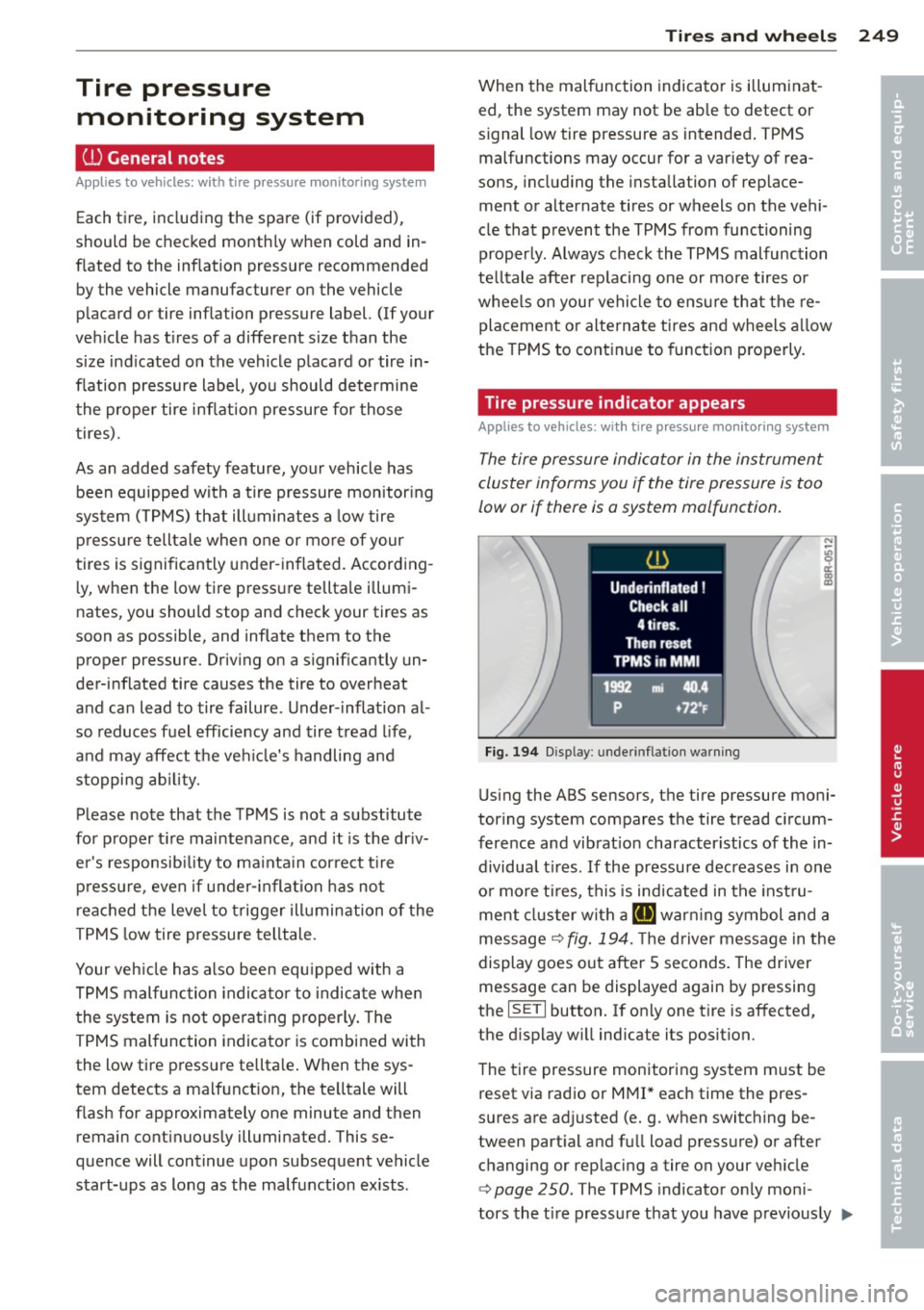
Fi g. 194 D isp lay: un de rin flat io n warni ng
U sing the ABS sensors, the tire pressure mo ni
toring system compares the tire tread c ircum
ference and vib rat ion character istics of the in
dividua l tir es . If the pressure decreases i n one
o r more t ires, this is indicated in the inst ru
ment cluster with a
RI] war ning symbol and a
message ¢
fig. 194. T he d river message in the
display goes o ut afte r 5 seconds . The driver
message can be displayed again by pressing
the
ISE TI button. If only one t ire is affected,
the d isplay w ill indicate its position.
T he tire pressure monitoring system m ust be
reset via radio or M MI* each time the pres
sures are ad justed (e.g. when switc hing be
tween part ial and f ull load pressure) o r after
changing or rep lacing a tire on your ve hicle
¢
page 250. T he TPMS indicato r o nl y mo ni-
tors the t ire p ress ure t hat yo u have p revio usly ..,.
•
•
Page 252 of 296
250 Tire s and wheel s
stored. You can find the recommended tire
pressures for your vehicle on the label on driv
er 's side 8-p illar ¢
page 234.
Tire tread c ircumference and vibration charac
teristics can change and ca use a tire pressure
warning if :
- the tire pressure in one or more t ires is too
low,
- the tire has st ructu ral damage,
- the tire pressure was changed, wheels rotat-
ed o r replaced but the TPMS was not reset
¢page 250.
Warning s ymbols
rD] Loss of pressure in at least one tire¢& .
Check the tire or tires and replace or repair if
n ecessary. The
rD] indicato r light in the instru
ment cluster also illuminates
¢ page 13.
Check/correc t the pressures of all four tires
and reset TPMS via radio or
MMI* .
Ill (T ire Pressu re M onitor ing System) Tire
pr essur e: Syst e m malfuncti on!.
Iflll appears after switching the ignit ion on
or while driving and the
rD] i ndicator light in
the instrument cluster blinks for approxi mately one mi nute and the n stays on, the re is
a system ma lfunction.
Attempt to store the correct tire pressure
¢ page 250. If the ind icator light does not
turn
off or if it tu rns o n short ly thereafter, im
mediately drive your veh icle to an autho riz ed
Aud i dea ler or autho rized repair facility to
have the ma lfunction corrected.
A WARNING
- If the tire pressure indicator appears in
the instrument cl uster d isplay, one or
more of your tires is s ignificantly under
inflated. Reduce your speed immediately
and avoid any hard steering or braki ng
maneuvers. Stop as soon as possible and
check the t ires and the ir pressures. In
flate the tire pres sure to the proper p res
s u re as in dic ated on the vehicle 's t ire
pressure label¢
page 234 . Driving on a
significantly under-inf lated tire ca uses the tire to overheat and can
lead to tire
fa ilure. Under-inflation also is likely to
impair the vehicle's handling and stop
ping ability.
- The driver is responsible for maintaining
the correct tire pressures. You must
check the tire pressures regu larly .
- Under certain conditions (such as a spor
ty driving style, winter conditions or un paved roads), the pressure monitor indi
cato r may be delayed .
-Ask your authorized Aud i dea ler if run
flat t ires may be used on you r vehicle.
Your vehicle registration becomes invalid
if you use these t ires when not perm it
ted. Damage to your vehicle or accidents
could a lso result.
(D Tips
- The tire pressure mon itoring system
stops work ing whe n there is an ESC/ABS
m alfu nction.
- Us ing snow chains may result in a system
ma lf u nction.
- The tire pressure mon itoring system on
your Audi was deve loped using tires with
t he "AO" or "R O" ident ifi cat ion on the
tire sidewa ll¢
page 242 . We recom
mend using these tires.
Reset tire pressure monitoring system
Appl ies to vehicles: wit h tire p ressu re mo nito rin g system
If the tire pressure is adjusted, wheels are ro
tated or changed, the TPM5 must be reset via
radio or MMI*.
" Before resetting t he TPM S, the c urrent pres
sures of a ll four tires must correspond to
the specified values . Ad just the tire p ressu re
and reset the pressure in the tire pressure
mon itoring system according to the load
you are carrying
¢ page 234.
"Turn on the ign ition.
" Select: the
I CAR I funct io n button > Tire pr es
sure monitoring
> Store now . Or
" Select: the
I CAR I funct ion button > Car sy s
tem s*
cont ro l button > Servi cing & che ck s > ..,..