roof AUDI S4 2014 User Guide
[x] Cancel search | Manufacturer: AUDI, Model Year: 2014, Model line: S4, Model: AUDI S4 2014Pages: 296, PDF Size: 73.56 MB
Page 136 of 296
134 Driving Safel y
-Always make sure that objects cannot
fall into the driver footwe ll wh ile the ve
hicle is moving. Objects can become
trapped under the brake pedal and accel
erator peda l causing a loss of veh icle
contro l.
Stowing luggage
Loading the luggage compartment
All luggage and other objects must be prop
erly stowed and secur ed in the luggage com
partment.
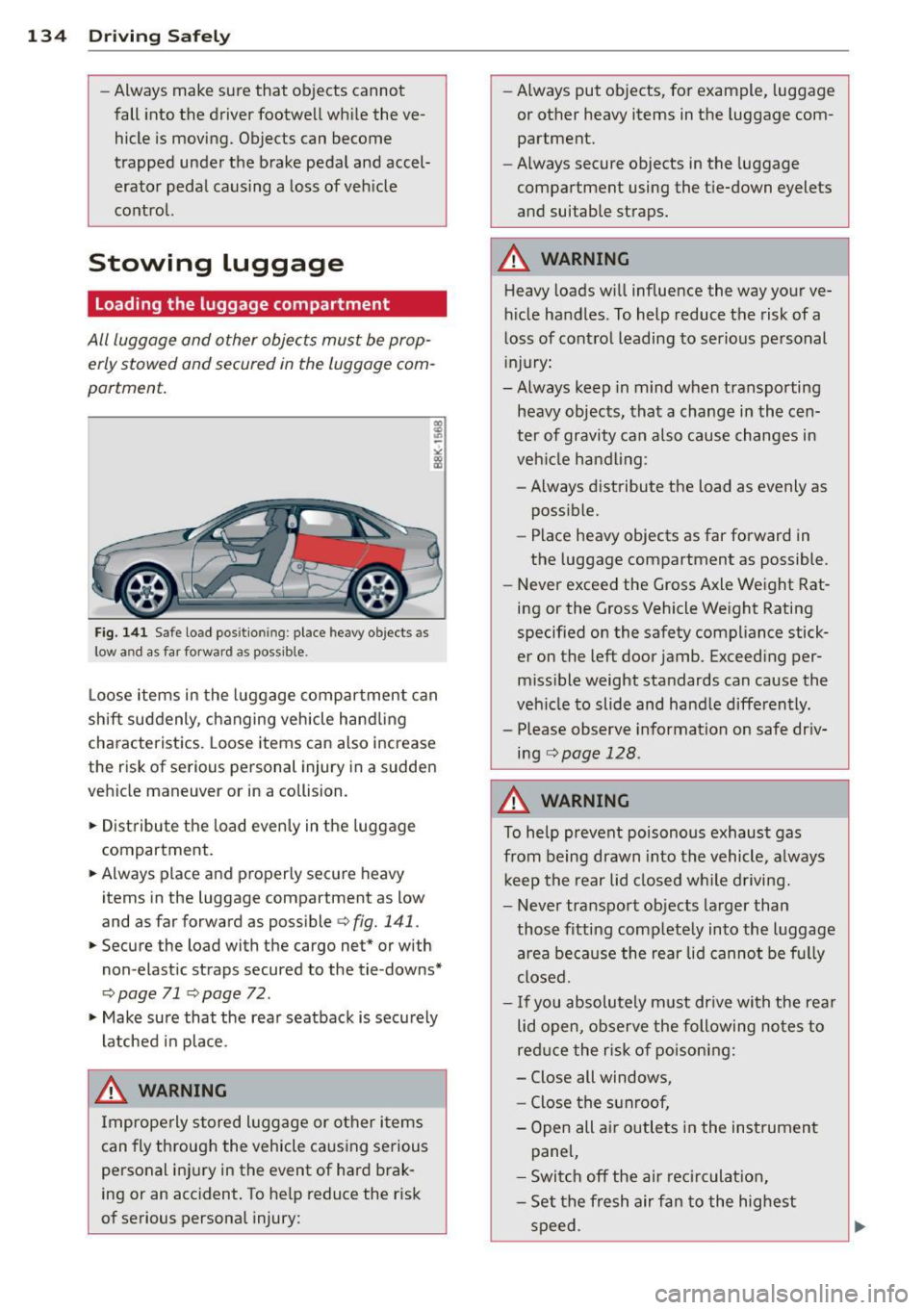
Fig. 141 S afe load positio nin g: place heavy objects as
l ow a nd a s far forward as pos sible.
Loose items in the luggage compartment can
shift suddenly, changing vehicle hand ling
characteristics. Loose items can also increase
the risk of serious personal injury in a sudden
vehicle maneuver or in a collision .
.,. Distribute the load even ly in the luggage
compartment .
.,. Always place and properly secure heavy
items in the luggage compartment as low
and as far forward as possible¢
fig. 141.
.,. Secure the load with the cargo net* or with
non -elastic straps secured to the tie-downs*
¢ page 71 ¢page 72 .
.,. Make sure that the rea r seatback is secu rely
latched in place.
.&_ WARNING
Improperly stored luggage or other items
can fly throug h the vehicle ca using serious
personal inj ury in the event of hard brak
ing or an accident. To help reduce the r isk
of serious personal injury: -
Always put objects, for example, luggage
or other heavy items in the luggage com
partment.
- Always secure objects in the luggage
compartment using the t ie-down eyelets
and suitable straps.
.&_ WARNING
-
Heavy loads w ill influence the way your ve
hicle handles . To help reduce the risk of a
loss of control leading to serious personal
in jury:
- Always keep in mind when transporting
heavy objects, that a change in the cen
ter of gravity can also cause changes in
veh icle handling :
- Always distribute the load as evenly as
possible.
- Place heavy objects as far forward in
the luggage compartment as possible .
- Never exceed the Gross Axle Weight Rat
ing or the Gross Vehicle Weight Rating
specified on the safety compliance stick
er on the left door jamb. Exceeding per
missible weight standards can cause the
veh icle to slide and handle differently.
- Please observe information on safe dr iv
ing
c> page 128.
.&_ WARNING
To help prevent poisonous exhaust gas
from being drawn into the vehicle, always
keep the rear lid closed while driving.
- Never transport objects larger than
those fitting completely into the luggage
a rea because the rear lid cannot be fully
closed.
- If you absolutely m ust dr ive with the rear
lid open, observe the following notes to
red uce the risk of poisoning:
- Close all windows,
- Close the sunroof,
- Open all air outlets in the instrument
panel,
- Switc h off the ai r recirculation,
- Set the fresh air fan to the highest
speed.
Page 137 of 296
A WARNING
Always make sure that the doors, all windows, the sunroof and the rear lid are se
curely closed and locked to reduce the risk
of injury when the vehicle is not being
used.
- After closing the rear lid, always make
sure that it is properly closed and locked.
- Never leave your vehicle unattended es
pecially with the rear lid left open . A
child could crawl into the vehicle through
the luggage compartment and close the
rear lid becoming trapped and unable to
get out. Being trapped in a vehicle can
lead to serious personal injury.
- Never let children play in or around the
vehicle .
- Never let passengers ride in the luggage
compartment. Vehicle occupants must
always be properly restrained in one of
the vehicle's seating positions.
(D Tips
- Air circulation helps to reduce window
fogging. Stale air escapes to the outside
through vents in the trim panel. Be sure
to keep these slots free and open .
- The tire pressure must correspond to the
load. The tire pressure is shown on the
tire pressure label. The tire pressure la
bel is located on the driver's side B-pillar.
The tire pressure label lists the recom
mended cold tire inflation pressures for
the vehicle at its maximum capacity
weight and the tires that were on your
vehicle at the time it was manufactured.
For recommended tire pressures for nor
mal load conditions, please see chapter
c:>poge234.
Driving Safely 135
Tie-downs
App lies to veh icles : w ith tie -d owns
The luggage compartment is equipped with
four tie-downs to secure luggage and other
items .
Use the tie-downs to secure your cargo prop
erly
c:> page 134, Loading the luggage com
partment .
In a collision, the laws of physics mean that
even smaller i tems that are loose in the vehi
cle will become heavy missiles that can cause
serious injury. Items in the vehicle possess en
ergy which vary with vehicle speed and the
weight of the item. Vehicle speed is the most
significant factor.
For example, in a frontal collision at a speed
of 30 mph (48 km/h), the forces acting on a
10-lb (4.5 kg) object are about 20 times the
normal weight of the item . This means that
the weight of the item would suddenly be
about 200 lbs. (90 kg). You can imagine the
injuries that a 200 lbs. (90 kg) item flying
freely through the passenger compartment could cause in a collision like this.
A WARNING
----Weak, damaged or improper straps used
to secure items to tie-downs can fail dur
ing hard braking or in a collision and cause
serious personal injury.
- Always use suitable mounting straps and
properly secure items to the tie-downs in
the luggage compartment to help pre
vent items from shifting or flying for
ward as dangerous missiles.
- When the rear seat backrest is folded
down, always use suitable mounting
straps and properly secure items to the
tie-downs in the luggage compartment
to help prevent items from flying for
ward as dangerous missiles into the pas
senger compartment .
- Never attach a child safety seat tether
strap to a tie-down . •
•
Page 151 of 296
For this reason, and because the back seat is
the safest place for children - when properly restrained according to their age and size - we
strongly recommend that children always sit in the back seat
Q page 167, Child Safety.
A WARNING
-
A child in a rearward-facing child safety seat installed on the front passenger seat
w ill be seriously injured and can be k illed if
the front a irbag inflates - even with an Ad
vanced Airbag System.
- T he inflating a irbag w ill hit the child
safety seat or infant carrier w ith great
force and w ill smash the ch ild safety sea t
and child against the backrest, cente r
armrest, door or roof .
- Always install rear -facing child safety
seats on the rear seat.
- If you mus t inst all a rearward facing
child safety seat on the front passenger
seat beca use of exceptional circumstan
ces and the
PASSENGER AIR BAG OFF
light does not come on and stay on , im
med iately install the rear-facing child
safety seat in a rear seating posit ion and
have the a irbag system inspected by your
authorized Aud i dealer .
- Forward-fac ing ch ild safety seats instal
led on the front passenger's seat may in
terfe re with the deployment of the air
bag and cause se rious personal injury to
the ch ild.
A WARNING
If, in exceptional c irc umstances, you mus t
install a forwa rd-facing child restra int on
the front passenger's seat:
- Alw ays make sure the forw ard -fac ing
sea t has been des igned and certified by
its manufacturer for use on a front seat
with a passenger front and side airbag.
- Never put the forward -facing child re
straint up aga inst or very near the instru
ment pane l.
- Always move the passenger seat into its
rearmost position in the seat's fore and
A irbag system 149
aft ad justment range, as far away from
the airbag as possible before installing
the forward-fac ing ch ild restraint. The
backrest must be adj usted to an upright
position .
- Make sure that the
PASSENGER AIR BAG
OFF
li ght comes on and stays on all the
time wheneve r the ignit ion is switched
on.
A WARNING
T o reduce the risk of ser ious injury, make
su re that the
PASSENGER AIR BAG OFF
light w ill be displayed whenever a child re
straint is installed on the front passenger
seat and the ignition is switched on.
- If the
PASSENGER AIR BAG OFF light
does not s tay on, per form the checks de
scribed
Q page 156, Monitoring the Ad
vanced Airbag System.
- Take the chi ld restraint off the front pas
senger seat and install it properly at one
of the rear seat positions if the
PASSEN
GER AIR BAG Off light does not stay on.
- Have the airbag system inspected by
your author ized Audi dealer immed iate
ly .
-Always carefu lly follow instr uctions from
child restraint manufacturers when in
stall ing ch ild restra ints .
A WARNING
If, in except iona l circumstances, you must
install a forward or rearward-facing child
restra int on the front passenger's seat :
- Improper instal lation of ch ild restraints
can reduce their effectiveness o r even
prevent them from providing any protec
tion.
- An improper ly installed ch ild restra int
can interfere with the airbag as it de
ploys and seriously i njure o r even kill the
child -even with an Advanced Airbag
System.
- Always carefu lly follow the manufact ur
er 's ins tructions p rov ided with the ch ild
safety seat or carrier . •
•
Page 154 of 296
152 Airbag sys te m
For exa mpl e, the air b ag ma y depl oy if:
- a small child that is heavier than a typical 1
year-o ld child is on the front passenger seat
(regardless of whe ther the child is in one of
the chi ld safety seats listed
¢ page 169),
-a ch ild who has outgrown child rest raints is
on the front passenger seat.
If the front passenger airbag is turned off, the
PA SSENGER AIR BAG OFF light in the cente r
of the instrument panel w ill come on and stay
on.
The front a irbag on the passenger side may
not deploy (the PAS SENGER AIR BAG OFF
light does not illuminate and stay lit) if:
- a small adult or teenager is on the front pas
senger seat
- a passenger who is not sitt ing upright wit h
their back against a non-reclined backrest
with their feet on the veh icle floo r in front
of the seat is on the front passenger seat.
If the front passenger airbag deploys, the Federal Standard requires the airbag to meet
the "low risk" deployment criteria to help re
d uce the risk of inju ry through interaction
with the airbag. " Low risk" deployment occurs
in those crashes that take place at lower de
celerations as defined in the e lectronic control
un it.
¢ page 156
Alw ays remember : Even though you r vehicle
is equipped with Advanced Airbags, the safest
p lace for children is properly restrained on the
back seat . Please be sure to read the impor
tant information in the sect ions that follow
and be sure to heed all of the WARNINGS.
A WARNING
To reduce the risk of injury when an airbag
inf lates, always wear safety belts properly.
- If you are unrestrained, lean ing forward,
sitting sideways or out of position in any
way, your risk of in jury is much higher.
- You w ill also receive serious injuries and
cou ld even be killed if you are up against
the a irbag or too close to it when it in- f
lates - even with an Advanced A irbag
¢page 146.
A WARNING
-A child in a rearward-fac ing ch ild safety
seat installed on the front passenger seat
will be serious ly injured and can be killed if
the front airbag inflates - even with an Ad
vanced A irbag System.
- Although the Advanced Airbag System in your veh icle is designed to turn off the
front airbag when a rearward-facing child restraint has been instal led on the
front passenger seat, nobody can abso
lutely g uarantee that dep loyment is im
possible in all conceivable situations that
may happen during the usefu l life of your
veh icle.
- The inflating airbag will hit the child
safety seat or infant carrier with great
force and will smash the child safety seat
and child aga inst the backrest, center
armrest, door, or roof.
-Always install rearward -facing ch ild re
straints in the back seat.
- If you must install a rearward fac ing
child safety seat on the front passenger
seat because of exceptiona l circumstan
ces and the
PASSENGER AIR BAG OFF
light does not come on and stay on, im
mediately insta ll th e rear-fac ing ch ild
safety seat in a rear seating position and
have the airbag system inspected by your
authorized Audi dealer .
A WARNING
If, in exceptional circumstances, you m ust
insta ll a forward -facing child restraint on
the front passenger's seat:
- Always make sure the forward-facing
seat has been designed and certified by
its manufacturer for use on a front seat
with a passenger front and s ide a irbag.
- Never p ut the forward-facing child re
straint up against or very near the instru- ment panel.
~
Page 158 of 296
156 Airbag sys te m
- Occupants who are unbelted, out of posi
t ion or too close to the airbag can be
seriously injured by an airbag as it un
folds with great force in the blink of an eye
~ page 147 .
A WARNING
-
A child in a rearward-facing child safety
seat installed on the front passenger seat
w ill be seriously injured and can be k illed if
the front a irbag inflates -even with an Ad
vanced Airbag System.
- T he inflating a irbag will hit the child
safety seat or infant carrier with g reat
force and wi ll smash the chi ld safety seat
and child against the backrest , center
armrest, door or roof .
- Always install rear -facing child safety
seats on the rear seat.
- If you must install a rearward facing
child safety seat on the front passenger
seat because of exceptional circ umstan
ces and the
PAS SENG ER A IR BAG OFF
light does not come on and stay on, im ·
med iately install the rear-facing child
safety seat in a rear seating position and
have the a irbag system inspected by your
authorized Audi dealer .
A WARNING
Objects between you and the a irbag will
increase the risk of injury in a crash by in
terfering with the way the airbag unfolds
or by being pushed into you as the a irbag
inflates.
- Never hold th ings in your hands or on
yo ur lap when the vehicle is in use.
- Never transport items on or in the area
of the front passenger seat . Objects
cou ld move into the area of the front air
bags during braking or other s udden ma
neuver and become dangerous projec
t iles that can cause serious personal in
jury if the airbags inflate .
- Never place or attach accessories or oth
er objects (such as cupholders, te le
phone brackets, large, heavy or bu lky ob -
-
jects) on the doors, over or near the area
marked "AIRBAG" on the steer ing whee l,
instrument panel, seat backrests or be
tween those areas and yourself . These
objects could cause inju ry in a crash, es
pecia lly when the airbags inflate .
- Never recline the front passenger's seat to transport objects . Items can a lso
move into the area of the s ide airbag or
the front a irbag du ring bra kin g or in a
sudden maneuver. Objects nea r the air
bags can become projectiles and cause
inj ury, partic ularly when the seat is re
clined .
A WARNING ~
The fine dust created when airbags deploy
can cause breathing prob lems for people
with a history of asthma or other breath i ng cond itions .
- To reduce the risk of breath ing problems,
those with asthma or other respiratory conditions shou ld get fresh air right
away by getting o ut of the veh icle or
open ing windows or doors .
- If you are in a collision in which airbags
deploy, wash your hands and face with
mild soap and wate r before eating.
- Be ca reful not to get the dust into your
eyes, o r into any c uts or sc ratches .
- If the res idue should get into your eyes ,
f lush them w ith wate r.
Monitoring the
Advanced Airbag
System
Airbag monitoring indicator light
T wo separate indicators monitor the function
of the Advanced Airbag System: the airbag
monitoring indicator light and the
PASSEN·
GER AIR BAG OFF
light.
The Advanced A irbag System (including the
electron ic cont ro l unit , sensor circu its and sys
tem wiring) is monitored continuously to make su re that it is funct io ni ng properly
Page 166 of 296
164 Airbag system
always be repaired immediately by an au
thorized Aud i dealer.
- If children are seated improper ly, their
risk of injury increases in the case of an
acc ident¢
page 167, Child Safety.
- Never attempt to modify any compo
nents of the airbag system in any way.
- In a side co llision, side a irbags will not
function properly if sensors cannot cor
rect ly measure increasing air pressure in
side the doors when air escapes through
larger, unclosed openings in the door
panel.
- Never drive with interior door trim pan
e ls removed .
- Never drive w hen parts have been re
moved from the inside door panel and
the openings they leave
have not been
properly closed.
- Never drive when loudspeakers in the
doors have been removed unless the
speaker holes have been properly
closed.
- Always make certain that openings are
covered or filled if additional speakers
or other equ ipment is installed in the
ins ide door panels.
- Always have work on the doors done by
an author ized Audi dealer or qualified
workshop .
Side curtain airbags
Description of side curtain airbags
The side curtain airbag system can provide
supplemen tal prote ction to properly restrain
ed occupan ts.
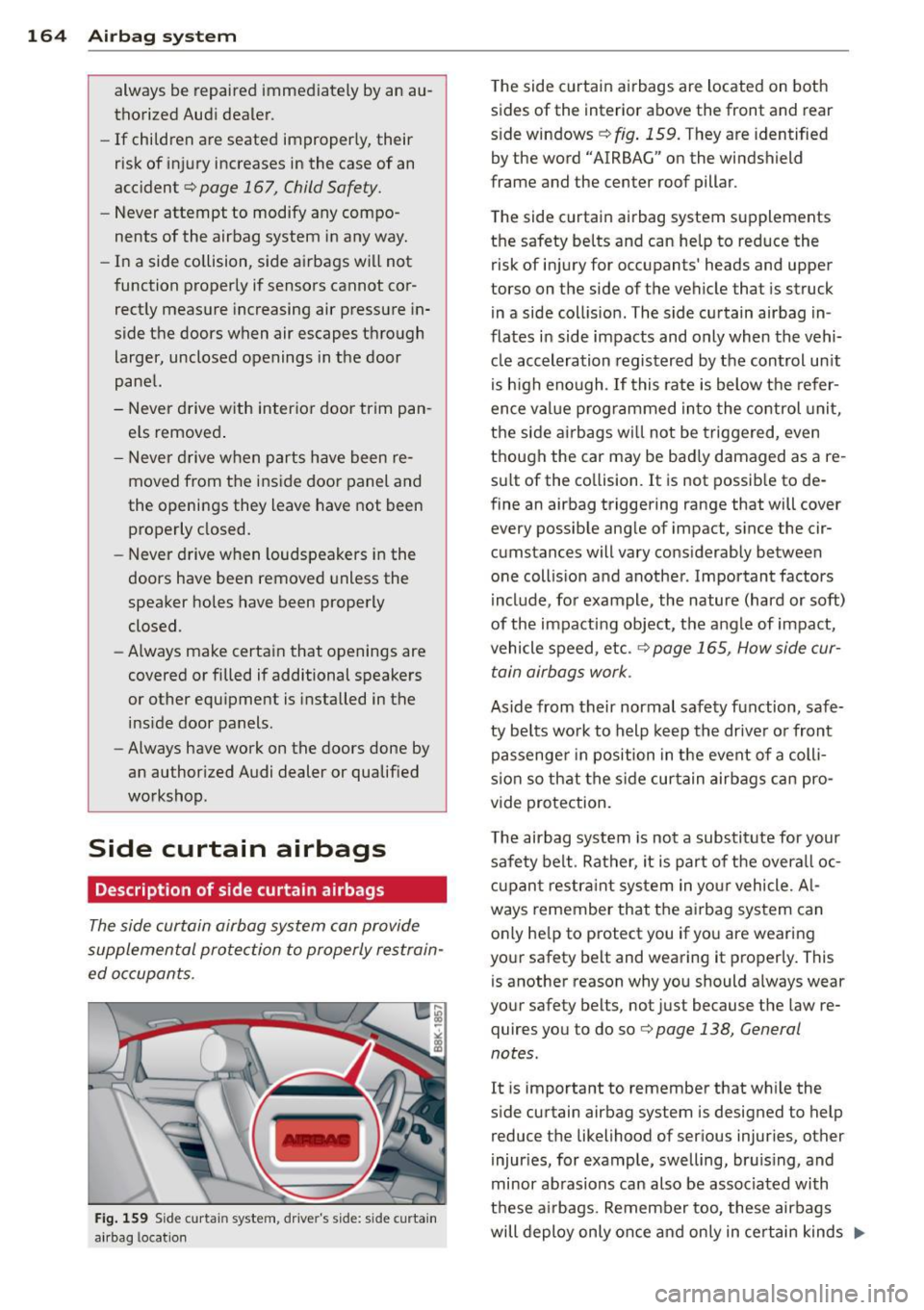
Fig . 159 Side curtain system, dr ive r's s ide: s ide curtain
a irbag locat ion
T he side curtain airbags are located on both
sides of the interior above the front and rear
side windows ¢
fig. 159. They are identified
by the word "AIRBAG" on the windshield
frame and the center roof pillar .
T he side curtain airbag system supplements
the safety belts and can help to reduce the risk of in jury for occupants' heads and upper
torso on the side of the vehicle that is struck in a side coll ision . The side cu rtain airbag in
flates in side impacts and only when the vehi cl e acceleration registered by the control un it
is h igh eno ugh . If this rate is below the refer
ence value p rogrammed in to the co ntrol uni t,
the side ai rbags wi ll not be triggered, even
though the car may be bad ly damaged as a re
s ul t of the co llision. It is not possib le to de
fine an airbag triggering range that will cover every possib le ang le of impact, since the cir
cumstances will vary cons iderably between
one collis ion a nd another . Important factors
i nclude, fo r example, the nature (hard or soft)
of the impacting object, the angle of impact,
vehicle speed, etc. ¢
page 165, How side cur
tain airbags work .
Aside from their normal safety function, safe
ty belts work to help k eep the drive r or front
passenge r in position in t he event of a coll i
s io n so that the s ide cur tain airbags can pro
vide protection.
T he airbag system is not a substit ute for your
safety belt . Rather, it is part of the overa ll oc
c u pan t restra int system in yo ur vehicle. Al
ways remember that the a irbag system can
only he lp to protect you if you are wearing
your safety belt and wearing it properly. This is another reason why you should always wear
your safety belts, not just because the law re
quires you to do so¢
page 138, General
notes .
It is important to remember that wh ile the
side curtain airbag system is designed to help
reduce the likelihood of ser ious injuries, other
i njur ies, for example , swelling, bru is ing, and
minor abrasions can also be assoc iated with
these a irbags. Remember too, these airbags
will deploy only once and on ly in ce rtain kinds
lill>
Page 173 of 296
A WARNING 1-=
Not using a child safety seat, using the
wrong child safety seat or improperly in
stalling a child restraint increases the risk
of serious personal injury and death .
-All vehicle occupants and especially chil dren must always be restrained properly
whenever riding in a vehicle.
~
- An unrestrained or improperly restrain
ed child can be injured or killed by be
ing thrown against the inside of the ve
hicle or by being ejected from it during
a sudden maneuver or impact.
- An unrestrained or improperly restrain
ed child is at much greater risk of injury
or death by being struck by an inflating
airbag.
- Commercially available child safety seats
are required to comply with U.S . Federal
Motor Vehicle Safety Standard (FMVSS)
213 (in Canada CMVSS 213).
- When buying a child restraint, select
one that fits your child and the vehicle.
- Only use child restraint systems that
fully contact the flat portion of the
seat cushion. The child restraint must
not tip or lean to either side. Audi does
not recommend using child safety
seats that rest on legs or tube-like
frames . They do not provide adequate
contact with the seat.
-Always heed all legal requirements per
taining to the installation and use of
child safety seats and carefully follow
the instructions provided by the manu
facturer of the seat you are using.
- Never allow children under 57 inches
(1.45 meters) to wear a normal safety
belt. They must always be restrained by a
proper child restraint system. Otherwise,
they could sustain injuries to the abdo
men and neck areas during sudden brak
ing maneuvers or accidents.
- Never let more than one child occupy a
child safety seat.
Child Safety 1 71
- Never let babies or older children ride in
a vehicle while sitting on the lap of an
other passenger.
- Holding a child in your arms is never a
substitute for a child restraint system .
- The strongest person could not hold
the child with the forces that exist in
an accident. The child will strike the in
terior of the vehicle and can also be
struck by the passenger.
- The child and the passenger can also
injure each other in an accident.
- Never install rearward-facing child safety
seats or infant carriers on the front pas
senger seat. A child will be seriously in
jured and can be killed when the passen
ger airbag inflates -even with an Ad
vanced Airbag System .
- The inflating airbag will hit the child
safety seat or infant carrier with great
force and will smash the child safety
seat and child against the backrest,
center arm rest, door or roof.
-Always install rearward-facing child
safety seats or infant carriers on the
rear seat.
- Forward-facing child safety seats instal
led on the front passenger's seat can in
terfere with the airbag when it inflates
and cause serious injury to the child. Al
ways install forward-facing child safety seats on the rear seat .
- If exceptional circumstances require the
use of a forward-facing child restraint on
the front passenger's seat, the child's
safety and well-being require that the
following special precautions be taken:
- Make sure the forward-facing seat has
been designed and certified by its man
ufacturer for use on a front seat with a
passenger front and side airbag .
- Always carefully follow the manufac
turer's instructions provided with the
child safety seat or carrier.
- Always move the front passenger seat into the rearmost position of the pas-
senger seat's fore and aft adjustment
~
•
•
Page 175 of 296
Child safety seats
Infant seats
Babies and infants up to about one year old
and 20 lbs. or 9 kg need special rearward -fac
ing child restraints that support the back,
neck and head in a crash.
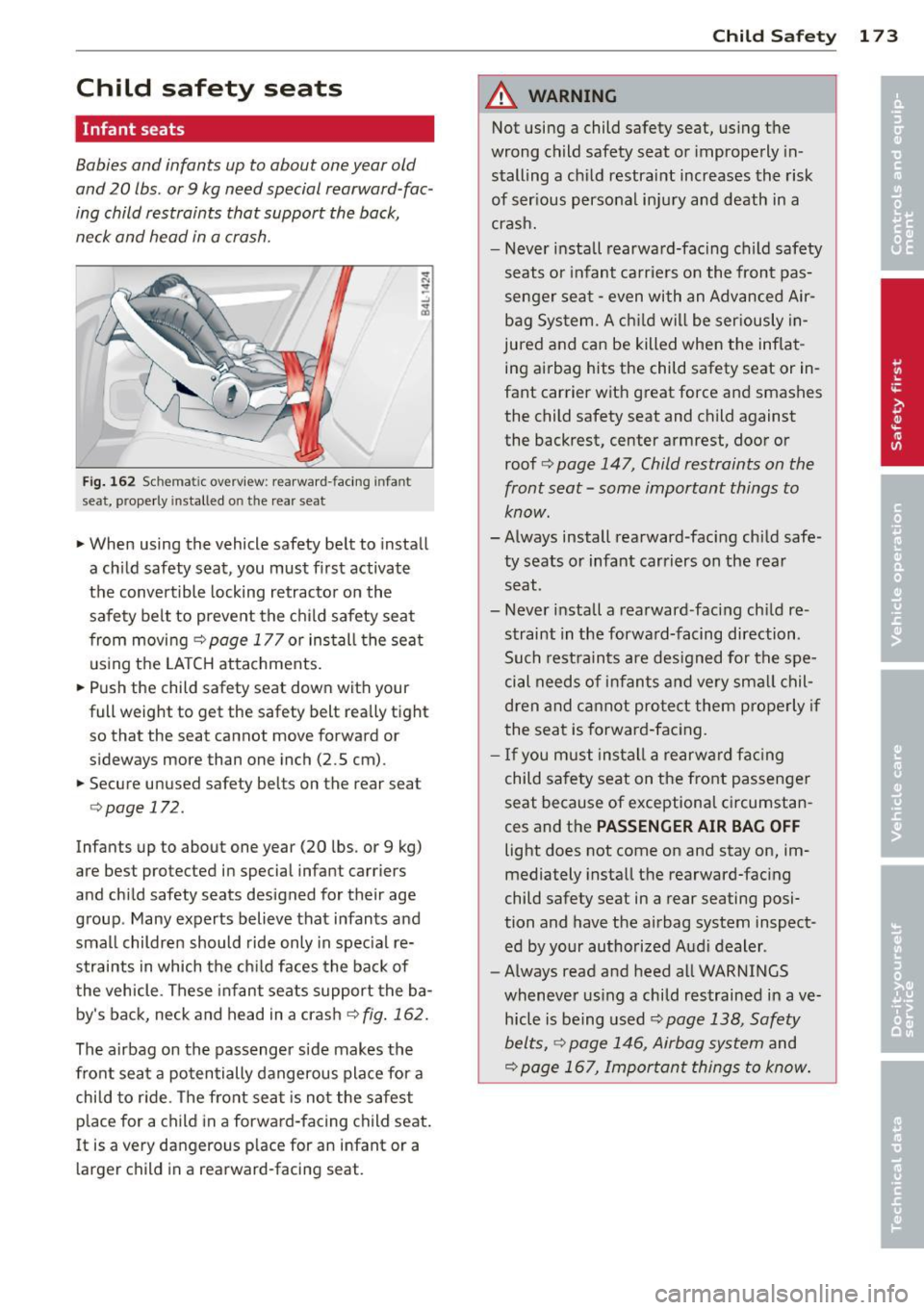
Fig . 162 Sche matic overv iew: rearward-fac ing infant
seat, properly installed o n the rear seat
.,. When using the vehicle safety belt to install
a ch ild safety seat, you must first activate
the convertible locking retracto r on the
safety be lt to prevent the child safety seat
from moving
¢ page 177 or install the seat
using the LA T CH attachments.
.,. Push the child safety seat down with your
full weight to get the safety belt rea lly tight
so that the seat cannot move forward or
sideways more than one inch (2.5 cm).
.,. Secure unused safety belts on the rear seat
¢page 172.
Infants up to about one year (20 lbs . or 9 kg)
are best protected in special infan t carriers
and child safety seats designed for their age
group . Many experts believe that infants and
small children should ride only in spec ial re
straints in which the ch ild faces the back of
the vehicle. These infant seats support the ba
by's back, neck and head in a crash
¢ fig . 162.
The airbag on the passenger side makes the
front seat a po tentially dangerous place for a
child to r ide . The front seat is not the safest
p lace for a child in a forward -facing child seat.
It is a very dangerous p lace for an infant or a
l arger ch ild in a rearward-facing seat.
Child Safety 173
A WARNING
Not using a child safety seat, using t he
wrong child safety seat or improperly in
stall ing a ch ild restraint increases the risk
of ser ious personal injury and death in a
crash.
- Never install rearwa rd-facing child safety
seats or infant ca rr ie rs on the front pas
senger seat -even with an Advanced Air
bag Sys tem. A ch ild will be ser iously in
jured and ca n be killed when the inflat
ing airbag hits the child safety seat or in
fant carrier with great force and smashes the child safety seat and child against
the backrest, center armrest, door or
roof ¢
page 147, Child restraints on the
front seat- some important things to
know .
-Always install rea rward -facing chi ld safe
ty seats or infant carriers on the rea r
seat .
- Never install a rea rward -facing ch ild re
straint in the forward-facing direction .
Such rest ra in ts are designed for the spe
cial needs of infants a nd ve ry sma ll chil
d ren and cannot pro te ct them p roperly if
the seat is forward -facing.
- If you must insta ll a rearwa rd fac ing
child safety seat on the front passenger
seat because of exceptiona l circumstan
ces and the
PASSENGER AIR BAG OFF
light does not come on and stay on, im
mediately insta ll t he rearward-facing
child safety seat in a rear seating posi
tion and have the airbag system inspect ed by your autho riz ed Audi dealer .
- Always read and heed all WARNINGS
wheneve r us ing a child restrained in ave
h icle is being used ¢
page 138, Safety
belts,
Q page 146, Airbag system and
¢ page 167, Impor tan t thi ngs to know .
Page 176 of 296
174 Child Safety
Convertible child safety seats
Properly used convertible child safety seats
can help protect toddlers and children over
age one who weigh between
20 and 40 lbs. (9
and 18 kg) in a crash.
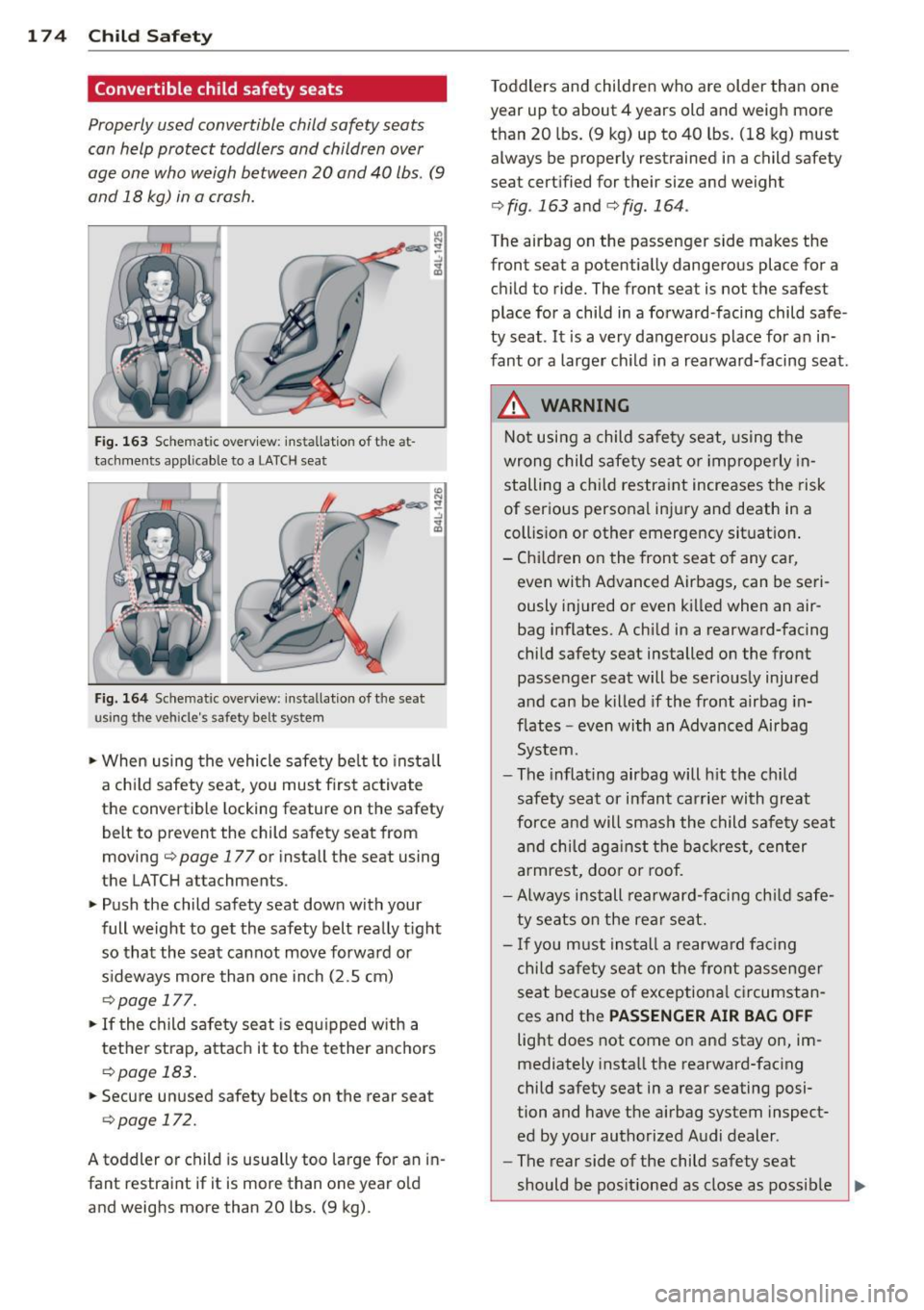
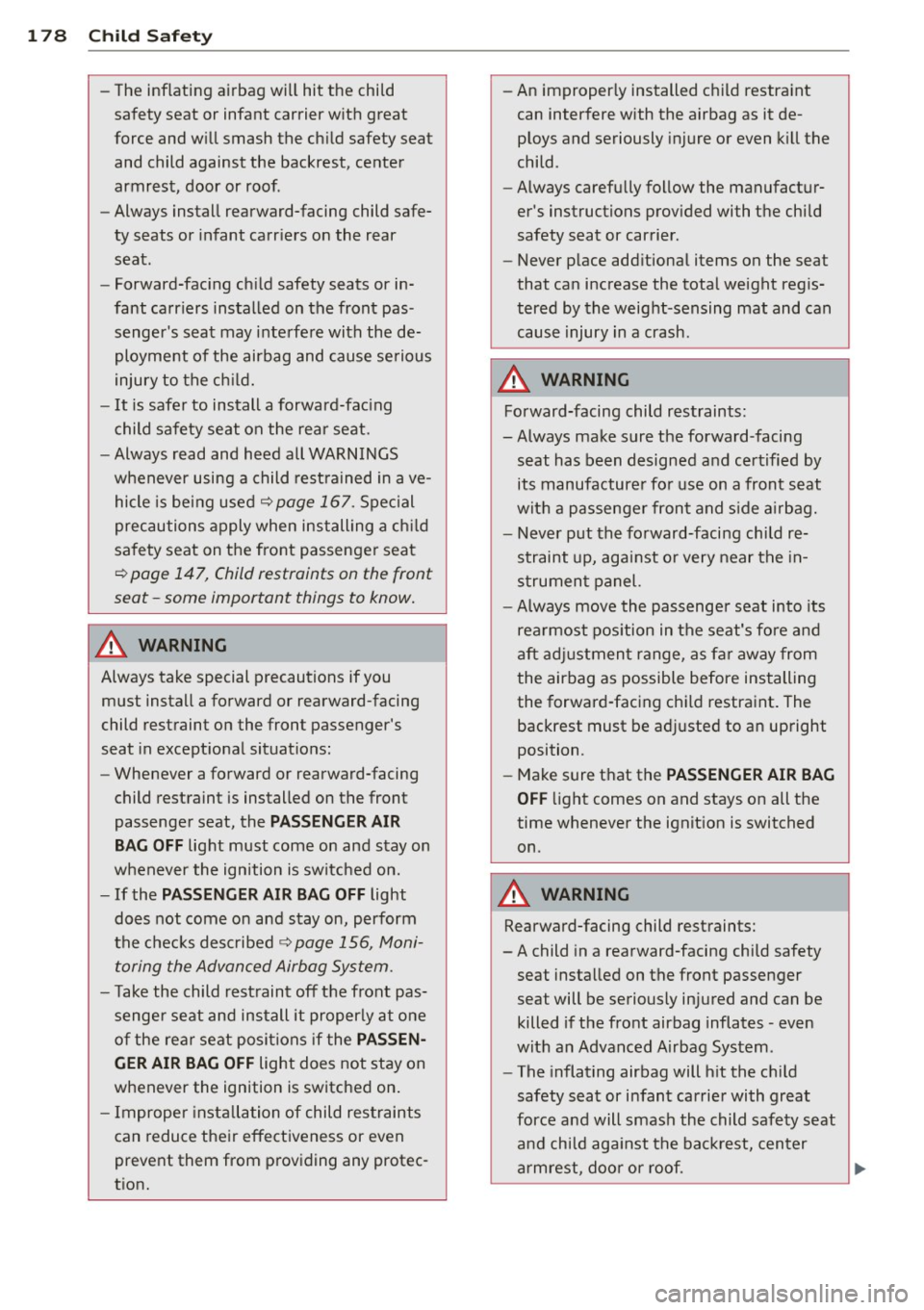
Fig. 163 Sche matic overview: installation of t he at
tachments applicable to a LATCH seat
Fig. 164 Schematic overview: installation of t he seat
us ing the veh icle's safety belt system
.. When using the vehicle safety belt to install
a child safety seat, you must first activate
the convertible locking feature on the safety
belt to prevent the child safety seat from
moving
c::> page 177 or install the seat using
the LATCH attachments .
.. Push the child safety seat down with your
full weight to get the safety belt really tight
so that the seat cannot move forward or sideways more than one inch (2.5 cm)
c::> page 177.
.. If
the child safety seat is equipped with a
tether strap, attach it to the tether anchors
i=>page 183.
.. Secure unused safety belts on the rear seat
c::> page 172.
A toddler or child is usually too large for an in
fant restraint if it is more than one year old
and weighs more than 20 lbs. (9 kg) . Toddlers
and children who are older than one
year up to about 4 years old and weigh more
than 20 lbs. (9 kg) up to 40 lbs. (18 kg) must
always be properly restrained in a child safety
seat certified for their size and weight
c::> fig . 163 and c::> fig . 164 .
The airbag on the passenger side makes the
front seat a potentially dangerous place for a
child to ride. The front seat is not the safest
place for a child in a forward-facing child safe
ty seat . It is a very dangerous place for an in
fant or a larger child in a rearward-facing seat.
_&. WARNING
Not using a child safety seat, using the
wrong child safety seat or improperly in
stalling a child restraint increases the risk
of serious personal injury and death in a
collision or other emergency situation.
- Children on the front seat of any car,
-
even with Advanced Airbags, can be seri
ously injured or even killed when an air bag inflates . A child in a rearward-facing
child safety seat installed on the front passenger seat will be seriously injured
and can be killed if the front airbag in
flates -even with an Advanced Airbag
System .
- The inflating airbag will hit the child
safety seat or infant carrier with great
force and will smash the child safety seat
and child against the backrest, center
armrest, door or roof.
- Always install rearward-facing child safe
ty seats on the rear seat.
- If you must install a rearward facing
child safety seat on the front passenger
seat because of exceptional circumstan
ces and the
PASSENGER AIR BAG OFF
light does not come on and stay on, im
mediately install the rearward-facing
child safety seat in a rear seating posi
tion and have the airbag system inspect
ed by your authorized Audi dealer .
- The rear side of the child safety seat
should be positioned as close as possible ..,.
Page 180 of 296
178 Child Safety
-The inflating airbag will hit the child
safety seat or infant carrier with great
force and will smash the child safety seat and child against the backrest, center
armrest, door or roof.
- Always install rearward-facing child safe
ty seats or infant carriers on the rear
seat.
- Forward-facing child safety seats or in
fant carriers installed on the front pas
senger's seat may interfere with the de
ployment of the airbag and cause serious
injury to the child.
-It is safer to install a forward-facing
child safety seat on the rear seat.
- Always read and heed all WARNINGS
whenever using a child restrained in ave
hicle is being used
¢page 167. Special
precautions apply when installing a child
safety seat on the front passenger seat
¢ page 147, Child restraints on the front
seat -some important things to know.
A WARNING
-
Always take special precautions if you
must install a forward or rearward -facing
child restraint on the front passenger's
seat in exceptional situations:
- Whenever a forward or rearward-facing
child restraint is installed on the front
passenger seat, the
PASSENGER AIR
BAG OFF
light must come on and stay on
whenever the ignition is switched on.
- If the PASSENGER AIR BAG OFF light
does not come on and stay on, perform
the checks described ¢
page 156, Moni
toring the Advanced Airbag System.
- Take the child restraint off the front pas
senger seat and install it properly at one
of the rear seat positions if the
PASSEN
GER AIR BAG OFF
light does not stay on
whenever the ignition is switched on.
- Improper installation of child restraints
can reduce their effectiveness or even
prevent them from providing any protec
tion. -
An improperly installed child restraint
can interfere with the airbag as it de
ploys and seriously injure or even kill the
child .
- Always carefully follow the manufactur
er's instructions provided with the child
safety seat or carrier.
- Never place additional items on the seat
that can increase the total weight regis
tered by the weight-sensing mat and can
cause injury in a crash .
A WARNING
-Forward-facing child restraints:
- Always make sure the forward -facing
seat has been designed and certified by its manufacturer for use on a front seat
with a passenger front and side airbag.
- Never put the forward-facing child re
straint up, against or very near the in
strument panel.
- Always move the passenger seat into its
rearmost position in the seat's fore and
aft adjustment range, as far away from
the airbag as possible before installing
the forward-facing child restraint. The backrest must be adjusted to an upright
position .
-Make sure that the PASSENGER AIR BAG
OFF
light comes on and stays on all the
time whenever the ignition is switched
on .
A WARNING
-
Rearward-facing child restraints:
- A child in a rearward-facing child safety
seat installed on the front passenger
seat will be seriously injured and can be killed if the front airbag inflates -even
with an Advanced Airbag System .
- The inflating airbag will hit the child
safety seat or infant carrier with great
force and will smash the child safety seat and child against the backrest, center
armrest, door or roof.