steering wheel AUDI S4 2014 User Guide
[x] Cancel search | Manufacturer: AUDI, Model Year: 2014, Model line: S4, Model: AUDI S4 2014Pages: 296, PDF Size: 73.56 MB
Page 149 of 296
angle of impact that will always trigger the
airbags, since the circumstances will vary con
siderably between one collision and another.
Important factors include, for example, the nature (hard or soft) of the object which the
car hits, the angle of impact, vehicle speed,
etc. The front airbags will also not inflate in
side or rear collisions, or in ro ll-overs .
Alwa ys rem ember : Airbags will deploy only
once, and only in certa in kinds of collisions .
Your safety belts are always there to offer pro
tection in those s ituations in which airbags
are not supposed to deploy , or when they have
a lready deployed ; fo r example , when yo ur ve
h icle strikes or is struck by another after the
first collision .
This is just one of the reasons why an a irbag is
a supplementary restra int and is not a s ubst i
tute for a safety belt . The airbag system
works most effectively when used with the
safety belts. Therefore, always properly wear
your safety belts
¢ page 138.
A WARNING
Sitting too close to the steer ing wheel or
instrument panel will decrease the effec
tiveness of the airbags and will increase
the risk of pe rsonal injury in a co llision .
- Never sit closer than
10 inches (25 cm)
to the stee ring wheel or instrument pan
el.
- If you cannot sit more than
10 i nches
(25 cm) from the steer ing whee l, investi
gate whether adaptive equipment may
be available to help you reach the pedals
and increase your seating dis tance from
the steering wheel.
- If you are unrestrained, lean ing fo rward,
sitting sideways or out of position in any
way, yo ur risk of inj ury is much highe r.
- You w il l also receive serio us inju ries and
cou ld even be killed if you are up against
the airbag or too close to it when it in
flates -even with an Advanced Airbag.
- To reduce the r isk o f injury when an air
bag inflates, a lways wear safety belts
proper ly ¢
page 141, Safety belts .
Airbag system 147
-Always make certain that chi ld ren age 12
or younger a lways ride in the rear seat. If
children are not properly restrained, they may be severe ly inju red or killed when an
airbag inf lates .
- Never let ch ildren ride unrestra ined or
improperly restrained in the vehicle . Ad
just the front seats prope rly.
- Never ride with the backrest reclined.
- Always sit as far as possible from the
steer ing whee l or the instrument pane l
¢page 129.
-Always sit upright with your back against
the backrest of your seat.
- Never p lace your feet on the instrument
panel or on the seat. Always keep both
feet on the f loor in front of the seat to
he lp prevent serio us in juries to the legs
a nd h ips if the airbag inflates.
- Never recline the front passenger 's seat
to tra nsport objects. Items can a lso
move i nto the area of the s ide a irbag or
the front a irbag du ring bra king or in a
sud den maneuve r. Obje cts ne ar the air
bags can become projectiles and cause
injury when an airbag inflates.
_&. WARNING ~
A irbags that have de ployed in a crash must
be replaced.
- Use on ly original equipment airbags ap
proved by Audi and installed by a trai ned
technician who has the necessary too ls
and d iagnost ic equipment to properly re
place any airbag in your vehicle and as
sure system effectiveness in a crash .
- Never perm it salvaged or recycled air
bags to be installed in your vehicle .
Child restraints on the front seat - some
important things to know
.,. Be su re to read t he importa nt information
and head the WARNINGS fo r important de
tails about children and Advanced Airbags
¢ page 167. ..,.
•
•
Page 152 of 296
150 Airbag system
-Never place additiona l items on the seat
that can increase the total weight regis
tered by the weight-sensing mat and can
cause injury in a crash.
Front airbags
Description of front airbags
The airbag system can provide supplemental
protection to properly restrained front seat
occupants.
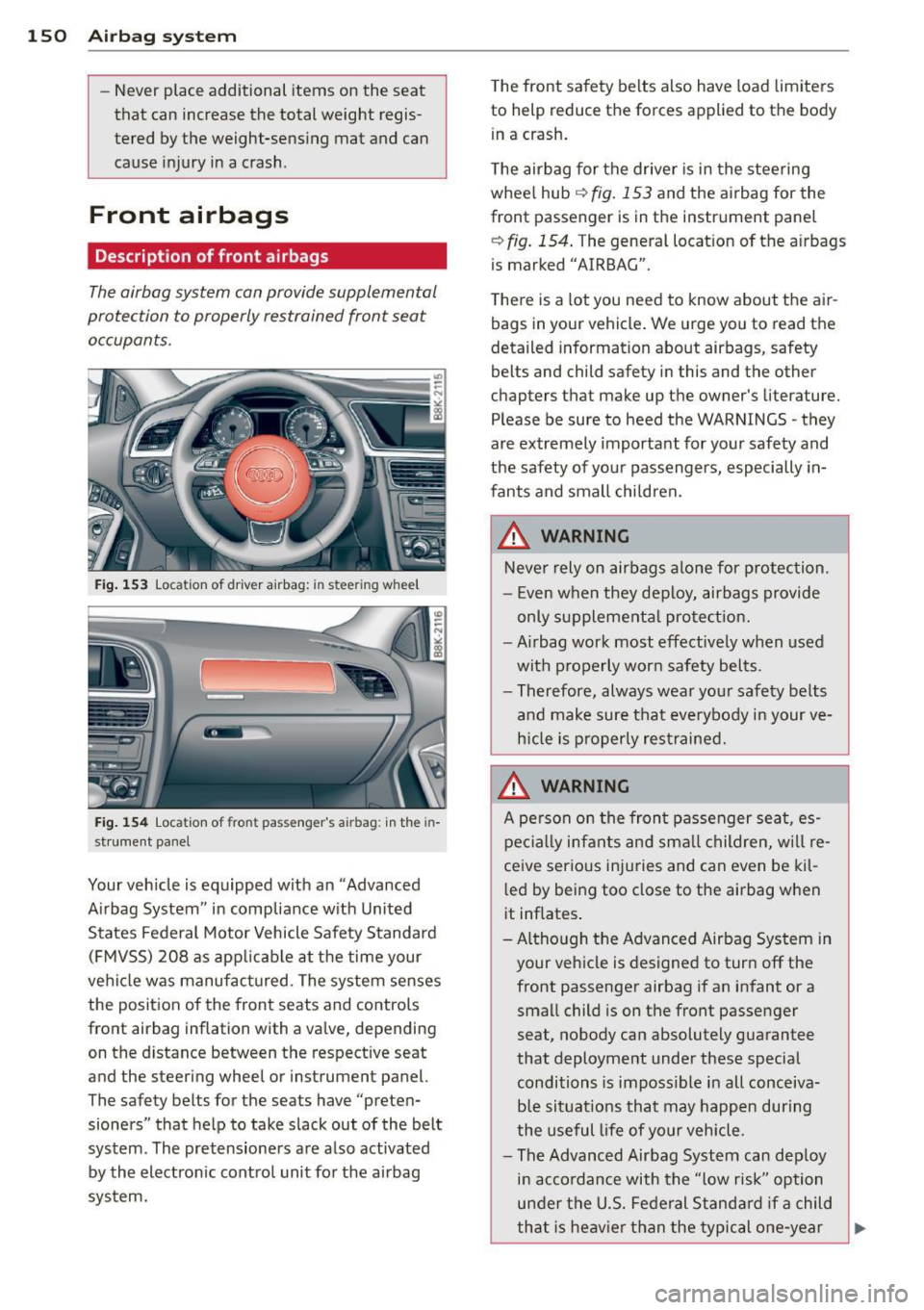
F ig . 153 Location of driver airbag: in steer ing whee l
Fig. 15 4 Location of front passenger's airbag: in the in
strument panel
Your veh icle is equipped with an "Advanced
A irbag System" in compliance with United
States Federal Motor Vehicle Safety Standard ( FM VSS) 208 as app licab le at the time your
ve hicl e was manufac tured. The system senses
the position of the front seats and controls
front airbag inflation with a valve, depending
on the distance between the respect ive seat
and the steering wheel or instrument panel.
The safety belts for the seats have "preten
sioners" that he lp to take slack out of the belt
system . The pretensioners a re also activated
by the electron ic cont ro l unit for the ai rbag
system. T
he front safety belts also have load limiters
to help reduce the forces applied to the body
i n a crash .
T he airbag for the drive r is in the stee ring
whee l hub¢
fig. 153 and the airbag for the
front passenger is in the instrument panel
~ fig. 154 . The general locat ion of the a irbags
is marked "AIRBAG".
T here is a lot you need to know about the ai r
bags in your vehicle. We urge you to read the
detailed information about airbags, safety
belts and child safety in this and the other
chapters that make up the owner's literature.
P lease be sure to heed the WARNINGS -they
are extremely importa nt for your safety and
the safety of your passengers, especially in
fants and small chi ldren.
_&. WARNING
Neve r rely on airbags alone for p rotection.
- Even w hen they deploy, airbags provide
only s upplement al pro te ctio n.
- Airbag work most effect ive ly when used
with p roperly wor n safety bel ts.
- Therefore, always wea r you r safety belts
a nd make sure tha t eve rybody in your ve
h icle is p roperly res trained.
_&. WARNING
A pe rson on the front passenger seat, es
pe cial ly infa nts and sm all ch ildren, w ill re
ceive serio us inju ries and can even be kil
l ed by being too close to the airbag when
it inflates .
- Although t he Advanced Airbag System in
your veh icle is designed to tur n off the
front passenger airbag if an infant or a
small child is on the front passe nger
seat, nobody can absolutely guarantee
that deployment under these special
conditions is imposs ible in all conceiva
b le sit uat ions that may happen during
the useful life of your vehicle.
- The Advanced Airbag System can dep loy
i n acco rdance with the "low risk" option
unde r the U.S . Feder al Standard if a child
that is heav ie r than the typical one -year
-
.
Page 162 of 296
160 Airbag system
-Never attach any objects such as cu
pholders or telephone mountings to the
surfaces covering the airbag units.
- For cleaning the horn pad or instrument
panel, use only a soft, dry cloth or one
moistened with plain water. Solvents or
cleaners could damage the airbag cover
or change the stiffness or strength of the
material so that the airbag cannot de
ploy and protect properly.
- Never repair, adjust, or change any parts
of the airbag system .
- All work on the steering wheel, instru
ment panel, front seats or electrical sys
tem (including the installation of audio
equipment, cellular telephones and CB
radios, etc.) must be performed by a
qualified technician who has the training
and special equipment necessary.
- For any work on the airbag system, we
strongly recommend that you see your
authorized Audi dealer or qualified work
shop.
- Never modify the front bumper or parts
of the vehicle body.
- Always make sure that the side airbag
can inflate without interference:
- Never install seat covers or replace
ment upholstery over the front seat
backs that have not been specifically
approved by Audi.
- Never use additional seat cushions that
cover the areas where the side airbags
inflate.
- Damage to the original seat covers or
to the seam in the area of the side air
bag module must always be repaired
immediately by an authorized Audi
dealer.
- The airbag system can be activated only
once. After an airbag has inflated, it
must be replaced by an authorized Audi
dealer or qualified technician who has
the technical information, training and
special equipment necessary.
- The airbag system can be deployed only once. After an airbag has been deployed,
it must be replaced with new replace- ment parts designed and approved espe
cially for your Audi model version . Re
placement of complete airbag systems
or airbag components must be per
formed by qualified workshops only. Make sure that any airbag service action
is entered in your Audi Warranty
& Main
tenance booklet under
AIRBAG REPLACE
MENT RECORD.
- In accidents when an airbag is deployed,
the vehicle battery separates the alterna
tor and the starter from the vehicle elec
trical system for safety reasons with a pyrotechnic circuit interrupter.
- Work on the pyrotechnic circuit inter rupter must only be performed by a
qualified dealer -risk of an accident!
- If the vehicle or the circuit interrupter
is scrapped, all applicable safety pre
cautions must be followed.
@ For the sake of the environment
Undeployed airbag modules and preten
sioners might be classified as Perchlorate
Material -special handling may apply, see
www .dtsc.ca.gov/hazardouswaste/per
chlorate. When the vehicle or parts of the restraint system including airbag modules
safety belts with pretensioners are scrap
ped, all applicable laws and regulations
must be observed. Your authorized Audi
dealer is familiar with these requirements
and we recommend that you have your
dealer perform this service for you.
Other things that can affect Advanced
Airbag performance
Changing the vehicle's suspension system can
change the way that the Advanced Airbag Sys
tem performs in a crash. For example, using
tire-rim combinations not approved by Audi, lowering the vehicle, changing the stiffness of
the suspension, including the springs, suspen
sion struts, shock absorbers etc. can change
the forces that are measured by the airbag sensors and sent to the electronic control
unit. Some suspension changes can, for
Page 170 of 296
168 Child Safety
-If you must install a rearward facing
child safety seat on the front passenger
seat in exceptional circumstances and
the
PASSENGER AIR BAG OFF light does
not come on and stay on, immediately
install the rearward-facing child safety
seat in a rear seating position and have
the airbag system inspected immediately
by your authorized Audi dealer.
.&, WARNING
If, in exceptional circumstances, you must
install a forward-facing child restraint on
the front passenger's seat:
- Always make sure the forward-facing
seat has been designed and certified by
its manufacturer for use on a front seat
with a passenger front and side airbag.
- Always follow the manufacturer's in
structions provided with the child safety
seat or carrier.
- Always move the passenger seat into its
rearmost position in the seat's fore and
aft adjustment range, as far away from
the airbag as possible before installing
the child restraint. The backrest must be adjusted to an upright position .
- Always make sure that the
PASSENGER
AIR BAG OFF
light comes on and stays
on all the time whenever the ignition is
switched on.
(D Tips
Always replace child restraints that were
installed in a vehicle during a crash. Dam
age to a child restraint that is not visible
could cause it to fail in another collision
situation.
Advanced front airbag system and children
Your vehicle is equipped with a front "Ad
vanced Airbag System" in compliance with
United States Federal Motor Vehicle Safety
Standard (FMVSS) 208 as applicable at the
time your vehicle was manufactured . The
Advanced Airbag system in your vehicle
has been certified to meet the "low-risk" re
quirements for 3- and 6-year old children on
the passenger side and small adults on the driver side. The low risk deployment criteria
are intended to reduce the risk of injury
through interaction with the airbag that can
occur, for example, by being too close to the
steering wheel and instrument panel when
the airbag inflates . In addition, the system
has been certified to comply with the "sup
pression" requirements of the Safety Stand
ard, to turn off the front airbag for infants up
to 12 months who are restrained on the front
passenger seat in child restraints that are list
ed in the Standard.
Even though your vehicle is equipped with an
Advanced Airbag system, all children, espe
cially those 12 years and younger, should al
ways ride in the back seat properly restrained
for their age and size. The airbag on the pas
senger side makes the front seat a potentially
dangerous place for a child to ride . The front
seat is not the safest place for a child in a for
ward-facing child safety seat.
It can be a very
dangerous place for an infant or a larger child
in a rearward-facing seat.
Advanced Airbags and the weight
sensing mat in the front seat
The Advanced Airbag System in your vehicle detects the presence of an infant or child in a
child restraint on the front passenger seat us
ing the weight-sensing mat in the seat cush
ion and the sensor below the safety belt latch
on the front passenger seat that measures the
tension on the safety belt.
The weight-sensing mat measures total
weight of the child and the child safety seat
and a child blanket on the front passenger
seat. The weight on the front passenger seat
is related to the design of the child restraint
and its "footprint", the size and shape of the
bottom of the child restraint as it sits on the
seat. The weight of a child restraint and its "footprint" vary for different kinds of child re -
straints and for the different models of the .,.
Page 189 of 296
ESC includes and/or works together with the
anti-lock brake system (ABS), brake assist sys
tem, anti -slip regulation (ASR) , e lectronic dif
ferential lock (EDL), dynamic steering* and electronic i nteraxle differential lock* /selective
wheel torque control* . ESC is switched on all
the t ime. I n certain s ituations when you need
less traction, you can switch
off ASR by press
i ng the button~~
page 188, fig. 174 or
~ page 188, fig. 175. Be sure to sw itch ASR
on again when you no longer need less trac
tion.
Anti-lock b ra king s ystem (ABS)
ABS prevents the wheels from locking up
when braking. The vehicle can still be steered
even d uring hard brak ing . Apply ste ady p res
sure to the brake pedal. Do not pump the ped
a l. A pulsing in the brake peda l indicates t hat
the system is he lping you to brake the vehicle .
Brake assist system
The brake assist system can decrease bra king
d istance. It increases braking power when the
d river presses the brake pedal quick ly in eme r
gency situations . You must press and hold the
brake peda l until the situation is over. In
veh icles w ith adaptive cru ise contro l*, the
brake assist system is more sensit ive if the
d istance detected to the veh icle ahead is too
small.
Anti- slip regulati on (ASR)
ASR reduces engine power when the drive
wheels begin to spin and adapts the force to
the road condit ions. This makes it eas ier to
start, accelerate and drive up hills.
Elect ronic diffe renti al lo ck (EDL )
The ED L brakes wheels that are spinning and
transfers the drive power to the other drive
wheel or wheels if the vehicle is equipped with
all-wheel drive*. This function is available up
to about 60 mph (100 km/h) .
In extreme cases, EDL automatica lly switches
off to help keep the brake on the braked whee l
from overheating. EDL w ill switch on again au-
Intellig ent technolog y 187
tomat ica lly when conditions have returned to
norma l.
Dynamic steering*
On vehicles with dynam ic steering*, ESC helps
stab il ize the s teer ing in crit ica l sit uat io ns.
Electronic interaxle differential lock* /
selective wheel torque control*
T he electronic i nteraxle differential lock (front
whee l dr ive) or the se lective whee l to rque
control (all-whee l dr ive) opera tes when dr iv
ing thro ugh curves. The front wheel on the in
side of the c urve or both whee ls on the inside
of the curve are braked selectively as needed .
This min imizes sliding in the front wheels and
allows for more precise driving through
cu rves . The applicable system may not acti
vate when dr iv ing in wet or snowy conditions.
A WARNING
- ESC, ABS , ASR, EDL dynam ic steering*
a nd the elect ronic interaxle differential
loc k* /se lective wheel torque control*
cannot overcome the laws of physics .
This is especially important on slippery
or wet roads. If the systems begin acting
to stabilize your veh icle, yo u should im
mediately change your speed to match
the road and traff ic conditions. Do not
let the increased safety provided by
these systems tempt you to take r isks.
Doing so will increase the risk of a loss of
veh icle contro l, col lision and ser ious per
sonal injuries.
- Always adapt your speed to road, traffi c
and wea ther conditions. The risk of los
ing con tro l of the vehicle increases when
driving too fast, espec ially through
curves and on slippery or wet roads, and
when dr iv ing too close to vehicles up
ahead. ESC, ABS, the brake ass ist sys
tem, ASR, EDL dynam ic steering* and the
electronic interaxle differentia l lock*/se
lective whee l torque control* cannot p re-
vent co llisions . ..,.
•
•
Page 193 of 296
th e brakes or hold the pedal down too
long or too ofte n. This cou ld cause the
brakes t o get hot and dimi nish b raking
efficiency .
- Do not "r ide t he b rakes" by resting your
foot on the pedal when you do n ot intend
t o brake . Th is may cause the brakes to
overheat, premature wear and increased
stopp ing distance.
- Under certa in climat ic and operating
condit ions such as passing through wa
ter, driving i n heavy rai n or after wash ing
the vehicle, the effe ct iveness of the
brakes can be re duced. In winter, ice can
acc umulate on the brake pads, linings,
discs and drums. Carefully apply brakes
f or a test. Brakes will dry and ice coat
ings will be cleaned off after a few care
ful brake app lications.
- Driv ing for an extended period of time on
salt-covered roads w ithout using your
brakes can also affect braking efficiency .
Clean off accumulated salt coating from
brake discs and pads w ith a few caref ul
brake applicat io ns.
- If you damage the front spo iler, or if you
install a diff ere nt spoiler, be sure the air
flow to t he front b ra kes is not obstr uct
ed . Otherwise the br ake sys tem co uld
overheat red ucing the effectiveness of
the ent ire brake sys tem.
- F ailure of one br ake circui t will im pair
the brakin g capability res ulting in an in
creased stop ping distance . Avoid driving
the vehicle and have it towed to t he near
est author ized Audi dealer or qualified
workshop.
- Never let the vehicle ro ll to a stop w ith
the engine shut off.
- If the brake booster is not work ing, the
brake pedal must be pressed considera
bly harder to make up for the lack of
booster assistance.
Int ellig ent technolog y 191
Electro-mechanical
power assist, dynamic
steering
The electro-mechanical power assist helps
t he driver when steering.
Power steer ing adap ts electronically based on
t he ve hicl e spee d.
Indicator lights and messages
• Steering defect ive! Do not drive vehicle!
If this indicator light turns on and stays on
and t his message appears, the power steer ing
may have failed.
Do
not continue driving. See your authorized
Audi dealer or a qualified repair facility for as
s istance.
':rij Dynamic steering: Sy stem fault! You can
continue dr iving
If the indic ator ligh t turns on and the mes
sage appears, the steering may be more diffi
cu lt to move o r more sensitive tha n usual. The
steering wheel may a lso be at an ang le when
driv ing straight.
Drive slowly to your a uth orized Audi dea ler or
qualified workshop to have the ma lf u nction
corrected.
(;rij Dynamic ste ering : initializing
If this drive r message appea rs and the indica
tor light is flas hing on the instrument panel,
dynam ic steer ing* i s being rein itia lized. After
sta rting the engine, the stee ring w heel will
move s light ly . Re- initializa tion might be nec
essary if the stee ring wheel was moved hard
to the left and right whi le the vehicle was not
moving. The display goes out as soon as initi
alization is complete .
A WARNING
-Have the dy namic stee ring* system mal
f u nction repa ired as soon as possible by an
authorized Audi dealer or qualified work
shop - risk of acc ident!
-
•
•
Page 194 of 296
192 Intelligent technology
(D Tips
-If the . or 'Tj indicator light only stays
on for a short time, you may continue
driving.
- The dynamic steering* stability systems
are not available in the event of a system
malfunction.
- For additional information on dynamic
steering*, refer to
c:> page 113.
Driving with your
quattro
App lies to vehicles: with a ll-wheel drive
With all-wheel drive, all four wheels are driv
en .
General information
With all-wheel drive, power is distributed to
all four wheels . This happens automatically
depending on your driving style and the road
conditions at the time . See also
c:> page 186.
A center differential distributes the driving
power variably to the front and rear axle .
It
works together with selective wheel torque
control , which activates when driving through
curves
c:> page 187. With the sport differen
tial*, power distribution to the rear wheels is
variable and can be adjusted with drive select
c:>page 113.
The all-wheel drive concept is designed for
high engine power . Your vehicle is exception
ally powerful and has excellent driving charac
teristics both under normal driving conditions
and on snow and ice. Always read and follow
safety precautions
c:> & .
Winter tires
When driving in the winter , your vehicle with
all-wheel drive has an advantage, even with regular tires. In winter road conditions it may
be advisable to mount winter tires (or all-sea
son tires) for improved driveability and brak
ing: these tires must be mounted on
all four
wheels .
See also c:> page 246, Winter tires .
Tire chains
Where tire chains are mandatory on certain
roads, this normally also applies to vehicles
with all-wheel drive
c:> page 247, Snow
chains.
Replacing wheels/tires
Vehicles with all-wheel drive must always have tires of the same size. Also avoid tires
with different tread depths. For details see
page
c:> page 242, New tires and replacing
tires and wheels.
Off-Road driving?
Your Audi does not have enough ground clear
ance to be used as an off-road vehicle.
It is
therefore best to avoid rough tracks and un even terrain as much as possible. Also refer to
c:> page 195.
A WARNING
-
Always adjust your driving to road and traf-
fic conditions. Do not let the extra safety
afforded by all-wheel drive tempt you into
taking extra risks.
- Although the all-wheel drive is very ef
fective, always remember that braking
capacity is limited by tire traction . You
should therefore not drive at excessive
speeds on icy or slippery road surfaces.
- On wet road surfaces, be careful not to
drive too fast because the front wheels
could begin to slide on top of the water
(aquaplaning). If this should occur, you
will have no warning from a sudden in crease in engine speed as with a front
wheel drive vehicle. Always drive at
speeds which are suited to the road con
ditions -risk of crash.
Page 233 of 296
-Never mount used tires on yo ur vehicle if
yo u are not sure of their "previous histo
ry." Old used tires may have been dam
aged even though the damage cannot be
seen that can lead to sudden tire failure
and loss of vehicle control.
- If you notice unusual vibration or if the
vehicle pulls to one side when d riving, al
ways stop as soon as it is safe to do so
and check the wheels and tires for dam
age .
(D Note
-Please note that summer and winter
tires are designed for the cond itions that
are typ ic al in those seasons. Aud i recom
mends using w inter t ires du ring the win-
Glossary of tire and loading terminology
Accessory weight
means the comb ined weight (in excess of
those standard items which may be replaced)
of automatic tra nsmission, power steering,
power brakes, power windows, power seats,
radio, and heater, to the extent that these
items are availab le as factory-installed equip
ment (whether installed or not) .
Aspect ratio
means the ratio of the height to the width of
the tire in percent . Numbers of 55 or lower in
d icate a low sidewall for improved steering re
sponse and better overall handling on dry
pavement .
Bead
means the pa rt of the ti re that is made of
steel wires, wrapped or reinforced by ply cords
and that is shaped to fit the rim.
Bead s eparation
means a b reakdown of the bond between
components in the bead.
Cord
means the strands forming the plies in the
tire.
Tire s an d wheel s 231
ter months . Low temperatu res signifi
cantly decrease the elastic ity of summer
t ires, which affects traction and braking
ability. If summer tires are used in very
co ld temperatures, cracks can form on
the tread bars, res ulting in permanent
ti re damage that can cause loud drivi ng
noise and unbalanced tires. Aud i is not
responsib le for this type of damage.
- Burn ished, polished or chromed rims
must not be used in winter weather. Th e
surfa ce of the rims does not have suffi
c ien t cor rosion pro te cti on for this and
c o ul d be pe rmanen tly damaged by road
salt or similar substances. This damage
is not covered by warranty.
Cold tir e inflation pressure
me ans the t ire press ure re commended by the
vehicle manufacturer fo r a tire o f a des igna ted
size that has not bee n driven for more than a
couple of miles (k ilomete rs) at low speeds in
the three hour pe riod before the tire press ure
is measured or adjusted.
Curb weight
means the weight o f a motor vehicle with
standard equipment including the maximum
capacity of fuel, o il, and coolant, air cond i
tion ing and additional weight of optiona l
equipment.
E xtra load tire
means a tire design to operate at higher loads
and at higher inflation pressures than the cor
responding standard tire. Extra load tires may
be identified as "XL", "xl", "EXTRA LOAD", or
"RF" on the sidewall.
Gross Axle Weight Rating ("GAWR")
means the load-carrying capacity of a single
axle system, measured at the tire-ground in-
ter~ces .
~
•
•
Page 243 of 296
symbols) indicate the positions of the tread
wear indicators. Worn tires must be replaced.
Different fig ures may apply in other co untries
c:> .&. .
Tir e pres sure
Incorrect tire pressure causes premature wear
and can cause sudden tire blow -out. For this
reason, tire pressure must be checked at least
once a month
<=:> page 237.
Driving sty le
Driving fast around curves , heavy acceleration
and hard braking increase tire wear .
Rotating tires for mo re even wear
For all four t ires on your vehicle to have the
same se rvice life, we recommend that the
fro nt and rea r tires are rotated according to
the t ire manufacture r's suggested tire rota
tion intervals. Please remember the follow
ing:
- T ire rotat ion inte rva ls may differ from the
vehicle service intervals outlined in your
Maintenance and Wa rranty Booklet .
- T he longer one tire is used in one location
on the vehicle, the more it wears at certa in
points; therefore, we recommend that you
fo llow the t ire manufacturer's suggested
t ire rotation intervals .
- Vehicles with front -wheel drive experience
more tread wear on the front wheels com
pared to all whee l drive (quattro).
- Please rotate tires as shown
<=:> fig. 192.
-Extra care must be taken when rotating di-
rection-specific tires
c:> page 259 .
Wheel balancing
The wheels on new vehicles are balanced .
H oweve r, va rio us situations d uring eve ryday
driving can cause them to be come unbal
anced, resu lting in vibrations you can us ually
feel through the steering wheel.
Unba lanced whee ls must be rebalanced to
avoid excessive wea r on s teer ing , suspens ion
and tires. A wheel must a lso be rebalanced
when a new tire is installed.
Tire s an d wheel s 241
Incorrect wh eel alignment
Incor rect wheel alignment can cause exces
sive tire wear, impairing the sa fety of the vehi
cle . If tires show excessive wear, have the
whee l alignment checked by an authorized
Audi dealer or qualified workshop.
All wheel drive
Vehicles wi th quattro must always have tires
of the same size, construction and tread type.
For details see
<=:> page 192.
_8 WARNING
Sudden tire fa ilure can lead to loss o f con
trol, a crash and serio us personal in jury!
- Never drive a vehicle when the tread on
any tire is worn down to the wear indica
tors.
- Worn ti res are a safety hazard, they do
not grip well on wet roads and increase
your r isk of "hydroplaning" and loss of
control.
- Always keep chemicals that can cause
tire damage, such as grease, o il, gasoline
and brake fluid away from tires.
- Tires age even if they are not being used
and can fail sudden ly, especially at high
speeds. T ires that are more than 6 years
old can only be used in an emergency
and then w ith special care and at lower
speeds.
- Never mount used tires on your veh icle if
you are not sure of thei r "previo us histo
ry ." O ld used tires may have been dam
aged even thoug h the damage cannot be
seen that can lead to sudden tire fai lure
and loss of vehicle control. •
•
Page 252 of 296
250 Tire s and wheel s
stored. You can find the recommended tire
pressures for your vehicle on the label on driv
er 's side 8-p illar ¢
page 234.
Tire tread c ircumference and vibration charac
teristics can change and ca use a tire pressure
warning if :
- the tire pressure in one or more t ires is too
low,
- the tire has st ructu ral damage,
- the tire pressure was changed, wheels rotat-
ed o r replaced but the TPMS was not reset
¢page 250.
Warning s ymbols
rD] Loss of pressure in at least one tire¢& .
Check the tire or tires and replace or repair if
n ecessary. The
rD] indicato r light in the instru
ment cluster also illuminates
¢ page 13.
Check/correc t the pressures of all four tires
and reset TPMS via radio or
MMI* .
Ill (T ire Pressu re M onitor ing System) Tire
pr essur e: Syst e m malfuncti on!.
Iflll appears after switching the ignit ion on
or while driving and the
rD] i ndicator light in
the instrument cluster blinks for approxi mately one mi nute and the n stays on, the re is
a system ma lfunction.
Attempt to store the correct tire pressure
¢ page 250. If the ind icator light does not
turn
off or if it tu rns o n short ly thereafter, im
mediately drive your veh icle to an autho riz ed
Aud i dea ler or autho rized repair facility to
have the ma lfunction corrected.
A WARNING
- If the tire pressure indicator appears in
the instrument cl uster d isplay, one or
more of your tires is s ignificantly under
inflated. Reduce your speed immediately
and avoid any hard steering or braki ng
maneuvers. Stop as soon as possible and
check the t ires and the ir pressures. In
flate the tire pres sure to the proper p res
s u re as in dic ated on the vehicle 's t ire
pressure label¢
page 234 . Driving on a
significantly under-inf lated tire ca uses the tire to overheat and can
lead to tire
fa ilure. Under-inflation also is likely to
impair the vehicle's handling and stop
ping ability.
- The driver is responsible for maintaining
the correct tire pressures. You must
check the tire pressures regu larly .
- Under certain conditions (such as a spor
ty driving style, winter conditions or un paved roads), the pressure monitor indi
cato r may be delayed .
-Ask your authorized Aud i dea ler if run
flat t ires may be used on you r vehicle.
Your vehicle registration becomes invalid
if you use these t ires when not perm it
ted. Damage to your vehicle or accidents
could a lso result.
(D Tips
- The tire pressure mon itoring system
stops work ing whe n there is an ESC/ABS
m alfu nction.
- Us ing snow chains may result in a system
ma lf u nction.
- The tire pressure mon itoring system on
your Audi was deve loped using tires with
t he "AO" or "R O" ident ifi cat ion on the
tire sidewa ll¢
page 242 . We recom
mend using these tires.
Reset tire pressure monitoring system
Appl ies to vehicles: wit h tire p ressu re mo nito rin g system
If the tire pressure is adjusted, wheels are ro
tated or changed, the TPM5 must be reset via
radio or MMI*.
" Before resetting t he TPM S, the c urrent pres
sures of a ll four tires must correspond to
the specified values . Ad just the tire p ressu re
and reset the pressure in the tire pressure
mon itoring system according to the load
you are carrying
¢ page 234.
"Turn on the ign ition.
" Select: the
I CAR I funct io n button > Tire pr es
sure monitoring
> Store now . Or
" Select: the
I CAR I funct ion button > Car sy s
tem s*
cont ro l button > Servi cing & che ck s > ..,..