wheel size AUDI S4 2014 User Guide
[x] Cancel search | Manufacturer: AUDI, Model Year: 2014, Model line: S4, Model: AUDI S4 2014Pages: 296, PDF Size: 73.56 MB
Page 248 of 296
24 6 T ire s and whee ls
Winter tires
Winter tires can improve vehicle handling on
snow and ice . At temperatures below 45 °F
(7 °C) we recommend changing to winter
tires.
In some heavy snow areas, local governments
may require true winter or "snow " tires, those
with
very deeply cut tread. These t ires shou ld
only be used in pairs and be installed on all
four wheels. Make sure you pu rchase snow
tires that are the same size and const ruction
type as the other tires on your vehicle.
Your veh icle is equipped with all whee l drive ,
this wi ll improve tract ion du ring w inter driv
ing,
even with the standard tires. However, we
strongly recommend that you a lways equip a ll
four wheels on you r vehicle with correctly fit
ted winter tires or all -se ason tires, when w in
t e r r oad conditions are expected . This also im
proves the vehicle's braking performance and
reduces stopping distances .
Summe r tires provide less grip on ice and
snow.
Winter tires (snow tires) must always be fitted
on all four wheels.
Ask your autho rized Aud i dea ler or qualified
workshop for permitted
wi nter tir e si zes . Use
only radia l winter tires.
W inter t ires lose the ir effectiveness when the
tread is worn down to a depth of
0.15 7 inch
(4 mm).
Only drive with winter tires unde r winter con
d itions . Summer tires hand le better when
there is no snow or ice on the roads and the
temperature is
above 45 °F (7 °C).
I f you have a flat tire, see notes on spare
wheel
9 page 242.
Please always remember that w inter t ires may
have a lower speed rating than the t ires origi
na lly installed on your vehicle at the t ime it
was manufactured. Please see
9 page 243,
Speed rating (letter code)
for a List ing of the
speed rating letter codes and the maxim um
speed at which the tires can be driven . The speed rating letter code
(
¢ page 233) is
on the side wall of the tire
9 poge 242.
A WARNING ,-
Winter t ires have maximum speed limits
that may be lower than your vehicle's max
i mum speed. Always know the max imum
speed before dr iv ing off . Never dr ive faster
than the speed permitted for yo ur specific
winter tires. This wi ll cause damage to the
tires leading to an accident and ser ious
personal injury to you and your passen
gers .
A WARNING ,..___ -
Driving faster than the maximum speed
for which the winter tires on your vehicle
were designed can cause tire failure in
cluding a blowout and sudden deflation, loss of control, crashes and ser ious per
sonal injuries. Have worn or damaged tires
replaced immediately .
- W inter tires have maximum speed rating
that may be lower than your vehicle's
maximum speed .
- Never drive faster than the speed for
which the winter or other tires installed on yo ur vehicle are rated .
A WARNING
-Always adjust your dr iv ing to the road and
traffic condit ions . Never let the good ac
celeration of the winter t ires and al l wheel
drive tempt yo u into taking ext ra risks. Al
ways remember:
- When braking, an all wheel drive vehicle
handles in the same way as a front drive
vehicle .
- Drive ca refully and reduce your speed on
icy and slippery roads,
even w inter tires
cannot help under black ice conditions .
@ For the sake of the environment
Use summer tires whe n weather condi
tions permi t. T hey are qu ieter, do not wear
as quickly and reduce fuel consumption .
Page 249 of 296
Snow chains
Snow chains may be fitted only to the front
wheels, and only to certain tire sizes. Ask your
authorized Audi dealer on which tire sizes
snow chains can be used.
The snow chains must have low-profile links
and must not be thicker than 0.53 inch
(13.5 mm), including the lock .
Remove wheel center covers and trim discs
before putting snow chains on your vehicle
~ 0. For safety reasons cover caps must then
be fitted over the wheel bolts. These are avail
able from authorized Audi dealers.
~ WARNING
Using the wrong snow chains for your vehi
cle or installing them incorrectly can in
crease the risk of loss of control leading to
serious personal injury.
- Snow chains are available in different sizes. Always make sure to follow the in
structions provided by the snow chain
manufacturer .
- When driving with snow chains never
drive faster than the speed permitted for
your specific snow chains.
- Always observe local regulations.
(D Note
- Remove snow chains before driving on
roads not covered with snow to avoid
damaging tires and wearing the snow
chains down unnecessarily.
- Snow chains, which come into direct con
tact with the wheel rim, can scratch or
damage it . Therefore, make sure that the
snow chains are suitably covered . Check
the position of the snow chains after
driving a few yards and correct if neces
sary. Follow the instructions from the
snow chain manufacturer when doing so.
(j) Tips
Where snow chains are mandatory oncer
tain roads, this normally also applies to
vehicles with all wheel drive.
Tires and wheels 24 7
Wheel bolts
Wheel bolts must always be tightened to the
correct torque.
The design of wheel bolts is ma tched to the
factory inst alled rims. If different rims are fit
ted, the correct wheel bolts with the right length and correctly shaped bolt heads must
be used. This ensures that wheels are fitted
securely and that the brake system functions
correctly.
In certain circumstances, you may not use
wheel bolts from a different vehicle -even if it
is the same model~
page 2 77.
&_ WARNING
Improperly tightened or maintained wheel
bolts can become loose causing loss of
control , a collision and serious personal in
jury.
- Always keep the wheel bolts and the
threads in the wheel hubs clean so the
wheel bolts can turn easily and be prop
erly tightened.
- Never grease or oil the wheel bolts and
the threads in the wheel hubs. They can become loose while driving if greased or
oiled, even if tightened to the specified
torque .
- Only use wheel bolts that belong to the
rim being installed .
- Never use different wheels bolts on your
vehicle.
-Always maintain the correct tightening torque for the wheel bolts to reduce the risk of a wheel loss. If the tightening tor
que of the wheel bolts is too low, they
can loosen and come out when the vehi
cle is moving.
If the tightening torque is
too high, the wheel bolts and threads
can be damaged and the wheel can be
come loose.
(I} Note
The specified torque for the wheel bolts is
90 ft lbs . (120 Nm) with a tolerance of
± 7,4 ft lbs. (± 10 Nm). Torque wheel bolts .,..
•
•
Page 250 of 296
248 Tires and wheels
diagonally. After changing a wheel, the
torque must be checked as soon as possi
ble with a torque wrench -preferably by an
authorized Audi dealer or qualified work
shop.
Low aspect ratio tires
Your Audi is factory-equipped with low aspect
ratio tires. These tires have been thoroughly
tested and been selected specifically for your
model for their superb performance, road feel
and handling under a variety of driving condi
tions. Ask your authorized Audi dealer for more details.
The low aspect ratio of these tires is indicated
by a numeral of
55 or less in the tire's size
designation. The numeral represents the ratio
of the tire's sidewall height in relation to its
tread width expressed in percentage. Conven
tional tires have a height/width ratio of 60 or
more.
The performance of low-aspect-ratio tires is
particularly sensitive to improper inflation
pressure. It is therefore important that low
aspect ratio tires are inflated to the specified pressure and that the inflation pressure is
regularly checked and maintained. Tire pres
sures should be checked at least once a
month and always before a long trip
~ page 23 7, Checking tire pressure.
What you can do to avoid tire and rim
damage
Low aspect ratio tires can be damaged more
easily by impact with potholes, curbs, gullies
or ridges on the road, particularly if the tire is
underinflated.
In order to minimize the occurrence of impact
damage to the tires of your vehicle, we recom
mend that you observe the following precau
tions:
- Always maintain recommended inflation
pressures. Check your tire pressure every
2,000 miles (3,000 km) and add air if neces
sary. -
Drive carefully on roads with potholes, deep
gullies or ridges. The impact from driving
through or over such obstacles can damage
your tires. Impact with a curb may also cause damage to your tires.
- After any impact, immediately inspect your
tires or have them inspected by the nearest
authorized Audi dealer. Replace a damaged
tire as soon as possible .
- Inspect your tires every 2,000 miles (3,000
km) for damage and wear. Damage is not al
ways easy to see . Damage can lead to loss of
air and underinflation, which could eventu
ally cause tire failure.
If you believe that a
tire may have been damaged, replace the
tire as soon as possible.
- These tires may wear more quickly than oth
ers.
- Please also remember that, while these tires
deliver responsive handling, they may ride
less comfortably and make more noise than
other choices.
Reduced performance in winter/cold
season conditions
All tires are designed for certain purposes.
The low aspect ratio, ultra high performance
tires originally installed on your vehicle are in
tended for maximum dry and wet road per
formance and handling. They are not suitable
for cold, snowy or icy weather conditions. If
you drive under those circumstances, you
should equip your vehicle with all-season or
winter tires, which offer better traction under
those conditions. We suggest you use the rec
ommended snow or all-season tires specified
for your vehicle , or their equivalent.
Refer to
~ page 246 for more detailed infor
mation regarding winter tires.
Page 251 of 296
Tire pressure monitoring system
UJ General notes
Applies to vehicles: with tire pressure monito ring system
Each t ire, i ncluding the spare (if provi ded),
should be chec ked month ly w hen cold and in
flated to the inflation pressure recommended by the vehicle manufacture r o n the vehicle
placar d or tire infla tion pressure label. (If your
veh icle has t ires of a diff erent siz e than the
size ind icat ed on the vehicle p lacard or tir e in
flation pressure label, you should deter mine
the proper tire inflation pressure for those
tires).
As an added safety feature, your vehicle has been equipped with a tire pressure monitor ing
system (TPMS) that illuminates a low tire
pr essu re tellta le when one or mo re of your
tires is significantly under -inflated . Accord ing
l y, when the low tire p ress ure telltale illumi
nates, you should stop and check your tires as
soon as possible, and inflate them to the
proper pressure. Driv ing on a signif icantly un
der-inflated tire causes the tire to overheat
and can lead to tire failure. Under -inflation al
so reduces fuel efficiency and tire t read life,
and may affect the ve hicle's handling and
stopping ab ility.
Please note that the TPMS is not a subst itute
for p roper t ire mainte nance , and it is the dr iv
e r's responsib ility to ma inta in cor re ct t ire
p ress ure, even if under- infla tion has no t
reached the leve l to trigger ill umin ation of the
TPMS low tire pressure telltale.
Your veh icle has also bee n equ ipped with a
TPMS malfunc tion indica to r to indica te when
the system is not opera ting properly. The
TPMS mal function indicato r is combined wi th
the low tire press ure tellta le . When the sys
tem detects a malf unct ion, the te lltale will
flash for approximately one minute and then remain cont inuo usly illuminated. This se
quence will continue upon subsequent vehicle
start-ups as long as the ma lf u nction ex ists .
Tire s an d wheel s 249
When the malfunction indicator is illum inat
ed , the system may not be ab le to detect or
s ignal low tire pressure as intended . TPMS
malfunctions may occur for a var iety of rea
sons, including the insta llation of replace
ment or alternate tires or wheels on the vehi
cle that p revent the TPMS from functioning
proper ly. Always check the TPMS malfunction
te lltale after rep laci ng one or more tires o r
whee ls on you r vehicle to e nsur e th at the re
placement or alterna te t ires and wheels a llow
the TPMS to continue to func tion p roperly.
Tire pressure indicator appears
Applies to vehicles: with tire pressure monitoring system
The tire pressure indica tor in the instrument
cluster informs you if the tire pressure is too
Low or if there is a system malfunction.
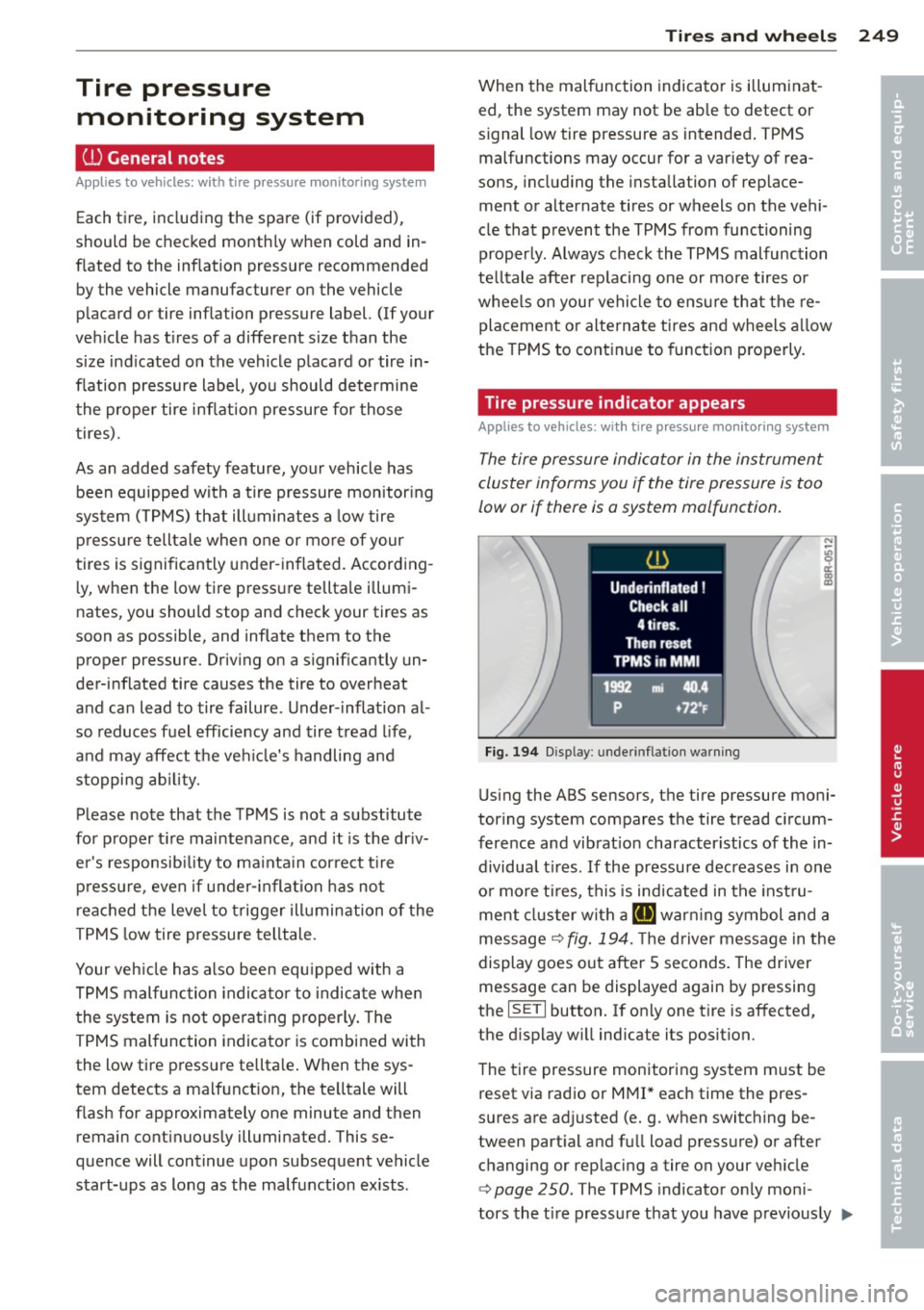
Fi g. 194 D isp lay: un de rin flat io n warni ng
U sing the ABS sensors, the tire pressure mo ni
toring system compares the tire tread c ircum
ference and vib rat ion character istics of the in
dividua l tir es . If the pressure decreases i n one
o r more t ires, this is indicated in the inst ru
ment cluster with a
RI] war ning symbol and a
message ¢
fig. 194. T he d river message in the
display goes o ut afte r 5 seconds . The driver
message can be displayed again by pressing
the
ISE TI button. If only one t ire is affected,
the d isplay w ill indicate its position.
T he tire pressure monitoring system m ust be
reset via radio or M MI* each time the pres
sures are ad justed (e.g. when switc hing be
tween part ial and f ull load pressure) o r after
changing or rep lacing a tire on your ve hicle
¢
page 250. T he TPMS indicato r o nl y mo ni-
tors the t ire p ress ure t hat yo u have p revio usly ..,.
•
•