brakes AUDI S4 2014 Owner's Manual
[x] Cancel search | Manufacturer: AUDI, Model Year: 2014, Model line: S4, Model: AUDI S4 2014Pages: 296, PDF Size: 73.56 MB
Page 204 of 296
202 Trailer towing
Tire pressure
When towing a trailer, inflate the tires of your
vehicle to the cold tire pressure listed under
"Full load" on the label located on the driver's
side B-pillar (visible when the door is open).
Inflate trailer tires to trailer and tire manufac
turers' specifications.
Lights
The headlight settings should be checked with
the trailer attached before driving off. Check
to make sure both vehicle and trailer lights
are working properly.
Safety chains
Be sure trailer safety chains are properly con
nected from the trailer to the hitch on the ve
hicle. Leave enough slack in the chains to per
mit turning corners. When you install safety
chains, make sure they will not drag on the road when you are driving.
The chains should cross under the trailer
tongue to prevent it from dropping in case of
separation from the hitch.
Driving instructions
Driving with a trailer always requires extra
care and consideration.
To obtain the best possible handling of vehicle
and trailer, please note the following:
.,. Do not tow a loaded trailer when your car it
self is not loaded.
.,. Be especially careful when passing other
vehicles.
.,. Observe speed limits .
.,. Do not drive at the maximum permissible
speed.
.,. Always apply brakes early.
.,. Monitor the temperature gauge.
Weight distribution
Towing a loaded trailer with an empty car re
sults in a highly unstable distribution of
weight . If this cannot be avoided, drive at very
low speeds only to avoid the risk of losing
steering control. A "balanced" rig is easier
to operate and con
trol. This means that the tow vehicle should be loaded to the extent possible and permissi
ble, while keeping the trailer as light as possi
ble under the circumstances. Whenever possi
ble, transfer some cargo to the luggage com
partment of the tow vehicle while observing
tongue load requirements and vehicle loading
considerations.
Speed
The higher the speed, the more difficult it be
comes for the driver to control the rig. Do not
drive at the maximum permissible speed. Re
duce your speed even more if load, weather or
wind conditions are unfavorable -particularly
when going downhill.
Reduce vehicle speed
immediately if the trail
er shows the slightest sign of swaying .
Do not
try to stop the swaying by accelerating.
Observe speed limits. In some areas, speeds
for vehicles towing trailers are lower than for
regular vehicles .
Always apply brakes early. When driving downhill, shift into a lower gear to use the en
gine braking effect to slow the vehicle . Use of
the brakes alone can cause them to overheat
and fail.
Coolant temperature
The coolant temperature gauge c> page 10
must be observed carefully . If the needle
moves close to the upper end of the scale, re
duce speed immediately and/or turn off the
air conditioner.
If the coolant temperature warning light •
in the instrument cluster starts flashing, pull
off the road, stop and let the engine
idle for
about two minutes to prevent heat build-up .
_& WARNING
Anyone not properly restrained in a mov
ing vehicle is at a much greater risk in an
accident. Never let anyone ride in your car
who is not properly wearing the restraints
provided by Audi.
-
Page 207 of 296
Vehicl e ca re a nd cl eanin g 205
A WARNING
-Only wash the vehicle when the ignition
is off and follow the instructions from
the car wash operator to reduce the risk of accidents .
- To reduce the r isk of cuts, protect your
self from sharp metal components when
wash ing the underbody or the inside of
t he wheel housings.
- After washing the vehicle, the braking ef
fec t may be delayed due to mo isture on
the brake rotors or ice in the winter. The
brakes must be dried first with a few
careful brake applications.
Q) Note
- If you wash t he vehicle in an automatic
car wash, yo u must fold the exterior m ir
rors in to reduce the r is k of damage to
the mirrors. Power folding exterior mir
rors* must only be folded in and out us
ing the power folding function.
- To prevent paint damage, do not wash
the vehicle in direct sunlight . -
To reduce the risk of damage to the sur
face, do not use insect removing spong
es, kitchen sponges or similar items.
- Matte finish painted vehicle compo
nents:
- To reduce the risk of damage to the surface, do not use polishing agents or hard wax.
- Never use car wash cycles that apply protective wax.
It can destroy the
matte fi nish effect.
- Do not place any stickers or magnet ic
signs on vehicle parts painted w ith
matte fi nish paint. The paint cou ld be
damaged when the stickers o r magnets
are removed.
@ For the sake of the environment
Only wash the vehi cle in facilities spec ial ly
designed for that purpose . This will red uce
the risk of dirty water contam inated with
oil from entering the sewer system.
Cleaning and care information
When cleaning and caring for individual vehi
cle components, refer to the fo llow ing tables .
The information contained there is s imply rec
ommendations. For quest ions or for compo- nents
that are not listed, refer to an author
ized Audi dea ler or qualified workshop. A lso
fo llow the information found inc>,& .
Cle anin g exter ior
Component Situation Solution
Wiper b lades
Dirty i=> page 54, Cleaning windshield wiper blades
Headligh ts / Dirty Soft
sponge with a m ild soap solutional
tail light s
S ensor s/
Dirty Sensors: soft cloth with a solvent-free cleaning product
camera l enses Camera lenses: soft cloth with an alcohol-free cleaning
solution
Snow/ice Hand brush/solvent-free de-icing spray
Wheels Road sa lt Water
Brake dust Acid-free special cleaning solution
Exhau st t ail Road sa lt Water, cleaning solut ion suitable for sta inless steel, if
pi pes necessary
•
•
Page 226 of 296
224 Checking and filling
Brake fluid
Checking brake fluid level
The brake fluid level can be checked with a
quick glance .
N N ~ N
" (X) (0
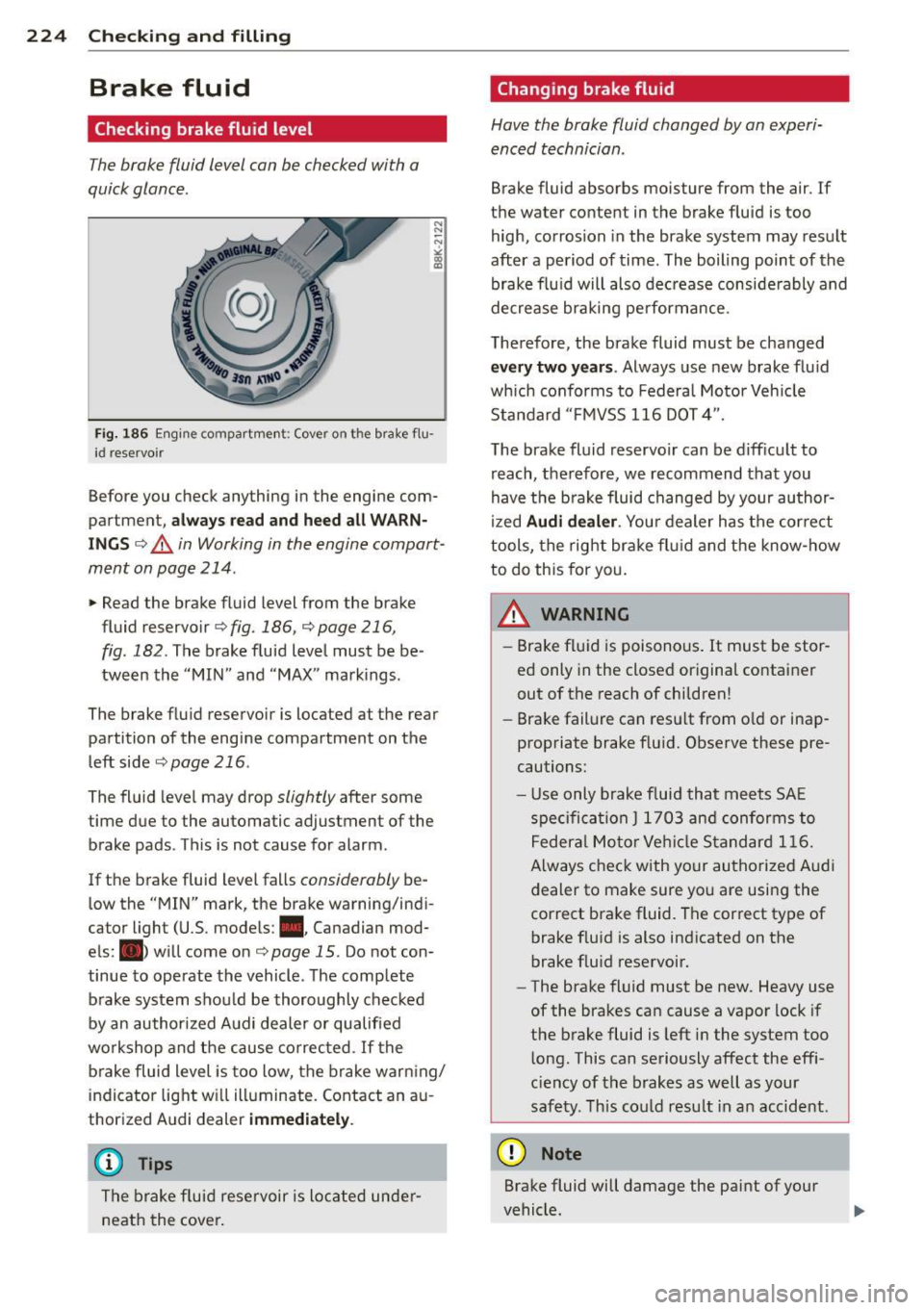
Fig. 186 Engine compart ment: Cover on the brake flu·
id reservo ir
Before you check anything in the engine com
partment,
always read and heed all WARN·
INGS ¢.&._ in Working in the engine compart
ment on page 214 .
.. Read the brake fluid level from the brake
fluid reservoir ¢
fig. 186, ¢ page 216,
fig . 182.
The brake fluid level must be be
tween the "MIN" and
"MAX" markings.
The brake fluid reservoir is located at the rear
partition of the engine compartment on the
left side
¢ page 216.
The fluid level may drop slightly after some
time due to the automatic adjustment of the
brake pads . This is not cause for alarm.
If the brake fluid level falls
considerably be
low the "MIN" mark, the brake warning/indi
cator light (U.S. models: ., Canadian mod
els: .) will come on¢
page 15. Do not con
tinue to operate the vehicle . The complete
brake system should be thoroughly checked
by an authorized Audi dealer or qualified
workshop and the cause corrected .
If the
brake fluid level is too low, the brake warning/
indicator light will illuminate. Contact an au
thorized Audi dealer
immediately .
@ Tips
The brake fluid reservoir is located under
neath the cover.
Changing brake fluid
Have the brake fluid changed by an experi
enced technician .
Brake fluid absorbs moisture from the air. If
t he water content in the brake fluid is too
high, corrosion in the brake system may result
after a period of time . The boiling point of the
brake flu id will also decrease conside rably and
decrease braking pe rformance.
Therefore, the brake fluid must be changed
every two years . Always use new brake flu id
which conforms to Federal Motor Vehicle
Standard "FMVSS 116 DOT 4".
The brake fluid reservoir can be difficult to reach, therefore, we recommend that you
have the brake fluid changed by your author
ized
Audi dealer. Your dealer has the correct
tools, the right brake fluid and the know-how
to do this for you .
A WARNING
- Brake fluid is poisonous . It must be stor
ed only in the closed original container
out of the reach of children!
- Brake failure can resu lt from o ld or inap
propriate brake fluid. Observe these pre
cautions:
- Use only brake fluid that meets SA E
specification
J 1703 and conforms to
Federal Motor Vehicle Standard 116.
Always check with your authorized Audi
dealer to make sure you are using the
correct brake fluid. The correct type of
brake f luid is also indicated on the
brake fluid reservoir.
- The brake fluid must be new. Heavy use
of the brakes can cause a vapor lock if
the brake fluid is left in the system too
long . This can seriously affect the effi
c iency of the brakes as well as your
safety. This could resu lt in an accident.
(D Note
Brake fluid will damage the paint of your
vehicle .
Page 233 of 296
-Never mount used tires on yo ur vehicle if
yo u are not sure of their "previous histo
ry." Old used tires may have been dam
aged even though the damage cannot be
seen that can lead to sudden tire failure
and loss of vehicle control.
- If you notice unusual vibration or if the
vehicle pulls to one side when d riving, al
ways stop as soon as it is safe to do so
and check the wheels and tires for dam
age .
(D Note
-Please note that summer and winter
tires are designed for the cond itions that
are typ ic al in those seasons. Aud i recom
mends using w inter t ires du ring the win-
Glossary of tire and loading terminology
Accessory weight
means the comb ined weight (in excess of
those standard items which may be replaced)
of automatic tra nsmission, power steering,
power brakes, power windows, power seats,
radio, and heater, to the extent that these
items are availab le as factory-installed equip
ment (whether installed or not) .
Aspect ratio
means the ratio of the height to the width of
the tire in percent . Numbers of 55 or lower in
d icate a low sidewall for improved steering re
sponse and better overall handling on dry
pavement .
Bead
means the pa rt of the ti re that is made of
steel wires, wrapped or reinforced by ply cords
and that is shaped to fit the rim.
Bead s eparation
means a b reakdown of the bond between
components in the bead.
Cord
means the strands forming the plies in the
tire.
Tire s an d wheel s 231
ter months . Low temperatu res signifi
cantly decrease the elastic ity of summer
t ires, which affects traction and braking
ability. If summer tires are used in very
co ld temperatures, cracks can form on
the tread bars, res ulting in permanent
ti re damage that can cause loud drivi ng
noise and unbalanced tires. Aud i is not
responsib le for this type of damage.
- Burn ished, polished or chromed rims
must not be used in winter weather. Th e
surfa ce of the rims does not have suffi
c ien t cor rosion pro te cti on for this and
c o ul d be pe rmanen tly damaged by road
salt or similar substances. This damage
is not covered by warranty.
Cold tir e inflation pressure
me ans the t ire press ure re commended by the
vehicle manufacturer fo r a tire o f a des igna ted
size that has not bee n driven for more than a
couple of miles (k ilomete rs) at low speeds in
the three hour pe riod before the tire press ure
is measured or adjusted.
Curb weight
means the weight o f a motor vehicle with
standard equipment including the maximum
capacity of fuel, o il, and coolant, air cond i
tion ing and additional weight of optiona l
equipment.
E xtra load tire
means a tire design to operate at higher loads
and at higher inflation pressures than the cor
responding standard tire. Extra load tires may
be identified as "XL", "xl", "EXTRA LOAD", or
"RF" on the sidewall.
Gross Axle Weight Rating ("GAWR")
means the load-carrying capacity of a single
axle system, measured at the tire-ground in-
ter~ces .
~
•
•
Page 234 of 296
232 Tires and wheels
Gross Vehicle Weight Rating ("GVWR" )
means the maximum total loaded weight o f
the vehicle.
Groove
means the space between two adjacent tread
ribs.
Load rating (code)
means the maximum load that a tire is rated
to carry for a given inflat ion pressure. You
may not find this informat ion on all tires be
cause it is not requ ired by law .
Ma ximum load rating
means the load rating for a t ire at the maxi
mum permissible inflation pressure for that
tire .
Maximum loaded vehicle weight
means the sum of:
(a) Curb weight
(b) Accessory weight
(c) Vehicle capacity we ight, and
(d) Production opt ions weight
Maximum (permissible) inflation pressure
means the maximum cold inflation pressure
to which a tire may be inflated . Also called
"maximum inflation pressure."
Normal occupant weight
means 150 lbs. (68 kilog rams) times the
number of occupants seated in the vehicle up
to the tota l seating capacity of your vehicle.
Occupant distribution
means dist ribution of occupants in a veh icle.
Outer diameter
means the overall diameter of an inflated new
tire.
Overall width
means the linear distance between the exteri
ors of the sidewalls of an inflated tire, includ
ing elevations due to labeling, decorations, or
protective bands or ribs .
Ply
means a layer of rubbe r-coated parallel cords.
Production options weight
means the combined weight of those installed
regular production opt ions we ighing over 5
lbs. ( 2.3 kg) in excess of those standa rd items
wh ich they replace, not previously cons idered
in curb weight or accessory weight, including
heavy duty brakes, ride levelers, roof rack,
heavy duty battery, and special tr im.
Radial ply tire
means a pneumat ic tire in which the ply cords
that extend to the beads are laid at substan
tially 90 deg rees to the center line of the
tread.
Recommended inflation pressure
see c:::> page 231, Cold tire inflation pressure .
Reinforced tire
means a tire design to operate at higher loads
and at higher inflation pressures than the cor
responding standard tire. Reinforced tires
may be identified as "XL", "xl", "EXTRA LOAD",
or "RF" on the sidewall.
Rim
means a metal support for a tire or a t ire and
tube assembly upon which the tire beads are
seated .
Rim diameter
means nominal diameter of the bead seat. If
you change your wheel s ize, you w ill have to
purchase new tires to match the new rim di
ameter .
Rim size designation
means rim diameter and width.
Rim width
means nom inal distance between rim flanges.
Sidewall
means that portion of a tire between the
tread and bead .
Page 238 of 296
236 Tires and wheels
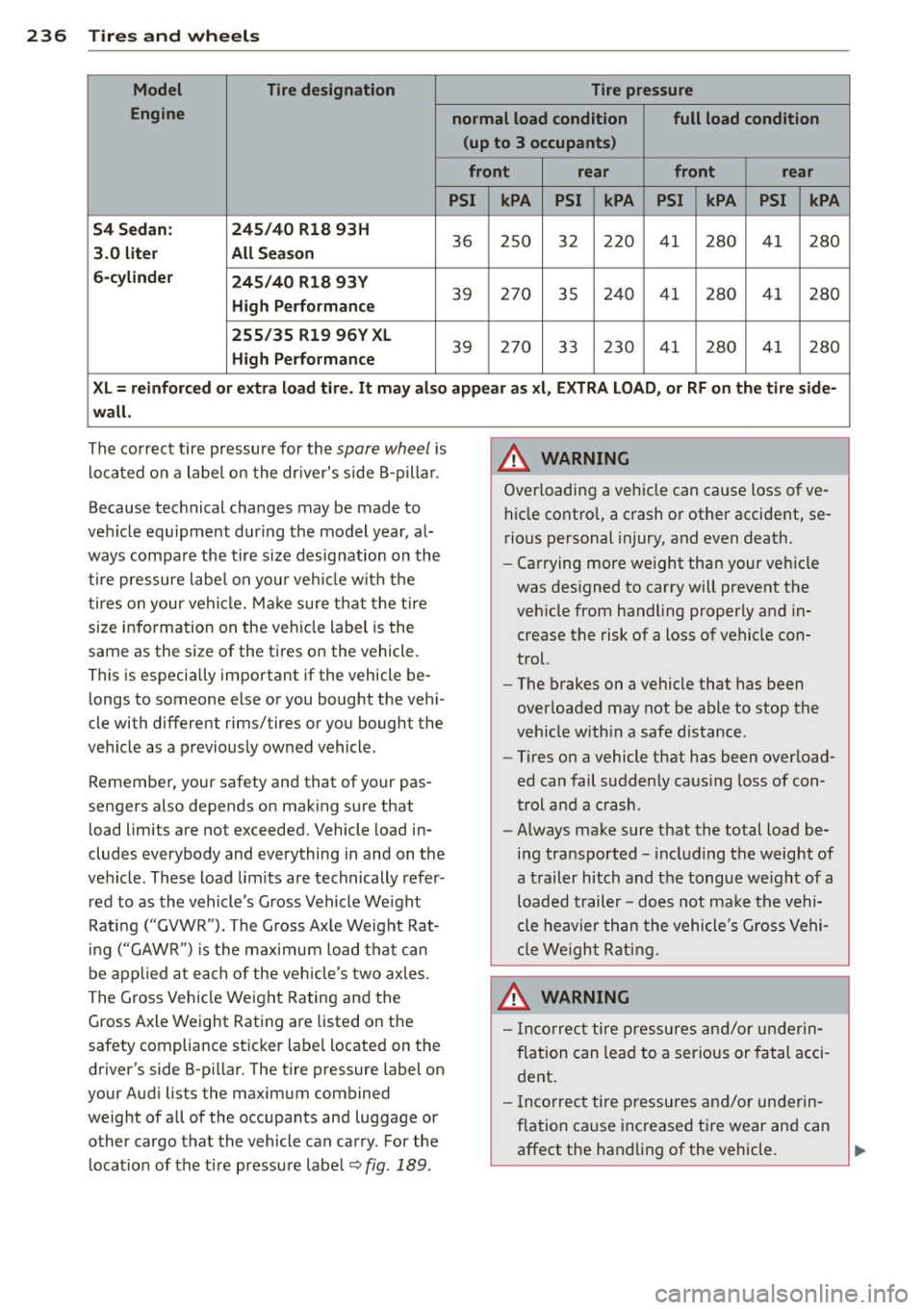
Model Tire designation Tire pressure
Engine normal load condition full load condition
(up to 3 occupants)
front rear front rear
PSI kPA PSI kPA PSI kPA PSI kPA
S4 Sedan : 245/40 Rl8 93H
36 250 32 220 41
280 41
280 3.0 liter All Sea son
6-cylinder 245/40 Rl8 93V
High Performance
39 270 3 5 24 0 41 28 0 41 280
255/35 Rl9 96V XL
39 270
33 230 41
280 41 280 High Perfo rmance
XL= reinforced or extra load tire. It may al so appear a s xl , EXTRA LOAD, or RF on the tire side-
wall.
The correct tire pressure for the spare wheel i s
l o cated on a label on the dr ive r's side B-p illa r.
Because tec hnical cha nges may be made to
ve hicle equ ipment dur ing the model yea r, a l
ways compa re the tire size designation on the
tire pressure labe l o n you r ve hicl e w it h the
tires on your vehicle. M ake s ure that the t ire
size info rmation on the veh icle label is the
same as the size of the t ire s on the vehicle.
This is especially important if the vehicle be
l ongs to someone else or you bought the veh i
cle with different rims/tires or you boug ht the
ve hicle as a p reviously owned vehicle.
Remembe r, your safety and that of your pas
sengers also depends on mak ing s ure that
load limits are not exceeded. Vehicle load in
cludes everybody and everything in and on the
ve hicle . These load lim its are technically refer
red to as th e vehicle's G ross Vehicle We ight
Rati ng ("GVWR"). The G ross Ax le Weight Rat
i ng ("GA WR") is the ma ximum load tha t can
be applied at each o f the veh icle's two axles.
T he G ross Vehicle We ig ht Rating and the
Gross Axle Weight Rating a re listed on the
safety compliance st ic k er labe l located on the
driver's side B-p illar. The tire pressure label on
your Aud i lists the maximum combined
weight of all of the occupants and luggage or
o ther cargo tha t the vehicl e can carry. For the
l ocat io n of the ti re pressu re labe l~
fig . 189 .
A WARNING
Overloadin g a vehicle can cause loss of ve
hi cle cont ro l, a c rash or other accident, se
rious pe rsonal injury, and even death.
- Ca rrying more we ight tha n your ve hicle
was des igned to carry will prevent the
veh icle from handling properly and in
crease the risk of a loss of vehicle con
trol.
- The brakes on a vehicle that has been
overloaded may not be able to stop the
ve hicle w ith in a safe distanc e.
- Tires on a vehicle that has been overload
ed can fail s uddenly ca us ing loss of con
trol and a crash.
- Always make sure that the total load be
i n g transported -including t he weight of
a trailer hitch and t he tongue we igh t of a
loaded tr ail er -does not ma ke t he ve hi
cle he avier th an the vehicle' s Gro ss V ehi
cle Weigh t Ra tin g.
.8_ WARNING
- In co rrec t tire pressure s and /or u nderin
fl ation can lead to a serio us or fatal acci
dent .
- I nco rrec t tire pressures an d/or un derin
fla tion ca use increased ti re wear an d can
affect the handling of the vehicle. .,.
Page 241 of 296
not exceeded . Vehicle load includes everybody
and everything in and on the vehicle. These
l oad limits are techn ica lly referred to as the
ve hicle's
Gross Veh icle We ight Rat ing
("GVWR").
The "GVWR" includes the weight of the basic
veh icle, all factory insta lled accessories, a full
tank of fu el, oil, coolant and other fluids plus
maximum load. The maximum load includes
the number of passengers that the vehicle is
i n tended to carry ("seating capacity") with a n
assumed weight of 150 lbs . (68 kg) for each
passenger at a des igna ted sea ting pos ition
and the tota l we ight of any l uggage in the ve
h icle. If you tow a trailer, the weight o f the
trailer hitch and the tong ue weight of the
l oaded trailer must be included as part of the
veh icle load.
The
Gro ss A xle Weight Rating ("GAWR") is
the maximum load that can be applied at each
of the vehicle's two ax les.
The G ross Vehicle We ight Rating and the
Gross Axle Weight Rating are listed on the
safety compliance sticker labe l located on the
driver's side B -pi llar . Your Audi has 5 seating
positions, 2 in the front and 3 in the rear for
tota l seating capacity of 5. Each seating posi
tion has a seat belt¢
page 138, Safety belts.
The fact that there is an upper limit to your
veh icle's Gross Vehicle Weight Rating means
that the tota l weight of whatever is being car
ried in the vehicle (including the weight of a
trailer hitch and the tongue weight of the
loaded trailer) is limited. The more passen
ge rs in the veh icle or passengers who are
h eav ier than the standa rd weights assumed
mean that less weight can be ca rr ied as l ug
gage.
The tire pressure labe l on you r Audi also lists
the maximum combined we ight of all of the
oc cu pants and luggage o r othe r ca rgo that
the vehicle can carry . For the location o f the
l abe l
¢page 234, fig. 189.
Tires an d wheel s 239
A WARNING
Overloading a vehicle can cause loss of ve
h icle contro l, a crash or other accident, se
rious pe rsonal injury, and even death.
- Carrying more we ight than your veh icle
was des igned to carry will prevent the
veh icle from handling properly and in
crease the risk of the loss of vehicle con
trol.
- The brakes on a vehicle that has been
overloaded may not be able to stop the
veh icle w ith in a safe distance.
- Tires on a vehicle that has been overload
ed can fail suddenly, incl uding a blowout
and sudden defla tion, causing loss of
contro l and a crash.
- Always ma ke sure that the total load be
ing transpor ted - incl uding the weight of
a trailer hitch and the tongue weight of a loaded trailer -does not ma ke the vehi
cle heavier than the vehicle's Gross Vehi
cle We ight Rating.
Determining correct load limit
U se th e example below to ca l
culate the total weight of the
pa ssengers and lu ggage or oth
e r thing s that you pl an t o tran s
po rt so that you can make sur e
that your vehicle will not be
o verloaded.
Steps for Determining
Correct Load Limit
1 . Lo cate th e statement "THE
COMBINED WEIGHT OF O C
CUPANTS AND CARGO
SHOULD NE VER E XCE ED XXX
KG OR XXX LBS"on your vehi-
c le 's pla card (tire inflation ..,
•
•
Page 246 of 296
24 4 T ire s and wheel s
Tire pl y compo sit ion and materi als used
The numbe r of plies ind icates the n umber of
l ayers of rubber -coated fabric in the tire. In
general, the greater the number of p lies, the
more weight a tire can support . Tire manufac
turers also must indicate the materials in the
tire, wh ic h include steel, nylon, polyester, and
others.
M ax imum Load R ating
This number indicates the maximum load in
kilograms and pounds that can be carried by
the tire .
Tire quality grading for treadw ear ,
tr act ion, a nd t emper ature re sis tan ce
Tread wear, traction and temperature grades
c:> page245.
Max imum Permiss ibl e Inflation Pressur e
This numbe r is the greates t amo unt of air
p ress ure that sho uld ever be put in the ti re
under normal driving conditions .
A WARNING
-Us ing incorrect or unmatched tires and/
or wheels or improper tire and wheel
combinations can lead to loss of contro l,
co llision and serious persona l injury .
- Always use tires, rims and wheel bo lts
that meet the specifications of orig inal
factory-installed t ires or other combina
t ions that have been spec ifically ap
proved by the vehicle manufacturer.
- Tires age even if they are not be ing used
and can fail suddenly, especially at high
speeds. Tir es that are more than 6 years
o ld can only be used in an emergency
and then with special care and at lower
speeds.
- Never mount used ti res on yo ur vehicle if
yo u are not su re of their "previous histo
ry ." Old used tires may have been dam
aged even though the damage cannot be
seen that can lead to sudden tire failure and loss of vehicle control.
- All four wheels must be fitted with radia l
t ires of the same type, size (roll ing c ir- cumference) and the same tread pattern
.
Driving with different tires reduces vehi
cle handling and can lead to a loss of
control.
- If the spare tire is not the same as the
tires that are mounted on the vehicle -
for example with winter tires - only use
the spare t ire fo r a short pe riod of time
and d rive with extra care . Refit the nor
mal road wheel as soon as safely poss i
b le.
- Never d rive faster than the max imum
speed for which the tires on you r vehicle
are rated because tires that are dr iven
faster than their rated speed can fai l
suddenly .
- Overloading tires cause heat build-up,
sudden tire fa ilure, including a blowout
and sudden deflation and loss of cont ro l.
- Temperature grades apply to tires that are properly inflated and not over or un
de rinf lated .
- For technica l reasons it is not always
possible to use whee ls from other
veh icles -in some cases not even wheels
from the same veh icle model.
- If you install wheel trim discs on the ve
hicle wheels, make sure that the a ir flow
to the brakes is not blocked. Reduced air
f low to the brakes can them to overheat,
increas ing stopp ing distances and caus
ing a co llision.
- Run flat tires may only be used on veh icles that were equipped with them
at the factory. The veh icle must have a
chassis designed for run flat tires and a
f a ctory -inst alled tire pressure monitor
ing sys tem * that indicates a loss of tire
pressu re . I ncorrect use of run flat tires
can lead to vehicle damage or accidents.
Check with an authorized Audi dealer or
tire specialist to see if your vehicle can be
equ ipped w ith run flat t ires. If run flat
tires are used, they must be installed on
all fo ur wheels . Mix ing tire types is not
pe rm itted.