fuel AUDI S4 2014 Owner's Guide
[x] Cancel search | Manufacturer: AUDI, Model Year: 2014, Model line: S4, Model: AUDI S4 2014Pages: 296, PDF Size: 73.56 MB
Page 240 of 296
238 Tire s and whee ls
- Adjust the tire pressure to the load you are
carrying.
- Reinsta ll the va lve stem cap on the valve .
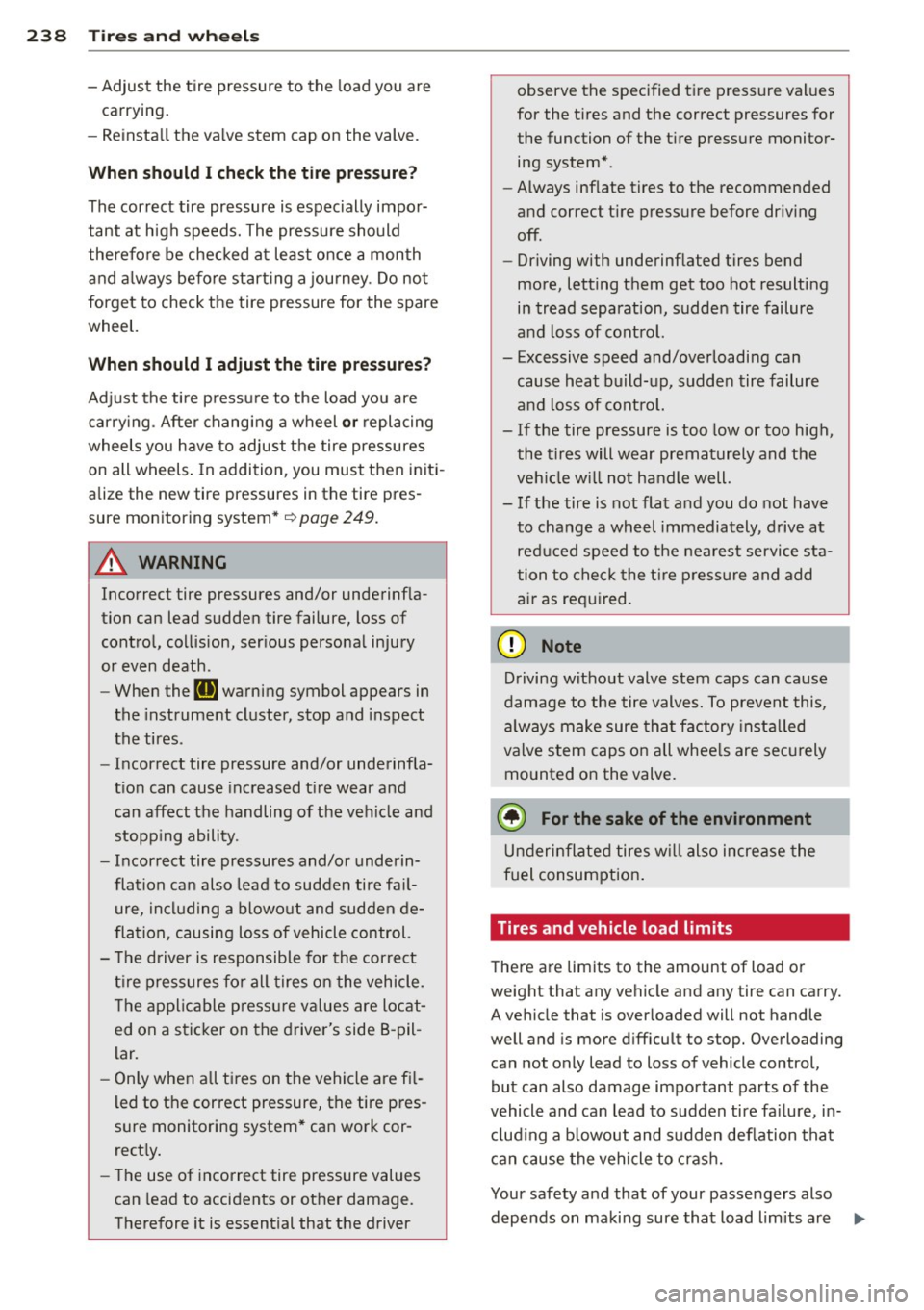
When should I ch eck the tire pres sur e?
The correct tire pressure is especially impor
tant at high speeds. The pressure should
therefore be checked at least once a month
and a lways before starting a journey. Do not
forget to check the tire pressure for the spare
wheel.
When should I adj ust the tire p re ss ures?
Adjust the tire pressure to the load you are
carry ing . After changing a wheel
o r replacing
wheels you have to adjust the tire pressures
on all wheels . In addition, you must then initi
alize the new tire pressures in the tire pres
sure monitoring system*~
page 249.
A WARNING
Incorrect tire pressures and/or underinf la
tion can lead sudden tire failure, loss of
control, collision, ser ious personal injury
or even death.
- When the
RI] warning symbol appears in
the instrument cluster, stop and inspect
the tires .
- Incorrect tire pressure and/or underinfla
t ion can cause increased t ire wear and
can affect the handling of the veh icle and
stopp ing ability.
- Incorrect tire pressures and/or underin
flation can also lead to sudden tire fa il
ure, including a blowout and sudden de
flation, causing loss of vehicle control.
- The driver is responsible for the correct
t ire pressures fo r all tires on the vehicle .
T he applicable p ressure va lues are locat
ed on a sticker on the driver's side B-pil
lar.
- Only when a ll ti res on the vehicle are fi l
led to the correct pressure, the tire pres
sure monitoring system* can work cor
rect ly.
- The use of incorrect tire pressure values
can lead to accidents or other damage.
Therefore it is essential that the driver observe the specified t
ire pressure values
for the tires and the correct pressures for
the function of the ti re pressure monitoring system*.
- Always inflate tires to the recommended
and correct t ire pressure before dr iv ing
off.
- Driving with underinflated tires bend
more, letting them get too hot resulting
in tread separation, sudden tire failure
and loss of control.
- Excessive speed and/overloading can
cause heat build-up, sudden tire failure
and loss of cont rol.
- If the tire pressure is too low or too high,
the t ires will wear prematurely and the
veh icle w ill not handle well.
- If the tire is not flat and you do not have
to change a wh eel immediately, drive at
reduced speed to the nearest service sta
tion to check the t ire p ressure and add
air as required.
Q) Note
D riving without valve stem caps can cause
damage to the tire valves. To prevent this,
a lways make sure tha t factory insta lled
valve stem caps on all whee ls are sec urely
mounted on the valve.
@ For the sake of the environment
U nderinflated tires w ill also incre ase the
fuel consumption .
Tires and vehicle load limits
There are limits to the amount of load or
weight that any veh icle and any tire can carry.
A vehicle that is over loaded will not handle
well and is more d iff icult to stop. Overloading
can not only lead to loss of vehicle control,
but can also damage important parts of the
vehicle and can lead to sudden tire fa ilure, in
clud ing a b lowout and sudden deflation tha t
can cause the vehicle to crash.
Your safety and that of your passengers also depends on making sure that load limits are .,..
Page 248 of 296
24 6 T ire s and whee ls
Winter tires
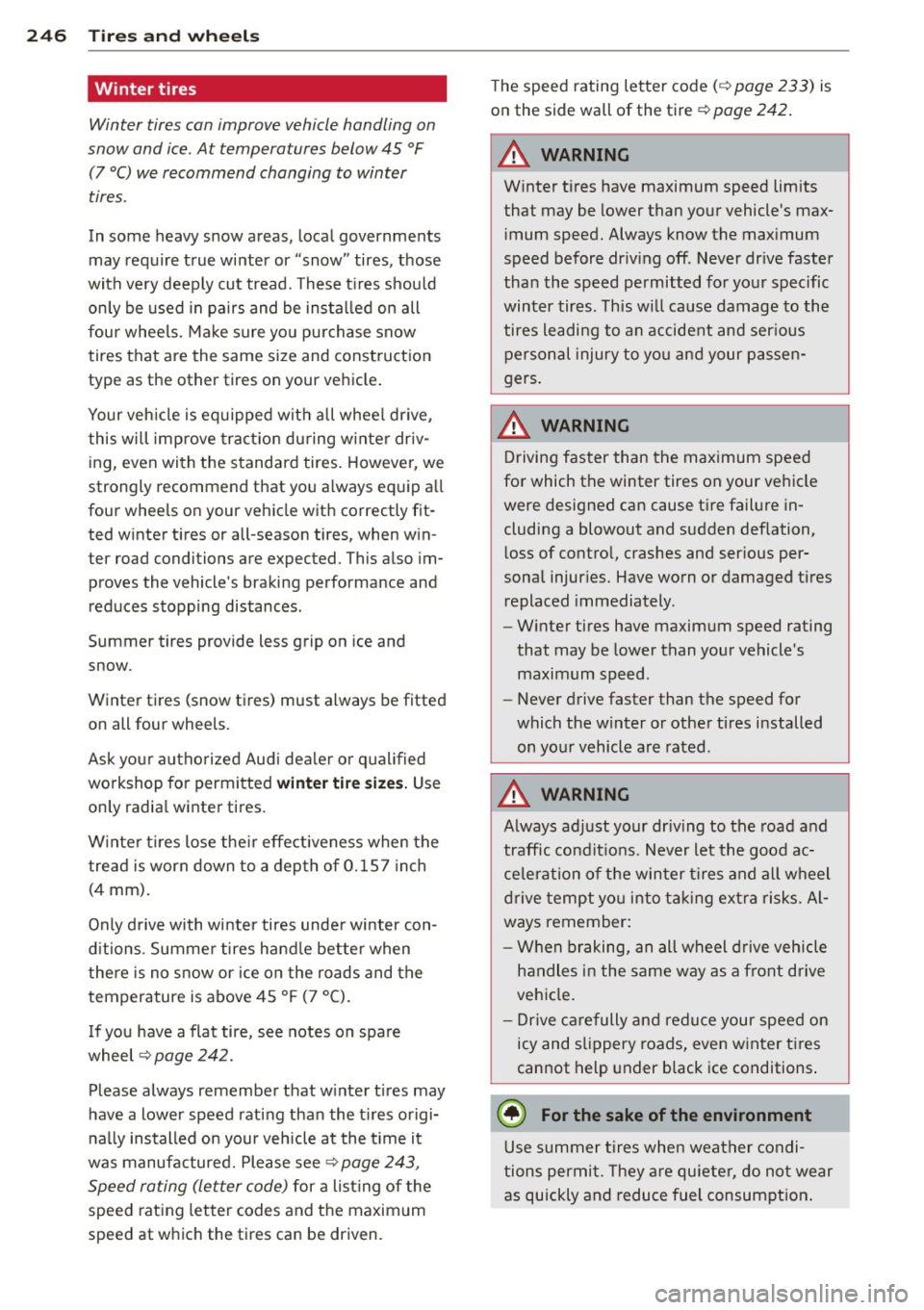
Winter tires can improve vehicle handling on
snow and ice . At temperatures below 45 °F
(7 °C) we recommend changing to winter
tires.
In some heavy snow areas, local governments
may require true winter or "snow " tires, those
with
very deeply cut tread. These t ires shou ld
only be used in pairs and be installed on all
four wheels. Make sure you pu rchase snow
tires that are the same size and const ruction
type as the other tires on your vehicle.
Your veh icle is equipped with all whee l drive ,
this wi ll improve tract ion du ring w inter driv
ing,
even with the standard tires. However, we
strongly recommend that you a lways equip a ll
four wheels on you r vehicle with correctly fit
ted winter tires or all -se ason tires, when w in
t e r r oad conditions are expected . This also im
proves the vehicle's braking performance and
reduces stopping distances .
Summe r tires provide less grip on ice and
snow.
Winter tires (snow tires) must always be fitted
on all four wheels.
Ask your autho rized Aud i dea ler or qualified
workshop for permitted
wi nter tir e si zes . Use
only radia l winter tires.
W inter t ires lose the ir effectiveness when the
tread is worn down to a depth of
0.15 7 inch
(4 mm).
Only drive with winter tires unde r winter con
d itions . Summer tires hand le better when
there is no snow or ice on the roads and the
temperature is
above 45 °F (7 °C).
I f you have a flat tire, see notes on spare
wheel
9 page 242.
Please always remember that w inter t ires may
have a lower speed rating than the t ires origi
na lly installed on your vehicle at the t ime it
was manufactured. Please see
9 page 243,
Speed rating (letter code)
for a List ing of the
speed rating letter codes and the maxim um
speed at which the tires can be driven . The speed rating letter code
(
¢ page 233) is
on the side wall of the tire
9 poge 242.
A WARNING ,-
Winter t ires have maximum speed limits
that may be lower than your vehicle's max
i mum speed. Always know the max imum
speed before dr iv ing off . Never dr ive faster
than the speed permitted for yo ur specific
winter tires. This wi ll cause damage to the
tires leading to an accident and ser ious
personal injury to you and your passen
gers .
A WARNING ,..___ -
Driving faster than the maximum speed
for which the winter tires on your vehicle
were designed can cause tire failure in
cluding a blowout and sudden deflation, loss of control, crashes and ser ious per
sonal injuries. Have worn or damaged tires
replaced immediately .
- W inter tires have maximum speed rating
that may be lower than your vehicle's
maximum speed .
- Never drive faster than the speed for
which the winter or other tires installed on yo ur vehicle are rated .
A WARNING
-Always adjust your dr iv ing to the road and
traffic condit ions . Never let the good ac
celeration of the winter t ires and al l wheel
drive tempt yo u into taking ext ra risks. Al
ways remember:
- When braking, an all wheel drive vehicle
handles in the same way as a front drive
vehicle .
- Drive ca refully and reduce your speed on
icy and slippery roads,
even w inter tires
cannot help under black ice conditions .
@ For the sake of the environment
Use summer tires whe n weather condi
tions permi t. T hey are qu ieter, do not wear
as quickly and reduce fuel consumption .
Page 251 of 296
Tire pressure monitoring system
UJ General notes
Applies to vehicles: with tire pressure monito ring system
Each t ire, i ncluding the spare (if provi ded),
should be chec ked month ly w hen cold and in
flated to the inflation pressure recommended by the vehicle manufacture r o n the vehicle
placar d or tire infla tion pressure label. (If your
veh icle has t ires of a diff erent siz e than the
size ind icat ed on the vehicle p lacard or tir e in
flation pressure label, you should deter mine
the proper tire inflation pressure for those
tires).
As an added safety feature, your vehicle has been equipped with a tire pressure monitor ing
system (TPMS) that illuminates a low tire
pr essu re tellta le when one or mo re of your
tires is significantly under -inflated . Accord ing
l y, when the low tire p ress ure telltale illumi
nates, you should stop and check your tires as
soon as possible, and inflate them to the
proper pressure. Driv ing on a signif icantly un
der-inflated tire causes the tire to overheat
and can lead to tire failure. Under -inflation al
so reduces fuel efficiency and tire t read life,
and may affect the ve hicle's handling and
stopping ab ility.
Please note that the TPMS is not a subst itute
for p roper t ire mainte nance , and it is the dr iv
e r's responsib ility to ma inta in cor re ct t ire
p ress ure, even if under- infla tion has no t
reached the leve l to trigger ill umin ation of the
TPMS low tire pressure telltale.
Your veh icle has also bee n equ ipped with a
TPMS malfunc tion indica to r to indica te when
the system is not opera ting properly. The
TPMS mal function indicato r is combined wi th
the low tire press ure tellta le . When the sys
tem detects a malf unct ion, the te lltale will
flash for approximately one minute and then remain cont inuo usly illuminated. This se
quence will continue upon subsequent vehicle
start-ups as long as the ma lf u nction ex ists .
Tire s an d wheel s 249
When the malfunction indicator is illum inat
ed , the system may not be ab le to detect or
s ignal low tire pressure as intended . TPMS
malfunctions may occur for a var iety of rea
sons, including the insta llation of replace
ment or alternate tires or wheels on the vehi
cle that p revent the TPMS from functioning
proper ly. Always check the TPMS malfunction
te lltale after rep laci ng one or more tires o r
whee ls on you r vehicle to e nsur e th at the re
placement or alterna te t ires and wheels a llow
the TPMS to continue to func tion p roperly.
Tire pressure indicator appears
Applies to vehicles: with tire pressure monitoring system
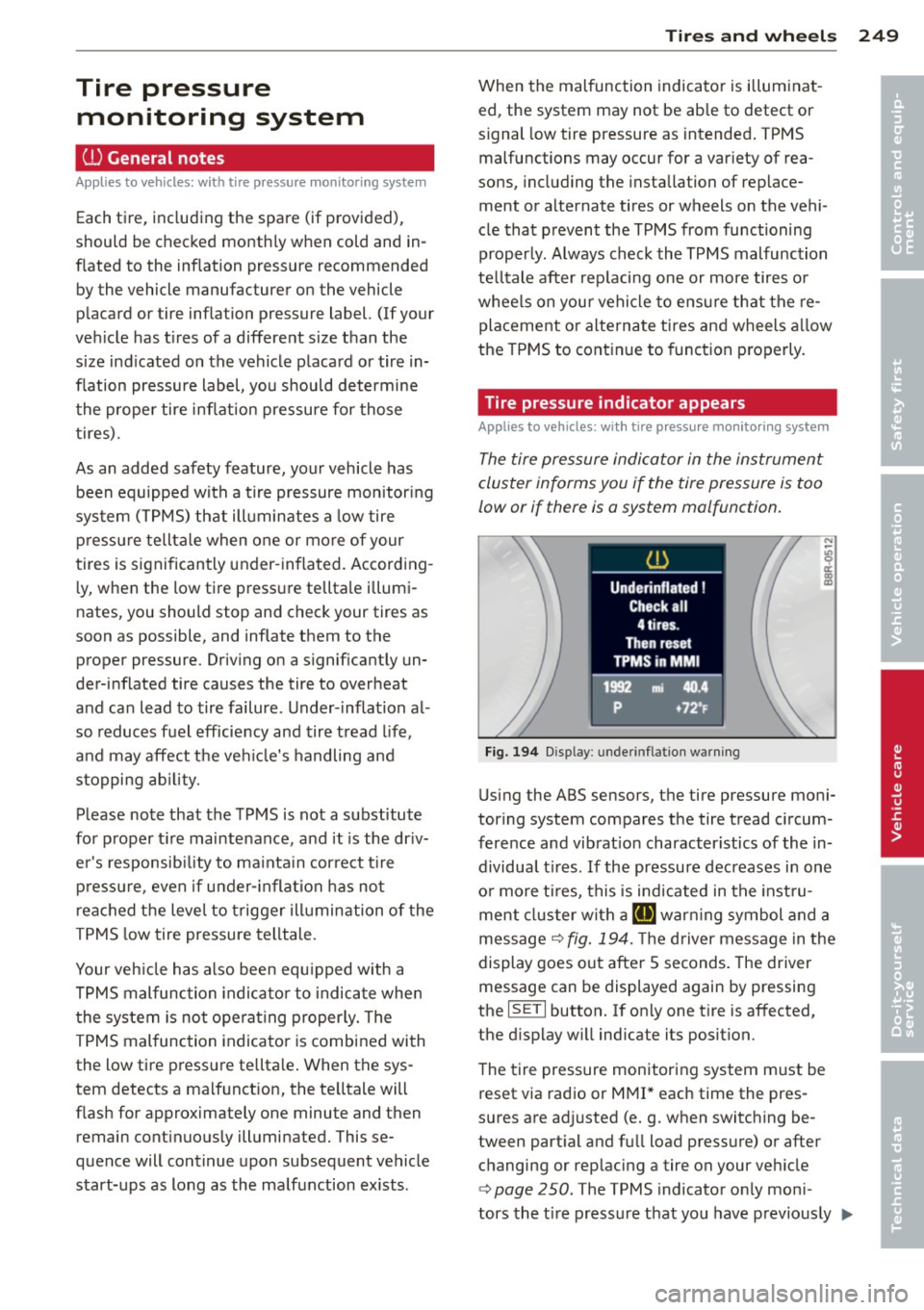
The tire pressure indica tor in the instrument
cluster informs you if the tire pressure is too
Low or if there is a system malfunction.
Fi g. 194 D isp lay: un de rin flat io n warni ng
U sing the ABS sensors, the tire pressure mo ni
toring system compares the tire tread c ircum
ference and vib rat ion character istics of the in
dividua l tir es . If the pressure decreases i n one
o r more t ires, this is indicated in the inst ru
ment cluster with a
RI] war ning symbol and a
message ¢
fig. 194. T he d river message in the
display goes o ut afte r 5 seconds . The driver
message can be displayed again by pressing
the
ISE TI button. If only one t ire is affected,
the d isplay w ill indicate its position.
T he tire pressure monitoring system m ust be
reset via radio or M MI* each time the pres
sures are ad justed (e.g. when switc hing be
tween part ial and f ull load pressure) o r after
changing or rep lacing a tire on your ve hicle
¢
page 250. T he TPMS indicato r o nl y mo ni-
tors the t ire p ress ure t hat yo u have p revio usly ..,.
•
•
Page 264 of 296
262 Fuses and bulb s
No. Consumer Amps No. Consumer Amps
A/C system pressure sensor, Two-door models: rear left
electromechanical parking window regulator; Four-
brake, Homelink, automatic
11 door models:
rear left door
30
3 dimming interior rear view
5 (window regulator, central
m irror, air quality/outside locking, switch, lighting)
air sensor, Electronic Stab ili-
12 Rain
and light sensor
5
zation Control (button)
5 Sound actuator 5
Fuse panel© (red)
6 Headlight
range control/
5/7,5
head light (corner ing light)
No . Consumer Amps
3 Lumbar support 10
7 Headlight (cornering light) 7,5
4 Dynamic steering
35
Contro l modu les (electro-
5 Interior lighting (Cabriolet)
5
8 mechanical parking brake,
5
shock absorber, quattro
sport), DCDC converter
9 Adaptive cruise contro l 5 6
W
indshield washer system,
35
headlight washer system
7 Vehicle electrical system
20
control module 1
10 Shift gate/clutch
sensor
5
11 Side ass ist 5
8
Vehicle electr ica l system
30
control module 1
12 Headlight range control,
5
park ing system 9 Left rear window regulator
7,5/20
motor (Cabriolet)/sunroof
13 Airbag 5
14 Rear wiper (allroad) 15 10
Vehicle e
lectrica l system
30
control module 1
15 Auxiliary fuse (instrument
10
pane l) 11 Right
rear window regulator
7,5/20
(Cabriolet)/sun shade motor
16 Aux
iliary fuse terminal 15
40
(engine area) 12 Anti-theft
alarm warning
5
system
Fuse panel @ (brown)
No. Consumer Amps
2 Brake light sensor 5
3 Fuel pump 25
4 Clutc h sensor 5
5 Left
seat heating with/with-
15/30
out seat ventilation
6 Electronic
Stabilization Con-
5
trol (electric)
7 Horn 15
Front left door (window reg-
8 ulator, centra I locking, mi r-
30
ror, switch, lighting)
9 Windshield wiper motor 30
10 Electronic Stabi
lizat ion Con-
25
trol (valves)
Page 274 of 296
272 Technical Data
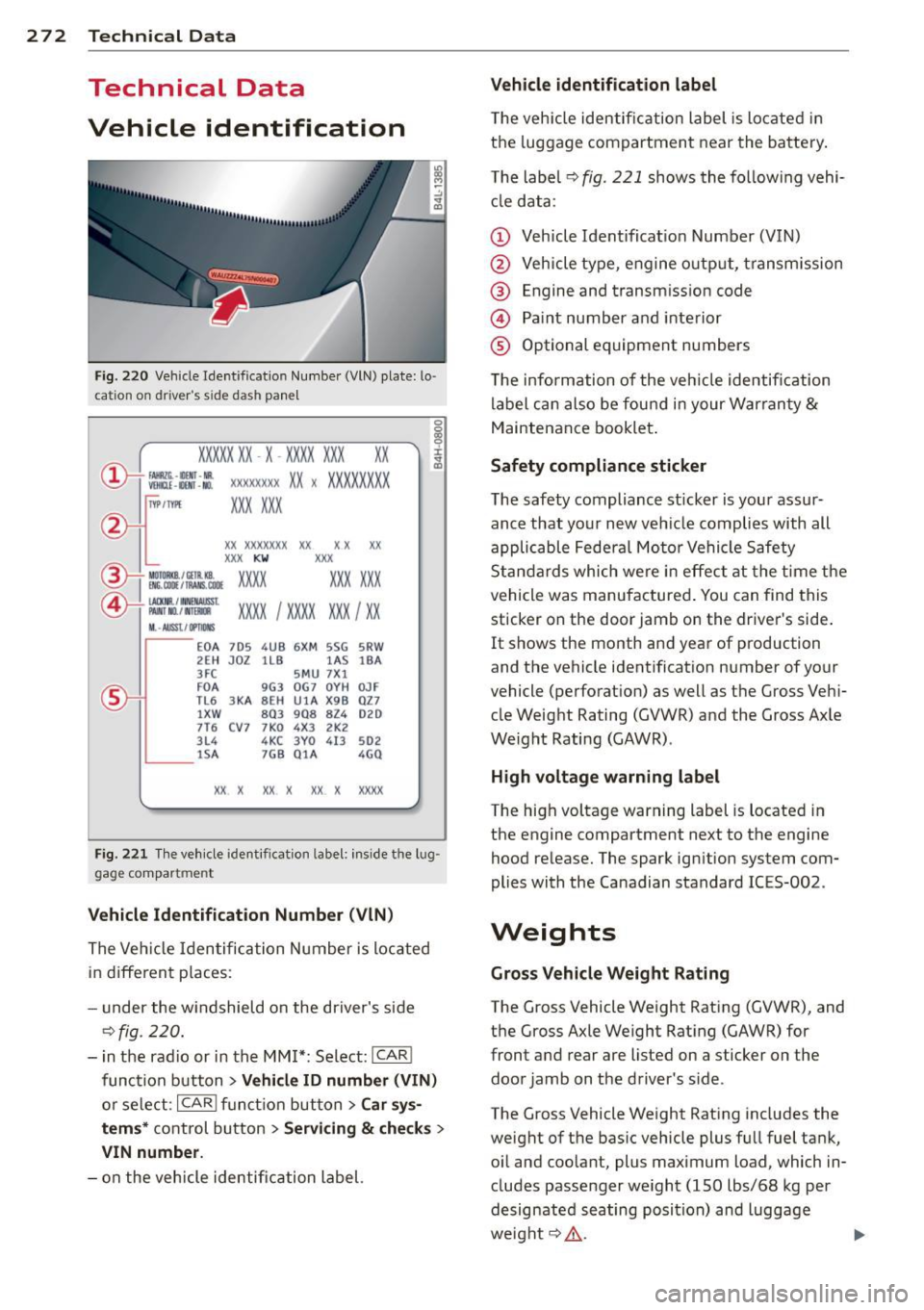
Technical Data
Vehicle identification
Fig . 220 Vehicle Ident ification Number (VlN) plate: lo ·
cation on driver 's s ide dash panel
XXXXX XX · X -XXXX XXX
r,"\__l f~ -11!111 · NII. ~ V!Hlll -llllll . NO.
xx
XXXXXXXX XX X XXXXXXXX
XXX XXX IYP IT'fl'E
XX XXXXXXX XX X X XX
XXX
KW XXX
®i ~~:f :l~~ XXXX XXX XXX
@+ ~~r= XXXX I XXXX XXX I XX M ,. AIIISl./ lflllllS
EOA 7D5 4 UB 6XM SSG 5RW
2E H JDZ llB l AS lBA
3FC 5MU 7Xl
FO A
9G3 OG7 O
YH OJF
TL6 3
KA BEH
UlA X9B QZ 7
l XW
8Q3 9Q8 82 4 020
7T6 CV 7 7KO 4X3 2K2
3L4 4 KC 3YO 4I3 502
lS A 7GB Q1A 4GQ
XX X
XX X XX X XXXX
Fig. 221 The vehicle identi fication label: ins ide the l ug
gage compart men t
Vehicle Identification Number (VlN)
The Vehicle Identification Number is located
in different pla ces :
- under the windshield on the driver's side
~fig. 220.
-in the radio or in the MM!": Select: I CAR!
function button >
Vehicle ID number (VIN)
or select: ICAR!function button> Car sys
tems* control button > Servicing & checks >
VIN number.
-on the vehicle identification label.
Vehicle identification label
The veh icle identification label is located in
the luggage compartment near the battery.
T he labe l~
fig. 221 shows the following vehi
cle data :
(D Vehicle Identificat ion Number (VIN)
@ Vehicle type, engine o utput, transmission
@ Engine and transm ission code
@ Paint number and interior
® Optional equipment numbers
T he information of the vehicle identification
label can also be found in your Warranty
&
Maintenance booklet.
Safety compliance sticker
The safety compliance sticker is your assur
ance that your new vehicle complies with all applicable Federal Motor Vehicle Safety
Standards which were in effect at the time the
vehicle was manufactured . You can find this
sticker on the door jamb on the driver's side .
It shows the month and year of production
and the vehicle ident ification number of your
vehicle (perforation) as well as the Gross Veh i
cle Weight Rating (GVWR) and the Gross Ax le
Weight Rating (GAWR) .
High voltage warning label
The high voltage warning label is located in
the engine compartment next to the engine
hood release. The spark ignition system com
plies with the Canadian standard ICES-002 .
Weights
Gross Vehicle Weight Rating
The Gross Vehicle Weight Rating (GVWR), and
the Gross Axle Weight Rating (GAWR) for
front and rear are listed on a sticker on the
door jamb on the driver 's s ide .
The Gross Vehicle Weight Rating includes the
weight of the basic vehicle plus full fuel tank,
o il and coolant, plus maximum load , which in
cludes passenger we ight (150 lbs/68 kg per
designated seating position) and luggage
we ight~ _&.
Page 275 of 296
Technical Dat a 273
Gros s Axle We ight Rating
The G ross Axle Weight Rating is the maxim um
l oad that can be applied at each axle of the
vehicle
c::> &. .
Vehicle capacity weight
The vehicle capac ity we ight (max. load) is list
ed on the d river 's side 8-p illar.
_& WARNING
- T he ac tual Gross Axle Weight Rat ing at
t he front and rea r axles sho uld not ex
ceed the perm issible weights, a nd their
combination must not exceed the G ross
Vehicle Weight Rat ing.
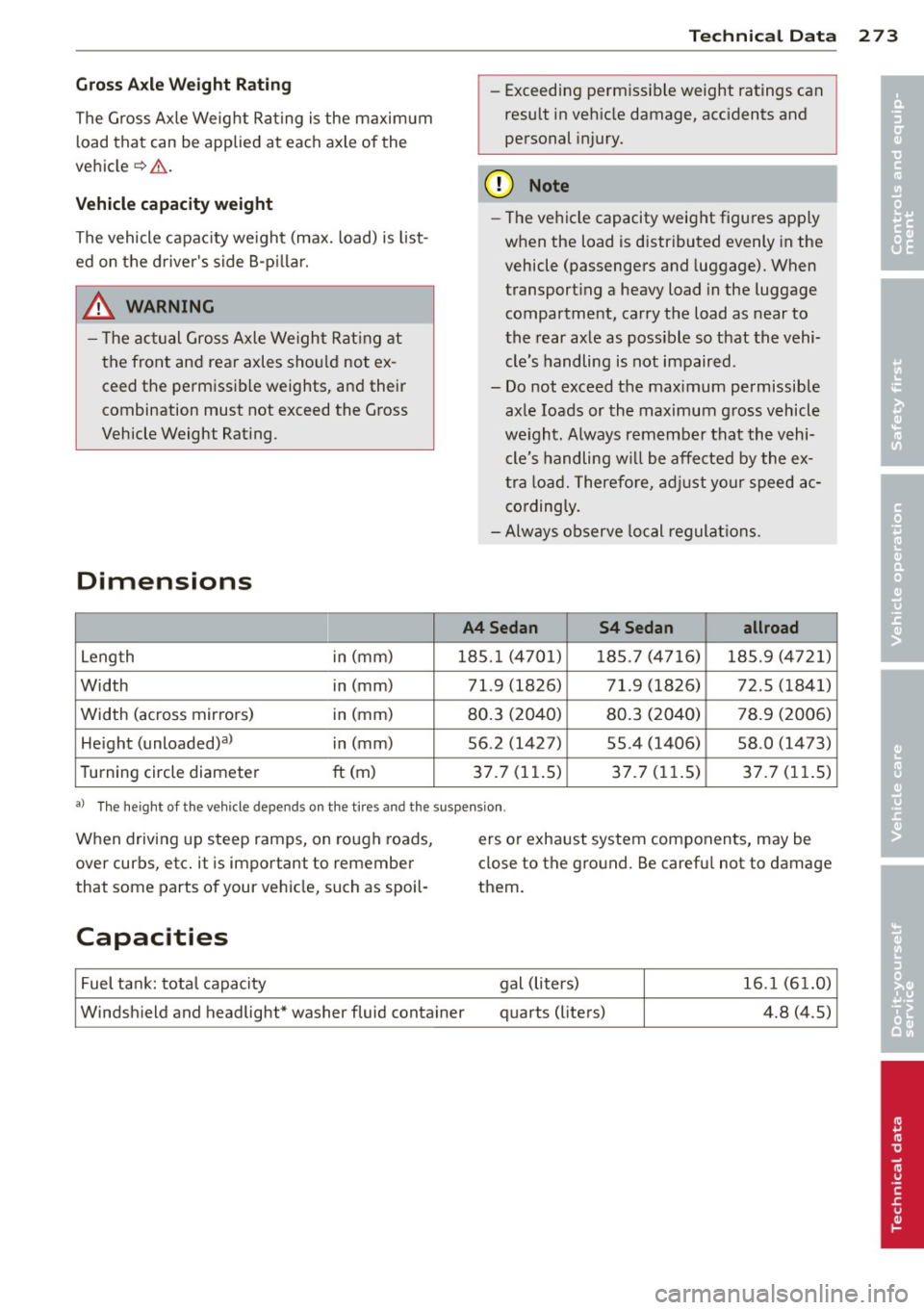
Dimensions
Leng th in (mm)
Width in (mm)
Width (across mir rors) in (mm)
He ight (unloaded)a) in (mm)
T urning circle diamete r
ft (m)
-
-Exceeding perm iss ible weight ratings can
result in veh icle damage, acc idents and
pe rsonal injury.
([) Note
-Th e ve hicl e capacity weig ht figu res apply
when the load is d istr ibuted evenly in the
vehicle (passengers and luggage). When
transport ing a heavy load in the luggage
compartment , carry the load as near to
t he rear ax le as poss ible so that the vehi
cle's handling is not impaired.
- Do not exceed t he maximum permissible
ax le loads or the maximum g ross vehicl e
we ight. A lways remember that the v ehi
cl e's handling w ill be affe cted by the ex
t ra lo ad. Therefo re, adju st yo ur speed ac
c o rding ly.
- Always o bserve loc al regulat io ns.
A4Sedan
S4Sedan allroad
1
85. 1 (4701) 185.7 ( 47 16 ) 1 85.9 (47 21)
71.9 (1826) 71.9 (1826) 72 .5 (1841)
80.3 (2 040) 80.3 (2 040) 78.9 (2 006)
56 .2 (1427) 55 .4 (1406) 58 .0 (1473)
37.7 (1 1.5) 37. 7 (11. 5) 37. 7 (11. 5)
aJ The heig ht of t he ve hicle depends on th e t ires and the suspensio n.
When driving up s teep ramps, on ro ugh roads,
over cur bs, etc . it is impo rtant to remembe r
that some parts of your ve hicle, such as spoil -
Capacities
Fuel ta nk: tota l capacity
Windsh ield and headlight* washer fluid container ers o
r exha ust system componen ts, may be
close to the ground. Be carefu l not to damage
them.
gal (liters) 16. 1 (6 1.0)
quarts (lite rs) 4.8 (4.5)
•
•
Page 276 of 296
274 Technical Dat a
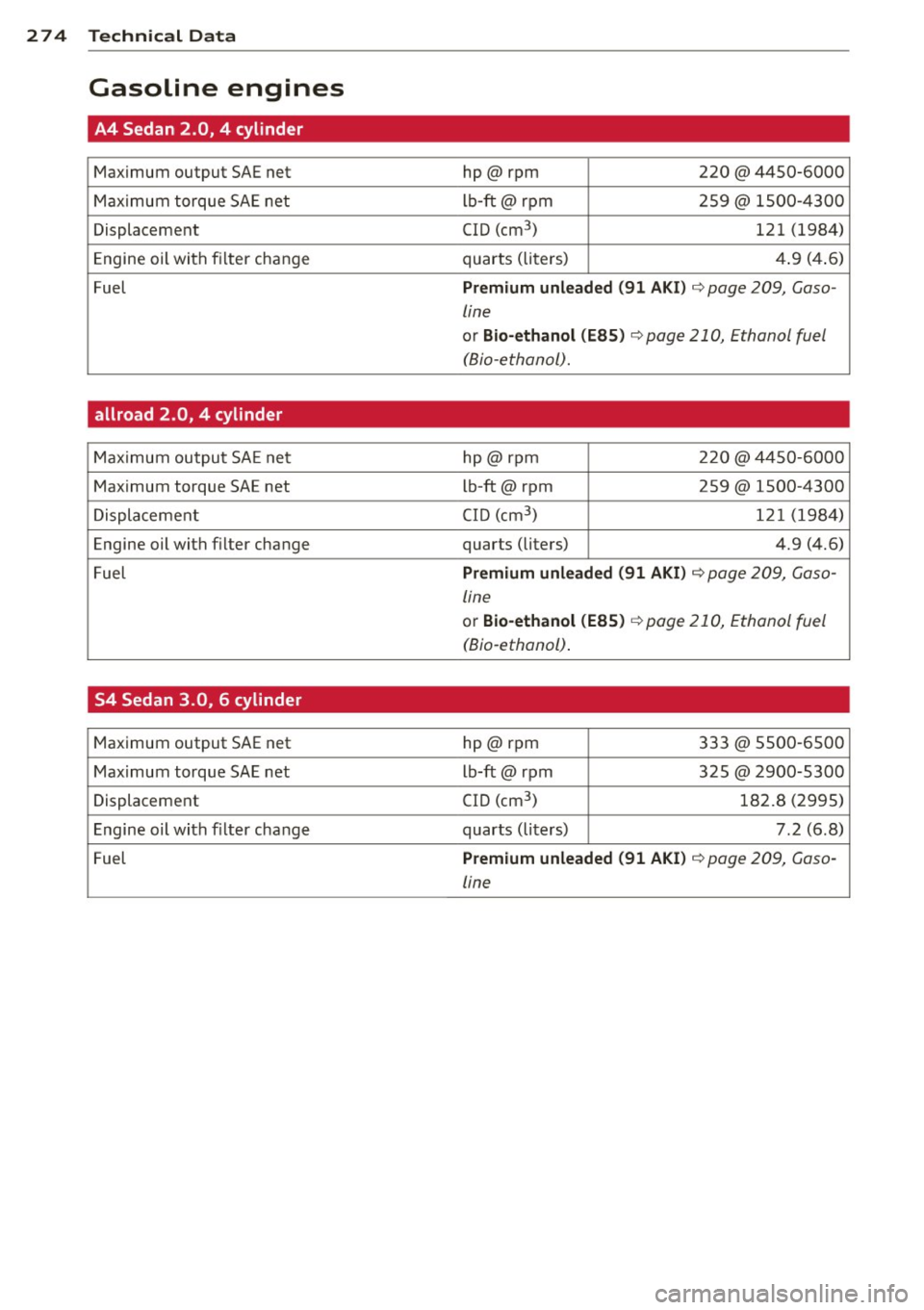
Gasoline engines
A4 Sedan 2.0, 4 cylinder
Maximum output SAE net hp@rpm 220 @ 4450-6000
Max imum torque SAE net Lb-ft@ rpm 259@ 1500-4300
Displacement CID (cm
3
) 121 (1984)
E ngine oil with f ilter change quarts (liters)
4.9 (4 .6)
Fuel
Premium unleaded (91 AKI) ¢ page 209, Caso-
line
or Bio-ethanol (E85 ) ¢ page 210, Ethanol fuel
(Bio-ethanol).
allroad 2.0, 4 cylinder
Max imum outpu t SA E net hp@rpm 220 @ 44 50-6000
Maximum torque SAE net Lb-ft@ rpm 259@ 1500-4300
Displacement C
ID (cm
3
) 12 1 (198 4)
Engine oil with filter change quarts (liters) 4.9 (4.6)
F uel
Premium unleaded (91 AKI) ¢ page 209, Caso-
line
o r Bio-ethanol (E85 ) ¢ page 210, Ethanol fuel
(Bio-ethanol) .
S4 Sedan 3.0, 6 cylinder
Maximum output SAE net hp@rpm 333@ 5500-6500
Max imum torque SAE net Lb-ft@ rpm 325@ 2900-5300
Displacement CI
D (cm
3
) 1 82.8 (2995)
E ngine oil with f ilter change quarts (liters) 7
.2 (6.8)
Fuel
Premium unleaded (91 AKI) ¢ page 209, Caso-
line
Page 277 of 296
Consumer Information
Warranty coverages
Your Audi i s cove red b y th e following w ar
ranties :
- New Vehicle Limited Warranty
- Limited Warranty Against Corrosion Perfo-
ration
- Emissions Control System Warranty
- Emissions Performance Warranty
- California Emissions Control Warranty (USA
vehicles only)
- California Emissions Performance Warranty
(USA vehicles only)
Detailed information regard ing yo ur warran
ties can be found in your
War ra nty & M ainte
nance booklet .
Operating your vehicle
outside the U.S.A. or
Canada
Government regu lations in the United States
and Canada require that a utomobiles meet
specific emission reg ulations and safety
standards . Therefore, ve hicles built for the
U.S.A. and Canada differ from vehicles sold in
other countries .
I f you p lan to take your vehicle outside the
continental limits of the United States or Can
ada, there is the possibility that:
- u nleaded fue ls for vehicles with cata lytic
converter may not be available;
- f uel may have a considerably lowe r oc tane
ra ting . Improper fue l may cause engine
damage;
- service may be inadequate due to lack o f
proper service facilities, tools or testing
equipment;
- replacement parts may not be readily availa
ble.
- Nav igat io n systems for vehicles built for the
U.S.A . and Canada will not necessari ly work
in Europe, and may not work in other coun
tries outside of North America.
Con sumer In formation 275
@ Note
A udi cannot be responsible for mechanical
damage that could result from inadequate
fuel, serv ice or parts availab ility.
Audi Service Repair
Manuals and Literature
Audi Offic ial Factory Service Manuals and L it
erature are published as soon as possib le after
model int roduct ion. Service manuals and lit
erat ure are available to o rder from the Audi
T echnical Literature O rderi ng Cente r at:
www.audi .te chliterature .com
Maintenance
' General
Your vehicle has been designed to help keep
maintenance requirements to a m inimum.
However, a certain amount of regu lar mainte
nance is still necessary to assure your vehicle's
safety, economy and reliability . For detai led
vehicle maintenance consult your Warranty
&
Maintenance booklet.
Under difficult op erating conditions , for ex
amp le at extreme ly low outside temperatures,
i n ve ry dusty regions, when towing a tra iler
very frequently, etc., some se rv ice work
shou ld be pe rformed between the intervals
specified. This applies particularly to :
- oil changes, and
- cleaning or replacing the air fi lter.
® For the sake of the environment
By regu larly maintaining your veh icle, you
help make sure that emission standards
are maintained, thus min imiz ing adverse
effects o n the environment .
Important considerations for you and
your vehicle
The increasing use of electronics, sophistica t
ed fuel i njection and emission contro l sys-
tems, and the genera lly increasing techn ica l ..,_
•
•
Page 279 of 296
-Always make sure the transm ission se
lector lever (automatic transmiss ion) is
in "P" (Park position) or Neutral (manual
transmission) and the park brake is firm
ly appl ied .
® For the sake of the environment
-Changing the eng ine settings w ill ad
versely affect em ission levels. This is det
rimental to the environment and increas
es fuel consumption .
- Always observe env ironmental regula
tions when d ispos ing of old engine oil,
used brake fluid, dirty engine coolant,
spent batter ies or worn out t ires.
- Undeployed airbag modules and p reten
s ioners might be classified as Perchlo
rate Material -special handling may ap
ply, see www.dtsc.ca .gov/hazardous
waste/perch lorate . When the veh icle or
parts of the restraint system including
airbag modules safety belts with preten
s ioners are scrapped, all applicable laws
and regulations must be observed. Your
authorized Audi dealer is familiar w ith
these requirements and we recommend
that you have your dealer perform this
serv ice for you .
Additional accessories,
modifications and
parts replacement
Additional accessories and parts
replacement
Always consult on authorized Audi dealer be
fore purchasing accessories.
Your veh icle incorporates the latest safety de
sign featu res ensu ring a high standard of ac
tive and passive safety.
This safety could be compromised by non-ap
proved changes to the veh icle. For this reason ,
if parts have to be replaced, p lease observe
the following points when installing addition
al accessories:
Con sumer In formation 2 77
Approved Audi accessories and genuine Audi
parts are available from authorized Audi deal
er.
T hese dea lers a lso have the necessary facili
ties, tools and trained specialists to install the
parts and accessories proper ly.
A WARNING
Using the wrong spare parts or using non
approved accessories can cause damage to
the vehicle and serious persona l injury.
- Use on ly accessories express ly approved
by Audi and genuine Audi spare parts
- These parts and accessories have been
specially designed to be used on your ve
hicle.
- Never install accessories such as tele
phone cradles or beverage holders on air
bag covers or within the airbag deploy
ment zones . Do ing so will increase the
risk of injury if a irbags are triggered in an
accident!
- Before you check anything in the engine
compartment, always read and heed all
WARNINGS ~
page 214.
(D Note
-If items other than genuine Audi spare
parts, add-on equipment and accessory
items are used or if repair work is not
performed accord ing to specified meth
ods, this can result in severe damage to
your vehicle's engine and body (such as
corrosion) and adversely affect your vehi
cle's warranty .
- If emergency repairs must be performed
elsewhere, have the vehicle examined by
an authorized Audi dealer as soon as
possible.
- The manufacturer cannot be held liable
for damage wh ich occurs due to failure
to comply with these stipulations.
•
•
Page 283 of 296
Automatic climate control Air vents ... .... .. .... ... .. .. .. .... 78
Operation . . . . . . . . . . . . . . . . . . . . . . . . . 77
Setup ... .. ................. .. .... 79
Automatic S hift Lock (ASL) . . . . . . . . . . . . 93
Automatic transmission ......... ... ... 91
Automatic S hift Lock (ASL) . . . . . . . . . . . 93
D riving .. .. ............. .... .. .. .. 9 3
E mergency mode . . . . . . . . . . . . . . . . . . . 97
E me rgency release . . . . . . . . . . . . . . . . . . 98
Kick -down . . . . . . . . . . . . . . . . . . . . . . . . . 96
M anual shift program .. ... .. .. .. .. .. 96
Remova l lock (ignition key) ... .. .. .. .. 80
Selector lever . . . . . . . . . . . . . . . . . . . . . . 92
Automatic wipe rs . . . . . . . . . . . . . . . . . . . . 53
Auto Safety Hotline ............. .... 136
Average speed . . . . . . . . . . . . . . . . . . . . . . . 25
Avoid damag ing the vehi cle .. .. .. .. .. . 195
B
Bag hooks . . . . . . . . . . . . . . . . . . . . . . . . . . 72
Battery . . . . . . . . . . . . . . . . . . . . . . . 17,225
Battery location inside the luggage com -
partment .. .. ........... .. .. .. ... 225
Charging . ................ ... ... .. 227
Important war nings when wo rking on
the battery . ................ ... ... 225
J ump starti ng ............ .... .. .. . 266
L ow . .. .. .. .. .. ........... .. .. ... 193
Replacing the ba ttery .. ... .. .. .. .. . 228
State of charge . ....... ... .. .. .. ... 193
Winter operation . ..... ... .. .. .. .. . 225
Working on the battery .... .. .. .. .. . 225
B efore dr iving ............. .... .. .. . 128
Bio-ethanol (Fuel) ..... ..... .. .. .. .. . 210
Blended gasoline ... .... ... .. .. .. .. . 209
B lower (automatic climate cont rol) . . . . . . 78
Booster seats ............. .... .. .. . 175
B rake fl uid
C hanging the brake fl uid ... .. .. .. .. . 224
Chec king the brake fluid level ... .. .. . 224
Reservoir .. ............. .... .. ... 224
What is the correct brake flu id leve l? . . 224
What should I do if the brake fluid warn-
i ng light comes o n? .. ..... .. .. .. .. . 224
Inde x 281
Brake system . ..... ... .. .. ..... ... .. 224
Anti- lock b raking system ..... ... .. .. . 19
B rake assist system .. .. ..... ... .. .. 186
Brake fluid .. .. .. ................. 224
Brake fluid specifications for refill and re-
placement ...... .. ............... 224
B rake light defective ... .. .. ... ... .. . 21
B ra ke powe r ass ist unit ............ . 189
Br akes .. .. .. .. .. .. . .............. 189
Ce ram ic bra kes . .. .... ........... .. 189
El ec tromechanica l parking brake ... .. . 85
Warning/indicator lights ..... ... .. .. . 15
Wor n brake pads symbo l . . . . . . . . . . . . . 20
B ra kin g
E mergency b ra ki ng f unction ..... .. .. . 87
braking guard . . . . . . . . . . . . . . . . . . . . . . . 99
Messages . . . . . . . . . . . . . . . . . . . . . . . . 107
Settings ........ .. ............... 106
Break -in per iod .. .. .... ............. 195
Tires ... .. .. .. .. .. ............... 195
Bul bs . ... .. .. .... .. . .. .. ..... ... .. 2 64
C
Califor nia Proposition 65 War ning . .. .. 215
B attery spec ifi c .. ............. .. .. 226
Capacities ........ .. ............... 273
Carbon pa rts
Cleaning . . . . . . . . . . . . . . . . . . . . 206, 207
Care ..... .. .. .. .... ... .......... .. 20 4
Cargo a rea
refer to L uggage compartment . . . 68, 134
Catalytic converter ... .. ...... ... .. .. 196
Cen te r armrest . . . . . . . . . . . . . . . . . . . . . . 60
Central lock ing .. .. ................. . 32
Cen tral lock ing switch ............. .. 36
Co nvenience key . . . . . . . . . . . . . . . . . . . . 36
Remote cont ro l key . ........... .... . 35
Ceram ic brake rotors
New brake pads .. ............. .... 189
Ce rtification . ... .... . ... ...... ... .. 278
Chang ing a flat t ire . .. ... ....... .... . 255
Chang ing a wheel .. ............. .... 255
Chang ing engine oil ............. .... 220
Checking Engine coolant level .... ....... .... . 221
Checking t ire pressure ............... 237
•
•