warning AUDI S4 2015 Owners Manual
[x] Cancel search | Manufacturer: AUDI, Model Year: 2015, Model line: S4, Model: AUDI S4 2015Pages: 304, PDF Size: 74.86 MB
Page 224 of 304
222 Check ing and filling
@ For the sake of the environment
Becau se of the pr oblem of proper disposa l
of brake flu id as we ll as the special tools
requ ired and the necessary expert ise, we
recommend that you have the brake fluid
changed by your author ized Audi dealer.
Battery
General information
Unde r normal operating conditions, the bat
tery in your Audi does not need any mainte
nance. With
high outside temperatures or
long daily dr ives we recommend that you have
the electro lyte level checked by an authorized
Aud i dea ler o r qualified workshop . The elec
trolyte leve l sho uld a lso be checked each t ime
the battery is charged ¢
page 224.
Have the battery checked when you take your
ve hicle in for service . Yo u are well adv ised to
replace a bat tery that is older tha n 5 yea rs .
W ith certa in types of a irbag deployment, t he
battery is d isconnected from the vehicle elec
tr ica l system fo r safety reasons ¢
& in Re
pair, core and disposal of the airbags on
page 157.
Disconnecting the battery terminals
Some veh icle functions (power w indow regu
lato rs, for example) are lost if the battery ter
m inals a re discon nected. These functions have
to be re lea rned after the batte ry terminals a re
connec ted agai n. T o prevent this, the battery
should o nly be d isconnec ted from the vehicle
e lec trica l syste m when absolu tely necess ary
for repairs.
Vehicles not driven for long periods
I f yo u do not drive you r vehicle over a pe riod
of severa l days or weeks, elec trical co m po
nen ts are gr adually cu t back o r swi tched off .
T his reduces energy consumption and main
tains sta rting capab ility over a lon ger period
¢ page 191.
Some o f the conven ien ce f unct ions m ay no t
ope rate, su ch as the in ter ior lights o r the power seat adjus
tment. The convenience
funct ions wi ll be available again when yo u
tu rn on the ignition and sta rt t he engine.
Winter operation
Du ring the w inte r mon ths , b att ery capac ity
tends to dec rease as temperatures drop . This
is beca use more power is a lso consumed w hile
starting, and the headlights, rear win dow de
f ogger, etc., are used more often.
Avoid unnecessa ry powe r consumpt ion, pa r
ticu lar ly in ci ty traffic o r when traveling only
sho rt distances . Let yo ur autho rized A udi
dealer check the capacity of the vehicle bat
tery before w inter sets in ¢
page 224. A well
charged battery will not on ly prevent starting
problems when the weather is cold, but will
also last longer .
@ Tips
If your vehicle is left standing for seve ral
weeks at extremely low temperatures, the
vehicle battery s hou ld be removed and
s tored w her e it w ill not freeze. This will
preve nt i t fr om be ing d amaged and having
t o be repla ced .
Working on the battery
Be especially careful when working on or near
the battery.
The battery is located in the luggage compar t
ment under the floor . Befo re you che ck any
t hi ng in the luggage co mpartment,
read and
heed all WARNINGS
¢ .&, .
Always heed the safety warnings , when work
i ng on the veh icle ba tte ry or the vehicle e le c
t ric al sys tem to p reven t inju ry.
The following WARNINGS are very
important when working on the battery:
Always heed the following WARNING SYM ·
BOLS and safety precautions when working
on the battery .
®
Always wear eye protection .
Page 225 of 304
'"" N
0 ::.,: co ,...., \!) 1.1'1 ,...., 1.1'1 ,....,
&
Battery acid contain s sulfuric acid. Al ·
wa ys wear glove s and e ye protection .
@
No
· sparks
- flame s
- smoking .
~
When a battery i s ch arged, it p roduce s
. hy drogen g as whi ch i s exp losive and
could cau se per sonal inju ry.
®
Always keep the batt ery well out of
re ach of children .
A WARNING
Whenever working on the battery or on
the electrical system, there is the r isk of
injury, acc ident and even fire. Read and
heed the following WARNINGS :
- Always wear eye protection. Do not let
battery acid or any lead particles get on
your sk in or cloth ing. Sh ield your eyes .
Explosive gases can cause blindness o r
other injury.
- Battery acid contains sulfuric acid . Sulfu
ric acid can cause blind ness and severe
burns.
- Always wear gloves and eye p rotection.
Do not tilt the battery because ac id
could leak out of the vent ilation open
ings.
- If you get battery acid in yo ur eyes or
on your sk in, immed iately r inse with
cold water for severa l m inutes and get
medical attention.
- If you should ingest any battery acid,
seek med ica l attention immediately.
- Do not expose the battery to an open
flame, electric sparks or an open light.
- Do not smoke.
- Do not interchange the positive and neg-
ative cab les .
- When working on the battery, be sure
not to short-circuit the terminals with
tools or other metal objects. This would cause the battery to heat up very quickly,
wh ich could lead to damage or explosion
and personal injury.
-
Checkin g and fillin g
-When a battery is charged, it produces
hyd rogen gas which is explos ive and
could cause personal injury.
- Always keep the battery well out of the
reach of children.
- Before work is done on the elect rical sys
tem, disconnect the negative ground ca ble.
- Before performing any work on the e lec
trical system, switch
off the eng ine and
ignit ion as well as any electrical equip
ment. The negative cable on the battery
must be disconnected. If yo u are just go
ing to replace a light bulb, then it is
enough to switc h
off the lights.
- Before disconnecting the battery, switch
off the anti-theft alarm system! Other
wise you wi ll set
off the al arm.
- When disconnecting the battery, first
discon nect the negat ive cab le and then
the posit ive cab le.
- Before reconnecting the batte ry, ma ke
sure all e lectr ica l cons umers are sw itch
ed off . Re connect the pos it ive cable first
and then the negative cable. Neve r in ter
change the cables -this could start a fire!
- Never cha rge a frozen or a thawed-out
battery.
It could exp lode! If a battery has
frozen, then it must be replaced . A dis
charged battery can freeze over at 32°F
(QOC).
- Make s ure the vent hose is always attach
ed to the opening on the side of the bat
tery.
- Never use batteries which are damaged.
There is the danger of an explosion! A l
ways rep lace a damaged batte ry.
A WARNING
Ca lifornia Proposition 65 Warning:
- Battery posts, terminals and related ac
cessories conta in lead and lead com
pounds, chemicals known to the State of
Ca lifornia to cause cance r and reproduc
tive problems. Wash hands after han- dling.
~
223
•
•
Page 226 of 304
224 Checking and filling
(D Note
- Do not disconnect the vehicle battery
when the ignition is switched on or when
the engine is running, otherwise, you will
damage e lectronic components i n the
electrical system.
- If your vehicle is going to stand for a
long period of time without being driven,
protect t he battery from "freezing", oth
e rwise it w ill be damaged and w ill then
have t o be repla ced.
Battery charging
Starting the engine requires a well charged
batt ery.
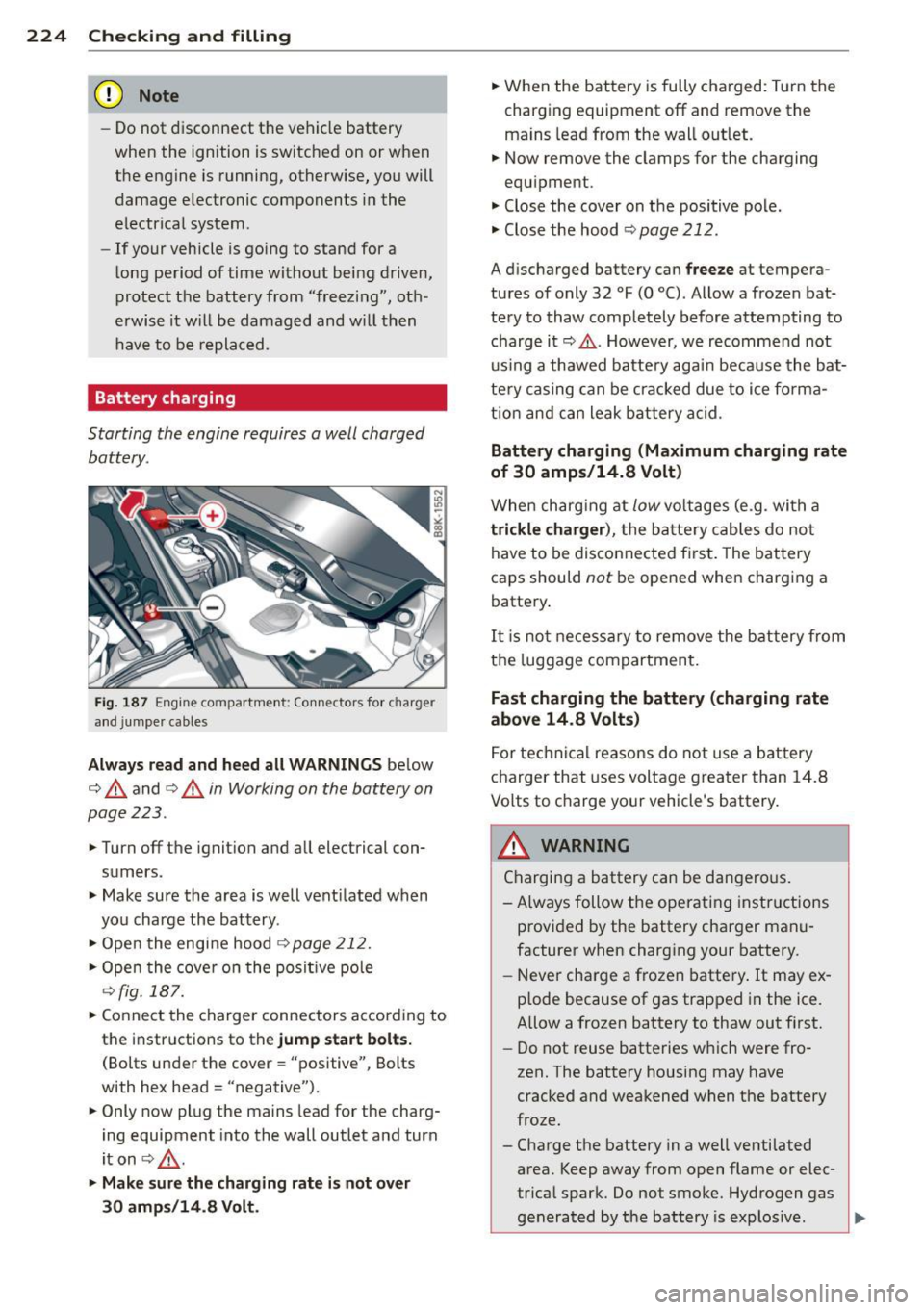
Fig. 187 Eng ine compartment: Connectors for charger
a nd jumper cables
Always read and heed all WARNINGS below
c::> & and c::> & in Working on the battery on
page 223 .
•Turnoff th e ignit ion and all electrical con
sumers.
• Make sure the area is well vent ilated when
yo u cha rge the battery .
• Ope n the engi ne hood
i=!.> page 2 12.
• Open the cove r o n the pos it ive pole
e!.>fig. 187.
• Connect the charger connectors according to
t h e instr uctions to the
jump start bolts.
(Bo lts under the cover = "positive", Bolts
with hex head= "negative").
• Only now plug the mains lead for the charg
i ng equipment into the wall outlet and turn
i t on
c::> .&,. .
• Make sure the charging rate i s not over
30 amps /14.8 Volt .
• When the battery is fully cha rged: Turn the
charging equipment off and remove the
mains lead from the wall out let.
• Now remove the clamps for the charging
equ ipment.
.,. Close the cover on the positive pole .
.,. Close the hood
c::> page 212.
A discha rged battery can freeze at tempera
tures of only 32 °F (0 °C). Allow a frozen bat
tery to thaw comp letely before attempting to
charge i t
c::> .&.. However, we recommend not
u sing a thawed batte ry aga in because the ba t
te ry casing can be c racked due to ic e f orma
t io n an d can leak ba ttery a cid.
Battery charging (Maximum charging rate
of
30 amps/14.8 Volt)
When ch arg ing at low vo lta ges (e.g. wi th a
trickle charger ), the ba tte ry cables do not
have to be disconnected f irs t. T he bat tery
caps should
not be opened when charg ing a
battery .
It is no t necessa ry to remove the b att ery from
t h e luggage com partmen t.
Fast charging the battery (charging rate
above 14.8 Volts)
F or te chnica l re asons do not u se a batt ery
ch arger that uses voltage greater than
14 .8
Volts to c harge yo ur vehicle's battery.
A WARNING
.------
C harging a battery can be dan gero us.
-A lways follow t he operati ng inst ru ctions
p rovi ded by the battery charger manu
facturer when charg ing your battery.
- Never charge a frozen batte ry . I t may ex
p lode because of gas trap ped in the ice.
A llow a frozen battery to thaw out f irst.
- Do not reuse batteries w hich were fro
zen. The battery housing may have
cracked and weakened w hen the battery
froze .
- Charge the battery in a we ll ventilated
area. Keep away from o pen flame or elec
tr ica l spark. Do not s moke. Hyd rogen gas
ge nera ted by t he battery is explos ive .
Page 227 of 304
"" N
0 ::.,: co ,...., \!) 1.1'1 ,...., 1.1'1 ,....,
-To r educe the danger of explosion, never
connect or disconnect charger cables
while the charger is operating.
- Fast charg ing a battery is dangerous and
should only be attempted by a compe
tent technician w ith the proper equip
ment .
- Battery acid that may spill during charg
ing should be washed
off with a solution
of warm water and baking soda to neu
t ralize the acid .
Never use a fast charger as a booster to
start the engine . This will seriously dam
age sensitive elect ronic components, such
as control units, relays, radio, etc. , as we ll
as t he battery charger.
Battery replacement
The new battery must have the same specifi
cations and dimensions as the original equip
ment battery.
Intell igent energy management in your veh i
cle is respons ible for d istr ibuting the e lectr i
cal energy throughout you r vehicle
¢ page 191. T he inte lligen t en ergy ma nage
men t system w ill keep the engine b attery
charged be tter then vehicles w ithout this sys
tem . To make sure t he additional e lectrica l e n
ergy is available once again after you have
changed t he battery, we recommend that you
install ba tteries of the same type and man u
facture only (the same as t hose installed at
the t ime your vehicle was delivered) . Specifi
cations a re listed on the battery hous ing . You r
author ized Audi dealer must code the bat tery
in the energy management system to enable
you to use the energy management functions
correctly after rep lac ing the battery .
I f it is not poss ible to use a battery of this
type, the new bat tery mus t have the s ame ca
pacity, vo ltage ( 12-volts), ampe rage, con
struction and pl ug sea ling.
Checkin g and fillin g 225
When installing the battery, make su re the ig
nition and a ll electrical consume rs a re turned
off.
Q) Note
M ake sure the ven tilat ion hose on the side
of the batte ry is connecte d, otherwise
fumes o r batte ry acid can leak out .
@ For the sake of the environment
Because o f the p rob lem of proper disposal
of a battery, we recommen d your author
i zed A udi dealer change the battery for
you. Batteries contain sulfur ic acid and
l ead and must always be disposed of prop
erly in comp liance with a ll environmental
r egula tions . Dispos ing of vehicle batter ies
i mprope rly is v ery dange rous to th e envi
r o nmen t.
Windshield/headlight*
washer container
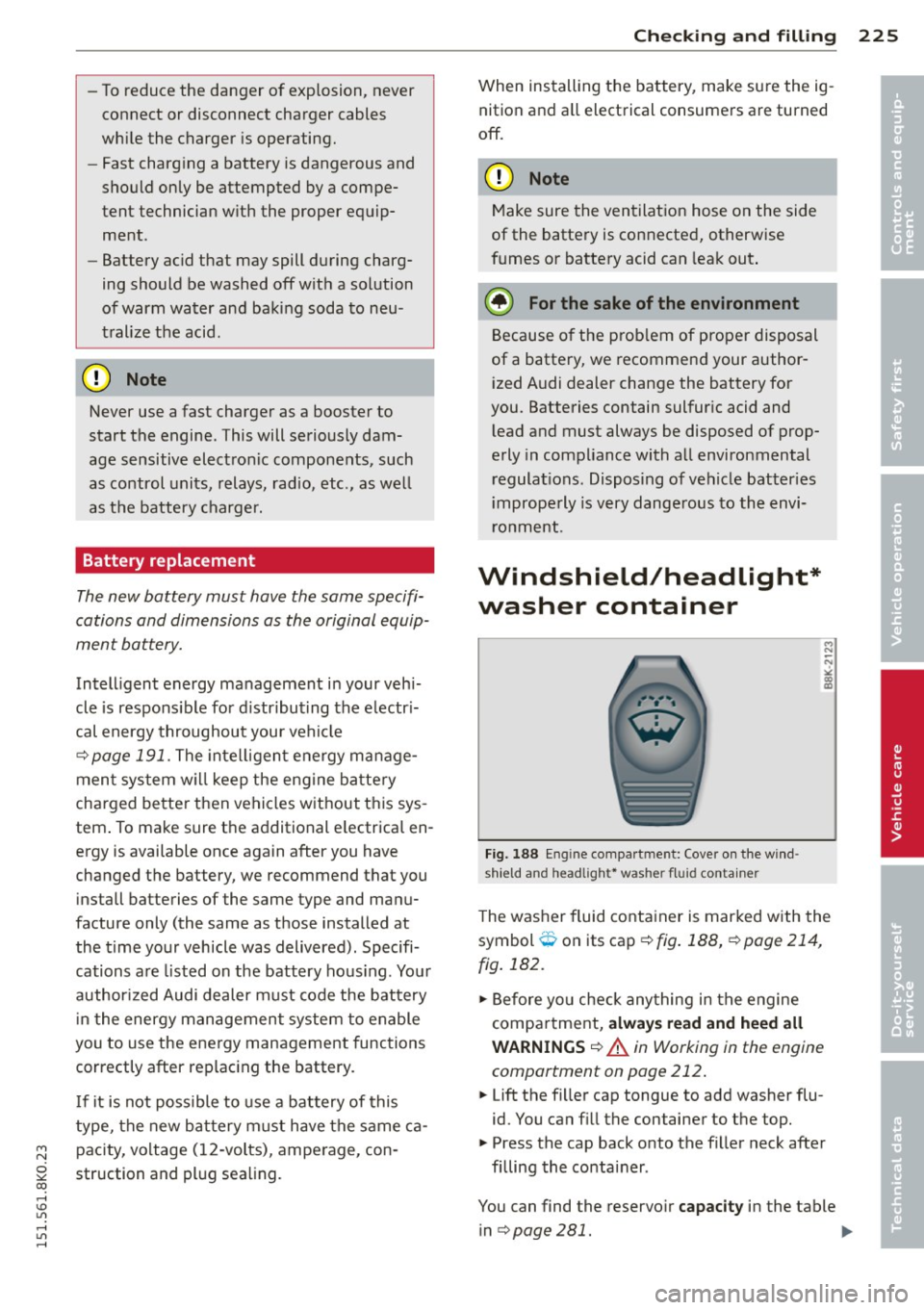
Fi g. 18 8 Eng in e co mpartm en t: Cove r o n th e w ind
s h iel d a nd headlig ht• was her fluid conta in er
T he was her fluid conta iner is mar ked w ith the
symbol
O on its cap ¢ fig . 188, ¢page 214,
fig . 182.
.. Before yo u check any thing in t he engine
compa rtment,
alwa ys re ad and heed all
WARNINGS ¢ & in Working in the engine
compartment on page 212 .
.. Lift the fi ller cap tongue to add washer flu
id. You can f ill the container to t he top.
.. Press the cap back o nto the fi lle r neck after
filling the co nta iner .
You can find the reservo ir
capacity in the table
in ¢
page 281. 111>
•
•
Page 243 of 304
Tires and wheels 241
-Turn the valve stem cap coun- ize the new tire pressures in the •
ter-clockwise to remove it tire pressure monitoring sys-• '
from the tire valve. tern*
¢ page 257.
-Place the air pressure gauge
A WARNING
on the valve.
Incorrect tire pressures and/
-The tire pressures should only or underinflation can lead
be checked and adjusted when sudden tire failure, loss of
the tires are cold. The slightly control, collision, serious per-
raised pressures of warm tires sonal injury or even death.
must not be reduced. -When the
ti] warning sym-
-Adjust the tire pressure to the bol appears in the instru-
load you are carrying. ment cluster, stop and in-
-Reinstall the valve stem cap spect the tires.
on the valve. -Incorrect tire pressure and/
When should I check the tire or underinflation can cause
pressure? increased tire wear and can
The correct tire pressure is es- affect the handling of the
pecially important at high vehicle and stopping ability.
speeds. The pressure should -Incorrect tire pressures
therefore be checked at least and/or underinflation can
once a month and always be- also lead to sudden tire fail-
fore start ing a journey. Do not ure, including a blowout
forget to check the tire pres- and sudden deflation, caus-
sure for the spare wheel. ing loss of vehicle control.
When should I adjust the
-
The driver is responsible for
the correct tire pressures for
tire pressures?
all tires on the vehicle. The
Adjust the tire pressure to the applicable pressure values
load you are carrying. After are located on a sticker on
changing a wheel
or replacing the driver's side B-pillar.
wheels you have to adjust the
'"" N
0 tire pressures on all wheels. In ::.,: co ....
addition, you must then initial-\!) 1.1'1
.... 1.1'1 ....
Page 249 of 304
Incorrect wheel alignment
Incorrect wheel alignment can
cause excessive tire wear, im
pairing the safety of the vehi
cle. If tires show excessive
wear, have the wheel alignment checked by an authorized Audi
dealer or qualified workshop.
All wheel drive
Vehicles with quattro must al
ways have tires of the same size, construction and tread
type. For details see
¢ page 190 .
A WARNING
Sudden tire failure can lead
to loss of control, a crash and
serious personal injury!
-Never drive a vehicle when the tread on any tire is worn
down to the wear indica
tors.
-Worn tires are a safety haz ard, they do not grip well on
wet roads and increase your risk of "hydroplaning" and
loss of control.
- Always keep chemicals that
can cause tire damage, such
as grease, oil, gasoline and brake fluid away from tires.
-
Tires and wheels 24 7
-Tires age even if they are not being used and can fail
suddenly, especially at high
speeds. Tires that are more
than 6 years old can only be
used in an emergency and
then with special care and at lower speeds.
-Never mount used tires on your vehicle if you are not
sure of their "previous histo ry ." Old used tires may have
been damaged even though
the damage cannot be seen
that can lead to sudden tire
failure and loss of vehicle
control.
•
•
'
Page 254 of 304
252 Tires and wheels
Maximum Permissible
Inflation Pressure
This number is the greatest
amount of air pressure that
should ever be put in the tire
under normal driving condi
tions.
.&_ WARNING
-Using incorrect or unmatch ed tires and/ or wheels or improper tire and wheel
combinations can lead to loss of control, collision and
serious personal injury.
-Always use tires, rims and wheel bolts that meet the
specifications of original
factory-installed tires or
other combinations that have been specifically ap
proved by the vehicle manu
facturer.
-Tires age even if they are
not being used and can fail
suddenly, especially at high
speeds. Tires that are more
than 6 years old can only be used in an emergency and
then with special care and
at lower speeds.
-Never mount used tires on your vehicle if you are not sure of their "previous
histo
ry." Old used tires may have
been damaged even though
the damage cannot be seen
that can lead to sudden tire
failure and loss of vehicle
control.
-All four wheels must be fit ted with radial tires of the
same type, size (rolling cir
cumference) and the same
tread pattern. Driving with different tires reduces vehi
cle handling and can lead to
a loss of control.
-If the spare tire is not the
same as the tires that are
mounted on the vehicle -for
example with winter tires -
only use the spare tire for a
short period of time and
drive with extra care. Refit
the normal road wheel as soon as safely possible.
-Never drive faster than the maximum speed for which
the tires on your vehicle are
rated because tires that are
driven faster than their rat
ed speed can fail suddenly.
-Overloading tires cause heat build-up, sudden tire fail
ure, including a blowout
..
Page 256 of 304
254 Tires and wheels
@ For the sake of the environment
Dispo se of old tires in accord
ance with the local require
ments.
Uniform tire quality grading
- Tread wear
- T raction AA A B C
- T empera ture ABC
Quality grades can be found where applicable
on the tire side wa ll between tread shou lder
and max imum sect ion width
¢ page 248,
fig. 193.
For example: Tread wear 200, Tract ion AA ,
Temperature A.
All passenger car tires must conform to Feder
al Safety Requirements in addition to these
grades.
Tread wear
The tread wear grade is a comparative rating
based on the wear rate of the tire when tested
under controlled conditions on a spec ified
government test course .
For example, a t ire graded 150 would wear
one and one half (1 1/2) t imes as well on the
government course as a tire graded 100.
The relat ive performance of t ires depends
upon the actua l conditions of their use, how
ever, and may depart significantly from the norm due to var iations in dr iving habits, serv
ice practices and differences in road character
istics and climate .
Traction
The traction grades, from highest to lowest,
are AA, A, Band
C. Those grades represent the
tire's abil ity to stop on wet pavement as
measured under controlled cond it ions on
specified government test surfaces of asphalt
and concrete . A tire marked C may have poor
trac tion performance ¢&,. .
Temperature
The temperature grades are A (the highest),
B, and C, representing the tire's resistance to
the generation of heat and its ability to dissi
pate heat when tested under controlled condi
tions on a specified indoor laboratory test
wheel.
Sustained high temperature can cause the
material of the tire to degenerate and red uce
tire life, and excessive temperature can lead
to sudden tire failure
¢ &,..
The grade C corresponds to a level of perform
ance which all passenger car tires must meet
under the Federal Motor Vehicle Safety Stand
ard No. 109. Grades Band A represent higher
levels of performance on the laboratory test
wheel than the minimum required by law .
A WARNING
The traction grade assigned to this tire is
based on straight-ahead braking traction
tests, and does not include acceleration,
cornering, hydroplaning or peak traction
characteristics.
A WARNING
The temperature grade for this tire is es
tablished for a tire that is properly inflated
and not overloaded. Excessive speed, un
derinflation, or excessive load ing, either
separately or in combination, can cause
heat buildup and possible tire failure.
Winter tires -
Winter tires can improve vehicle handling on
snow and ice . At temperatures below 45 °F
(7 °C) we recommend changing to winter
tires .
In some heavy snow areas, local governments
may require true winter or "snow" tir es, those
with very deeply cut tread . These tires should
only be used in pairs and be installed on all
four wheels. Make sure you purchase snow
tires that are the same size and construction
type as the other tires on your vehicle. .,.
Page 257 of 304
"" N
0 ::.,: co ...... \!) 1.1'1
...... 1.1'1 ......
Your vehicle is equipped with all whee l drive,
this will improve traction during winter driv ing, even with the standard tires. However, we
strongly recommend that you a lways equ ip a ll
four wheels on your veh icle w ith correctly fit
ted wi nte r tires or all -season tires, when w in
ter road conditions are expected. This also im
p roves the vehicle 's braking performance and
reduces stopping distances.
Summer tires provide less grip on ice and
snow .
W inter tire s (snow t ires) must always be fitted
on all four wheels.
Ask your authorized Audi dea ler o r qualified
workshop for permitted
w inter t ire sizes. Use
only radia l winter tires .
Winte r ti res lose thei r effectiveness when the
tread is worn down to a depth of
0 .15 7 inch
(4 mm) .
On ly drive with winter tires under winter con
d itions. Summer tires hand le better when
there is no snow or ice on the roads and the
temperature is above 45
°F (7 °().
If yo u have a flat tire, see notes on spare
wheel ¢ page 248 .
Pl ease always remembe r th at w inte r ti res may
have a lower speed rating tha n the t ires origi
n all y ins talled on your veh icle at the t ime i t
was manufactured . Please see ¢ page 250,
Speed roting (letter code) for a Listing of the
speed rat ing letter codes and the maximum
speed at wh ich the t ires can be driven .
The speed rating letter code( ¢ page 232) is
on the side wall of the tire ¢ page 248.
A WARNING
Winter tires have maximum speed limits
that may be lower than your vehicle's max
imum speed. Always know the maximum
speed befo re driving off . Never drive faster
than the speed permitted for your specific
w inte r tir es . This will cause damage to the
ti res leading to an ac cident and se rious
pe rsonal i njury to you and yo ur p assen
gers .
Tire s an d wheel s 255
A WARNING
Driving faster than the maximum speed
for which the winter tires on your ve hicle
were designed can cause t ire fail ure in
cluding a blowout and sudden deflation,
l oss of cont ro l, crashes and ser ious per
sona l injuries. Have wo rn or damaged ti res
replaced immedia tely.
- Wi nte r tires h ave maxim um speed ra ting
that may be lower than yo ur vehicle 's
maxim um speed.
- Never d rive fas ter than the speed for
whi ch the w inter or othe r ti res installed
on yo ur vehicle are rated.
A WARNING
=
A lways ad just yo ur driving to t he roa d and
traffic conditions. Never let the good ac
celeration of the winter tires and a ll wheel
drive tempt you into taking extra risks. Al
ways remember:
- When braking, an all wheel drive vehicle handles in the same way as a front drive
veh icle.
- Drive carefully and reduce your speed on
icy and slippery roads, even w inter t ires
cannot help under black ice conditions.
@ For the sake of the environment
Use summer tires when weather condi
tions permit. They are qu ieter, do not wear
as quickly and reduce fuel consumpt ion.
Snow chains
-
Snow cha ins may be fitted only to the fro nt
whee ls, and on ly to certain tire sizes . Ask your
autho rized Aud i dea le r o n whi ch tire sizes
snow chains can be used.
The snow chains must have low-p rofile links
and must not be th icker than
0 .53 inch
(13 . 5 mm) , in cl ud ing t he lo ck.
Remove wheel center covers and trim discs
before putt ing snow cha ins on your veh icle
¢ 0 . For safety reasons cover caps must then ..,.
•
•
Page 258 of 304
256 Tires and wheels
be fitted over the wheel bolts. These are
available from authorized Audi dealers.
A WARNING
Using the wrong snow chains for your vehi
cle or installing them incorrectly can in
crease the risk of loss of control leading to
serious personal injury.
- Snow chains are available in different
sizes. Always make sure to follow the in
structions provided by the snow chain
manufacturer .
- When driving with snow chains never
drive faster than the speed permitted for
your specific snow chains.
- Always observe local regulations .
- Remove snow chains before driving on
roads not covered with snow to avoid
damaging tires and wearing the snow
chains down unnecessarily .
- Snow chains, which come into direct con
tact with the wheel rim, can scratch or
damage it . Therefore, make sure that the
snow chains are suitably covered . Check
the position of the snow chains after
driving a few yards and correct if neces
sary. Follow the instructions from the
snow chain manufacturer when doing so.
(D Tips
Where snow chains are mandatory oncer
tain roads, this normally also applies to
vehicles with all wheel drive.
Wheel bolts
Wheel bolts must always be tightened to the
corr ect torque.
The design of wheel bolts is matched to the
factory installed rims. If different rims are fit
ted, the correct wheel bolts with the right
length and correctly shaped bolt heads must
be used. This ensures that wheels are fitted
secu rely and that the b rake system functions
correctly . In certain circumstances, you may not use
wheel bolts from a different vehicle -even if it
is the same model ¢
page 285.
A WARNING "--
Improperly tightened or maintained wheel
bolts can become loose causing loss of
control, a collision and serious personal in
jury .
- Always keep the wheel bolts and the
threads in the wheel hubs clean so the
wheel bolts can turn easily and be prop erly tightened.
- Never grease or oil the wheel bolts and
the threads in the wheel hubs. They can become loose while driving if greased or
oiled, even if tightened to the specified
torque.
- Only use wheel bolts that belong to the
rim being installed .
- Never use different wheels bolts on your
vehicle.
- Always maintain the correct tightening
torque for the wheel bolts to reduce the
risk of a wheel loss. If the tightening tor
que of the wheel bolts is too low, they
can loosen and come out when the vehi
cle is moving. If the tightening torque is
too high, the wheel bolts and threads
can be damaged and the wheel can be
come loose.
Q) Note
The specified torque for the wheel bolts is
90 ft lbs. (120 Nm) with a tolerance of
± 7,4 ft lbs. (± 10 Nm). Torque wheel bolts
diagonally . After changing a wheel, the
torque must be checked as soon as possi
ble with a torque wrench -preferably by an
authorized Audi dealer or qualified work
shop .
Low aspect ratio tires
Your Audi is factory-equipped with low aspect
ratio tires. These tires have been thoroughly
tested and been selected specifically for your model for their superb performance, road feel ..,.