wheel AUDI S4 2015 Owner's Guide
[x] Cancel search | Manufacturer: AUDI, Model Year: 2015, Model line: S4, Model: AUDI S4 2015Pages: 304, PDF Size: 74.86 MB
Page 191 of 304
'"" N
0 ::.,: co ,...., \!) 1.1'1 ,...., 1.1'1 ,....,
the brake rotors for a short amount of time.
This occurs at regular intervals without the
driver noticing and provides for better brake response time under wet condit ions.
The effectiveness of the brakes can be reduced
when the vehicle is driven on a salt-covered road and the brakes are not used. Likewise,
you clean
off accumulated sa lt coating from
brake discs and pads with a few cautious ap
plications of the brake
i:> ,& .
Co rrosion
There may be a tendency for dirt to build up
on the brake pads and corrosion to form on
the discs if the car is not dr iven regularly or
only for short trips with little use of the
brakes .
If the brakes are not used frequently, or if cor rosion has formed on the discs, it is advisable
to clean
off the pads and discs by brak ing
firmly a few times from a moderately high
speed
i:> ,& .
Fa ult s in the brake system
If you should notice a sudden increase in
brake pedal travel, then one of the two brake
circu its may have failed
i:> ,& .
Low brak e flu id l eve l
Malfunctions can occur in the brake system if
the brake fluid level is too low. The brake fluid
leve l is monitored electronically .
Brake boo ste r
The brake boos ter increases the press ure that
you generate with the brake pedal. It works
only when the engine is running
. ¢ .&
Brake lining w ear statu s
Brake lining wea r may be checked by visual in
spection of the condi tion of the brake pads
through the openings in the whee l. If neces
sary, the whee l may be removed for this in
spection
c> page 263, Changing a wheel .
Intellig ent technolog y 189
A WARNING
-New brake pads don't have the best stop
ping power and must be "b roken -in" dur
ing the initial 100 to 150 miles (150 to
200 kilometers) of normal c ity dr iving .
You can compensate for this by pressing the brake pedal more firmly. This also
applies la ter when new pads are instal
led.
- You should per form braking m aneuvers
for the purpose of cleaning the brake
system only if road conditions permit .
Other road users must not be p ut at risk -
you may ca use an accident!
- Before descend ing a steep grade, reduce
speed and sh ift transmission into a lower
gea r or lower dr iving range. Do not ride
the brakes or hold the pedal down too
long or too often . Th is could cause the
brakes to get hot and diminish braking
efficiency.
- Do not "ride the brakes" by rest ing your
foot on the pedal when you do not intend
to b rake. This may cause the brakes to
overheat, p remature wear and increased
s topping distance .
- Unde r ce rtain climatic and ope rat ing
conditions such as passing thro ugh wa
ter, dr iv ing in heavy rain o r after washing
the vehicle, the effectiveness of the
brakes can be reduced. In winter, ice can
accumu late on the brake pads, linings,
discs and drums. Carefully app ly brakes
for a test. Brakes w ill dry and ice coat
ings w ill be cleaned
off after a few care
fu l brake applicat ions .
- Driving for an extended period of time o n
salt-cove red roads without using your
brakes can a lso affect braking efficiency .
C lean
off accum ulated salt coa ting from
br ak e disc s and pad s wi th a few ca re ful
bra ke applications.
- If you damage the front spoiler, or if yo u
install a diffe rent spoiler, be s ure the ai r
f low to the front brakes is not obstruct
ed . Otherw ise the bra ke system could •
•
Page 192 of 304
190 Intelligent technology
overheat re ducin g the effectiveness of
the ent ire brake system.
- Failure of one brake circuit will impair
the braking capability resulting in an in
creased stopp ing distance. Avoid driv ing
the vehicle and have it towed to the near est author ized Audi dealer or qualified
workshop .
- Never let the vehicle ro ll to a stop w ith
the engine shut off.
- If the brake booster is not working, the
brake pedal must be pressed conside ra
bly harder to make up for the lac k of
booster assistance.
Electro-mechanical
power assist, dynamic
steering
The electro-mechanical power assist helps
the driver when steering.
Power stee ring adapts electronically based on
the vehicle speed.
Indicator lights and messages
• Steering defective! Do not drive vehicle!
If this ind icator lig ht tu rns on and stays on
an d th is message appears, t he power steer ing
may have f ailed.
D o
not cont in ue d riving. See yo ur autho rized
Aud i deale r or a q ua lifi ed r epa ir facility for as
sistance.
'1:I Dynamic steering : System fault! You can
cont inue driv ing
If the indicator light t urns on and the mes
sage appears, the steer ing may be more diffi
cul t to move or more se nsitive than usual. The
steer ing wheel may also be at an angle whe n
d riving straight .
Drive s low ly to your author ized Audi dealer or
q ua lified workshop to have the malfunction
cor rected .
'y.ij Dynamic steering: initializing
If this driver message appears and the indica
tor light is f lashing on the instrument panel,
dynam ic steer ing * is being re in it ia lized. After
starting the engine, the steering wheel will move s light ly. Re- initialization might be nec
essary if the steering wheel was moved hard
to the left and right wh ile the vehicle was not
moving . Th e display goes out as soon as ini ti
ali za tion is complete.
_& WARNING
Ha ve the dy namic stee ring * system m al
f u nction repa ired as soon as possib le by an
a uthorized Audi dea ler or qua lified work
shop -risk of acc ident !
@ Tips
-If the . or '1:I indic ator li ght only s tays
on fo r a shor t time, you m ay continue
dr iving.
- T he dynamic s teering * stabi lit y syste ms
are no t av ail ab le in the even t of a system
ma lf u nction.
- F or ad di tion al information on dynamic
steering *, refe r to
¢page 115 .
-
Driving with your
quattro
App lies to vehicles: wi th all-w hee l drive
With a/I-wheel drive, all four wheels are driv
en .
General information
With a ll-wheel d rive, power is distr ib uted to
all four wheels. This happens automatically
depending on your driving style and the road
co ndit ions at the time . See also
¢ page 185.
A center d ifferential distributes the driving
power variably to the front and rear axle. It
wor ks together with selective w heel torque
co ntrol, wh ich activates when dr iving t hrough
c ur ves
c::;,page 186. With the sport differe n
t ia l* , pow er d istr ibut ion to the rea r wheels is
variable a nd can be adjusted w ith drive se lect
c::;, page 115. .,..
Page 193 of 304
"" N
0 ::.,: co ,...., \!) 1.1'1 ,...., 1.1'1 ,....,
The all-wheel drive concept is designed fo r
high engine power. Your vehicle is exception
ally powerful and has exce llent dr iving charac
ter istics both under normal driving conditions
and on snow and ice . Always read and follow
safety precautions
c> & .
Winte r tir es
When driving in the winter, your ve hicle with
all-wheel drive has an advantage, even with
regular t ires. In winter road conditions it may
be adv isable to mount winter tires (or all-sea
son t ires) for imp roved driveability and brak
ing: these tires must be mounted on
a ll four
w heel s.
See also c> page 254, Winter tires.
Tire chain s
Where tire cha ins are mandatory on certain
roads, th is normally also applies to vehicles
with all-wheel drive
c> page 255, Snow
chains.
R eplacing wheel s/tire s
Vehicles with all-wheel drive must a lways
have tires of the same size. Also avoid t ires
with d ifferent tread depths . For details see
page ~
page 248, New tires and replacing
tires and wheels.
Off-Ro ad dri ving ?
Your Audi does not have enough ground clear
ance to be used as an off-road veh icle. It is
therefore best to avoid rough tracks and un
even terrain as much as possible . Also refer to
c> page 193.
A WARNING
Always adjust your driving to road and traf
fic condit ions . Do not let the ext ra safety
afforded by all-wheel drive tempt you into
taking extra risks .
- Although the all-whee l dr ive is very ef
fective, a lways remember that b raking
capacity is limited by tire traction. Yo u
sho uld therefore not drive at excessive
speeds on icy or slippery road surfaces.
- On wet road surfaces, be careful not to
drive too fast because the front wheels
Int ellig ent technolog y 191
could begin to slide on top of the water
(aquaplaning). If th is should occur, you
will have no warning from a sudden in crease in engine speed as w ith a front
wheel drive veh icle . Always drive at
speeds which are su ited to the road con
ditions - risk of crash.
Energy management
Starting ability is optimized
Energy management controls the distribution
of electrical energy and thus optimizes the
availability of electrical energy for starting the engine.
If a vehicle with a conventiona l energy system
is not driven for a long period of time, the bat
tery is discharged by idling current consumers (e .g. immobilizer). In certain circumstances it
can resu lt in there being insuffic ient energy
available to start the eng ine .
Intelligent energy management in your vehi
cle handles the distribution of e lectr ica l ener
gy. Start ing ability is markedly improved and
the life of the battery is extended .
Basically, energy management consists of
battery diagnosis , idling current manage
ment
and dynamic ene rgy management .
Batte ry diagnos is
Battery diagnosis continuously determines
the state of the battery . Sensors determine
battery voltage, battery current and battery
temperature. This determines the current
state of charge and the power of the battery.
Idling current management
Idling current management reduces energy
consumption while the vehicle is standing.
With the ign ition switched off, it controls the
energy supply to the various electrical compo
nents. Data from battery diagnos is is cons id
ered .
Depend ing on the battery's state of charge,
individual consumers are gradually turned
off .,_ •
•
Page 199 of 304
'"" N
0 ::.,: co ,...., \!) ..,.,
,...., ..,., ,....,
the engine is at its proper operating tempera
ture and fuel economy has reached a normal
level. So you can see that you should avoid
short trips whenever possib le.
The
outside temperature is also critical in this
regard. Your car consumes more fuel in the
winter than in the summer .
allroad: Driving offroad
General information
Applies to vehicles: atlroad
When driving offroad, the funct ions for the
e lectronic stab ilization control (ESC) are ex
panded. The ESC-Offroad-Mode can be activat
ed in driving situations in which a wheel lock
or a differentia l lock function is needed
c::> page 187. In addition, your Audi provides
continuous all wheel drive .
Your Audi is however , not an offroad vehicle.
Never drive the vehicle in terrain which is not
suitable for the vehicle, or which exceeds
your driving skills. Never take any unneces
sary risks!
After driving offroad
-After driving offroad, remove branches and
other debris from the radiator grille, under
body, and wheels. Look especially for objects
(stones) that have been caught in the tire
tread .
- Clean the body and the vehicle underbody
and inspect the vehicle for possible damag
es.
- Clean off the dirty windows, headlights, tail
lights and the license plate.
- Perform a brake test (especially after driving through water).
A WARNING
- Be espec ially aware and attentive when
dr iv ing under diff icult conditions . Dam
ages to the vehicle and injuries may oc
cur when driving at an excess ively high
speed or with incorrect driving maneu
vers.
Driving and environment 197
- Always adjust your speed and handling
to the roads, terrain, traff ic and weather
conditions. Drive especially slow if off road with low visibility.
- Please note that the wheels can spin and
the vehicle can break away when the ESC
Offroad Mode is switched off, especially
when the road is slippery .
- Driving stability is reduced in the ESC
Offroad mode .
® For the sake of the environment
Avoid harming the environment and take
nature into cons ideration.
(D Tips
Only drive where it is allowed and always
stay on the provided roads and paths.
Driver messages
Applies to vehicles : a ll road
There is only one right way to drive in difficult
conditions: slowly and with caution!
When dr iving offroad, observe the following:
... Never drive the vehicle i n terrain which is
not suitab le for the vehicle, or which ex
ceeds your driv ing ski lls. Never take any un
necessary risks!
... Drive slow ly and cautiously!
... Pay attention to the
ground clearance of
your vehicle! This may vary depending on the load and composition of the ground and
the environment. The driver is therefore re
sponsible for deciding whether a veh icle can
handle a specific situation.
... Act ivate the
ESC -Offroad-Mode c::> page 18 7
as needed.
Difficult terrain
Never dr ive in areas that are not familiar to
you and drive slowly when offroad and be pre
pared and expect the unexpected (e.g. pot
holes, boulders, tree stumps, etc.)
To prevent the vehicle from bottoming and avo id damage to the underbody, you should
drive straight across severe bumps in the
IJII>
•
•
Page 200 of 304
198 Driving and environment
ground with only one side of the vehicle so
that only two of your wheels cross the bumps .
Drive quickly through sandy or marshy offroad
sec tions and do not stop, if at all possible.
Driving through water on roads
Read the information on ~ page 193 .
Page 203 of 304
Trailer towing tips
Important to know
Your vehicle hand les different ly when tow ing
a trailer because o f the addit ional weight and
d iffe ren t weight distribution . Safety, pe rform
ance and economy w ill greatly depend on how
caref ully you load your trailer and operate
your rig.
B efore you actua lly tow your trailer, pr actice
turning, stopp ing and bac king up in an area
away from traffic. Keep practicing until you have become comp lete ly fam iliar with the way
your veh icle-trailer comb ination behaves and
responds.
Backing up is d ifficu lt a nd requires practice .
Backing up with a tra iler genera lly requires
steer ing action opposite to that when backing
up your vehicle without a trailer.
M aintain a g reater distance betwee n your ve
h icle and the one in front o f you . You will need
mo re room to stop. To compensate for the
trailer, you will need a larger than normal
turning radius .
W hen pass ing, remember that yo u cannot ac
celerate as fast as yo u normally wo uld be
cause of the added load. Ma ke s ure you have
e nough room to pass . After passing , allow
p lenty o f room fo r your tra iler before chang
in g la nes aga in .
Avoid jerky starts, sharp turns or rap id lane
changes.
(D Tips
- Do not tow a tra iler during the break-in
period of you r vehicle.
- If you tow a trailer, your A udi may re
quire more frequent maintenance due to
the extra load
o page 283.
Trailer towin g 201
Parking on a slope
Do not park on a slope with a trailer . If it can
not be avoided, do so only after doing the fol lowing:
When parking:
.. App ly the foot brake.
.. Have someone p lace chocks under both the
veh icle and the tra iler wheels .
.,. With chocks in place, slowly release t he
bra kes unt il t he whee l choc ks absorb the
load .
.. Tu rn the whee ls towards the curb.
.,. App ly the par king b rake .
.. Place an a utomatic transm ission* in P, re
spectively a manual transmission in first or
reverse gear.
When restarting after parking:
.,. App ly th e foot br ake .
.. Start t he en gine.
.. Move the selector lever to D/S , respect ively
a man ual transmiss ion in first gea r.
.. Release the parking bra ke and s low ly pull
out and away from the wheel chocks .
.. Stop and have someone retr ieve the wheel
chocks.
@ Tips
If you move the selector leve r of the auto
matic transmissio n* to P before applying
the pa rking brake and before blocking the
whee ls, you may hav e to use mor e forc e
l ater to m ove the le ver out of the P posi
tion.
•
•
Page 205 of 304
'"" N
0 ::.,: co ,...., \!) 1.1"1 ,...., 1.1"1 ,....,
Vehicl e ca re a nd cl eanin g 203
& WARNING
-Only wash the vehicle when the ignition
is off and follow the instructions from
the car wash operator to reduce the risk
of accidents.
- To reduce the risk of cuts, protect your
self from sharp meta l components when
washing the underbody or the inside of
the wheel housings.
- After washing the vehicle, the braking ef
fect may be delayed due to moisture on
the brake rotors or ice in the winter . The
brakes must be dried first with a few
careful brake applicat ions .
{[) Note
-If you wash the vehicle in an automatic
car wash, you must fold the exterior m ir
rors in to reduce the r isk of damage to
the mirrors . Power folding exterior m ir
ro rs* must only be folded in and out us
i ng the power folding function.
- To prevent pa int damage, do not wash
the veh icle in direct sunl ight. -
To reduce the r isk of damage to the sur
face, do not use insect removing spong es, kitchen sponges or similar items.
- Matte finish painted vehicle compo
nents :
- To reduce the risk of damage to the
surface, do not use polishing agents or hard wax.
- Never use car wash cycles that apply
protective wax.
It can destroy the
matte fi nish effect.
- Do not place any stickers or magnet ic
signs on vehicle parts painted w ith
matte fi nish paint. The paint cou ld be
damaged when the stickers o r magnets
are removed.
@ For the sake of the environment
Only wash the vehi cle in facilities spec ial ly
designed for that purpose . This will red uce
the risk of dirty water contam inated with
oil from entering the sewer system.
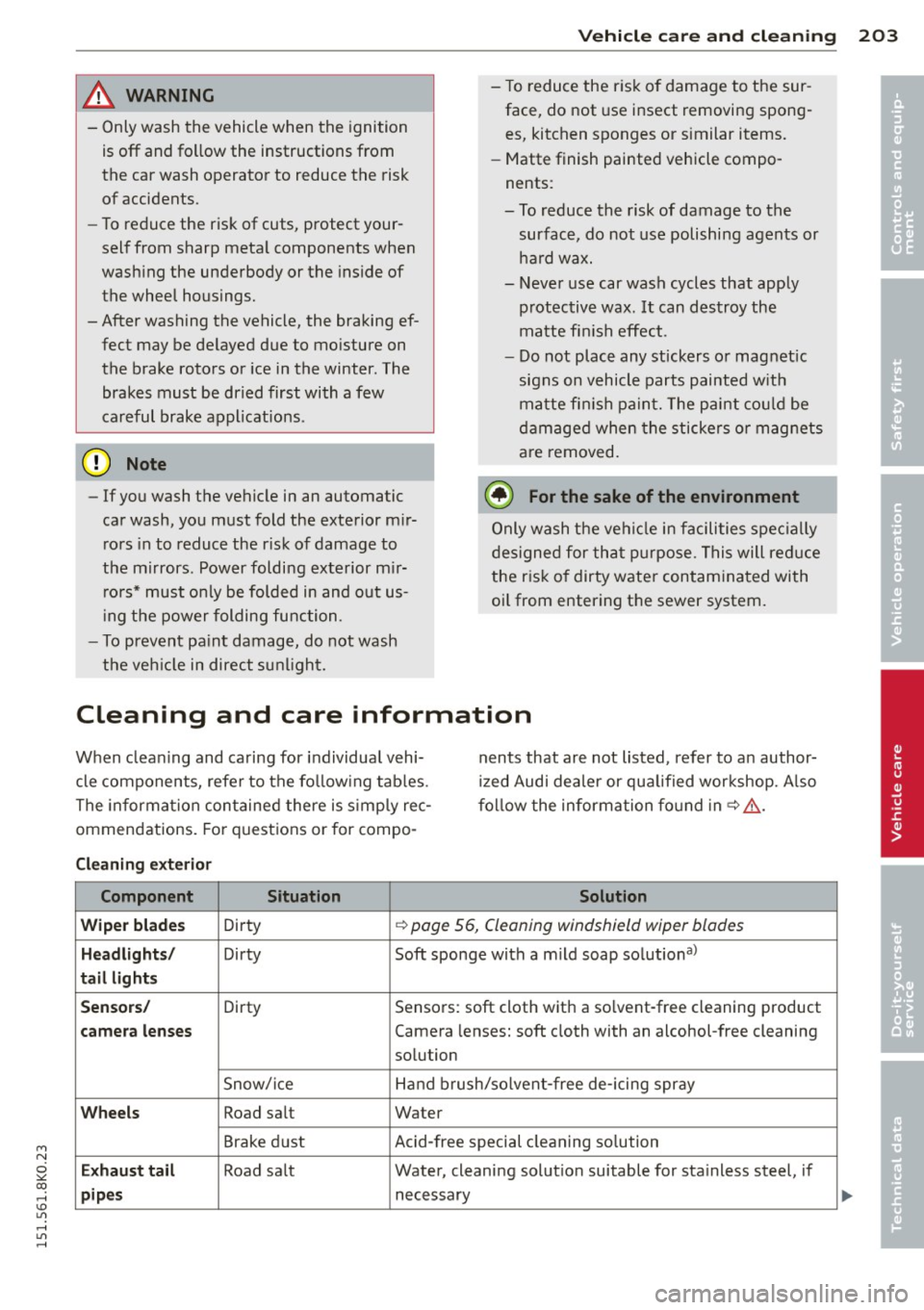
Cleaning and care information
When clean ing and caring for individua l vehi
cle components, refer to the fo llow ing tab les .
The informa tion contained there is s imply rec
ommendations. For questions or for compo- nents that are not listed
, refer to an author
ized Audi dea ler or qua lified workshop. A lso
fol low the information fo und in ¢ ,&. .
Cleanin g exte rior
Component Situation Solution
Wiper blade s
Dirty ¢ page 5 6, Cleaning windshield wiper blades
Hea dlight s/ Dirty Soft sponge with a mild soap solution a>
t a il light s
Sen sors /
Dirty Sensors: soft cloth with a so lvent-free cleaning product
came ra lens es Camera lenses: soft cloth with an alcohol-free cleaning
solution
Snow/ice Hand brush/so
lvent-free de-icing spray
Wheels Road sal t Water
Brake d ust Acid-free special cleaning so
lution
Ex haust tail Road sa lt Water, cleaning solut io n suitable for sta inless steel, if
pipe s necessary
•
•
Page 207 of 304
"" N
0 ::.,: co ,...., \!) 1.1'1 ,...., 1.1'1 ,....,
Vehicle care and cleaning 205
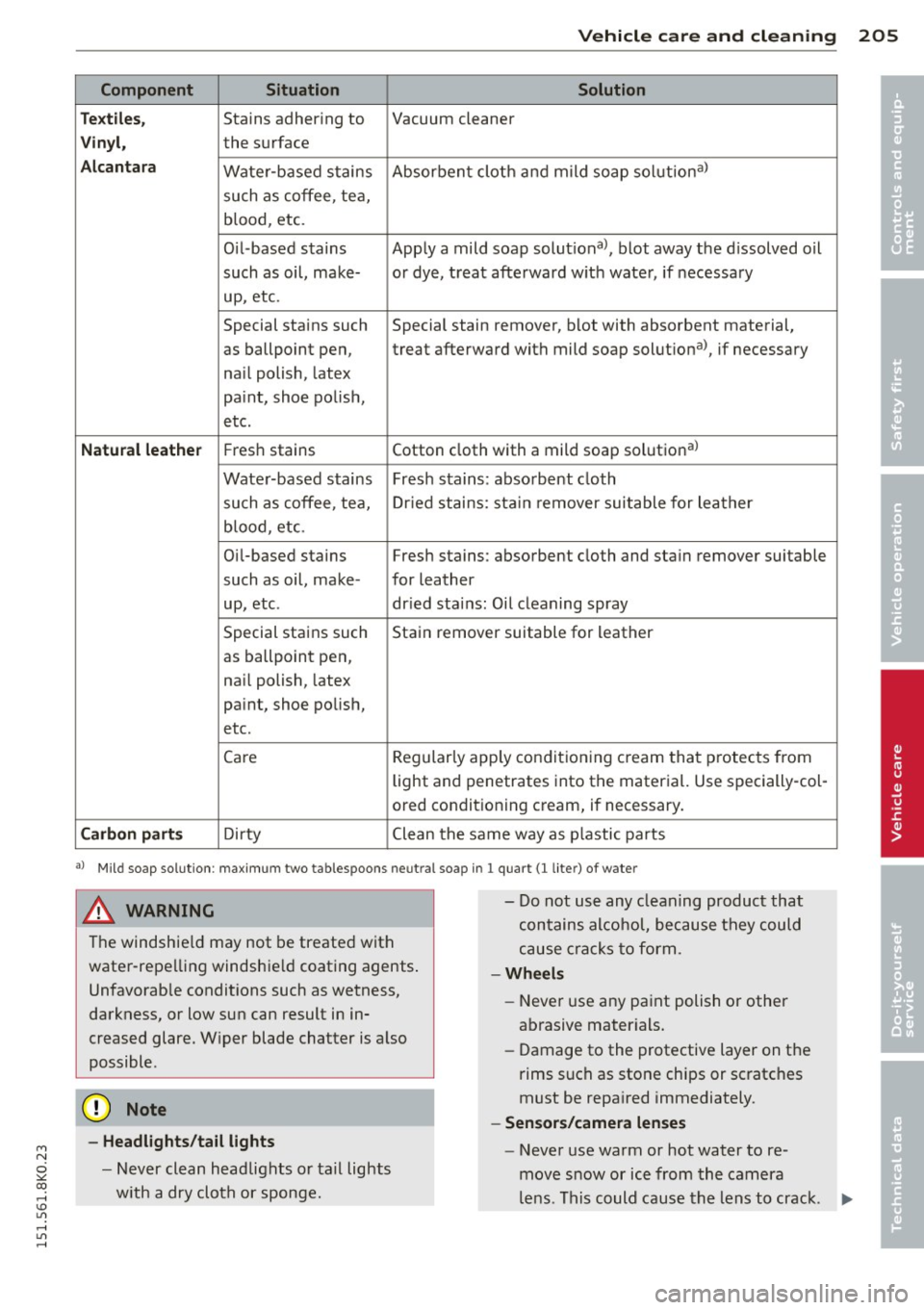
Component Situation Solution
Te xtile s,
Stains adhering to Vacuum cleaner
Vinyl, the surface
Alcantara Water-based stains Absorbent cloth and mild soap solutiona>
such as coffee, tea, blood, etc.
Oil-based stains Apply a mild soap solutiona>, blot away the d issolved oil
such as oil, make- or dye, treat afterward w ith water, if necessary
up, etc.
Special stains such Special stain remover, blot with absorbent material,
as ballpoint pen, treat afterward with mild soap solutiona>, if necessary
na il polish, latex
pa int, shoe polish,
etc.
Natural leather Fr es h stains Cotton cloth with a mild soap solutiona)
Water-based stains Fresh sta ins: absorbent cloth
such as coffee, tea, Dr ied stains: sta in remover suitable for leather
blood, etc.
Oil-based stains Fresh sta ins: absorbent cloth and stain remover suitable
such as oil, make- for leather
up, etc . dried sta ins: Oil cleaning spray
Special stains such Stain remover suitable for leather
as ballpo int pen,
na il polish, latex
pa int, shoe polish,
etc .
Care Regularly
apply conditioning cream that protects from
light and penetrates into the material. Use specially-col-
ored conditioning cream, if necessary.
Carbon parts Dirty Clean the same way as plastic parts
al Mild soap solution: maximum two tablespoons neut ral soap in 1 quart (I liter) of water
& WARNING
The windshie ld may not be treated with
water-repelling windshie ld coating agents .
Unfavorab le conditions such as wetness,
darkness, or low sun can result in in
creased glare. W iper blade chatter is also
possible.
- Headlights/tail lights
- Never clean headlights or tail lights
w ith a dry cloth or sponge. -
Do not use any cleaning product that
contains alcohol, because they could
cause cracks to form .
-Wheels
-Never use any paint polish or other
abrasive mater ials.
- Damage to the protective layer on the
rims such as stone chips or scratches
must be repaired immediately.
- Sensors/camera lenses
- Never use warm or hot water to re-
move snow or ice from the camera
len s. This could cause the lens to crack .
IJII>
•
•
Page 229 of 304
Tires and wheels
Tires
General notes
Tires may be the least appreci
ated and most abused parts of
a motor vehicle .
Tires may be the least appreci
ated and most abused parts of
a motor vehicle. Tires are, how
ever, one of the most important
parts of a vehicle, particularly
considering the comparatively
small patch of rubber on each
tire that assures that all-impor
tant contact between you, your
vehicle and the road.
Maintaining the correct tire
pressure, making sure that your
vehicle and its tires do not have
to carry more weight than they can safely handle, avoiding
damage from road hazards and
regularly inspecting tires for
damage including cuts, slashes
irregular wear and overall con
dition are the most important
things that you can do to help avoid sudden tire failure includ
ing tread separation and blow-
~ outs.
0 ::.,: co ,...., \!) 1.1'1 ,...., 1.1'1 ,....,
Tires and wheels 22 7
Avoiding damage
If you have to drive over a curb
or similar obstacle , drive very
slowly and as close as possible
at a right angle to the curb.
Always keep chemicals includ ing grease, oil, gasoline and
brake fluid off the tires.
Inspect the t ires regularly for
damage (cuts, cracks or blis
ters, etc.). Remove any foreign bodies embedded in the treads.
Storing tires
Mark tires when you remove
them to indicate the direction
of rotation. This ensures you to be able to mount them correct
ly when you reinstall them.
When removed, the wheels or
tires should be stored in a cool, dry and preferably dark place.
Store tires in a vertical position if they are not mounted on
rims, in a horizontal position if
they are mounted on rims.
New tires
New tires have to be broken in
¢ _&..
The tread depth of new tires
may vary , according to the type .,.
•
•
'
Page 231 of 304
-If you notice unusual vibration or if the vehicle pulls to one side when driving, al
ways stop as soon as it is safe to do so and check the
wheels and tires for dam age.
(D Note
-Please note that summer and winter tires are de
signed for the conditions
that are typical in those sea
sons. Audi recommends using winter tires during the
winter months. Low tem peratures significantly de
crease the elasticity of
summer tires, which affects
traction and braking ability.
Tires and wheels 229
If summer tires are used in
very cold temperatures, cracks can form on the tread bars, resulting in perma
nent tire damage that can
cause loud driving noise and unbalanced tires. Audi is not
responsible for this type of
damage.
-Burnished, polished or chromed rims must not be used in winter road condi
tions. The surface of the
rims does not have suffi
cient corrosion protection
for this and could be perma
nently damaged by road salt
or similar substances.
•
•
'
Glossary of tire and loading terminology
Accessory weight
means the combined weight (in
excess of those standard items
which may be replaced) of auto matic transmission, power
steering, power brakes, power
windows, power seats, radio, and heater, to the extent that
these items are available as fac
tory-installed equipment (whether installed or not).
Aspect ratio
means the ratio of the height to
the width of the tire in percent. Numbers of 55 or lower indi
cate a low sidewall for im proved steering response and
better overall handling on dry
pavement.