fuel AUDI S4 2016 User Guide
[x] Cancel search | Manufacturer: AUDI, Model Year: 2016, Model line: S4, Model: AUDI S4 2016Pages: 278, PDF Size: 70.26 MB
Page 30 of 278
Driver information s ystem
Fuel economy messages
Applies to vehicles: with trip computer with efficiency pro
gram
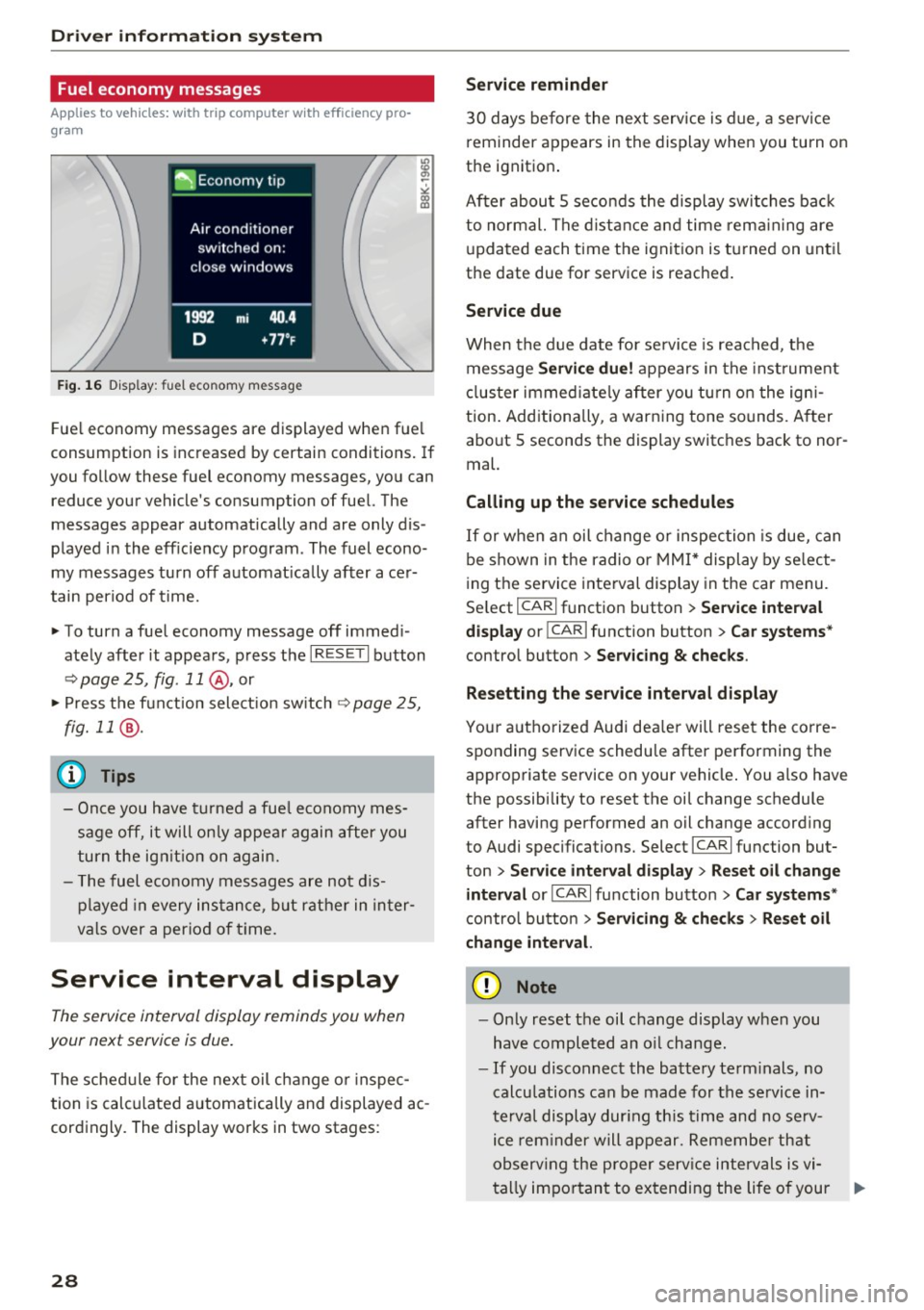
F ig. 16 D isplay: fuel eco nomy message
Fue l economy messages are displayed when fue l
consumption is inc reased by certain conditions. If
you follow these fuel economy messages, you can reduce your vehicle's consumption of fuel. The
messages appear automatically and are only dis
p layed in the eff iciency program . The fuel econo
my messages turn off automat ica lly afte r ace r
tain period of t ime.
"' To turn a fuel economy message off immed i
ate ly after it appears , press t he I R ESE T I button
¢ page 25, fig. 11 @ , or
"' Press t he f unct ion sele ct io n sw itch
~ page 2 5,
fig. 11
® ·
(D Tips
- Once you have t urned a fue l economy mes
sage off, it will on ly appea r again after you
turn the ig nition on ag ain.
- T he fuel economy messages a re not d is
p layed in every ins tance, but rather in in ter
v al s over a per io d of t ime.
Service interval display
The service interval display reminds you when
your next service is due .
The schedule for the next oil change o r inspec
tion is calc ulated a utomatically and displayed ac
cord ingly. The display works in two stages:
28
Service reminder
3 0 days before the next service is due , a servi ce
r eminder appears in the display when you turn on
the ignition .
After abou t
5 seconds the display swit ches bac k
to normal. The dist ance a nd time rem aining are
u pda ted each time the ignit ion is turned on unt il
the date due for service is reached.
Service due
Whe n the d ue date for se rvice is rea ched, the
message
Service due! appears in the inst rument
cl uster immed iate ly after you tu rn o n the igni
tion . Add itiona lly, a warn ing tone sounds. A fter
about
5 seconds the display switches back to nor
mal.
Calling up the service schedules
I f or w hen an oil change o r inspec tion is due, can
be shown in the radio or MMI * display by se lect
i ng the service interval display in the car menu.
Se lect
I CAR I fu nction button > Se rvice interval
display
or ! CAR I function button > Car systems *
control button > Ser vicing & checks .
Resetting the s ervice interval display
Yo ur a utho rized Aud i dea ler will rese t the corre
sponding service schedu le after performing the
approp riate service on your vehicle . You also have
the possibility to reset t he oi l change schedule
after having pe rformed an oil change accord ing
to Audi specifications. Select
I CA R I fu nction but
ton
> Service interval display > Re set oil change
interval
or ICA RI fu nction button > Car systems *
control button > Servicing & check s > Reset oil
change interval.
(D Note
- Only reset the oil c hange display when you
h ave completed an o il change.
- If you disconnect the battery term inals, no
calcu lations can be made for the se rvice in
te rv al display dur ing th is time and no se rv
i c e rem inder will appear. Remembe r th at
ob serv ing the pro per serv ice intervals is vi-
ta lly im po rt an t to extending the life o f your .,.
Page 31 of 278
,....,
N
0
""' CX) ,....,
I.Cl U"I ,....,
I.Cl ,....,
vehicle, particularly the engine, and main
taining its value. Even if the mileage driven
is low, the maximum period of one year
from one service to the next must not be ex
ceeded.
@ Tips
The informat ion in the Service Rem inder re
mains stored even when the vehicle battery is
disconnected.
On Board Diagnostic
System (OBD)
Malfunction Indicator Lamp (MIL)
The Malfunction Indicator Lamp (MIL) ¢..ift in the
instrument cluster is part of the On-Board Diag
nostic (OBD II) system .
The warning/indicator light illuminates when the
ignition is switched on and goes out after the en
gine starts and the idle has stabilized. This indi
cates that the MIL is working properly .
If the light does not go out after the engine is
started, or illuminates while you are driving, a malfunction may exist in the engine system.
If
the light illuminates, the catalytic converter
could be damaged.
Continue driving
with reduced power (avoiding
sustained high speeds and/or rapid accelera
tions) and have the condition corrected. Contact
your authorized Audi dealer.
If the light illuminates, the electronic speed limiter may also be malfunctioning. For more infor
mation
¢ page 29, Electronic speed limiter.
An improperly closed fuel filler cap may also
cause the MIL light to illuminate ¢
page 200.
Driver in forma tion system
On-Board Diagnostics
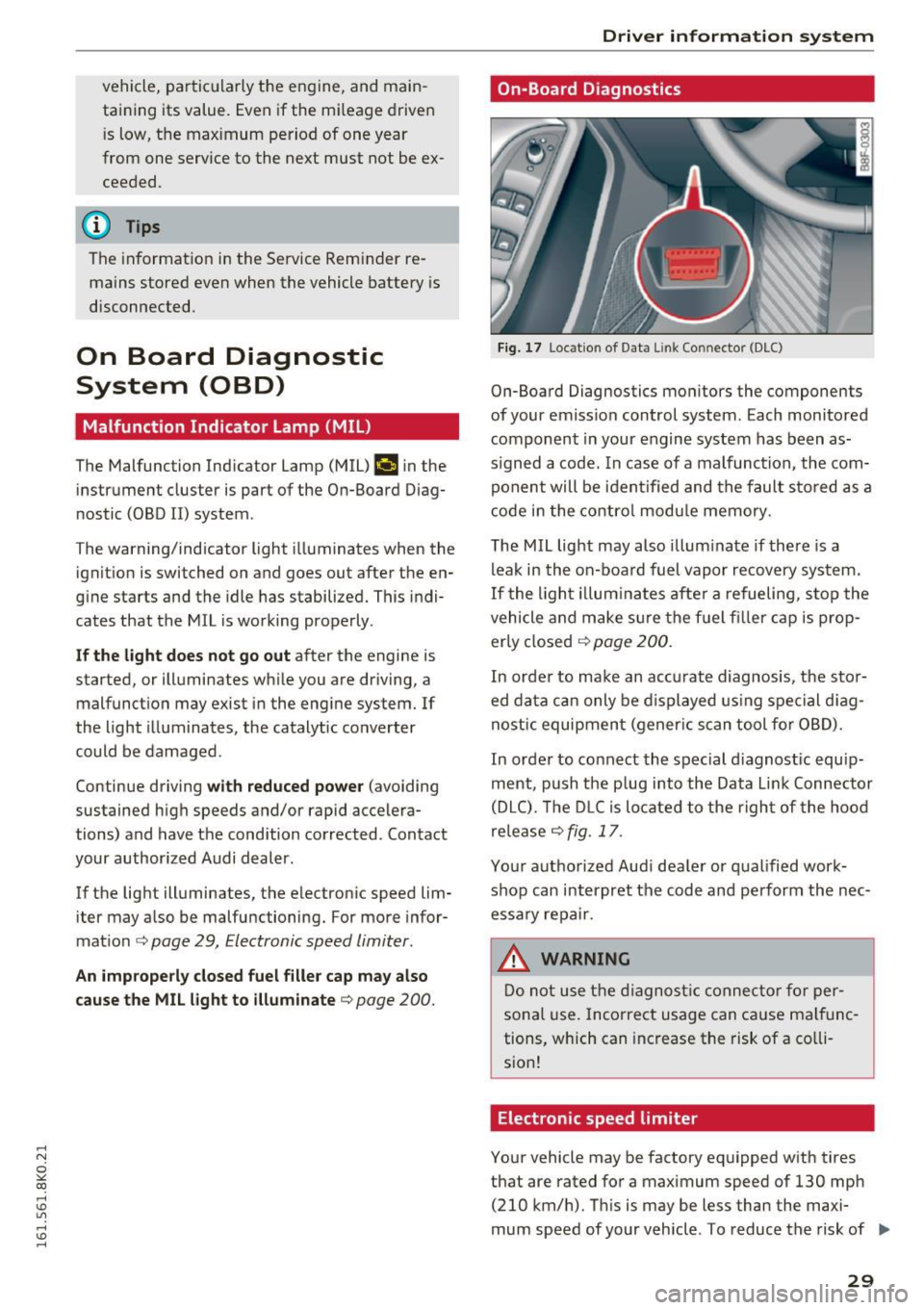
Fig. 17 Loca tion of Data Link Connector (DLC)
On-Board Diagnostics monitors the components
of your emission control system. Each monitored
component in your engine system has been as
s igned a code. In case of a malfunction, the com
ponent will be identified and the fault stored as a
code in the control module memory.
The MIL light may also illuminate if there is a
leak in the on-board fuel vapor recovery system.
If the light illuminates after a refueling, stop the
vehicle and make sure the fuel f iller cap is prop
erly closed
¢ page 200.
In order to make an accurate diagnosis, the stor
ed data can only be displayed using special diag
nostic equipment (gener ic scan tool for OBD).
In order to connect the special d iagnost ic equip
ment, push the p lug into the Data L ink Connector
(DLC). The DLC is located to the right of the hood
release
¢ fig. 17.
Your authorized Audi dealer or qualified work
shop can interpret the code and perform the nec
essary repair.
.&, WARNING
Do not use the diagnostic connector for per
sonal use. Incorrect usage can cause malfunc
tions, which can increase the risk of a co lli
sion!
Electronic speed limiter
Your vehicle may be factory equipped with tires
that are rated for a maximum speed of 130 mph (210 km/h). This is may be less than the maxi
mum speed of your vehicle . To reduce the risk of .,.
29
Page 34 of 278

Opening and clo sin g
- If the power locking system should fail, you
can still open the fuel tank flap in an emer
gency ¢
page 202.
-You are well advised not to keep val uables
inside an unatte nded vehicle, v is ible or not.
Even a properly locked vehicle cannot pro
v ide the security of a safe.
- If the LED in the upper edge of the driver's
door panel comes on for about 30 seconds
after t he vehicle is locked, there is a mal
funct ion in the power lock ing or the anti
theft warning system . Have the malf unct io n
cor rected by an authorized Audi dealership
or q ualified repair facility.
Key set
F ig . 18 Key set
m 0 ±
~
@ Remote control key with mechanical key
You can centrally lock and unlock your veh icle
and start the engine w it h the master key with re
mote cont rol. A mecha nical key is i nteg rated in
the master key ¢
page 33.
@ Eme rgency key
The emergency key is not intended for constant
use . It shou ld only be used in an emergency, for
example, in place of the ign ition key
¢
page 82 . Keep it in a safe place and do not
car ry it on yo ur key r ing.
Key replacement
If you lose a key, contact your author ized Audi
dealer immediately to have the
lost key disab led .
Be s ure to bring all your keys with you .
32
Number of keys
You can chec k the number of assigned keys to
your vehicle
r=;, page 11 . This a llows yo u to make
sure yo u have received all of the keys when you
purchase a used vehicle .
Data in the master key
During driving, serv ice and maintenance-re levan t
da ta is cont inuo usly stored on your master key.
You r A udi service adviser can read out this data
and te ll yo u about the work you r vehicle needs.
This applies also to veh icles with convenience
key* .
Personal comfort settings
If two people use one vehicle, it is recommended
that each person always uses "their own" maste r
k ey . W hen the ignit ion is turned off or when the
vehicle is loc ked, personal conven ience settings
for the following systems are stored and as
signed to the remote master key.
- Climate control
- Power locking system
- Sea t memory *
- Park ing system*
-Adaptive cr uise control*
- Side assist*
- Drive select*
The stored settings are a utomat ica lly rec alled
when you unlock t he vehicle, when yo u ope n the
doo rs or when yo u turn on the ignition.
A WARNING
- Do not leave you r vehicle unattended with
the key in the ignition lock. Entry by una u
thor ized persons could endanger you or re
sult i n theft o r damage the vehicle .
- Do not leave childre n unattended i n the ve
hicle, especially with access to vehicle keys .
Ungua rded access to the keys provides chil
dren t he oppor tunity to start the engine
an d/or activa te ve hicl e sys tems s uch as the
powe r windows etc. Unsupervised ope ration
of any vehicle system by children c an res ult
in ser ious injury.
.
Page 69 of 278
,....,
N
0
""' CX) ,....,
I.Cl U"I ,....,
I.Cl ,....,
-The coat hooks must only be used for light
weight clothing . Do not leave any heavy or
sharp edged objects in the pockets which
may interfere with the side curtain airbag
deployment and can cause personal injury in
a crash .
- Do not use coat hangers for hanging cloth ing on the coat hooks as this can interfere
with proper deployment of the side curtain
airbags in an accident.
- Do not hang heavy objects on the coat
hooks, as they could cause personal injury in
a sudden stop.
-Always keep the compartment above the
rearview mirror closed while driving to re
duce the risk of injury in the event of sudden
braking maneuvers or a collision.
0 Note
Objects located on the rear shelf that rub
against the rear window could damage the
heating wires for the rear window defogger.
(j) Tips
-A vent slot is located between the shelf and
the rear window. Do not block the vent with
any items you may place on the rear window
shelf.
- Do not p lace bulky items on the rear window
shelf as they could restrict or block the driv
er's vision in the rear view mirror.
Roof rack
Description and mounting locations
Additional cargo can be carried with a roof lug
gage rack .
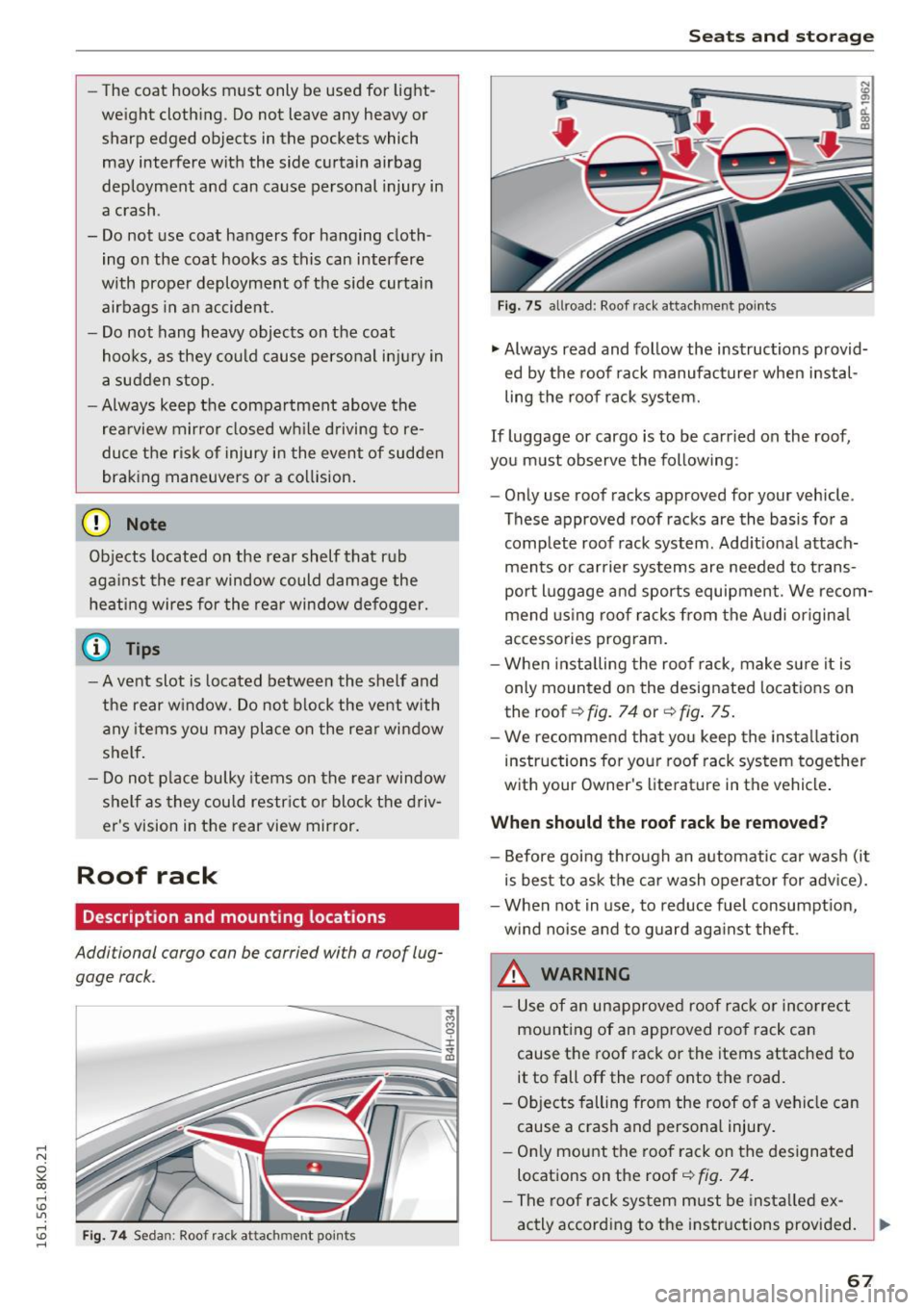
Fig. 74 Sedan: Roof rack a ttac hm en t poin ts
Seats and storage
Fig. 75 allroad : Roof rack attachme nt points
"'Always read and follow the instructions provid
ed by the roof rack manufacturer when instal
ling the roof rack system.
If luggage or cargo is to be carried on the roof,
you must observe the following :
- Only use roof racks approved for your vehicle .
These approved roof racks are the basis for a
complete roof rack system . Add it ional attach
ments or carrier systems are needed to trans
port luggage and sports equipment. We recom
mend using roof racks from the Audi original
accessories program.
- When insta lling the roof rack, make sure it is
only mounted on the designated locations on
the roof
r::!> fig. 74 or r::!> fig. 75.
- We recommend that you keep the installation
instructions for your roof rack system together
with your Owner's literature in the vehicle .
When should the roof rack be removed?
-Before going through an automatic car wash (it
is best to ask the car wash operator for advice).
- When not in use, to reduce fuel consumption,
wind noise and to guard against theft .
_&. WARNING
- Use of an unapproved roof rack or incorrect
mounting of an approved roof rack can
cause the roof rack or the items attached to
it to fall off the roof onto the road.
- Objects falling from the roof of a vehicle can
cause a crash and personal injury.
- Only mount the roof rack on the designated
locations on the roof
r::!> fig. 7 4.
- The roof rack system must be install ed ex-
actly according to the instructions provided. ..,.
67
Page 70 of 278
Seat s and sto rage
-When driving with a roo f rack system,
changes to the center of gravity and wind
resistance can change the vehicle handling
and lead to a collision . A lways adapt your
dr iv ing and your speed to the current condi·
t ions .
{U) Note
- Your vehicle warranty does not cover any
damages to the vehicle caused by using roof
racks or mounting structures not approved
by Aud i for your vehicle . The same applies to
damage resulting from incorrect roof rack i nst allation .
- Always check the roof rack mount ings and
hardware befo re each trip and dur ing a tr ip
to make s ure everyt hing is securely tight
ened.
If necessary, ret ighten the mo unt ings
and check the entire system from time to
time.
- After mounting a roo f rack system, or when
you transport objects on the roof of your ve
hicle, the height of the veh icle is naturally
i nc reased. Be careful when driving under
l ow bridges or in parking garages for exam
ple . This could cause damage to the load
and even the vehicle itself.
- Make sure that the open rear lid and the
su nroof do not come into contact with ob·
j ects on the roof .
Loading the roof rack
Always distribute loads evenly. Make sure any
thing on the roof rack is securely tied down .
"'Always distribute the loads on the roof rack
evenly .
"' Always attach items to the roof rack securely
before you dr ive off .
The max imum perm issible roo f weight is
2 00 lb
( 90 kg ).
The roof weight is the total of the
weight of the roof rack, the attachme nts and the
cargo you are carrying . You must also not exceed
the maximum load weight fo r the roof rack yo u
a re using.
68
When using a roof rack system wh ich has a lower
l oad carrying capacity, you must not use up the
total max imum permissib le load carry ing capac i
ty specified above. Instead, you should load the
roof rack sys tem only to the maximum capacity
specified by the manufacturer of the roof rack
system.
A WARNING
Weak, damaged or improper straps used to
secure items to the roof rack can fail du ring
hard brak ing or in a collision and cause seri
ous persona l injury .
- Ma ke sure the roof rack is i nstalled exactly
as spe cified above
~ page 67 .
-Always use suitable mo unt ing straps fo r se·
cur ing items to the roof ra ck to help preven t
items from sh ifting or flying forward .
- Items on the roof rack must a lways be se·
cure ly mounte d.
- The use of a roof rack can negative ly affect
the way a vehicle handles . Cargo that is
large, heavy, b ulk y, long or flat w ill have a
greater negative influence on the vehicle's
aerodynamics, center of grav ity and overa ll
handling . Always drive slowly, avoid sudden
braking and maneuvers when transporting
cargo on the roof of your vehicle .
- Never exceed the maximum permissib le
load carry ing capacity of the roof of your ve
hicle, the perm iss ible axle weights and the
perm iss ible total we ight of your vehicle
~ page 255, Weights.
(D Note
Make sure that the opened rear lid does not
come in contact with the cargo on the roof .
@ For the sake of the environment
As a result of the increased wind resistance
created by a roof rack, your vehicle is using
fuel unnecessarily . So remove the roof rack
after using it .
-
Page 78 of 278
Warm and cold
Warm and cold
Climate control system
Description
The climate control system warms, cools and
adds humidity to the air in the veh icle inter ior. It
is the most effective when the windows and sun
roof are closed. If there is a build-up of heat in
side the vehicle, ventilation can help to speed up
the cooling process.
I n all heating mode functions except
defrost, the
b lower only switches to a higher speed once the
engine coolant has reached a certain tempera
ture .
Condensat ion from the cooling system can drip
and form a puddle of water under the veh icle.
This is normal and does not mean there is a leak.
P ollutant filt er
The pol lutant filte r removes pollutants such as
dust and pollen from the a ir.
The air pollutants filter must be changed at the intervals specif ied in your Warranty
& Mainte
nance booklet, so that the a ir cond it ione r can
properly work.
If you drive your vehicle in an area with high air pollut ion, the filter may need to be changed
more frequently than specified i n your Aud i War
ranty
& Maintenance booklet. If in doubt, ask
your author ized Audi Service Advisor for advice.
Ke y cod ed setting s
The climate control settings are automatically
stored and assigned to the remote control key
that is in use .
.8, WARNING
Reduced visib ility is dangerous and can ca use
accidents.
- For safe dr iv ing it is very impo rtan t that all
windows be free of ice, snow and condensa
t ion .
76
- Complete ly familiarize yourself with the
proper use and function of the heating and
ventilation system and espec ially how to de
fog and defrost the wi ndows .
- Never use the windshield wiper/washer sys
tem in freezing weather until you have
warmed the windshield first, using the heat ing and vent ilation system. The washer solu
tion may freeze on the windshield and re
duce visibi lity.
(D Note
- If you suspect that the air conditioner has
been damaged, sw itch the system off to
avoid further damage and have it inspected
by a q ualified dealership.
- Repa irs to the Aud i air cond itioner requ ire
special techn ica l know ledge and spec ial
tools. Contact an a uthorized Audi dealer fo r
assistance.
@ For the sake of the environment
By reduc ing the amo unt of fuel you use, you
also reduce the amount of pollutants emitted
into the a ir.
(D Tips
- Keep t he a ir intake slots (in front of the
windshield) free from ice, snow and debr is
in orde r to maintain the prope r funct ion of
the climate control system .
- The energy management sys tem may sw itch
the seat heating* o r rea r window defroster
off temporarily. These systems are available
again as soon as the energy balance has
been restored.
- Air escapes through vents under the rear
window. When placing items of clothing on
the luggage compartment cover, ensure
that the openings are not covered.
Page 81 of 278

..... N
0 ::..:: co .....
The basic climate control settings can be adjust
ed in the radio or
MMI* .
11-Select : I CARI function button > A/C control but
ton. Or
11-Select: ~I C~ A~R~ I funct ion button > Car systems*
control button > AC.
Automatic recirculation*
When switched on, automatic recirculation con
trols the recirculation mode automatically .
If the
windows fog up, press the
I@ FRON T I button.
Synchronization*
When synchronization is switched on, the same
settings are applied to both the driver and front
passenger, except for the seat heating/venti la
tion*. Synchronizat ion switches off when you ad
just the settings on the front passenger's side.
You can a lso switch synchronization on by press
ing and holding the knob on the driver's side.
Supplementary heater
The supplementary heater warms the interior of
vehicles with flexible fuel engines more quickly.
The supplementary heater is controlled automat
ically in the
Auto setting .
Warm and cold
79
Page 92 of 278
Automatic transmission
Automatic transmission Manual transmission
Gearshift lever
A pp lies to veh icles: w ith manu al transmiss ion
The clutch pedal must be depressed all the way
before you can start the engine .
The manual transmission in your Audi is equip
ped with an
interlock-feature.
• Depress the clutch pedal a ll the way.
• Start the engine w it h the gearshift lever in Neu
tral and the clutch pedal depressed.
(D Note
Always depress the clutc h pedal fu lly when
chang ing gears. Do not ho ld the vehicle on a
hill with the clutch pedal partially depressed.
This may cause premature clutch wear or
damage.
@ Tips
- Resting your hand o n the gearshift leve r
k nob while driving will cause premature
wear in the transmiss io n.
- The back-up lights go on when you shift into
Reverse w ith the ignition o n.
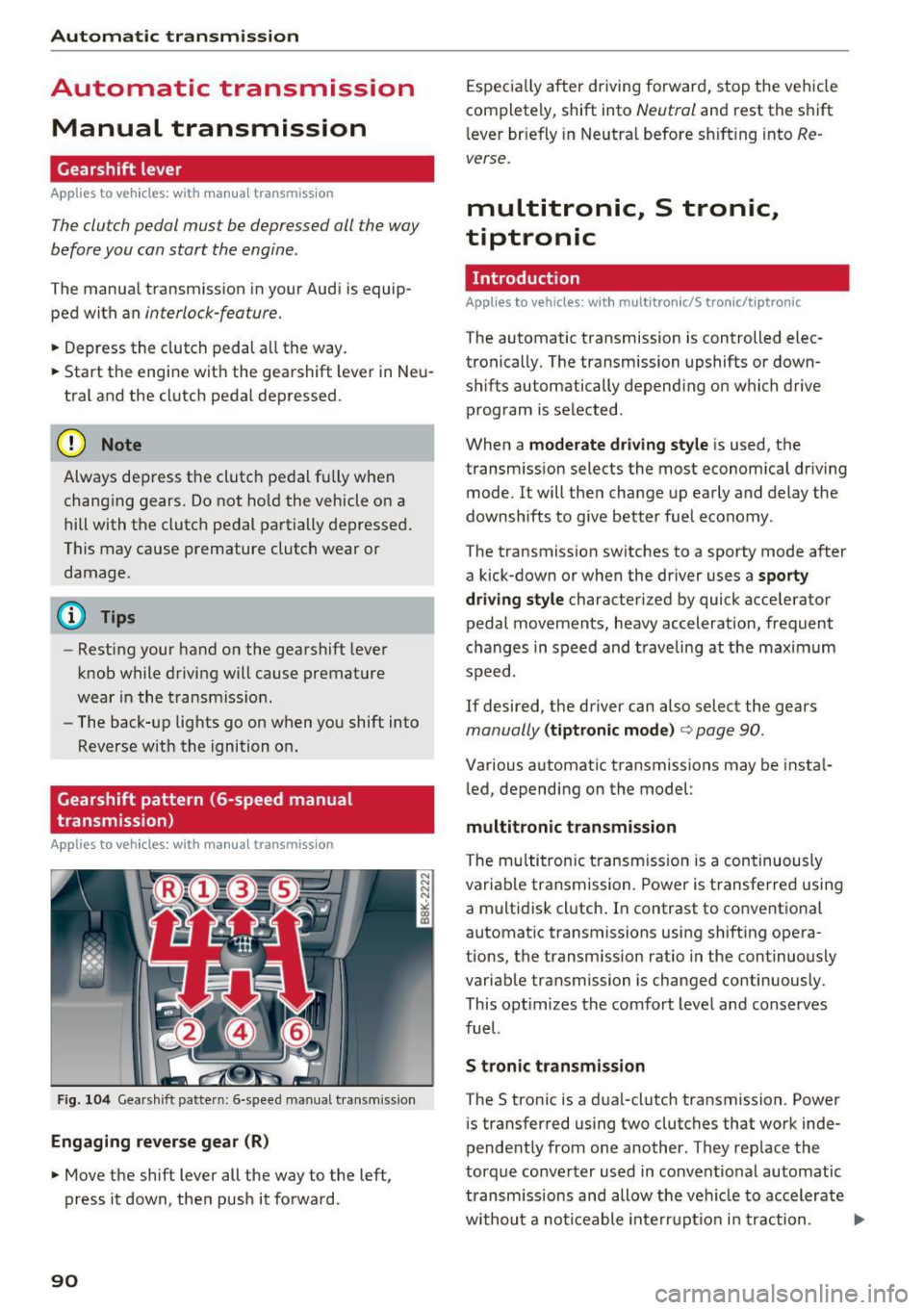
Gearshift pattern (6-speed manual
transmission)
Ap plies to veh icles: w ith man ual transmiss ion
F ig . 104 Gears h ift pattern: 6-speed manual transm iss io n
Engaging reverse gear (R)
• Move the shift lever all the way to the left,
press it down, the n push it forward.
90
Espec ia lly after driving forward, stop the vehicle
completely, shift into
Neutral and rest the shift
l ever br iefly in Neutra l before s hift ing into
Re
verse.
multitronic, S tronic,
tiptronic
Introduction
Applies to vehicles : wi th mult itro nic/S tro nic/ tip tronic
The automatic transmission is controlled elec
tronically. The transmission upshifts or down
shifts automatically depend ing o n which drive
program is se lected .
When a
moderate driving style is used, the
transm ission selects the most economica l driv ing
mode . It will the n change up early and delay the
downshifts to give better fuel economy .
The transmission switches to a sporty mode after
a kick-down or when the driver uses a
sporty
dri ving style
characterized by quick accelerator
pedal movements, heavy acceleration, frequent
c hanges in speed and traveling at the maxim um
speed.
If desired, the driver can also select the gears
manually (tiptronic mode ) ¢ page 90.
Various automatic transmissions may be insta l
l ed, depending on the model :
multitronic transmission
The mu ltitron ic t ransm iss ion is a continuously
variable transmission. Power is transferred using
a multidisk cl utch . In contrast to conventional
automat ic transmissions using shifting opera
tions, the transmission ratio in the continuously
variable transmission is changed continuously.
This opt imizes the comfort leve l and conserves
fuel.
S tronic t ran smission
The S tronic is a d ua l-clutch transmission. Power
i s transferred using two clutches that work inde
pendently from one another . They rep lace the
torque converter used in convent io nal automatic
transm issions and allow the vehicle to accelerate
withou t a noticeable inte rru pt io n in traction. ..,.
Page 187 of 278
..... N
0 ::..:: co .....
environment
Breaking in
New engine
The engine needs to be run-in during the first
1,000 miles (1,500 km).
For the first 600 miles (1 ,000 kilometer s):
"' Do not use full throttle .
"' Do not drive at engine speeds that are more
than
2/3 of the max imum permitted RPM .
From 600 to 1,000 miles (1 ,000 to 1 ,500
kilometers):
"' Speeds can gradually be increased to the maxi
mum pe rm issib le road or engine speed .
During and after break-in pe riod
"' Do not rev the engine up to high speeds when it
is cold. This applies whether the transmission is
in N (Neutral) or in gear .
After the break-in period
"'Do not exceed maximum engine speed under
any c ircumstances.
"'U pshift into the next higher gear
before reach
ing the red area at the end of the tachometer
sca le
c=>page 10.
During the first few hours of driving, the eng ine's
internal friction is higher than later when all the
mov ing parts have been broken in . How well this
b reak-in process is done depends to a considera
b le exte nt on the way the veh icle is d rive n during
t he first 1,000 miles (1,500 kilometers).
(D Note
Extremely high eng ine speeds a re au toma ti
cally reduced. However, these rpm limits are
programme d for a n engine well run-in, not a
new engine.
@) For the sake of the environment
D o not dr ive with u nnecessari ly high eng in e
spee ds -ups hifting ea rly saves fuel, reduces
noise and pro tec ts the envi ronme nt.
Driving and the envir onment
New tires
If your vehicle is runn ing on new tires, d rive very
car efu lly fo r the firs t 35 0 miles (500 kilometers)
a ft er fit ting.
New tires tend to be slippe ry and must a lso
be "bro ken-in". Be sure to remembe r th is dur
i ng the fi rst 350 m iles (500 kilometers).
Brake gent ly. Avoid following closely behind
other vehicles or other s ituations that m ight
r equire sudden, hard b raking.
Avoid damaging the
vehicle
When yo u are dr iv ing o n poor roa ds, or over
cur bs, stee p ramps, e tc., ma ke cert ain that low
ly ing parts s uch a s spo ile rs a nd exh aust sy stem
parts do no t bottom o ut and get dama ged.
T his is espec ially true for ve hicles with low-s lung
c h ass is (sports c hass is) * and fully loaded
vehicles.
Driving through water on
roads
Note t he following to avoi d ve hicle damage w hen
driv ing through water, for examp le on flooded
roads:
- The water must not be any hig her t han the bot
tom of the vehicle body.
- Do not dr ive faste r than walk ing speed.
A WARNING
= -
Afte r driv ing th ro ugh water, m ud, slush, etc .,
the brakes may be slow to take effect beca use
of wet brake rotors and pa ds. Dry the brakes
f irst by braking carefully to restore the full
b raking effect.
(D Note
Ve hicle compone nts such as the engine,
transmission, suspension o r electrica l system
can be severely damaged by driving throug h
water.
185
Page 188 of 278
Driving and th e en vironm ent
(D Tips
- Check the depth of the water before driving
through it .
- Do not stop the veh icle, drive in reverse or
switch the engine
off when driving through
water.
- Keep in mind that oncoming vehicles may
create waves that raise the water level and
make it too deep for your veh icle to drive
through safely.
- Avoid driving through salt water because it
can cause corrosion .
Catalytic converter
It is very impor tant tha t your emission con trol
system (ca talytic converter) is functioning prop
erly to ensure that your vehicle is running in an
environmentally sound manner .
~ Always use lead-free gasoline ¢ page 198,
Fuel supply .
~ Never run the tank down a ll the way to empty .
~ Never put too much motor oil in your engine
¢ page 20 7, 9::?l Adding engine oil .
~ Never try to push- or tow-start you r vehicle.
The cata lytic converter is an efficient "clean-up"
dev ice bu ilt into the exha ust system of the vehi
cle. The cata lytic conve rter burns many of the
pollutants in the exhaust gas before they are re
leased into the atmosphere.
The exclusive use of unleaded fue l is critica lly im
portant for the life of the catalytic conve rter and
p roper functioning of the engine.
A WARNING ,..____ -
- The temperature of the exhaust system is
high, both when driving and after stopping
the engine.
- Never touch the exha ust tail pipes once they
have become hot. This could result in burns.
- Do not park or ope rate t he vehicle in areas
where t he hot exha ust system may come in
contact with dry grass, br ush, fue l spill or
other mater ial which can cause a fire.
- Do not apply additional undercoating or
rustproofing on or near the exhaust mani-
186
fold, exha ust pipes, cata lytic conve rter or
heat shields . D uring driving, the substance
used for undercoat ing could overheat and
cause a f ire .
Cl) Note
-Be aware that just one tank f illing wit h
leaded fu e l w ill already seriously degrade
the performance of the catalytic converter.
- Do not exceed the correct engine oil leve l
¢page 207.
-Do not drive until the fue l tank becomes
completely empty . The engine could mis
fire. Unbu rned fue l cou ld also get into the
exhaust system and this could cause the
catalytic converter to overheat.
- Do not turn off the ign ition while the vehicle
is moving .
- Do not continue to operate your vehicle un
der these conditions, as otherw ise fuel can
reac h the catalytic converter . T hi s could re
sult in overheat ing of the converter, requir
ing its replacement.
- T o ass ure eff icient ope rat ion of the Emis
sion Contro l System:
- Have you r vehicle maintained properly and
i n accordance wit h the service recommen
dations in your Warranty & Ma intenance
booklet.
- Lack of proper ma intenance as well as im
p roper use of the veh icle will impa ir the
function of the emission control system
and could lead to damage .
(® For the sake of the environment
Even when the Emission Control System is op
erating properly, t he exhaust gas can have a
sulfur-like exhaust gas smell under some op
erating states. Th is depends on the sulfur
con tent of the fuel being used . Us ing a d iffer
ent brand of fuel may help , or fi lli ng the tank
wi th lead-free super g rade g asoline.
Shutting down vehicle
If you wo uld like yo ur vehicle to remain inopera
tive for a longer pe riod of time, con tact an Audi
o r other spec ia liz ed dealer. They can adv ise you ..,.