fuel AUDI S4 2016 Owner's Manual
[x] Cancel search | Manufacturer: AUDI, Model Year: 2016, Model line: S4, Model: AUDI S4 2016Pages: 278, PDF Size: 70.26 MB
Page 189 of 278
..... N
0 ::..:: co .....
tion, maintenance and storage . Pay attention to
addit ional information concerning the battery .
Refer to
c::;, poge 212.
Economical and environ
mentally-friendly driving
General
Your personal style of driving will determine the
economy of your vehicle, as well as exhaust and
noise levels.
F ue l economy, environmenta l impact, and we ar
on your engine, brakes and tires la rgely depend
on three factors :
- you r persona l dr iving sty le
- operating conditions
- technical lim itations
If you anticipate what you need to do next and
drive economically, you can eas ily cut your fue l
consumption by
10-15 percen t. This section will
g ive you some tips on how you can help the envi
ronment and yo ur pocketbook .
(!) Tips
The consumpt ion estimates as published by
ENVIRONMENTAL PROTECTION AGENCY (EPA) and Transport Canada may not cor re
spond to your actual consumption on the
road, which will va ry depending upon vehicle
load and speed, road and wea ther condi tions,
t rip length, etc.
Drive smoothly and keep a lookout ahead
Vehicles use the most fuel when they are acceler
ating.
" Avoid unnecessary accelerating a nd braking .
Veh icles use the most fuel when they are acceler
ating . If you anticipate what is going to happen
next , you will need to brake less and, thus, accel
e rate less . let the vehicle coast wheneve r possi
b le -fo r example when yo u see that the next traf
fic light is red .
Driving and the envir onment
Avoid full throttle
Driving at moderate speeds saves fuel and im
proves your mileage .
"Try and keep well below your car 's maximum
speed.
Acce lerating gently reduces fuel consumption,
engine wear, and does not disturb the environ
ment.
Fuel consumption, exhaust emissions and engine
noise increase disproport ionately at high speeds.
If you drive at approximately three quarters of
top speed, fuel consumption will be reduced by
one half. Never drive faster than the posted
speed limit and weather cond itions permit .
Reducing unnecessary idling
Even when your car is jus t idling it burns up fuel.
" Shut the eng ine off when you are not driving
the vehicle.
" Do not warm up the vehicle by lett ing the en-
gine run at idle.
It makes sense to shut off the engine in traffic
jams, when waiting for trains to pass at railroad cross ings, or at traff ic lights that have long waits
on red . Turning the engine off for just
30 -40 sec
onds saves more f uel than is burned starting the
. . engine again.
It takes a long time for the eng ine to warm up
fully when it is running at idle . However, wear
and noxious emissions are especially h igh when
the engine is warming up . So yo u should dr ive
away as soon as you start the eng ine and avoid
runn ing at high rpms w hile the engine is st ill
warming up .
(D Note
Do not leave eng ine idling unattended after
s tart ing. If wa rning lights sho uld come on to
i ndicate improper operation, they would go
unheeded . Extended idling also prod uces
heat, which could resu lt in overheating or
other damage to the vehicle or other proper
ty.
187
Page 190 of 278
Driving and th e en vironm ent
Regular maintenance
A badly tuned engine unnecessarily wastes a lot of fuel.
.,. Have your vehicle serviced at regular intervals.
By having your vehicle regu larly serviced by an
author ized Audi dealer he lps to ensure that it
runs properly and econom ically . The condition of
your veh icle not only affects its safety and ability
to hold its value, it also affects
fu el consump
tion .
C he ck your oil e ach t ime you fill you r ta nk .
The amount of oil used is re lated to engine load
and speed.
It is normal for the oil consumpt ion of a new en
g ine to reach its lowest val ue afte r a certa in mile
age has been driven .
You must d rive you r vehicle about 3 ,000 miles
(5,000 k ilome ters) before you can p roperly as
sess o il cons umption .
This a lso applies to fuel consumption and engine
outpu t.
(D Note
- Have your vehicle maintained properly and
in accordance with the service recommenda
tions in you r Warranty
& Maintenance book
l et . La ck of p roper main tenance as well as
i mproper use of the vehicle will impa ir the
f u nct ion of the emission control system and
could lead to damage.
- Do not al ter or remove any component of
the Emission Control System unless ap proved by the manufacturer.
- Do not a lter or remove any device, such as
heat shie lds, switches, ignition wires,
valves, which are designed to protect your
vehicle's Emission Control System and other i mportant vehicle components.
188
· Fewer short trips
Fuel consumption will always be relatively high
on short trips .
.,. Try to avoid driving short distances with a cold
eng ine .
T he eng ine and catalytic converter have to reac h
their opt imal
operating temper atu re to reduce
fuel consumpt ion and noxious emiss ions effec
tively .
Just after start ing, a cold engine in a mid-size car
on ly achieves a fuel economy of 6-8 miles per
gallon (30-40 l/100 km) . After about a half a
mile, fuel economy climbs to 12 mpg (20 l/100
km) . After about
2 .5 m iles (4 km), the engine is
at its proper operating temperatu re and fuel
economy has reached a no rma l level. So you can
see that you should avoid sho rt tr ips wheneve r
possible .
The
out sid e temperatur e is also cr it ica l in th is re
gard. Your car cons umes more fue l in the winter
than in the summer.
allroad: Driving offroad
General information .
App lies to vehicles : allroad
When dr iving offroad, the functions for the elec
tronic stabilization co ntrol (ESC) are expanded .
The ESC-Offroad-Mode ca n be activated in d riving
s ituations in which a wheel loc k or a d iffe rential
l ock f unct ion is needed ~
page 178. In addit ion,
you r A udi p rovides cont in uo us all whee l dr ive.
You r Audi i s how ever, not an offroad vehicl e.
Nev er dri ve the vehicl e in t errain whi ch i s not
suitable for the vehicl e, or whi ch exce ed s your
driving skills . Nev er take any unnece ssary ri sk s!
Afte r driving offro ad
- After driving offroad, remove branches and
other deb ris from the rad iator g rille , under
body, and wheels. Look especially fo r objects
(s tones) that have been caught in the tire
t read.
- Clean the body and the ve hicle unde rbody and
inspect the ve hicl e for possible damages.
IJI>
Page 197 of 278
..... N
0 ::..:: co .....
Component Situation Solution
Carbon parts
Deposits clean the same way as
painted parts~ page 193, Car
washes
Paint Paint damage Refer to the paint number on the vehicle data label, repair
with touch up paint~
page 255
Spilled fuel Rin se with water immediately
Surface rust Rust remover,
then protect with hard wax; for questions,
consult an authorized Audi dealer or authorized Audi Serv- ice Facility.
Corrosion Have it removed by an authorized Aud i dealer or author-
ized Audi Se rvice Facility.
Water no longer Protect with hard wax (at least twice per year)
beads on the surface
of clean paint
No shine even though Treat with suitable
polish; then apply paint protectant if
paint has been pro- the polish that was used does not contain any protectant
tected/paint looks
poor
Deposits such as in-Dampen with wate r immediately and remove wit h a m icro-
sects, bird droppings, fiber cloth
tree sap and road salt
Grease-based con-Remove immediately with a mild soap solution a) and a
taminants such as soft cloth
cosmetics or sunb lock
•> Mild soap solution: maximum two tab lespoons of neutral soap in 1 quar t (1 liter) of wa ter
Internal cleaning
Component Situation Solution
Windows
Deposits Glass
cleaner, then wipe dry
Decorative parts / Deposits Mild soap solutiona>
trim
Plastic parts
Deposits Damp doth
Heavier deposits Mild soap solution a), detergent-free plastic cleaning solu-
tion, if ne cessary
Displays Deposits Soft cloth with LCD cleaner
Controls Deposits Soft brush,
then a soft cloth with a mild soap solutiona)
Safety belts Deposits Mild soap solution a>, allow to dry before letting them re-
tract
195
Page 200 of 278
Fuel and Refueling
Fuel and Refueling
Fuel
Fuel supply
Using the right fuel helps keep the environment
clean and prevents engine damage.
Fuel recommendation
The fuel recommended for your vehicle is unlead
ed premium
grade gasoline. Audi recommends
using TOP TIER Detergent Gasoline with a mini
mum octane rating of 91 AKI (95 RON). For more
information on TOP TIER Detergent Gasoline,
p lease go to the official website
(www.toptiergas.com).
The recommended gasoline octane rating for
your engine can also be found on a label located
on the ins ide of the fuel filler flap . This rating
may be specified as AKI or RON.
Your vehicle may also be operated using unlead
ed regular gasoline with a minimum octane rat
ing of 87 AKl/91 RON . However, using 87 AKI/91
RON octane fuel w ill slightly reduce engine per
formance.
Use unleaded gasoline only. Unleaded gasoline
is available throughout the USA, Canada, and in
most European countries . We recommend that
you do not take your vehicle to areas or countries
where un leaded gaso line may not be available.
For more information on refueling your vehicle,
see
c::> page 200.
Octane rating
Octane rating indicates a gasoline's ability to re
sist engine damaging "knock" caused by prema
ture ignit ion and detonation . Therefore, buy ing
the correct grade of gasoline is very important to
he lp prevent poss ible engine damage and a loss
of engine performance.
Gasoline most commonly used in the United
States and Canada has the following octane rat
i n gs that can usually be found on the filler pump:
- Premium Grade: 91 - 96 AKI
- Regular Grade: 87 -90 AKI
198
Explanation of the abbreviations:
AKI= Anti Knock Index= (R+M)/2 = (RON +MON)/
2
RON = Research Octane Number
MON = M otor Octane Number.
CJ) Note
- Do not use any fue l with octane ratings low
er than 87 AKI or 91 RON otherwise expen
sive engine damage will occur.
- Do
not use leaded gasoline. The use of lead
ed gasoline will severely damage your vehi
cle's catalytic converter and its ability to
control exhaust emissions.
Blended gasoline
Use of gasoline containing alcohol or MTBE
(methyl tertiary butyl ether)
You may use unleaded gasoline blended with al
cohol or MTBE (commonly referred to as oxygen
ates) if the blended mixt ure meets the following
criteria:
Blend of gasoline methanol (wood alcohol or
methyl alcohol)
- Anti-knock index must be 87 AKI or higher.
- Blend must contain no more than 3% metha-
nol.
- Blend must contain more than 2% co-solvents.
Blend of gasoline and ethanol (grain alcohol or
ethyl alcohol)
-Anti-knoc k index must be 87 AK I or higher.
- Blend must not contain more than 15% etha-
nol.
- Vehicles with flexib le fue l eng ine: blend must
not contain more than 85% ethanol.
Blend of gasoline and MTBE
-Anti-knock index must be 87 AKI or higher.
- Blend must contain not more than 15% MTBE.
Seasonally adjusted gasoline
Many gasoline grades are blended to perform es
pecially well for winter or summer dr iv ing . Dur-
i ng seasonal change-ove r, we suggest that you .,.
Page 201 of 278
..... N
0 ::..:: co .....
adjustm ent is mor e likely to be made in time .
(D Note
-Fu els con taining a high pe rcentage of etha
no l such as ESQ and EBS may only be used in
vehicles with flexible fuel engines. Using high ethanol f uel in veh icles not equ ipped
with flexib le fue l engines can cause severe
engine damage.
- Methanol fuels which do not meet these re quirements may cause corros ion and dam
age to plast ic and rubber components in the
fuel system.
- Do not use fuels that fail to meet the spec i
fied c riter ia in this chapter .
- If you are unable to determine whether or
not a particular fuel blend meets the spec i
fications, ask your service station o r its fuel
supplier .
- Do not use fue l for wh ich the contents can
not be identif ied .
- Fuel system damage and performance prob
lems result ing from the use of fuels differ
ent from those specif ied a re not the respon
s ibility of Audi and are not covered under
t h e New Veh icle o r the Emiss io n Control
Syste m Wa rra nt ies.
- If yo u experience a loss of fue l economy o r
driveability an d pe rform ance pr oble m s du e
to t he use of one of these fuel blends we
,
recommend that you switch to unb lended
fuel.
Ethanol fuel (Bio-ethanol)
Applies to vehicles: with flex ible fuel engine
You can recognize vehicles wi th a flexible fuel
engine by looking at the lab el on the inside of
the fuel filler flap.
Ve hicl es w ith flex ible f uel engines may be oper
ated w ith b io -e thanol fuels such as EBS (85%
ethano l and 15% gasoline) or with un leaded gas
oline (91 AKI/ROZ 95) . The ve hicle may a lso b e
operated with a mixtu re of these fuels.
Fuel and R efueling
Your fuel consumpt ion w ill increase when using
bio-ethano l fue ls due to th e lower amount of en
ergy conta ined per un it vol ume in ethanol.
Warming up the flexible fuel engine in low
temperature s
Due to the chemica l composition of b io -ethanol ,
a certa in amount of fue l ends up in the engine o il
when driving short distances in very low temper
atures . This fuel evaporates again when the en
gine is warmed up.
II Please warm up engine .
If the drive r message appears in the instr ume nt
cluster disp lay, drive with a warm engine to re
duce the oil leve l.
(D Note
- N ever fill wi th metha no l o r with a higher
percentage of b io -ethanol than 85% (E85).
A highe r percentage of bio-ethanol in the
fuel can cause damage to the engine or to the fuel system.
- If you use on ly E85, it is recommende d to
fill the fue l tank complete ly w ith unleaded
premium g rade gasoline every 5,000 mi les.
- If you expe rience starting, rough id le or hes
itat ion d riveab ility prob lems, f ill the fuel
tank complete ly w ith unleaded p remium
grade gaso line and drive it norma lly until
t he gaso line is used. See your author ized
Audi dea ler if the problem persists.
- Inform your author ized Audi dealer that you
are ope rating o r have operate d the vehicle
w ith EBS.
- Read and follow the i nfo rmat ion and tips
abou t gasoli ne
<=:> page 198.
(D Tips
It may take longer to start the engine when
the outs ide temperat ure is very cold . If possi
ble, use w inte rize d fue l if tempe ratures are
below free zing .
199
Page 202 of 278
Fuel and Refueling
Gasoline additives
A major concern among many auto manufactur
ers is carbon deposit build-up ca used by the type
of gasoline you use.
Although gasoline grades d iffer from one manu
facturer to another, they have certain things in
common. All gasoline grades contain substances
that can cause deposits to collect on v ital engine
parts, such as fuel injectors and intake valves. Al
though most gasoline brands include additives to
keep engine and fuel systems clean, they are not
equally effective.
Audi recommends using TOP TIER Detergent Gas
oline. For more information on TOP TIER Deter
gent Gasoline, please go to the official website (www.toptiergas.com).
After an extended period of using inadequate
fue ls, built-up carbon depos its can rob your en
g ine of peak performance.
CD Note
- Damage or malfunction due to poor fuel
quality is not covered by the Audi New Vehi
cle Limited Warranty .
- Do not add aftermarket fuel additive prod
ucts to yo ur fuel tank.
Refueling
Fuel filler neck
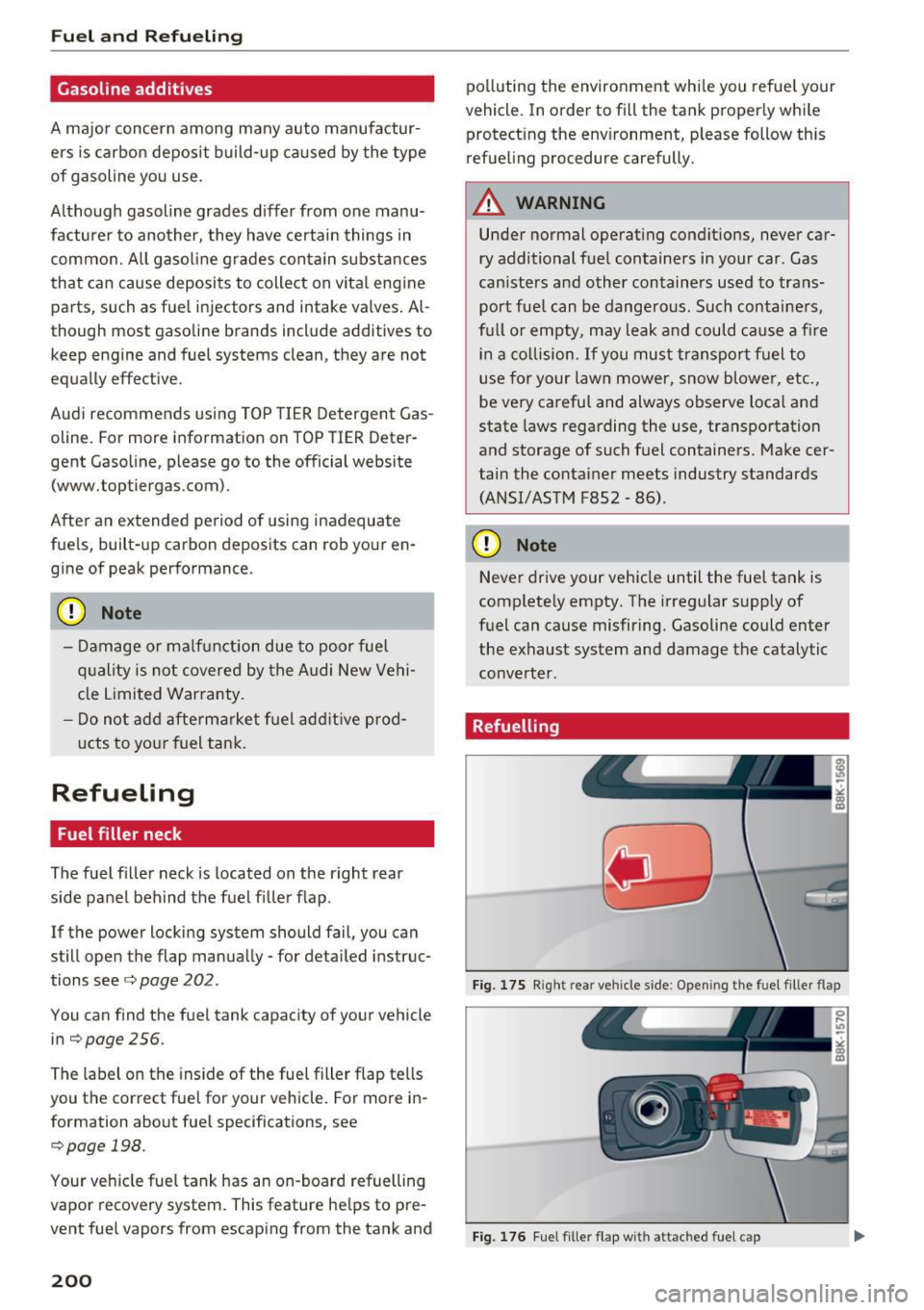
The fuel filler neck is located on the right rear
side panel behind the fuel f iller flap .
If the power locking system should fail, you can
still open the flap manually -for detailed instruc
tions see
c> page 202.
You can find the fuel tank capacity of your vehicle
in
c> page 256 .
The label on the inside of the fuel filler flap tells
you the correct fue l for your vehicle. For more in
formation about fuel specifications, see
<=>page 198.
Your vehicle fuel tank has an on-board refuelling
vapor recovery system. This feature he lps to pre
vent fuel vapors from escaping from the tank and
200
polluting the environment whi le you refuel your
vehicle. In order to fill the tank proper ly while
protecting the env ironment, please follow th is
refueling procedure carefully.
A WARNING
Under normal operating conditions, never car
ry additional fuel containers in your car. Gas
can isters and other containers used to trans
port fue l can be dangerous. Such containers,
full or empty, may leak and could cause a fire
in a col lision.
If you must transport fuel to
use for your lawn mower, snow blower, etc.,
be very careful and always observe local and
state laws regarding the use, transportation
and storage of such fuel containers. Make cer
tain the container meets industry standards (ANSI/ASTM F852 -86).
CD Note
Never drive your vehicle until the fuel tank is
complete ly empty. The irregular supply of
fuel can cause misfiring. Gasoline could enter the exhaust system and damage the catalytic
converte r.
Refuelling
Fig. 175 R ight rea r vehicle side: Open ing the fuel filler flap
Fig. 176 Fuel filler flap w ith attac hed fuel cap
Page 203 of 278
..... N
0 ::..:: co .....
er flap is automatically unlocked or locked. Re
fue l the vehicle with the ignit ion turned
off.
T a king the fuel cap off
.,. Turn off the ignition.
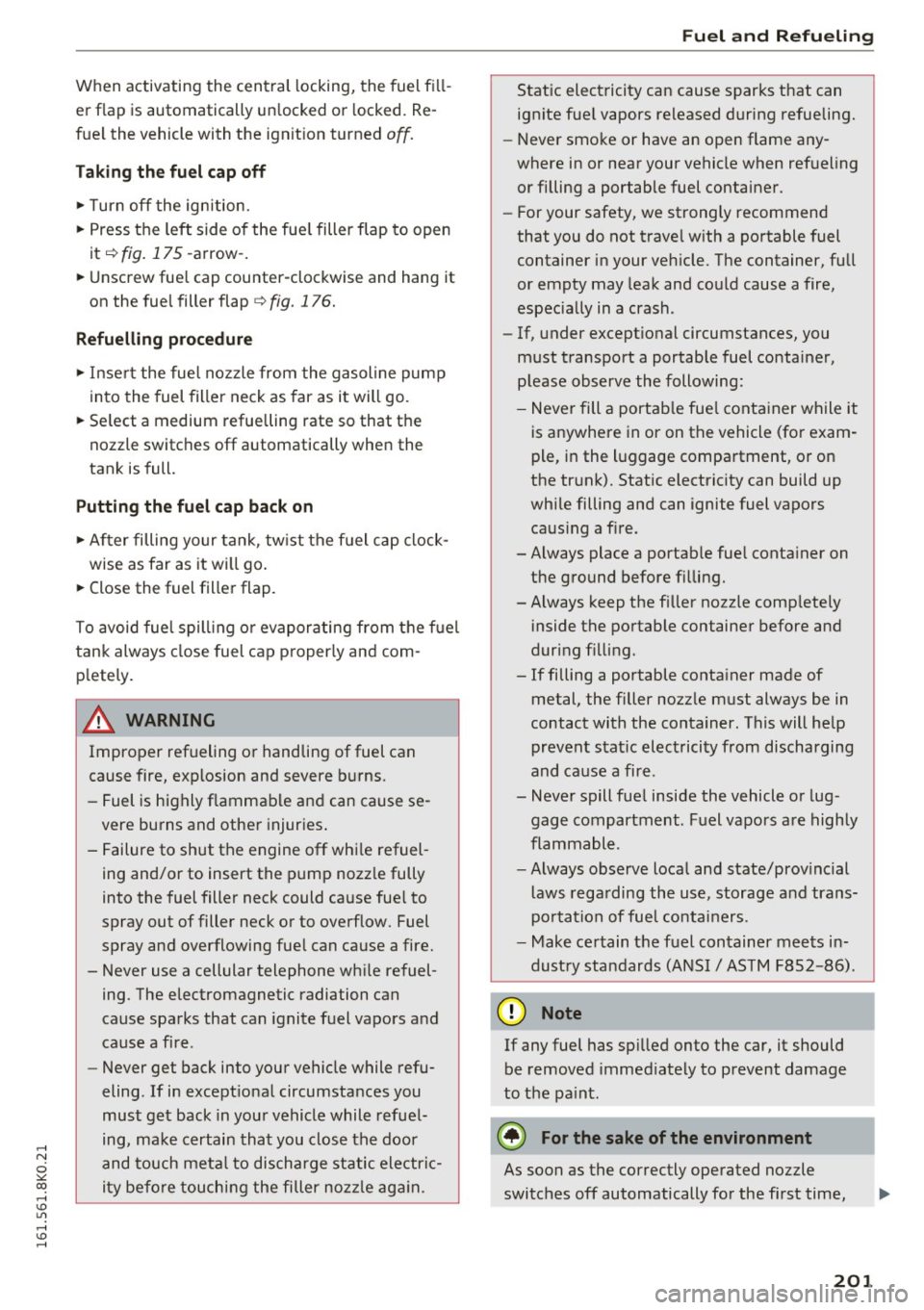
.,. Press the left side of the fue l filler flap to open
it
c:> fig . 175 -arrow -.
.,. Unscrew fue l cap counter -clockwise and hang it
on the fue l filler flap
c:> fig. 176.
Refuelling proc edure
.,. Inse rt the fue l nozzle from the gasoline pump
into the fuel filler neck as far as it will go .
.,. Se lect a medium refuelling rate so that the
nozzle switches off automatically when the
tank is full.
Putting the fuel cap back on
.,. After filling your tank, tw ist the f uel cap clock-
wise as far as it wi ll go .
.,. Close the fuel filler flap.
To avoid fuel spill ing o r evaporating from the f uel
tank always close fuel cap proper ly and com
pletely.
A WARNING
Improper refueling or handling of fuel can
cause fire, explosion and severe b urns.
-
- Fuel is highly flammable and can cause se
vere burns and other injur ies .
- Failure to shut the engine off wh ile refuel
ing and/or to insert the pump nozz le fully
into the fuel filler neck could ca use fue l to
spray out of filler neck or to ove rflow. Fuel
spray and overflowing fue l can cause a fire.
- Never use a cellular telephone wh ile refuel
ing. The electromagnetic radiation can
cause spa rks that can ignite f uel vapors and
cause a fire.
- Never get back into your vehicle while refu
eling. If in except ional circumstances you
must get back in your vehicle while refuel
ing, make certain that you close the door
and touch meta l to discha rge static ele ctric
ity befo re touching the filler noz zle ag ain.
Fuel and R efueling
Stat ic elect ricity can cause sparks that can
ignite fue l vapors released during refueling.
- Never smo ke or have an open flame any
where in or near your vehicle when ref ueling
or filling a portable fuel container .
- For your safety, we strongly recommend
that you do not trave l with a po rtable fuel
container in your veh icle. The container, fu ll
or empty may leak and co uld cause a fire,
especially in a crash.
- If, under except ional circumstances, you
m ust transport a portable fuel container,
p lease observe the following:
- Never fill a portab le fue l conta iner while it
is anywhere in or on the vehicle (for exam
ple, in the l uggage compa rtment, o r on
the trunk). Static electricity can build up
while filling and can ignite fuel vapors caus ing a f ire .
-Always place a portab le fue l conta iner on
the ground before fi lling .
-A lways keep the f iller nozzle comp lete ly
inside the portable container before and
during f il li ng.
- If filling a portable conta iner made of
metal, the filler nozz le must always be in
contact with the container . This will he lp
prevent stat ic elec trici ty from discharging
and ca use a fire.
- Never spill fue l inside the vehicle o r lug
gage compartment. F uel vapors a re highly
flammable.
- Always observe loca l and state/prov incial
laws rega rding the use, storage a nd trans
po rtation of fuel contai ners.
- Make ce rtain the f uel con tainer mee ts i n
dust ry standards (A NSI/ AS TM F852 -86).
(D Note
If any fuel has sp illed onto the car, it should
be removed immed iately to p revent damage
to the pa int.
@) For the sake of the environment
As soon as the correctly operated nozzle
switches off automatically for the first time,
201
Page 204 of 278
Fuel and Refueling
the tank is full . Do not try to add more fuel
because fuel may spill out. In addition, the
expansion space in the fuel tank will be filled -
causing the fuel to overflow when it becomes
warm and pollute the environment.
(D Tips
- Running your engine while refuelling may
cause vapors to escape or even cause fuel to
sp ill out of the tank. This would then shut
off the fuel nozzle before the tank is full.
- Do not refuel your vehicle with the ignition
turned on. The fuel gauge may otherwise
not indicate the correct fuel level after refu
elling .
- The fuel filler flap of your vehicle is not
l ocked when you lock the veh icle from the
inside .
Unlocking the fuel filler flap by hand
You can open the fuel filler flap by hand if the
power locking system should fail.
F ig. 177 Sedan Luggage compartmen t: open ing th e s ide
trim
Fig. 178 L uggage compartment: Emergency opening of
fuel filler fla p
202
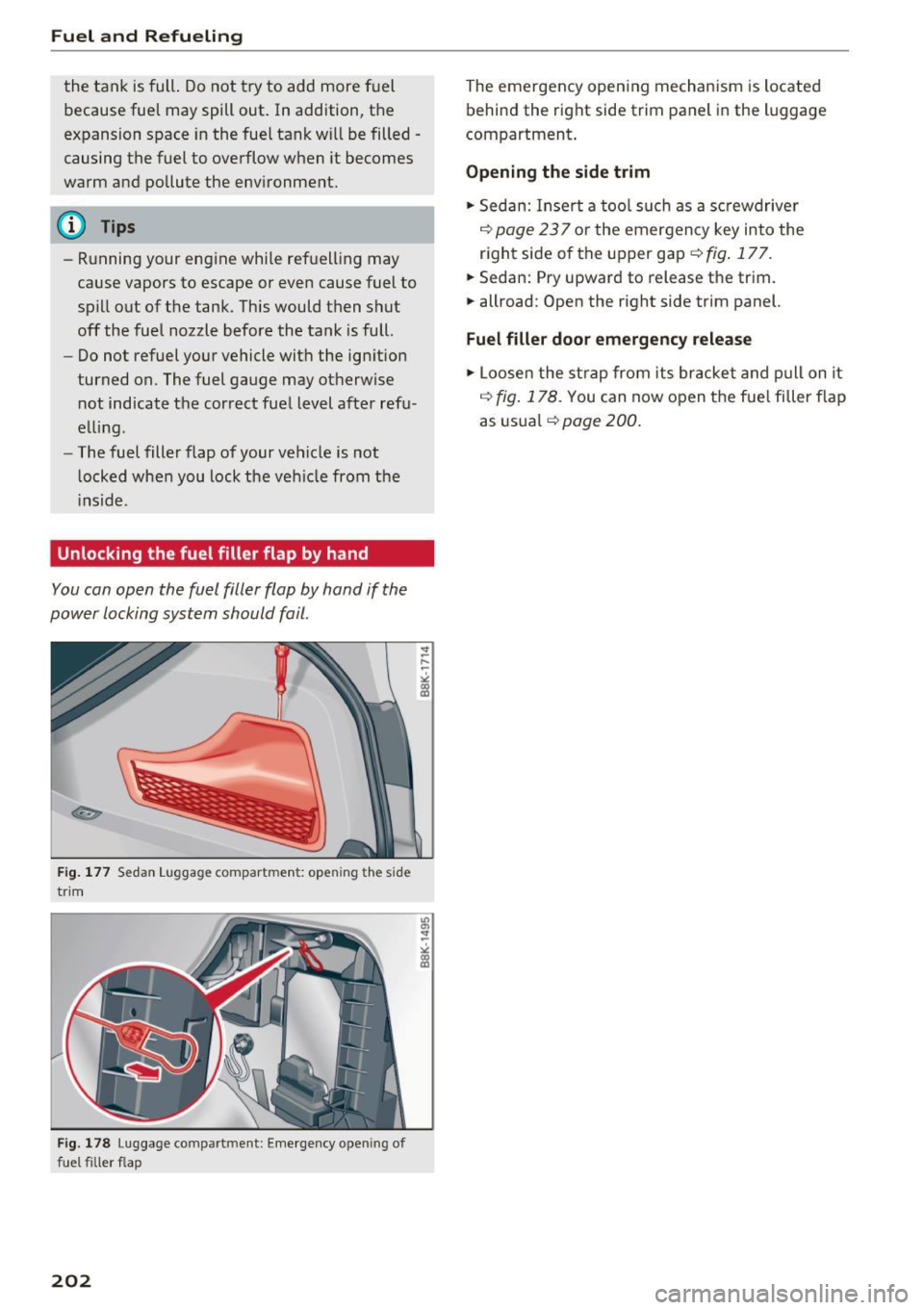
The emergency opening mechanism is located
beh ind the right side trim panel in the luggage
compartment .
Opening the side trim
.. Sedan: Insert a tool such as a screwdriver
¢
page 237 or the emergency key into the
right side of the upper gap¢
fig. 177 .
.. Sedan: Pry upward to release the trim.
.. allroad: Open the right side trim panel.
Fuel filler door emergency release
.. Loosen the strap from its bracket and pull on it
¢
fig. 178. You can now open the fue l filler f lap
as usual ¢
page 200 .
Page 206 of 278
Checking and Filling
-To reduce the risk of being burned, never
open the hood if you see or hear steam or
coolant escaping from the engine compart
ment . Wait until no steam or coolant can be
seen or heard before carefully opening the hood.
- Keep children away from the engine com partment.
- Never spill fluids on hot engine compo
nents. They can cause a fire.
- Never touch the radiator fan. The auxiliary
electric fan is temperature controlled and
can switch on suddenly .
- Never open the coolant reservoir cap when
the engine is still warm. The coolant system is pressurized and hot coolant could spray
out.
- Protect your face, hands and arm from
steam or hot engine coolant by placing a
thick rag over the cap when you open the coolant reservoir.
- Do not remove the engine cover under any
circumstances. This increases the risk of
burns.
- If work on the fuel system or the electrical
system is necessary:
- Always disconnect the battery.
- Never smoke or work near heaters or open
flames. Fluids in the engine compartment could start a fire.
- Keep an approved fire extinguisher imme
diately available.
- To avoid electrical shock and personal injury
while the engine is running or being started,
never touch:
- Ignition cables
- Other components of the high voltage
electronic ignition system .
- If you must perform a check or repair with
the engine running:
- First, fully apply the parking brake, move
selector lever of automatic transmission
204
to "P" (Park); put manual transmission in
Neutral.
- Always use extreme caution to prevent
clothing, jewelry, or long hair from get
ting caught in the radiator fan, V-belts or
other moving parts, or from contacting hot parts . Tie back hair before starting,
and do not wear clothing that will hang or
droop into the engine.
- Minimize exposure to emission and chemi
cal hazards
c::> /.1. .
A WARNING
California Proposition 65 Warning:
- Engine exhaust, some of its constituents, and certain vehicle components contain or
emit chemicals known to the State of Cali
fornia to cause cancer and birth defects and
reproductive harm . In addition, certain flu
ids contained in vehicles and certain prod
ucts of component wear contain or emit
chemicals known to the State of California
to cause cancer and birth defects or other
reproductive harm.
- Battery posts, terminals and related acces
sories contain lead and lead compounds,
chemicals known to the State of California
to cause cancer and reproductive harms .
Wash hands after handling.
(D Note
When adding fluids, always make sure that
they are poured into the proper container or
filler opening, otherwise serious damage to
vehicle systems will occur.
@ For the sake of the environment
To detect leaks in time, inspect the vehicle
floor pan from underneath regularly . If you
see spots from oil or other vehicle fluids, have
your vehicle inspected by an authorized Audi
dealer.
Page 208 of 278
Check ing and F illing
Using the proper engine oil is impo rtant for the
functionality and service life of the engine. Your engine was facto ry-filled with a h igh-quality oi l
which can usually be used throughout the entire
year.
@) Note
Your Limited New Vehicle War ranty does not
cover damage or malfunctions due to failure
to follow recommended maintenance and use
requirements as set forth in the Audi Owner's
Manual and Warran ty
& Maintenance booklet.
- Use only a high quality eng ine oil t hat ex-
p ressly complies with the Audi oil qua lity
standard specified for your vehicle's engine .
Using a ny o ther oil can cause serious engine
d am age.
- D o not mix any lubricants o r other addit ives
i nto the engine oil. Doing so ca n cause en
g ine damage.
(D Tips
I f you need to add oil and there is none availa
ble t hat meets the Audi o il quality standard
your eng ine requi res , you m ay ad d a tot al of
no more than 0.5 qu art /li ter o f a h igh-quality
"synthe tic"oil that meets t he following speci
fications.
- Vehicles w it h gasoline eng ine: AC EA A3 o r
API SM with a viscosity grade of SAE 0W-30,
SAE SW -30 or SAE SW-40.
- Fo r more information about en gine o il that
has been approve d for your ve hicle, please
contact eithe r you r a uthorized Aud i dea ler
or A udi C ustome r Relat ions at
1 (800) 822-2834 or visit our web site at
www .audiusa .com or www.aud icanada .ca .
Engine oil consumption
The engine in your vehicle depends on an ade
quate amoun t of oil to lubricate and cool all of
its moving parts .
In order to provide effective lubr ication and coo l
ing of in ternal engine components, all internal
combustion eng ines consume a certain amou nt
of oil. Oil co nsumption varies from engine to en
g ine and may change significant ly over the life of
206
th e engine. Typically, engines w ith a specified
break-in period (see
r=:> poge 185) consume more
o il dur ing the b reak-in per iod than they consume
after oil consumption has stabili zed .
U nder normal cond itions, the rate of oil con
sumption depends on the q ua lity and viscosity of
the oil, the RPM (revo lutions per m inute) at
which the engine is operated, the ambient tem perature and road condit ions. Further factors are
the amo unt of o il di lution from water condensa
t ion or fuel residue a nd the oxidation level of the
o il. As any engine is subject to wea r as mileage
builds up, the o il cons umption may increase ove r
t i me unt il repla ce m ent of wo rn components m ay
be come necessary .
With a ll these va riab les coming into p lay, no
sta ndard rate of o il cons umption can be estab
li sh ed or spec ified . T he re is no alte rn ative to reg
ul ar and frequen t checking of the oi l level, see
Note .
If the yellow engine oi l leve l wa rning symbo l Ill
in the instrument clus ter lights up , you sho uld
c h eck t he o il level as soon as possible
r=:> page 207 . Top off the oi l at your ea rliest con
venience
r=:> poge 207.
A WARNING
Before you check anyth ing in the engine com
partment, always read and heed all WARN
INGS
r=:> .&. in Working in the engine compart
ment on page 203 .
@ Note
Driving wit h an insuffic ient oil level is like ly to
cause severe damage to the eng ine.
(D Tips
- The oil pressure warning display. is not
an indicator of the oil level. Do not rely on
it . Instead, check the oil level in your en
gine at regular intervals, preferably each
time you refuel, and always before going
on a long trip .
-If you have the impress io n your e ngine con
sumes excessive amou nts of oil, we recom-
mend th at yo u consult an authori zed A udi .,.