ECO mode AUDI S4 2016 Owner's Manual
[x] Cancel search | Manufacturer: AUDI, Model Year: 2016, Model line: S4, Model: AUDI S4 2016Pages: 278, PDF Size: 70.26 MB
Page 105 of 278
,....,
N
0
""' CX) ,....,
I.Cl U"I ,....,
I.Cl ,....,
Audi adaptive cruise control and braking guard
~--- ~-Di stance 3: This setting corresponds
to a distance of 164 feet/SO meters when travel
ing at 62 mph (100 km/h), or a time interval of
1.8 seconds.
~ ---- ~ Distance 4: This setting corresponds
to a distance of 210 feet/64 meters when travel
ing at 62 mph (100 km/h), or a time interval of
2 .3 seconds.
A WARNING
Following other vehicles too closely increases
the risk of collisions and ser ious personal in
jury.
- Setting short distances to the traffic ahead
reduces the time and distance available to
br ing your vehicle to a safe stop and makes
it even more necessary to pay close atten
tion to traffic.
- Always obey applicable traffic laws, use
good judgment, and select a safe following
distance for the traffic, road and weather
conditions.
¢j) Tips
- Distance 3
is set automatically each time
you switch the ignition on.
- Your standard sett ings are automat ically
stored and assigned to the remot e control
k ey be ing used.
Setting the driving program
Applies to vehicles: with Audi adaptive cruise control
Depending on the selected dr iv in g program and
d istance, driving behav ior when accelerating w ill
vary from dynamic to comfortable.
Setting the driving program for vehicles
without Audi drive select*
~ In the radio/MM!*, select: !CARI function but
ton >
Adaptive cruise control > Driving prog. >
comfort, standard or dynamic . Or
~ Select: ICARI function button> Car systems*
contro l button > Driver ass ist > Adaptive cruise
control > Driving program* > Comfort, Stand
ard or Dynamic . Setting the driving mode for vehicles with
Audi drive select*
Refer to c!:>poge 112 .
(D Tips
Your settings are automatically stored and as
s ig ned to the remote control key being used.
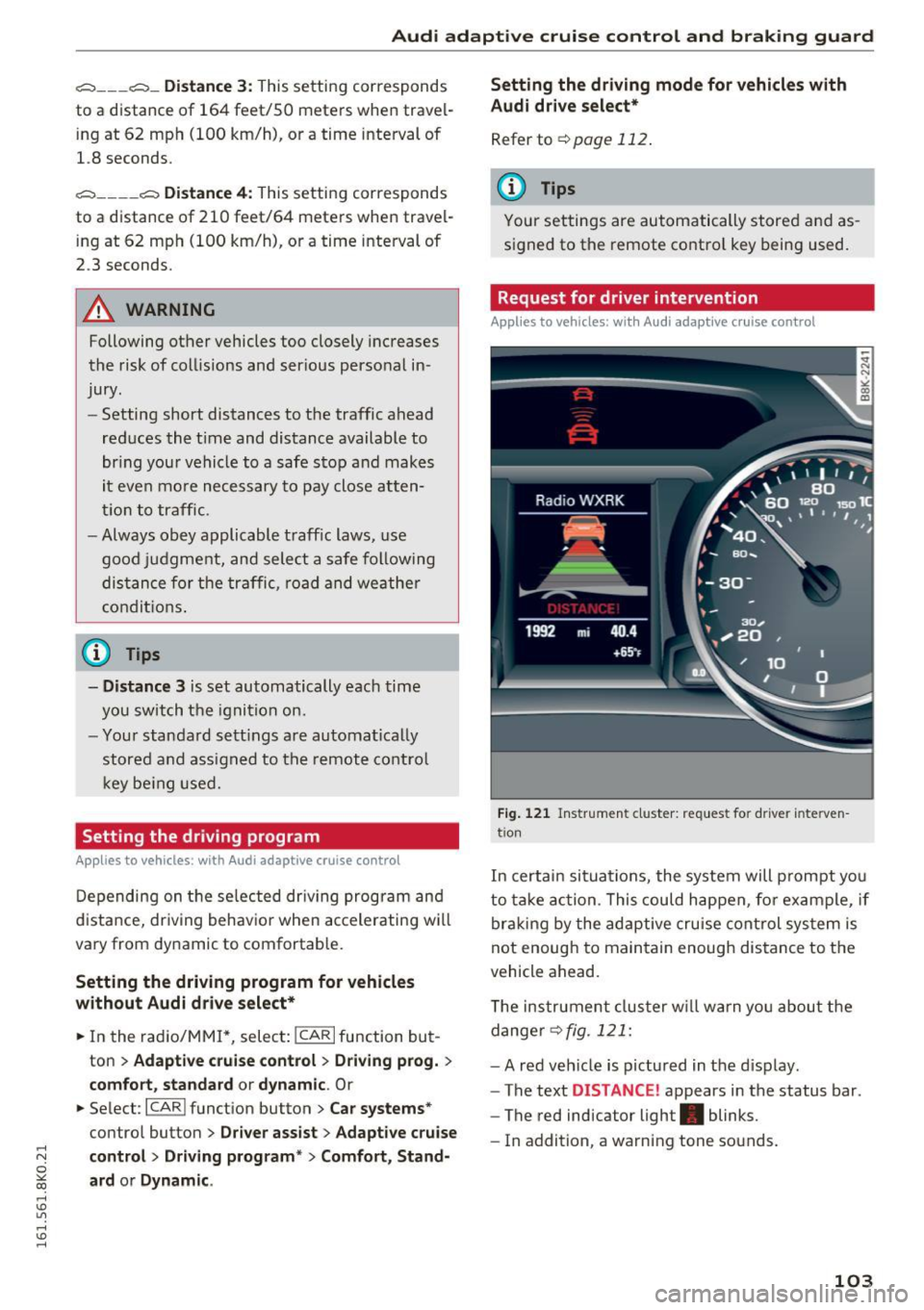
Request for driver intervention
Applies to vehicles: with Audi adapt ive cruise control
Fig. 121 Ins trumen t cluster: request for driver interve n
tio n
In certain situa tions, the system will prompt yo u
to take action . This could happen, for example, if
braking by the adaptive cruise control system is
not enoug h to maintain enough dis tance to the
vehicle ahead.
T he instrument cluster will warn you about the
danger
c!:> fig. 121:
-A red vehicle is pictured in the display.
- The text
DISTANCE ! appears in the status bar.
- The red indicator light. blinks.
- In addition, a warning tone sounds.
103
Page 113 of 278

..... N
0 ::..:: co .....
Introduction
Applies to vehicles: with Audi drive select
Drive select provides the possibility to experience
d iff erent types of vehicle settings in one veh icle.
F or instance, using the three
Comfort, Auto and
Dynamic modes, the driver can switch from a
sporty to a comfortab le driving mode with the
press of a button.
Addit ionally, in vehicles with MM I*, the vehicle
setup for
Individual* mode can be customized by
you. This makes it possible to combine settings
such as a sporty engine tuning with comfortable
steering.
A WARNING
-
Improper use of the Audi drive select can
cause collisions, other accidents and serious
personal injury .
Description
Applies to vehicles: with Audi drive select
The vehicle setup in each mode depends on the
veh icle's features . However, the engine, auto
matic transmission* and steering are always in
volved.
Engine and automatic transmission*
Depending on the mode, the engine and the au
tomatic transm ission respond quicker or in a
more balanced manner to accelerator pedal
movements . In the sporty dynamic mode, the au
tomatic transmission shifts at higher RPMs.
Steering
The steering adapts in terms of steering effort
and steering ratios. Indirect steer ing that moves
eas ily, like the steering in comfort mode, is best
suited to long drives on a highway. In contrast,
dynamic mode provides sporty, direct steering.
The follow ing applies to vehicles with dynam ic
steer ing*: the steering rat io changes based on
vehicle speed in order to maintain optimum
steer ing effort for the driver at all times. This
Audi drive select
sets the steering to be less sensitive at higher
speeds in order to provide improved vehicle con
trol. At reduced speeds, however, steering is
more direct in order to keep the steering effort as
minimal as possible when the driver is maneuver
ing the vehicle. At low and average speeds, dy
nam ic steering additionally prov ides more re
spons ive steering performance .
Adaptive dampers*
The adaptive dampers* use sensors to record in
formation regarding steering movements, brak
ing and acceleration operations by the driver,
road surface, driving speed, and load . This makes
it possible to adapt damping to the driving situa
tion virtua lly in real time. Drive select also makes
it possible to sat isfy the desire for sporty suspen
sion (Dynamic) and comfortable suspension
(Comfort) without giving up balanced tuning (Au
to).
Sport differential*
As a component of the all whee l dr ive system
(quattro)
c::> page 182, the sport different ial* dis
tributes the driving power to the rear axle de
pending on the situation. The distribution of
power varies depending on the mode selected.
The goal is a high level of ag ility and ability to ac
celerate on curves. The vehicle is very responsive
to steering.
Audi adaptive cruise control*
The behavior when accelerating can be adjusted
from comfortable to sporty, depending on the
drive select mode. Adaptive cruise control also
responds to the driving behavior of the vehicle
ahead in a more conservative or sporty manner .
Engine sound*
The sound of the engine is adapted to the select
ed mode and ranges from subtle to sporty.
(D Tips
- In some models, the maximum vehicle
speed can only be reached in the
Auto and
Dynamic modes.
- For vehicles with an automatic transmis-
sion, se lecting the
Dynamic mode resu lts in ...,
111
Page 150 of 278
Airbag syste m
-Never place or attach accessories or other
objects (such as cupholders, telephone
brackets, large, heavy or bulky objects) on
the doors, over or near the area marked "AIRBAG" on the steering wheel, instru
ment panel, seat backrests or between
those areas and yourself. These objects
could cause injury in a crash, especially
when the airbags inflate.
- Never recline the front passenger's seat to
transport objects. Items can also move into
the area of the side airbag or the front a ir
bag during braking or in a sudden maneu
ver. Objects near the airbags can become projectiles and cause injury, particularly
when the seat is reclined.
A WARNING
The fine dust created when airbags deploy can
cause breath ing problems for people w ith a
history of asthma or other breathing condi
t ions.
- To reduce the risk of breathing problems,
those w ith asthma or other respiratory con
ditions should get fresh air right away by
gett ing out of the vehicle o r opening w in
dows or doors.
- If you are in a collision in which airbags de
ploy, wash your hands and fa ce with mild
soap and water before eat ing.
- Be careful not to get the dust into your eyes,
o r into any cuts or sc ratches.
- If the resid ue should get into yo ur eyes,
flush them with water.
Monitoring the
Advanced Airbag System
~i ( USA model s) /!f (Canada models )
Airbag monitoring indicator light
Two separate indicators monitor the function of
the Advanced Airbag System: the airbag moni
toring indicator light and the
PASSENGER AIR
BAG OFF light.
The Advanced Airbag System (including the elec
tronic co ntrol unit, senso r ci rcui ts and system
wiring) is monitored continuously to make su re
148
that it is functioning properly whenever the igni
tion is on. Every time you turn on the ignition, the
airbag system indicator light
II (USA models) I
E,I (Canada models) will come on for a few sec
onds (function check).
The system must be inspected wh en th e
indicator light
fl ( USA models) 1m
( Canada models ):
- does not come on when the ignition is sw itched
on,
- does not go out a few seconds after you have
sw itched on the igni tion, or
- comes on while driving .
If an airbag system malfunction is detected, the
indicator light will first start flashing to catch the
driver's attention and then stay on continuously
to serve as a constant reminder to have the sys
tem inspected immediately .
If a malfunction occurs that turns the front air
bag on the passenger side off, the
PASSEN GER
AIR BAG OFF
light will come on and stay on
whenever the ignition is on .
A WARNING
An airbag system that is not functioning prop
e rly cannot provide supp lemental protection
i n a fronta l crash.
- If the airbag ind icator light ¢
page 19
comes when the veh icle is being used, have
t he system inspected immedia tely by your
author ized Audi dealer . It is possib le that
the airbag will inflate when it is not sup
posed to, or wi ll not inflate when it should .
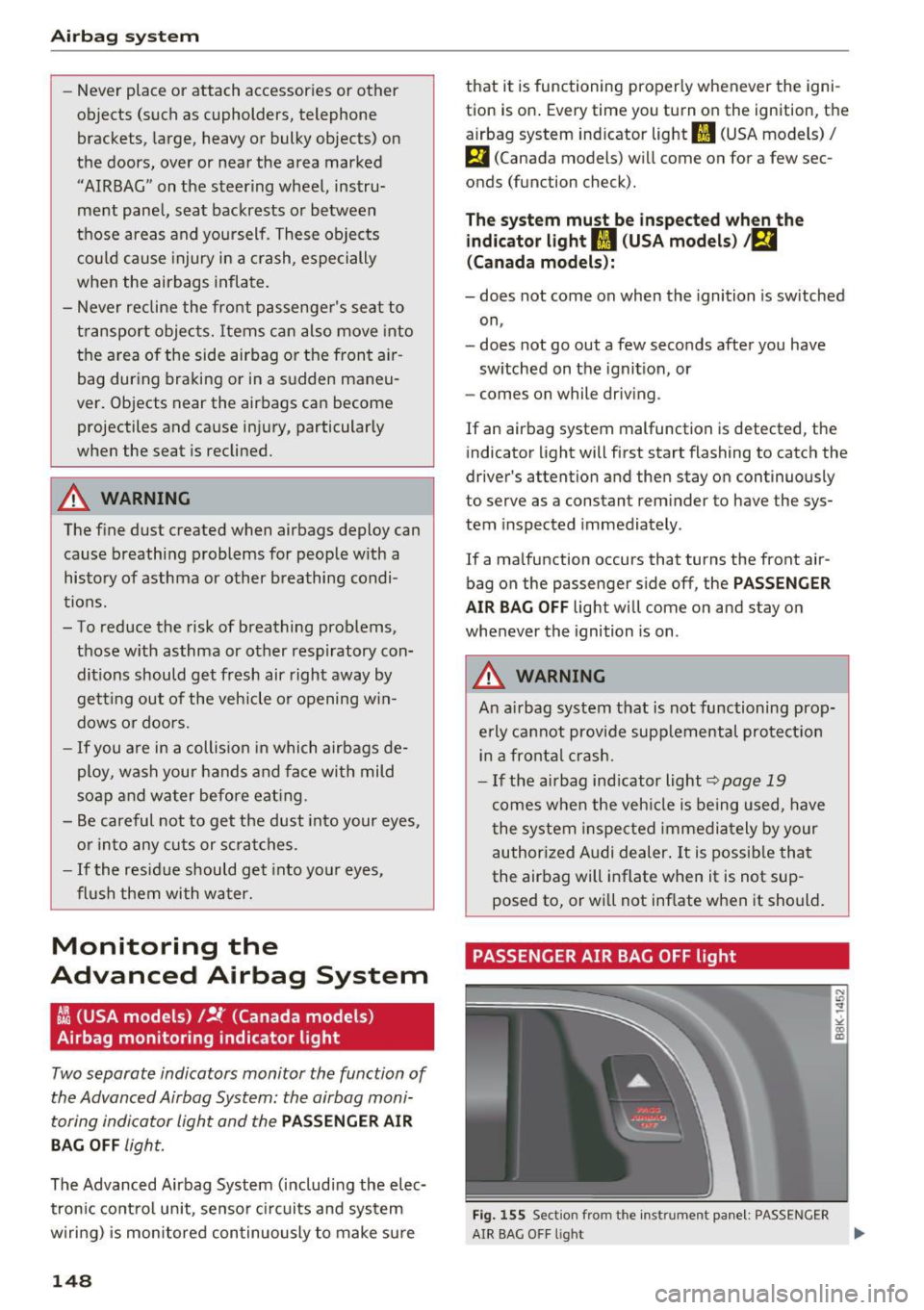
PASSENGER AIR BAG OFF light
Fig . 155 Se ction from the inst rument panel: PASSENGER
AIR BAG O FF light .,,_
Page 153 of 278
..... N
0 ::..:: co .....
If the weight-sensing mat in the front passen
ger seat detects an empty seat, the front air
bag on the passenger side will be turned off,
and
P ASS ENGER AIR B AG OFF will stay on.
Repair , care and disposal of the airbags
Parts of the a irbag system are installed at many
d ifferent p laces on your Aud i. Installing, remov
ing, servicing o r repa iring a part in an area of the
vehicle can damage a pa rt of an airbag system
and prevent that system from working properly in a co llision.
There are some importa nt things you have to
know to make sure that the effectiveness of the
system w ill not be impaired and that discarded
components do not cause injury or pollute the
environment.
A WARNING
Improper care, serv icing and repair proce
dures can increase the r isk of personal injury
and death by preventing an airbag from de
ploying when needed or deploying an airbag
unexpectedly :
-
-Never cover, obstruct, or change the steer
ing wheel horn pad or a irbag cover or the in
strument panel or mod ify them in any way .
- Never attach any objects such as cupholders
or telephone mountings to the surfaces cov
er ing the airbag units .
- For cleaning the horn pad or instrument panel, use only a soft, dry cloth or one mois
tened with plain water. Solvents or cleaners
cou ld damage the a irbag cover or change
the stiffness or strength of the mater ial so
that the airbag cannot dep loy and protect
properly.
- Never repair, adjust, or change any parts of
the airbag system.
- All wo rk on the stee ring wheel, instr ument
pane l, front seats or electrical system (in
cluding the installation of audio equipment,
cellu lar telephones and CB radios, etc .)
must be performed by a qualified technician
Airb ag sys tem
who has the training and special equ ipment
necessary.
- For any wo rk on the airbag system, we
strong ly recommend that you see your au
thorized Audi dealer or qualified workshop .
- Never modify the front bumper or parts of
the vehicle body.
- Always make sure that the side a irbag can
inflate without interference:
- Never install seat covers or replacement
upholstery ove r the front seatbacks that
have not been specifica lly approved by
Audi .
- Never use addi tional seat c ushions that
cove r the areas where the side airbags in
flate.
- Damage to the orig inal seat cove rs or to
the seam in the area of the s ide airbag
module must a lways be repaired immedi
ate ly by an authorized Aud i dealer.
- The airbag system can be activated only
once . A fter an airbag has inflated, it must
be replaced by an authorized Audi dealer or
qualified technic ian who has the technical
information, t raining and spec ial equ ipment
necessary.
- The airbag system can be deployed only
once . After an airbag has been deployed, it
must be replaced with new rep lacement
parts des igned and approved especially for
your Aud i model version. Replacement of
comp lete airbag systems or airbag compo
nents must be performed by qualified work
shops only. Ma ke sure that any airbag serv
ice act ion is en tered in your Aud i Wa rranty
& Maintenance booklet under AIRBAG RE
PLACEMENT RECORD.
- In accidents when an airbag is dep loyed, the
vehicle battery separates the alternator and
the starter from the veh icle electrical sys
tem for safety reasons w ith a pyrotechnic
circu it interrupter.
- Wo rk on the pyrotechnic c ircuit inte rrupt
er must on ly be performed by a qu alified
dealer -risk of an acc ident!
- If the vehicle or the circuit interr upter is
scrapped, all applicable safe ty p recautions
must be followed .
151
Page 162 of 278
Child safet y
and typical 1 year -old child have been sto red in
the co ntrol unit of the Advanced Airbag System.
When a chi ld restra int is being used on the front
passenger seat with a typical 1 year-old child, the
Advanced Airbag System compares the we ight
measured by the we ight sensing mat with the in
formation stored in the electronic control unit.
The electronic control un it also registers the ten
sion on the front passenger safety belt. The ten
sion on the safety belt for the fro nt passenger
seat will be d ifferent for an adult w ho is p roperly
using the safety belt as compared to the tension
on the belt w hen it is used to attach a ch ild re
s tra int to the sea t. The senso r below the la tch for
t he safety belt for the front sea t passenger
measures the tension on the belt. The inp ut from
this senso r is then used with the weight to "de
cide", whether there is a child restra int w ith a
typical 1 year-old child on the front passenge r
seat and whether or not the a irbag must be
turned off.
Child restraints and Advanced Airbags
Regard less of the child restra int tha t you use,
make su re that it h as been cert ified to meet Safe
ty Standa rds and has been certified by its manu
facture r for use wi th an a irba g. A lways be sure
t hat the chi ld restrain t is properly insta lled at
one of the rear seating positions . If in exception
al c ircumstances yo u m ust use it on the front
passenger seat, carefully read all of the informa
tion on child safety and Advanced Airbags and heed a ll of the app licab le WARNINGS . Make cer
tain tha t the child res tra int is correc tly recog
n iz ed by the we ight-sens ing mat inside the front
passenger seat, that t he fron t passe nger a irbag
is t urned off and tha t the airbag st atus is always
corre ct ly sign aled by the
PASSENGER AIR BAG
OFF li ght .
M any types and mo dels of child res traints have
been available ove r the ye ars, new mode ls are in
troduce d regularly inco rpora ting new and im
p roved designs and o lder mode ls are taken o ut of
product ion . Chi ld restraints a re not standardized .
Ch ild restraints of the same type typ ica lly have
d ifferent weights and s izes and d ifferent 'foot
prints,' the size a nd shape of the bottom of t he
160
ch ild restraint t hat sits on the seat, when they
a re installed on a vehicle seat . These differences
make it virtua lly impossib le to certify comp liance
with the requirements for advanced a irbags w ith
each and every child restra int that has ever been
sold in the past or wi ll be sold over the course of
t h e usefu l life of your vehicle .
For t his reason, the United States National High
way Traffic Safety Admin istrat ion has published a
li st of specific type, makes and mode ls of ch ild
res tra ints tha t must be used to certify compli
ance of the Advanced Airbag System in your ve hi
cl e w ith the s uppression requirements of Federa l
Mot or Ve hicl e Safety St and a rd 208. These child
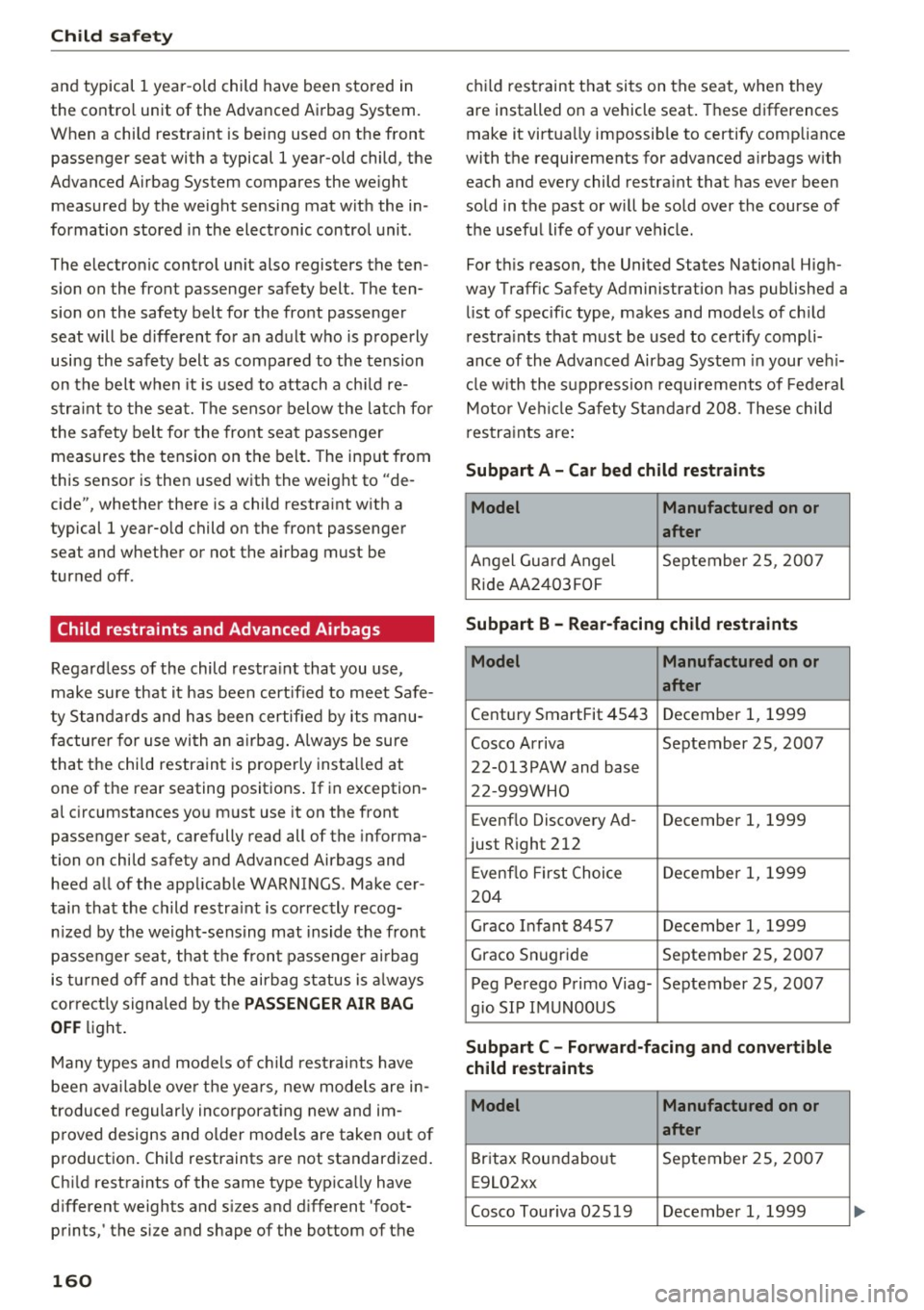
r es tra ints are :
Subpart A- Car bed child restraints
Model Manufactured on or
after
A ngel Guard Angel Se pte mber 2 5, 20 07
Ride AA 2403F OF
Subpart B - Rear-facing child restraints
Model Manufactured on or
after
Century SmartFit 4543 December 1, 1999
Cosco Arriva September 25, 2007
22-013PAW and base 22- 999WHO
Evenflo Discove ry Ad- December 1, 1999
just R ight 212
E ven flo Firs t Choi ce December
1, 1 999
2 04
Grace I nfant 8457 December 1, 1999
Grace Sn ugride September 25, 2007
Peg Perego Primo Viag- September 25, 2007
g io SIP I MUNOOUS
Subpart C -Forward-facing and convertible
child restraints
Model Manufactured on or
after
Br itax Roundabo ut September 25, 2007
E9L02xx
Cosco Tou riva 0 2519 December 1, 1999
...
Page 189 of 278
..... N
0 ::..:: co .....
tion, maintenance and storage . Pay attention to
addit ional information concerning the battery .
Refer to
c::;, poge 212.
Economical and environ
mentally-friendly driving
General
Your personal style of driving will determine the
economy of your vehicle, as well as exhaust and
noise levels.
F ue l economy, environmenta l impact, and we ar
on your engine, brakes and tires la rgely depend
on three factors :
- you r persona l dr iving sty le
- operating conditions
- technical lim itations
If you anticipate what you need to do next and
drive economically, you can eas ily cut your fue l
consumption by
10-15 percen t. This section will
g ive you some tips on how you can help the envi
ronment and yo ur pocketbook .
(!) Tips
The consumpt ion estimates as published by
ENVIRONMENTAL PROTECTION AGENCY (EPA) and Transport Canada may not cor re
spond to your actual consumption on the
road, which will va ry depending upon vehicle
load and speed, road and wea ther condi tions,
t rip length, etc.
Drive smoothly and keep a lookout ahead
Vehicles use the most fuel when they are acceler
ating.
" Avoid unnecessary accelerating a nd braking .
Veh icles use the most fuel when they are acceler
ating . If you anticipate what is going to happen
next , you will need to brake less and, thus, accel
e rate less . let the vehicle coast wheneve r possi
b le -fo r example when yo u see that the next traf
fic light is red .
Driving and the envir onment
Avoid full throttle
Driving at moderate speeds saves fuel and im
proves your mileage .
"Try and keep well below your car 's maximum
speed.
Acce lerating gently reduces fuel consumption,
engine wear, and does not disturb the environ
ment.
Fuel consumption, exhaust emissions and engine
noise increase disproport ionately at high speeds.
If you drive at approximately three quarters of
top speed, fuel consumption will be reduced by
one half. Never drive faster than the posted
speed limit and weather cond itions permit .
Reducing unnecessary idling
Even when your car is jus t idling it burns up fuel.
" Shut the eng ine off when you are not driving
the vehicle.
" Do not warm up the vehicle by lett ing the en-
gine run at idle.
It makes sense to shut off the engine in traffic
jams, when waiting for trains to pass at railroad cross ings, or at traff ic lights that have long waits
on red . Turning the engine off for just
30 -40 sec
onds saves more f uel than is burned starting the
. . engine again.
It takes a long time for the eng ine to warm up
fully when it is running at idle . However, wear
and noxious emissions are especially h igh when
the engine is warming up . So yo u should dr ive
away as soon as you start the eng ine and avoid
runn ing at high rpms w hile the engine is st ill
warming up .
(D Note
Do not leave eng ine idling unattended after
s tart ing. If wa rning lights sho uld come on to
i ndicate improper operation, they would go
unheeded . Extended idling also prod uces
heat, which could resu lt in overheating or
other damage to the vehicle or other proper
ty.
187
Page 190 of 278
Driving and th e en vironm ent
Regular maintenance
A badly tuned engine unnecessarily wastes a lot of fuel.
.,. Have your vehicle serviced at regular intervals.
By having your vehicle regu larly serviced by an
author ized Audi dealer he lps to ensure that it
runs properly and econom ically . The condition of
your veh icle not only affects its safety and ability
to hold its value, it also affects
fu el consump
tion .
C he ck your oil e ach t ime you fill you r ta nk .
The amount of oil used is re lated to engine load
and speed.
It is normal for the oil consumpt ion of a new en
g ine to reach its lowest val ue afte r a certa in mile
age has been driven .
You must d rive you r vehicle about 3 ,000 miles
(5,000 k ilome ters) before you can p roperly as
sess o il cons umption .
This a lso applies to fuel consumption and engine
outpu t.
(D Note
- Have your vehicle maintained properly and
in accordance with the service recommenda
tions in you r Warranty
& Maintenance book
l et . La ck of p roper main tenance as well as
i mproper use of the vehicle will impa ir the
f u nct ion of the emission control system and
could lead to damage.
- Do not al ter or remove any component of
the Emission Control System unless ap proved by the manufacturer.
- Do not a lter or remove any device, such as
heat shie lds, switches, ignition wires,
valves, which are designed to protect your
vehicle's Emission Control System and other i mportant vehicle components.
188
· Fewer short trips
Fuel consumption will always be relatively high
on short trips .
.,. Try to avoid driving short distances with a cold
eng ine .
T he eng ine and catalytic converter have to reac h
their opt imal
operating temper atu re to reduce
fuel consumpt ion and noxious emiss ions effec
tively .
Just after start ing, a cold engine in a mid-size car
on ly achieves a fuel economy of 6-8 miles per
gallon (30-40 l/100 km) . After about a half a
mile, fuel economy climbs to 12 mpg (20 l/100
km) . After about
2 .5 m iles (4 km), the engine is
at its proper operating temperatu re and fuel
economy has reached a no rma l level. So you can
see that you should avoid sho rt tr ips wheneve r
possible .
The
out sid e temperatur e is also cr it ica l in th is re
gard. Your car cons umes more fue l in the winter
than in the summer.
allroad: Driving offroad
General information .
App lies to vehicles : allroad
When dr iving offroad, the functions for the elec
tronic stabilization co ntrol (ESC) are expanded .
The ESC-Offroad-Mode ca n be activated in d riving
s ituations in which a wheel loc k or a d iffe rential
l ock f unct ion is needed ~
page 178. In addit ion,
you r A udi p rovides cont in uo us all whee l dr ive.
You r Audi i s how ever, not an offroad vehicl e.
Nev er dri ve the vehicl e in t errain whi ch i s not
suitable for the vehicl e, or whi ch exce ed s your
driving skills . Nev er take any unnece ssary ri sk s!
Afte r driving offro ad
- After driving offroad, remove branches and
other deb ris from the rad iator g rille , under
body, and wheels. Look especially fo r objects
(s tones) that have been caught in the tire
t read.
- Clean the body and the ve hicle unde rbody and
inspect the ve hicl e for possible damages.
IJI>
Page 192 of 278
Trailer mod e
Trailer mode
Driving with a trailer
General information
Your Audi was designed primarily for passenger
transportation.
If you plan to tow a trailer, please remember that
the additional load will affect durability, econo
my and performance.
Trailer towing not only places more stress on the
vehicle, it also calls for more concentration from
the driver.
F or this reason, always follow the operating and
driving instructions provided and use common
sense.
Technical requirements
Tr aile r hitch
Use a weight-carrying hitch conforming to the
gross trailer weight. The hitch must be suitable
for your veh icle and trailer and must be mounted
securely on the vehicle's chassis at a technically
sound
location . Use only a trailer hitch with a re
movable ball mount . Always check w ith the t rail
er hitch man ufact urer to make su re that you are
using the co rrect hitch .
Do not use a bump er hit ch .
The hitch must be installed in such a way that it
does not interfere with the impact -absorbing
bumper system. No mod ificat ions should be
made to the vehicle exhaust and brake systems .
From t ime to t ime, check that a ll hitch mount ing
bolts rema in securely fastened.
When you are not tow ing a tra iler, remove the
tra iler hitch ba ll mount . This prevents the hitch
from caus ing damage shou ld your veh icle be
s truck from be hind ¢
,&..
Trailer brakes
If your trailer is equipped with a brak ing system,
check to be sure that it conforms to all regula
tions .
190
The trailer hydraulic brake system must not be
directly connected to the vehicle's hydraulic
brake system ¢&. .
Safety chains
Always use safety chains between you r vehicle
and the trailer.
Trailer lights
Traile r lights must meet all regulations . Be sure
to check w ith your author ized Audi dealer for cor
r ec t wiring , switches, and relays.
M irrors
If you are unable to see the traffic behind you us
ing the regular outs ide mirrors, then you
must in
stall extended mirrors . It is important that you
always have clear vision to the rear.
.&_ WARNING
- If a tra ile r has e lectr ica l brakes p lease no te
t hat these brakes are not activated by the
factory-fit ted contro l unit -risk of accident!
'
- After removing the trai ler hitch, do not
store it in your vehicle. In case of sudden
braking, the hitch co uld fly forward and in
jure you or yo ur passengers.
Operating instructions
Ma ximum traile r we ight
A trailer for your vehicle is limited to a typical
class 1 or class 2 trailer.
Trailer load distribution
Be sure the load in the trai ler is held securely in
place to p revent i t from shifting forward, back
ward or sideways.
Nev er allow a pa ssen ger to rid e in a trailer ¢ &.
in Driving instructions on page 191.
Engine cooling system
Towing a tra iler makes the engine work harder . It
i s important that the cooling system's perform
ance is up to the additional load. Make sure that
the cool ing system has enoug h fluid.
Page 194 of 278
Trailer mode
Trailer mode notes
Important to know
Your vehicle handles different ly when tow ing a
tra iler because of the additional weight and dif
ferent weight distr ibution. Safety, performance
and economy w ill great ly depend on how careful
ly you load your trailer and operate your rig.
Before you actua lly tow your trailer, practice
turning, stopping and backing up in an area away
from traffic . Keep practicing until you have be
come completely familiar with the way your vehi
cle-trailer combination behaves and responds.
Backing up is d ifficult and requires practice.
Backing up with a trailer generally requires steer
ing action opposite to that when backing up your
vehicle without a trailer.
Maintain a greater distance between your vehicle
and the one in front of you. You w ill need more
room to stop . To compensate for the trai ler, you
will need a larger than norma l turning radius.
When passing, remembe r that you cannot accel
erate as fast as you normally would because of
the added load. Make sure you have enough room
to pass. After passing, allow plenty of room for
your trai ler before chang ing lanes again.
Avoid jerky starts, sharp turns or rapid lane
changes.
(D Tips
- Do not tow a trailer during the break-in peri
od of you r vehicle.
- If you tow a trailer, your Audi may require
more frequent maintenance due to the ex
tra load~
page 258.
Parking on a slope
Do not pork on a slope with a trailer. If it cannot
be avoided, do so only ofter doing the following:
When parking:
.,. Apply t he foot brake .
.,. Have someone place chocks under both the ve
hicle and the trailer wheels.
192
.. With chocks in place, slowly release the brakes
until the wheel chocks absorb the load.
.. Turn the whee ls towards the curb .
.. App ly the parking brake .
.. Place an automat ic transmission* in P, respec
tively a manual transmission in first or reverse
gear .
When restarting after parking:
.. App ly the foot brake.
.. Start the engine.
.. Move the selector lever to 0/5, respectively a
manual transmission in first gear.
.. Release the parking brake and slowly pull out
and away from the whee l chocks.
.,. Stop and have someone ret rieve the wheel
chocks.
(D Tips
If you move the selector lever of the automat
ic transmission* to P before applying the
parking brake and before blocking the wheels,
you may have to use more force later to move
the lever out of the P position.
Page 211 of 278
..... N
0 ::..:: co .....
er's g lycol-bas edcoo lant additive Gl3 antifreeze
with anticorrosion additives (50% for USA mod
e ls; 60% for Canadian models). This m ixture
both assures the necessary frost protection and
protects metal components in the engine's cool
ing system from corrosion and scaling.
It also
raises the boiling point of the coolant .
Do not reduce the concentration of the coolant in
the summer by adding p lain water .
The propor
tion of coolant addit ive must be at l eas t 50° /4
but not more th an 60 %
to maintain antifreeze
p rotection and cooling effic iency. If the coolant
frost protec tion is too low, the coolant co uld
freeze and damage the vehicle heating and en
gine cooling system.
F or yea r-round driving, antifreeze is added at the
factory for temperatures down to :
- -31 °F (- 35 °C) USA
- -40 °F ( - 40 °C) Canada.
If you must add coolant, use a mixture of water
and coolant addit ive. Mixing the coolant additive
with d istilled water is recommended.
A WARNING
Before you check anything in the engine com
partment, always read and heed all WARN
INGS
Q &. in Working in the engine compart
ment on page 203.
(D Note
- Before winter sets in, have the coolant
checked to see if the coolant additive in your
vehicle is sufficient to meet the climate con
dit ions. This is especially important if you
li ve in a reg ion where the w inte r is ext reme
l y co ld. If ne cessary, in cre ase the proport io n
of coo lant add itive to 60%.
- When addi ng coolant addit ive to you r cool
i ng system, remember:
- We recommend using only coolant addi
tive Gl2 ++ or Gl3 for your ve hicle. T his
coolant additive is available at authorized
Audi dea lers. Othe r types of antifreeze can
significant ly reduce cor ros ion p rotection .
Ch eck ing and Filling
The resulting co rrosion can cause a loss of
coolant and serious engine damage.
- Do not add any type of radiator lea k sealant
to your vehicle's engine coolant. Adding ra
diator repair fluid may adversely affect the
function and performance of your cooling
system and cou ld resu lt in damage not cov
ered by your New Veh icle Limited Warranty.
Checking the engine coolant level
The engine coolant level can be checked with a
quick glance.
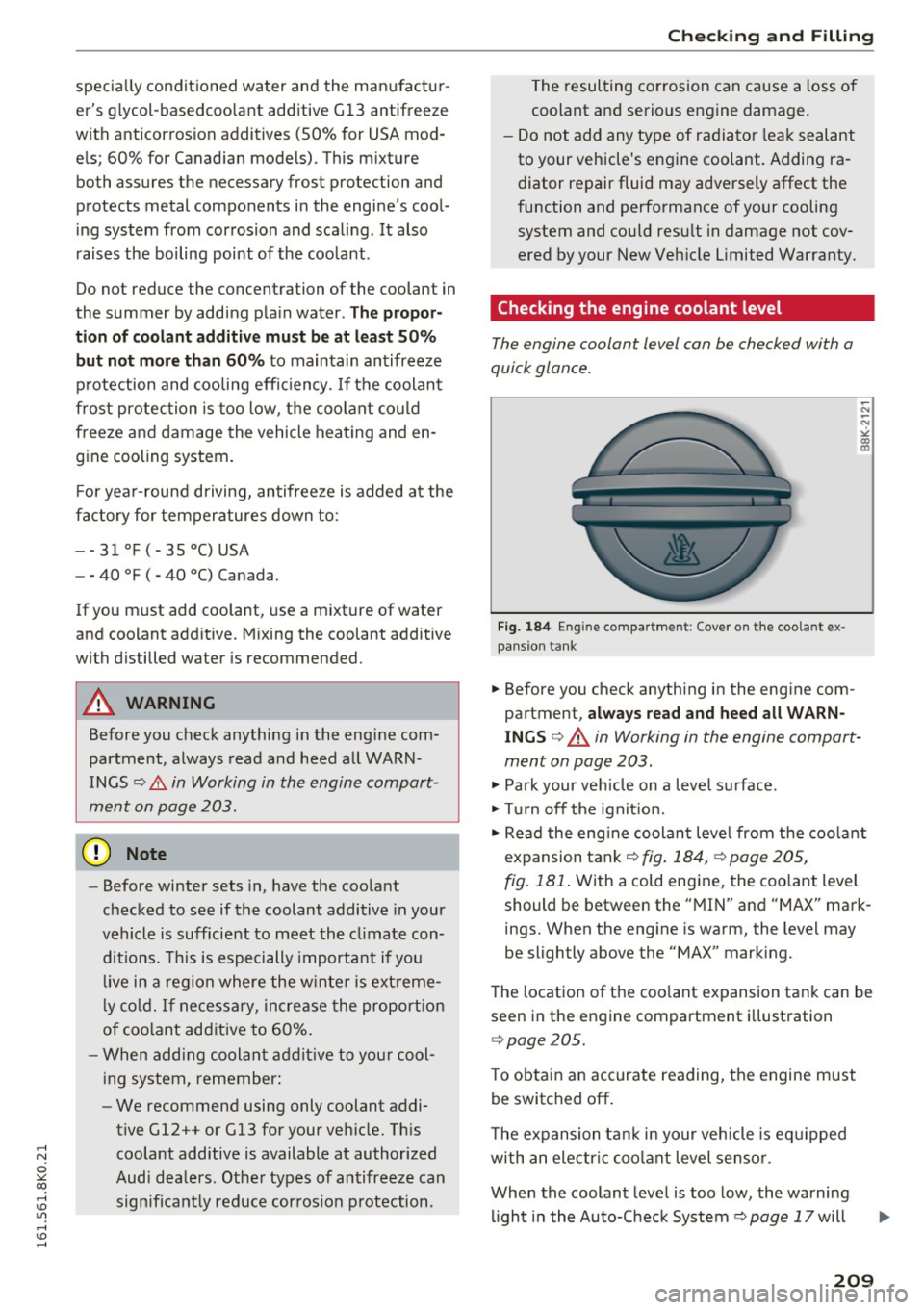
F ig. 184 En gin e co mpa rt men t: Cover o n the coo la nt ex
pans ion t ank
.. Before you check anything in the eng ine com
partment,
al ways read and heed all WARN
INGS
q ..&. in Working in the engine compart
ment on page 203 .
.. Park your ve hicle on a leve l sur face .
.. Tu rn off the ignit io n .
.. Read the eng ine coolan t level from the coo lant
expansion tank
q fig . 184, Q page 205,
fig. 181 .
With a cold engine, the coolant level
should be between the " MIN" and "MAX" mark
ings. When the engine is warm, the level may
be slightly above the "MAX" marking.
The location of the coo lant expansion tank can be
seen in the engine compartment illustration
q page 205.
To obtain an accurate reading, the engine must
be switched off.
T he expansion ta nk in your veh icle is eq uipped
with an electric coo lant level senso r.
When the coolant leve l is too low , the warning
light i n the Auto-Check System
Q page 17 will
209