brake AUDI S4 2016 Service Manual
[x] Cancel search | Manufacturer: AUDI, Model Year: 2016, Model line: S4, Model: AUDI S4 2016Pages: 278, PDF Size: 70.26 MB
Page 182 of 278
Intelligent Technology
Braking
What affects braking efficiency?
New brake pads
During the firs t 25 0 miles (400 km), new b rake
pads do not possess their full braking effect , they
have to be "broken i n" first ¢& . You can com
pensate for this slight ly reduced braking power
by push ing harder on the brake pedal. Avoid
heavy braking loads during the break-in period .
Operating conditions and driving habits
The brakes on today's automobiles a re still sub
ject to wear, depend ing largely on ope rating con
ditions and driving habits¢& . On vehicles that
are either dr iven most ly in stop-and-go city traf
f ic or are driven hard, the brake pads should be
checked by you r authorized Aud i dea ler more of
ten than spec ified in the
Warranty & Mainte
nance booklet .
Failu re to have your brake pads
i n spected c an resu lt in reduced bra ke pe rform
ance.
O n steep slopes, you sho uld use the braking ef
fect of the eng ine . This way, you prevent unnec
es sary wear on t he b rake system. If yo u m ust use
your b rake s, d o not hold the brakes down cont in
uously. Pum p th e b rakes at intervals.
Operating noise
Noises may occur when brak ing depend ing on the
speed, b raking force and outs ide cond it ions such
as tempe ra tu re and humidi ty.
Effect of water and road salt
In certain s ituations, for example after driving
through water, in heavy ra in, afte r ove rnig ht con
densat ion or after washing your car, the b raking
effect can be reduced by mo isture or ice on the
b rake rotors and b rake pads . T he brakes must be
d ried first w ith a few careful b rake a pplica tions.
At highe r speeds and with t he windsh ield wipers
tur ned on, the br ake pads press aga inst the brake
rotors for a sho rt amoun t of time. This occur s at
regular intervals w it h out t he dr iver noticing and
p rov ides for better bra ke response time under
wet conditions.
180
The effectiveness of the brakes can be reduced
when the vehicle is driven on a salt-covered road
and t he b rakes are not used . Likewise, yo u clean
off accum ulated salt coating from brake discs
and pads with a few caut ious app lications of the
brake ¢& .
Corrosi on
There may be a tendency fo r dirt to build up on
the b rake pads and corrosion to form on the discs
i f the car is not driven regu larly or only for short
trips with little use of the brakes .
If the bra kes are not used frequent ly, or if corro
s ion has formed on the discs, it is advisable to
clean off the pads and discs by braking firmly a
few times from a moderately high speed ¢ &.
Faults in th e brake system
If you shou ld notice a sudden increase in brake
pedal travel , then one of t he two brake circu its
may have failed¢& .
Low brake fluid level
Malfu nctions can occu r in the brake system if the
br ake fluid level is too low . The brake fluid leve l
is mo nitored electronica lly .
Brake booster
The bra ke booster i ncreases the press ure t hat
yo u ge nera te with the brake ped al.
It works only
whe n the eng ine is ru nning .¢ &
Brake lining wear status
Brake lining wea r may be c hecked by visua l in
spection o f the condition of the brake pads
t hr ough t he openings in t he wheel. If necessary,
t h e wheel m ay be removed fo r thi s inspe ction
¢ page 240, Replacing wheel s.
_& WARNING
- New brake pads don't have the be st sto p
ping power and m ust be " broken-in" du ring
the initial 250 miles (400 kilometers). You
can compensate for this by p ressing the
brake pedal more firmly. This also app lies
later w hen new pads are installed.
Page 183 of 278
..... N
0 ::..:: co .....
the p urpose of clean ing the brake system
only if road conditions permit. Other road
users must not be put at risk - you may
cause an accident!
- Before descend ing a steep grade, reduce
speed and shift transm iss io n into a lower
gear or lowe r d riv ing range. Do not ride the
bra kes or hold the pedal down too long or
t oo often. This could ca use the bra kes to get
hot an d diminish brak ing efficiency.
- Do not "r ide t he b rakes" by resting your foot
on the pe dal when yo u do not inten d to
br ak e. This may cause the br akes to over
heat, p remat ure wea r and increased stop
ping distance.
- Under certa in climatic and operating condi
tions such as passing thro ugh water, driving
in heavy ra in or after washing the vehicle,
the effectiveness of the brakes can be re
duced. In w inte r, ice can acc umulate on the
brake pads, linings, discs and drums. Care
fully apply brakes for a test. Brakes will dry and ice coatings w ill be cleaned off after a
few careful b rake applica tions.
- Driv ing for an ex tended period of time on
salt-covered roads witho ut using your
bra kes can also affe ct bra king efficie ncy .
C le an off a ccumula ted s alt co ating from
bra ke discs and pads with a few caref ul
bra ke app lications.
- If you dam age the fro nt sp oiler, or if yo u in
st all a diff erent spoi le r, be sure the ai r flow
to the front brakes is not obstr ucte d. Othe r
wise the bra ke system could overheat reduc
ing the e ffectiveness of the entire b rake sys
tem.
- Failure of one brake circuit will impair the
brak ing capability resulting in an increased
stopp ing distance. Avoid driving the vehicle
and have it towed to the nearest authorized
Audi dealer or qualif ied workshop.
- Never let the veh icle roll to a stop w ith the
engi ne shut off .
-If the brake booster is not working, the
bra ke pedal m ust be pressed conside rably
harder to make up for the lac k of booster
assista nee .
Intellig ent Technology
Electro-mechanical
power assist, dynamic
steering
The ele ctro-mechanical power a ssist helps the
driver when steering .
P ower s teer ing adapts electronically based on
t h e veh icle spee d.
Indicator lights and messages
• Steering defective! Do not drive vehicle!
If this indicator light turns on and stays on and
t hi s message appears, the power steering may
have failed.
Do
not continue driving. See your author ized
Audi dealer or a qualified repair facility for assis
tance.
' :r, y Dynamic steering: System fault! You can
continue d riving
If the indic ator l igh t turns on and the message
appe ars, the steering may be more diffic ult to
move o r more sensitive than usu a l. T he steering
whee l may a lso be at an angle w hen d riving
straight .
Drive slowly to you r autho rized Audi dea le r or
qualified wo rks hop to have the malfunction cor
rected .
,T u Dynamic steering: initializing
If this drive r message appea rs and t he indicator
li ght is flashing on t he instrument pane l, dynam
ic s teer ing* is being re ini tialized. After s tarting
t h e engine, t he steer ing w heel w ill move sligh tly.
Re- ini tializa tion might be necessary if the s teer
ing wheel was moved hard to the left a nd right
whi le the vehicle was not moving . The display
goes out as soon as initialization is comp lete.
A WARNING ~
Have the dynam ic steeri ng* system malfunc -
tion repaired as soon as poss ible by an au
thor ized Audi dealer or qualified workshop -
r isk of acc ident!
181
Page 187 of 278
..... N
0 ::..:: co .....
environment
Breaking in
New engine
The engine needs to be run-in during the first
1,000 miles (1,500 km).
For the first 600 miles (1 ,000 kilometer s):
"' Do not use full throttle .
"' Do not drive at engine speeds that are more
than
2/3 of the max imum permitted RPM .
From 600 to 1,000 miles (1 ,000 to 1 ,500
kilometers):
"' Speeds can gradually be increased to the maxi
mum pe rm issib le road or engine speed .
During and after break-in pe riod
"' Do not rev the engine up to high speeds when it
is cold. This applies whether the transmission is
in N (Neutral) or in gear .
After the break-in period
"'Do not exceed maximum engine speed under
any c ircumstances.
"'U pshift into the next higher gear
before reach
ing the red area at the end of the tachometer
sca le
c=>page 10.
During the first few hours of driving, the eng ine's
internal friction is higher than later when all the
mov ing parts have been broken in . How well this
b reak-in process is done depends to a considera
b le exte nt on the way the veh icle is d rive n during
t he first 1,000 miles (1,500 kilometers).
(D Note
Extremely high eng ine speeds a re au toma ti
cally reduced. However, these rpm limits are
programme d for a n engine well run-in, not a
new engine.
@) For the sake of the environment
D o not dr ive with u nnecessari ly high eng in e
spee ds -ups hifting ea rly saves fuel, reduces
noise and pro tec ts the envi ronme nt.
Driving and the envir onment
New tires
If your vehicle is runn ing on new tires, d rive very
car efu lly fo r the firs t 35 0 miles (500 kilometers)
a ft er fit ting.
New tires tend to be slippe ry and must a lso
be "bro ken-in". Be sure to remembe r th is dur
i ng the fi rst 350 m iles (500 kilometers).
Brake gent ly. Avoid following closely behind
other vehicles or other s ituations that m ight
r equire sudden, hard b raking.
Avoid damaging the
vehicle
When yo u are dr iv ing o n poor roa ds, or over
cur bs, stee p ramps, e tc., ma ke cert ain that low
ly ing parts s uch a s spo ile rs a nd exh aust sy stem
parts do no t bottom o ut and get dama ged.
T his is espec ially true for ve hicles with low-s lung
c h ass is (sports c hass is) * and fully loaded
vehicles.
Driving through water on
roads
Note t he following to avoi d ve hicle damage w hen
driv ing through water, for examp le on flooded
roads:
- The water must not be any hig her t han the bot
tom of the vehicle body.
- Do not dr ive faste r than walk ing speed.
A WARNING
= -
Afte r driv ing th ro ugh water, m ud, slush, etc .,
the brakes may be slow to take effect beca use
of wet brake rotors and pa ds. Dry the brakes
f irst by braking carefully to restore the full
b raking effect.
(D Note
Ve hicle compone nts such as the engine,
transmission, suspension o r electrica l system
can be severely damaged by driving throug h
water.
185
Page 189 of 278
..... N
0 ::..:: co .....
tion, maintenance and storage . Pay attention to
addit ional information concerning the battery .
Refer to
c::;, poge 212.
Economical and environ
mentally-friendly driving
General
Your personal style of driving will determine the
economy of your vehicle, as well as exhaust and
noise levels.
F ue l economy, environmenta l impact, and we ar
on your engine, brakes and tires la rgely depend
on three factors :
- you r persona l dr iving sty le
- operating conditions
- technical lim itations
If you anticipate what you need to do next and
drive economically, you can eas ily cut your fue l
consumption by
10-15 percen t. This section will
g ive you some tips on how you can help the envi
ronment and yo ur pocketbook .
(!) Tips
The consumpt ion estimates as published by
ENVIRONMENTAL PROTECTION AGENCY (EPA) and Transport Canada may not cor re
spond to your actual consumption on the
road, which will va ry depending upon vehicle
load and speed, road and wea ther condi tions,
t rip length, etc.
Drive smoothly and keep a lookout ahead
Vehicles use the most fuel when they are acceler
ating.
" Avoid unnecessary accelerating a nd braking .
Veh icles use the most fuel when they are acceler
ating . If you anticipate what is going to happen
next , you will need to brake less and, thus, accel
e rate less . let the vehicle coast wheneve r possi
b le -fo r example when yo u see that the next traf
fic light is red .
Driving and the envir onment
Avoid full throttle
Driving at moderate speeds saves fuel and im
proves your mileage .
"Try and keep well below your car 's maximum
speed.
Acce lerating gently reduces fuel consumption,
engine wear, and does not disturb the environ
ment.
Fuel consumption, exhaust emissions and engine
noise increase disproport ionately at high speeds.
If you drive at approximately three quarters of
top speed, fuel consumption will be reduced by
one half. Never drive faster than the posted
speed limit and weather cond itions permit .
Reducing unnecessary idling
Even when your car is jus t idling it burns up fuel.
" Shut the eng ine off when you are not driving
the vehicle.
" Do not warm up the vehicle by lett ing the en-
gine run at idle.
It makes sense to shut off the engine in traffic
jams, when waiting for trains to pass at railroad cross ings, or at traff ic lights that have long waits
on red . Turning the engine off for just
30 -40 sec
onds saves more f uel than is burned starting the
. . engine again.
It takes a long time for the eng ine to warm up
fully when it is running at idle . However, wear
and noxious emissions are especially h igh when
the engine is warming up . So yo u should dr ive
away as soon as you start the eng ine and avoid
runn ing at high rpms w hile the engine is st ill
warming up .
(D Note
Do not leave eng ine idling unattended after
s tart ing. If wa rning lights sho uld come on to
i ndicate improper operation, they would go
unheeded . Extended idling also prod uces
heat, which could resu lt in overheating or
other damage to the vehicle or other proper
ty.
187
Page 191 of 278
..... N
0 ::..:: co ,....,
lights and the license plate .
- Perform a brake test (especially after dr iving
t h rough water) .
& WARNING
-Be espec ially aware and attentive when driv
ing under difficult conditions. Damages to
the vehicle and injuries may occur when
dr iv ing at an excessive ly high speed or w ith
incorrect dr iving maneuvers.
- Always adjust your speed and handling to
the roads, terrain, traffic and weather con
ditions. Drive especially slow if offroad wit h
low v is ibility.
- Please note that the wheels can spin and
the vehicle can break away when the ESC
Off road Mode is switched off, especia lly
w he n t he roa d is slippery.
- Driv ing stabi lity is reduced in the ESC Off
road mode.
@) For the sake of the environment
Avoid harming the environme nt and take na
ture into conside ra tion .
(D Tips
Only drive where it is allowed and always stay
on t he p rovided roads and paths.
Driver messages
App lies to vehicles: allroad
There is only one right way to drive in difficult
conditions: slowly and with caution!
When driving offroad, observe the fo llowing:
.. Never dr ive the veh icle in te rrai n which is not
s ui tab le for the vehicle, o r which exceeds your
driving skills. Never ta ke any unnecessary risks!
.. Drive slowly and ca utiously!
.. Pay attention to the
ground clearance of yo ur
vehicle! This may vary depending on the load and compos it io n of the ground and the environ
me nt. The driver is therefore responsible for
deciding whether a vehicle can handle a specif ic
s itu atio n.
Driving and the envir onment
.. Activate the ESC-Offroad-Mode ¢ page 178 as
needed .
Difficult terrain
Never dr ive in areas t hat are not fam ilia r to you
and dr ive slow ly when off road and be prepare d
and expect the unexpected (e .g. potho les, bould
ers, t ree stumps, etc.)
T o p reve nt the vehicle from bottom ing and avoid
damage to t he un derbody, you shou ld dr ive
straight ac ross seve re bumps in the ground w ith
on ly one side of the vehicle so tha t on ly two of
your whee ls cross the bumps .
Dr ive quickly th ro ugh sandy o r m ars hy off road
sections and do not stop, if at all possible .
Driving through water on roads
Read the informa tion on ¢ page 185.
189
Page 192 of 278
Trailer mod e
Trailer mode
Driving with a trailer
General information
Your Audi was designed primarily for passenger
transportation.
If you plan to tow a trailer, please remember that
the additional load will affect durability, econo
my and performance.
Trailer towing not only places more stress on the
vehicle, it also calls for more concentration from
the driver.
F or this reason, always follow the operating and
driving instructions provided and use common
sense.
Technical requirements
Tr aile r hitch
Use a weight-carrying hitch conforming to the
gross trailer weight. The hitch must be suitable
for your veh icle and trailer and must be mounted
securely on the vehicle's chassis at a technically
sound
location . Use only a trailer hitch with a re
movable ball mount . Always check w ith the t rail
er hitch man ufact urer to make su re that you are
using the co rrect hitch .
Do not use a bump er hit ch .
The hitch must be installed in such a way that it
does not interfere with the impact -absorbing
bumper system. No mod ificat ions should be
made to the vehicle exhaust and brake systems .
From t ime to t ime, check that a ll hitch mount ing
bolts rema in securely fastened.
When you are not tow ing a tra iler, remove the
tra iler hitch ba ll mount . This prevents the hitch
from caus ing damage shou ld your veh icle be
s truck from be hind ¢
,&..
Trailer brakes
If your trailer is equipped with a brak ing system,
check to be sure that it conforms to all regula
tions .
190
The trailer hydraulic brake system must not be
directly connected to the vehicle's hydraulic
brake system ¢&. .
Safety chains
Always use safety chains between you r vehicle
and the trailer.
Trailer lights
Traile r lights must meet all regulations . Be sure
to check w ith your author ized Audi dealer for cor
r ec t wiring , switches, and relays.
M irrors
If you are unable to see the traffic behind you us
ing the regular outs ide mirrors, then you
must in
stall extended mirrors . It is important that you
always have clear vision to the rear.
.&_ WARNING
- If a tra ile r has e lectr ica l brakes p lease no te
t hat these brakes are not activated by the
factory-fit ted contro l unit -risk of accident!
'
- After removing the trai ler hitch, do not
store it in your vehicle. In case of sudden
braking, the hitch co uld fly forward and in
jure you or yo ur passengers.
Operating instructions
Ma ximum traile r we ight
A trailer for your vehicle is limited to a typical
class 1 or class 2 trailer.
Trailer load distribution
Be sure the load in the trai ler is held securely in
place to p revent i t from shifting forward, back
ward or sideways.
Nev er allow a pa ssen ger to rid e in a trailer ¢ &.
in Driving instructions on page 191.
Engine cooling system
Towing a tra iler makes the engine work harder . It
i s important that the cooling system's perform
ance is up to the additional load. Make sure that
the cool ing system has enoug h fluid.
Page 193 of 278
..... N
0 ::..:: co ..... oJ) Lil
..... oJ) .....
Tire pressure
When tow ing a tra ile r, infl ate the tires of yo ur
ve hicl e to the co ld tire press ure listed under "Fu ll
l oad" on the label located on the driver's side B
pi llar (visib le when th e door is open). Inflate
tra ile r tir es to t railer and tire manufacture rs'
specifications.
Light s
The headlight settings should be checked wi th
the trai ler attached before driv ing
off . Check to
make sure both veh icle and trai ler lights are
wo rking prope rly .
Safety chains
Be s ure trai ler s afety chains are p ro p erly conne ct
ed from the trailer to the hitc h on the vehicle .
L eave enough slack in the chains to permit turn
ing corners . When you install safety cha ins, make
sure they w ill not drag on the road when yo u are
driving.
The chains s hou ld cross under the t railer tongue
to p revent it from dropp ing in case of separat ion
from t he hitc h.
Driving instructions
Driving with a trailer always requires extra core
and consideration.
To ob tain the best possible handling of vehicle
and trailer, please note the fo llowing :
.,. Do no t tow a lo ad ed t railer w hen yo ur car i tse lf
i s not lo ad ed.
.,. Be especia lly caref ul when passing ot he r
vehicles .
.,. Observe speed limits.
.,. Do not d rive at the maximum permissible
speed .
.,. Always apply brakes early .
.,. Moni to r th e temperature gauge .
Weight distribution
T owing a loaded trailer w ith an empty car res ults
in a high ly unstable distribution of weight . If this
cannot be avo ided, drive at very low speeds o nly
to avoid the risk of losing steering control.
Trailer mode
A "ba lanced" rig is easier to opera te and co ntrol.
This means that the tow vehicle sho uld be loaded
to the extent possib le and permissib le, w hile
keeping the trailer as light as possible under the
cir cumstances . Wheneve r poss ib le, transfer
some cargo to the luggage compartment of the
tow ve hicle while observing tongue load require
ments and vehicle loa ding consi de rations .
Speed
The higher the speed, the mo re diff icult it be
comes for the driver to control the r ig. Do not
drive at t he max imum permissib le speed. Reduce
you r sp eed even more if load, weathe r or wind
cond it ions are u nfavo rab le -pa rticularly when
go ing down hill.
Reduce vehicle speed
immediately if the trailer
shows the slightes t sign of sway ing .
Do not try
to stop the swaying by accelerating .
Observe speed limits . In some a reas, speeds fo r
vehicles towing trailers are lower tha n for regular
vehicles .
Always apply bra kes early . When d riving down
hill, shift into a lower gear to use the e ngine
braki ng effect to slow the vehicle . Use of the
brakes alone can cause them to overhea t and fa il.
Coolant temperature
The coo lant tempe rature gauge c:> page 10 m ust
be obse rved caref ully. If the needle moves close
to the upper end of the scale, reduce speed im
me diate ly and/or t urn
off th e a ir cond it io ne r .
If the coolant temperat ure warning light . in
t h e instr ument cluster starts flashing, pull
off
the road, stop and let the engine idle for about
two m inu tes to pre vent heat build -u p .
A WARNING ,.__ -
A nyone not prope rly restr ained in a moving
ve hicl e is at a m uch grea te r risk in an a cci
d ent. Never le t anyon e ride in your car w ho is
n o t pr ope rly we arin g th e res tra ints p ro vid ed
by Au di .
191
Page 194 of 278
Trailer mode
Trailer mode notes
Important to know
Your vehicle handles different ly when tow ing a
tra iler because of the additional weight and dif
ferent weight distr ibution. Safety, performance
and economy w ill great ly depend on how careful
ly you load your trailer and operate your rig.
Before you actua lly tow your trailer, practice
turning, stopping and backing up in an area away
from traffic . Keep practicing until you have be
come completely familiar with the way your vehi
cle-trailer combination behaves and responds.
Backing up is d ifficult and requires practice.
Backing up with a trailer generally requires steer
ing action opposite to that when backing up your
vehicle without a trailer.
Maintain a greater distance between your vehicle
and the one in front of you. You w ill need more
room to stop . To compensate for the trai ler, you
will need a larger than norma l turning radius.
When passing, remembe r that you cannot accel
erate as fast as you normally would because of
the added load. Make sure you have enough room
to pass. After passing, allow plenty of room for
your trai ler before chang ing lanes again.
Avoid jerky starts, sharp turns or rapid lane
changes.
(D Tips
- Do not tow a trailer during the break-in peri
od of you r vehicle.
- If you tow a trailer, your Audi may require
more frequent maintenance due to the ex
tra load~
page 258.
Parking on a slope
Do not pork on a slope with a trailer. If it cannot
be avoided, do so only ofter doing the following:
When parking:
.,. Apply t he foot brake .
.,. Have someone place chocks under both the ve
hicle and the trailer wheels.
192
.. With chocks in place, slowly release the brakes
until the wheel chocks absorb the load.
.. Turn the whee ls towards the curb .
.. App ly the parking brake .
.. Place an automat ic transmission* in P, respec
tively a manual transmission in first or reverse
gear .
When restarting after parking:
.. App ly the foot brake.
.. Start the engine.
.. Move the selector lever to 0/5, respectively a
manual transmission in first gear.
.. Release the parking brake and slowly pull out
and away from the whee l chocks.
.,. Stop and have someone ret rieve the wheel
chocks.
(D Tips
If you move the selector lever of the automat
ic transmission* to P before applying the
parking brake and before blocking the wheels,
you may have to use more force later to move
the lever out of the P position.
Page 196 of 278

Care and cleaning
wash operator to reduce the risk of acci
dents.
- To reduce the risk of cuts, protect yourself
from sharp metal components when was h
ing the underbody or the inside of the wheel
housings.
- A fter washing the vehicle, the braking effect
may be delayed due to mo isture on the
brake rotors or ice i n the winter. The brakes
must be dried first w it h a few careful brake
applications.
{U) Note
- If you wash the ve hicle in an automatic car
wash, you must fold the exterior m irrors in
to reduce the risk of damage to the mirrors.
Power folding exte rior m irrors* must on ly
be fo lded in and out us ing the power folding
f u nct io n.
- T o p revent paint damage, do not wash the
vehicle in di rect sunlight. -
To red uce the risk of damage to the s urface,
do not use insect removing sponges, k itchen
sponges o r similar items .
- Matte finish painted vehicle components:
- To reduce the r isk of damage to the sur-
face, do not use polishing agents or hard
wax.
- Neve r use protective wax. It can destroy
the matte finish effect .
- Do not place any stickers or magnetic
signs on vehicle parts painted with matte
finish paint. The paint could be damaged
when the stickers or magnets are re
moved.
@ For the sake of the environment
Only wash t he veh icle in facili ties spec ially de
s igned for that pu rpose. This will reduce the
r isk of dirty wate r cont am ina ted with o il from
en te ring the sewe r system.
Cleaning and care information
W hen clean ing and ca ring for ind ividua l vehicle
com ponents, refer to the fo llow ing tables. The
i n fo rmat ion conta ined there is s imply recom
mendations. For ques tions or for components that are
not listed, cons ult an autho riz ed Aud i
dealer or au thor ized A udi Servi ce Fac ility. Also
f o llow the informa tion fo und in ¢ .&, .
Exterior cleaning
Component Situation Solution
Wind shield wiper
Deposits ¢ page 55, Cleaning windshield wiper blades
blades
Headlights
/ Tail
Deposits Soft sponge with a m ild soap solutiona>
lights
Sensors /camera
Deposits Sensors: soft cloth with solvent-free cleaning solut ion
lenses Camera lenses: soft cloth w ith alcohol-free cleaning so lu-
tion
Snow/ice H
and br ush/solvent-free de-icing spray
Wheels Road salt Water
Brake dus t Acid
-free special clean ing solu tion
E x haust tail pipes Road salt Water, clean ing solution su itab le for stainless stee l, if nee -
essary
Decorative parts / Deposits Mild soap so
lution al, a cleaning so lution suitable for stain-
t rim less stee l, if necessary
194
Page 205 of 278
,....,
N
0
""' CX) ,....,
I.Cl U"I ,....,
I.Cl ,....,
Checking and Filling Hood
Releasing and opening the engine hood
The engine hood is released from inside the vehi
cle.
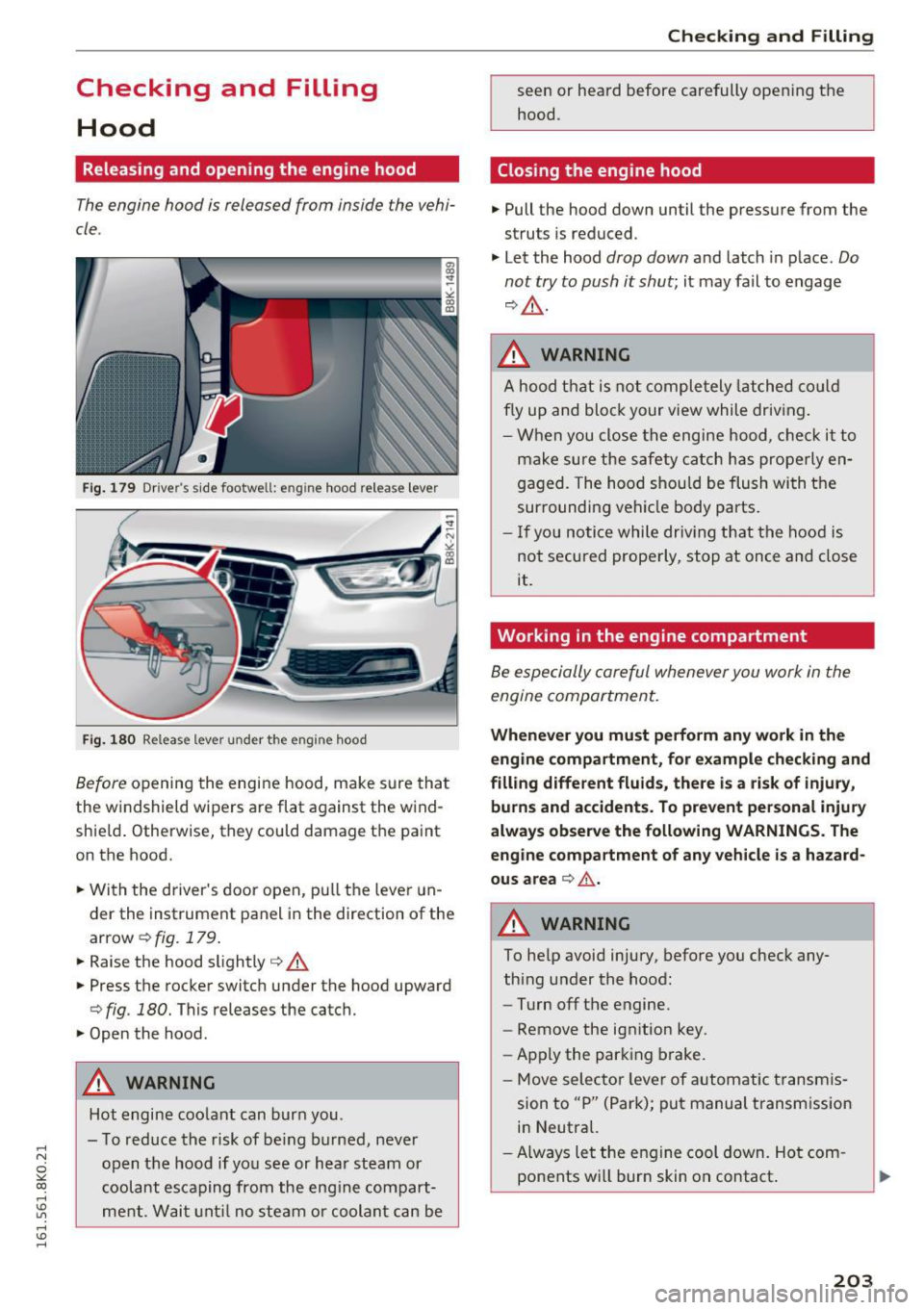
Fig. 179 Driver's side footwell: engine hood re lease lever
... ~ - -
Fig. 1 80 Release lever under the engine hood
Before opening the engine hood, make sure that
the windshield wipers are flat against the w ind
shie ld. Otherwise, they could damage the paint
on the hood.
.. Wi th the driver's door open, pu ll the leve r un
der the instrument panel in the direction of the
arrow ¢
fig. 179 .
.. Raise the hood slightly¢&.
.. Press the rocker switch under the hood upward
¢fig . 180. This releases the catch.
.. Open the hood.
A WARNING
Hot engine coo lant can burn you.
- To reduce the risk of be ing burned, never
open t he hood if yo u see or hear steam or
coolant esca ping from the eng ine compart
me nt. Wait unt il no s team or coolant ca n be
Checking and Filling
seen or hea rd before carefully opening the
hood.
Closing the engine hood
.. Pull the hood down until the pressure from the
struts is reduced.
"' Le t the hood
drop down and latch in p lace. Do
not try to push it shut;
it may fail to engage
¢ &, .
A WARNING
A hood that i s not comple tely latched co uld
fly up a nd blo ck your view while driv ing.
- W hen you close the engine hood, check it to
ma ke sure the s afety catch h as prope rly en
ga ged. The hood should be flush with t he
surroundi ng ve hicl e body pa rts.
- If you no tic e while driv ing t hat t he hoo d is
not secured properly, stop at once and close
it.
Working in the engine compartment
Be e specially careful whenever you work in the
engine compartment.
-
Whenever you mu st perform an y work in the
engine compartment, for example checking and
filling different fluids, there is a risk of injury, burn s and a ccidents. To prevent per sonal injury
always observe the following WARNINGS. The
eng ine compa rtment of any vehicle is a hazard
ous area
¢ .&. .
A WARNING
-~
To help avoid injury, before you check any
th ing under the hood:
- Turn off the engine.
- Remove the ignition key .
- Apply the par king brake.
- Move selector leve r of autom atic t ransm is-
sion to "P" (Park); put manual transm ission
in Neutral.
- Always let the engine cool down. Ho t com
ponents w ill bur n skin on contact .
203