brake AUDI S4 2016 Workshop Manual
[x] Cancel search | Manufacturer: AUDI, Model Year: 2016, Model line: S4, Model: AUDI S4 2016Pages: 278, PDF Size: 70.26 MB
Page 206 of 278
Checking and Filling
-To reduce the risk of being burned, never
open the hood if you see or hear steam or
coolant escaping from the engine compart
ment . Wait until no steam or coolant can be
seen or heard before carefully opening the hood.
- Keep children away from the engine com partment.
- Never spill fluids on hot engine compo
nents. They can cause a fire.
- Never touch the radiator fan. The auxiliary
electric fan is temperature controlled and
can switch on suddenly .
- Never open the coolant reservoir cap when
the engine is still warm. The coolant system is pressurized and hot coolant could spray
out.
- Protect your face, hands and arm from
steam or hot engine coolant by placing a
thick rag over the cap when you open the coolant reservoir.
- Do not remove the engine cover under any
circumstances. This increases the risk of
burns.
- If work on the fuel system or the electrical
system is necessary:
- Always disconnect the battery.
- Never smoke or work near heaters or open
flames. Fluids in the engine compartment could start a fire.
- Keep an approved fire extinguisher imme
diately available.
- To avoid electrical shock and personal injury
while the engine is running or being started,
never touch:
- Ignition cables
- Other components of the high voltage
electronic ignition system .
- If you must perform a check or repair with
the engine running:
- First, fully apply the parking brake, move
selector lever of automatic transmission
204
to "P" (Park); put manual transmission in
Neutral.
- Always use extreme caution to prevent
clothing, jewelry, or long hair from get
ting caught in the radiator fan, V-belts or
other moving parts, or from contacting hot parts . Tie back hair before starting,
and do not wear clothing that will hang or
droop into the engine.
- Minimize exposure to emission and chemi
cal hazards
c::> /.1. .
A WARNING
California Proposition 65 Warning:
- Engine exhaust, some of its constituents, and certain vehicle components contain or
emit chemicals known to the State of Cali
fornia to cause cancer and birth defects and
reproductive harm . In addition, certain flu
ids contained in vehicles and certain prod
ucts of component wear contain or emit
chemicals known to the State of California
to cause cancer and birth defects or other
reproductive harm.
- Battery posts, terminals and related acces
sories contain lead and lead compounds,
chemicals known to the State of California
to cause cancer and reproductive harms .
Wash hands after handling.
(D Note
When adding fluids, always make sure that
they are poured into the proper container or
filler opening, otherwise serious damage to
vehicle systems will occur.
@ For the sake of the environment
To detect leaks in time, inspect the vehicle
floor pan from underneath regularly . If you
see spots from oil or other vehicle fluids, have
your vehicle inspected by an authorized Audi
dealer.
Page 207 of 278
,....,
N
0
""' CX) ,....,
I.Cl U"I ,....,
I.Cl ,....,
Checking and Filling
Engine compartment
Engine compartment
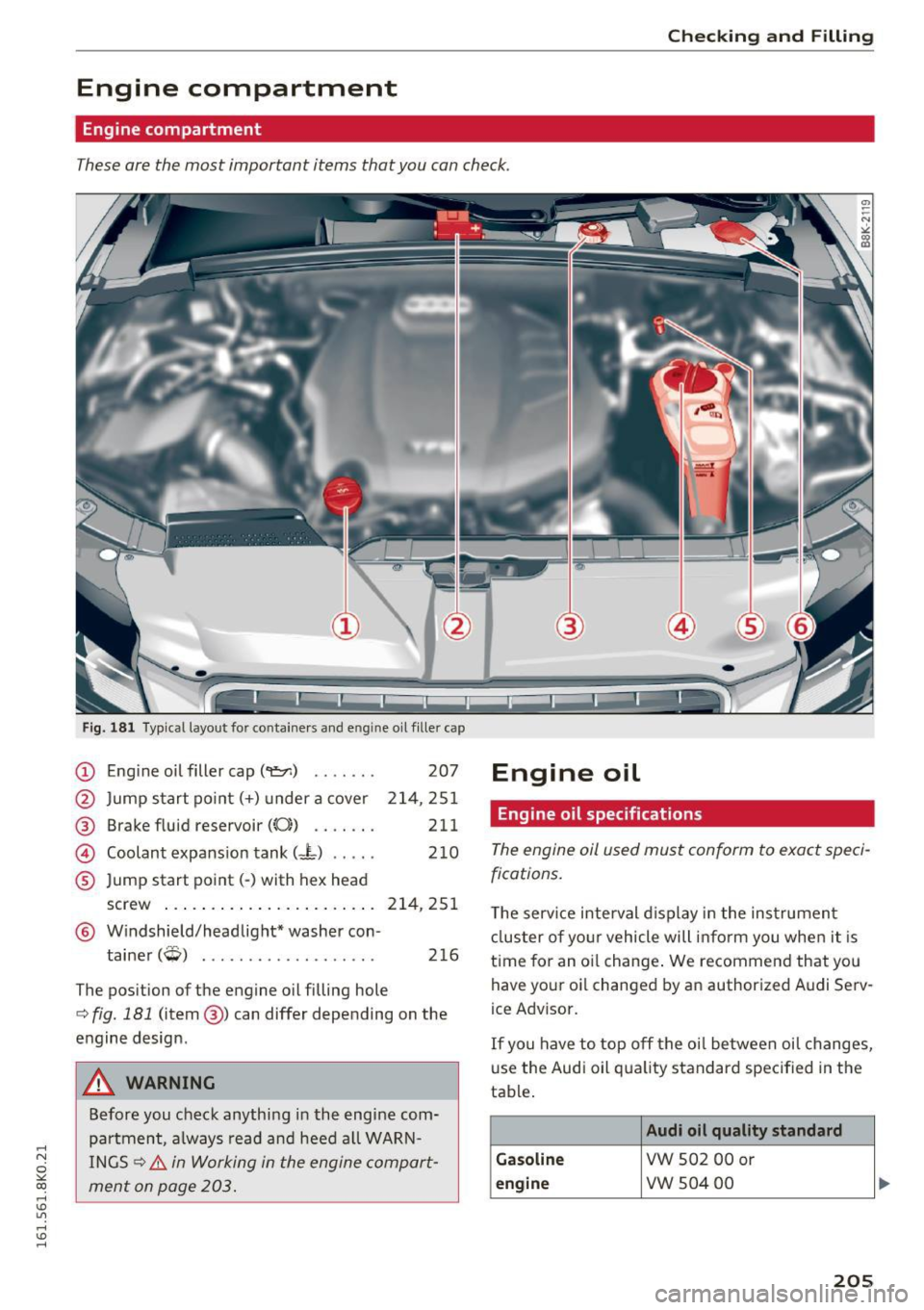
These are the most important items that you can check.
Fig. 181 Typical layout for containers and e ngin e oil fille r cap
(D Eng ine o il filler cap (
@ Brake fluid reservoir
((0) ...... .
@ Coolant expansion tank (- L) .... .
® Jump start point( -) with hex head 207
214,251
211 210
screw . . . . . . . . . . . . . . . . . . . . . . . 214, 251
@ Windshield/headlight* washer con-
tainer
(W) . . . . . . . . . . . . . . . . . . . 216
The position of the engine oil filling hole
c:> fig. 181 (item @) can differ depending on the
engine design .
A WARNING
Before you check anything in the engine com
partment, always read and heed all WARN
INGS
c:> &. in Working in the engine compart
ment on page 203.
Engine oil
Engine oil specifications
The engine oil used must conform to exact speci
fications.
The service interval display in the instrument
cluster of your vehicle will inform you when it is
time for an oi l change . We recommend that you
have your oi l changed by an authorized Audi Serv
ice Advisor.
If you have to top off the oil between oil changes,
use the Audi oil quality standard specified in the
table .
Audi oil quality standard
Gasoline
VW 502 00 or
engine vw 504 00
205
Page 213 of 278
,....,
N
0
""' CX) ,....,
I.Cl U"I ,....,
I.Cl ,....,
-To avoid being burned, do not spill anti
freeze or coolant on the exhaust system or hot engine parts. Under certain condi
tions, the ethylene glycol in engine cool ant can catch fire.
- Antifreeze is poisonous. Always store anti
freeze in its original container and well out
of the reach of children.
- If you drain the coolant, it must be caught
and safely stored in a proper container
clearly marked "poison".
(D Note
-Do not add coolant if the expansion tank is
empty . Air could enter the cooling system
and damage the engine. If this is the case,
do not continue driving. Seek professional
assistance.
- Coolant pollutes the environment and could
cause an engine fire. Excess coolant will be
forced out through the pressure relief valve
in the cap when the engine becomes hot.
- If, in an emergency, only water can be add
ed, the correct ratio between water and an
tifreeze
c::> page 208 must be restored as
soon as possible.
@) For the sake of the environment
Drained coolant should not be reused. Always
dispose of used coolant while observing all
environmental regulations.
Radiator fan
The radiator fan switches on automatically by it
self.
The radiator fan is driven by the engine via the V
belt . The viscous clutch regulates the speed of
the fan according to the temperature of the cool
ant.
An auxiliary electric radiator fan* switches on and
off depending on coolant temperature and other
vehicle operating conditions.
After you switch the engine off, the auxiliary fan
can continue running for up to 10 minutes -even
Checking and Filling
with the ignition off. It can even switch on again
later by itself
c::> & , if
- the temperature of the engine coolant rises due
to the heat build-up from the engine in the en
gine compartment, or
- the engine compartment heats up because the
vehicle is parked in intense sunlight.
A WARNING
-To reduce the risk of personal injury never
touch the radiator fan.
- The auxiliary electric fan is temperature
controlled and can switch on suddenly even
when the engine is not running.
- The auxiliary radiator fan switches on auto
matically when the engine coolant reaches a
certain temperature and will continue to run
until the coolant temperature drops.
Brake fluid
Checking brake fluid level
The broke fluid level con be checked with o quick
glance .
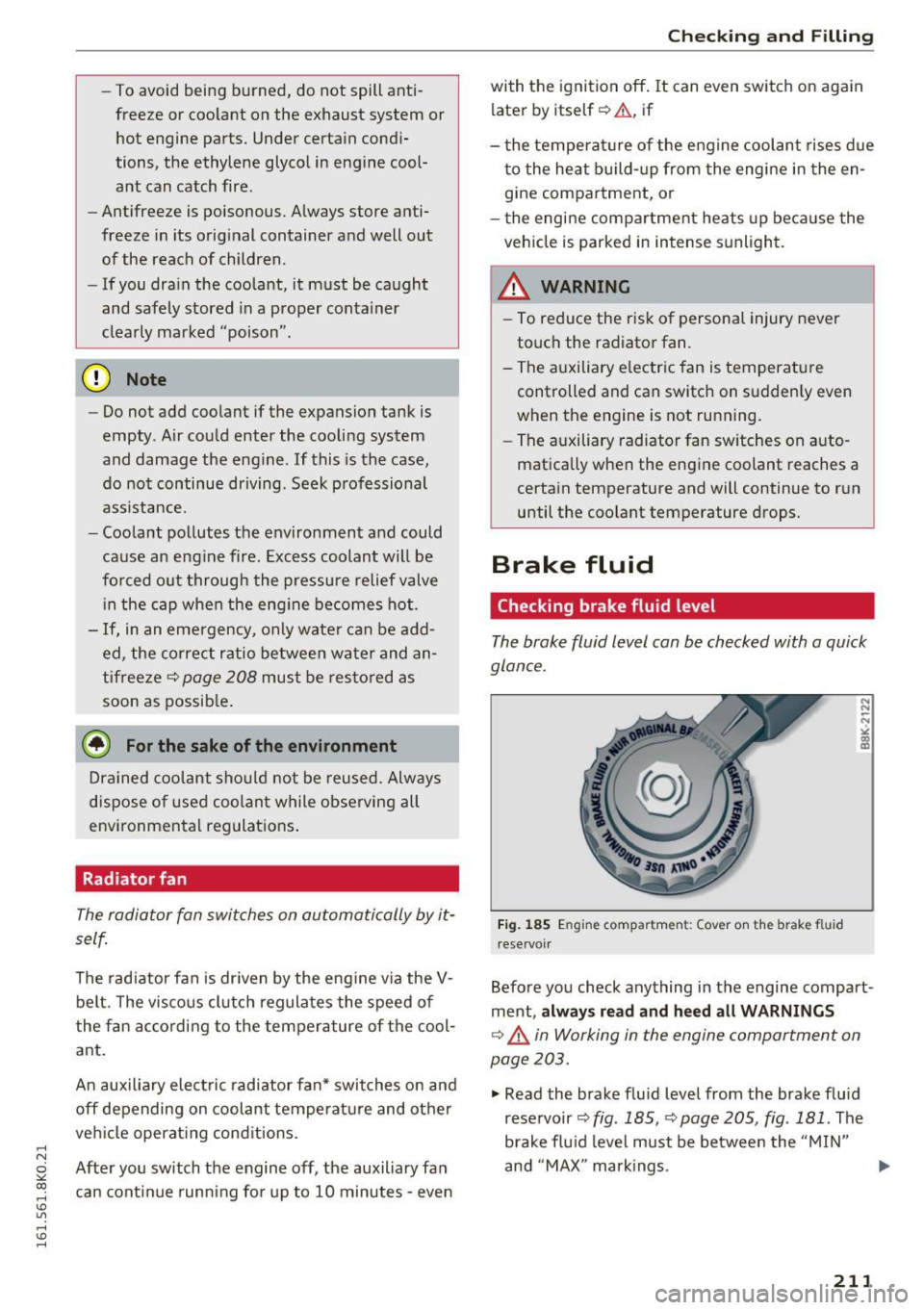
Fig. 185 En gi ne compartmen t: Cover on the b rake fl uid
reservoir
Before you check anything in the engine compart
ment,
always read and heed all WARNINGS
c::> _.& in Working in the engine comportment on
page 203.
.,. Read the brake fluid level from the brake fluid
reservoir
c::> fig. 185, c::> page 205, fig . 181 . The
brake fluid level must be between the "MIN"
and "MAX" markings.
211
Page 214 of 278
Check ing and F illing
The brake fluid rese rvoir is located at the rear
partition of the engine compartment on the l eft
side ¢
page 205 .
The fl uid level may drop slightly after some time
due to the automatic adjustment of the brake
pads . This is not cause for alarm.
If th e b rake fl uid level fa lls considerably be low
the "M IN" mark, the b rake warning/ind icator
lig ht ( U.S. mode ls :
1111 , Canadian models:. )
will come on ¢
page 15. Do not contin ue to oper
ate the vehicle . T he comp lete brake system
should be thoroughly checked by an authori zed
Aud i dealer or qualified workshop and the cause
corrected . If the brake flu id level is too low, the
b rake warning/indicator light will i llum inate.
Contact a n author ized Audi dealer
immediately .
{D) Tips
The brake fluid reservoir is located under
neath the cover .
Changing brake fluid
Have the brake fluid changed by an experienced
technician .
Brake fluid absorbs mo isture from the air. If the
water content in the b rake fluid is too high, cor
rosion in the brake system may resu lt afte r ape
riod of t ime. The boiling poi nt of the brake flu id
will also decrease cons iderably and decrease
b raking perfo rman ce.
Therefore, the brake fluid must be changed
every
two year s.
Always use new brake fluid wh ic h con
forms to Fede ral Motor Veh icle Standard "FMVSS
1 16 DO T 4".
The brake fluid reservoir can be diff icult to reach,
therefore, we recommend that yo u have the
brake fl uid changed by yo ur autho rized
Audi
dealer .
Your dealer has t he corre ct tools, t he
right brake fluid and the know-how to do this for
you.
A WARNING
- Brake fluid is poisonous. It must be stored
only in the closed orig inal container out of
the reach of chi ldren!
212
- Bra ke fa ilure ca n result from old or inapp ro
priate brake fluid . Observe these precau
tions:
- Use only brake fluid t hat meets SA E speci
fi ca ti on
J 170 3 and con forms to Federa l
Motor Ve hicle Standard 116 . Always check
wi th yo ur autho rized Audi dea le r to make
s ur e yo u are using the correct brake fluid .
The correct type of brake flu id is also ind i
cated on the b rake fluid reservo ir .
- The brake fluid m ust be new . Heavy use of
the brakes can cause a vapo r lock if the
brake fluid is left in the system too long .
This can se riously affect the efficiency of
the b rakes as well as your safety . This
could resu lt in an accident .
(D Note
Brake fluid will damage the paint of your veh i
cle.
@ For the sake of the environment
Because of the problem o f proper d isposa l o f
brake fluid as well as the spec ial too ls re
q ui red a nd the necessary expertise, we rec
omme nd that you have the bra ke f luid
changed by yo ur autho rized Aud i dea le r.
Battery
, General information
U nder normal operating condit ions, the battery
i n your Audi does not need any maintenance.
With
high outside temperatures or long daily
drives we recommend that you have the elect ro
lyte level c hecked by an au thorized Aud i dealer o r
qualified workshop. The electro lyte level shou ld
a lso be che cked each time the battery is c ha rged
~ page 214.
Have the batte ry chec ked when you take yo ur ve
hicle in for service. You are we ll adv ised to re
pla ce a battery tha t is older than 5 yea rs.
With certain types of airbag deployment, t he
batte ry is d iscon nected from the ve hicle electri
ca l system for safety reasons ¢.&.
in Repair, care
and disposal of the airbags on page 151. .,.
Page 221 of 278
be happy to provide more infor
mation.
® Mud and snow capability
"M/5 " or "M+S" indicates the tire
has character istics that make it
suitable for driving on mud and
snow .
& indicates a winter tire .
@Composition of the tire cord
and materials
The number of plies indicates the
number of rubberized fabric lay
ers in the tire. In general: the
more layers , the more weight a
tire can carry . Tire manufacturers
must also specify the materials
used in the tire. These inc lude
steel, nylon, polyester and other
materials.
@ Maximum permitted load
This number indicates the max i
mum load in kilograms and
pounds that the tire can carry.
@ Uniform tire quality grade
standards for treadwear,
traction and temperature resistance
Treadwear, traction and tempera
ture ranges
c::> page 234 .
;;: @ Running direction
\:i ~ ...
'° V, ....
'° ....
The arrows indicate the running
direction of unidirectional tires .
Wheels
You must always follow the speci
fied runn ing d irect ion
c::> page 244 .
@ Maximum permitted
inflation pressure
This number ind icates the maxi
mum pressure to which a tire can
be inflated unde r normal operat
ing condit ions.
Glossary of tire and loading
terminology
Accessory weight
means the comb ined weigh t (in
excess of those standard items
which may be replaced) of auto
matic transm ission, power steer
ing , power brakes, power win
dows, power seats, radio, and
heater, to the extent that these
items are available as facto ry-in
stalled equipment (whether in
stalled or not) .
Aspect ratio
means the ratio of the heigh t to
the width of the tire in percent .
Numbers of 55 or lowe r indicate a
low sidewa ll for improved steer
ing response and better overall
handling on dry pavement. .,.
219
Page 223 of 278
(a) Curb weight
(b) Accessory weight
(c) Vehicle capacity weight, and
(d) Production options we ight
Ma ximum (permissible)
inflation pressure
means the maximum cold infla
tion pressure to which a t ire may
be inflated. Also called "maxi
mum inflation pressure."
Normal occupant weight
means 150 lbs. (68 kilograms)
times the number of occupants
seated in the veh icle up to the to
tal seating capacity of your vehi c le.
Occupant distribution
means distribution of occupants
in a vehicle.
Outer diameter
means the overall diameter of an
inflated new tire.
Overall width
means the linear distance be
tween the exteriors of the side
walls of an inflated tire, including elevations due to labeling, deco
rations, or protective bands or
ribs .
Wheels
Ply
means a layer of rubber-coated
parallel cords .
Production options weight
means the combined weight of
those installed regular production
options weighing over 5 lbs. (2.3 kg) in excess of those standard
items which they replace, not pre
viously considered in curb weight
or accessory weight, including heavy duty brakes , ride levelers,
roof rack, heavy duty battery, and
special trim .
Radial ply tire
means a pneumatic tire in which
the ply cords that extend to the beads are laid at substantially 90
degrees to the centerline of the
tread.
Recommended inflation
pressure
see ~ page 220, Cold tire infla
tion pressure .
Reinforced tire
means a tire designed to operate
at higher loads and at higher in
flation pressures than the corre sponding standard tire. Rein
forced tires may be identified as .,.
221
Page 227 of 278
different tire speeds. For this reason, in case of emergency, only
use a spare tire* that is the same
circumference as the regular
tires.
&_ WARNING -
-Only use tire/rim combina tions and suitable wheel bolts
that have been approved by
Audi. Otherwise, damage to
the vehicle and an accident could result.
-For technical reasons, it is not possible to use tires from oth
er vehicles - in some cases,
you cannot even use tires from
the same vehicle model.
-Make sure that the tires you
select have enough clearance
to the vehicle . Replacement
tires should not be chosen
simply based on the nominal
size, because tires with a dif
ferent construction can differ
greatly even if they are the
same size. If there is not
enough clearance, the tires or
the vehicle can be damaged and this can reduce driving
safety and increase the risk of
an accident.
Wheels
-Only use tires that are more
than 6 years old when abso lutely necessary and drive
carefully when doing so.
-If you install wheel covers on
the vehicle, make sure they al
low enough air circulation to
cool the brake system. If they
do not, this could increase the
risk of an accident.
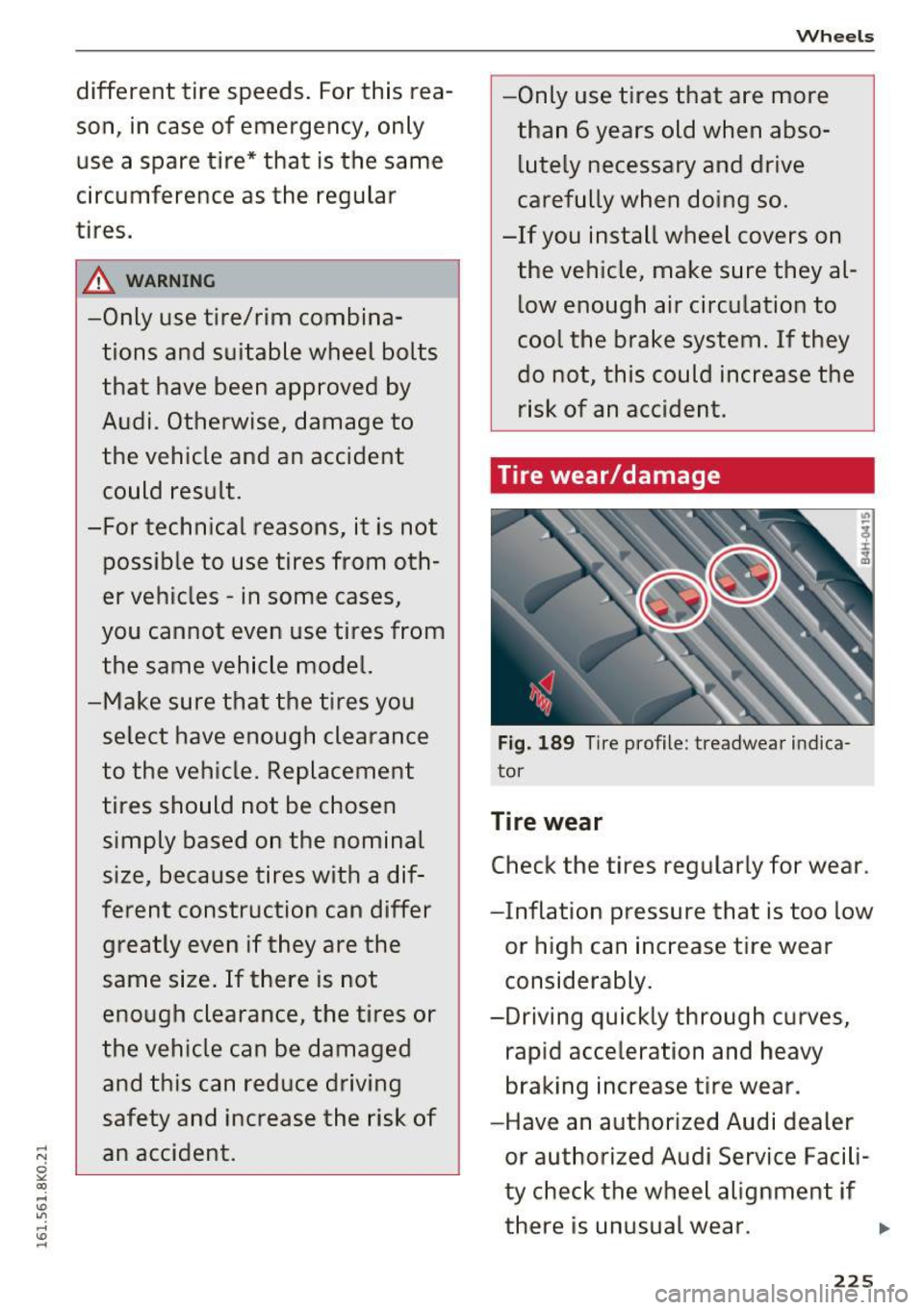
Tire wear/damage
Fig. 189 Tire profile : treadwear indica
tor
Tire wear
Check the tires regularly for wear .
-Inflation pressure that is too low
or high can increase tire wear
considerably.
-Driving quickly through curves, rapid acceleration and heavy
braking increase tire wear .
-Have an authorized Audi dealer
or authorized Audi Service Facili
ty check the wheel alignment if
there is unusual wear. ..
225
Page 233 of 278
increase the risk of the loss of
vehicle control.
- The brakes on a vehicle that
has been overloaded may not
be able to stop the vehicle
within a safe distance.
-Tires on a vehicle that has
been overloaded can fail sud
denly, including a blowout and
sudden deflation, causing loss
of control and a crash.
-Always make sure that the to
tal load being transported -
including the weight of a trail
er hitch and the tongue
weight of a loaded trailer -
does not make the vehicle
heavier than the vehicle's
Gross Vehicle Weight Rating.
Determining correct load
limit
Use the example below to calcu
late the total weight of the pas
sengers and luggage or other
things that you plan to transport so that you can make sure that
your vehicle will not be overload
ed.
Wheels
Steps for Determining Correct Load Limit
1. Locate the statement "THE
COMBINED WEIGHT OF OCCU
PANTS AND CARGO SHOULD
NEVER EXCEED XXX KG OR XXX
LBS"on your vehicle's placard
(tire inflation pressure label)
~ page 227, fig. 190.
2.
Determine the combined
weight of the driver and pas
sengers that will be riding in
your vehicle.
3. Subtract the combined weight of the driver and passengers
from
" XXX " kilograms or "XXX "
pounds shown on the sticker
¢page 227, fig. 190.
4. The resulting figure equals the
available amount of cargo and
luggage load capacity. For ex
ample, if the
" XXX " amount
equals
1400 lbs. and there will
be five
150 lbs. passengers in
your vehicle, the amount of
available cargo and luggage load capacity is
650 lbs.
(1400-750 (5 X 150) = 650
lbs.)
5. Determine the combined weight of luggage and cargo being loaded on the vehicle.
231
Page 242 of 278
Emergency assistance
"'Let the compressor run until the va lue specified
on the tire pressure label is reach ed
¢ page 227, fig. 191 . Switch the compressor
off after running for 12 minutes at the mos t -
danger of overheating!
A WARNING
The compressor and the tire filler hose can become extremely hot while they are running
- danger of burns!
CD Note
Switch the compressor off after running for
12 minutes at the most -danger of overheat
ing! Allow the compressor to cool down for a
few minutes before you use it again.
Replacing wheels
Before changing a wheel
Observe the following precaut ions for your own
and your passenger's safety when changing a
wheel.
"' After you experience a tire failure, pull the car
well away from moving traffic and try to reach
level ground before you stop ¢.&_ .
"' All passengers shou ld
leave the car and move
to a safe location (for instance, behind the
guardrail) ¢.&_ .
"' Engage the
parking brake to prevent your vehi
cle from rolling unintentionally ¢&_ .
"' Sh ift into
1st gear on vehicles w ith manual
transmission, or move the
selector lever to the
P position
on vehicles with automatic transmis
sion .
"' If you are towing a trailer: unhitch the trailer
from your vehicle.
"' Take the
jack¢ page 237 and the spare tire
¢ page 238 out of the luggage compartment .
A WARNING
You or your passengers could be injured wh ile
chang ing a wheel if you do not follow these
safety precautions :
- If you have a flat tire, move a safe distance
off the road . Turn off the engine, turn the
240
emergency flashers on and use other warn
ing devices to alert other motorists.
- Make sure that passengers wait in a safe
place away from the vehicle and well away
from the road and traffic.
- To help prevent the vehicle from moving
suddenly and possibly slipping off the jack,
always fully set the parking brake and block
the wheel diagonally opposite the wheel be ing changed with the folding chocks or oth
er objects . When one front whee l is lifted
off the ground, placing the Automat ic
T ransmission in "P" (Par k) w ill
not prevent
the vehicle from moving.
- Before you change a wheel, be sure the
ground is level and firm . If necessary, use a
sturdy board under the jack.
- Always store the vehicle tool kit, the jack*
and the replaced tire in the luggage com
partment
¢ page 126.
CD Note
If you a re changing the wheel on a steep in
cline, use a rock or similar object to block the
opposite wheel to prevent the vehicle from
moving.
(D Tips
Obey all laws.
Changing a wheel
When you change a wheel, follow the sequence
described below step-by-step and in exactly that
order .
1. Remove the decorative wheel cover* or the
wheel bolt caps* . For more details see also
¢ page 241, Decorative wheel covers or
¢ page 241, Wheels with wheel bolt cops.
2. Loosen the wheel bolts ¢page 242.
3. Locate the proper mounting point for the
jack and align the jack below that point
¢ page 242.
4. Lift the car with the jack¢ page 242.
5. Remove the wheel with the flat tire and then
install the
spare tire ¢page 243.
6. Tighten all whee l bolts lightly .
Page 244 of 278
Emergency assistance
The caps are to protect and keep the whee l bolts
clean.
Loosening and tightening the wheel bolts
The wheel bolts must be loosened before raising
the vehicle.
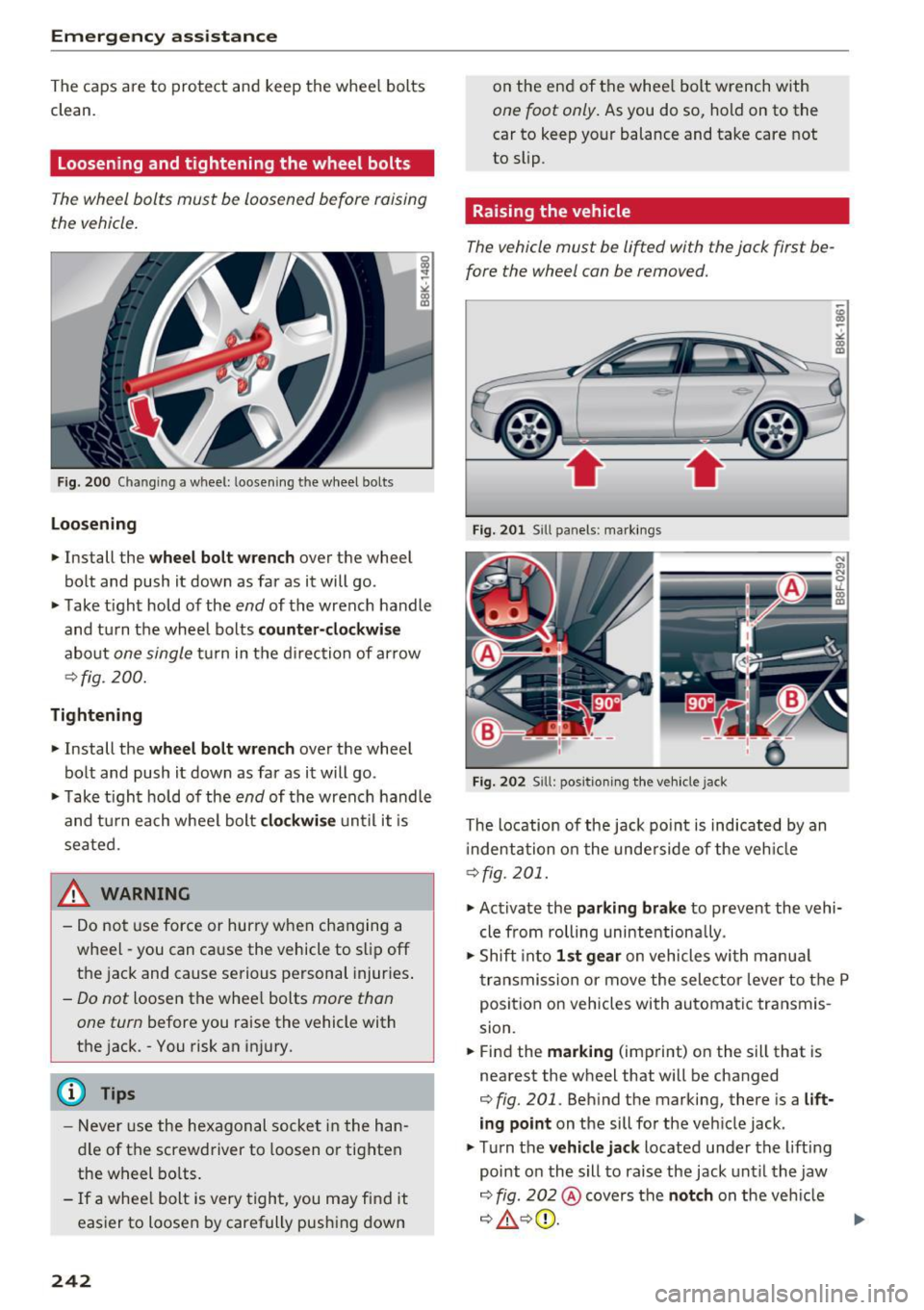
Fig . 200 Changing a wheel: loosening the wheel bolts
Loosening
• Install the wheel bolt wrench over the wheel
bolt and push it down as far as it will go.
• Take tight hold of the
end of the wrench handle
and turn the wheel bolts
counter-clockwise
about one single tur n in the direction of ar row
¢fig. 200.
Tightening
• Install the wheel bolt wrench over the wheel
bolt and push it down as far as it will go.
• Ta ke tight hold of the
end of the wrench handle
and turn each whee l bolt
clockwise until it is
seated.
_& WARNING
- Do not use force or hurry when changing a
wheel -you can cause the vehicle to slip off
the jack and cause serious personal injuries.
-Do not loosen the whee l bolts more than
one turn
before you raise the vehicle with
the jack. -You risk an injury .
(D Tips
-Never use the hexagonal socket in the han
dle of the screwdriver to loosen o r tighten
the wheel bolts.
- If a whee l bolt is very tight, you may find it
easier to loosen by carefully push ing down
242
on the end of the whee l bolt wrench with
one foot only. As you do so, hold on to the
car to keep your balance and take care not
to slip.
Raising the vehicle
The vehicle must be lifted with the jack first be
fore the wheel can be removed.
Fig. 201 Sill panels: marking s
Fig. 202 Sill: positio ning the vehicle jack
The location of the jack point is indicated by an
i ndentation on the underside of the vehicle
¢fig. 201.
• Activate the parking brake to prevent the vehi
cle from rolling unintentionally.
• Shift into
1st gear on vehicles with manua l
transmission or move the selector lever to the P
position on vehicles with automatic transmis
sion.
• Find the
marking (imp rint) on the sill that is
nearest the wheel that will be changed
¢ fig. 201. Behind the marking, there is a lift
ing point on the sill for the vehicle jack.
• Turn the
vehicle jack located under the lifting
point on the sill to raise the jack until the jaw
¢ fig. 202@covers the notch on the veh icle
¢ ~ ¢©. ~