service AUDI S4 2017 Owners Manual
[x] Cancel search | Manufacturer: AUDI, Model Year: 2017, Model line: S4, Model: AUDI S4 2017Pages: 386, PDF Size: 96.32 MB
Page 340 of 386
Care and cleaning
& WARNING
-Only wash the vehicle when the ignition is
off or follow the instruct ions from the car
wash operator to reduce the risk of acci dents.
- To reduce the risk of cuts, protect yourself from sha rp metal components when wash
ing the underbody or the inside of t he wheel
hous ings.
- After was hing the vehicle, the braking effect
may be delayed due to mo isture on the
bra ke rotors o r ice i n the winte r. This in
c reases the risk of an a cciden t. The bra kes
must be dried first with a few care ful brake
applications .
@ Note
-If you wash the ve hicle in an automa tic car
wash, yo u must fold the exterior m irrors in
to reduce the risk of damage to the mirrors.
Power folding exterior mirrors * must on ly
be fo lded in and out us ing the power folding
funct ion.
- To reduce the risk of damage to the rims
and tires, compare the width between the
whee ls on your vehicle w ith the distance be
tween t he gu ide rai ls in the car wash. -
To red uce the risk of damage, compare the
heig ht and width of your vehicle with the
heig ht and w idth of the inside of the car
wash.
- To prevent paint damage, do not wash the
vehicle in direct sunlight.
- To reduce the risk of damage to the surface,
do not use insect removing sponges, k itchen
sponges or s imilar items.
- Matte finish painted vehicle components:
- To reduce the r isk of damage to the sur-
face, do not use polishing agents or hard
wax.
- Never use protective wax. It can destroy
the matte finish effect.
- Do not place any stickers or magnetic signs on vehicle parts pain ted with matte
finish paint. The paint could be damaged
when the stickers or magne ts are re
moved.
@ For the sake of the environment
Only wash the veh icle in facilities spe cially de
signed for that pu rpose. This will reduce the
r isk of dirty wate r contamina ted with o il from
entering the sewer system .
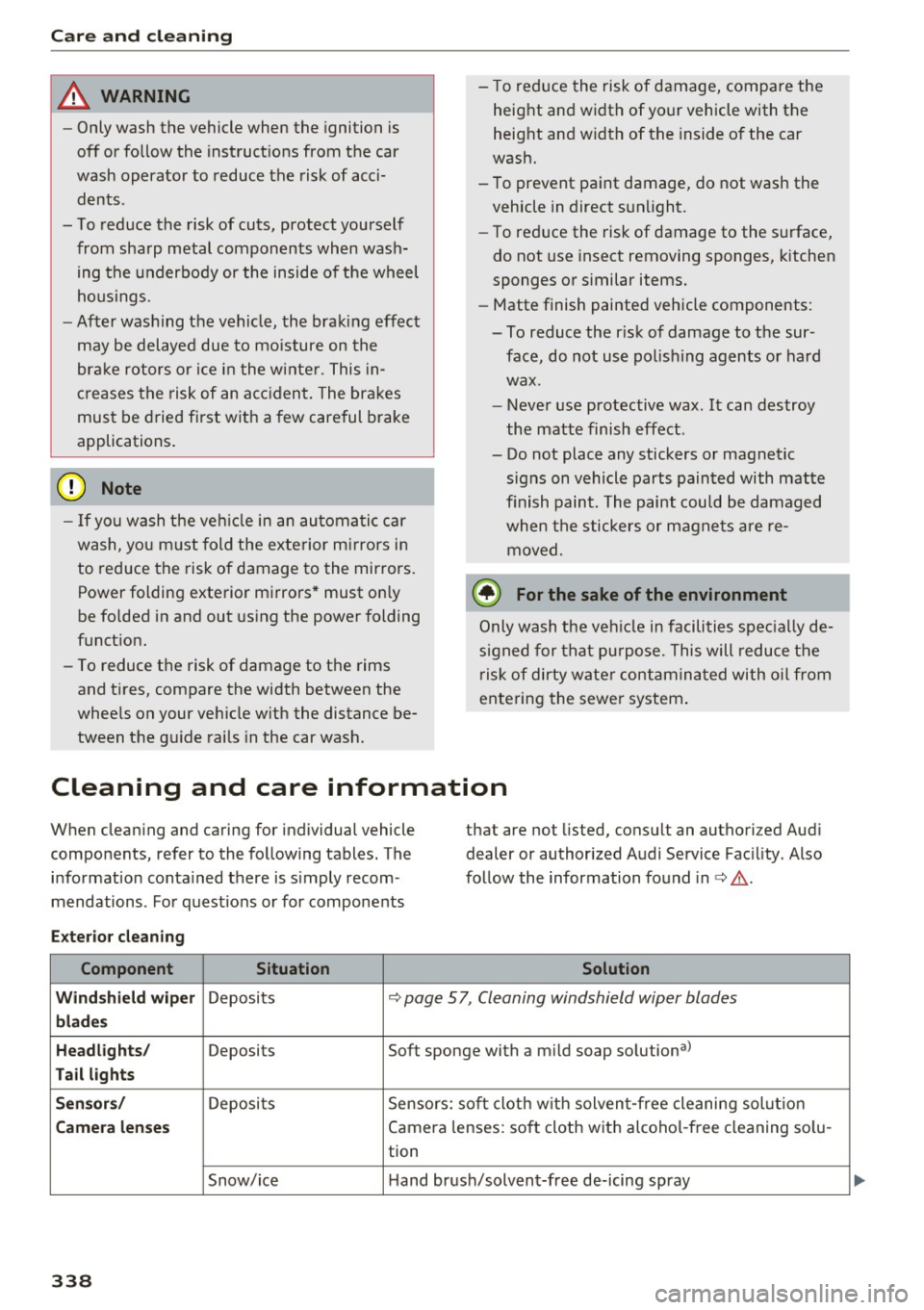
Cleaning and care information
When cleaning and caring for individual vehicle
components, refer to the fo llowing tables. The
information conta ined there is s imply recom
mendations . For quest io ns or for components that are not
listed, consult an authorized Aud i
dealer or authorized Audi Service Facility . Also
follow the information found in c> & .
Exter io r cleaning
Component Situation Solution
Wind shi eld wip er
Deposits c> page 5 7, Cleaning windshield wiper blades
blades
Headlights /
Deposits Soft sponge with a mild soap solutiona>
Tail light s
S ensor s/
Deposi ts Sensors: soft cloth w ith solven t-free cleaning sol ution
Camera lenses Camera lenses: soft cloth with alcohol -free cleaning so lu-
tion
Snow/ice Hand brush/solvent-free de-icing spray
338
Page 341 of 386
<( a, .... N ,....
N .... 0 0
3 a,
Care and cleaning
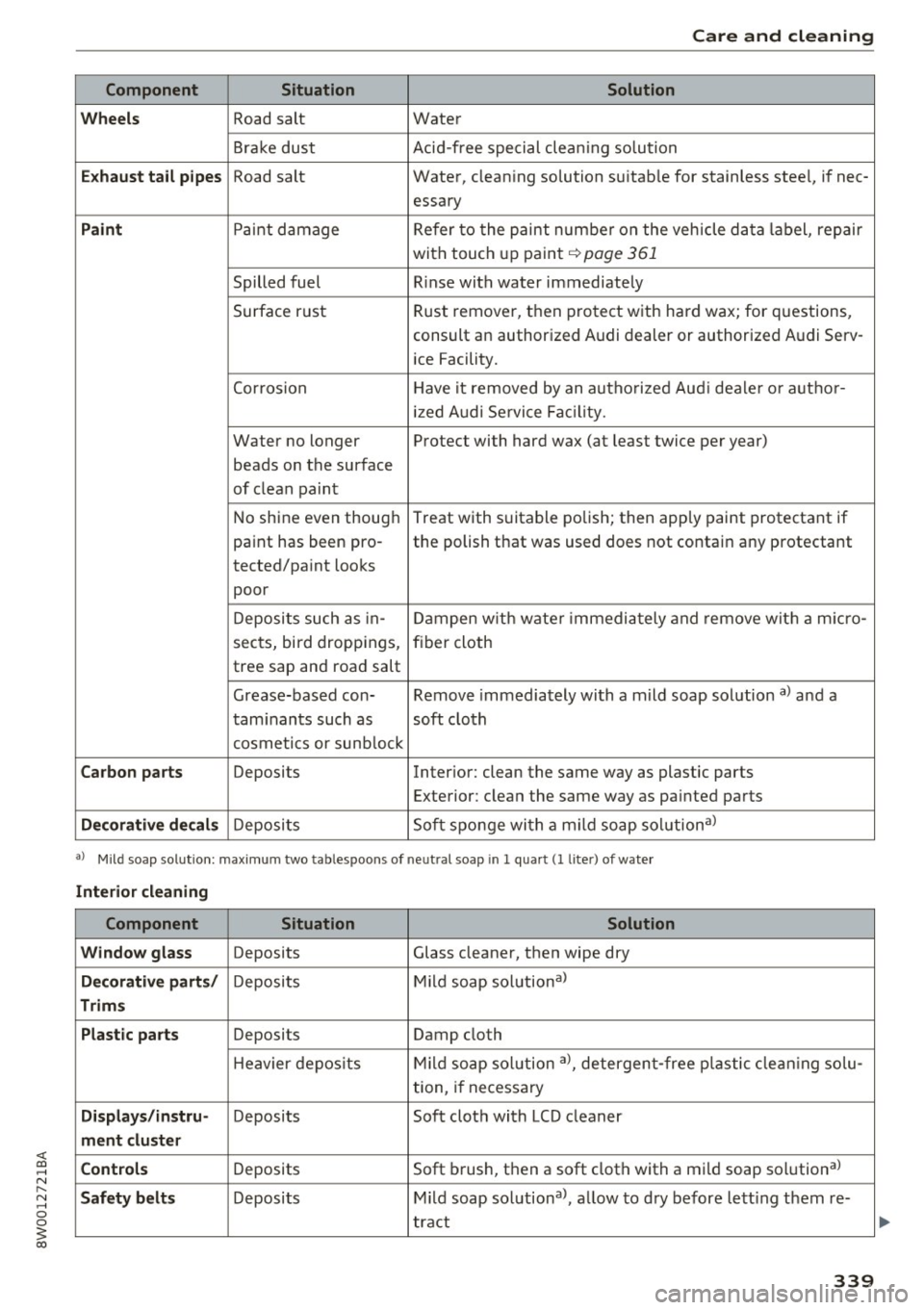
Component Situation Solution
Wheels
Road salt Water
Brake dust Acid-free special clea ning solution
Exhaust tail pipes Road salt Water, cleaning solution su itab le for stainless steel, if nee-
essary
Paint Paint damage Refer to the paint number on the vehicle data label, repair
with touch up paint
qpage 361
Spilled fuel Rinse with water immediately
Surface rust Rust remover, then protect with hard wax; for questions,
consult an authorized Audi dealer or authorized Audi Serv- ice Facility.
Cor rosion Have it removed by an autho rized Aud i dealer or author-
iz ed A udi Service Fac ility.
Water no longer Protect with hard wax (at least twice per year)
beads on the surface
of clean paint
No shine even thoug h Treat with suitable polish; then apply paint protectant if
paint has been pro- the polish that was used does not contain any protectant
tected/paint looks poor
Deposits such as in-
Dampen with wate r immedia tely and remove wit h a m icro-
sects, bi rd droppings, fiber cloth
tree sap and road salt
Grease-based con- Remove immediately with a mild soap solution
a) and a
taminants such as soft cloth
cosmetics or sunblock
Carbon parts Deposits Interior: clean the same way as plastic parts
Exterior: clean the same way as pa inted parts
Decorative decals Deposits Soft
sponge with a m ild soap solutional
a) Mild soap solut ion: max imum two tab lespoons of ne utral soap in 1 quart (1 lite r) of wate r
Interior cleaning
Component Situation Solution
Window glass
Deposits Glass cleaner, then wipe dry
Decorative parts/ Deposits Mi
ld soap solutiona>
Trims
Plastic parts
Deposits Damp cloth
H eavier deposits Mild
soap solution a>, detergent-free p lastic cleaning solu-
tion, if necessary
Displays /instru-Deposits Soft cloth with LCD cleaner
ment cluster
Controls
Deposits Soft
brush, then a soft cloth with a mild soap solutiona>
Safety belts Deposits Mild soap solutiona>, allow to dry before letting them re-
tract
339
Page 343 of 386
<( a, .... N ,....
N .... 0 0
3 a,
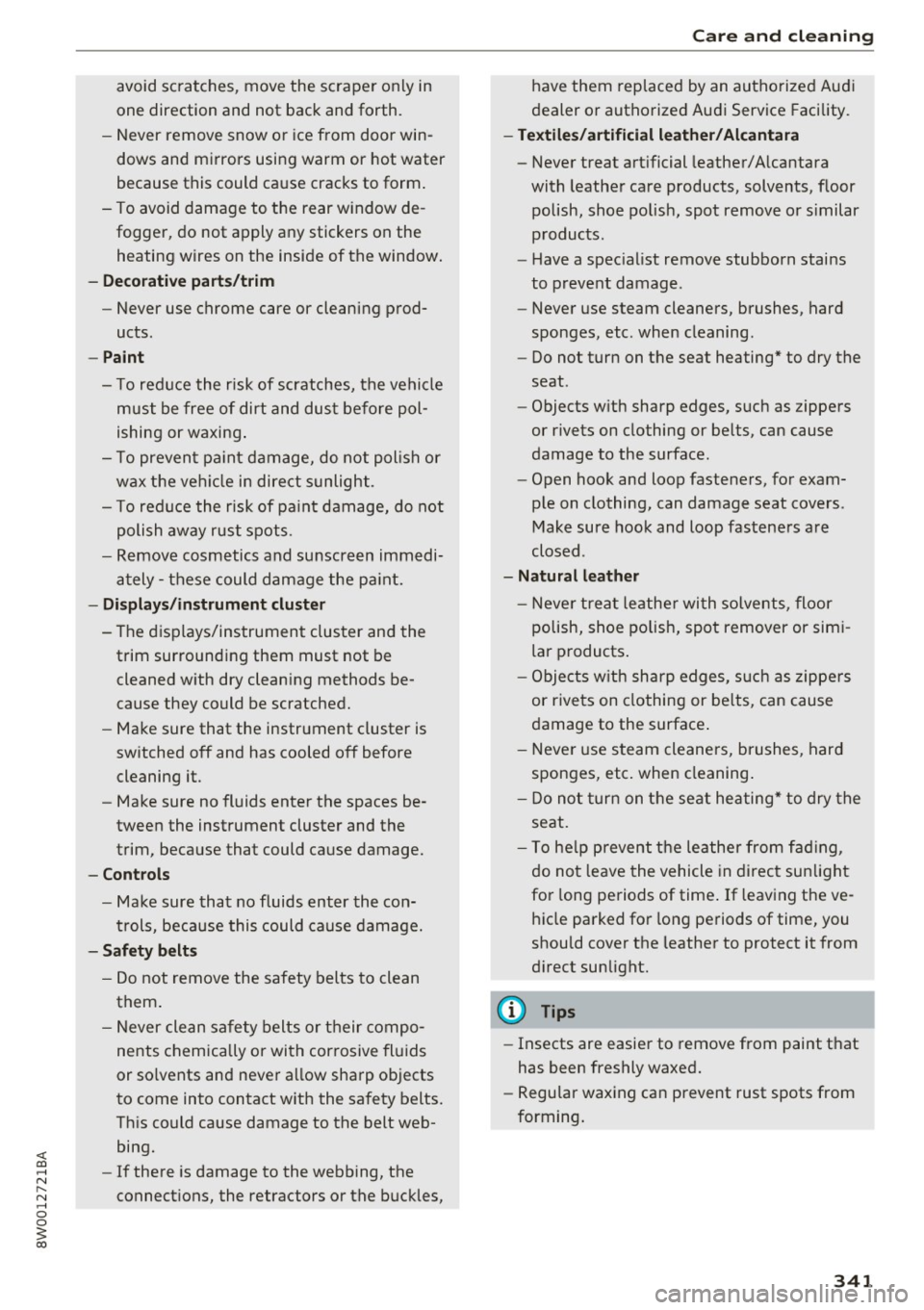
avoid scratches, move the scraper only in
one direction and not back and forth.
- Never remove snow or ice from door win
dows and mirrors using warm or hot water
because this could cause cracks to form.
- To avoid damage to the rear window de
fogger, do not apply any stickers on the
heating wires on the inside of the window.
- Decorative part .s/trim
- Never use chrome care or cleaning prod-
ucts .
- Paint
- To reduce the risk of scratches, the vehicle
must be free of dirt and dust before pol
ishing or waxing .
- To prevent paint damage, do not polish or
wax the vehicle in direct sunlight .
- To reduce the risk of paint damage, do not
polish away rust spots.
- Remove cosmetics and sunscreen immedi
ately- these could damage the paint.
- Displays/instrument cluster
- The displays/instrument cluster and the
trim surrounding them must not be
cleaned with dry cleaning methods be
cause they could be scratched.
- Make sure that the instrument cluster is
switched off and has cooled off before
cleaning it.
- Make sure no fluids enter the spaces be
tween the instrument cluster and the
trim, because that could cause damage.
- Controls
- Make sure that no fluids enter the con-
trols, because this could cause damage.
- Safety belts
- Do not remove the safety belts to clean
them.
- Never clean safety belts or their compo
nents chemically or with corrosive fluids
or solvents and never allow sharp objects
to come into contact with the safety belts.
This could cause damage to the belt web bing.
- If there is damage to the webbing, the
connections, the retractors or the buckles,
Care and cleaning
have them replaced by an authorized Audi
dealer or authorized Audi Service Facility.
- Textiles/artificial leather/ Alcantara
- Never treat artificial leather/Alcantara
with leather care products, solvents, floor
polish, shoe polish, spot remove or similar
products.
- Have a specialist remove stubborn stains
to prevent damage.
- Never use steam cleaners, brushes, hard
sponges, etc . when cleaning.
- Do not turn on the seat heating* to dry the
seat .
- Objects with sharp edges, such as zippers
or rivets on clothing or belts, can cause
damage to the surface.
- Open hook and loop fasteners, for exam
ple on clothing, can damage seat covers .
Make sure hook and loop fasteners are
closed .
- Natural leather
- Never treat leather with solvents, floor
polish, shoe polish, spot remover or simi
lar products.
- Objects with sharp edges, such as zippers
or rivets on clothing or belts, can cause
damage to the surface .
- Never use steam cleaners, brushes, hard
sponges, etc. when cleaning.
- Do not turn on the seat heating* to dry the
seat.
- To help prevent the leather from fading,
do not leave the vehicle in direct sunlight
for long periods of time. If leaving the ve
hicle parked for long periods of time, you
should cover the leather to protect it from
direct sunlight.
(D Tips
- Insects are easier to remove from paint that
has been freshly waxed.
- Regular waxing can prevent rust spots from
forming.
341
Page 344 of 386
Care and cleaning
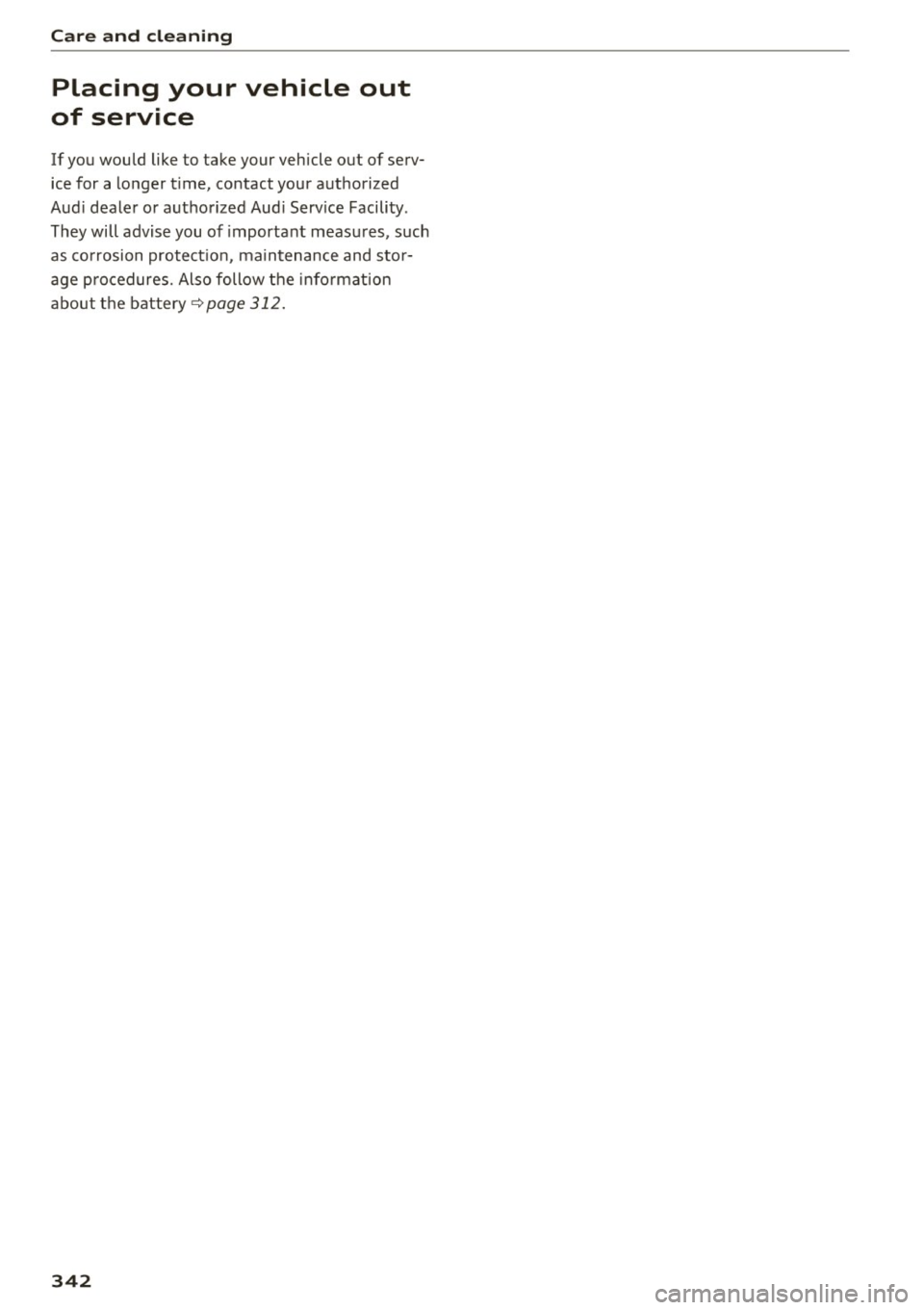
Placing your vehicle out
of service
If you would like to take your vehicle out of serv
ice for a longer t ime, contact your authorized
Aud i dealer or a uthorized Aud i Serv ice Facility .
They will advise you of important measu res, such
as co rrosion protectio n, main tenance and sto r
age p rocedures. Also follow the i nfo rmation
about the battery
~ page 312.
342
Page 346 of 386
Emergency assistance
.,. Se lect the P selector lever position.
.,. Check if a repair with the tire mobility kit is pos
s ib le
r::!:> pag e 344.
Using the tire mobility kit
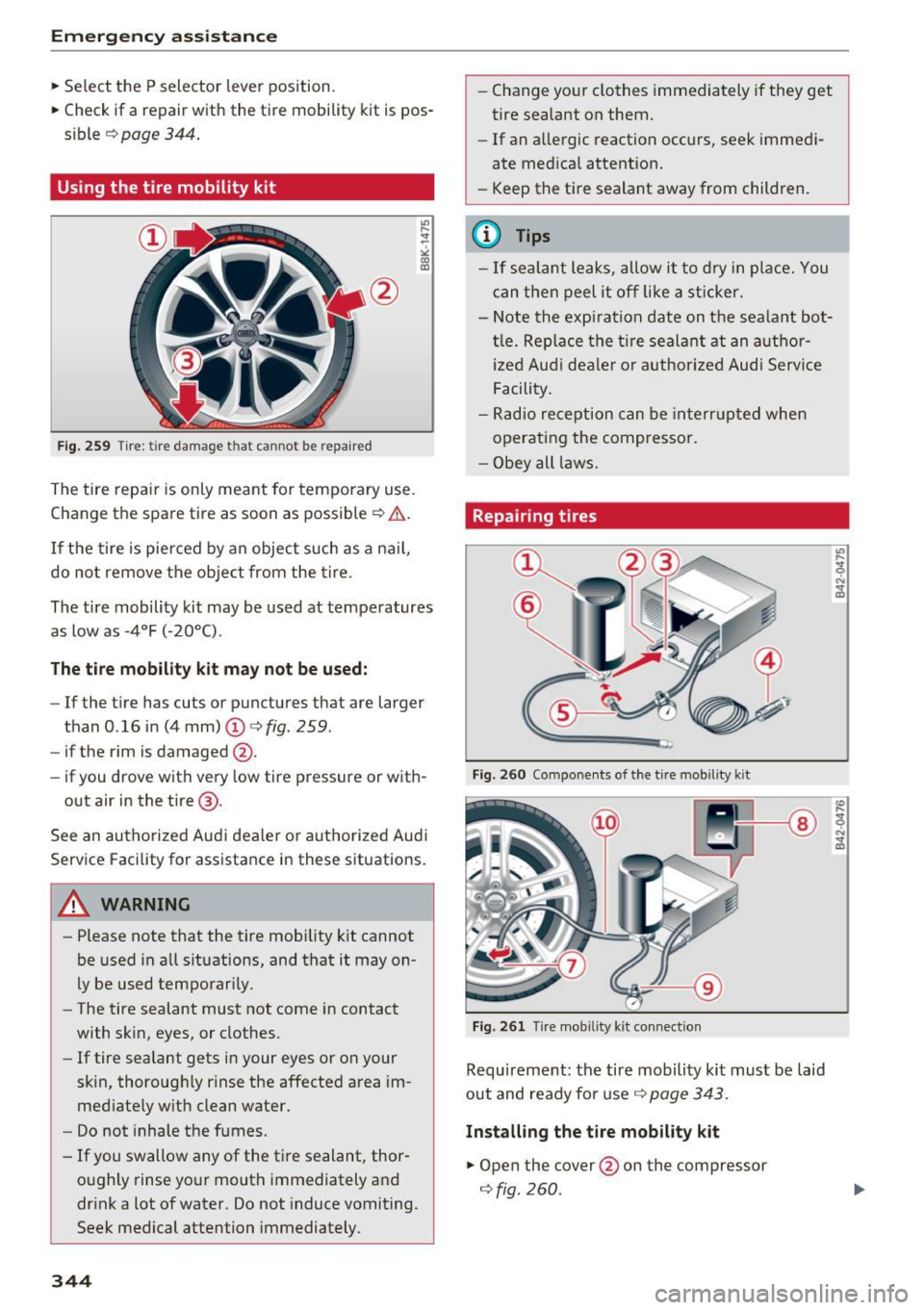
Fig. 259 Tire: t ire da mag e th at cann ot be repaired
The tire repair is only meant for temporary use.
Change the spare tire as soon as possible
c::> .&. .
If the tire is pierced by an object such as a nail,
do not remove the object from the tire.
The tire mobility kit may be used at temperatures
as low as -4°F (-20°C).
The tire mobility kit may not be used:
-If the tire has cu ts or punctures that are larger
than 0 .16 in (4 mm)@¢
fig. 259 .
-if the rim is damaged @.
- if you drove with very low t ire pressure or with-
out air in the tire @.
See an authorized Aud i dealer or autho rized Audi
Service Facility for assistance in these situations.
A WARNING
-Please note that the tire mobility kit cannot
be used in a ll situations, and that it may on
ly be used temporarily.
- The tire sealant must not come in contact
with skin, eyes, or clothes.
- If tire sealant gets in your eyes or on your
skin, thoroughly r inse the affected area im
med iately with clean water.
- Do not inhale the fumes .
- If you swallow any of the tire sealant, thor -
oughly rinse your mouth immediately and
drink a lot of water. Do not induce vomiting .
Seek medical attention immediately.
344
- Change your clothes immediately if they get
tire sealant on them.
- If an allergic reaction occurs, seek immedi
ate medica l attention.
- Keep the tire sealant away from children .
a) Tips
-If sealant leaks, allow it to dry in place. You
ca n then peel it off like a sticker.
- Note the expiration date on the sealant bot
tle. Replace the tire sealant at an author
ized Audi dea le r or authorized Audi Service
Facility.
- Radio reception can be interrupted when
operating the compressor.
- Obey all laws.
Repairing tires
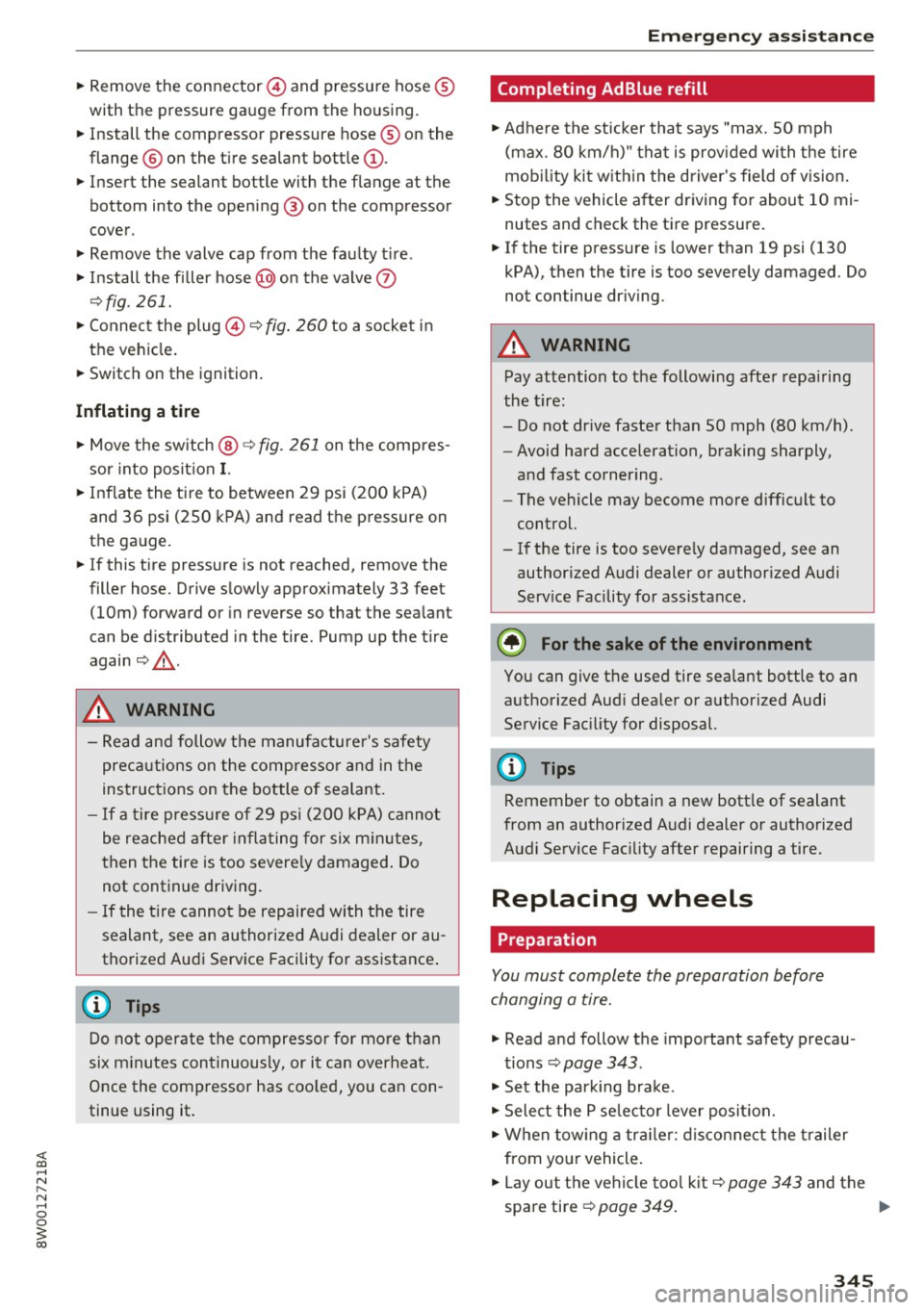
Fig. 260 Co mponents of the tire mo bility k it
Fig. 261 T ire mobil ity k it connec tion
Requirement: the tire mobility kit must be laid
out and ready fo r use
c::> page 343 .
Installing the tire mobility kit
.,. Open the cover @on the compressor
¢fig. 260 .
Page 347 of 386
<( a, .... N ,....
N .... 0 0
3 a,
• Remove the connector@) and pressure hose ®
with the pressure gauge from the housing.
• Install the compressor pressure hose ® on the
flange @ on the tire sealant bottle@.
• Insert the sealant bottle with the flange at the
bottom into the opening @ on the compressor
cover .
• Remove the valve cap from the fau lty t ire .
• Install the fi ller hose @on the valve(!)
r::!vfig. 261.
• Connect the plug@¢ fig. 260 to a socket in
the vehicle .
• Switch on the ignition.
Inflating a tire
• Move the sw itch @ r::?v fig. 261 on the comp res
sor into posit ion
I.
• Inflate the tire to between 29 psi (200 kPA)
and 36 psi (2SO kPA) and read the pressure on
the gauge.
• If this tire pressure is not reached, remove the
filler hose. Drive slowly approximately 33 feet (10m) forward or in reverse so that the sea lant
can be d istributed in the tire . Pump up the t ire
again
~ A .
A WARNING
-Read and follow the manufacture r's safety
precautions on the compresso r and in the
ins tructions on the bottle of sealant.
- If a tire press ure of 29 ps i (200 kPA) cannot
be reached afte r inflating for six m in utes,
then the tire is too severe ly damaged . Do
not continue driving.
- If the t ire cannot be repaired with the tire
sealant, see an authorized A udi dealer or au
thorized Audi Serv ice Facility for assistance .
@ Tips
Do not operate the compressor for mo re than
six m inutes continuously, or i t can overheat .
Once the compressor has coo led, you can con
tinue using it .
Emergenc y ass is tanc e
Completing AdBlue refill
• Ad here the sticker that says "max. SO mph
(max . 8 0 km/h) " that is provided wi th t he tire
mob ility kit w it hi n the driver's field of vision.
• Stop the vehicle a fter driving for abou t 10 mi
nutes and check the tire pressure.
• If the tire pressure is lower than 19 psi (130
kPA), then the tire is too severely damaged. Do not continue dr iving.
A WARNING
Pay attention to the following afte r repa iring
the tire:
- Do not dr ive faste r than SO mph (80 km/h) .
- Avoid hard acce leration, braking sharply,
and fast cornering .
- The vehicle may become more difficult to
control.
- If the tire is too severe ly damaged, see an
authorized Audi dealer or authorized Audi
Serv ice Facility for assistance.
(® For the sake of the environment
You can give the used tire sealant bottle to an
a uthorized Audi dea ler or authorized Audi
Service Fac ility for disposal.
(D Tips
Remember to obtain a new bott le of sealant
from an authorized A udi dealer or authorized
A udi Service Fac ility after repairing a tire.
Replacing wheels
Preparation
You must complete the preparation before
changing a tire.
• Read and follow the important safety precau-
tions
~ page 343 .
• Set the par king brake.
• Sele ct the P selec to r lever posit ion.
• W hen tow ing a tr ailer: d isconne ct the trailer
from your vehicle .
• Lay out the vehicle too l kit ~
page 343 and the
spare tire
¢ pag e 349 . .,,.
345
Page 351 of 386
<( a, .... N ,....
N .... 0 0
3 a,
~ If the removed wheel does not fit in the spare
whee l we ll, store it securely in the luggage
compartment ¢
page 242.
~ Check the tire pressure on the installed whee l
as soon as possible.
~ On vehicles with a Tire Pressure Monitoring Sys
tem*, check the tire pressure and store it in the
Infotainment system
<::;> page 336 .
~ The wheel bolt tightening specification must be
90
ft lbs (120 Nm). Check it as soon as possible
with a torque wrench . Drive carefully until then.
~ Have the faulty wheel replaced as quickly as
possible.
(D Tips
- If you notice that the wheel bolts are cor
roded and difficult to turn while changing a
tire, they should be replaced before you
check the tightening torque.
- Drive at reduced speed until you have the
tightening torques checked.
Notes on wheel changing
Please read the information ¢ page 324 if you
are go ing to use a replacement tire which is dif
ferent from the tires on your vehicle.
After you change a tire:
- Check the tire pressure on the replacement
tire immediately after installation.
- Have the wheel bolt tightening torque
checked with a torque wrench as soon as pos
sible by your authorized Audi dealer or quali
fied workshop.
- With steel and alloy wheel rims, the wheel
bolts are correctly tightened at a torque of
90 ft lbs (120 Nm).
- If you notice that the wheel bolts are corroded
and difficult to turn while changing a tire,
they should be replaced before you check the
tightening torque.
- Replace the flat tire with a new one and have
it installed on your vehicle as soon as possi
ble . Remount the wheel cover.
Until then, drive with extra care and at reduced
speeds .
Emergency assistance
A WARNING
- If you are going to equip your vehicle with
tires or rims which differ from those which
were factory installed, then be sure to read
the information
r::;> page 324.
-Always make sure the damaged wheel or
even a flat tire and the jack and tool kit are
p ro perly secured in the luggage compart
ment and are not loose in the passenger
compa rtment.
- In an accident or sudde n maneuver they
could fly forward , injur ing anyone in the ve
h icl e.
- Always store damaged wheel, jack and tools
securely in the luggage compartment. Oth
erwise, in an acc ident or sudden maneuver
they could fly forward, causing injury to pas
sengers in the ve hicle.
Space-saving spare tire
Applies to: vehicles with space-saving spare tire
-
The spare tire is intended fo r short-term use on
ly. Have the damaged tire checked and replaced,
if necessary, by an authorized Audi dea ler or au
thori zed Audi Service Facility as soon as possible.
T he re are some restrictions on the use of the
spare tire. The spare tire has been designed spe
cifically for your type of vehicle . Do not rep lace it
with the spare tire from another type of vehicle .
T he tire press ure must be 61 PS I (420 kPA).
Removing the spare tire
~ Lift the cargo floor using the p lastic handle and
hook the handl e onto the luggage compa rt
ment seal
¢page 343, fig . 258.
~ Remove the handle by turning it counter-clock
wise and remove the spare tire.
~ Unhook the cargo floor before closing the rear
lid.
Snow chains
For technical reasons, the use of snow chains on
the compact spare tire is not pe rmitted .
If you have to drive w ith snow chains and a front
tire fails , mount the spare wheel in place of a .,..
349
Page 354 of 386
Fuses and bulbs
Fuse color identification
Color Current rating
in amps
Black 1
Purple 3
Light brown 5
Brown 7.5
Red 10
Blue 15
Yellow 20
White or transparent 25
Green 30
orange 40
A WARNING
Do not repair fuses and never replace a blown
fuse with one that has a higher amp rating.
This can cause damage to the electrical sys
tem and a fire.
(D Note
If a new fuse burns out again shortly after you
have installed it, have the electrical system
checked as soon as possible by an authorized
Audi dealer or authorized Audi Service Facili
ty .
Q) Tips
-The following table does not list fuse loca
tions that are not used.
- Some of the equipment listed in the follow ing tables applies only to certain model ver
sions or certain optional equipment.
352
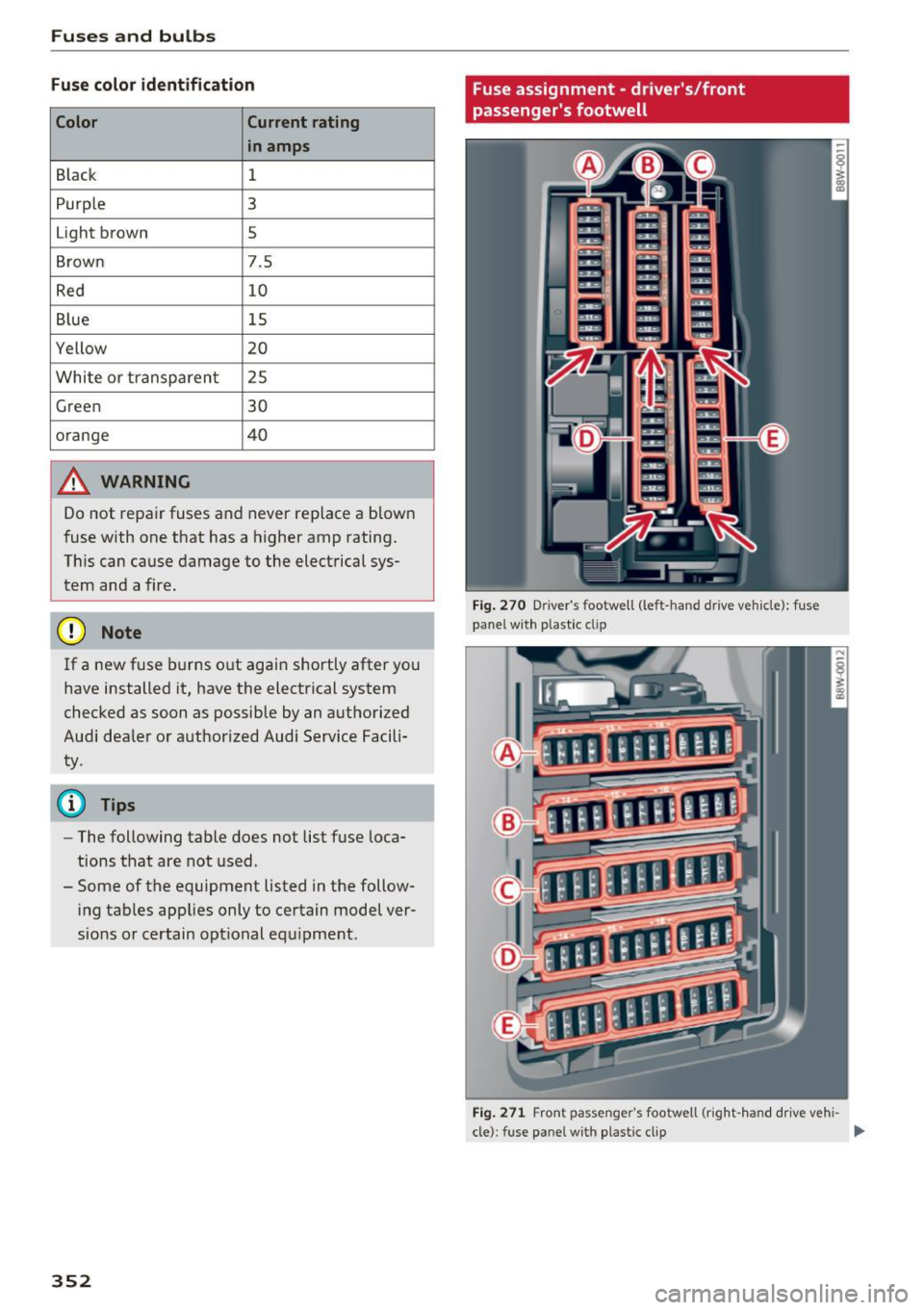
Fuse assignment - driver's/front
passenger's footwell
Fig. 270 D river 's footwell (left -hand drive vehicle) : fuse
panel w ith plastic clip
Fig. 271 Front passenger 's footwell (right -hand drive vehi-
cle) : fuse pa nel wit h plastic cl ip
Ill>
Page 359 of 386
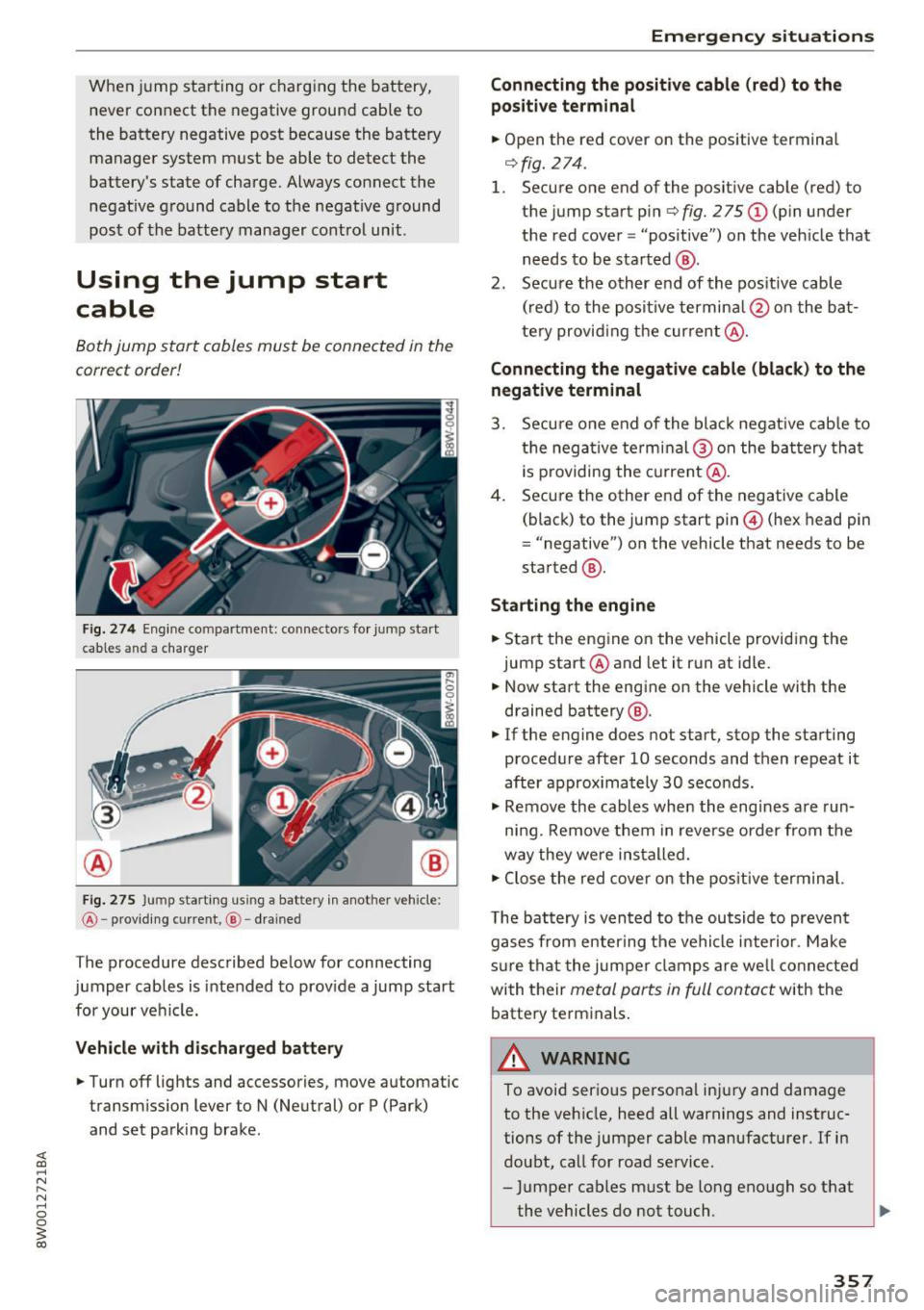
When jump starting or charging the battery,
never connect the negative ground cable to
the battery negative post because the battery
manager system must be able to detect the
battery's state of charge . Always connect the
negative ground cable to the negat ive ground
post of the battery manager control unit .
Using the jump start
cable
Both jump start cables must be connected in the
correct order!
Fig. 274 Engine co mpa rtment: connecto rs for jump start
cables and a charger
@
Fig. 275 Ju mp sta rting us ing a battery in another vehicle:
@ -providing cu rre nt, @ - drained
The procedure described below for connecting
jumper cables is intended to provide a jump start
for your vehicle.
Vehicle with discharged battery
.. Turn off lights and accessories, move automatic
transmission lever to N (Neutral) or P (Park)
and set parking brake .
Emergency situations
Connecting the positive cable (red) to the
po sitive terminal
.. Open the red cover on the positive terminal
r=>fig.274 .
1. Secure one end of the positive cable (red) to
the jump start pin
r=> fig. 275 (D (pin under
the red cover = "posit ive") on the vehicle that
needs to be started @.
2. Secure the other end of the pos itive cable
(red) to the positive termina l@ on the bat
tery provid ing the current @.
Connecting the negative cable (black) to the
negative terminal
3. Secure one end of the black negat ive cab le to
the negative terminal @on the battery that
i s p roviding the current@.
4. Secure the other end of the negative cable
(black) to the jump start pin@ (hex head pin
= "negative") on the vehicle that needs to be
started @.
Starting the engine
.. Start the engine on the vehicle providing the
jump start @and let it run at idle .
.. Now start the engine on the vehicle with the
drained battery @ .
.. If the engine does not start, stop the starting
procedure after 10 seconds and then repeat it
after approx imately 30 seconds .
.. Remove the cables when the engines are run
ning. Remove them in reverse order from the
way they were installed.
.. Close the red cover on the positive terminal.
T he battery is vented to the outside to prevent
gases from enter ing the vehicle interior . Make
s ur e that the jumper clamps are well connected
with their
metal ports in full contact with the
battery terminals.
_& WARNING
-To avoid serious personal injury and damage to the vehicle, heed all warnings and instruc
tions of the jumper cable manufacturer. If in
doubt, call for road service.
- Jumper cables must be long enough so that
the vehicles do not touch . ..,_
357
Page 363 of 386

Technical data
Vehicle specifications
F ig. 281 W indshield (front left): Ve hicle Ident ification
Number (VIN)
XXXXX XX -X -XX XX X XX XX
CD+ ~t :1 :: xxxxxxxx xx x xxx xxxxx
TVP/fffl XXX XXX
XX XXXXXXX XX X X XX
XXX
KW XXX
®i ~:J ·f lfils~~ XXXX XXX XXX
®-+ ~N:a=i~l xxxx ; xxxx xx x ; xx
11. • AUSS, I OPTIONS
E0 A
7D 5 4UB 6
XM 5SG 5R W
2E H
J0Z lL B l
A S lB A
3FC SM U 7 Xl
F 0 A 9G3 0G7 0YH 0JF
TL 6 3KA 8EH UlA X 98 Q Z7
lXW 803 908 824 020
7T6 C V7 7 K0 4 X3 2K2
3L4
4KC 3 Y 0 413
502
lSA 7GB 01 A 4G0
XX . X XX X XX X xxxx
Fig. 282 Vehicle identification label
Vehicle Identification Number (VIN) in the
Infotainment system
• Select in the Infotainment system: the I MENU I
button > left control button > Service & checks
> Vehicle information.
Vehicle Identification Number (VIN)
The VIN can be found in the Infotainment sys
tem, on the vehicle data label and under the
windshield on the driver's side*¢
fig. 281 . The
VIN is also in the right side of the luggage com
partment.
Technical data
Vehicle identification label
T he veh icle identification label¢ fig. 282 is locat
ed in the luggage compartment under the cargo
floor cover .
T he information of the veh icle identification label
can also be found in your Warranty
& Mainte
nance booklet.
The sticker contains the fol low ing vehicle data:
(D Vehicle Identification Number (VIN)
@ Vehicle type, eng ine output, transm ission
@ Engine and transmission codes
@ Paint and interior codes
® Optional equipment numbers
Safety compliance sticker
The safety compliance sticker is your assurance
that your new vehicle complies w ith all applicable
Federal Motor Vehicle Safety Standards which
were in effect at the time the vehicle was manu
factured. You can find this sticker on the front end of the driver's door.
It shows the month and
year of production and the vehicle identification number of your vehicle (perforation) as well as
the Gross Vehicle Weight Rating (GVWR) and the Gross Axle Weight Rating (GAWR).
High voltage warning label
The high voltage warning label is located in the
engine compartment next to the engine hood re
lease. The spark ignition system complies with
the Canadian standard ICES-002.
Weights
Gross Vehicle Weight Rating
The Gross Vehicle Weight Rating (GVWR), and
the Gross Axle Weight Rating (GAWR) for front
and rear are listed on a sticker on the front end of
the driver's door .
The Gross Vehicle Weight Rating includes the
weight of the basic vehicle plus full fuel tank, oil and coolant, plus maximum load, which includes
passenger weight (150 lbs/68 kg per designated
seating pos ition) and luggage weight¢,&. . .,.
361