brake AUDI S4 2017 Workshop Manual
[x] Cancel search | Manufacturer: AUDI, Model Year: 2017, Model line: S4, Model: AUDI S4 2017Pages: 386, PDF Size: 96.32 MB
Page 313 of 386
and have the cooling system inspected. If the
cooling system is not leaking, a loss can come
from the coolant boiling through overheating and being pushed out of the cooling system.
A WARNING
- The cooling system is under pressure. Do
not open the coolant expansion tank cap
when the engine is hot. This increases the
risk of burns .
- The coolant add itive and the coolant can be
dangerous to your health. For this reason,
keep the coolant in the original container
and away from children. There is a risk of
poisoning.
- When working in the engine compartment,
remember that the radiator fan can switch
on even if the ignition is switched off, which
increases the risk of injury.
(D Note
Do not add coolant if the expansion tank is
empty. There may be a ir in the cooling sys
tem, which increases the risk of engine dam
age . If this is the case, do not continue driv
ing . See an authorized Audi dealer or author
ized Audi Service Facility for assistance.
Brake fluid
Checking brake fluid level
The brake fluid level can be checked with a quick
glance .
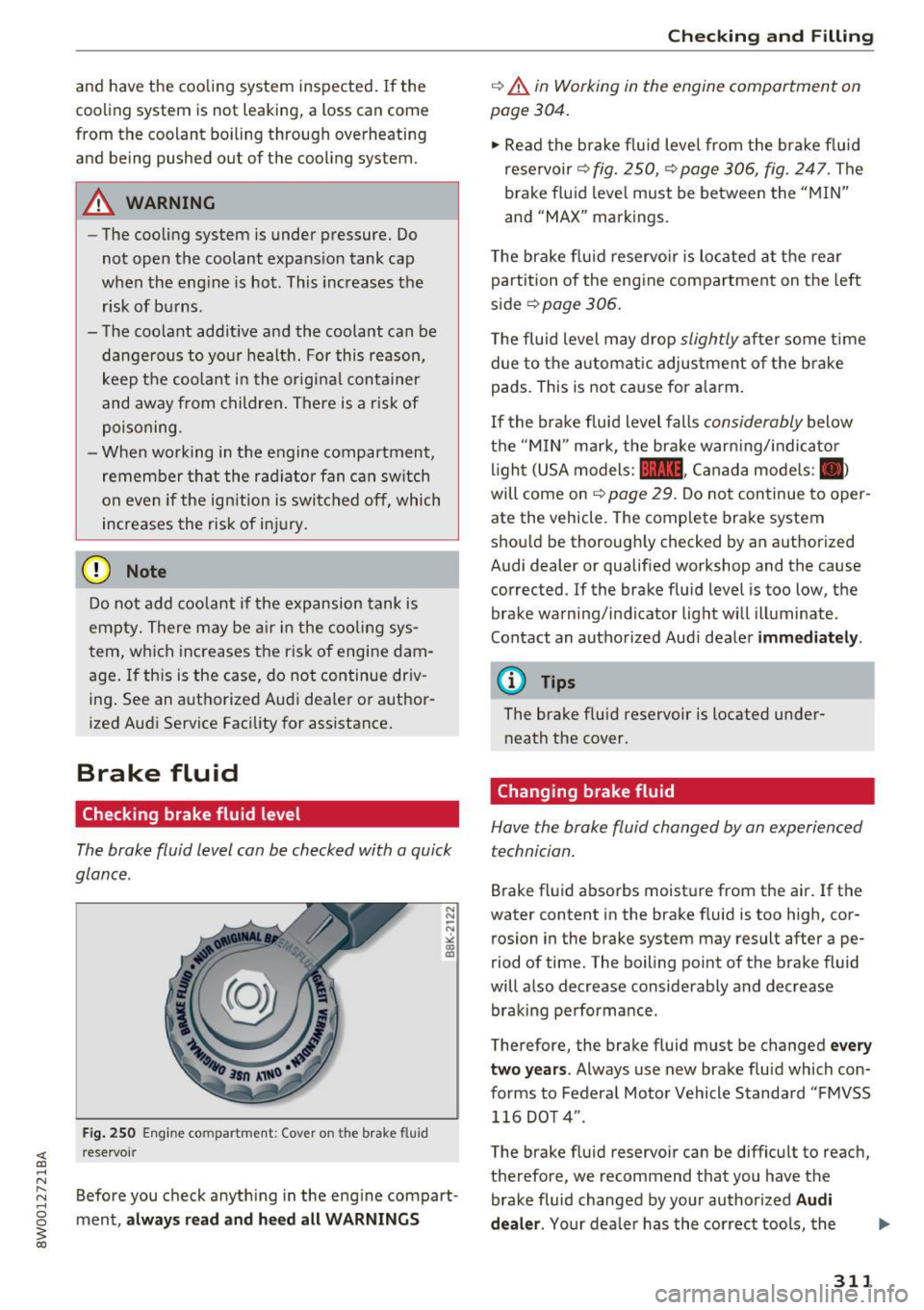
Fig. 250 Engine compa rtment: Cover o n the brake fluid
rese rvoir
Before you check anything in the eng ine compart
ment,
always read and heed all WARNINGS
Checking and Filling
c::> .&. in Working in the engine compartment on
page 304.
" Read the brake fluid level from the brake fluid
reservoir
c::> fig. 250, c::> page 306, fig. 247. The
brake fluid level must be between the "MIN"
and "MAX" markings.
The brake flu id reservoir is located at the rear
partition of the engine compartment on the left
side
~ page 306 .
The fluid level may drop slightly after some time
due to the automatic adjustment of the brake
pads . This is not cause for alarm.
If the brake fluid level falls considerably below
the "MIN" mark, the brake warning/indicato r
light (USA models:
11111 , Canada models : II>
will come on c::> page 29. Do not continue to oper
ate the vehicle. The complete brake system
should be thoroughly checked by an authorized
Audi dealer or qualified workshop and the cause
corrected . If the brake fluid level is too low, the
brake warning/indicator light will illuminate .
Contact an authorized Audi dealer
immediately .
@ Tips
The brake fluid reservoir is located under
neath the cover.
Changing brake fluid
Hove the broke fluid changed by on experienced
technician.
Brake fluid absorbs moisture from the air. If the
water content in the brake fluid is too high, cor
rosion in the brake system may result after ape
riod of time. The boiling point of the brake fluid
will also decrease considerably and decrease braking performance .
Therefore, the brake fluid must be changed
every
two years .
Always use new brake fluid which con
forms to Federal Motor Vehicle Standard "FMVSS
116 DOT 4" .
The brake fluid reservoir can be difficult to reach,
therefore, we recommend that you have the brake fluid changed by your authorized
Audi
dealer.
Your dealer has the correct tools, the
311
Page 314 of 386

Check ing and F illing
right brake fluid and the know -how to do this for
you.
A WARNING
- Brake fluid is poisonous. It must be stored
only in the closed orig inal container out of
the reach of chi ldren!
- B rake failure can resu lt from old or inappro
pr iate brake flu id. Observe these precau
t ions:
- Use on ly brake fluid that mee ts SA E speci
fi cation) 17 0 3 and confo rms to Fede ral
Motor Ve hicle Standard 116. Always check
wit h your authorized Audi dealer to make
sure you are using the correct brake fluid.
The cor rect type o f brake fluid is a lso indi
cated on the brake fluid reservoir.
- The brake fluid must be new. Heavy use of
the brakes can cause a vapor lock if the
brake flu id is left in the system too long.
This ca n ser iously affect t he efficiency of
the bra kes as well as your safety. This
could result in an acc ident.
{U) Note
Brake fluid w ill damage the pa int of yo ur vehi
cle.
@ For the sake of the environment
Because of the prob lem of proper disposal of
brake flu id as we ll as the special tools re
quired and the necessary expertise, we rec
ommend tha t you have the brake fluid
changed by your author ized Audi d ealer.
Battery
General information
Unde r normal operating conditions, the battery
i n your Audi does not need any maintenance.
W ith
high outs ide temperat ures o r long da ily
d rives we recommend that you have the electro
lyte leve l checked by an a uth orized Audi dea le r or
qua lified wor kshop. The e lectroly te leve l should
a lso be checked each time the batte ry is ch a rged
¢ page 314.
312
Have t he battery chec ke d when yo u take yo ur ve
hicle in for service . You are we ll advised to re
place a battery that is o lder than 5 yea rs .
With ce rta in types o f airbag deployment, t he
b atte ry is disconnected from the veh icle elect ri
ca l system for safety reasons ¢.&
in Repair, care
and disposal of the airbags on page 268.
Disconnecting the battery terminals
Some ve hicl e fu nctions (power window regula
tors, for examp le) are lost if the batte ry te rm i
nals a re disconnected . These f unc tions have to be
relearned after the battery term inals are con
nected again . To p revent this, the battery should
o nl y be disconnected from the vehicle electrical
system when absolute ly necessary for repairs.
Vehicles not driven for long periods
If you do not d rive yo ur vehicle ove r a period of
severa l days o r weeks, electr ica l components are
grad ua lly cut back or switched of f. T his reduces
energy consumpt ion and maintains start ing ca
pability over a longer period ¢
page 138.
Some of the convenience functions may not oper
ate, such as the inter ior lights or the power seat
adjustment . The convenience functions will be
available again w hen you turn on the ignit io n and
start the eng ine .
Winter operation
Dur ing the winte r months, battery capacity tends
to decrease as tempe ratures drop. This is be
ca use more power is also consumed while start
i ng, and t he headlights, rear w indow defogger,
etc ., are used more often.
Avo id unnecessary powe r consumption, partic u
l a rly in city traffic or when traveling o nly short
distances . Let your author ized Audi dealer check
the capacity of the vehicle battery before win ter
sets in ¢
page 314 . A well charged battery will
n ot only p reve nt sta rting prob lems when the
we ather is co ld , but will also last longer.
@ Tips
I f yo ur vehicle is left sta nding for several
weeks at extreme ly low te mpera tures, th e ve-
h icl e b att ery should be re mo ved and store d
II>-
Page 321 of 386
® Mud and snow capability
"M/5" or "M+S" indicates the tire
is suitable for driving on mud and
snow. £ indicates a winter tire.
@ Composition of the tire cord
and materials
The number of plies indicates the
number of rubberized fabric lay
ers in the tire . In general: the
more layers, the more weight a
tire can carry. Tire manufacturers must also specify the materials
used in the ti re . These inc lude
stee l, nylon, polyester and other
materials.
@ Maximum permitted load
This number indicates the maxi
mum load in kilograms and
pounds that the tire can carry.
@ Un iform tire quality grade
standards for treadwear,
traction and temperature resistance
Treadwear, traction and tempera
ture ranges
¢page 333.
@ Running direction
T he arrows indicate the running
direction of unidirectional tires.
You must always follow the speci
fied running direction
¢page 348.
Wheels
~ Maximum permitted tire
pressure
T his number indicates the maxi
mum pressure to which a tire can
be inflated under normal operat
ing conditions .
Glossary of tire and loading
terminology
Accessory weight
means the combined weight (in
excess of those standard items
which may be replaced) of auto matic t ransmission, power steer
ing, power brakes, power win
dows , powe r seats, radio, and
heater, to the extent tha t these
items are avai lab le as factory- in
stalled equipment (whether in
s t alled or not).
Aspect ratio
means the ratio of the height to
the w idth of the tire in percent.
Numbers of 55 or lower indicate a
low sidewall for improved steer
ing response and better overall
handling on dry pavement .
Bead
means the part of the tire that is
made of steel wires, wrapped or
reinfo rced by ply cords and that is
shaped to fit the rim. ...
319
Page 323 of 386
Maximum (permissible )
inflat ion pressure
means the maximum cold infla
tion pressure to wh ich a t ire may
be inflated . Also called "maxi
mum inflation pressure ."
Normal occupant weight
means 150 lbs . (68 kilograms)
times the numbe r of occupants
seated in the veh icle up to the to
tal seating capacity of your vehi
c le .
Occupant distribution
means distribution of occupants
in a vehicle .
Outer diameter
means the overall diameter of an
inflated new tire .
Overall width
means the linear dis ta n ce be
tween the exteriors of the side
walls of an inflated tire, inc luding
e levations due to labeling, deco
rations, or protect ive bands or
ribs.
Ply
means a layer of rubber-coated
parallel cords .
Wheels
Production options weight
means the combined weight of
those installed regular production
options weighing over 5 lbs. (2.3 kg) in excess of those standard
items which they replace, not pre
viously considered in curb weight
or accessory weight, including heavy duty brakes, ride levelers,
roof rack , heavy d uty ba tte ry , and
special trim .
Radial ply tire
means a pneumatic tire in which
the ply cords that extend to the
beads are laid at substantia lly 90
degrees to the centerline of the
tread .
Recommended inflation
pressure
see ¢ page 320, Cold tire infla
tion pressure .
Reinforced tire
means a tire designed to operate
at higher loads and at higher in
fl at ion pressures than the corre
sponding standard tire. Rein
forced tires may be identified as
"X L", "x l", "EXTRA LOA D", or "RF"
on the s idewa ll. ..,
321
Page 327 of 386
&_ WARNING . -
-Only use tire/rim combina-tions and suitable wheel bolts
that have been approved by
Audi. Otherwise, damage to
the vehicle and an accident
could result.
-For technical reasons, it is not possible to use tires from oth
er vehicles - in some cases,
you cannot even use tires from
the same vehicle model.
-Make sure that the tires you select have enough clearance
to the vehicle. Replacement
tires should not be chosen simply based on the nominal
size, because tires with a dif
ferent construction can differ
greatly even if they are the
same size. If there is not
enough clearance, the tires or
the vehicle can be damaged
and this can reduce driving
safety and increase the risk of
an accident.
-Only use tires that are more than six years old when abso
lutely necessary and drive
carefully when doing so.
-If you install wheel covers on
the vehicle, make sure they al low enough air circulation to
Wheels
cool the brake system. If they
do not, this could increase the
risk of an accident.
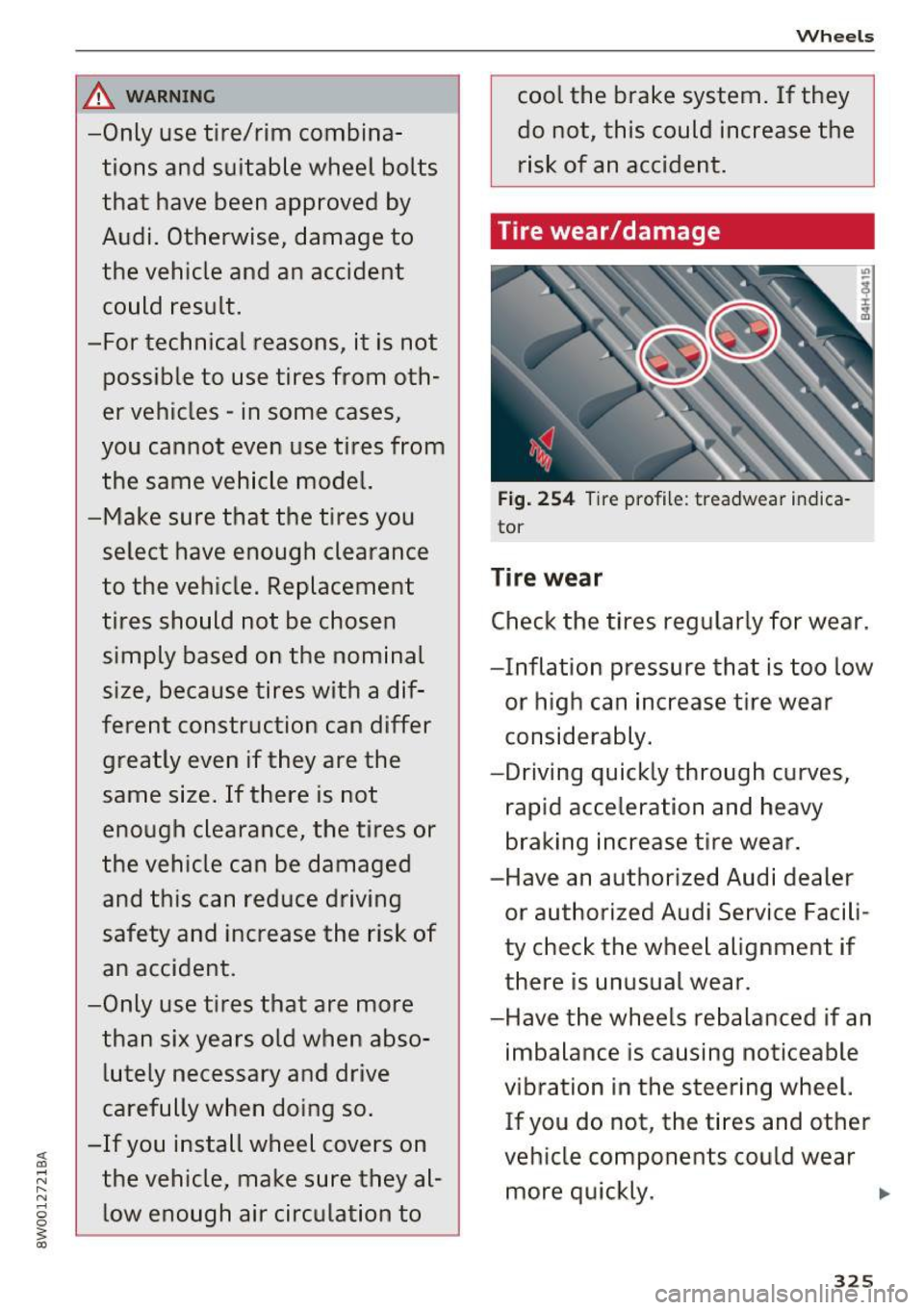
Tire wear/damage
Fig. 254 Tire profile: treadwear indica
tor
Tire wear
Check the tires regularly for wear.
-Inflation pressure that is too low or high can increase tire wear
considerably.
-Driving quickly through curves,
rapid acceleration and heavy
braking increase tire wear.
-Have an authorized Audi dealer or authorized Audi Service Facili
ty check the wheel alignment if
there is unusual wear.
-Have the wheels rebalanced if an imbalance is causing noticeable
vibration in the steering wheel.
If you do not, the tires and other
vehicle components could wear more quickly. .,..
325
Page 332 of 386
Wheels
plus maximum load . The maxi
mum load includes the number of
passengers that the vehicle is in
tended to carry ("seat ing capaci
ty") with an assumed weight of
150 lbs (68 kg) for each passen
ger at a designated seating posi
tion and the total weight of any luggage in the vehicle. If you tow
a trailer , the weight of the trailer
hitch and the tongue weight of
the loaded trailer must be includ
ed as part of the vehicle load .
The
Gross Axle Weight Rating
(" GAWR") is the maximum load
that can be applied at each of the
vehicle 's two axles.
The fact that there is an upper limit to your vehicle's Gross Vehi
cle Weight Rating means that the
total weight of whatever is being
carried in the vehicle (including
the weight of a trailer hitch and
the tongue weight of the loaded
trailer) is limited . The more pas
sengers in the vehicle or passen
gers who are heavier than the
standard weights assumed mean
that less weight can be carried as
luggage.
The Gross Vehicle Weight Rating and the Gross Axle Weight Rating
330
are listed on the safety compli
ance sticker label located on the
driver's side B-pillar
~ page 327,
fig . 255 .
& WARNING ~ -
Overloading a vehicle can cause
loss of vehicle control, a crash
or other accident, serious per
sonal injury, and even death.
-Carrying more weight than your vehicle was designed to
carry will prevent the vehicle
from handling properly and increase the risk of the loss of
vehicle control.
-The brakes on a vehicle that
has been overloaded may not
be able to stop the vehicle
within a safe distance .
-Tires on a vehicle that has been overloaded can fail sud
denly, including a blowout and
sudden deflation, causing loss
of control and a crash .
-Always make sure that the to tal load being transported -
including the weight of a trail
er hitch and the tongue
weight of a loaded trailer - does not make the vehicle
heavier than the vehicle 's
Gross Vehicle Weight Rating.
Page 340 of 386
Care and cleaning
& WARNING
-Only wash the vehicle when the ignition is
off or follow the instruct ions from the car
wash operator to reduce the risk of acci dents.
- To reduce the risk of cuts, protect yourself from sha rp metal components when wash
ing the underbody or the inside of t he wheel
hous ings.
- After was hing the vehicle, the braking effect
may be delayed due to mo isture on the
bra ke rotors o r ice i n the winte r. This in
c reases the risk of an a cciden t. The bra kes
must be dried first with a few care ful brake
applications .
@ Note
-If you wash the ve hicle in an automa tic car
wash, yo u must fold the exterior m irrors in
to reduce the risk of damage to the mirrors.
Power folding exterior mirrors * must on ly
be fo lded in and out us ing the power folding
funct ion.
- To reduce the risk of damage to the rims
and tires, compare the width between the
whee ls on your vehicle w ith the distance be
tween t he gu ide rai ls in the car wash. -
To red uce the risk of damage, compare the
heig ht and width of your vehicle with the
heig ht and w idth of the inside of the car
wash.
- To prevent paint damage, do not wash the
vehicle in direct sunlight.
- To reduce the risk of damage to the surface,
do not use insect removing sponges, k itchen
sponges or s imilar items.
- Matte finish painted vehicle components:
- To reduce the r isk of damage to the sur-
face, do not use polishing agents or hard
wax.
- Never use protective wax. It can destroy
the matte finish effect.
- Do not place any stickers or magnetic signs on vehicle parts pain ted with matte
finish paint. The paint could be damaged
when the stickers or magne ts are re
moved.
@ For the sake of the environment
Only wash the veh icle in facilities spe cially de
signed for that pu rpose. This will reduce the
r isk of dirty wate r contamina ted with o il from
entering the sewer system .
Cleaning and care information
When cleaning and caring for individual vehicle
components, refer to the fo llowing tables. The
information conta ined there is s imply recom
mendations . For quest io ns or for components that are not
listed, consult an authorized Aud i
dealer or authorized Audi Service Facility . Also
follow the information found in c> & .
Exter io r cleaning
Component Situation Solution
Wind shi eld wip er
Deposits c> page 5 7, Cleaning windshield wiper blades
blades
Headlights /
Deposits Soft sponge with a mild soap solutiona>
Tail light s
S ensor s/
Deposi ts Sensors: soft cloth w ith solven t-free cleaning sol ution
Camera lenses Camera lenses: soft cloth with alcohol -free cleaning so lu-
tion
Snow/ice Hand brush/solvent-free de-icing spray
338
Page 341 of 386
<( a, .... N ,....
N .... 0 0
3 a,
Care and cleaning
Component Situation Solution
Wheels
Road salt Water
Brake dust Acid-free special clea ning solution
Exhaust tail pipes Road salt Water, cleaning solution su itab le for stainless steel, if nee-
essary
Paint Paint damage Refer to the paint number on the vehicle data label, repair
with touch up paint
qpage 361
Spilled fuel Rinse with water immediately
Surface rust Rust remover, then protect with hard wax; for questions,
consult an authorized Audi dealer or authorized Audi Serv- ice Facility.
Cor rosion Have it removed by an autho rized Aud i dealer or author-
iz ed A udi Service Fac ility.
Water no longer Protect with hard wax (at least twice per year)
beads on the surface
of clean paint
No shine even thoug h Treat with suitable polish; then apply paint protectant if
paint has been pro- the polish that was used does not contain any protectant
tected/paint looks poor
Deposits such as in-
Dampen with wate r immedia tely and remove wit h a m icro-
sects, bi rd droppings, fiber cloth
tree sap and road salt
Grease-based con- Remove immediately with a mild soap solution
a) and a
taminants such as soft cloth
cosmetics or sunblock
Carbon parts Deposits Interior: clean the same way as plastic parts
Exterior: clean the same way as pa inted parts
Decorative decals Deposits Soft
sponge with a m ild soap solutional
a) Mild soap solut ion: max imum two tab lespoons of ne utral soap in 1 quart (1 lite r) of wate r
Interior cleaning
Component Situation Solution
Window glass
Deposits Glass cleaner, then wipe dry
Decorative parts/ Deposits Mi
ld soap solutiona>
Trims
Plastic parts
Deposits Damp cloth
H eavier deposits Mild
soap solution a>, detergent-free p lastic cleaning solu-
tion, if necessary
Displays /instru-Deposits Soft cloth with LCD cleaner
ment cluster
Controls
Deposits Soft
brush, then a soft cloth with a mild soap solutiona>
Safety belts Deposits Mild soap solutiona>, allow to dry before letting them re-
tract
339
Page 345 of 386

Emergency assistance
Trunk escape latch
In case of an emergency, the rear lid can be
opened from the inside using the trunk escape
latch.
Fig. 257 Luggage compartment: Trunk escape latc h
• Push the latch in the direction of the arrow un
t il the lock releases.
The trunk escape latch ins ide the rear lid is made
of fluorescent material to glow in the dark.
_& WARNING
The trunk escape latch is to be used only in an
emergency .
@ Tips
The emergency release lever should never be
used as a handle fo r closing the luggage com
par tment l id.
General information
• Park the vehicle as far as poss ible from moving
t raff ic in the event of a breakdown . In the event
of a flat tire , park the vehicle on a leve l surface .
It you are on a steep hill, be especially careful.
• Set the parking brake.
• Switch the emergency flashers on.
• Have the passengers exit the vehicle. They
should move to a safe place, for example be
hind a guard rail.
Emergen cy a ssis tanc e
_& WARNING
-Follow the steps given above. Th is is for your
protection and the for the safety of other driv
ers .
Equipment
Vehicle tool kit/vehicle jack
Applies to: vehicles wit h the vehicle tool kit and vehicle jack
Fig. 258 Lu ggage compa rt ment: vehicle tool kit, vehicle
jack*, tir e m ob ility kit and compressor
The vehicle tool kit, vehicle jack, tire mobility k it
and compressor are stored in the luggage com
partment under the cargo floor cover.
• Lift the cargo floor using the p lastic handle and
hook the handle onto the luggage compart
ment seal
c:> fig . 258.
• Vehicles with spare tire: turn the handle coun
ter -clockwise and remove the spare tire .
"' Unhook the cargo floor before closing the rear
lid .
Depending on vehicle equipment, the vehicle tool
k it, tire mobility kit and compressor may be lo
cated under another cover that is secured w ith a
handwheel.
(D Tips
The vehicle jack in your vehicle is mainte
nance-free.
Tire mobility kit
Preparation
"' Read and follow the important safety precau
tions
c:> page 343.
• Set the parking brake. ll>-
34 3
Page 347 of 386
<( a, .... N ,....
N .... 0 0
3 a,
• Remove the connector@) and pressure hose ®
with the pressure gauge from the housing.
• Install the compressor pressure hose ® on the
flange @ on the tire sealant bottle@.
• Insert the sealant bottle with the flange at the
bottom into the opening @ on the compressor
cover .
• Remove the valve cap from the fau lty t ire .
• Install the fi ller hose @on the valve(!)
r::!vfig. 261.
• Connect the plug@¢ fig. 260 to a socket in
the vehicle .
• Switch on the ignition.
Inflating a tire
• Move the sw itch @ r::?v fig. 261 on the comp res
sor into posit ion
I.
• Inflate the tire to between 29 psi (200 kPA)
and 36 psi (2SO kPA) and read the pressure on
the gauge.
• If this tire pressure is not reached, remove the
filler hose. Drive slowly approximately 33 feet (10m) forward or in reverse so that the sea lant
can be d istributed in the tire . Pump up the t ire
again
~ A .
A WARNING
-Read and follow the manufacture r's safety
precautions on the compresso r and in the
ins tructions on the bottle of sealant.
- If a tire press ure of 29 ps i (200 kPA) cannot
be reached afte r inflating for six m in utes,
then the tire is too severe ly damaged . Do
not continue driving.
- If the t ire cannot be repaired with the tire
sealant, see an authorized A udi dealer or au
thorized Audi Serv ice Facility for assistance .
@ Tips
Do not operate the compressor for mo re than
six m inutes continuously, or i t can overheat .
Once the compressor has coo led, you can con
tinue using it .
Emergenc y ass is tanc e
Completing AdBlue refill
• Ad here the sticker that says "max. SO mph
(max . 8 0 km/h) " that is provided wi th t he tire
mob ility kit w it hi n the driver's field of vision.
• Stop the vehicle a fter driving for abou t 10 mi
nutes and check the tire pressure.
• If the tire pressure is lower than 19 psi (130
kPA), then the tire is too severely damaged. Do not continue dr iving.
A WARNING
Pay attention to the following afte r repa iring
the tire:
- Do not dr ive faste r than SO mph (80 km/h) .
- Avoid hard acce leration, braking sharply,
and fast cornering .
- The vehicle may become more difficult to
control.
- If the tire is too severe ly damaged, see an
authorized Audi dealer or authorized Audi
Serv ice Facility for assistance.
(® For the sake of the environment
You can give the used tire sealant bottle to an
a uthorized Audi dea ler or authorized Audi
Service Fac ility for disposal.
(D Tips
Remember to obtain a new bott le of sealant
from an authorized A udi dealer or authorized
A udi Service Fac ility after repairing a tire.
Replacing wheels
Preparation
You must complete the preparation before
changing a tire.
• Read and follow the important safety precau-
tions
~ page 343 .
• Set the par king brake.
• Sele ct the P selec to r lever posit ion.
• W hen tow ing a tr ailer: d isconne ct the trailer
from your vehicle .
• Lay out the vehicle too l kit ~
page 343 and the
spare tire
¢ pag e 349 . .,,.
345