seat adjust AUDI S4 2018 Owner's Manual
[x] Cancel search | Manufacturer: AUDI, Model Year: 2018, Model line: S4, Model: AUDI S4 2018Pages: 403, PDF Size: 66.81 MB
Page 270 of 403
a co .... N ..... N .... 0 0
3 co
The shoulder belt should lie as close to the center
of the collar bone as possib le and should fit w ell
on the bod y ¢
A in Saf ety belt position on
page 267 .
.. Push the loop- around fittings up ¢ fig . 237 @,
or
.. sque ez e to gether the @ button, and push the
loop-around fit tings
do wn@ .
.. Pull the belt to make sure that the upper at
tachment is p roperly engaged .
A WARNING
Always read and heed all WARNINGS and oth
er important
i nformat ion ¢ page 265.
With the front seats, the height adjustment
of the seat can also be used to adjust the po
sition of the safety belts .
Improperly worn safety belts
Incorrectly positioned safety belts can cause se
vere injuries .
Wearing safety belts improperly can cause seri
ous injury or death . Safety belts can only work
when they are correctly pos itioned on the body .
Improper seating positions reduce the effect ive
n ess of safety be lts and will even inc rease the
ris k of injury and death by mov ing the safety bel t
to cr it ica l areas of the body. Imp roper seating
positions also increase the risk of serious inj ury
and death when an airbag deploys and strikes an
occ upant who is not in the co rrect s eat ing posi
tion . A driver is respons ible for the safety of all
vehicle occupants and espec ia lly for children .
T herefore:
.. Nev er permit anyone to ass ume an incorr ect
s itting position in the veh icle wh ile traveling
¢ &, .
A WARNING
Improperly worn safety belts i ncrease the risk
of serious personal injury and death wheneve r
a vehicle is be ing used.
S afet y be lts
- Always make sure that all veh icle occupants
are correctly restrained and stay in a correct
seating position whenever the vehicle is be ing used .
- Always read and heed all WARNINGS and
other important
i nformat ion¢ page 265.
Belt tensioners
How safety belt pretensioners work
Reversible safety belt pr etensioners
T he following fu nctions a re availab le w hen safety
bel ts w it h reversib le safety bel t tensione rs a re
f astened:
- In ce rtain driving situations , the safety belts
may tighten w it h a reversib le tensioning func
tion ¢ page 120.
-The safety be lts may also tighten with this re-
versible tens ion ing f un ct ion in m ino r colli sions.
Pyrotechnic safety belt pretens ioners
Seat belts with pyrotechnic safety belt preten
sioners are tensioned automatically i n severe col·
lisions , depending on the circumstances . This
helps to reduce the fo rwa rd motion of the o ccu
pants.
A WARNING
r-----
- I t is poss ible for the pretensioners to dep loy
incorrectly .
- Any wo rk on the tens ioner system o r remov
al and installation of system components
for other repairs m ust be performed by a
qualified wor kshop.
- The pyrote chnic system can only provide
protection for one collision. If the py rotech
n ic pretens ioners deploy, the pretensioning
system must be replaced .
(D Tips
- A fine dust is re leased when the pyrotechnic
safety belt pretensioners dep loy. This is no r
ma l and is not caused by a f ire in the veh i-
cle.
..,
269
Page 272 of 403
a co .... N ,....
N .... 0 0
3 co
Airbag system
Important information
Importance of wearing safety belts and
sitting properly
Airbags are only supplemental restraints. For
airbags to do their job, occupants must always
properly wear their safety belts and be in a prop er seating position.
For your safety and the safety of your passen
gers, before driving off, always :
.,. Adjust the driver's seat and steering wheel
properly
9 page 255,
.,. Adjust the front passenger's seat properly
¢page 256,
.,. Wear safety belts properly¢ page 265,
.,. Always properly use the proper child restraint
to protect children ¢
page 295.
In a collision, airbags must inflate within the
blink of an eye and with considerable force. The
supplemental airbags can cause injuries if the
driver or the front seat passenger is not seated
properly. Therefore in order to help the airbag to
do its job, it is important, both as a driver and as
a passenger to sit properly at all times.
By keeping room between your body and the
steering wheel and the front of the passenger
compartment, the airbag can inflate fully and
completely and provide supplemental protection in certain frontal
collisions ¢ page 255, Correct
passenger seating positions .
For details on the
operation of the seat adjustment controls
¢page 65.
It's especially important that children are proper
ly restrained
¢page 295.
There is a lot that the driver and the passengers
can and must do to help the individual safety fea
tures installed in your Audi work together as a
system.
Proper seating position is important so that the
front airbag on the driver side can do its job. If
you have a physical impairment or condition that prevents you from sitting properly on the driver
seat with the safety belt properly fastened and
Airbag system
reaching the pedals, or if you have concerns with
regard to the function or operation of the Ad
vanced Airbag System, please contact your au
thori zed Audi dealer or qualified workshop, or
call Audi Customer Relations at 1-800-822-2834
for possible modifications to your vehicle.
When the airbag system deploys, a gas generator
will fill the airbags, break open the padded cov ers, and inflate between the steering wheel and
the driver and between the instrument panel and
the front passenger. The airbags will deflate im
mediately after deployment so that the front oc
cupants can see through the windshield again
without interruption.
All of this takes place in the blink of an eye, so
fast that many people don't even realize that the airbags have deployed. The airbags also inflate
with a great deal of force and nothing should be
in their way when they deploy. Front airbags in
combination with properly worn safety belts slow
down and limit the occupant's forward move
ment . Together they help to prevent the driver
and front seat passenger from hitting parts of
the inside of the vehicle while reducing the forces
acting on the occupant during the crash . In this
way they help to reduce the risk of injury to the
head and upper body in the crash. Airbags do not
protect the arms or the lower parts of the body.
Both front airbags will not inflate in all frontal
collisions . The triggering of the airbag system de
pends on the vehicle deceleration rate caused by
the collision and registered by the electronic con
trol unit . If this rate is below the reference value
programmed into the control unit, the airbags
will not be triggered, even though the car may be badly damaged as a result of the collision. Vehi
cle damage, repair costs or even the lack of vehi
cle damage is not necessarily an indication of
whether an airbag should inflate or not.
Since the circumstances will vary considerably between one collision and another, it is not possi
ble to define a range of vehicle speeds that will
cover every possible kind and angle of impact
that will always trigger the airbags . Important
factors include, for example, the nature (hard or
soft) of the object which the car hits, the angle of
impact, vehicle speed , etc. The front airbags will
II>
271
Page 281 of 403
Airbag syste m
The additio na l l ayers prevent the capacitive
passenger detection system from accurately
measuring the capac itance of the ch ild safe
ty seat and/or the person on the seat and
thus keep the Advanced Airbag System from
working p roperly.
- Never place or use any electrical device (such as a laptop, CD player, elect ronic
games dev ice, power inverte r or seat heater
for child seats) on the front passenger seat
if the device is connected to the 12-vol t
socket or the cigarette lighter socket . S uch
devices can infl uence the capacitance regis
tered by the capacitive passenger detection
system, so that incorrect information is pro
vided to the airbag control unit.
- If you must use a c hild restraint on the front
passenger seat and the child restraint man
ufacturer's instructions require the use of a
towel, foam cushion or something else to prope rly position the ch ild restraint, make
certain that the
PASSENGER AIR BAG OFF
~; light comes on and stays on whenever
the chi ld restraint is installed on the front
passenge r seat .
-If the PASSENGER AIR BAG OFF ~; light
does not come on and s tay on , immediate ly
ins tall child restra int in a rea r seating posi
tion and have the airbag system inspected
by you r A udi dealer.
_& WARNING
If the front passenger seat gets wet, dry it im
mediately.
- If liquid soaks into the front passenger seat,
this can keep the a irbag system from work
ing prope rly and may, for instance, deact i
vate the passenger frontal airbag. If this happens, the
PASSENGER AIR BAG OFF ~;
light will come on and stay on togethe r with
the a irbag ind icator
light E,I in the inst ru
men t cluster.
- If liquid is poo led on the seat, bu t has not
soa ked i n, this may also keep the airbag sys
tem from wo rking properly and ca use the
passenge r frontal a irbag to be enabled
(tu rned on), even though there is a properly
280
installed child rest raint system on the seat .
Wet towels or other wet things on the seat
cushion can have the same effect.
If the
front passenger fronta l airbag is turned on,
t he
PASSENGER AIR BAG OFF ~; light light
w ill go out.
How the Advanced Airbag System
components work together
The front Advanced A irbag System and the side
airbags supp lement the p rotection offered by the
front three-point safety be lts and the adjustable
head restraints to he lp reduce the risk of injury in
a wide range of accident and crash situat ions. Be
sure to read the important i nformat ion about
safety and heed the WARNINGS in this chapter .
Deployment of the Advanced A irbag System and
the activation of the safety belt pretensioners de pend on the dece leration measured by the crash
sensors and registered by the elec tronic contro l
u nit . Crash severity depends on speed and decel
e ration as well as the mass and stiffness of the
vehicle or object invo lved in the cras h.
On the passenger side, regard less of safety be lt
u se, the front passenge r frontal airbag will be
turned off if t he e lectr ica l capaci tance m easured
by the capaci tive p assenge r detection system o n
t h e fron t passenger sea t is less th an the amou nt
programmed in t he e lec tronic cont ro l unit. The
front passenger frontal airbag wi ll also be turned
off if the capacitance measured by the system for
the front passenger seat equals that of an infant
of about one year of age in one of the child seats
that was used to certify the Advanced Airbag Sys
tem under Federal Motor Vehicle Safety Standard 208. The
PASSENGER AIR BAG OFF ~; light
comes on and stays on to tell you whe n the front
Advanced Airbag System on the passenge r side
has been tu rned
off~ page 283.
_& WARNING
T o reduce the ris k of injury when an airbag in
f lates, always wea r safety belts prope rly.
- If you are un res trained, leaning forward, sit
ting sideways or out of position in any way,
your r isk of injury is much higher.
Page 286 of 403
a co .... N ,....
N .... 0 0
3 co
seat positions. Have the airbag system inspect
ed by your Audi dealer immediately .
- move the chi ld to a rear seat position and make
sure that the child is properly restrained in a
child restraint that is appropriate for its size
and age.
Th e PASSENGER AIR BAG OFF ~ ; light
s h ould NOT com e on ...
The PASS ENGER AI R BAG OFF ~ ; light should
NO T come on when the ignition is on and an
adult is sitting in a proper seating position on the
front passenger seat . If the
PASS ENGER AIR
BAG
O FF ~; light comes on and stays on while
driving, under these circumstances, make sure
that :
- the adult on the front passenger seat is proper
ly seated on the center of the seat cushion with
his or he r back up aga inst the backrest and the
back rest is not reclined,
- the adult is not tak ing weight off the seat by
ho lding on to the passenger assist handle
above t he front passenger door or supporting
their we ight on the a.rm rest ,
-the safety belt is be ing properly worn and that
there is not a lot of slack in the safety belt web
bing,
- there are no aftermarket seat covers or cush
ions or other things (such as blankets) on the
front passenger seat that migh t ca use the ca
pacitive passenger detection system to miscal
cu late electrical capacitance .
Important safety instructions on
monitoring the Advanced Airbag System
A WARNING
- If the status of the Adv a need A irbag System
has changed while the vehicle is moving, the
PASSENGER AIR BAG OFF ,;; ON @ light
blinks for about 5 seconds to catch the driv
er's attention .
If this happens, always stop
as soon as it is safe to do so and check the
steps described above .
- If the
PASSENGER AIR BAG OFF ,;; light
does not go off when an adult who is not
very small is s itting on the front passenger
-
Airb ag sys tem
seat after taking the steps described above,
make sure the adu lt is properly seated and
restrained at one of the rear seating posi
tions . Have the a irbag system inspected by
your author ized Audi dealer before trans
port ing anyone on the front passenger seat.
A WARNING
f-
An a irbag system that is not functioning prop-
e rly cannot prov ide supplemental protect io n
i n a front al crash.
- I f the ai rbag ind icator light
~page 32
comes when the veh icle is being used, have
the system inspected immedia tely by your
authorized Audi dealer . It is possib le that
the airbag will inflate when it is not sup
posed to, or will not inflate when it should.
A WARNING
If the front airbag inflates, a ch ild without a
chi ld restraint, or in a rearward-facing child
safety seat, or in a forward-fac ing child re
stra int that has not been properly insta lled
will be seriously injured and can be killed.
- Even though your vehicle is equipped with
an Advanced A irbag System, make certain
that all children , espec ially 12 years and
younge r, always ride on the back seat p rop
erly rest rained for the ir age and s ize .
- Always install fo rwa rd or rear-facing child
safety seats on the rear seat - even with an
Advan ced Airbag System.
- I f you must install a rea rwa rd-facing child
safety seat on the front passenger seat be
cause of excep tional circums tances and the
PASSENGER AIR BAG OFF ,;, light does not
appear and stay on, immediate ly install the
rear-facing chi ld safety seat in a rear seat ing
position and have the a irbag system in
spected by your authori zed Aud i dea ler.
- If, in exceptional circumstances, you must
install a forward-facing child restraint on
the front passenger seat, always move the seat into its rearmost position in the seat's
fore and aft ad justment range, as far away
from the a irbag as poss ible . The back rest
m ust be adjusted to an upr ight position .
285
Page 287 of 403
Airbag syste m
Make sure that the PASSENGER AIR BAG
OFF
11;; li ght comes on and stays on all t he
t ime whenever the ignition is switched on.
A WARNING
- If the PA SSEN GER AIR BAG OFF 11;; light
does not go ou t when an adult is sitting on
the front passe nger seat a fte r ta king the
steps described above, make sure the adult is p roperly seated and restrained at one of
the rear seating positions.
- Have the airbag system inspected by your
authorized Aud i dealer before transporting
anyone on the front passenger seat.
@ Tips
If the capacitive passenger detection system
determines that the front passenger seat is
empty, the frontal airbag on the passenge r
side w ill be tu rned off, and the
PASSENGER
AIR BAG OFF
11;; light will stay on.
-
Repair , care and disposal of the airbags
Parts of the a irbag system are installed at many
different places on your Audi. Installing, remov ing, servic ing or repa iring a part in an area of the
ve hicle can damage a part of an airbag system
and prevent that system from working properly
i n a collision .
There are some important things you have to
know to make sure that the effectiveness of the
system w ill not be impaired and that discarded
components do not cause injury or pollute the
env ironment.
A WARNING
Improper care, serv icing and repai r proce
dures can increase the r is k of personal injury
and death by preventing an airbag from de
ploying when needed or dep loying an airbag
unexpectedly:
-
- Never cover, obstruct, or change the steer
ing wheel horn pad or airbag cover or the in
strument pane l or modify them in any way.
286
- Never attach any objects s uch as c upholders
or telephone mountings to the surfaces cov
ering the a irbag un its.
- For cleaning the horn pad or instrument
panel, use only a soft, dry cloth or one mois
tened w ith plain water. Solvents or cleaners
could damage the airbag cover or change
the st iffness or strength of the material so
that the airbag cannot deploy and p rotect
properly.
- Never repair, adjust, or change any parts of
the airbag system.
- All work on the steering wheel, inst rument
panel, front seats or e lectr ica l system ( in
cluding the installation of a udio eq uipment,
cellular telephones and C B radio s, etc.)
m ust be perfo rmed by a qualified techn ician
who has the training and specia l equipment
necessary.
- For any work on the airbag system, we strong ly recommend that you see your au
thorized A udi dealer or qualified workshop.
- Never modify the front b umper or parts of
the vehicle body.
- Always make sure that the side a irbag can
inflate w ithout interference:
- Never install seat covers or replacement
u pholstery ove r the front seatbacks that
have not been specifically approved by
A udi.
- Never use additional seat cushions that
cover the areas where the side airbags in
flate.
- Damage to the orig inal seat cove rs or to
the seam in the area of the s ide airbag
module mus t always be repaired immedi
ate ly by an authori zed Au di dealer.
- The a irbag system can deploy on ly once. Af
ter an airbag h as been deployed, i t m ust be
repla ced with new replacement parts de
signed and approved espec ia lly for your
Audi model version . Replacement of com
plete airbag systems or airbag components
must be perfo rmed by qua lified workshops
only. Make sure that any airbag service ac
tion is entered in your A udi Warranty
&
Ma intenance boo klet under AIRBAG RE-
PLAC EM EN T RECORD.
~
Page 297 of 403
Child safet y
A WARNING
Children on the front seat of any car even with
Advanced Airbags can be seriously injured or even killed when an airbag inflates. A child in
a rearward-facing child safety seat installed
on the front passenger seat will be serious ly
injured and can be killed if the front a irbag in
flates .
- The inflating a irbag w ill hit the child safety
seat or infant carrier with great force and
will smash the chi ld safety seat and child
against the backrest, center armrest, o r
doo r.
- Always install rear-facing child safety seats
on the rear seat.
- If you must install a rearward fac ing ch ild
safety seat on the front passenger seat in
exceptional c ircumstances and the
PASSEN
GER AIR BAG
OFF ~; light does not come
on and stay on, immediately install the rear
facing child safety seat in a rear seating po sition and have the airbag system inspected
immediately by your Audi dealer.
A WARNING
- Forward-facing chi ld seats installed on the
front passenger seat may interfere with the deployment of the a irbag and cause serious
personal injury to the child .
- If except ional circumstances require the use
of a forward -facing child restraint on the
front passenger's seat , the child's safety
and well-being require the following special
precautions to be taken:
- Always make sure that the forward-facing
seat has been designed and certified by its manufacturer for use on a front passenger
seat with a front and s ide a irbag.
-Always carefully follow the manufacturer's instructions provided with the child seat
or infant carrier.
- Never install a child restraint without a
properly attached top tether strap if the
child restraint manufacturer 's instructions
require the top tether strap to be used.
296
- Never put the forward-fac ing child re
straint up against or very near the instru
ment panel.
- Always set the safety belt upper anchor
age to the adjustment position that per
mits proper installation in accordance
with the child restraint manufacturer's in
structions .
- Always move the front passenger seat to
the h ighest position in the up and down
adjustment range and move it back to the
r earmos t position in the seat's fore and
aft adj ustmen t range, as far away from
the airbag as possible, before installing
the forward-facing child restraint .
- Always make s ure that the safety belt up
per anchorage is behind the chi ld restraint
and not next to or in front of the child re
straint so that the safety belt wi ll be prop
erly pos itioned.
- Always make sure that nothing prevents
the front passenger's seat from being moved to the rearmost position in its fore
and aft adjustment range.
- Never place objects on the seat (such as a
laptop, CD player, electronic games de
v ice, power inverter or seat heater for
ch ild seats) . These may influence the elec
trical capacitance measured by the capaci
tive passenger detection system and can
also fly a round in an accident and cause
serious personal injury.
- Never place or use any elect rical device
(such as a laptop, CD p layer, electronic
games device, power inverter or seat heat
er for child seats) on the front passenger
seat if the device is connected to the 12-
vo lt socket or the cigarette lighter socket .
- If a seat heater has been retrofitted or
otherwise added to the front passenger
seat, never install any child restraint sys
tem on this seat.
- Make sure that there are no wet objects
(such as a wet towel) and no water or oth
er liquids on the front passenger seat
cush ion .
- Always make sure that the
PA SSEN GER
AIR BAG
OFF ~; light comes on and stays
Page 301 of 403
Child safety
-The child and the passenger can also in
jure each other in an accident.
- Never install rear-facing child safety seats
or infant carriers on the front passenger
seat. A child will be seriously injured and
can be killed when the passenger airbag in
flates -even with an Advanced Airbag Sys
tem.
- The inflating airbag will hit the child safety
seat or infant carrier with great force and
will smash the child safety seat and child against the backrest, center armrest, door
or roof.
- Always install rear-facing child safety seats
or infant carriers on the rear seat.
- Make sure there is enough space in front of
the child in the child seat. If necessary, ad
just the angle and position of the seat in
front of the child seat.
- Forward-facing child safety seats installed
on the front passenger's seat can interfere
with the airbag when it inflates and cause
serious injury to the child. Always install for
ward-facing child safety seats on the rear
seat.
- If exceptional circumstances require the use
of a forward-facing child restraint on the
front passenger's seat, the child's safety
and well-being require that the following
special precautions be taken:
- Make sure the forward-facing seat has
been designed and certified by its manu
facturer for use on a front seat with a pas
senger front and side airbag.
- Always carefully follow the manufacturer's
instructions provided with the child safety
seat or carrier.
- Always move the front passenger seat to the highest position in the up and down
adjustment range and move it back to the rearmost position in the seat's fore and
aft adjustment range, as far away from
the airbag as possible, before installing
the forward-facing child restraint.
- Always make sure that the safety belt up
per anchorage is behind the child restraint
and not next to or in front of the child
re-
300
straint so that the safety belt will be prop
erly positioned.
- Always make sure that nothing prevents
the front passenger's seat from being moved to the rearmost position in its fore
and aft adjustment range.
-Always make sure that the backrest is in
the upright position.
- Never place or use any electrical device
(such as a laptop, CD player, electronic
games device, power inverter or seat heat
er for child seats) on the front passenger seat if the device is connected to the 12-
volt socket or the cigarette lighter socket.
- If a seat heater has been retrofitted or
otherwise added to the front passenger
seat, never install any child restraint sys
tem on this seat.
- Make sure that there are no wet objects
(such as a wet towel) and no water or oth
er liquids on the front passenger seat
cushion.
- Never place objects on the seat (such as a
laptop, CD player, electronic games de
vice, power inverter or seat heater for
child seats). These may influence the elec
trical capacitance measured by the capaci
tive passenger detection system and can
also fly around in an accident and cause
serious personal injury.
- Always buckle the child safety seat firmly in
place even if a child is not sitting in it. A
loose child safety seat can fly around during
a sudden stop or in a collision .
- Always read and heed all WARNINGS when
ever using a child restrained in a vehicle is
being used<::;>
page 263, Safety belts,
r:::;,page 271, Airbag system and
r:::;, page 295, Child safety.
.8. WARNING
To reduce the risk of serious injury, make sure
that the
PASSENGER AIR BAG OFF 11,;; light
comes on and stays on whenever a child re
straint is installed on the front passenger seat
and the ignition is switched on.
.,_
Page 304 of 403
Convertible child safety seats
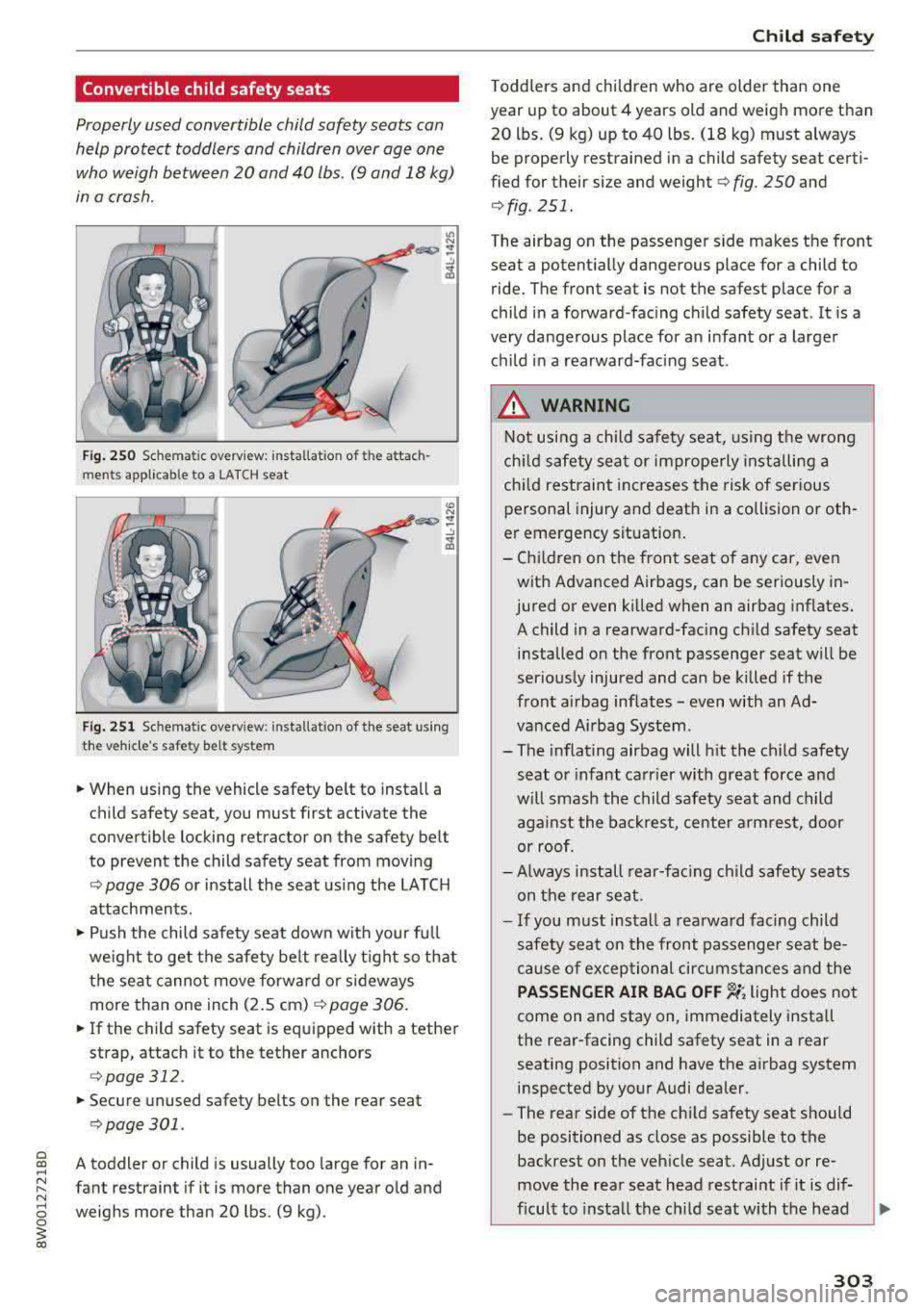
Properly used convertible child safety seats can
help protect toddlers and children over age one
who weigh between
20 and 40 lbs. (9 and 18 kg)
in a crash.
Fig. 250 Schematic overv iew: insta llatio n of the attach
ments applicab le to a LATCH seat
Fig. 251 Schematic overv iew: installat ion of the seat using
the vehicle 's safety belt system
.. When using the vehicle safety belt to install a
child safety seat, you must first activate the
convertible locking retractor on the safety belt
to prevent the child safety seat from moving
Q page 306 or install the seat us ing the LATC H
attachments .
.. Push the child safety seat down with your fu ll
weight to get the safety belt really tight so that
the seat cannot move forward o r sideways
more than one inch (2.5 cm)
Q page 306.
.. If the child safety seat is equipped with a tether
strap, attach it to the tether anchors
Q page 312.
.. Secure unused safety belts on the rear seat
Qpage 301 .
A toddler or child is usually too large for an in
fant restraint if it is more than one year old and
weighs more than 20 lbs. (9 kg).
Child safety
To ddlers and children who are older than one
year up to about 4 years old and weigh more than
20 lbs. (9 kg) up to 40 lbs. (18 kg) must always
be properly restrained in a child safety seat certi
fied for their size and weight
Q fig. 250 and
q fig . 251.
The airbag on the passenger side makes the front
seat a potentially dangerous place for a child to
ride. The front seat is not the safest place for a
child in a forward-facing child safety seat. It is a
very dangerous place for an infant or a larger
child in a rearward-facing seat .
_&. WARNING
Not using a child safety seat, us ing the wrong
child safety seat or improperly instal ling a
chi ld restraint increases the risk of serious
personal injury and death in a collision or oth
er emergency situation.
-Children on the front seat of any car, even
with Advanced Airbags, can be seriously in
jured or even killed when an airbag inflates.
A child in a rearward-facing ch ild safety seat
installed on the front passenger seat will be
seriously injured and can be killed if the
front airbag inflates
-even with an Ad
vanced Airbag System.
-The inflating airbag will hit the child safety
seat or infant carr ier with great force and
will smash the child safety seat and child
against the backrest, center armrest, door
or roof.
-Al ways install rear-fa cing child safety seats
on the rear seat .
-If you must insta ll a rearward facing child
safety seat on the front passenger seat be
cause of excep tional circumstances and the
PASSENGER AIR BAG OFF '-I; light does not
come on and stay on, immediately insta ll
the rear-facing child safety seat in a rear
seating position and have the a irbag system
inspected by your Audi dealer .
-The rear side of the ch ild safety seat shou ld
be positioned as close as possible to the
backrest on the veh icle seat. Adjust or re
move the rear seat head restraint if it is dif
f icult to install the child seat with the head
303
Page 305 of 403
Child safety
restraint in place~ page 67. Install the
head restraint again immediately once the
child seat is removed. Driving without head
restraints or with head restraints that are
not properly adjusted increases the risk of
serious or fatal neck injury dramatically .
- Always read and heed all WARNINGS when
ever using a child restrained in a vehicle is
being used
~ page 263, Safety belts,
~ page 2 71, Airbag system and
~ page 295, Important information.
_& WARNING
If exceptional circumstances require the use
of a forward-facing child restraint on the
front passenger's seat , the child's safety and
well-being require that the following special precautions be taken:
- Make sure the forward-facing seat has been
designed and certified by its manufacturer
for use on a front seat with a passenger
front and side airbag.
- Always follow the manufacturer 's instruc
tions provided with the child safety seat or
infant carrier.
- Always move the front passenger seat to the highest position in the up and down ad
justment range and move it back to the
rearmost position in the seat's fore and aft
adjustment range, as far away from the air
bag as possible, before installing the for
ward-facing child restraint.
- Always make sure that the safety belt upper
anchorage is behind the child restraint and
not next to or in front of the child restraint
so that the safety belt will be properly posi
tioned.
- Always make sure that nothing prevents the
front passenger's seat from being moved to
the rearmost position in its fore and aft ad
justment range.
- Always make sure the backrest is in an up
right position.
- Never place or use any electrical device (such as a laptop, CD player, electronic
games device, power inverter or seat heater
for child seats) on the front passenger seat
304 if the device is connected to the 12-volt
socket or the cigarette lighter socket.
- If a seat heater has been retrofitted or oth
erwise added to the front passenger seat,
never install any child restraint system on
this seat.
- Make sure that there are no wet objects (such as a wet towel) and no water or other
liquids on the front passenger seat cushion .
- Never place objects on the seat (such as a
laptop, CD player, electronic games device,
power inverter or seat heater for child
seats) . These may influence the electrical
capacitance measured by the capacitive pas
senger detect ion system and can also fly
around in an accident and cause serious per
sonal injury.
- Make sure that the
PASSENGER AIR BAG
OFF
11,;; light comes on and stays on all the
time whenever the ignition is switched on.
- If the
PASSENGER AIR BAG OFF 11,;; light
does not come on and stay on, immediately
install the forward-facing child seat at a
seating position on the rear seat and have
the airbag system inspected by your author
ized Audi dealer.
- Take the child restraint off the front passen
ger seat and install it properly at one of the rear seat positions if the
PASSENGER AIR
BAG OFF
11,;; light does not stay on whenever
the ignition is switched on .
Page 306 of 403
Booster seats and safety belts
Properly used booster seats can help protect
children weighing between about 40 lbs. and
80 lbs . (18 kg and 36 kg) who are less than 4
ft.
9 in. (57 inches/1.45 meters) tall.
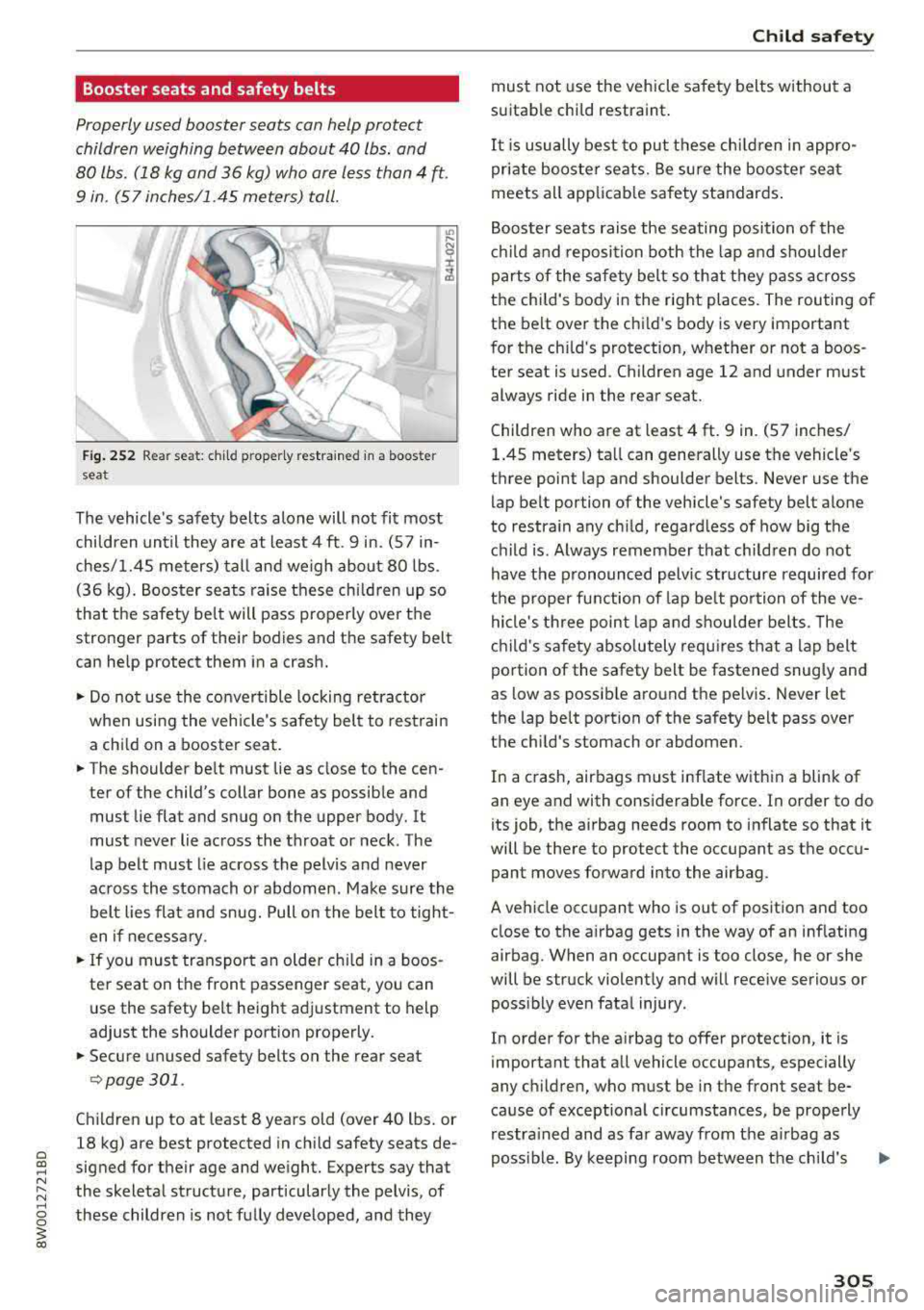
Fig. 252 Rear seat; chi ld proper ly restrained in a booster
sea t
The vehicle's safety belts alone will not fit most
children until they are at least 4
ft. 9 in. (57 in
ches/1.45 meters) tall and weigh about 80 lbs.
(36 kg). Booster seats raise these children up so
that the safety belt will pass properly over the
stronger parts of their bodies and the safety belt
can help protect them in a crash.
.,. Do not use the convertible locking retractor
when using the vehicle's safety belt to restrain
a chi ld on a booster seat .
.. The shoulder belt must lie as close to the cen
ter of the child's collar bone as possible and
must lie fla t and snug on the upper body.
It
must never lie across the throat or neck. The
lap belt must lie across the pelvis and never
across the stomach or abdomen. Make sure the
belt lies flat and snug. Pull on the belt to tight
en if necessary .
.,. If you must transport an older child in a boos
ter seat on the front passenger seat , you can
use the safety belt height adjustment to help
adjust the shoulder portion properly .
.. Secure unused safety belts on the rear seat
r:=>page 301.
Children up to at least 8 years old (over 40 lbs. or
18 kg) are best protected in child safety seats
de
signed for their age and we ight. Experts say that
the skeletal structure , part icularly the pelvis , of
these children is not fully developed, and they
Child safety
must not use the vehicle safety belts without a
suitable child restraint .
It is usually best to put these children in appro
priate booster seats. Be su re the booster seat
meets all applicab le safety standards .
Booster seats raise the seating position of the
child and reposition both the lap and shoulder
parts of the safety belt so that they pass across
the child's body in the right places. The routing of
the belt over the chi ld's body is very important
for the ch ild's protection, whether or not a
boos
ter seat is used. Children age 12 and under must
always ride in the rear seat.
Ch ildr en who are at least 4
ft. 9 in. (57 inches/
1.45 meters) tall can generally use the vehicle 's
three point lap and shoulder belts . Never use the
lap belt portion of the vehicle 's safety belt alone
to restrain any ch ild, regard less of how big the
ch ild is. Always remember that childr en do not
have the pronounced pelvic structure required for
the proper function of lap belt portion of the
ve
hicle's three point lap and shoulder belts . T he
child's safety absolutely requires that a lap belt
portion of the safety belt be fastened snugly and
as low as possible around the pe lvis. Never let
the lap belt portion of the safety belt pass over
the child 's stomach or abdomen .
In a crash, airbags must inflate within a blink of
an eye and with considerab le force. In order to do
its job, the airbag needs room to inflate so that it
will be there to protect the occupant as the
occu
pan t moves forward into the airbag .
A vehicle occ upant who is out of position and too
close to the a irbag gets in the way of an inflating
airbag. When an occupant is too close , he or she
will be struck violently and will receive serious or possibly even fata l injury .
In order for the airbag to offer protection, it is
important that all vehicle occupants, especially
any children, who must be in the front seat
be
cause of exceptiona l circumstances, be properly
restrained and as far away from the airbag as
poss ible. By keeping room between the child 's
..,.
305