ECU AUDI S4 2018 Workshop Manual
[x] Cancel search | Manufacturer: AUDI, Model Year: 2018, Model line: S4, Model: AUDI S4 2018Pages: 403, PDF Size: 66.81 MB
Page 361 of 403
Emergency assistance
Emergency assistance
General information
... Park the vehicle as far as possible from moving
traffic in the event of a breakdown. In the event
of a flat tir e, park the vehicle on a level surface .
It you are on a steep hill, be especially careful.
.,. Set the parking brake .
.,. Switch the emergency flashers on .
... Have the passengers exit the vehicle . They
should move to a safe place, for example be
hind a guard rail.
_& WARNING
Follow the steps given above . This is for your
protection and the for the safety of other driv
ers.
Equipment
Vehicle tool kit/tire mobility kit/vehicle
jack
Applies to: vehicles with the vehicle tool kit, tire mobility kit
and veh icle jack
Applies to: sedan
Fig. 278 L uggage compartmen t: vehicle too l kit , ve hicle
j ack, tire mob ility kit an d comp resso r
Applies to: allroad
Fig. 279 Lug gage compa rtmen t: ve hicl e tool kit, v ehicle
j ack, tir e mobil ity k it and comp resso r
360
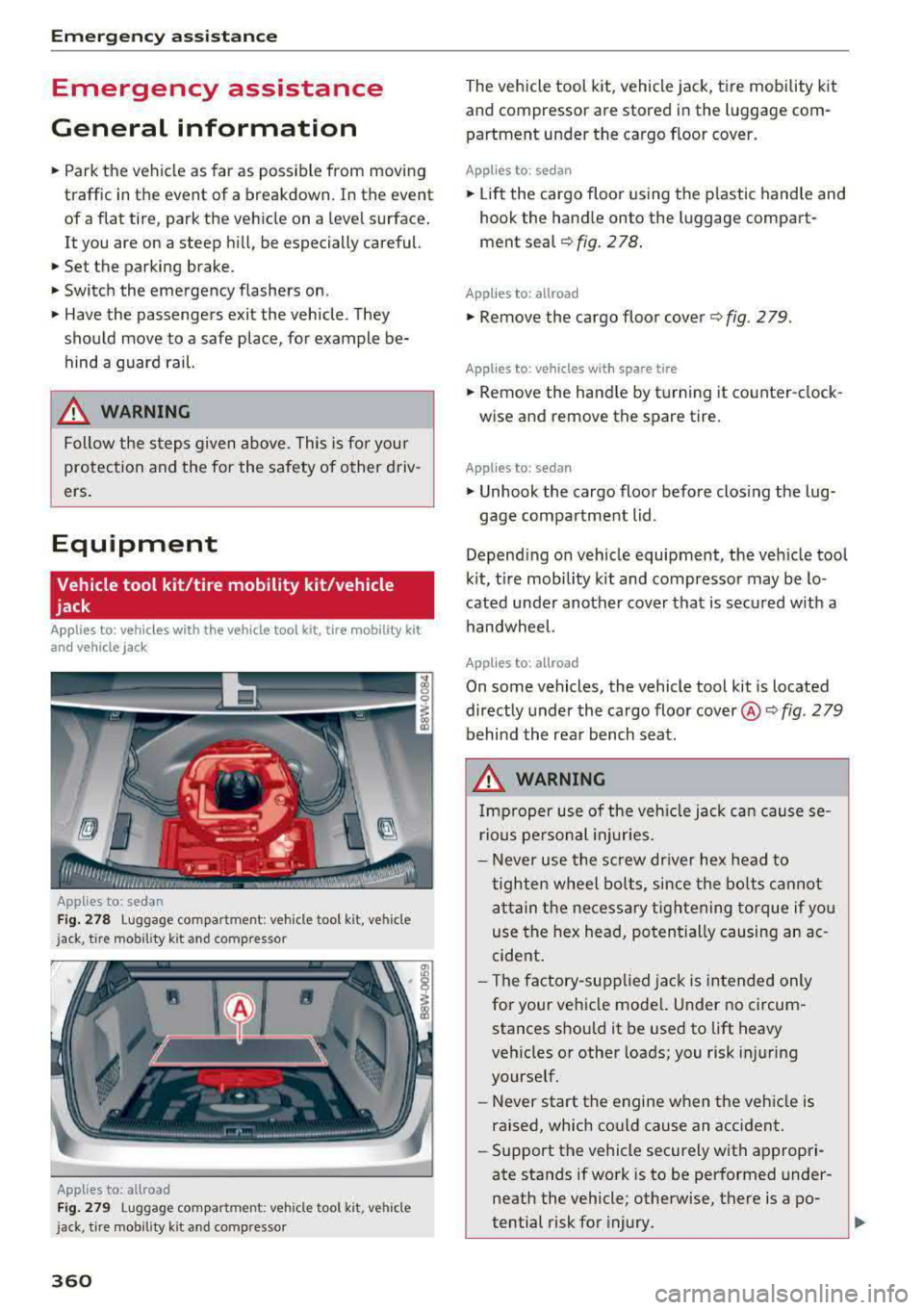
The vehicle tool kit, vehicle jack, tire mobility kit
and compressor are stored in the luggage com
partment under the cargo floor cover.
Applies to: sedan
.,. Lift the cargo floor using the plastic handle and
hook the hand le onto the luggage compart
ment
seal ~ fig. 2 78.
Applies to: allroad
... Remove the cargo floor cover ~ fig. 279 .
Applies to : vehicles with spare tire
... Remove the handle by turning it counter-clock
wise and remove the spare tire.
Appl ies to: sedan
.,. Unhook the cargo floor before closing the lug-
gage compartment lid .
Depend ing on vehicle equipment, the vehicle tool
kit, tire mobility kit and compressor may be lo
cated under another cover that is secured w ith a
handwheel.
Applies to : allroad
On some vehicles, the vehicle tool kit is located
directly under the cargo floor
cover@~ fig. 2 79
behind the rear bench seat.
_& WARNING
Impr oper use of the vehicle jack can cause se
rious personal injur ies.
- Never use the screw driver hex head to
tighten wheel bolts, since the bolts cannot
attain the necessary tightening torque if you
use the hex head, potentially causing an ac
cident.
- The factory-supp lied jack is intended only
for your vehicle mode l. Under no circum
stances should it be used to lift heavy
veh icles or other loads; you risk injuring
yourself.
- Never start the engine when the vehicle is
raised, which cou ld cause an accident.
- Support the vehicle securely with appropri
ate stands if work is to be performed under
neath the vehicle; otherwise, there is a po
tential risk for injury.
Page 365 of 403
Emergency assistance
Loosening the wheel bolts
Fig. 284 Wheel: loosening the wheel bolt
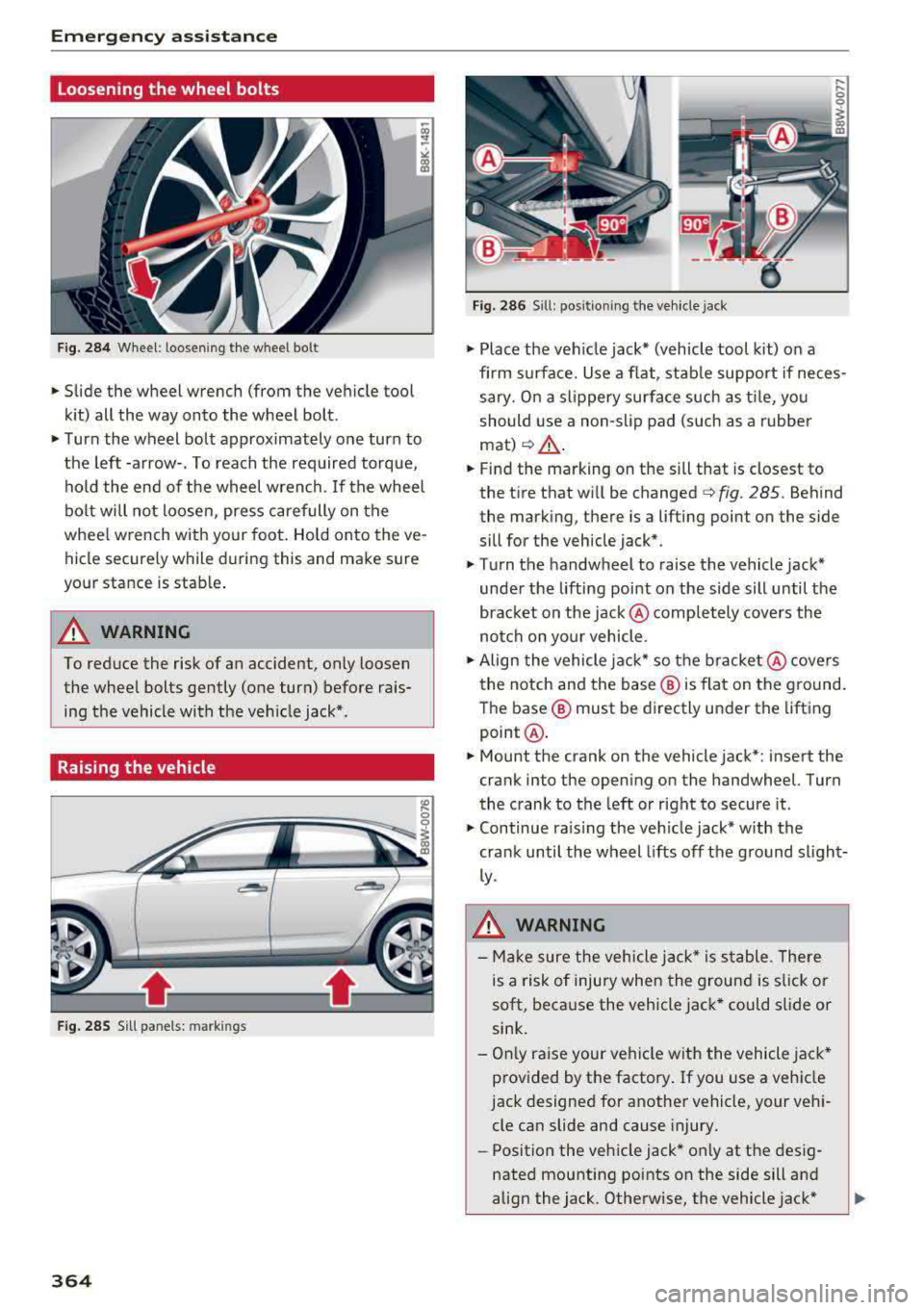
• Slide the wheel wrench (from the vehicle tool
kit) all the way onto the wheel bolt.
• Turn the wheel bolt approximately one turn to
the left -arrow-. To reach the required torque,
hold the end of the wheel wrench. If the wheel
bolt will not loosen, press carefully on the
whee l wrench with your foot. Hold onto the ve
hicle securely while during this and make sure
your stance is stable .
A WARNING
To reduce the risk of an accident, only loosen
the wheel bolts gently (one turn) before rais
ing the vehicle with the veh icle jack*.
Raising the vehicle
Fig . 28S Sill panels: markings
364
Fig. 286 Sill: positio ning the vehicle jack
• Place the veh icle jack* (vehicle tool kit) on a
firm s urface. Use a flat, stable support if neces
sary. On a slippery surface such as tile, you
should use a non-slip pad (such as a rubber
mat)¢ &.
• Find the marking on the sill that is closest to
the tire that will be
changed¢ fig. 2 85 . Behind
the marking, there is a lifting point on the side
sill for the vehicle jack*.
• Turn the handwheel to raise the vehicle jack*
under the lifting point on the side sill until the
bracket on the jack @ completely covers the
notch on your vehicle.
• Align the vehicle jack* so the bracket @covers
the notch and the base ® is flat on the ground.
The base ® must be directly under the lifting
point @.
• Mount the crank on the vehicle jac k*: insert the
crank into the opening on the handwheel. Turn
the crank to the left or right to secure it.
• Continue ra is in g the veh icle jack* with the
crank until the wheel lifts off the ground slight
ly.
A WARNING
- Ma ke sure the vehicle jack* is stable. Th ere
is a risk of injury when the ground is slick or
soft, because the vehicle jack* could slide or
sink.
- Only raise your vehicle with the vehicle jack*
provided by the factory . If you use a vehicle
jack designed for another vehicle, your vehi
cle can slide and cause injury.
- Position the vehicle jack* only at the desig
nated mounting points on the side sill and
align the jack. Otherwise, the vehicle jack*
Page 366 of 403
could slip and cause an injury if it does not
have sufficient hold on the vehicle.
- To reduce the risk of an accident, never start
the engine when the vehicle is raised.
- To reduce the risk of injury, support the ve
hicle securely with suitable stands if work is
to be performed underneath the vehicle.
- To help prevent injury to yourself and your
passengers:
- Do not raise the vehicle until you are sure the jack* is securely engaged.
- Passengers must not remain in the vehicle when it is jacked up.
- Make sure that passengers wait in a safe
place away from the vehicle and well away
from the road and traffic.
- Make sure jack position is correct, adjust as necessary and then continue to raise
the jack*.
- If work has to be done under the vehicle, ensure that it is safely supported on suita
ble stands
-risk of injury!
- Never start the engine when the vehicle is on the jack*
-risk of accident!
(D Note
Do not lift the vehicle by the sill. Position the
vehicle jack* only at the designated mounting points on the side sill. Otherwise, your vehicle
will be damaged.
Removing and installing a wheel
Fig. 287 Wheel: inte rnal hex socket to turn the whee l
bolts
Emergency assistance
Fig. 288 Whee l: alignment pin in the top ho le
Removing a wheel
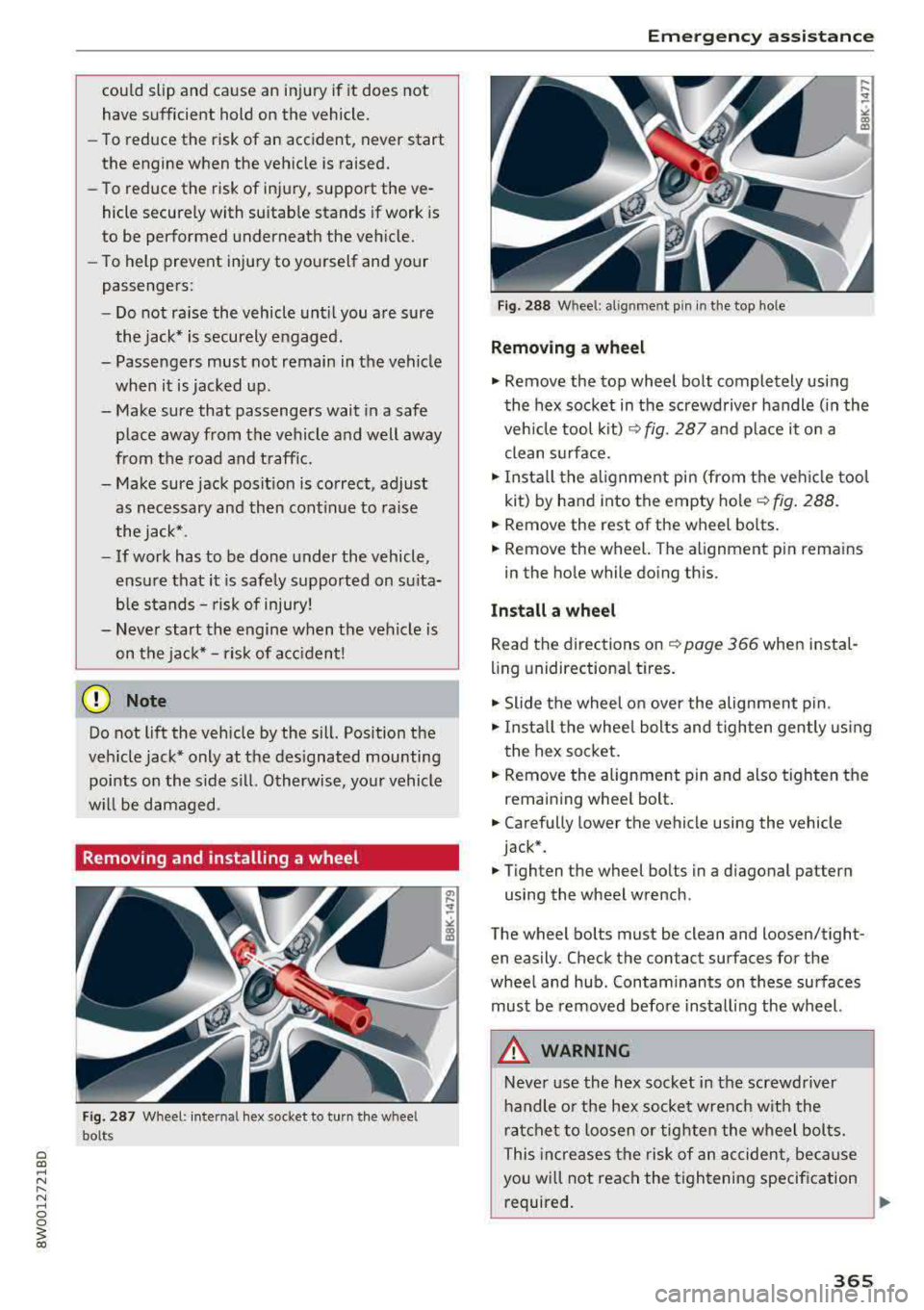
.,. Remove the top wheel bolt completely using
the hex socket in the screwdriver handle (in the
vehicle tool kit)
~fig. 287 and place it on a
clean surface.
.,. Install the alignment pin (from the vehicle tool
kit) by hand into the empty
hole ~ fig. 288.
.,. Remove the rest of the wheel bolts.
.,. Remove the wheel. The alignment p in remains
in the hole while doing this.
Install a wheel
Read the directions on~ page 366 when instal
ling unidirectional tires.
.,. Slide the wheel on over the alignment pin .
.,. Install the wheel bolts and tighten gently using
th e hex socket.
.,. Remove the alignment pin and also tighten the
remai ning wheel bolt.
.,. Carefully lower the vehicle using the vehicle
jack*.
.,. Tighten the wheel bolts in a diagonal pattern
using the wheel wrench .
The wheel bolts must be clean and loosen/tight
en easily. Check the contact surfaces for the
wheel and hub . Contaminants on these surfaces
must be removed before installing the wheel.
A WARNING
Never use the hex socket in the screwdriver
handle or the hex socket wrench with the
ratchet to loosen or tighten the wheel bolts.
This increases the risk of an accident, because
you will not reach the tightening specification
required .
~
365
Page 368 of 403
a co .... N ,....
N .... 0 0
3 co
-Always store damaged wheel, jack* and
tools securely in the luggage compartment.
Otherwise, in an accident or sudden maneu
ver they could fly forward, causing injury to
passengers in the vehicle.
Space-saving spare tire
App lies to: ve hicles with space-saving spare t ire (co mpact
spare tire)
The spare tire is intended for short -term use on
ly. Have the damaged tire checked and replaced,
if necessary, by an authorized Audi dealer or au
thorized Audi Service Facility as soon as possible.
There are some restrictions on the use of the
compact spare tire . The compact spare tire has
been designed specifically for your type of vehi
cle. Do not replace it with the spare tire from an
other type of vehicle.
The compact spare tire is located in the luggage
compartment under the cargo f loor cover
c::>page360.
The tire pressure must be 61 PSI (420 kPA).
Snow chains
For technical reasons, the use of snow chains on
the compact spare tire is not permitted.
If you have to drive with snow chains and a front
tire fails, mount the spare t ire in place of a rear
tire. Install the snow chains on the rear tire that
you removed, and insta ll that in place of the
front tire that failed.
A WARNING
-After installing a spare tire, the tire pres
sure must be checked as soon as possible.
-Do not drive faster than 50 mph (80 km/h)
with a compact spare tire. Driving faster
than that increases the risk of an accident.
-T o reduce the risk of an accident, avoid full
thrott le acceleration, heavy braking, and
fast cornering with the compact spare tire.
-To reduce the risk of an accident, never drive
with more than one compact spare tire.
-Normal summer or winte r tires must not be
mounted on the compact spare wheel rim.
Emergency assistance
Collapsible spare tire
Applies to: vehicles with collapsible spare tire
The collapsible spare tire is intended for short
term use only . Have the damaged tire checked
and rep laced, if necessary, by an authorized A udi
dealer or authorized Audi Service Facility as soon
as possible.
There are some restrictions on the use of the co l
l apsible spare tire. The collapsible spare tire has
been designed spec ifically for your type of vehi
cle. Do not replace it with the collaps ible spare
t ir e from another type of vehicle .
The co llapsible spare tire is located in the lug
gage compartment under the cargo floor cover.
Requirement: the vehicle too l kit
c::> page 360 and
the compressor must be laid out .
Removing
"' Remove the cargo floo r cover c::> page 360,
fig. 279.
"' Turn the handwheel counter-clockwise and re-
move it.
"' Remove the co llapsible spare tire.
You must inflate the collapsible spare tire be
fo rehand in order to use it.
Inflating
"' Remove the valve cap from the collapsible
spare tire.
"'Tighten the comp ressor hose on the collapsible
spare tire valve.
"'Connect the comp ressor hose to a vehicle soc k
et and switch it on .
"'Let the compressor run until the specified value
on the tire pressure sticker is reached
c::> page 344, fig. 277 c::>(D.
"'Screw the valve cap back onto the valve.
Returning to storage
"'R emove the valve cap to drain the air .
"'Wait severa l hours before placing the collapsi
ble spare tire in the spare wheel well. Only then
w ill it fold down comp letely so that you can
store it securely .
"' Then screw the valve cap back onto the valve . ..,_
367
Page 369 of 403
Emergency assistance
"'Secure the collapsible spare tire with the hand -
whee l.
"'Fo ld the cargo floor cover back into p lace.
Snow chains
Using snow chains on the collapsible spare tire is
not permitted for technical reasons.
If you have to drive with snow chains and a front
tire fa ils, mount the collapsible spare tire in
p la ce of a rear tire. Insta ll the snow cha ins on the
rear tire that you removed, and install that in
p lace of the front tire that failed.
A WARNING
-
- Only use the collapsible spare tire in emer
gencies and drive very carefully, especially if
it is more than six years old .
- The compressor and the hose can become
very hot during operation which increases
the risk of burn injuries.
- After installing a collapsible spare tire, the
t ir e pressure must be checked as quickly as
poss ible to reduce the risk of an acc ident.
- Do not drive faster than 50 mph (80 km/h)
with a collapsible spare tire. Driving faster
than that increases the risk of an accident .
- Avoid full-throttle acceleration, heavy brak
ing, and fast cornering with the collapsible
spare tire, because this increases the risk of
an accident .
- Never drive using more than one collapsible
spare tire, because this increases the risk of
an accident.
- Normal tires or winter tires must not be
mounted on the collaps ible spare tire rim.
«J:) Note
The compressor must be switched off after 12
minutes at the most to reduce the risk of
overheating . Let the compressor cool down
for several minutes before using it again.
368
Page 376 of 403

@ Tips
The discharged battery must be properly con
nected to the vehicle's electrical system .
When jump starting or charg ing the battery,
never connect the negative ground cable to
the battery negative post because the battery
manager system must be able to detect the
battery's state of charge. Always connect the
negative ground cable to the negative ground
post of the battery manager control unit.
Using the jump start
cable
Both jump start cables must be connected in the
correct order!
Fig. 295 Engine compartment: connec tors for jump start
cables and a charger
Fig. 296 Ju mp starting us ing a battery in another vehicle:
@ -providing current, @-drained
The procedure described below for connecting
jumper cables is intended to prov ide a jump start
for your vehicle .
Vehicle with discharged battery
•Turnoff lights and accessories, move the auto
matic transmission* selecto r lever to N (Neu
tral) or P (Par k), and set the park ing brake.
Emergency situations
Connecting the positive cable (red) to the
positive terminal
• Open the red cover on the positive terminal
c:>fig. 295 .
1. Secure one end of the positive cable (red) to
the jump start pin
c:> fig. 296 (D (pin under
the red cover = "posit ive") on the vehicle that
needs to be started @.
2. Secure the other end of the positive cable
(red) to the positive termina l@ on the
bat
tery provid ing the current @.
Connecting the negative cable (black) to the
negative terminal
3. Secure one end of the negative cable (black)
to the nega tive term inal @ on the battery
that is providing the current @.
4. Secure the other end of the negative cable
(black) to the jump start
pin @ (hex head pin
= "negative") on the vehicle that needs to be
started @.
Starting the engine
• Start the engine on the vehicle providing the
jump start @and let it run at idle.
• Now start the engine on the vehicle with the
drained battery @.
• If the engine does not start, stop the starting
procedure after 10 seconds and then repeat it
after approx imately 30 seconds.
• Remove the cables when the engines are run
ning. Remove them in reverse order from the
way they were installed.
• Close the red cover on the positive terminal.
T he battery is vented to the outside to prevent
gases from enter ing the vehicle interior . Make
sure that the jumper clamps are well connected
with their
metal parts in full contact with the
battery terminals.
_& WARNING
-To avoid serious personal injury and damage to the vehicle, heed all warnings and instruc
tions of the jumper cable manufacturer. If in
doubt, call for road service.
-Jumper cables must be long enough so that
the vehicles do not touch .
..,_
375
Page 377 of 403
Emergency situations
-When connecting jumper cables, make sure
that they cannot get caught in any moving
parts in the engine compartment.
-Do not bend over the batteries -danger of
chemical burns!
-The battery cell locking screws must be
tightened securely.
-Before you check anything in the engine
compartment, always read and heed all
WARNINGS
c> page 323.
(D Note
Improper hook-up of jumper cables can ruin
the generator.
- Always connect POSITIVE(+) to POSITIVE
(+), and NEGATIVE(-) to NEGATIVE(-)
ground post of the battery manager control
unit.
- Check that all screw p lugs on the battery
cells are screwed in firmly. If not, tighten
plugs prior to connect ing clamp on negative
battery terminal.
-Please note that the procedure for connect
i ng a jumper cable as described above ap
plies specifically to the case of your vehicle
being jump started . When you are giving a
ju mp start to another vehicle, do
not con
nect the negative (-) cable to the negative
(-) terminal on the discharged batte ry @
c> fig. 296. Instead, securely connect the
negative( -) cab le to either a solid metal
component that is firm ly bolted to the en
gine block or to the engine block itself. If
the battery that is being charged does not
vent to the outside, escap ing battery gas
could ignite and explode!
Towing with a tow truck
General hints
Your Audi requires special handling for towing.
The following information is to be used by com
mercial tow truck operators who know how to op
erate the ir equipment safely.
-Never tow your Audi, towing will cause dam
age to the engine and transmission.
376
-Never wrap the safety chains or winch cables
around the brake lines .
- To prevent unnecessary damage, your Audi
must be transported with a flat bed truck .
- To load the vehicle on to the flat bed, use the
towing loop found in the vehicle tools and at
tach to the front or rear anchorage
i:>page 376 and i:>page 377 .
A WARNING
A vehicle being towed is not safe for passen
gers. Never allow anyone to ride in a vehicle
being towed, for any reason.
Front towing loop
Only install the front towing loop when it is
needed.
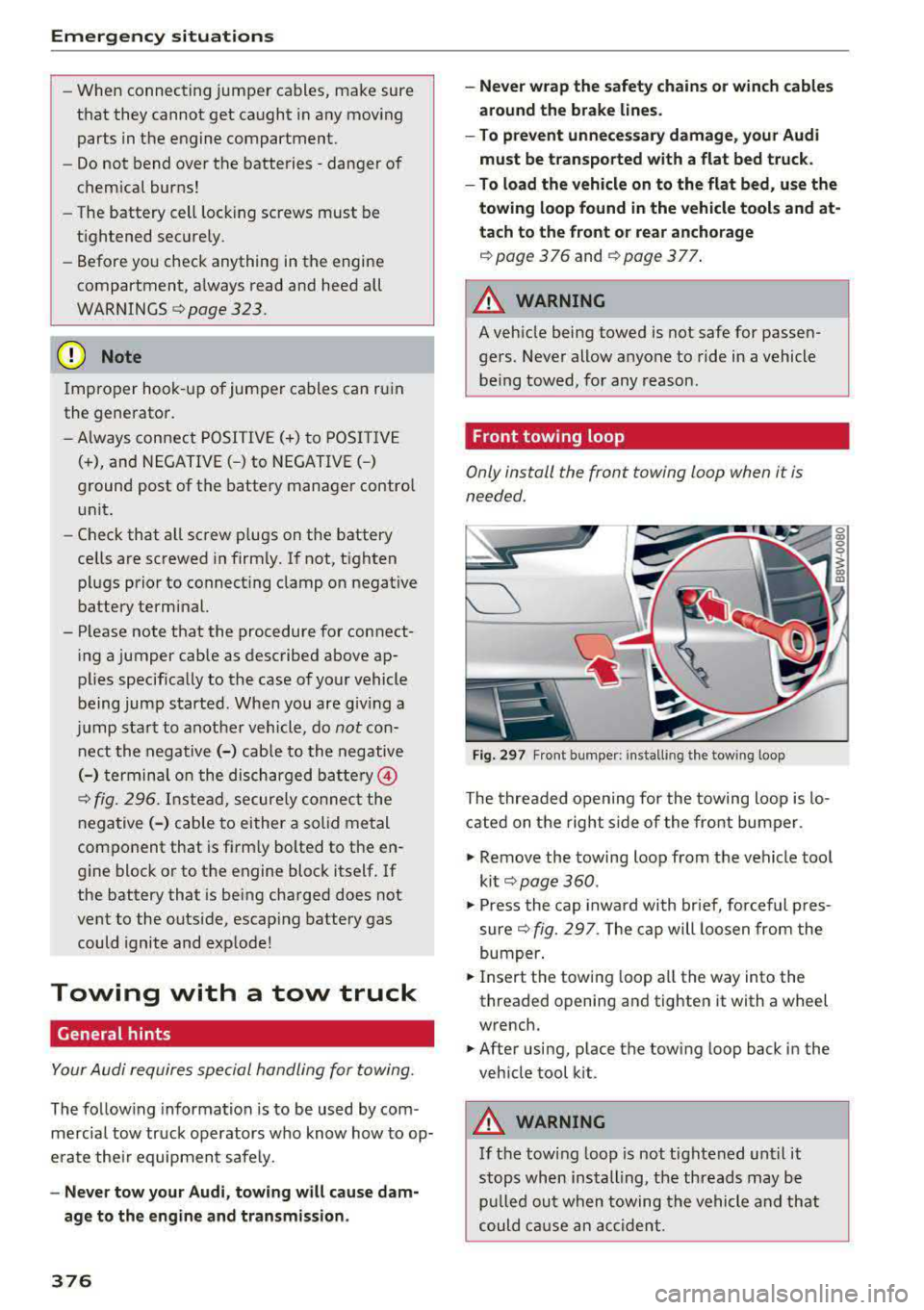
Fig. 297 F ront bumper: installing the towing loop
The threaded opening for the towing loop is lo
cated on the right s ide of the front bumper.
.,. Remove the towing loop from the vehicle too l
ki t
c> page 360 .
.,. Press the cap inward with brief, forceful p res
sure
c> fig. 297 . The cap will loosen from the
bumper .
.,. Insert the towi ng loop all the way into the
threaded opening and tighten it with a wheel
wrench.
.,. After using, place the towing loop back in the
vehicle tool kit .
A WARNING
If the towing loop is not tightened until it
stops when installing, the threads may be
pulled out when towing the vehicle and that
could cause an accident.
-
Page 378 of 403
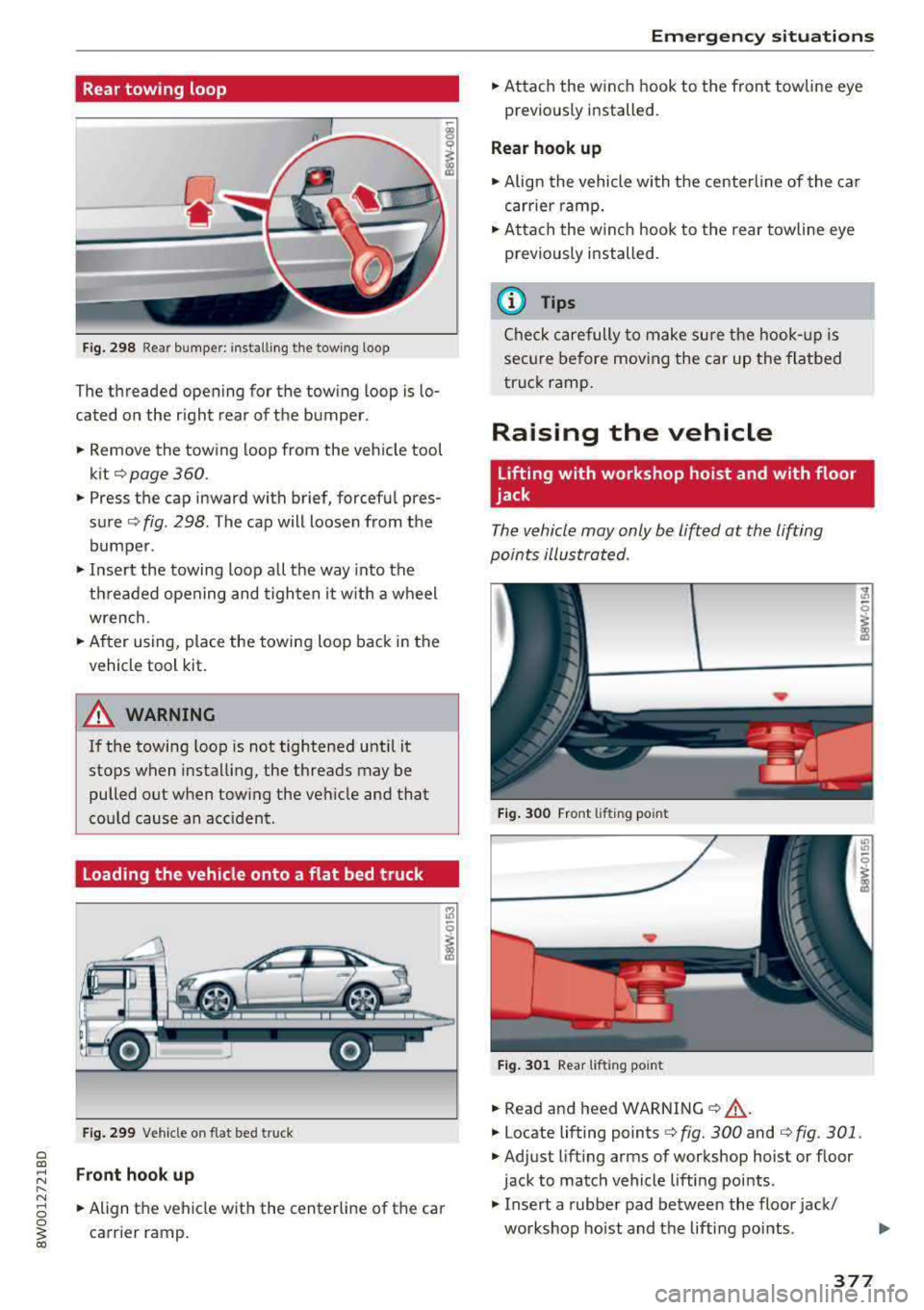
Rear towing loop
Fig. 298 Rea r bumper: install ing the tow ing loop
The threaded opening for the towing loop is lo
cated on the r ight rear of the bumper.
.. Remove the towing loop from the vehicle tool
kit¢ page 360.
.. Press the cap inward with brief, forcefu l pres
sure ¢ fig. 298. The cap will loosen from the
bumper .
.,. Insert the towing loop all the way into the
threaded opening and tighten it w ith a wheel
wrench .
.. After using, place the towing loop back in the
vehicle tool kit.
A WARNING
If the towing loop is not tightened until it
stops when installing, the threads may be
pulled out when tow ing the vehicle and that
cou ld cause an accident .
Loading the vehicle onto a flat bed truck
Fig. 299 Vehicle on flat bed truck
Front hook up
-
.. Align the vehicle with the centerline of the car
carrier ramp.
Emergency situations
.. Attach the winch hook to the front towline eye
previously installed.
Rear hook up
.. Align the vehicle with the centerline of the car
carrier ramp .
.. Attach the w inch hook to the rear towline eye
previously installed.
(D Tips
Check carefully to make sure the hook-up is
secure before moving the car up the flatbed
truck ramp.
Raising the vehicle
Lifting with workshop hoist and with floor
jack
The vehicle may only be lifted at the lifting
points illustrated .
Fig. 300 Front lifting point
Fig. 301 Rear lif tin g po int
.. Read and heed WARNING ¢&, .
.. Locate lifting points¢ fig. 300 and ¢ fig. 301.
.,. Adjust lifting arms of workshop hoist or floor
jack to match vehicle lifting points .
.. Insert a rubber pad between the floor jack/
workshop hoist and the lifting points .
.,.
377
Page 390 of 403

a co .... N ,....
N .... 0 0
3 co
Cell phone refertoTe le phone ...................
175
Center armrest . . . . . . . . . . . . . . . . . . . . . . . . 66
Central locking . . . . . . . . . . . . . . . . . . . . . . . . 3 7
Central locking switch . . . . . . . . . . . . . . . . .
41
Convenience key . . . . . . . . . . . . . . . . . . . . . . 40
Emergency locking . . . . . . . . . . . . . . . . . . . . 42
Power windows . . . . . . . . . . . . . . . . . . . . . . 49
Remote control key . . . . . . . . . . . . . . . . . . . 40
Setting . . . . . . . . . . . . . . . . . . . . . . . . . . . . . 41
Certificat ion . . . . . . . . . . . . . . . . . . . . . . . . . 386
Changing engine oi l . . . . . . . . . . . . . . . . . . . 328
Changing the scale . . . . . . . . . . . . . . . . . . . . . 13
Charging the battery (mobile devices) . . . . 234
Child restraints
Danger of using child restraints in the front
seat . . . . . . . . . . . . . . . . . . . . . . . . . . . . . . .
272
Where can I get additional information
about child restraints and their use? . . . .
314
Child restraint system anchors . . . . . . . . . . 309
Chi ld safety . . . . . . . . . . . . . . . . . . . . . . . . . . 295
Important safety instructions for using chi ld
safety seats . . . . . . . . . . . . . . . . . . . . . . . .
299
Install ing a child restraint using the LATCH
system . . . . . . . . . . . . . . . . . . . . . . . . . . . .
311
Mounting and releasing the anchorage
hook . ... .. .. ................ ..... .
311
Tether anchors . . . . . . . . . . . . . . . . . . . . . . 312
Tether straps . .. ........... .. .. .. .. . 312
Child safety lock
Power windows . . . . . . . . . . . . . . . . . . . . . .
48
Rear doors . . . . . . . . . . . . . . . . . . . . . . . . . . 48
Ch ild safety seats . . . . . . . . . . . . . . . . . . . . . 301
Booster seats . . . . . . . . . . . . . . . . . . . . . . . 305
Convertible child seats . . . . . . . . . . . . . . . 303
Danger of using child restraints in the front
seat . . . . . . . . . . . . . . . . . . . . . . . . . . . . . . .
272
How do I prope rly install a child safety seat
in my vehicle? . . . . . . . . . . . . . . . . . . . . . . .
299
Infant seats . . . . . . . . . . . . . . . . . . . . . . . . 301
LA TCH system . . . . . . . . . . . . . . . . . . . . . . 311
Safety instructions . . . . . . . . . . . . . . . . . . . 299
Securing . . . . . . . . . . . . . . . . . . . . . . . . . . . 306
Unused safety belts on the rear seat 301
Child seats
Lower anchorages . . . . . . . . . . . . . . . . . . .
310
C lassic view . . . . . . . . . . . . . . . . . . . . . . . . . . . 15
Index
Cleaning . . . . . . . . . . . . . . . . . . . . . . . . . . . . 354
Cleaning Alcantara . . . . . . . . . . . . . . . . . . . . 357
Cleaning artificial leather. . . . . . . . . . . . . . . 357
Cleaning carbon parts . . . . . . . . . . . . . 356, 357
Cleaning decorative parts/trim . . . . . . . . . . 356
Cleaning decorative parts and trim . . . . . . . 356
Cleaning exhaust tail pipes . . . . . . . . . . . . . 356
Cleaning plastic parts . . . . . . . . . . . . . . . . . . 356
Cleaning textiles . . . . . . . . . . . . . . . . . . . . . . 357
Climate control system
refer to Automatic climate control . . . . . . . 76
Clock . . . . . . . . . . . . . . . . . . . . . . . . . . . . 17, 248
Cockpit (overview) . . . . . . . . . . . . . . . . . . . . . . 8
Collapsible spare tire Inflating . . . . . . . . . . . . . . . . . . . . . . . . . . .
367
Collapsible ti re
refer to Collapsible spa re tire . . . . . . . . . . 367
Command (voice recognition system) . . . . . 168
Compact spare t ire . . . . . . . . . . . . . . . . . . . . 367
Compartments . . . . . . . . . . . . . . . . . . . . . . . . 69
Compass in the mirror . . . . . . . . . . . . . . . . . . 63
Compliance . . . . . . . . . . . . . . . . . . . . . . . . . . 386
Connection manager . . . . . . . . . . . . . . . . . . 249
Connect ions
refer to Media .. ... ....... ... ... 227, 236
Con sumer Information . . . . . . . . . . . . . 261, 383
Consumption (fuel) . . . . . . . . . . . . . . . . . . . . 17
Contacting NHTSA . . . . . . . . . . . . . . . . . . . . 261
Contacts . . . . . . . . . . . . . . . . . . . . . . . . . . . . 183
Addi tional directory . . . . . . . . . . . . . . . . . . 250
Importing/exporting . . . . . . . . . . . . . . . . . 185
Memory capacity . . . . . . . . . . . . . . . . . . . . 186
Stor ing as destination . . . . . . . . . . . . . . . . 212
Control buttons (operating the MMI) . . . . . 15 7
Control knob with joyst ick function (MMI op
eration) . . . . . . . . . . . . . . . . . . . . . . . . . . . . .
160
Convenience key
Switching the ignition on . . . . . . . . . . . . . .
83
Unlocking/locking . . . . . . . . . . . . . . . . . . . . 40
Convenience opening/closing . . . . . . . . . . . . 49
Convertib le child safety seats . . . . . . . . . . . 303
Convertible locking retractor
Activating . . . . . . . . . . . . . . . . . . . . . . . . . .
308
Deactivating . . . . . . . . . . . . . . . . . . . . . . . . 309
Using to secure a ch ild safety seat . . . . . . 308
Cooled glove compartment . . . . . . . . . . . . . . 69
389
Page 397 of 403
Index
Rearview camera
re fer to Parking systems . . . . . . . . . . 137, 138
Rear window defogger . . . . . . . . . . . . . . . . . . 78
Rear window sh ade . . . . . . . . . . . . . . . . . . . . .
60
Rear window washer system . . . . . . . . . . . . . 60
REAR (button) . . . . . . . . . . . . . . . . . . . . . . . . . 78
Recircu lation mode (automatic climate con-
t rol) . . . . . . . . . . . . . . . . . . . . . . . . . . . . . . . . . 78
Recuperation . . . . . . . . . . . . . . . . . . . . . . . . . 17
Refueling ....... ........... ........ .. 317
Fuel filler door emergency release 319
Remote control
refer to Remote control key . . . . . . . . . . . . 38
Remote control key . . . . . . . . . . . . . . . . . . . . 38
Remote control operation Garage door opener (Homelink) . . . . . . . . . 52
Remote locking and unlocking
Audi connec t vehicle control . . . . . . . . . . . 199
Removing the caps (wheel bolts) . . . . . . . . . 363
Repair manuals . . . . . . . . . . . . . . . . . . . . . . . 383
Repairs Airbag system . . . . . . . . . . . . . . . . . . . . . . 286
Replacement key . . . . . . . . . . . . . . . . . . . . . . 38
Replacing Light bulbs . . . . . . . . . . . . . . . . . . . . . . . . . 373
Replacing wiper b lades . . . . . . . . . . . . . . 62, 63
Reporting Safety Defects . . . . . . . . . . . 261, 262
Reset
refer to Restart (MMI) . . . . . . . . . . . . . . . . 253
Reset button (trip odometer) . . . . . . . . . . . . 12
Resetting the trip odometer . . . . . . . . . . . . . 12
Residual heat (automatic climate control) . . 79
Resta rt (MMI) . . . . . . . . . . . . . . . . . . . . . . . . 253
Retractor . . . . . . . . . . . . . . . . . . . . . . . . . . . . 266
Reverse gea r . . . . . . . . . . . . . . . . . . . . . . . . . . 91
Reversible cargo floor . . . . . . . . . . . . . . . . . . 7 4
Rewinding (audio/video file) . . . . . . . . . . . . 236
Right control button . . . . . . . . . . . . . . . . . . . . 14
Rims ..... .. .. .... ... ... ..... .. .. .. . 349
Clean ing . . . . . . . . . . . . . . . . . . . . . . . . . . . 355
Ringtone settings . . . . . . . . . . . . . . . . . . . . . 1 85
Roaming
refer to Data connection . . . . . . . . . . . . . . 1 95
Roof emergency operation . . . . . . . . . . . . . . . 50
396
Roof rack . . . . . . . . . . . . . . . . . . . . . . . . . . . . . 7 4
Roof load . . . . . . . . . . . . . . . . . . . . . . . . . . .
7 4
also ref er to Roof rack . . . . . . . . . . . . . . . . . 7 4
Route criteria . . . . . . . . . . . . . . . . . . . . . . . . 213
Route guidan ce
refer to Navigation . . . . . . . . . . . . . . . . . . . 204
Running direc tion (tires)
s
Safe driving habits
Safety 366
254
Airbag system . . . . . . . . . . . . . . . . . . . . . . 271
Belts . . . . . . . . . . . . . . . . . . . . . . . . . . . . . . 263
Cargo . . . . . . . . . . . . . . . . . . . . . . . . . . . . . 259
Correct seating position . . . . . . . . . . . . . . 255
P edal area . . . . . . . . . . . . . . . . . . . . . . . . . . 259
T ele phone. . . . . . . . . . . . . . . . . . . . . . . . . . 175
Safety belt height adjustment . . . . . . . . . . . 268
Safety belt position . . . . . . . . . . . . . . . . . . . 267
Safety belt height adjustment . . . . . . . . . 268
Safety belts worn by pregnant women . . . 268
Safety belt pretensioner Serv ice and d isposal. . . . . . . . . . . . . . . . . . 270
Safety be lts . . . . . . . . . . . . . . . . . . . . . . 263, 266
Cleaning . . . . . . . . . . . . . . . . . . . . . . . . . . . 356
Danger to passengers who do not w ear a
saf ety b elt . . . . . . . . . . . . . . . . . . . . . . . . . 264
Fas tening . . . . . . . . . . . . . . . . . . . . . . . . . . 266
Improperly worn . . . . . . . . . . . . . . . . . . . . 269
Not worn . . . . . . . . . . . . . . . . . . . . . . . . . . 264
Safety belt position . . . . . . . . . . . . . . . . . . 267
Safety instructions . . . . . . . . . . . . . . . . . . . 265
Securing child safety seats . . . . . . . . . . . .
306
Special considerat ions for pregnant wom -
en .......... ..... .. ............... 268
Unfastening . . . . . . . . . . . . . . . . . . . . . . . . 268
Warning/indicator light . . . . . . . . . . . . . . 263
Worn p roperly . . . . . . . . . . . . . . . . . . . . . . 265
Safety belt warning light . . . . . . . . . . . . . . . 263
Safety instructions for side curtain airbags . . . . . . . . . . . . . . . 294
for using child safety seats . . . . . . . . . . . . 299
for using safety belts . . . . . . . . . . . . . . . . . 265
Monitoring the Advanced Airbag System 285
Saving fuel Energy consumers . . . . . . . . . . . . . . . . . . . . 18
Recuperation . . . . . . . . . . . . . . . . . . . . . . . . 17