ignition AUDI S4 2018 Repair Manual
[x] Cancel search | Manufacturer: AUDI, Model Year: 2018, Model line: S4, Model: AUDI S4 2018Pages: 403, PDF Size: 66.81 MB
Page 299 of 403
Child safet y
one o f the rear seating posit ions . If in exception
al circumstances you must use it on the front passenger seat, carefully read all of the informa
tion on child safety and Advanced Airbags and heed a ll of the app licab le WARNINGS. Make cer
tain that the child and child restraint are correct ly recogn ized by the capacit ive passenger detec
tion system i n the front passenge r seat, that the
fron t passenger airbag is turned off, and that the
a irbag status is always cor rectly sig naled by the
PASSENGER AIR BA G OFF~; light.
M any types and models of child rest raints have
been available ove r the yea rs , new models are in
troduced regularly incorporat ing new and im
p roved designs and older mode ls are taken o ut of
product ion . Chi ld restraints a re not standardized .
Ch ild rest raints of the same type typica lly have
d ifferent weights and s izes and d ifferent "foot
prints", the s ize and shape of the bottom of the
chi ld restraint that s its on the seat, when they
are installed on a vehicle seat . These differences
make it virtually impossible to ce rtify compliance
with the requ irements fo r advanced airbags with
each and eve ry ch ild rest raint that has ever been
sold in the past or will be sold ove r the co urse of
the useful life of your vehicle.
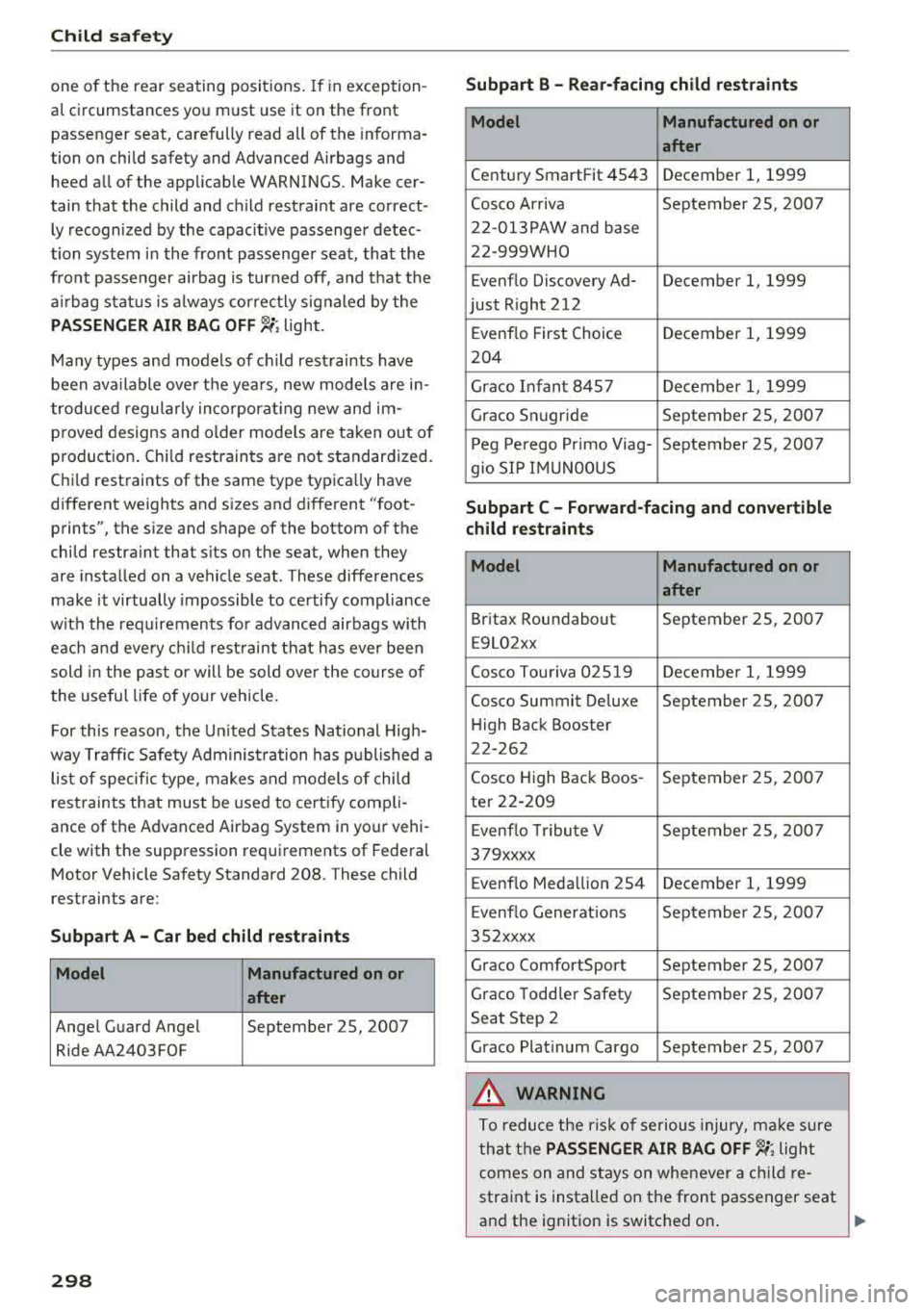
F or this reason, the Un ited States National High
way Traffi c Safety Administ ration has p ublished a
lis t of specific type, makes and models of child
restraints that must be used to cert ify comp li
ance of the Advanced Airbag System in your vehi
cle with the suppression requirements of Federal
Motor Vehicle Safety Standard 208. These child
restraints are:
Subpart A -Car bed child restraints
Model Manufactured on or
after
Ange l G uard Angel September 25, 2007
Ride AA2403FOF
298
Subpart B -Rear -facing child rest raints
Model Manufactured on or
after
Century SmartFit 4543 December 1, 1999
Cosco Arriva September 25, 2007
22-013PAW and base
22-999WHO
Evenflo Discovery Ad- December 1, 1999
just R ight 212
Evenflo First Choice December 1,
1999
204
Graco Infant 8457 December 1, 1999
Graco Snugr ide September 25, 2007
P eg Perego P rimo Viag- September 25, 2007
g io SI P IMU NOOUS
Subpart C -Forward-facing and convertible
child r estraints
Mod el Manufactured on or
after
Br itax Roundabout September 25, 2007
E9L02xx
Cosco Tou riva 025 19 December 1, 1999
Cosco Summit De luxe September 25, 2007
H igh Back Booster
22-262
Cosco High Back Boos -September 25, 2007
ter 22 -209
Evenflo Tribute V September 25, 2007
379xxxx
Evenflo Meda llion 254 December 1, 1999
E venflo Generat ions September 25, 200 7
35 2xxxx
Graco ComfortSport September 25, 2007
Graco Todd le r Safety September 25, 200 7
Seat Step 2
Graco Plat inum Cargo September 25, 2007
A WARNING
To redu ce the ris k of serious injury, ma ke sure
that the
PASSENGER AIR BAG OFF ,;; light
comes on and stays on whenever a c hild re
straint is installed on the front passenger seat
and the ignition is switched on .
~
Page 301 of 403
Child safety
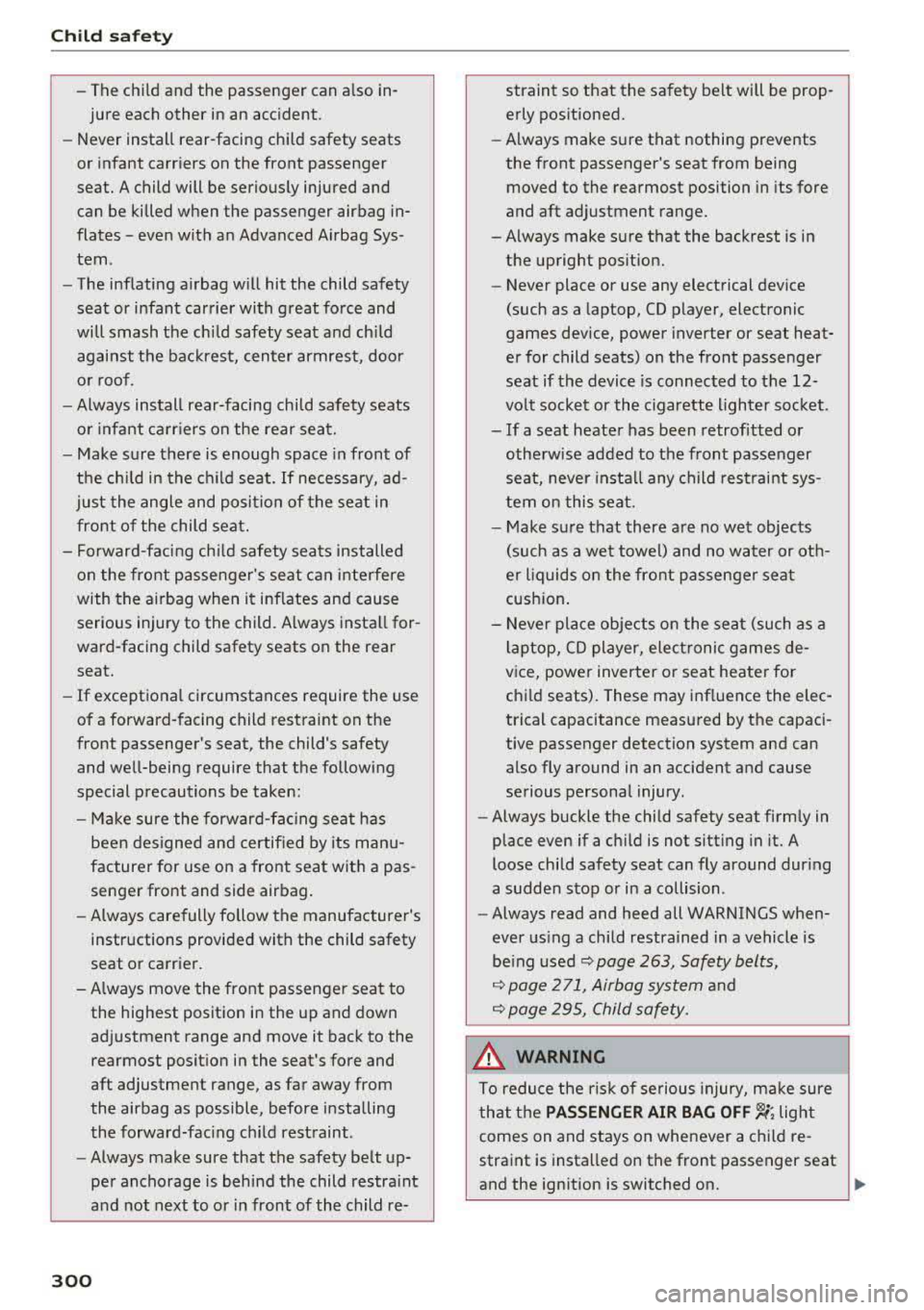
-The child and the passenger can also in
jure each other in an accident.
- Never install rear-facing child safety seats
or infant carriers on the front passenger
seat. A child will be seriously injured and
can be killed when the passenger airbag in
flates -even with an Advanced Airbag Sys
tem.
- The inflating airbag will hit the child safety
seat or infant carrier with great force and
will smash the child safety seat and child against the backrest, center armrest, door
or roof.
- Always install rear-facing child safety seats
or infant carriers on the rear seat.
- Make sure there is enough space in front of
the child in the child seat. If necessary, ad
just the angle and position of the seat in
front of the child seat.
- Forward-facing child safety seats installed
on the front passenger's seat can interfere
with the airbag when it inflates and cause
serious injury to the child. Always install for
ward-facing child safety seats on the rear
seat.
- If exceptional circumstances require the use
of a forward-facing child restraint on the
front passenger's seat, the child's safety
and well-being require that the following
special precautions be taken:
- Make sure the forward-facing seat has
been designed and certified by its manu
facturer for use on a front seat with a pas
senger front and side airbag.
- Always carefully follow the manufacturer's
instructions provided with the child safety
seat or carrier.
- Always move the front passenger seat to the highest position in the up and down
adjustment range and move it back to the rearmost position in the seat's fore and
aft adjustment range, as far away from
the airbag as possible, before installing
the forward-facing child restraint.
- Always make sure that the safety belt up
per anchorage is behind the child restraint
and not next to or in front of the child
re-
300
straint so that the safety belt will be prop
erly positioned.
- Always make sure that nothing prevents
the front passenger's seat from being moved to the rearmost position in its fore
and aft adjustment range.
-Always make sure that the backrest is in
the upright position.
- Never place or use any electrical device
(such as a laptop, CD player, electronic
games device, power inverter or seat heat
er for child seats) on the front passenger seat if the device is connected to the 12-
volt socket or the cigarette lighter socket.
- If a seat heater has been retrofitted or
otherwise added to the front passenger
seat, never install any child restraint sys
tem on this seat.
- Make sure that there are no wet objects
(such as a wet towel) and no water or oth
er liquids on the front passenger seat
cushion.
- Never place objects on the seat (such as a
laptop, CD player, electronic games de
vice, power inverter or seat heater for
child seats). These may influence the elec
trical capacitance measured by the capaci
tive passenger detection system and can
also fly around in an accident and cause
serious personal injury.
- Always buckle the child safety seat firmly in
place even if a child is not sitting in it. A
loose child safety seat can fly around during
a sudden stop or in a collision .
- Always read and heed all WARNINGS when
ever using a child restrained in a vehicle is
being used<::;>
page 263, Safety belts,
r:::;,page 271, Airbag system and
r:::;, page 295, Child safety.
.8. WARNING
To reduce the risk of serious injury, make sure
that the
PASSENGER AIR BAG OFF 11,;; light
comes on and stays on whenever a child re
straint is installed on the front passenger seat
and the ignition is switched on.
.,_
Page 305 of 403
Child safety
restraint in place~ page 67. Install the
head restraint again immediately once the
child seat is removed. Driving without head
restraints or with head restraints that are
not properly adjusted increases the risk of
serious or fatal neck injury dramatically .
- Always read and heed all WARNINGS when
ever using a child restrained in a vehicle is
being used
~ page 263, Safety belts,
~ page 2 71, Airbag system and
~ page 295, Important information.
_& WARNING
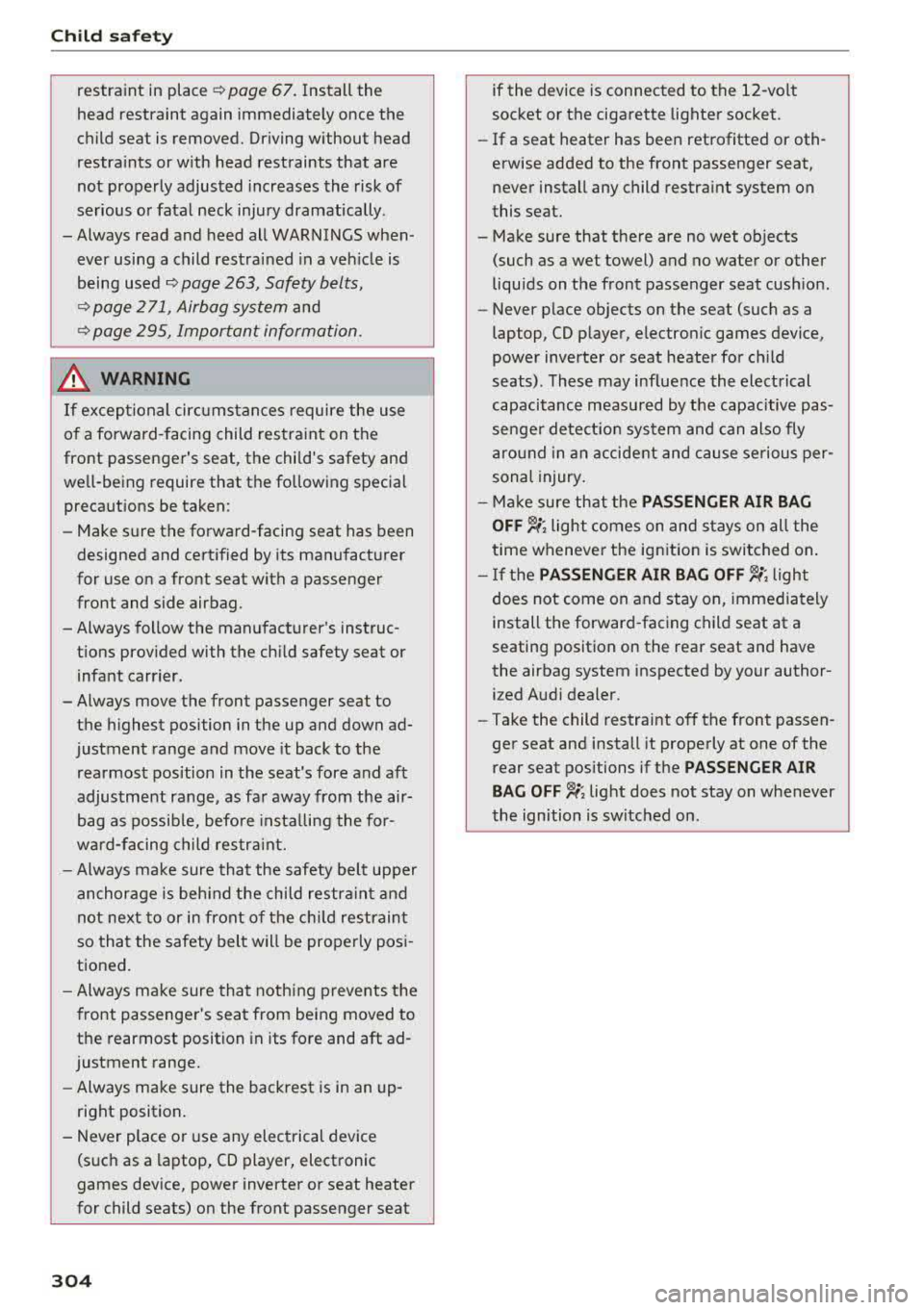
If exceptional circumstances require the use
of a forward-facing child restraint on the
front passenger's seat , the child's safety and
well-being require that the following special precautions be taken:
- Make sure the forward-facing seat has been
designed and certified by its manufacturer
for use on a front seat with a passenger
front and side airbag.
- Always follow the manufacturer 's instruc
tions provided with the child safety seat or
infant carrier.
- Always move the front passenger seat to the highest position in the up and down ad
justment range and move it back to the
rearmost position in the seat's fore and aft
adjustment range, as far away from the air
bag as possible, before installing the for
ward-facing child restraint.
- Always make sure that the safety belt upper
anchorage is behind the child restraint and
not next to or in front of the child restraint
so that the safety belt will be properly posi
tioned.
- Always make sure that nothing prevents the
front passenger's seat from being moved to
the rearmost position in its fore and aft ad
justment range.
- Always make sure the backrest is in an up
right position.
- Never place or use any electrical device (such as a laptop, CD player, electronic
games device, power inverter or seat heater
for child seats) on the front passenger seat
304 if the device is connected to the 12-volt
socket or the cigarette lighter socket.
- If a seat heater has been retrofitted or oth
erwise added to the front passenger seat,
never install any child restraint system on
this seat.
- Make sure that there are no wet objects (such as a wet towel) and no water or other
liquids on the front passenger seat cushion .
- Never place objects on the seat (such as a
laptop, CD player, electronic games device,
power inverter or seat heater for child
seats) . These may influence the electrical
capacitance measured by the capacitive pas
senger detect ion system and can also fly
around in an accident and cause serious per
sonal injury.
- Make sure that the
PASSENGER AIR BAG
OFF
11,;; light comes on and stays on all the
time whenever the ignition is switched on.
- If the
PASSENGER AIR BAG OFF 11,;; light
does not come on and stay on, immediately
install the forward-facing child seat at a
seating position on the rear seat and have
the airbag system inspected by your author
ized Audi dealer.
- Take the child restraint off the front passen
ger seat and install it properly at one of the rear seat positions if the
PASSENGER AIR
BAG OFF
11,;; light does not stay on whenever
the ignition is switched on .
Page 307 of 403
Child safety
body and the front of the passenger compart
ment, the airbag can inflate completely and pro
vide supplemental protection in certain frontal
collisions.
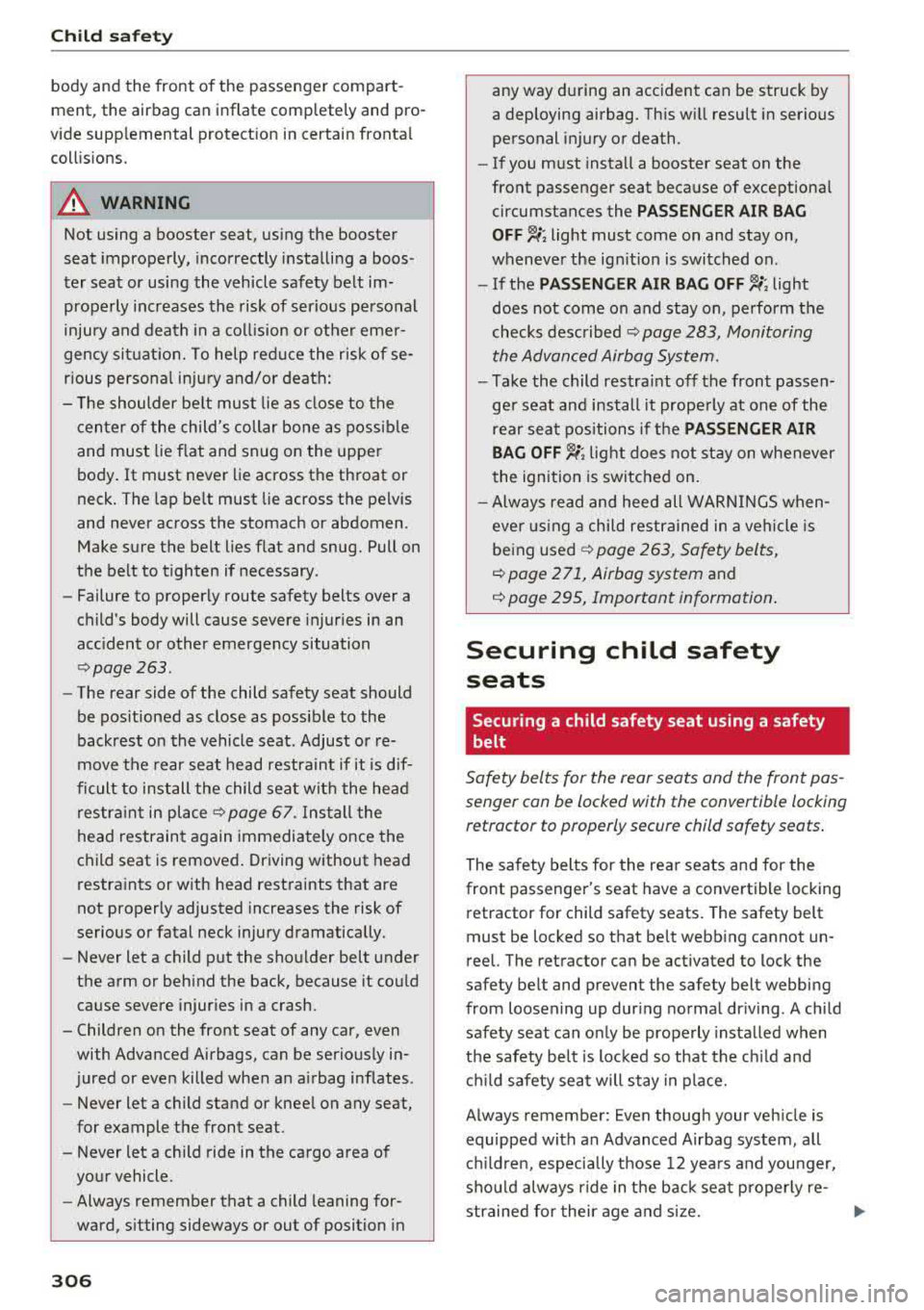
.,&. WARNING
Not using a booster seat, using the booster
seat improperly, incorrectly installing a boos
ter seat or using the vehicle safety belt im
properly increases the risk of serious personal
injury and death in a collision or other emer
gency situation. To help reduce the risk of se
rious personal injury and/or death:
- The shoulder belt must lie as close to the
center of the child's collar bone as possible
and must lie flat and snug on the upper
body.
It must never lie across the throat or
neck. The lap belt must lie across the pelvis
and never across the stomach or abdomen .
Make sure the belt lies flat and snug. Pull on
the belt to tighten if necessary .
- Failure to properly route safety belts over a
child's body will cause severe injuries in an
accident or other emergency situation
¢ page 263 .
-The rear side of the child safety seat should
be positioned as close as possible to the
backrest on the vehicle seat . Adjust or re
move the rear seat head restraint if it is dif
ficult to install the child seat with the head
restraint in place
¢page 67. Install the
head restraint again immediately once the
child seat is removed. Driving without head
restraints or with head restraints that are
not properly adjusted increases the risk of
serious or fatal neck injury dramatically.
- Never let a child put the shoulder belt under
the arm or behind the back, because it could
cause severe injuries in a crash.
- Children on the front seat of any car, even
with Advanced Airbags, can be seriously in
jured or even killed when an airbag inflates .
- Never let a child stand or kneel on any seat,
for example the front seat.
- Never let a child ride in the cargo area of
your vehicle.
- Always remember that a child leaning for
ward, sitting sideways or out of position in
306
any way during an accident can be struck by
a deploying airbag. This will result in serious
personal injury or death .
- If you must install a booster seat on the
front passenger seat because of exceptional
circumstances the
PASSENGER AIR BAG
OFF
fj,;; light must come on and stay on,
whenever the ignition is switched on.
- If the
PASSENGER AIR BAG OFF fj,;; light
does not come on and stay on, perform the
checks described ¢
page 283, Monitoring
the Advanced Airbag System.
- Take the child restraint off the front passen
ger seat and install it properly at one of the rear seat positions if the
PASSENGER AIR
BAG
OFF~; light does not stay on whenever
the ignition is switched on.
- Always read and heed all WARNINGS when
ever using a child restrained in a vehicle is
being used¢
page 263, Safety belts,
¢ page 2 71, Airbag system and
¢ page 295, Important information.
Securing child safety
seats
Securing a child safety seat using a safety
belt
Safety belts for the rear seats and the front pas
senger can be locked with the convertible locking
retractor to properly secure child safety seats.
The safety belts for the rear seats and for the
front passenger's seat have a convertible locking
retractor for child safety seats. The safety belt
must be locked so that belt webbing cannot un
reel. The retractor can be activated to lock the
safety belt and prevent the safety belt webbing
from loosening up during normal driving . A child
safety seat can only be properly installed when
the safety belt is locked so that the child and
child safety seat will stay in place.
Always remember : Even though your vehicle is
equipped with an Advanced Airbag system, all children, especially those 12 years and younger,
should always ride in the back seat properly re-
strained for their age and size.
ll-
Page 308 of 403
a co .... N ,....
N .... 0 0
3 co
A WARNING
-
Improperly installed child safety seats in
crease the risk of serious personal injury and
death in a collision.
- Always make sure that the safety belt re
tractor is locked when installing a child
safety seat. An unlocked safety belt retrac
tor cannot hold the child safety seat in place
during normal driving or in a crash.
-Always buckle the child safety seat firmly in place even if a child is not sitting in it. A
loose child safety seat can fly around during
a sudden stop or in a collision.
- Always make sure that the rear seat back
rest to which the center rear safety belt* is
attached is securely latched whenever the
rear center safety belt is being used to se
cu re a ch ild restraint .
-If the backrest is not securely latched, the
child and the child restraint will be thrown
forward together w ith the backrest and will
strike parts of the vehicle interior. The ch ild
can be se riously injured or killed .
-Never install rear-facing child safety seats
or infant carriers on the front passenger
seat . A child will be serious ly injured and
can be killed when the passenger airbag in
flates.
-The inflating airbag will hit the child safety seat or infant carrier with great force and
will smash the ch ild safety seat and chi ld
against the backrest, center armrest, door
or roof .
-Always install rear-facing child safety seats
or infant carriers on the rear seat.
-Forward-fac ing ch ild safety seats or infant
carriers installed on the front passenger's
seat may interfere with the deployment of
the a irbag and cause serious injury to the
child .
-It is safer to install a forward -fac ing ch ild
safety seat on the rear seat .
- Always read and heed all WARNINGS when
ever using a child restrained in a veh icle is
being used
~ page 295 . Specia l precaut ions
apply when installing a child safety seat on
the front passenger seat
~ page 2 72, Child
Ch ild safety
restraints an the front seat -some impor
tant things to know.
A WARNING
-A lways take special precautions if you must
i nstall a forward or rearward-facing child re
stra int on the front passenger's seat in excep
tional s ituations:
-Whenever a forward or rearward-fac ing
child restraint is installed on the front pas
senger seat, the
PASSENGER AIR BAG OFF
~; light must come on and stay on whenev
er the ign ition is switched o n.
-If the PASSENGER AIR BAG OFF ~; light
does not come on and stay on, perform the
checks desc ribed
~ page 283, Monitoring
the Advanced Airbag System.
-Take the child restra int off the front passen
ge r seat and install it prope rly at one of the
rear seat positions i f the
PASSENGER AIR
BAG
OFF ~; light does not stay on whenever
the ignition is switched on .
-Improper installat ion of child res tra ints can
reduce their effectiveness or even prevent
them f rom providing any protect ion .
-An improperly installed child restraint can
interfere with the airbag as it deploys and
serious ly injure or even kill the chi ld.
-Always carefully follow the manufacturer's
instr uctions provided with the child safety
seat or carr ier .
- After checking to make sure that the c hild
restraint is properly installed, make certain
that the child restraint is correctly recog
n ized by the capacitive passenger detection
system in the front passenger seat and that
the
PASSENGER AIR BAG OFF ~; light sig
na ls the cor rect front passenger fronta l air
bag status.
A WARNING
F orwa rd-facing child restra ints:
-Always make sure the forward-facing seat
has bee n des igned and certified by its man
ufacturer for use on a front seat with a pas
senger front and side airbag.
-
307
Page 309 of 403
Child safety
-Never put the forward-facing child restraint
up, against or very near the instrument pan
el.
- Always move the front passenger seat to
the highest position in the up and down ad
justment range and move it back to the
rearmost position in the seat's fore and aft
adjustment range, as far away from the air
bag as possible, before installing the for
ward-facing child restraint.
- Always make sure that the safety belt upper
anchorage is behind the child restraint and
not next to or in front of the child restraint
so that the safety belt will be properly posi
tioned.
- Make sure that the
PASSENGER AIR BAG
OFF~ ; light comes on and stays on all the
time whenever the ignition is switched on.
A WARNING
Rearward-facing child restraints:
- A child in a rearward-facing child safety seat
installed on the front passenger seat will be
seriously injured and can be killed if the
front airbag inflates -even with an Ad
vanced Airbag System.
- The inflating airbag will hit the child safety
seat or infant carrier with great force and
will smash the child safety seat and child
against the backrest, center armrest, door
or roof .
- Always be especially careful if you must in
stall a rearward facing child safety seat on
the front passenger seat in exceptional cir
cumstances .
- Make sure that the
PASSENGER AIR BAG
OFF~; light comes on and stays on all the
time whenever the ignition is switched on.
- If the
PASSENGER AIR BAG OFF~; light
does not come on and stay on, immediately
install the rear-facing child safety seat in a
rear seating position and have the airbag
system inspected by your Audi dealer .
308
· Activating the convertible locking retractor
Use the convertible locking retractor to secure a
child restraint.
Always heed the child safety seat manufacturer 's
instructions when installing a child restrain t in
your vehicle . To activate the convertible locking
retractor:
.. Place the child restraint on a seat, preferably
on the rear seat .
.. Slowly pull the belt all the way out.
.. Route it around or through the child restraint
belt path
~ ,&. .
.. Push the child safety seat down with your full
weight to get the safety belt really tight.
.. Insert the belt tongue into the buckle for that
seating position.
.. Guide the safety belt back into the retractor un
til the belt lies flat and snug on the child safety
seat.
.. You should hear a "clicking" noise as the belt
winds back into the inertia reel. Test the con
vertible locking retractor by pulling on the belt.
You should no longer be able to putt the belt
out of the retractor. The convertible locking re
tractor is now activated .
.. Make sure that the red release button is facing
away from the child restraint so that it can be
unbuckled quickly.
.. Pull on the belt to make sure the safety belt is
properly tight and fastened so that the seat
cannot move forward or sideways more than
one inch (2 .5 cm) .
A WARNING
Using the wrong child restraint or an improp
erly installed child restraint can cause serious
personal injury or death in a crash.
- Always make sure that the safety belt re
tractor is locked when installing a child
safety seat. An unlocked safety belt retrac
tor cannot hold the child safety seat in place
during normal driving or in a crash.
- Always buckle the child safety seat firmly in
place even if a child is not sitting in it. A
loose child safety seat can fly around during
a sudden stop or in a crash.
Page 319 of 403
Checking and Filling
filler door. For additional information on fuel,
see
<=> page 315.
The fuel tank capacity of your vehicle is listed in
the
Technical Data section <=> page 381.
To avoid fuel spilling or evaporating from the fuel
tank always close fuel cap properly and com
pletely . An improperly closed fuel filler cap may
also cause the MIL lamp
<=>page 24 to come on.
A WARNING
Not paying attention when fueling or han
dling fuel incorrectly can lead to fires, explo
sions or serious injuries.
- Fuel ignites easily and can cause serious
burns and other injuries .
- If you do not switch the engine off when fu
eling and/or do not insert the fuel nozzle
completely into the tank opening, fuel can
leak out or run over. Leaked fuel can ignite
and start a fire .
- Do not use the telephone while fueling. The
electromagnetic rays can cause sparks,
which can ignite fuel vapors and start a fire.
- Do not sit in your vehicle while fueling. If
you must make an exception and enter your
vehicle again while fueling, close the door and touch metal to discharge static electric
ity before touching the fuel nozzle . Static
electricity can create sparks, which can ig
nite vapors when fueling.
- Do not smoke or have an open flame in the
area when fueling your vehicle or filling a
fuel container because this increases the
risk of an explosion .
-For your safety , carrying fuel containers in
your vehicle is not recommended. Whether
full or empty, the container can leak and
cause a fire in the event of an accident.
-If you must make an exception and trans
port a fuel container, note the following:
- Never fill the fuel container with fuel
while it is in or on the vehicle . Stat ic elec
tricity is discharged when filling which can
cause the fuel vapors to ignite and in
creases the risk of an explosion.
- Always place a fuel container on the
ground before filling.
318
-Always hold the fuel nozzle completely in
the fuel container when filling.
-If the fuel container is made of metal, the
fuel nozzle must always be in contact with
the container when filling it with fuel. This
prevents static electricity from discharg
ing .
-Never spill fuel in the vehicle or the lug
gage compartment . Evaporated fuel is ex
plosive and increases the risk of serious in
jury or death .
- Follow legal requirements when using, storing and transporting fuel containers .
-Make sure the fuel container conforms to
industry standards (ANSI/ASTM F8S2 -86).
{(D Note
- Remove spilled fuel from vehicle paint im
mediately, because it can damage paint.
- Never drive until the fuel tank is completely
empty. The irregular supply of fuel that re
sults from that can cause engine misfires.
Uncombusted fuel will enter the exhaust
system and increase the risk of damage to
the catalytic converter.
- If the fuel tank runs completely empty in a
vehicle with a
diesel engine, the ignition
must remain switched on for at least 30
seconds after refueling before starting the
engine.
It may take longer than usual for
the engine to start, even up to a minute.
This is because the air must first bleed out
of the fuel system when starting the engine.
@ For the sake of the environment
Do not overfill the fuel tank, otherwise fuel
can leak out when the vehicle is warming up.
@ Tips
Diesel vehicles are equipped with a diesel mis
fueling guard.
It allows the vehicle to be fu
eled only with a diesel fuel pump nozzle. A
worn or damaged nozzle or a nozzle that is
too small may not be able to open the diesel
misfueling guard. If this is the case, try turn
ing the nozzle before inserting it in the fuel
filler neck, use a different fuel pump, or see
..,_
Page 320 of 403
an authorized Audi dealer or authorized Audi
Service Facility for assistance.
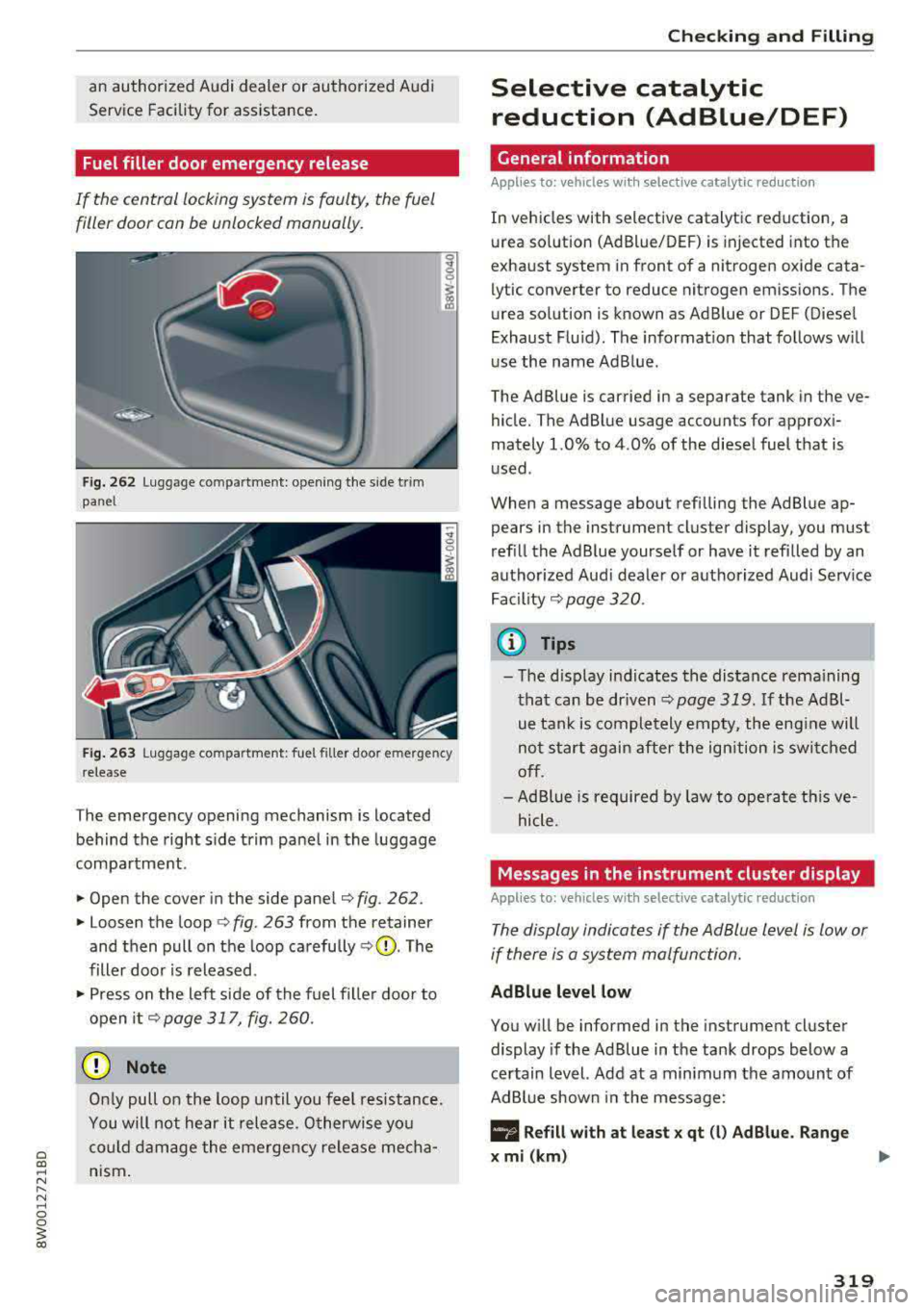
Fuel filler door emergency release
If the central locking system is faulty, the fuel
filler door can be unlocked manually.
Fig. 262 Luggage co mpartment: opening the side trim
panel
Fig . 263 Luggage compartment: fuel filler door e merge ncy
r elease
The emergency opening mechanism is located
behind the right side trim panel in the luggage
compartment.
... Open the cover in the side panel ¢fig. 262.
... Loosen the loop c;, fig. 263 from the retainer
and then pull on the loop carefully
¢(D . The
filler door is released .
... Press on the left side of the fuel filler door to
open it
¢ page 317, fig. 260.
(D Note
Only pull on the loop until you feel resistance.
You will not hear it release . Otherwise you
could damage the emergency release mecha
nism.
Checking and Filling
Selective catalytic
reduction (AdBlue/DEF)
General information
Applies to: vehicles with selec tive catalytic reduction
In vehicles with selective catalytic reduction, a
urea solution (AdBlue/DEF) is injected into the
exhaust system in front of a nitrogen oxide cata
lytic converter to reduce nitrogen emissions. The
urea solution is known as Ad Blue or DEF (Diesel
Exhaust Fluid). The information that follows w ill
use the name AdBlue.
The Ad Blue is carried in a separate tank in the ve
hicle. The AdBlue usage accounts for approxi
mately 1.0% to 4 .0% of the diesel fuel that is
used .
When a message about refilling the AdBlue ap
pears in the instrument cluster display, you must
refill the AdBlue yourself or have it refilled by an
authorized Audi dealer or authorized Audi Service
Facility
c;, page 320 .
{D Tips
-The display indicates the distance remaining
that can be dr iven
c;, page 319. If the Ad Bl
ue tank is completely empty, the engine will
not start again after the ignition is switched
off.
-Ad Blue is required by law to operate this ve
hicle.
Messages in the instrument cluster display
Appl ies to: vehicles wi th selective catalytic reduction
The display indicates if the Ad Blue level is low or
if there is a system malfunction.
AdBlue level low
You will be informed in the instrument cluster
display if the AdBlue in the tank drops below a
certain level. Add at a minimum the amount of
AdBlue shown in the message:
II Refill with at least x qt (l) Ad Blue. Range
x mi (km )
319
Page 321 of 403
Checking and Filling
This message appears when there is only enough
Ad Blue left to drive the distance indicated in the
instrument cluster . Fill the Ad Blue .
• Refill with at least x qt (l) Ad Blue. No en
gine start in x mi (km). See owner's manual
This message appears when there is only enough
Ad Blue left to drive the distance indicated in the
instr ument cluster. Fill the Ad Blue. Otherwise
the engine will not start again if you stop it once
the d istance indicated has been driven .
• Refill with at least x qt (l) AdBlue. Engine
start not possible . See owner's manual
This message appears when the AdBlue tank is
empty. Fill the AdB lue. Otherwise you will not be
able to start the engine again once you stop it .
The AdBlue must be refilled when the amount in
the tank has reached the minim um level
c::> page 320, Preparation.
Incorrect filling/system malfunction
A message appears if the Ad Blue tank was filled
with a fluid other than AdBlue and the system has detected that the tank was fi lled incorrectly ,
or if there is a system malfunction .
II Ad Blue: malfunction! No engine start in
x mi (km). See owner's manual
This message appears when it is only possible to
drive the d istance ind icated in the instrument
cluster. Drive to the nearest authorized Audi
dealer or authorized Aud i Serv ice Facility to have
the malfun ction corrected. Otherwise the engine
will not start again if you stop it once the dis
tance indicated has been driven .
• Ad Blue: malfunction! No engine start possi
ble. See owner's manual
This message appears if the system has detected
that the tank was filled incorrectly or that there
is a malfunction . Drive immediately to the near
est authorized Aud i dealer or authorized Audi
Service Facility to have the malfunction cor rect
ed. Otherwise you will not be able to start the en
g in e again once you stop it .
320
Preparation
App lies to : vehicles with selective cata lyt ic reduct ion
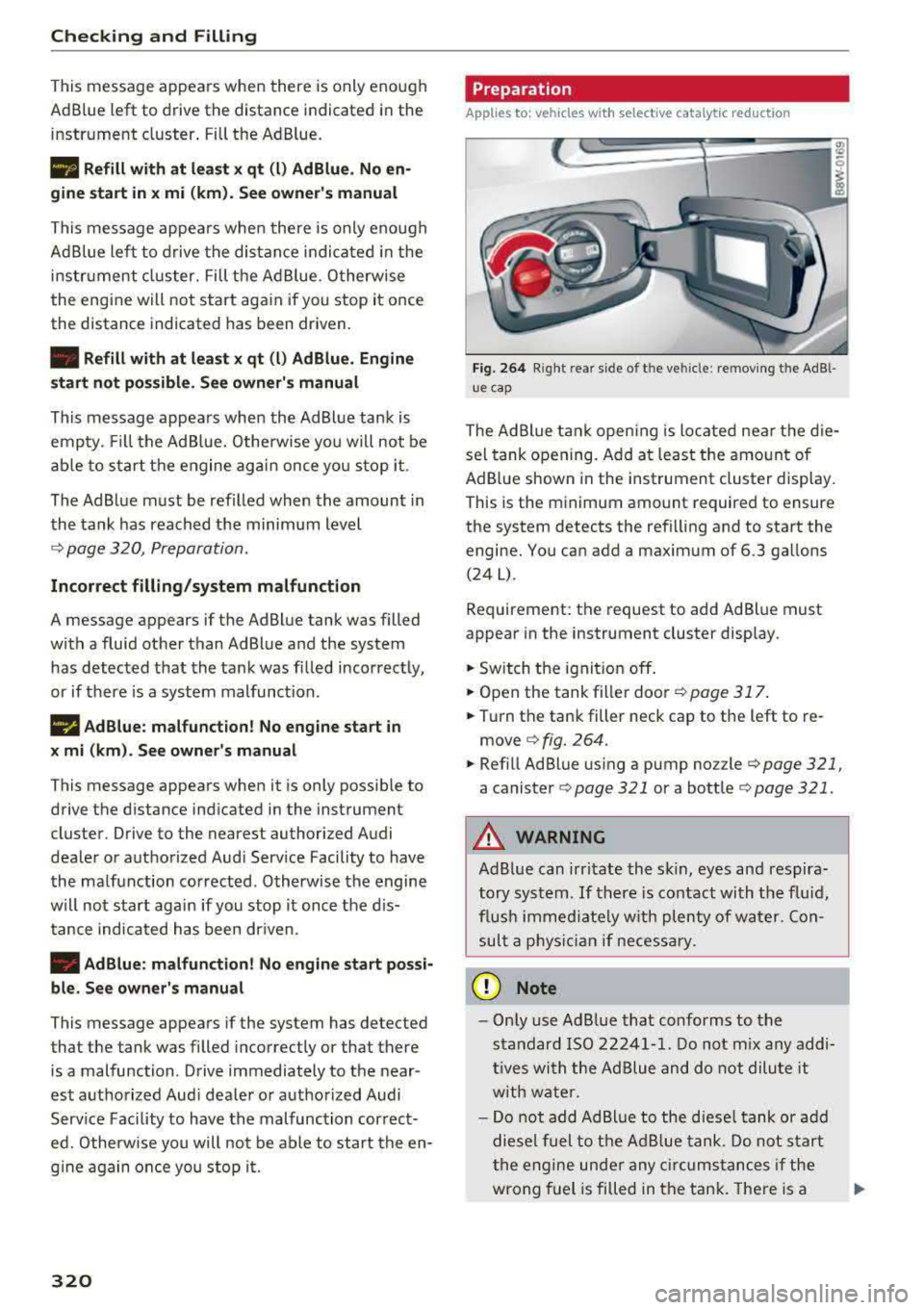
Fig. 264 R ig ht re ar sid e o f th e ve hicle: removing th e Ad B l
ue cap
The Ad Blue tank open ing is located near the die
sel tank opening. Add at least the amount of
Ad Blue shown in the instrument cluster display.
This is the minimum amount required to ensure
the system detects the refilling and to start the
engine. You can add a maximum of 6 .3 gallons
(24
L) .
Requ irement: the request to add Ad Blue must
appear in the instrument cluster display .
.. Switch the ignition off.
.. Open the tank fille r doo r c::> page 317 .
.. Turn the tank filler neck cap to the left to re
move
c::> fig. 264 .
.. Refill Ad Blue using a pump no zzle c::> page 321,
a canister c::> page 321 or a bottle c::>page 321.
A WARNING
AdBlue can irritate the skin, eyes and respira
tory system .
If there is contact with the fluid,
flush immed iately w ith plenty of water . Con
sult a physician if necessary .
(D Note
-Only use Ad Blue that conforms to the
standard ISO 22241-1. Do not mix any addi
ti ves wi th the Ad Blue and do not dilute it
with water .
- Do not add AdBlue to the diesel tank or add
diesel fuel to the Ad Blue tank. Do not start
the engine under any circumstances if the
wrong fuel is filled in the tank. There is a
Page 324 of 403
a co .... N ,....
N .... 0 0
3 co
Engine compartment
Working in the engine compartment
Special care is required if you are working in the
engine compartment
F or wo rk in th e en gine c ompar tment , suc h as
ch eckin g and fi llin g flu id s, th ere is a risk of in
j u ry , sca lding , acci dent s, a nd b urn s. Fo r this
re aso n, follow all the warnin gs and ge nera l
safet y pr eca uti ons pr ov ided in the follow ing in
form ation . Th e e ng ine c ompartm en t is a d an
ger ous a re a .
~ ,&. .
_& WARNING
- T urn the engine off.
- Switch the ign ition off .
- Set the parking brake .
- Shift the gearshift lever to neutral in vehicles with a manual transm ission and se
lect the P selector lever posit ion in vehicles
with an automatic transmission .
- Let the engine coo l down.
- Never open the hood when there is steam or coolant escaping from the eng ine compart
ment, because there is a risk that you cou ld
be burned . Wait until no steam or coolant is
escaping.
- Keep children away from the engine com
partment.
- Never spill flu ids on a hot engine. These flu
ids (such as the anti-freezing agent con
tained in the coolant) can ignite.
- Avoid sho rt circu its in the e lectrical system.
- When working in the engine compartment,
remember that the radiator fan can sw itch
on even if the ign ition is switched off , which
increases the risk of inj ury .
- Never open the cap on the coolant expan
sion tank when the eng ine is warm. The
cooling system is under press ure.
- T o protect your face, hands, and arms from
hot steam or coolant, cover the cap with a
large cloth when opening.
- Do not remove the eng ine cover under any
c ircumstances . This increases the risk of
burns .
Check ing and Filling
-If tests need to be performed with the en
gine running, there is add itiona l danger due
to mov ing components (such as the ribbed
belt, alternator and radiator fan) and from
the high-voltage ignition system.
-Do not under any circumstances activate the
throttle inadvertently (for example, by hand
from the engine compartment) if the veh i
cle is stat ionary but the eng ine is running
and a gea r is engaged. Otherwise, the veh i
cle will start to move immed iate ly and this
could result in an accident.
- Pay attent ion to the following warn ings
when wor k on the fue l system is required :
- Do not smoke.
- Never work near open flames.
-Always have a working fi re extinguisher
nearby.
-All work on the battery or electrical system in your vehicle can result in injuries, chemi
cal burns, accidents or burns. Because of
this, all work must be performed
o nly by an
author iz ed Audi dealer or author iz ed Audi
Serv ice Facility.
-To reduce the r isk of electric shock and in
jury, never touch the following components
when the engine is runn ing or is being start
ed:
- Ign ition cable
- Other components in the e lectronic high-
vo ltage ign ition system
-I f you must check or perform wo rk on the
engine wh ile it is running:
-First, set the parking brake and and move
the gearshift lever to neutral (for manual
transm issions) or select the P selector lev
er position (for automatic transm iss ions).
- Always proceed w ith extreme caution so
that clothing, jewelry or long hair do not become caught in the radiator fan, fan
belt or other moving components or do
not come into contact with hot compo
nents. Tie bac k long hair befo re beginning
work and do not wear clothing that can hang down into the engine.
-Lim it your exposure to exhaust and chemi
cals to as short a time as possible
¢ .&. .
32 3