warning AUDI S4 CABRIOLET 2009 Owners Manual
[x] Cancel search | Manufacturer: AUDI, Model Year: 2009, Model line: S4 CABRIOLET, Model: AUDI S4 CABRIOLET 2009Pages: 340, PDF Size: 77.32 MB
Page 155 of 340
________________________________________________ D_r_iv _ i _n_, g,::._ S_ a_ fe__, ly'-------.J"'
Only use floor mats that leave the pedal area free and can be
secured with floor mat fasteners.
If a brake circuit fails, increased brake pedal travel is required to
bring the vehicle to a full stop.
& WARNING
Pedals that cannot move freely can cause loss of vehicle control
and increase the risk of serious injury.
• Never place any objects in the driver's footwell. An object could
get into the pedal area and interfere with pedal function . In case
of sudden braking or an accident, you would not be able to brake
or accelerate!
• Always make sure that nothing can fall or move into the
driver's footwell. •
Floor mats on the driver side
Always use floor mats that can be securely attached to
the floor mat fasteners and do not interfere with the free
movement of the pedals.
-Make sure that the floor mats are properly secured and
cannot move and interfere with the pedals~&.
Use only floor mats that leave the pedal area unobstructed and that
are firmly secured so that they cannot slip out of position. You can
obtain suitable floor mats from your authorized Audi Dealer.
Floor mat fasteners are installed in your Audi.
Floor mats used in your vehicle must be attached to these fasteners.
Properly securing the floor mats will prevent them from sliding into
positions that could interfere with the pedals or impair safe opera
tion of your vehicle in other ways .
Controls and equip
ment Safety first Vehicle operation
& WARNING
Pedals that cannot move freely can result in a loss of vehicle
control and increase the risk of serious personal injury.
•
Always make sure that floor mats are properly secured .
• Never place or install floor mats or other floor coverings in the
vehicle that cannot be properly secured in place to prevent them
from slipping and interfering with the pedals or the ability to control the vehicle.
• Never place or install floor mats or other floor coverings on top
of already installed floor mats. Additional floor mats and other
coverings will reduce the size of the pedal area and interfere with
the pedals.
• Always properly reinstall and secure floor mats that have been
taken out for cleaning .
• Always make sure that objects cannot fall into the driver foot
well while the vehicle is moving. Objects can become trapped
under the brake pedal and accelerator pedal causing a loss of
vehicle control . •
Stowing luggage
Loading the luggage compartment
All luggage and other objects must be properly stowed
and secured in the luggage compartment.
Loose items in the luggage compartment can shift
suddenly, changing vehicle handling characteristics. Loose
items can also increase the risk of serious personal injury in
a sudden vehicle maneuver or in a collision.
- Distribute the load evenly in the luggage compartment . ..,
Vehicle care Do-it-yourself service Technical data
Page 156 of 340
___ D_ ri_v _i_n ..::g::;.._ S_ a_ f _e__, ly'---------------------------------------------------
- Alw ay s place an d prop erly secure h eavy items in the
luggage com partm en t as fa r fo rwa rd as possi ble.
& WARNING
Improperly stored luggage or other items can fly through the
vehicle causing ser ious personal injury in the event of hard br aking
or an a ccident. To help reduce the risk of serious personal injury :
• Always put objects , for e xample , luggage or other heavy items
in the luggage compartment.
& WARNING
Heavy loads will influence the way your vehicle handles. To help
reduce the risk of a loss of control leading to serious personal
injury :
• Always keep in mind when transporting heavy objects , that a
change in the center of gravity can also cause changes in vehicle
handling:
-Always distribute the load as e venly as possible .
- Place heavy objects as far forward in the luggage compart -
ment as possible .
• Never exceed the Gross Axle Weight Rating or the Gros s
Vehicle Weight Rating specified on the safety compliance sti cker
on the left door jamb. Exceeding permis sible weight standards
c an cau se the veh icle to slide and handle differently .
• Please ob serve information on safe driving:::::,
page 146.
& WARNING
To help prevent poisonous exhaust gas from being dra wn into the
vehicle , always keep the rear l id clo sed while driv ing.
• Ne ver t ransport obje cts larger than those fitting completely
into the luggage area because the rear lid cannot be fully closed.
& W ARNING (continued )
• If you absolutely must drive with the rear lid open, observe the
following notes to reduce the risk of poisoning :
- Close all windows ,
- Close the power top ,
- Open all air outlets in the instrument panel ,
- Switch off the air recirculation ,
- Set the fre sh air fan to the highest speed .
& WARNING
Always make sure that the doors, all windows , the power roof and
the rear lid are securely closed and locked to reduce the ri sk of
injury when the vehicle is not being used.
• After closing the rear lid , always make sure that it i s properly
closed and locked .
• Never leave your vehicle unattended especially with the rear lid
left open. A child could crawl into the vehicle through the luggage
compartment and close the rear lid becoming trapped and unable
to get out . Being trapped in a vehi cle can le ad to serious personal
injury.
• Never let ch ildren play in or around the vehicle.
• Never let pa ssengers ride in the luggage compartment . Vehicle
occupants must always be properly restrained in one of the
vehicle's seating po sition s.
[ i ] Tips
• Air circu lat io n helps to reduce window fogg in g when the power
top is c losed. Stale air escapes to the outside through slots in the
t rim pa nels o n both sides of the luggage co mpartment. Make sure
that these s lots are not b locked. _.
Page 158 of 340
___ D_ r _i_v _i_n ..;::g =-- S_ a_ f_ e--= ly'----------------------------------------------------
Automatic rollover protection system
Function
The automatic roll over protection system helps to protect
the passengers in case the vehicle turns over.
1J ~
I ...
,
... . ' : :
: :
'
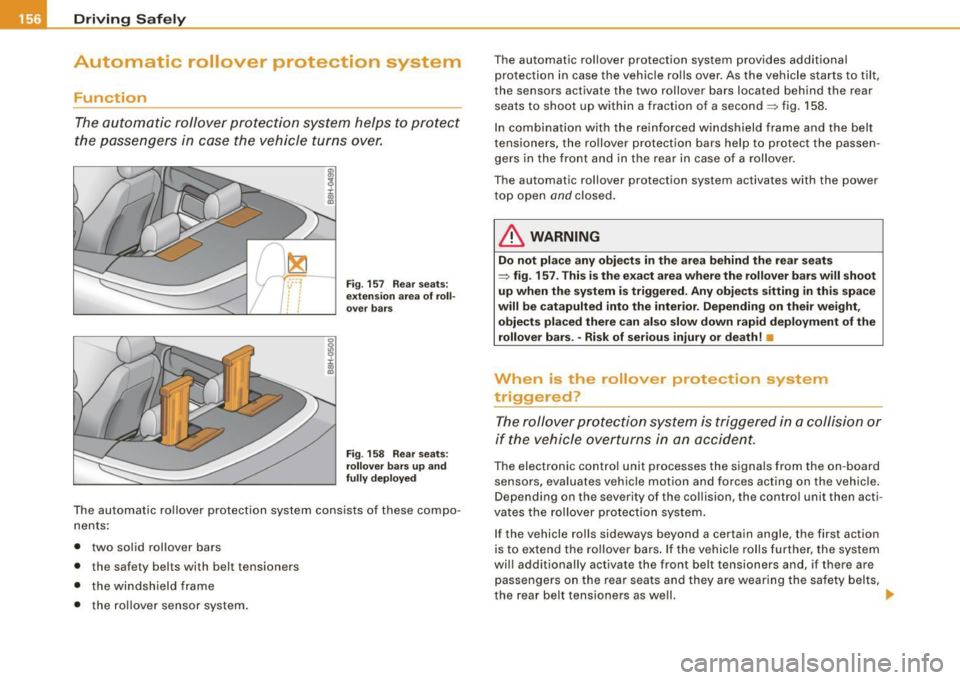
F ig . 157 Rear sea ts:
ex te n sio n area o f ro ll
over ba rs
F ig . 158 Rea r sea ts :
r ollo ver bars up and
full y dep loyed
The automatic rollover protection system cons ists of these compo
nents:
• two solid rollover bars
• the safety bel ts with belt tensioners
• the windshield frame
• the ro llover sensor system. The automatic rol
lover protection system provides additional
protection in case the vehicle ro lls over. As the vehicle starts to tilt,
the sensors activate the two rollover bars located behind the rear
seats to shoot up wi thin a fraction of a second~ fig. 158 .
In combinat ion with the reinforced windshield frame and the bel t
tensioners, the rollover p rotection bars help to protect the passen
gers in the front and in the rear in case of a rollover.
The automatic rollover protection system activates with the power
top open
and closed.
& WARNING
Do not place any obje cts in the ar ea be hind the r ear seats
~ fig . 157. T his is the e xact area where the rollover b ars will shoot
up wh en th e syst e m i s triggered . An y ob jects si tting in th is s pac e
w ill be cata p ulte d into the inter ior. Depending on the ir wei ght,
object s pl ace d there can also s lo w do wn rap id deploym ent of th e
r o llover bars. -Ri sk of seri ou s inj ur y or deat h! •
When is the rollover protection system
triggered?
T he rollover protection system is triggered in a collisi on or
if the vehicle overturns in an accident.
The electronic control unit processes the signals from the on -board
sensors, evaluates vehicle motion and forces act ing on the vehic le.
Depending on the severity of the co llision, the control unit then acti
vates the rol lover protection system .
If the vehicle rol ls sideways beyond a certain angle , the first action
is to extend the ro llover bars . If the vehicle rolls further, the system
wil l additional ly activate the front belt tensioners and, if there are
passengers on the rear seats and they are wearing the safety belts,
the rear belt tensioners as well. ..,
Page 160 of 340
___ D_ r _i_v _i_n ..;;:g ::;,._ S_ a_ f_ e---= ly'----------------------------------------------------
- Then press the rollover bar all the way down until you
hear it engage.
Check to make sure the rollover bar is securely engaged
before you release your grip on the bar.
Close the cover @~ page
157, fig. 160 .
- Perform the same procedure on the second rollover bar.
- You can now open and close the power top again.
& WARNING
• If there is a problem in the rollover protection system, the
system must be checked by a professional mechanic as soon as
possible.
If this is not done, there is a risk that the rollover protec
tion system may not be activated in the event of an accident.
• No modifications of rollover protection system components
are permitted.
• Work on the rollover protection system must only be done by a
professional mechanic . Improperly performed work can cause the
system to fail or release unintentionally, possibly causing an
injury!
• Always have your vehicle serviced whenever the service
interval display indicates that it is time for service . This will ensure
that the system will operate properly over the long term. The roll over protection system must be checked by a professional
mechanic every two years or sooner. •
Page 161 of 340
_______________________________________________ S_a _f _e _t -=-y _ b_ e_lt _s ______ lffllll
Safety belts
General notes
Always wear safety belts!
Wearing safety belts correctly saves lives!
This chapter explains why safety belts are necessary, how
they work and how to adjust and wear them correctly.
- Read all the information that follows and heed all of the
instructions and WARNINGS.
& WARNING
Not wearing safety belts or wearing them improperly increases
the risk of serious personal injury and death.
• Safety belts are the single most effective means available to
reduce the risk of serious injury and death in automobile acci
dents. For your protection and that of your passengers, always
correctly wear safety belts when the vehicle is moving.
• Pregnant women, injured, or physically impaired persons must
also use safety belts . Like all vehicle occupants, they are more
likely to be seriously injured if they do not wear safety belts. The
best way to protect a fetus is to protect the mother -throughout
the entire pregnancy. •
Number of seats
Your vehicle has a total of four seating positions : two in the front
and two in the rear. Each seating posi tion has a safety belt .
Controls and equip ment Safety first
Vehicle operation
& WARNING
Not wearing safety belts or wearing them improperly increases
the risk of serious personal injury and death.
• Never strap more than one person, including small children,
into any belt. It is especially dangerous to place a safety belt over
a child sitting on your lap.
• Never let more people ride in the vehicle than there are safety
belts available.
• Be sure everyone riding in the vehicle is properly restrained
with a separate safety belt or child restraint. •
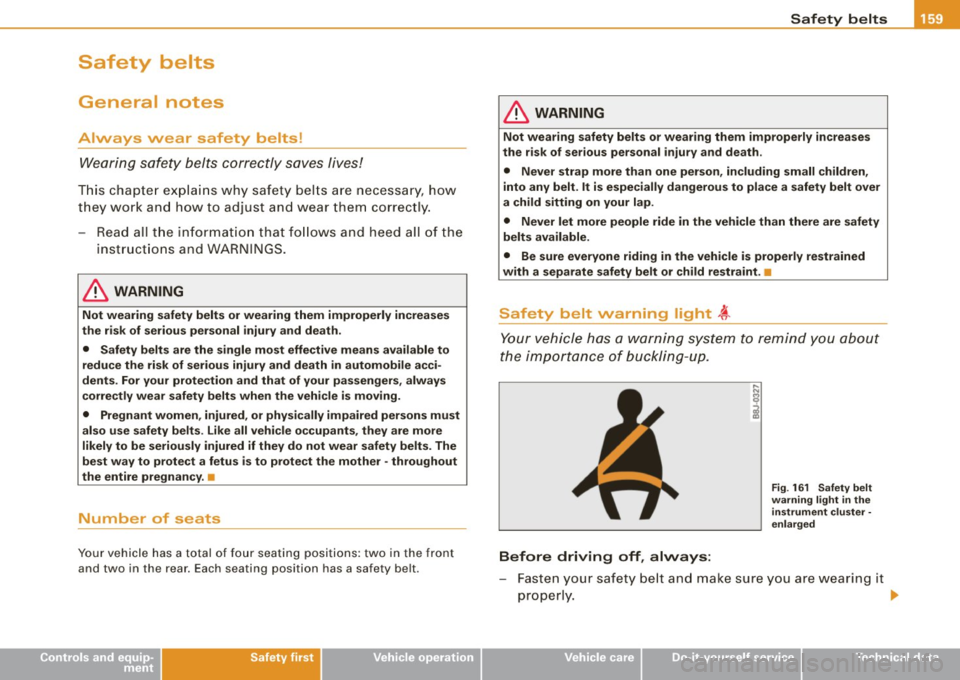
Safety belt warning light ~
Your vehicle has a warning system to remind you about
the importance of buckling-up.
Before driving off, always:
Fig. 161 Safety belt
warning light in the
instrument cluster ·
enlarged
- Fasten your safety belt and make sure you are wearing it
properly. .,
Vehicle care Do-it-yourself service Technical data
Page 162 of 340
___ S_a_ f_ e_ t-= y_ b_e_ l_ t _s _______________________________________________ _
- Make sure that your passengers also buckle up and prop
er ly wea r th eir sa fe ty be lts.
Protect your children with a child restraint system appro
pria te for t he size and age o f the children.
The warning light~ in the instrument cluster lights up when the
ignition is switched on as a reminder to fasten the safety belts. In
addition, you will hear a warning sound.
After the ignition is switched on, the warning tone will come on for about 6 seconds a long w ith a-~ warning light in the instru ment
cluster if the driver has not fastened his safety belt . As soon as the
driver has fastened his safety belt, the warning tone will stop and
the warning light will go out .
I f the driver has not buckled -up within about 24 seconds after the
warn ing tone has stopped, the warn ing tone will sound again for
about 6 seconds. The warning tone will sound repeated ly for about
6 seconds at 24 second intervals unti l the driver has buckled-up . The
safety belt warning system is active for about 5 minutes and during
this time the wa rning light in the instrument c luster will stay on.
Fa sten you r safety belt no w and make sure that your pa ssengers
also properl y put on the ir saf ety belts. •
Why safety belts?
Frontal collisions and the law of physics
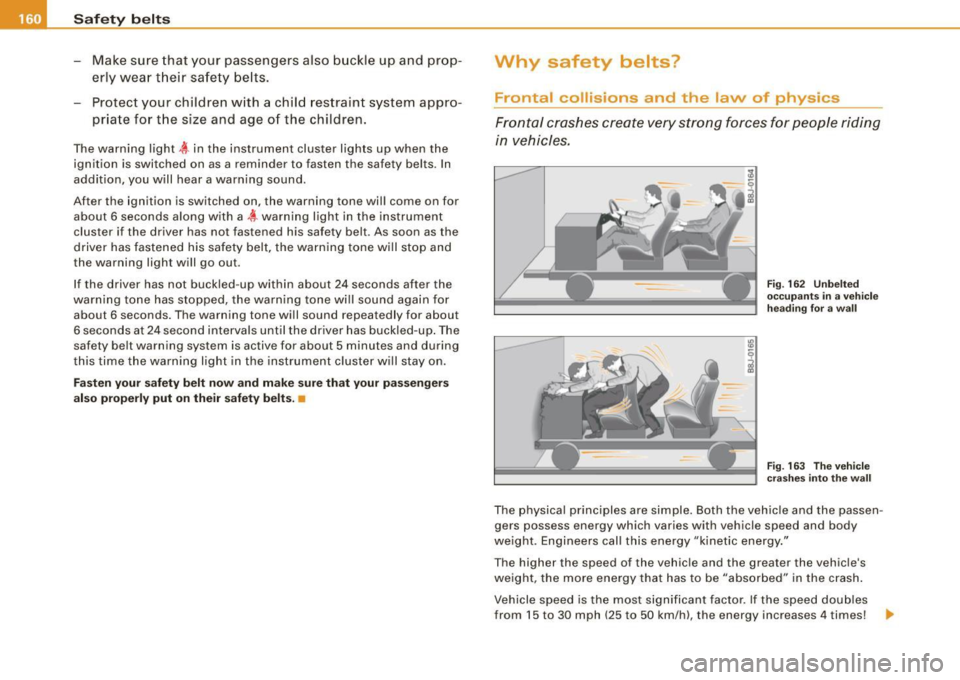
Frontal crashes create ve ry strong forces for pe ople ri ding
in vehicles.
Fig . 16 2 Unbel ted
occ upants in a ve hicle
h ead in g fo r a wall
F ig . 16 3 T he vehi cle
c ras he s in to t he wa ll
The physica l principles are simple. Both the vehicle and the passen
gers possess energy which varies with vehicle speed and body
we ight . Engineers call this energy "kinetic energy ."
The higher the speed of the vehicle and the greater the vehicle's
we ight, the mo re energy that has to be "absorbed" in the crash .
Vehicle speed is the most significant factor. If the speed doub les
from 15 to 30 mph (25 to 50 km/h), the energy increases 4 times!
~
Page 164 of 340
--~S~a ~f ~e ~t l'.y ...: b~ e~lt =:s!._ _____________________________________________ _
Safety belts protect
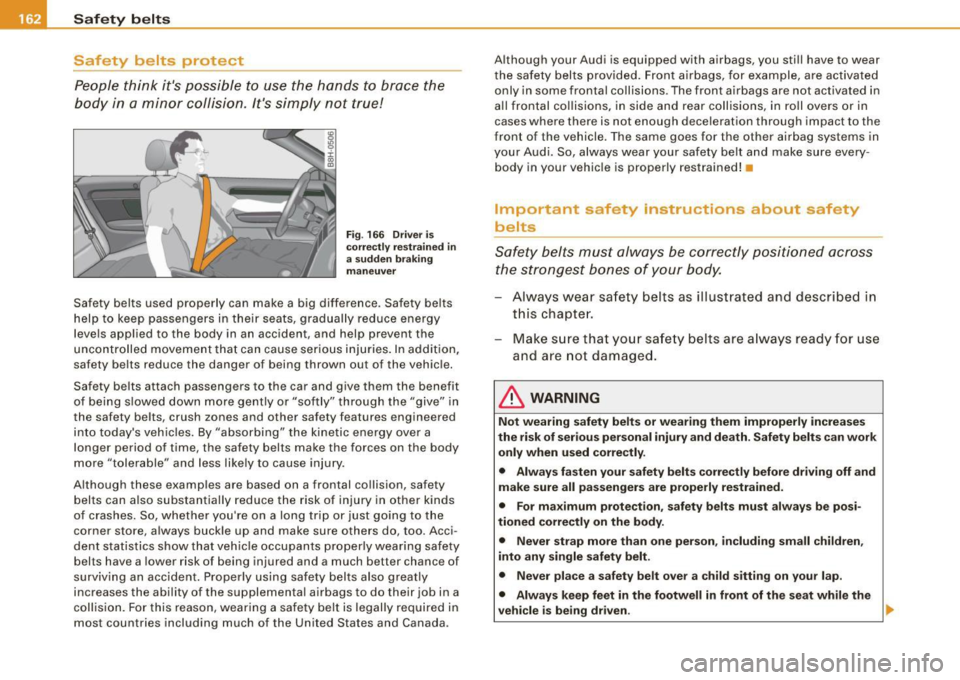
People think it's possible to use the hands to brace the
body in a minor collision . It's simply not true!
Fig . 166 Dri ver is
co rrec tly r est rai ned i n
a s ud den braking
man euv er
Safety belts used properly can make a big difference . Safety belts
help to keep passengers in their seats, gradually reduce energy levels app lied to the body in an accident, and help prevent the
uncontrolled movement that can cause serious injuries . In addition,
safety be lts reduce the danger of being thrown out of the vehic le.
Safety belts attach passengers to the car and give them the benefit
of being s lowed down more gently or "sof tly" through the "give" in
the safety belts, crush zones and other safety features engineered
into today's vehicles. By "absorbing" the kinetic energy
over a
longer period of time, the safety belts make the forces on the body
more "tolerable" and less likely to cause injury.
Although these examples are based on a frontal co llision, safety
belts can a lso substantially reduce the risk of injury in other kinds
of crashes. So, whether you're on a long tr ip or just going to t he
corner store, always buckle up and make sure others do, too. Acci
dent statistics show that vehic le occupants properly wearing safety
belts have a lower risk of being injured and a much better chance of
s u rviv ing an acc ident. Proper ly using safety belts also great ly
increases the abi lity of the supplementa l airbags to do their job in a
coll ision. For this reason, wearing a safety be lt is legally required in
most countries including much of the United States and Canada . Although your Audi is equipped with airbags, you sti
ll have to wear
t he safety belts provid ed. Fron t airbags, for example, are activated
only in some frontal collisions. The front airbags are not activated in
a ll frontal co llisions, in side and rear collisions, in ro ll
ove rs or in
cases where there is not enough dece leration through impact to the
front of the vehicle. The same goes for the other ai rbag systems in
your Audi. So, a lways wear your safety belt and make sure
eve ry
body in your vehic le is properly restrained! •
Important safety Instructions about safety
belts
Safety belts must always be correctly positioned across
the strongest bones of your body.
Always wear safety belts as illustrated and described in
this cha pte r.
Make s ure tha t your sa fe ty belts ar e always ready for us e
and are not damaged .
& WARNING
Not wearing safety belts or wearing them improperl y increases
the risk of serious per sonal injury and death . Safety belt s can w ork
only when used corre ctl y.
• Alway s fa sten yo ur safety belt s correctl y before driving off and
make sure all pa ssenger s are properl y restrained .
• For m aximum protection , safet y belts must alw ays be po si
tion ed corre ctly on the body .
• Never strap mo re than one person , including sm all children ,
into any single safety belt.
• Never pla ce a s afety belt ove r a child sitting on your lap .
• Alway s ke ep feet in the footwell in front of the seat while the
vehicle is being dr iven .
~
Page 165 of 340
& WARNING (continued)
• Never let any person ride with feet on the instrument panel or
sticking out the window or on the seat.
• Never remove a safety belt while the vehicle is moving. Doing
so will increase your risk of being injured or killed.
• Never wear belts twisted .
• Never wear belts over rigid or breakable objects in or on your
clothing, such as eye glasses, pens, keys , etc. , as these may cause
injury .
• Never wear the shoulder part of the belt under your arm or
otherwise out of position .
• Several layers of heavy clothing may interfere with correct posi
tioning of belts and reduce their effectiveness.
• Always keep belt buckles free of anything that may prevent the
buckle from latching securely.
• Never use comfort clips or devices that create slack in the
shoulder belt. However , special clips may be required for the
correct use of some child restraint systems.
• Never allow safety belts to become damaged by being caught
in door or seat hardware .
• Torn or frayed safety belts can tear and damaged belt hardware
can break in an accident . Inspect belts regularly. If webbing, bind
ings, buckles , or retractors are damaged , have belts replaced by an
authorized Audi dealer or qualified workshop.
• Safety belts that have been worn and loaded in an accident
must be replaced with the correct replacement safety belt by an
authorized Audi dealer or qualified workshop. Replacement may
be necessary even if damage cannot be clearly seen. Anchorages
that were loaded must also be inspected.
• Never remove, modify, disassemble, or try to repair the safety
belts yourself .
Safety first
Safety belts
& WARNING (continued)
• Always keep the belts clean. Dirty belts may not work properly
and can impair the function of the inertia reel
~ page 242, "Safety
belts" .•
Safety belts
Fastening safety belts
Seat first -everybody buckle up!
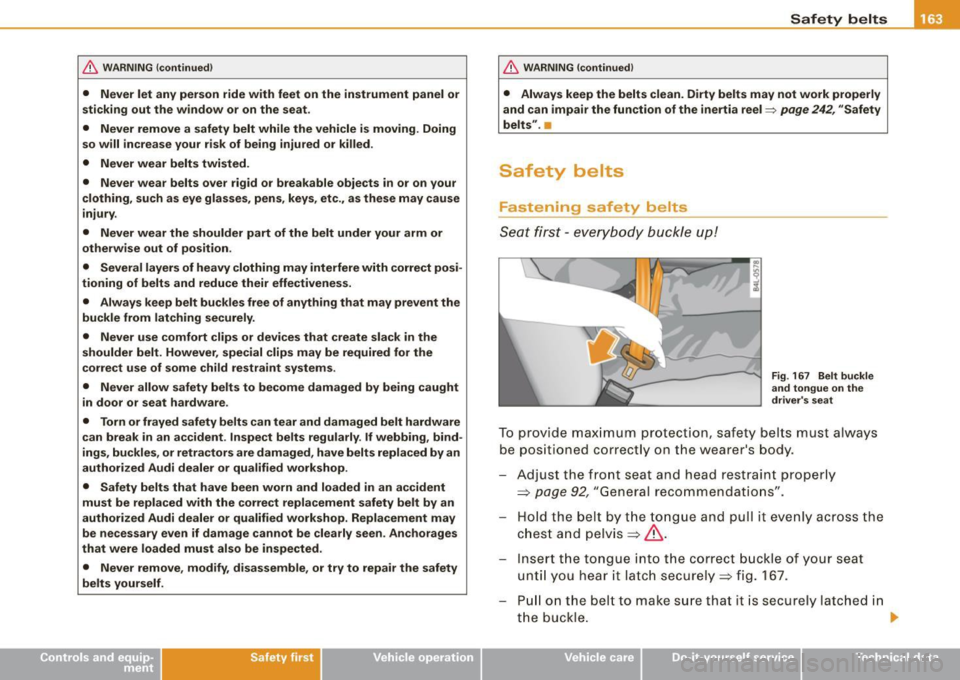
Fig. 167 Belt buckle
and tongue on the
driver 's seat
To provide maximum protection, safety belts must always
be positioned correctly on the wearer's body .
Adjust the front seat and head restraint properly
=> page 92, "General recommendations".
Hold the belt by the tongue and pull it evenly across the
chest and pelvis=>& .
Inse rt the tongue into the correct buckle of your seat
until you hear it latch securely=> fig. 167.
Pull on the belt to make sure that it is securely latched in
the buckle. ..,
~ehicle care irechnical data
Page 166 of 340
-Safety belts ___ .:,__ _____________________________________ _
Automatic safety belt retractors
Every safety belt is equipped with an automatic belt retractor on the
shoulder bel t. This featu re locks the bel t when the belt is pulled out
fast, during hard braking and in an accident. The belt may also lock
when you drive up or down a steep hill or through a sharp curve. During normal driving the bel t lets you move freely.
Safety belt pretensioners
The safety belts are equipped with a belt pretension er that helps to
tighten the safety belt and remove slack when the pretensioner is
activated. The function of the pretensioner is monitored by a
warning light:::::, page
20, "Airbag system @;".
Switchable locking feature
Every safe ty belt except the one on the driver seat is equipped with
a switchable locking feature that must be used when the safety belt
is used to attach a child seat . Be sure to read the important informa
tion about this feature:::::, page
200.
& WARNING
Improperly positioned safety belts can cause serious injury in an
accident :::::,
page 164, "Safety belt position" .
• Safety belts offer optimum protection only when the seat back
is upright and belts are properly positioned on the body.
• Never attach the safety belt to the buckle for another seat.
Attaching the belt to the wrong buckle will reduce safety belt
effectiveness and can cause serious personal injury.
• A passenger who is not properly restrained can be seriously
injured by the safety belt itself when it moves from the stronger
parts of the body into critical areas like the abdomen.
• Always lock the convertible locking retractor when you are
securing a child seat in the vehicle :::::,
page 202. •
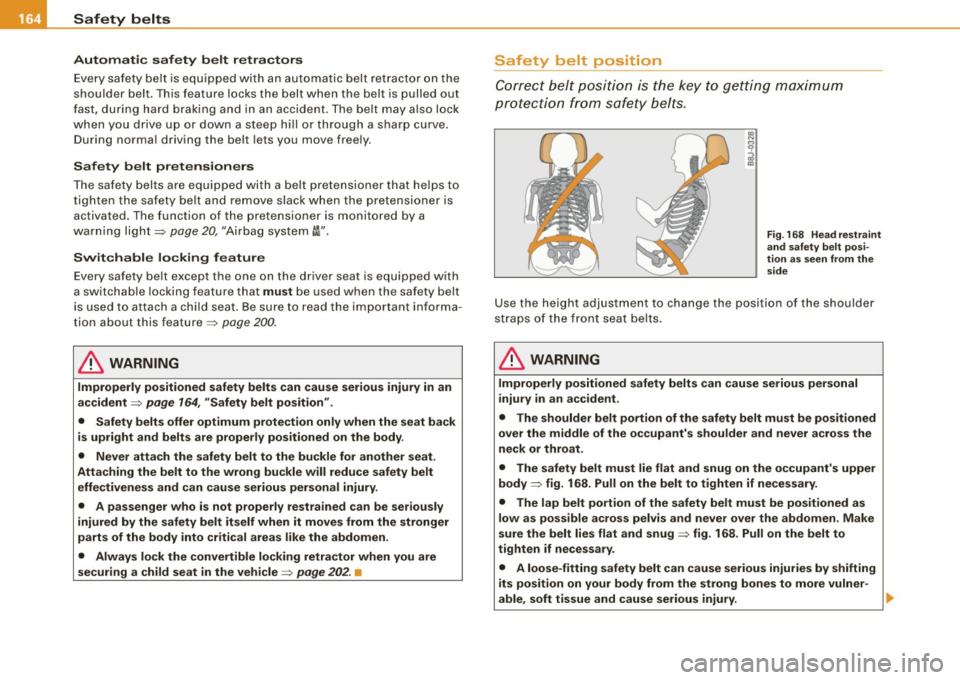
Safety belt position
Correct belt position is the key to getting maximum
protection from safety belts.
Fig . 168 Head restraint
and safety belt posi
tion as seen from the
side
Use the height adjustmen t to change the position of the shoulder
straps of the front seat belts.
in. WARNING
Improperly positioned safety belts can cause serious personal
injury in an accident .
• The shoulder belt portion of the safety belt must be positioned
over the middle of the occupant's shoulder and never across the
neck or throat.
• The safety belt must lie flat and snug on the occupant's upper
body
:::::> fig. 168. Pull on the belt to tighten if necessary.
• The lap belt portion of the safety belt must be positioned as
low as possible across pelvis and never over the abdomen. Make
sure the belt lies flat and snug :::::, fig. 168. Pull on the belt to
tighten if necessary.
• A loose-fitting safety belt can cause serious injuries by shifting
its position on your body from the strong bones to more vulner-
able, soft tissue and cause serious injury. ..,.
Page 167 of 340
& WARNING (continued)
• Always read and heed all WARNINGS and other important infor
mation
=> page 162. •
Pregnant women must also be correct ly
restrained
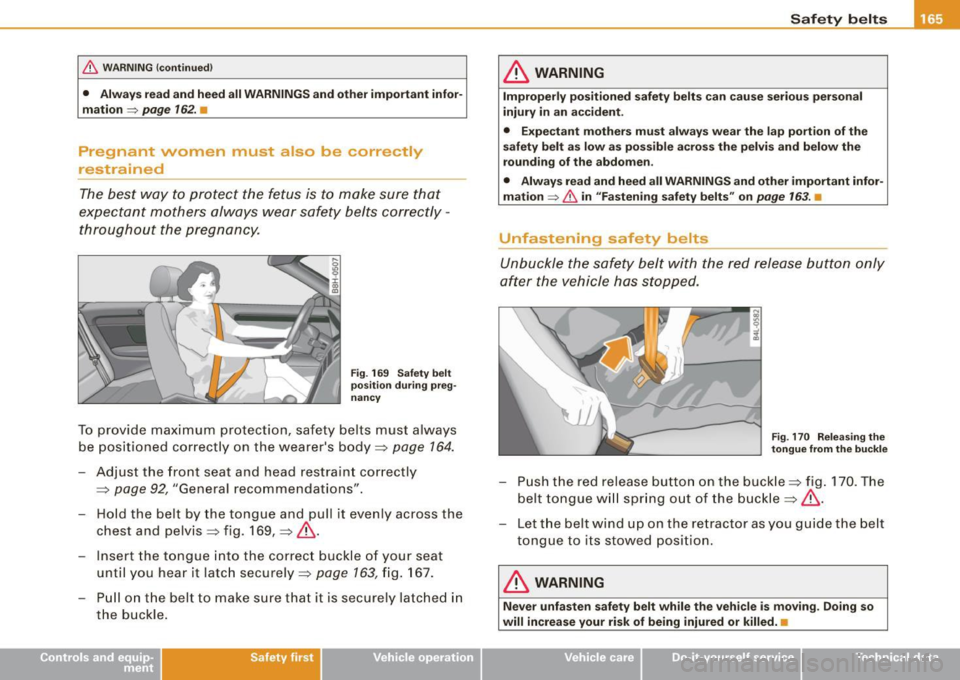
The best way to protect the fetus is to make sure that
expectant mothers always wear safety belts correctly·
throughout the pregnancy.
Fig . 169 Safety belt
position during preg
nancy
To provide maximum protection, safety belts must always
be posit ioned correctly on the wearer's body=>
page 164.
-Adjust the front seat and head restraint correctly
=>
page 92, "General recommendations".
- Hold the belt by the tongue and pull it evenly across the
chest and pelvis=> fig. 169, =>
&.
- Insert the tongue into the correct buckle of your seat
until you hear it latch securely=>
page 163, fig. 167.
- Pull on the belt to make sure that it is securely latched in
the buck le.
Safety first
Safety belts
& WARNING
Improperly positioned safety belts can cause serious personal
injury in an accident.
• Expectant mothers must always wear the lap portion of the
safety belt as low as possible across the pelvis and below the
rounding of the abdomen.
• Always read and heed all WARNINGS and other important infor
mation =>
& in "Fastening safety belts" on page 163. •
Unfastening safety belts
Unbuckle the safety belt with the red release button only
after the vehicle has stopped.
Fig . 170 Releasing the
tongue from the buckle
- Push the red release button on the buckle=> fig. 170. The
belt tongue will spring out of the buckle =>
&.
- Let the belt wind up on the retractor as you guide the belt
tongue to its stowed position.
& WARNING
Never unfasten safety belt while the vehicle is moving. Doing so
will increase your risk of being injured or killed. •
~ehicle care irechnical data