engine AUDI S4 SEDAN 2013 Owners Manual
[x] Cancel search | Manufacturer: AUDI, Model Year: 2013, Model line: S4 SEDAN, Model: AUDI S4 SEDAN 2013Pages: 294, PDF Size: 73.71 MB
Page 264 of 294
262 Emergency situations
Emergency situations
General
This chapter is intended for trained emer
gency crews and working personnel who
have the necessary tools and equipment to perform these operations.
Starting by pushing or
towing
Q;) Note
Vehicles with an automatic transmission
cannot be started by pushing or towing.
Starting with jumper
cables
If necessary , the engine can be started by
connecting it to the battery of another vehi
cle.
If the engine should fail to start because of a
discharged or weak battery, the battery can be
connected to the battery of
another vehicle,
using a
pair of jumper cables to start the en
gine .
Jumper cables
Use only jumper cables of sufficiently
large cross section to carry the starter current
safely. Refer to the manufacturer's specifica
ti ons.
Use only jumper cables with
insulated termi
nal clamps which are distinctly marked :
plus(+) cable in most cases colored red
minus (-) cable
in most cases colored black .
A WARNING
Batteries contain electricity, acid, and gas.
Any of these can cause very serious or fatal
injury. Follow the instructions below for
safe handling of your vehicle's battery.
- Always shield your eyes and avoid lean
ing over the battery whenever possible. -
A discharged battery can freeze at tem
peratures just below 32 °F (0 °C). Before
connecting a jumper cable, you must
thaw the frozen battery completely, oth
erwise it could explode.
- Do not allow battery acid to contact eyes
or skin . Flush any contacted area with
water immediately .
- Improper use of a booster battery to
start a vehicle may cause an explosion.
- Vehicle batteries generate explosive gas
es . Keep sparks, flame and lighted ciga
rettes away from batteries .
- Do not try to jump start any vehicle with
a low acid level in the battery .
- The voltage of the booster battery must
also have a 12-Volt rating. The capacity
(Ah) of the booster battery should not be
lower than that of the discharged bat
tery . Use of batteries of different voltage
or substantially different "Ah" rating
may cause an explosion and personal in
jury.
- Never charge a frozen battery. Gas trap
ped in the ice may cause an explosion.
- Never charge or use a battery that has
been frozen. The battery case may have
be weakened.
- Use of batteries of different voltage or
substantially different capacity (Ah) rat
ing may cause an explosion and injury.
The capacity (Ah) of the booster battery
should not be lower than that of the dis
charged battery.
- Before you check anything in the engine
compartment, always read and heed all
WARNINGS¢
page 208, Engine com
partment.
@ Note
- Applying a higher voltage booster bat
tery will cause expensive damage to sen
sitive electronic components, such as
control units, relays, radio, etc.
- There must be no electrical contact be
tween the vehicles as otherwise current
could already start to flow as soon as the
positive(+) terminals are connected. ..,.
Page 265 of 294
@ Tips
The discharged battery must be properly
connected to the vehicle's electrical sys
tem. When jump starting or charg ing the
battery, never connect the negative
ground cable to the batte ry negat ive post
because the ba tte ry manager system must
be ab le to detect the battery's state of
charge. Always connect the negative
g round cab le to the negative ground pos t
of t he battery manager cont ro l unit.
Use of jumper cables
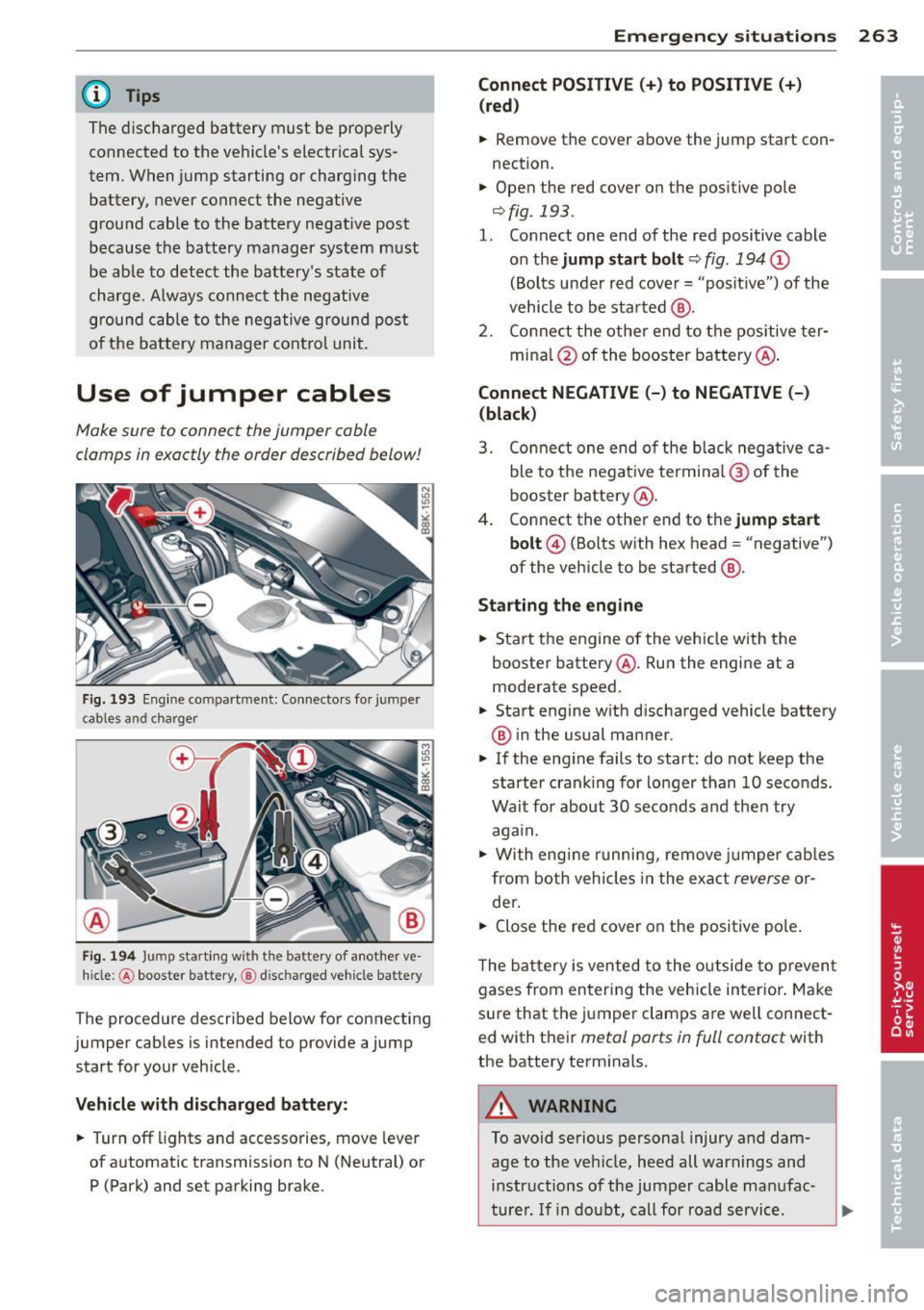
Make sure to connect the jumper coble
clomps in exactly the order described b elow!
Fi g. 193 Eng ine co mpar tment: Co nnecto rs fo r jum per
c ab les a nd c har ge r
F ig. 1 94 Jump start in g w ith t he ba ttery of a not her ve ·
hi cle :@ booster battery, @ disc harged veh icle battery
The procedure described below for connecting
jumper cables is intended to provide a jump
start for your veh icle .
Vehicle with di scharged battery :
~ Turn off lights and accessories, move leve r
of automatic transmission to N (Neutral) or P (Park) and set parking brake .
Emergency situ ation s 263
Connect POSITIVE(+) to POSITIVE(+ )
(red )
~ Remove the cover above the jump start con
nection .
~ Open the red cover on the positive pole
¢fig. 193 .
1. Connect one end of the red positive cable
on the
jump sta rt bolt c::;, fig. 194 (D
(Bolts under red cove r= "positive ") of the
vehicle to be sta rted @.
2 . Conne ct the othe r end to the pos itive ter -
mina l@ of the booster battery @.
Connect NEGATIVE (-) to NEGATIVE (-)
(black )
3. Co nnect one end o f the b lack neg ative c a
ble to the nega tive te rmi na l@ of the
booster battery @.
4 . Connect the other end to the
jump start
bolt @
(Bolts with hex head = "negative")
of the vehicle to be started @.
Starting the engine
~ Start t he e ngine o f the veh icle w ith the
booste r batte ry @ . Run the engine at a
moderate speed.
~ Start engine w ith d ischarged vehicle battery
® in the usual man ner .
~ If the eng ine fails to start : do not keep the
s tarter cran king for lo nger than 10 seconds .
Wait for about 30 seco nds and the n try
aga in.
~ With engi ne r unni ng , remove j umper cab les
from both vehicles in the exa ct
reverse o r
der .
~ Close the red cover on the positive pole .
T he b attery is vented to the o utside to p reven t
gases from en tering the veh icle in ter ior . Ma ke
s ur e that the j umper clamps a re well connect
ed with their
metal ports in full contact with
the batte ry term inals.
A WARNING
To avoid serious personal injury and dam
age to the vehicle, heed all warnings and
in structions of the jumper cable ma nufac-
turer . If i n dou bt, call for road servic e.
Ill>
Page 266 of 294
264 Emergency sit uat ions
-Jumper cables mus t be long enough so
that the vehicles do not touch.
- W hen connecting jumper ca bles, make
sure that they cannot get caught in any moving parts in the eng ine compart
ment.
- Do not bend over the batteries -danger
of chemical burns!
- The battery ce ll locking screws must be
tightened securely .
- Before you check anything in the engine
compartment, always read and heed all
WARNINGS
9 page 208, Engine com
partment.
(D Note
Improper hook-up of jumper cables can r u
in the generator.
- Always connect POSITIVE( +) to POSI
TIVE(+), and NEGATIVE( -) to NEGATIVE
( - ) ground post of the battery manager
control unit.
- Check that a ll screw plugs on the battery
cells are sc rewed in firmly. If not, tighten
plugs prior to connecting clamp on nega
tive battery term inal.
- Please note that the procedure for con
nect ing a jumper cable as described
above applies spec ifically to the case of
your vehicle being jump started . When
you are giv ing a jump start to a nothe r ve
hicle, do
not connect the negat ive (-) ca
ble to the negat ive (-) term inal on the
discharged battery @
9 fig. 194. In
stead, securely connect the negative(- )
cab le to e ither a solid metal component
that is firmly bolted to the engine bloc k
or to the engine block itse lf. If the bat
tery that is being charged does not vent
to the outside, escaping batte ry gas
could ignite and explode!
Emergency towing
with commercial tow
truck
General hints
Your Audi requires special handling for tow
ing.
T he following information is to be used by
commercial tow truck operators who know
how to operate their equipment safely.
- Ne ver tow your Audi , towing will cau se
damage to the engine and transmi ssion .
- Ne ver wrap th e safet y chains or winch ca
ble s around the brak e lines.
- To prevent unne cessar y damage, your Audi
must be tr an sp o rted with a flat bed tru ck.
- To load th e vehi cle on to the fl at bed, use
the towing l oop found in the ve hicle to ols
and atta ch to th e front or rea r anchorage
c:> page 265 and c:> page 265 .
& WARNING
= -
A vehicle being towed is not safe for pas
sengers. Never allow anyone to ride in a
vehicle being towed, for any reason.
Page 269 of 294
This might happen, for examp le, w hen
heavy components such as the engine
b lock or transmiss io n are removed .
- When removing heavy components like
these, anchor vehicle to ho ist o r add cor
responding weig hts to mai nta in the cen
ter of g ravity. Othe rwise, the veh icle
m ight tilt o r slip off t he hois t, causi ng
serious p ersona l injury.
(I) Note
- Be awa re of th e fo llowing po ints befo re
li fting the vehicle:
- The vehicle should never be lifted or
jacked up from underneath the engine oil pan , the transmission housing , the
front or rear axle or the body s ide
members. This could lead to ser ious
damage.
- To avoid damage to the underbody or
chassis frame , a rubber pad must be
inserted between the floor jack and
the lift points .
-Before driv ing over a workshop hoist,
check that the vehicle weight does not
exceed the permi ssible lifting capacity
of the hoi st.
- Before driv ing over a workshop hoist,
ensure that there i s sufficient clear
ance between the hoist and low parts
of the vehicle.
Emergency situations 267
•
•
Page 270 of 294
268 General information
General information Explanation of
technical data
Some of the technical data listed in this man
ual requires further explanation .
The technical data for your vehicle is listed in
the charts starting on
r:::> page 2 70. This sec
tion provides general information, notes and restrictions which apply to this data .
Vehicle identification
The key data is given on the vehicle identifica
tion number (VIN) plate and the vehicle data
sticker.
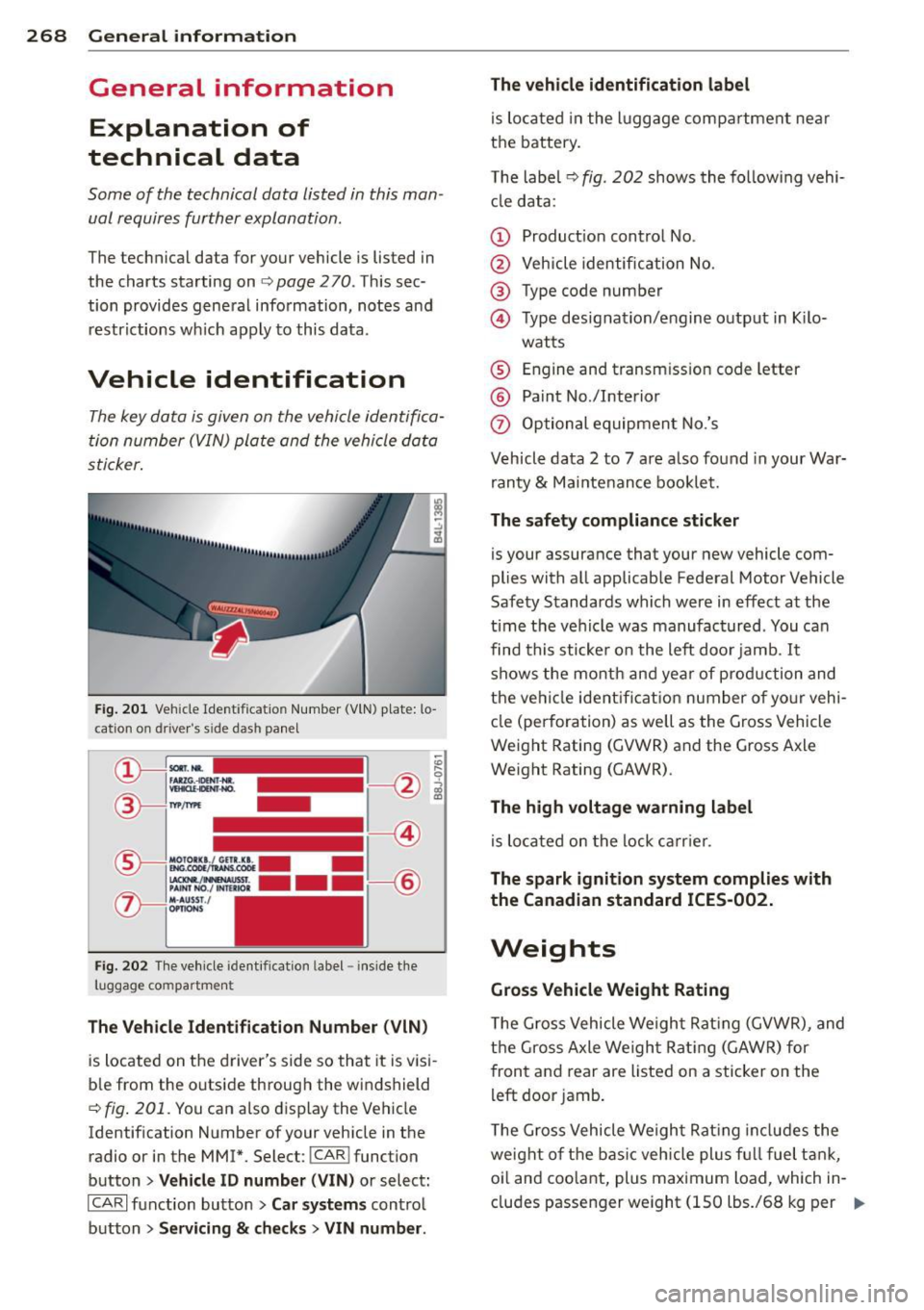
Fig. 201 Veh icle Ide ntific atio n Number (VlN) p late: lo
cation on driver 's sid e das h panel
Fig. 202 The vehicle identi fication label -inside the
luggage co mpa rtmen t
The Vehicle Identification Number (VIN)
is located on the driver's side so that it is visi
ble from the outside through the windshield
r:::> fig . 201 . You can also display the Vehicle
Identification Number of your vehicle in the
radio or in the MM!*. Select :
!CAR ! function
button
> Vehicle ID number (VIN) or select:
ICARI function button > Car systems control
button
> Servicing & checks > VIN number . The
vehicle identification label
is located in the luggage compartment near
the battery .
The label¢
fig. 202 shows the following vehi
cle data :
(D Production control No .
@ Vehicle identification No.
® Type code number
@ Type designation/engine output in Kilo-
watts
® Engine and transmission code letter
@ Paint No./Interior
(f) Optional equipment No.'s
Vehicle data 2 to 7 are also found in your War
ranty
& Maintenance booklet.
The safety compliance sticker
is you r assurance that your new vehicle com
plies with all applicable Federal Motor Vehicle
Safety Standards which were in effect at the
time the vehicle was manufactured . You can
find this sticker on the left door jamb.
It
shows the month and year of production and
the ve hicle ident ification number of your vehi
cle (perforation) as well as the Gross Vehicle
Weight Rating (GVWR) and the Gross Axle
Weight Rating (GAWR) .
The high voltage warning label
is located on the lock carr ier .
The spark ignition system complies with
the Canadian standard ICES-002.
Weights
Gross Vehicle Weight Rating
The Gross Vehicle Weight Rating (GVWR), and
the Gross Axle Weight Rating (GAWR) for
front and rear are Listed on a sticker on the
left door jamb.
The Gross Vehicle Weight Rating includes the
weight of the basic vehicle plus full fuel tank,
oi l and coolant, plus maximum load, wh ich in
cludes passenger weight (150 lbs./68 kg per
Ill>
Page 272 of 294
270 Data
Data
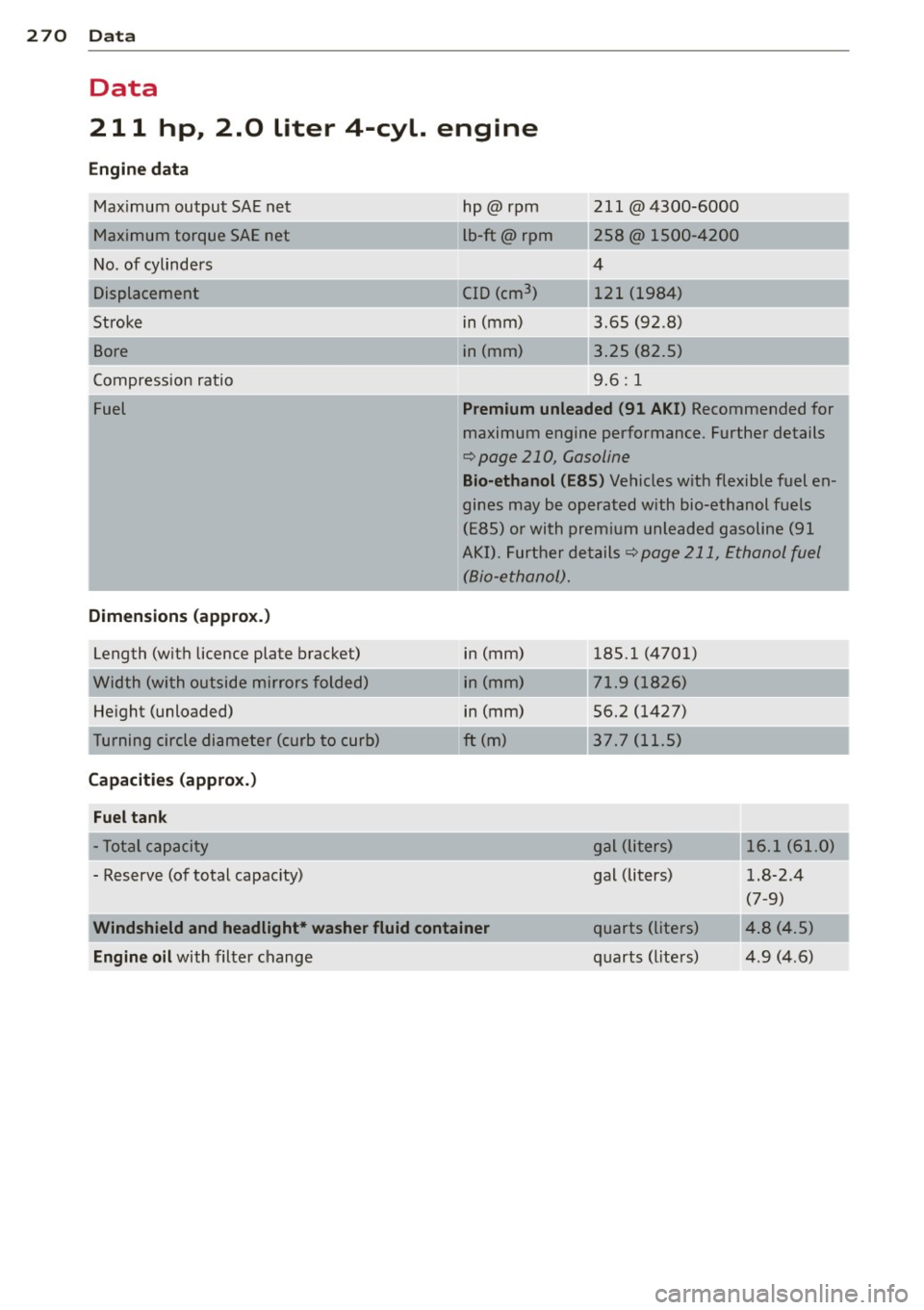
211 hp, 2.0 liter 4-cyl. engine
Engine data
Maximum output SAE net
Maximum torque SAE net
No. of cylinders
Displacement
Stroke
Bore
Compression ratio
Fuel
Dimensions (approx .)
Length (with licence plate bracket)
Width (with outside mirrors folded)
He ight (unloaded)
T urning circle diameter (curb to curb)
Capacities (approx.)
Fuel tank
h p@rpm
l b-ft@rpm
CID (cm
3 )
in (mm)
i n (mm)
211 @4300-6000
258@ 1500-4200
4
121 (1984)
3.65 (92 .8)
3 .25 (82 .5)
9.6: 1
Premium unleaded (91 AKI ) Recommended for
maximum engine performance . Further details
¢ page 210, Gasoline
Bio-ethanol (E85 ) Vehicles with flexible fuel en
gines may be operated with bio-ethanol fuels
(E85) or with premium unleaded gasoline
(91
AKI) . Further details~ page 211, Ethanol fuel
(Bio-ethanol).
in (mm)
in (mm)
in (mm)
ft (m)
185.1 (4701)
56.2 (1427)
37.7 (11.5)
- Total capacity gal (liters)
-------------
- Reserve (of total capacity)
Wind
shield and headlight* wa sher fluid container
Engine oil
with filter change gal (liters)
quarts (liters)
q
uarts (lite rs)
1.8-2.4
(7 -9)
4 .8 (4 .5)
4 .9 (4 .6)
Page 273 of 294
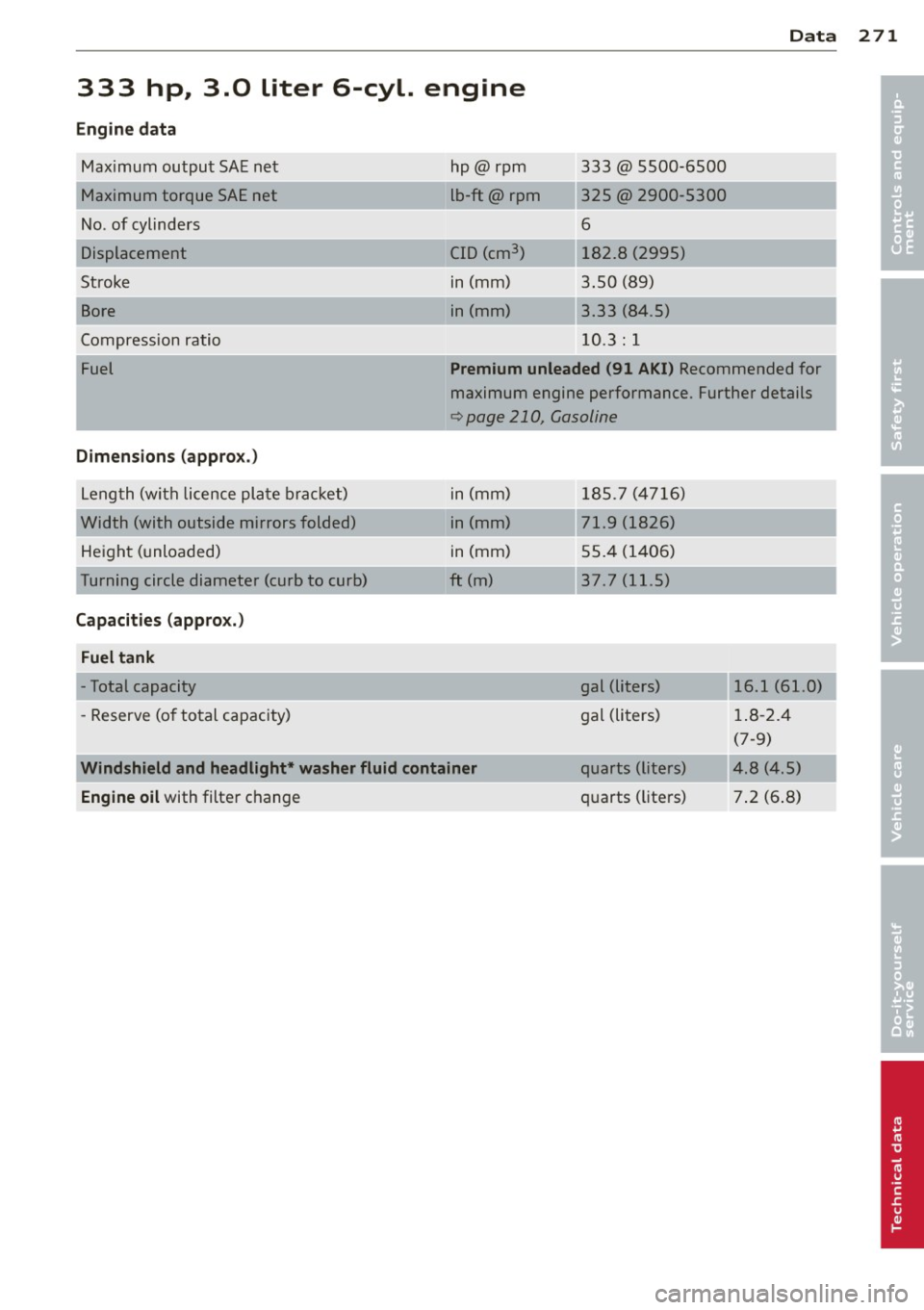
333 hp, 3.0 liter 6-cyl. engine
Engine data
Maximum output SA E ne t
M aximum torque SAE net
No . of cylinders
Displacement
Stroke
Bore
C ompression ratio hp@rpm
lb-ft@ rpm
-~,
ClD (cm3
)
in (mm)
in (mm)
333 @ 5500 -6500
325
@ 2900-5300
6
182.8 (2995)
3 .50 (89)
3 .33 (84 .5)
1 0.3 : 1
Data
Fuel Prem ium unleaded (91 AKI) Recommended for
maximum engine performance. Further details
c:> page 210, Gasoline
Dimension s (approx .)
L eng th (with licence pla te bra ck et)
Width (with outside mirrors folded) He igh t (unloaded)
T urning circle diameter (curb to curb)
Capacities (appro x.)
Fuel tank
- Total capac ity
- Reserve (o f to tal capacity) in (mm)
in (mm)
in (mm)
ft (m)
Windshield and headlight* wa
sher fluid container
Engine oil
with filte r ch ange
18 5.7 ( 4716)
71.9 (1826)
55 .4 ( 1406)
37 .7 (11.5)
gal (liters) 1 6 .1 (61.0)
gal (li ters) 1.8- 2.4
( 7- 9)
quarts (liters) 4.8 (4.5)
qu arts (lite rs) 7. 2 (6 .8)
271
•
•
Page 274 of 294
272 Consumer Information
Consumer Information
Warranty coverages
You r Audi is covered by the following war
ranties:
- New Vehicle Limited Warranty
- Limited Warranty Against Corrosion Perfo-
ration
- Emissions Control System Warranty
- Emissions Performance Warranty
- California Emissions Control Warranty (USA
vehicles only)
- California Emissions Performance Warranty
(USA vehicles only)
Detailed information regarding your warran
ties can be found in your
Warranty & Mainte
nance booklet .
Operating your vehicle
outside the U.S.A. or
Canada
Government regu lations in the United States
and Canada require that automobiles meet
specific emission regulations and safety
standards. Therefore, veh icles built for the
U.S.A . and Canada differ from vehicles sold in
other countries .
If you p lan to take your vehicle outside the
continental limits of the United States or Can
ada, there is the possibility that:
- unleaded fuels for vehicles with cata lytic
converter may not be available;
- fuel may have a considerably lowe r octane
rating. Improper fuel may cause engine
damage ;
- service may be inadequate due to lack of
proper service facilities, tools or testing
equipment ;
- replacement pa rts may not be readily availa
ble.
- Navigation systems for vehicles built for the
U.S.A. and Canada will not necessar ily work
in Europe, and may not work in other coun
tries outside of North America.
(D Note
Audi cannot be responsible for mechanical
damage that could result from inadequate
fuel, service or parts availability.
Audi Service Repair Manuals and Literature
Audi Official Factory Service Manuals and Lit
erature are published as soon as possible after
model introduction. Service manuals and lit
erature are available to order from the Audi
T echnical Literature Ordering Center at:
www.audi.techliterature.com
Maintenance
General
Your vehicle has been designed to help keep
maintenance requirements to a minimum.
However, a certain amount of regular mainte
nance is still necessary to assure your vehicle's
s afety, economy and rel iability. For detailed
vehicle maintenance consult your Warranty &
Maintenance booklet.
Under difficult operating conditions, for ex
ample at extremely low outside temperatures,
i n very dusty regions , when towing a trailer
very frequently, etc., some service work
should be performed between the intervals
specified. This applies particularly to:
- oil changes, and
- cleaning or replacing the air filter .
(® For the sake of the environment
By regularly maintaining your vehicle, you
help make sure that emission standards
are maintained, thus minimizing adverse
effects on the environment.
Important considerations for you and
your vehicle
The increasing use of electronics, sophisticat
ed fuel injection and emission contro l sys-
tems, and the genera lly increasing technical
liJJ,
Page 275 of 294
complexity of today's automobi les, have
steadi ly reduced the scope of maintenance
and repairs which can be carried out by vehicle
owners.
Also, safe ty and e nvir onm en tal con
cerns p lace very strict limits on the na ture of
repairs and adjustments to engine and trans
miss io n pa rts which an owner can perform .
Maintenance, adjustments and repa irs usua lly
require special tools, testing dev ices and oth
er equipment avai lab le to specially trained
workshop personnel in order to assure prope r
performance, reliab ility and safety of the vehi
cle and its many systems .
Improper ma intenance, adjustments and re
pa irs can impair the operation and reliability
of your vehicle and even void your vehicle war ranty. The refo re, p roof of servici ng in accord
ance w ith the maintenance sched ule may be a
condition for upholding a poss ible war ranty
claim made within the warranty period.
Above all, operational safety can be adversely
affected, crea ting unnecessary risks for you
and your passengers.
If in doubt about any servicing, have it done
by your authorized Audi dealer or any other
properly equipped and q ualified workshop .
We strong ly urge you to give you r a uthorized
Audi dealer the opportunity to perform all
schedu led maintenance and necessary repairs .
Your dea ler has the facilities, or iginal parts
and trained spec ialists to keep your vehicle
running properly .
Performing limit ed m aintenance you rself
The fo llowing pages describe a limited num
ber of procedures which can be performed on
your vehicle with ordinary too ls, should the
need arise and trained personnel be unavaila
b le. Before performing any of these proce
dures, always thoroughly read all of the app li
cable text and carefully follow the instruc
tions given . Always rigorously obse rve the
WARNINGS provided .
Before you check anything in th e engine
compartment, a lway s re ad and heed all
Con sumer In formation 273
WARNINGS ¢ & and ¢ & in Working in the
engine comportment on page 215 .
A WARNING
-Ser ious personal injury may occur as a re
sult of improperly performed mainte nance, adjustments or repa irs.
-Always be extremely careful when work ing on the vehicle. Always follow com
mon ly accepted safety pract ices and gen
eral common sense . Never r isk personal
lnJU ry .
- Do not attempt any of the ma intenance ,
checks or repairs descr ibed on the fol
lowing pages if you are not fully fam iliar
wit h these or othe r pro cedures with re
spect to t he veh icle, or are uncerta in how
to p roceed .
- Do not do any work without the proper
too ls and equipment. Have the necessary
work done by your authorized A udi deal
er or another proper ly equipped and
qualified workshop .
- The engine compartment o f any motor
veh icle is a potentially hazardous area.
Never reach into the area around or
touch the rad iator fan. It is temperature
contro lled and can switch on suddenly -
even when the engine is
off and the igni
tion key has been removed. The rad iator
fan switches on automat ica lly when the
coo lant reaches a certai n temperatu re
and will cont inue to run until the coo lan t
tempera ture drops .
- Always remove the ign itio n key befo re
anyone gets under the vehicle.
- Always support your veh icle with safety
s tands i f it is necessary to work under
neath the vehicle. The jack s upplied with
the vehicle is not adequate for this pur
pose and cou ld collapse causing serio us
personal injury.
- If you must work underneath the vehicle
with the wheels on the ground, a lways
make sure the vehicle is on leve l ground,
that the wheels are a lways securely
blocked a nd that the engine cannot be
started .
•
•
Page 276 of 294
274 Con sum er Inf ormation
-Always make sure the transmission se
lector lever (automatic transmiss ion) is
in "P" (Park position) or Neutral (manual
transmission) and the park brake is firm
ly applied.
@) For the s ake of the environment
-Changing the engine settings w ill ad
versely affect emission levels. This is det
rimental to the environment and increas
es fuel consumption .
- Always observe environmental regula
tions when disposing of old engine oil,
used brake fluid, dirty engine coolant,
spent batteries or worn out tires.
- Undeployed airbag modules and preten
s ioners might be classified as Perchlo
rate Material -spec ial handling may ap
ply, see www.dtsc.ca .gov/hazardous
waste/perch lorate. When the veh icle or
parts of the restraint system including
airbag modules safety belts with preten
sioners are scrapped, all app licable laws
and regulations must be observed . Your
authorized Audi dealer is familiar with
these requirements and we recommend
that you have your dealer perform this
serv ice for you .
Additional accessories,
modifications and
parts replacement
Additional accessories and parts
replacement
Always consult on authorized Audi dealer be
fore purchasing accessories.
Your veh icle inco rporates the latest safety de
sign featu res ensuring a high standard of ac
tive and passive safety.
This safety could be compromised by non-ap
proved changes to the veh icle. For this reason ,
if pa rts have to be replaced , please observe
the following points when installing addition
a l accessories: Approved Audi accessories and genuine Audi
parts are available from authorized Audi deal
ers.
T hese dea lers a lso have the necessary facili
ties, tools and trained specialists to install the parts and acc essories proper ly .
A WARNING
-Using the wrong spare parts or using non-
approved accessories can cause damage to
the veh icle and ser ious personal injury.
- Use on ly accessories express ly approved
by Audi and genuine Audi spare parts
- These parts and accessories have been
specially designed to be used on your ve
h icle .
- Never install accessories such as tele
phone crad les or beverage ho lders on a ir
bag covers or within the airbag deploy
ment zones . Do ing so will increase the
risk of injury if a irbags are triggered in an
accident!
- Before you check anything in the engine
compa rtment, always read and heed a ll
WARNINGS
9 page 208 .
(D Note
-If items other than genu ine Audi spare
parts, add-on equipment and accessory
items are used or if repair work is not
performed accord ing to specified meth
ods, this can resu lt in seve re damage to
your vehicle's eng ine and body (such as
corrosion) and adversely affect yo ur vehi
cle's warranty .
- If emergency repairs must be performed
elsewhere, have the vehicle examined by
an authorized Audi dealer as soon as
possible .
- The manufacturer cannot be held liable
for damage wh ich occ urs due to failure
to comply with these stipu lations.