oil AUDI S4 SEDAN 2013 User Guide
[x] Cancel search | Manufacturer: AUDI, Model Year: 2013, Model line: S4 SEDAN, Model: AUDI S4 SEDAN 2013Pages: 294, PDF Size: 73.71 MB
Page 77 of 294
CD Note
If the engine has been under heavy load
for an extended period, heat builds up in
the engine compartment after the engine
is switched off- there is a risk of damaging
the engine . Allow the engine to run at idle
for about two minutes before switching it
off.
Convenience key
Starting the engine
Applies to vehicles: with convenience key
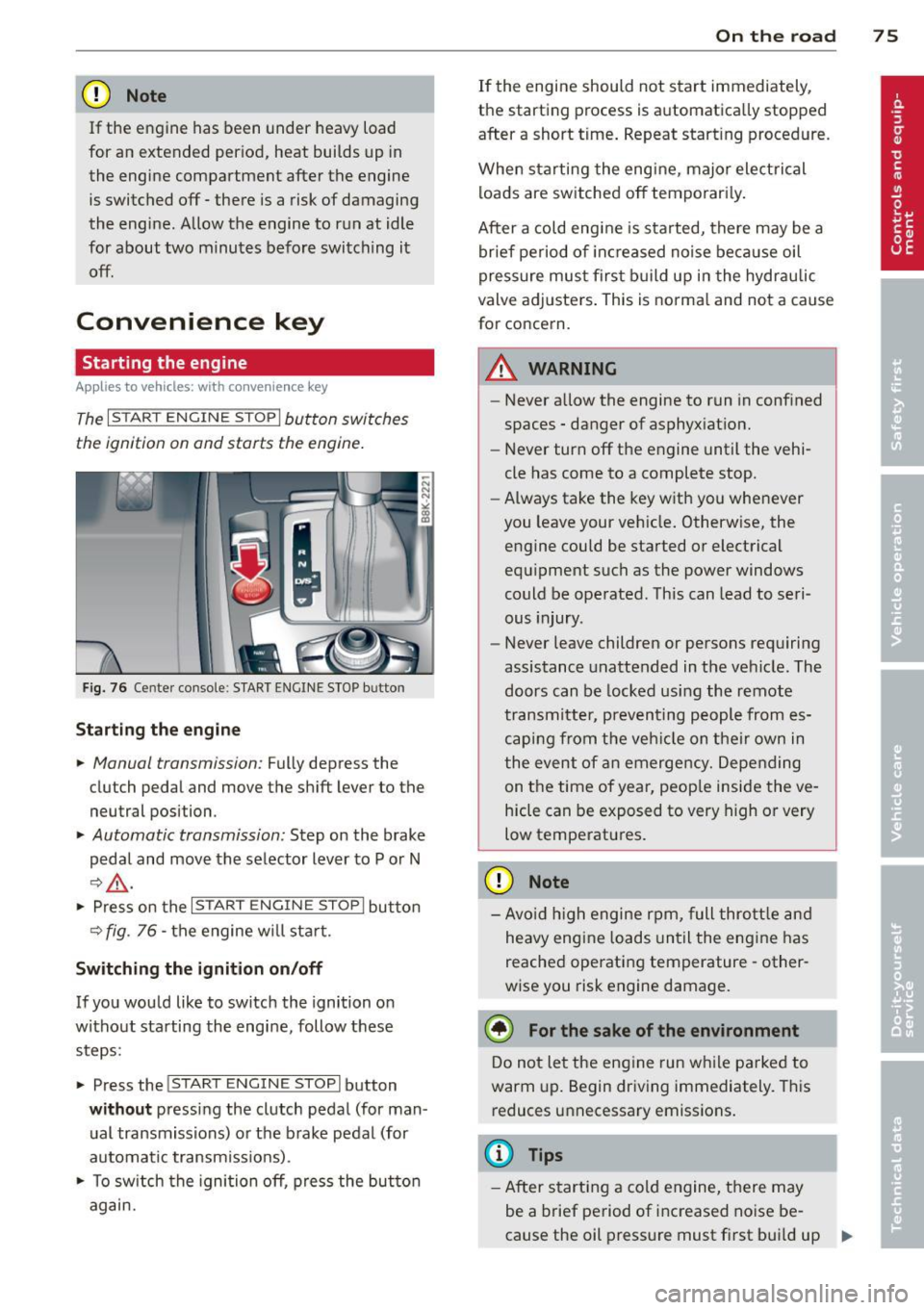
The I STAR T ENGINE ST OPI button switches
the ignition on and starts the engine.
Fig. 76 Ce nter console : S TART ENGINE STOP b utto n
Starting the engine
.. Manual transmission: Fully depress the
clutch pedal and
move the shift lever to the
neutral position .
.. Automatic transmission: Step on the brake
pedal and
move the selector lever to P or N
~ .&, .
.. Press on the I STAR T ENGINE S T OPI button
~ fig . 76 - the engine will sta rt.
Switching the ignition on/off
If you would like to switch the ignition on
without starting the engine, follow these
steps :
.. Press the
!START E NGIN E STOPI button
without pressing the clutch pedal (for man
ual transmissions) or the brake pedal (for
automatic transmissions) .
.. To switch the ignition off, press the button
again.
On the road 75
If the engine should not start immediately,
the starting process is automatically stopped
after a short time. Repeat starting procedure .
When starting the engine , major electrical
loads are switched off temporarily.
After a cold engine is started, there may be a
brief period of inc reased noise because oil
pressure must first build up in the hydraulic
valve adjusters. This is norma l and not a cause
for concern.
A WARNING
- Never allow the engine to run in confined
spaces - danger of asphyxiation.
- Never turn off the engine until the vehi
cle has come to a complete stop.
- Always take the key with you whenever
you leave your vehicle. Otherwise, the
engine could be started or electrical
equipment such as the power windows
could be operated . This can lead to seri
ous injury .
- Never leave children or persons requiring
assistance unattended in the vehicle. The
doors can be locked using the remote
transmitter, preventing people from es
caping from the vehicle on their own in
the event of an emergency. Depending
on the time of year, peop le inside the ve
hicle can be exposed to very high or very
low temperatures .
CD Note
-Avo id high engine rpm, full throttle and
heavy engine loads until the engine has
reached operating temperature - other
wise you risk engine damage.
@ For the sake of the environment
Do not let the engine run while parked to
warm up. Begin driving immediately. This
reduces unnecessary emissions.
(D Tips
-After starting a cold engine, there may
be a brief period of increased noise be-
cause the oil pressure must first bui ld up
II-
Page 91 of 294
There is a system malfunction in the transmis
sion. You may continue driving. Drive to your
authorized Audi dealer or qualified repair fa
cility soon to have the malfunction corrected.
[O] Transmission malfunction: Limited driv·
ing functionality
There is a system malfunction in the transmis
sion . The transmission is switching to emer
gency mode. This mode only shifts into cer
tain gears or will no longer shift at all. The en
gine may stall. Drive to your authorized Audi
dealer or qualified repair facility immediately
to have the malfunction corrected .
[O] Transmission malfunction: Stop vehicle
and shift to park.
Do not continue driving. Select the P selector
lever position and see your authorized Audi
dealer or qualified repair facility for assis
tance.
([) Note
If the transmission switches to emergency
mode, you should take the vehicle to an
authorized Audi dealership as soon as pos
sible to have the condition corrected.
Emergency release of the selector lever
Applies to vehicles: with multitronic or tiptro nic
If the vehicle's power supply foils, the selec
tor lever can be released in an emergency.
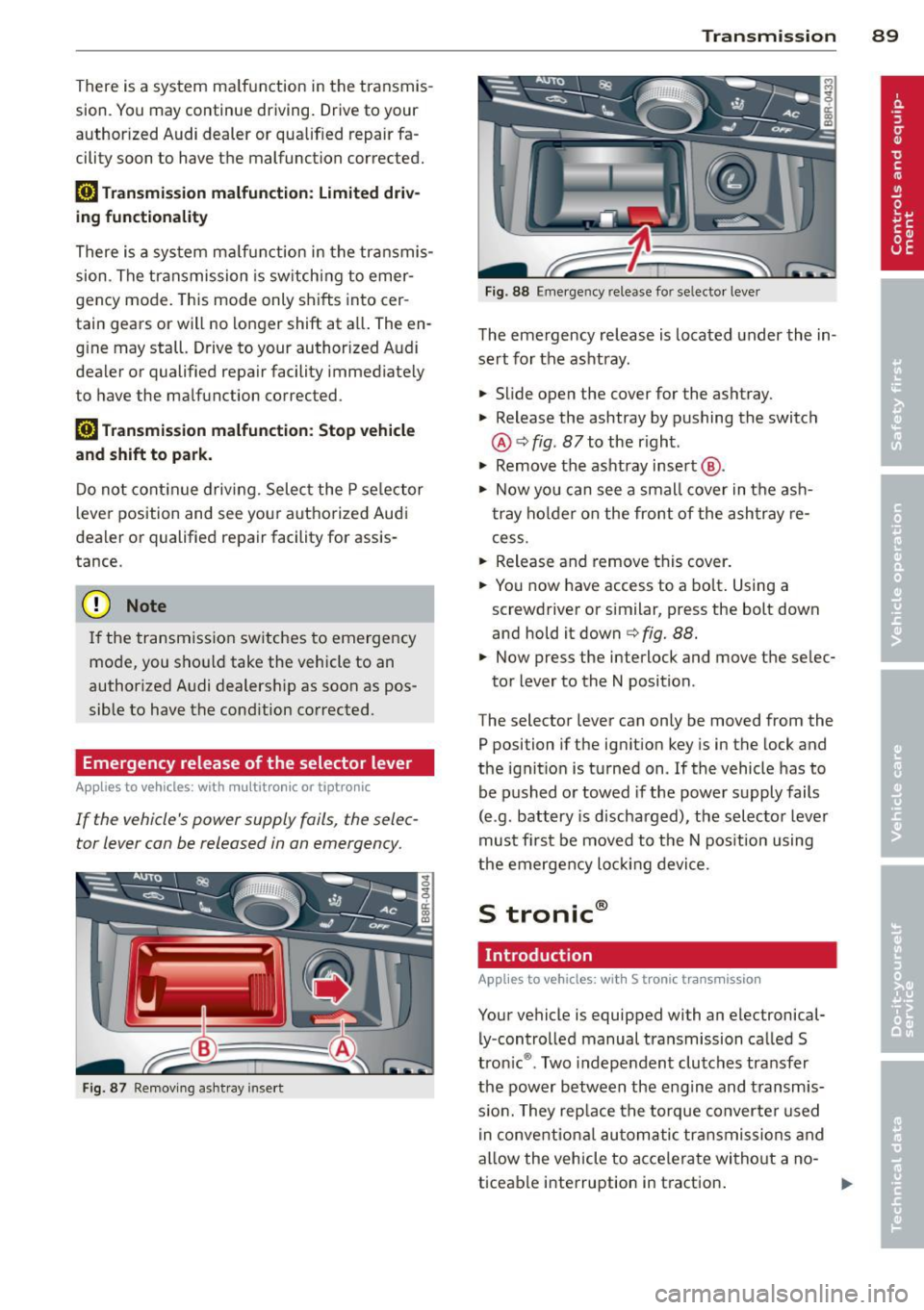
Fig . 87 Removing ashtray insert
Transmission 89
Fig . 88 Emerge ncy release fo r se lecto r lever
The emergency release is located under the in
sert for the ashtray.
.,. Slide open the cover for the ashtray.
.,. Release the ashtray by pushing the switch
@ ¢
fig. 87 to the right .
.,. Remove the ashtray insert @ .
.,. Now you can see a small cover in the ash
tray holder on the front of the ashtray re
cess .
.,. Release and remove this cover.
.,. You now have access to a bolt. Using a
screwdriver or similar, press the bolt down
and hold it down ¢
fig. 88.
.,. Now press the interlock and move the selec-
tor lever to the N position .
The selector lever can only be moved from the
P position if the ignition key is in the lock and
the ignition is turned on . If the vehicle has to
be pushed or towed if the power supply fails
(e .g . battery is discharged), the selector lever
must first be moved to the N position using
the emergency locking device.
S tronic®
Introduction
Applies to vehicles : with S tronic transmission
Your vehicle is equipped with an electronical
ly -controlled manual transmission called S
tronic ®. Two independent clutches transfer
the power between the engine and transmis
s ion. They rep lace the torque converter used
in conventional automatic transmissions and
allow the vehicle to accelerate without a no
ticeable interruption in traction.
Page 190 of 294
188 Intelligent technology
200 kilometers) of normal city driving.
You can compensate for this by pressing
the brake pedal more firmly. This also applies later when new pads are instal
led .
- You should perform braking maneuvers
for the purpose of cleaning the brake
system only if road conditions permit.
Other road users must not be put at risk -
you may cause an acc ident!
- Before descending a steep grade, reduce
speed and shift transmission into a lower
gear or lowe r driving range. Do not ride
the brakes or hold the pedal down too
long or too often. This could cause the
brakes to get hot and diminish braking
efficiency.
- Do not "ride the brakes" by resting your
foot on the pedal when you do not intend
to brake . This may cause the brakes to
overheat, premature wear and increased
stopping distance.
- Under certain climatic and operating
conditions such as passing through wa
ter, driving in heavy rain or after washing
the vehicle, the effectiveness of the
brakes can be reduced. In winter, ice can
accumulate on the brake pads, linings,
discs and drums. Carefully apply brakes
for a test. Brakes will dry and ice coat
ings will be cleaned off after a few care
ful brake applications.
- Driving for an extended period of time on
salt-covered roads without using your
brakes can also affect braking efficiency.
Clean off accumulated salt coating from
brake discs and pads with a few careful
brake applications.
- If you damage the front spoiler, or if you
install a different spoiler, be sure the air
flow to the front brakes is not obstruct
ed . Otherwise the brake system could
overheat reducing the effectiveness of
the entire brake system.
- Failure of one brake c ircuit will impair
the braking capability resulting in an in
creased stopping distance. Avoid driv ing
the vehicle and have it towed to the near- est authorized Audi dealer or
qualified
workshop.
- Never let the vehicle roll to a stop with
the engine shut off.
- If the brake booster is not working, for
example when towing your vehicle, or
because the brake booster has somehow
been damaged, the brake pedal must be
pressed considerably harder to make up
for the lack of booster assistance.
Electro-mechanical
power assist, dynamic
steering
The electro-mechanical power assist helps
the driver when steering.
Power steering adapts electronically based on
the vehicle speed .
Indicator lights and messages
• Steering defective! Do not drive vehicle!
If this indicator light turns on and stays on
and this message appears, the power steering
may have failed.
Do
not continue driving . See your authorized
Audi dealer or other qualified repair facility
for assistance.
E!"4 Dynamic steering: System fault! You can
continue driving
If the indicator light turns on and the mes
sage appears, the steering may be more diffi
cult to move or more sensitive than usual. The
steering wheel may also be at an angle when
driving straight .
Drive slowly to your authorized Audi dealer or
qualified workshop to have the malfunction
corrected .
ls!'fl Dynamic steering: initializing
If this driver message appears and the indica
tor light is flashing on the instrument panel,
dynamic steering* is being reinitialized. Once
you start the engine after this is finished, the ..,..
Page 191 of 294
steering wheel wi ll be easy to move . Re
initialization might be necessary if the steer
ing wheel was moved hard to the left and
right while the vehicle was not moving. The
d isplay goes out as soon as in itializat ion is
comp lete .
A WARNING
Have the dynamic steering* system mal
function repaired as soon as poss ible by an
authori zed A udi dealer or any qualified
workshop -risk of accident!
@ Tips
- If the . or 1;r,ij indicator light only stays
on for a short t ime, you may continue
driving.
- The dynamic steering * stability systems
are not available in t he event of a system
malfunction.
- Fo r additional informat ion on dynamic
stee ring*, re fer to
c::> page 111.
Driving with your
quattro ®
Applies to vehicles: with all-wheel drive
With oil-wheel drive, oil four wheels ore driv
en.
General information
W ith all -whee l dr ive, power is dis tributed to
a ll fo ur wheels. This happens automatica lly
depending on yo ur driving sty le and the road
conditions at the time. See also
c::> page 184 .
A center different ial d is tributes the dr iv ing
power var iably to the front and rear axle. It
wo rks together with se lective whee l to rque
contro l, which activates when driving throug h
curves
c::> page 185. With the sport d ifferen
tial*, power distribution to the rear w heels is
variable and can be adjusted with Audi drive se lect
c::> page 111 .
The all-wheel drive concept is designed for
hi gh engine power. Your vehicle is exception
ally powerful and has exce llent dr iving charac
ter ist ics both under normal d riving conditions
Int ellig ent technolog y 189
and on snow and ice . Always read and follow
safety precautions
c::> & .
Winter tires
When dr iving in t he winter, yo ur vehicle wi th
a ll -wheel drive h as an adv ant age, even w it h
regular tires. In wi nter road conditions it may
be advisable to mount winter tires (or all -sea
son tires) for improved driveability and brak
ing : these tires must be mounted on
all fou r
wheels .
See also c::> page 245, Winter tires.
Tire chains
Where tire chains a re mandatory on certain
roads, this no rma lly also app lies to veh icles
with all-wheel drive
c::> page 246 , Snow
chains .
Replacing wheels /tires
Vehicles wi th a ll-wheel drive must alw ays
have tires of the same s ize. A lso avoid tires
with different tread depths . For detai ls see
page
c::> page 241, New tires and replacing
tires and wheels.
Off-Road driving?
Your A udi does no t have enough g ro und cle ar
ance to be used as an off -road vehi cle. It is
therefore best to avoi d rough tracks and un
even te rrain as much as possib le . Also refer to
c::> page 192.
A WARNING
A lways ad just yo ur dr iv ing to road and traf
fic conditions. Do not let the extra safety
afforded by all-wheel drive tempt you into
taking extra risks .
-Al tho ugh t he all-wheel driv e is ve ry ef
fective, always remember that braking
capacity is lim ited by tire t raction. You
should t herefore not d rive a t excessive
speeds on i cy or slippery ro ad s urfa ces.
- On wet road surfa ces, be careful not to
d rive too fast bec ause the fron t whee ls
co uld begin to slide on top of the water
(aquaplani ng) . If th is should occur, yo u •
•
Page 194 of 294
192 Driving and environment
Driving and
environment
The first 1,000 miles
(1,500 km) and
afterwards
New engine
The engine needs to be run-in during the first
1,000 miles (1,500 km).
For the fir st 600 miles (1,000
kilometers ):
.,. Do not use full throttle.
... Do not drive at engine speeds that are more
than 2/3 of the max imum permitted RPM.
From 600 to 1,000 miles (1 ,000 to
1,500 kilometers):
.,. Speeds can gradually be increased to the
max imum pe rm iss ible road or eng ine speed .
During and after break-in per iod
... Do not rev the eng ine up to h igh speeds
when it is cold. Th is app lies whether the
transmission is in N (Neutral) or in gear.
After the break- in period
... Do not exceed max imum eng ine speed un
der any circumstances .
... Upshift into the next higher gear
before
reaching the red area at the end of the tach
ometer scale¢
page 10.
During the first few hours of driving, the en
g ine's inter na l friction is higher tha n later
when alt the moving parts have been broken
i n. How welt this break- in process is done de
pends to a conside rable extent on the way the
ve hicl e is driven du ring the first 1,000 miles
(1, 500 kilome ters).
(D Note
E xtremely high engi ne speeds are auto
mat ica lly re duced. However, these rpm
lim its are programmed for a n engine welt
r u n- in, not a new eng ine.
{® For the sake of the environment
Do not drive with unnecessarily high en
g ine speeds - upshifting ear ly saves fuel,
reduces no ise and protects the environ
ment.
, New tires
If your vehicle is runni ng on new tires, drive
very carefully for the first 350 miles (500 kilo meters) after fitting.
_& WARNING
N ew tires tend to be slip pery a nd mus t al
so be "broken -in" . Be s ure to remembe r
this dur ing the fi rst 350 mi les (500 kilo
meters) . Brake gently . Avoid fo llow ing
closely behind other vehicles or other sit
uations that m ight require sudden, hard
braking.
Avoid damaging the
vehicle
When you a re d rivi ng on poo r roads, or over
cu rbs, ste ep ramps, etc., ma ke certai n that
low- ly ing parts s uch as spoile rs and ex ha ust
s ystem parts do not bot tom o ut and get dam
aged.
T his is espec ially true for veh icles with low
s lu ng chassis (s por ts chassis)* and fully load
ed vehicles.
Driving through water
on roads
Note th e following to avoid vehicle damage
whe n driving through water, for examp le on
flooded roads:
- The wa ter must not be any hig he r th an the
bottom of the vehicle body .
- Do not dr ive faste r than walk ing speed.
Page 195 of 294
A WARNING ,~ ~
After driving through water, mud, slush,
etc., the brakes may be slow to take effect
because of wet brake rotors and pads. Dry
the brakes first by braking carefully to re
store the full brak ing effect.
([) Note
Vehicle components such as the engine,
transmiss ion, suspension or electrical sys
tem can be severely damaged by driving
through wate r.
@ Tips
- Check the depth of the water before dr iv
i ng through it.
- Do not stop the veh icle, dr ive in reverse
or switch the engine off when driving
th rough water.
- Keep in mind that oncoming vehicles
may create waves that raise the water
level and make it too deep for you r vehi
cle to drive th rough safely.
- Avoid dr iving through sa lt water because
i t can ca use corrosion.
Catalytic converter
It is very important that your emission con
trol system (catalytic converter) is function
ing properly to ensure that your vehicle is run
ning in an environmentally sound manner.
11-Always use lead-free gasoline q page 210,
Fuel supply .
"'" Never run the tank down a ll the way to
empty.
11-Never put too much motor oil in your en-
gine
q page 220, ~ Adding engine oil .
11-Never try to push -or tow-start your veh icle .
The catalytic converter is an efficient "clean up" device built into the exhaust system of
the vehicle . The catalytic converter burns
many of the pollutants in the exhaust gas be
fore they are released into the atmosphere .
Drivin g and en vironm ent 193
The exclusive use of unleaded fuel is critically
important for the life of the catalytic convert
er and proper funct ion ing of the engine.
A WARNING
-
- Do not park or operate the vehicle in
areas where the hot exhaust system may
come in contact with dry grass, brush,
fuel spill or other mate rial wh ich can
cause a fir e.
- Do not apply additional undercoating or rustp roof ing on or near the exhaust
manifold, exhaust pipes, catalytic con
ve rter or heat shields. During driv ing, the
substance used for undercoating co uld
overheat and cause a fire.
(D Note
- Be aware that just one tank filling with
leaded fu el w il l already ser iously de
gra de the performance of the catalytic
c onverte r.
- Do not ex ceed t he cor rect eng ine oil level
qpage 220.
- Do not drive until the fue l tank becomes
comple tely empty. The engine co uld m is
fire . Unburned fuel could also get in to
the exhaust system and th is co uld cause
the catalytic converter to overheat .
- Do not turn off the ignition while the ve
hicle is moving.
- Do not continue to ope rate your veh icle
unde r these conditions, as otherwise fuel
can reach the catalytic converte r. T his
cou ld result in overheating of the con
verter, requir ing its replacement.
- To assure efficient operation of the Emis
sion Control System:
- H ave you r vehicle maintained prope rly
and in accorda nce w ith the serv ice rec
ommendat ions in yo ur Warranty &
M ain tenance boo klet.
- L ack of prope r maintenance as we ll as
improper use of the vehi cle w ill impair
the function of the em ission contro l
system and could lead to damage . ..,. •
•
Page 197 of 294
(D Note
Do not leave engine idling unattended af
ter starting . If warning lights should come
on to indicate improper operation, they
would go unheeded. Extended idling also
produces heat, which could result in over
heating or other damage to the vehicle or
other property .
Regular maintenance
A badly tuned engine unnecessarily wastes a
lot of fuel .
.,. Have your vehicle serv iced at regular inter-
vals .
By having your vehicle regularly serviced by an
authori zed Audi dealer helps to ensure that it
runs properly and economically . The condition
of your vehicle not only affects its safety and
ab il ity to hold its value, it also affects
fuel
consumption.
Check your oil each time you fill your tank.
The amount of oil used is related to engine
load and speed.
It is normal for the oil consumption of a new
engine to reach its lowest value after a certain
mileage has been driven.
You must drive your vehicle about 3 ,000 miles
(5,000 kilometers) before you can properly
assess oi l consumption.
This a lso applies to fuel consumption and en
g ine output .
0 Note
-Have your vehicle maintained properly
and in accordance with the service rec
ommendations in your Warranty
& Main
tenance booklet. Lack of proper mainte
nance as well as improper use of the ve
hicle will impair the function of the
emission control system and could lead
to damage.
Driving and environment 195
- Do not alter or remove any component of
the Emission Control System unless ap
proved by the manufacturer .
- Do not alter or remove any device, such
as heat shields, switches, ignition wires,
valves, which are designed to protect
your vehicle's Emission Control System and other important vehicle compo
nents .
Fewer short trips
Fuel consumption will always be rela tively
high on short trips .
.,. Try to avoid driving short distances with a
cold engine.
The engine and cata lytic converter have to
reach their opt imal
operating temperature to
reduce fuel consumpt ion and noxious emis
sions effectively .
Just after starting, a co ld engine in a mid-size
car only achieves a fuel economy of 6-8 miles
per gallon (30-40 l/100 km). After about a
half a mile, fuel economy climbs to 12 mpg
(20 l/100 km) . After about
2 .5 miles (4 km),
the engine is at its proper operat ing tempera
ture and fuel economy has reached a normal
level. So you can see that you should avoid
short trips whenever possible.
T he
outside temperature is also cr itical in th is
regard. Your car consumes more fue l in the
winter than in the summer.
•
•
Page 202 of 294
200 Cleaning and protec tio n
Automatic car wash
The vehicle can be washed in almost any
modern automatic car wash .
The vehicle paint is so durable that the vehicle
can normally be washed without problems in
an automatic car wash. However, the effect on
the paint depends to a large extent on the de
sign of the facility, the filtering of the wash
water, the type of wash and care mater ial , etc.
I f the pa int has a dull appearance afte r going
through the car wash or is scratched, bring
this to the attention of the operator immedi
ately.
If necessary, use a different car wash.
Before going through a car wash, be sure to
take the usual precautions such as closing the
windows and the roof . Factory installed an
tennas must not be removed.
I f you have installed additional accessor ies on
the vehicle - such as spoilers, roof rack, etc. -
it is best to ask the car wash operator if these
should be removed .
A WARNING
Always read and heed all WARNINGS and
other information
c;, page 199.
Before washing the vehic le in an automatic
car wash, p lease make sure to retract the
exterior m irrors to prevent them from be
ing damaged.
Washing the vehicle by hand
A lot of water is needed when washing a vehi cle by hand.
• Before you start washing, make sure you
have read and understood the WARNINGS
r:::;, A in General information on page 199 .
• First soak all dried di rt until it is soft, then
rinse it off .
• As you clean your vehicle, start with the
roof and work your way down to the bottom,
us ing a sponge, a sponge glove o r a clean
brush. •
Rinse the sponge or the sponge g love often,
flushing it clean each time .
• Use spec ial car shampoo only for very per
sistent d irt .
• Rinse the car thoroughly with wa ter .
• Use a chamo is leather to gently w ipe the ex-
ter ior dry .
Use a separate sponge for cleaning the
wheels, door sills and other regions exposed
to road dirt . In this way, you will not scratch
the pa int with coarse particles imbedded in
the sponge the next t ime you wash the car.
&_ WARNING
- Do not clean the underside of the chas
sis, fenders, wheel covers, or o ther ha rd
to reach parts withou t protecting you r
hands and arms. You may cut yourself on
sharp-edged metal parts .
-A lways read and heed a ll WARNINGS and
other info rmation
c;, page 199.
{D Note
- N ever try to remove dirt, mud or dust if
t he su rface of the veh icle is dry . Neve r
use a dry cloth or sponge, since this
cou ld scratch your vehicle's paint or win
dows .
- Never wash your car in bright s unli ght .
Drops of wate r act as magn ifying lenses
and may damage your paint .
- When you wash your car in the winter: if
you rinse yo ur vehicle with a hose, be
careful not to aim the stream of water
directly at locks, or at door or hatch
openings - they can freeze shut .
- Never use sponges designed to remove
insects, or any k itchen scouring sponges
o r simi lar p roducts . They can damage
your pai nt finish .
- You should remove debris (such as in
sects) from the headlight lenses on a
regu lar basis, for example when refuel
ing your vehicle . Never use a d ry cloth o r
sponge to clean the headlights. On ly use
wet cloths o r sponges to prevent
scratches. It is best to use soapy water.
-
Page 204 of 294
202 Cleaning and protec tio n
paint extra p rotection, particularly if water no
longer beads on the clean paint.
P rotec t plastic body parts with ca r wax in the
same way as the vehicle body.
During warm weather dead insects tend to
collect on the front bumper and on the for
ward area of the hood. They are much easier
to remove from paint that is waxed
often.
Poli shing
Polish your vehicle only if the paint has lost its
shine and the gloss cannot be brought back
with wax.
If the polish used does not contain preserva
tive compounds, the paint must be waxed af
terwards.
.8, WARNING
Always read and heed a ll WARNINGS and
other information ¢
page 199.
(D Note
Do not use car wax on
- matte or anod ized metal trim
- rubber or rubber-like tr im.
Trim strips
Metal trim needs special care.
F or environmenta l reasons, Audi fabricates
the bright trim strips and trim pieces from pure chromium-free a luminum .
Dirt and marks on the trim str ips should be
removed with a
pH-bal anc ed cleaning agent
(do not use a chrome cleaner) . Authorized
Audi dealers carry cleaning products which have been tested for use on your vehicle and
are not harmful to the environment.
To avoid corrosion on the exterior trim strips,
only a pH-balanced solution should be used
for the windshield washer.
.8, WARNING
Always read and heed all WARNINGS and other information ¢
page 199.
Plastic and vinyl
Plastic needs special care.
Use a clean, damp cloth or sponge to remove
dust and light surface dirt. For other soil, use
a lukewarm all-purpose cleaning solution or a
mild saddle soap for v inyl tr im . Remove water
spots and traces of soap with a clean, damp
cloth o r sponge. Use a clean, soft cloth to rub
dry.
Grease, tar or oil stains can be removed with a
clean cloth or sponge soaked with all-purpose
cleaner or with a solvent designed espec ially
to clean v inyl.
Occas ionally apply a colorless vinyl or leather
preservative to retain the material's luster
and pliability .
.8, WARNING
Always read and heed all WARNINGS and
other information¢
page 199.
Aluminum trim
Use only neutral-pH products to remove spots
and deposits from a luminum surfaces .
Chrome care products and alkaline cleaners
will attack a luminum surfaces and can dam
age them over time.
.8, WARNING
Always read and heed all WARNINGS and
other information¢
page 199.
Touch-up paint
Minor paint damages should be touched up
immediately.
.,. Use either a touch-up paint stick or spray
paint to cover minor scratches and nicks.
Your authorized Audi dea ler has touch-up
paint for minor scratches and stone chips.
Scratches should be touched up soon after
they occur to prevent corrosion .
Page 207 of 294
Your authorized Audi dealer can provide clean
ing products that have been tested and ap
proved for your vehicle .
Care of interior
Infotainment components
The Radio/MM!* display may be clea ned with
a soft cloth and commercially-availab le "LCD
cleaner" . The cloth should be coated lightly
when the cleaning solution when cleaning the
display .
The
MMI* controls must be cleaned first with
a brush so that dirt does not enter the un it or
enter between the buttons and the housing.
Then wiping the controls with a cloth damp
ened with dish detergent and water is recom
mended.
(D Note
- To avoid scratch ing the display, you
shou ld never clean it dry.
- To prevent damage, make s ure fl uids do
not enter the controls.
Aluminum trim
Use only neutral-pH products to remove spots
and depos its from alum inum surfaces.
Chrome care products and alkaline cleaners
will attack alum inum surfaces and can dam
age them ove r time.
A WARNING
Always read and heed all WARNINGS and
other information
r::> page 199.
Fabrics and fabric coverings
Fa brics and fabric coverings (e.g. seats, door
trim panels, etc.) should be cleaned at regular
intervals with a vacuum cleaner. This removes
surface dirt particles which could become em bedded in the fabr ic through use. Steam
cleaners should not be used, because the
steam tends to push the dirt deeper into the
fabric and lock it there.
Cleaning and protection 205
Normal cleaning
Generally, we recommend using a soft sponge
or a lint -free microfiber cloth to the clean fab
ric. Brushes shou ld only be used for carpets
and floor mats, since other fabric surfaces
could be harmed by brushes.
Normal sur face stains can be cleaned using a
commercially available foam cleaner . Spread
the foam on the s urface of the fabric with a
soft sponge and work it in gently. Do not satu
rate the fabric. Then pat the foam dry using
absorbent, dry cloths (e.g. m icrofiber cloth)
and vacuum it after it has dried completely.
Cleaning stains
Stains caused by beverages (e.g. coffee, fr uit
jui ce, etc.) can be treated with a mild deter
gent solution. Apply the detergent solution
with a sponge. In the case of stubborn stains,
a detergent paste can be applied directly to
the stain and worked into the fabric. After
wards, use copious amounts of clean water to
remove the remaining deterge nt. Apply the
water with a damp cloth or sponge and pat
the fabric dry with an absorbent, dry cloth.
Stains from choco late or makeup should have
detergent paste rubbed into them. After
wards, remove the soap with water (damp
sponge).
Alcohol can be used to treat stains from
grease, oil , lipstick or a ballpoint pen. Melted
grease or dye must be patted off using ab
sorbent materia l.
It may be necessary to re
treat the areas with detergent paste and wa
ter.
In the case of genera l soiling of the upho ls
tery and cover material, we recommend hiring
a specia list t hat has the equipment to clean
the seat covers and other fabr ic surfaces by
shampooing and spray extraction.
A WARNING
Always read and heed all WARNINGS and
the information
r::> page 199.
•
•