light AUDI S5 COUPE 2016 Owners Manual
[x] Cancel search | Manufacturer: AUDI, Model Year: 2016, Model line: S5 COUPE, Model: AUDI S5 COUPE 2016Pages: 264, PDF Size: 66.92 MB
Page 178 of 264
Intelligent Technology
according to t he needs of the individua l compo
nents. It regu lates consumption , so that more
e lectr ical energy is not being used than is being
generated and ensures an optimal state of
charge for the battery.
(D Tips
- But even energy management cannot neg
ate the limits of physics . Cons ider that the
power and life of a battery are limited.
- If starting ability is threatened, the indica
tor light (•) appears ¢
page 16.
What you should know
The highest priority is given to maintaining start
ing capability.
The batte ry is severely taxed in short-distance
driving, in c ity traffic and d uring the co ld time of
year. Abundant electrical energy is req uired, but
only a little is generated . It is also c rit ica l if the
engine is not runn ing and electrical components
are turned on . In this instance energy is be ing
consumed but none is be ing generated .
It is in precisely t hese situations that you will no
tice energy management active ly regulat ing the
d istr ibut ion of energy .
Vehicle stands fo r an e xtended period
If you do not drive your vehicle over a period of
several days or weeks, electrical components are
gradually cut back or sw itched off. T his reduces
energy consumption and ma inta ins starting ca
pab ility over a longer period . Some of the con
ve nience funct ions may not ope rate, such as the
i n terio r lights or the powe r seat adjustment. The
conven ience f unc tions w ill be available again
when yo u switch on the ign it io n and s tart the en
g ine.
With the engine turned off
I f you listen to t he radio, fo r example , with the
engine tu rned off o r use other MMI functions,
the batte ry is being discharged.
If start ing capabili ty is jeopardized due to energy
consumpt ion, a message appears in t he M MI dis
p lay. The message indicates that the system wi ll
176 b
e switched off a utomat ica lly in a moment . If
you wish to continue using the functions, you have to sta rt the eng ine.
With the engine running
Althoug h elec trica l energy is gene rated w hen t he
vehicle is bei ng drive n, the batte ry can become
discharged. This happens mostly when little en
ergy is being generated and a great dea l con
s u med and the battery 's state of charge is not
optimal.
To bring the energy balance back into equilibri
u m, consumers whic h require espec ia lly large
amounts of energy are temporar ily cut back or
switched off. Heating systems in particular re
quire a great dea l of energy. If you notice, for ex
ample, that the heated seats* o r the heated rear
window are not heati ng, they have bee n tempo
r arily cut back o r switched off . These systems will
be available again as soon as the ene rgy balance
has been res tored.
You w ill also no tice that eng ine idle speed has
been increased slig htly . T his is no rma l and not a
ca use for concer n. By in cr easi ng engine idle
speed t he ad ditional energy required is gene rat
ed and the battery is charged.
Page 181 of 264
.... N
0 Ico ....
tion, maintenance and storage . Pay attention to
addit ional information concerning the battery .
Refer to¢
page 200 .
Economical and environ
mentally-friendly driving
General
Your personal style of driving will determine the
economy of your vehicle, as well as exhaust and
noise levels.
F ue l economy, environmenta l impact, and we ar
on your engine, brakes and tires la rgely depend
on three factors :
- you r persona l dr iving sty le
- operating conditions
- technical lim itations
If you anticipate what you need to do next and
drive economically, you can eas ily cut your fue l
consumption by
10-15 percen t. This section will
g ive you some tips on how you can help the envi
ronment and yo ur pocketbook .
(!) Tips
The consumpt ion estimates as published by
ENVIRONMENTAL PROTECTION AGENCY (EPA) and Transport Canada may not cor re
spond to your actual consumption on the
road, which will va ry depending upon vehicle
load and speed, road and wea ther condi tions,
t rip length, etc.
Drive smoothly and keep a lookout ahead
Vehicles use the most fuel when they are acceler
ating.
" Avoid unnecessary accelerating a nd braking .
Veh icles use the most fuel when they are acceler
ating . If you anticipate what is going to happen
next , you will need to brake less and, thus, accel
e rate less . let the vehicle coast wheneve r possi
b le -fo r example when yo u see that the next traf
fic light is red .
Driving and the envir onment
Avoid full throttle
Driving at moderate speeds saves fuel and im
proves your mileage .
"Try and keep well below your car 's maximum
speed.
Acce lerating gently reduces fuel consumption,
engine wear, and does not disturb the environ
ment.
Fuel consumption, exhaust emissions and engine
noise increase disproport ionately at high speeds.
If you drive at approximately three quarters of
top speed, fuel consumption will be reduced by
one half. Never drive faster than the posted
speed limit and weather cond itions permit .
Reducing unnecessary idling
Even when your car is jus t idling it burns up fuel.
" Shut the eng ine off when you are not driving
the vehicle.
" Do not warm up the vehicle by lett ing the en-
gine run
at idle.
It makes sense to shut off the engine in traffic
jams, when waiting for trains to pass at railroad cross ings, or at traff ic lights that have long waits
on red . Turning the engine off for just
30 -40 sec
onds saves more f uel than is burned starting the
. . engine again.
It takes a long time for the eng ine to warm up
fully when it is running at idle . However, wear
and noxious emissions are especially h igh when
the engine is warming up . So yo u should dr ive
away as soon as you start the eng ine and avoid
runn ing at high rpms w hile the engine is st ill
warming up .
(D Note
Do not leave eng ine idling unattended after
s tart ing. If wa rning lights sho uld come on to
i ndicate improper operation, they would go
unheeded . Extended idling also prod uces
heat, which could resu lt in overheating or
other damage to the vehicle or other proper
ty.
179
Page 183 of 264
.... N
0 Ico ....
General information
Your Audi was designed primarily for passenger
transportation .
If you plan to tow a trailer, please remember that
the additional load will affect durability, econo my and performance.
T railer towing not only places more stress on the
vehicle, it also calls for more concentration from
the driver.
For this reason, always follow the operating and
driving instructions provided and use common
sense.
Technical requirements
Trailer hitch
Use a weight-carrying hitch conforming to the
gross trailer weight. The hitch must be suitable
for your vehicle and trailer and must be mounted
securely on the vehicle's chassis at a technically
sound
location . Use only a trailer hitch with a re
movable ball mount . Always check with the trail
er hitch manufacturer to make sure that you are
using the correct hitch.
Do not use a bumper hitch.
The hitch must be installed in such a way that it
does not interfere with the impact -absorbing
bumper system . No modifications should be
made to the vehicle exhaust and brake systems .
From time to time, check that all hitch mounting
bo lts remain securely fastened.
When you are not towing a trailer,
remove the
tra iler hitch ball mount . This prevents the hitch
from causing damage should your vehicle be
struck from beh ind ¢
,&. .
Trailer brakes
If your trailer is equipped with a braking system,
check to be sure that it conforms to all regula
tions .
Trailer mode
The trailer hydraulic brake system must not be
directly connected to the vehicle's hydraulic
brake system ¢.&. .
Safety chains
Always use safety chains between your vehicle
and the trailer.
Trailer lights
T ra iler lights must meet all regulations . Be sure
to check with your author ized Audi dealer for cor
rect wiring, switches, and relays.
Mirrors
If you are unable to see the traffic behind you us
ing the regular outside mirrors, then you
must in
stall extended mirrors. It is important that you
always have clear vision to the rear.
,8. WARNING
-If a trailer has electrical brakes please note
that these brakes are not activated by the
factory-fitted control unit -risk of accident!
- After removing the trailer hitch, do not store it in your vehicle. In case of sudden
braking, the hitch could fly forward and in
jure you or your passengers.
Operating instructions
Maximum trailer weight
A trailer for your vehicle is limited to a typical
class 1 or class 2 trailer.
Trailer load distribution
Be sure the load in the trailer is held securely in
place to prevent it from shifting forward, back
ward or sideways.
Never allow a passenger to ride in a trailer¢.&.
in Driving instructions on page 182.
Engine cooling system
Towing a trailer makes the engine work harder . It
is important that the cooling system's perform
ance is up to the additional load . Make sure that
the cooling system has enough fluid. .,..
181
Page 184 of 264

Trailer mode
Tire pressure
When towing a trailer, inflate the tires of you r
veh icle to the cold tire pressure listed under "Fu ll
load" on the label located on the driver's side B
pillar (visib le when the door is open) . Inflate
trai ler tires to trailer and tire manufacturers'
specifications.
Lights
The headlight settings should be checked with
the trailer attached before driving off. Check to
make sure both vehicle and trailer lights are
working properly .
Safety chains
Be sur e trailer safety chains are properly connect
ed from the trai ler to the hitch on the vehicle .
Leave enough slack in the chains to permit turn
ing corners . When you install safety chains, make
sure they w ill not drag on the road when you are
driving.
The chains shou ld cross under the trailer tongue
to prevent it from dropping in case of separation
from the hitch.
Driving instructions
Driving with a trailer always requires extra care
and consideration.
To obtain the best possible handling of vehicle
and trailer, please note the fo llowing :
.. Do not tow a loaded trailer when your car itself
is not load ed .
.. Be especia lly carefu l when passing other
vehicles .
.. Observe speed limits.
.. Do not drive at the maximum permissible
speed .
.. Always apply brakes early.
.. Monitor the temperature gauge .
Weight distribution
Towing a loaded trailer with an empty car resu lts
in a high ly unstable distribution of weight. If this
cannot be avo ided, drive at very low speeds only
to avoid the risk of losing steering control.
182
A "balanced" rig is easier to operate and control.
This means that the tow vehicle shou ld be loaded
to the extent possible and permissib le, wh ile
keeping the trailer as light as poss ible under the
c ir cumstances . Whenever possible, transfer
some cargo to the luggage compartment of the
tow veh icle while observing tongue load require
ments and vehicle load ing considerations .
Speed
The higher the speed, the more difficult it be
comes for the driver to control the r ig. Do not
drive at the maximum permissible speed. Reduce
your speed even more if load, weather or wind
cond it ion s are unfavorab le -particularly when
go ing downh ill.
Reduce vehicle speed
immediately if the trailer
shows the slightest sign of sway ing .
Do not try
to stop the swaying by accelerating.
Observe speed limits. In some areas, speeds for
vehicles towing tra ilers are lower than for regular
vehicles.
Always apply brakes early. When driving down
hill, shift into a lower gear to use the engine
braking effect to slow the vehicle . Use of the
brakes alone can cause them to overheat and fail.
Coolant tempe rature
The coolant temperature gauge c::> page 10 must
be observed carefully.
If the needle moves close
to the upper end of the scale, reduce speed im
med iately and/or turn off the a ir cond itioner .
If the coolant temperature warning light . in
the instrument cluster starts flashing, pull off
the road, stop and let the engine
idle for about
two m inutes to prevent heat build-up .
A WARNING
Anyone not properly restrained in a moving
vehicle is at a much greater risk in an acci
dent. Never let anyone ride in your car who is
not properly wearing the restraints provided
by Audi.
-
Page 186 of 264
Care and cleaning
Care and cleaning
General information
Regular, proper care helps to maintain your vehi
cle's value.
It can also be a requirement when
submitting warranty claims for corrosion damage
and paint defects on the body.
The necessary care products can be obtained
from your authorized Audi dealer . Read and fol
low the instructions for use on the packaging.
A WARNING
-Using cleaning and care products incorrectly
can be dangerous to your health.
-Always store cleaning and care products out of reach of children to reduce the risk of poi
soning .
@ For the sake of the environment
-Preferably use environmentally-friendly
products when buying cleaning agents.
- Do not dispose of leftover cleaning and care
products with household trash.
Car washes
The longer that deposits remain on the vehicle,
the more the surface may be damaged. High
temperatures such as those caused by sunlight
increase the damaging effect.
Before washing, rinse
off heavy deposits with
plenty of water.
Stubborn deposits such as bird droppings or tree
sap are best removed with plenty of water and a
microfiber cloth.
Also , wash the underside of your vehicle once
road sa lt stops being used for the season.
Pressure washers
When washing your vehicles with a pressure
washer, always follow the operating instructions
provided with the pressure washer. This is espe
cially important in regard to the pressure and
spraying distance . Do not aim the spray directly
at seals on side windows, doors, the hood, the
luggage compartment lid or the sunroof* or at
184 tires,
rubber hoses, insulating material, sensors*
or ca mer a lenses*. Keep a distance of at least
40.64 cm (40 cm).
Do not remove snow and ice with a pressure
washer.
Never use rotary nozzles or high pressure noz
zles.
The water temperature must not be above 140 °F
(60
°() .
Automatic car washes
Spray off the vehicle before washing.
Make sure that the windows and roof* are closed
and the windshield wipers are
off . Follow instruc
tions from the car wash operator, especially if
there are accessories attached to your vehicle.
If possible, use car washes that do not have
brushes.
Washing by hand
Clean the vehicle starting from the top and work
ing down using a soft sponge or cleaning brush.
Use solvent-free cleaning products.
Washing vehicles with matte finish paint by
hand
To avoid damaging the paint when washing, first
remove dust and large particles from your vehi
cle. Insects, grease spots and fingerprints are
best removed with a special cleaner for matte
finish paint .
Apply the product using a microfiber cloth. To
avoid damaging the paint surface, do not use too
much pressure.
Rinse the vehicle thoroughly with water. Then
clean using a neutral shampoo and a soft micro
fiber cloth .
Rinse the vehicle thoroughly again and let it air
dry. Remove any water residue using a sham my.
A WARNING
-
- Only wash the vehicle when the ignition is
off and follow the instructions from the car
Page 187 of 264
.... N
0 Ico ....
dents.
- To reduce the risk of cuts, protect yourself
from sharp metal components when wash
ing the underbody or the inside of the wheel
housings .
- After washing the vehicle, the brak ing effect
may be delayed due to mo isture on the
brake rotors or ice in the w inter . The brakes
must be dried first w ith a few careful brake
applica tions .
- If you wash the vehicle in an automatic car
wash, yo u m ust fold the exterior m irrors i n
to reduce the risk of damage to the mirrors.
Power folding exte rior m irrors* must on ly
be fo lded in a nd out using the power folding
funct ion.
- To p revent paint damage, do not wash the
vehicle i n direct sunlight.
- To reduce the risk of damage to the surface,
do no t use insect remov ing s ponges, kit chen
spo nge s or similar i tems .
- M atte fi nish pa inted vehicle components :
- To red uce the risk of damage to the s ur-
face, do not use polishing agents or hard
wax.
- Never use protect ive wax .
It can dest roy
the matte finish effect.
- Do not place any stickers o r magnet ic
signs on vehicle pa rts pa inted with matte
fin is h pa int. The paint could be damaged
when the stickers or magnets are re moved .
@ For the sake of the environment
Only wash the vehicle in facilities specially de
signed for that purpose. This will reduce the r isk of dirty water contaminated with oil from
entering the sewer system .
Placing your vehicle out
of service
I f you wou ld like to ta ke your vehicle o ut of se rv
i ce for a lo nger time, co nta ct you r authorized
Ca re and cleaning
Audi dealer or qualified repa ir facility . They will
advise you of important measures, such as corro
s ion protection, maintenance and storage p roce
dures. Also follow the info rmation about the bat
tery ¢
page 200.
185
Page 188 of 264
Fuel and Refueling
Fuel and Refueling
Fuel
Fuel supply
Using the right fuel helps keep the environment
clean and prevents engine damage.
Fuel recommendation
The fuel recommended for your vehicle is unlead
ed premium
grade gasoline. Audi recommends
using TOP TIER Detergent Gasoline with a mini
mum octane rating of 91 AKI (95 RON). For more
information on TOP TIER Detergent Gasoline,
p lease go to the official website
(www.toptiergas.com).
The recommended gasoline octane rating for
your engine can also be found on a label located
on the ins ide of the fuel filler flap . This rating
may be specified as AKI or RON.
Your vehicle may also be operated using unlead
ed regular gasoline with a minimum octane rat
ing of 87 AKl/91 RON . However, using 87 AKI/91
RON octane fuel w ill slightly reduce engine per
formance.
Use unleaded gasoline only. Unleaded gasoline
is available throughout the USA, Canada, and in
most European countries . We recommend that
you do not take your vehicle to areas or countries
where un leaded gaso line may not be available.
For more information on refueling your vehicle,
see r::;,
page 188.
Octane rating
Octane rating indicates a gasoline's ability to re
sist engine damaging "knock" caused by prema
ture ignit ion and detonation . Therefore, buy ing
the correct grade of gasoline is very important to
he lp prevent poss ible engine damage and a loss
of engine performance.
Gasoline most commonly used in the United
States and Canada has the following octane rat
i n gs that can usually be found on the filler pump:
- Premium Grade: 91 - 96 AKI
- Regular Grade: 87 -90 AKI
186
Explanation of the abbreviations:
AKI= Anti Knock Index= (R+M)/2 = (RON +MON)/
2
RON = Research Octane Number
MON = M otor Octane Number.
CJ) Note
- Do not use any fue l with octane ratings low
er than 87 AKI or 91 RON otherwise expen
sive engine damage will occur.
- Do
not use leaded gasoline. The use of lead
ed gasoline will severely damage your vehi
cle's catalytic converter and its ability to
control exhaust emissions.
Blended gasoline
Use of gasoline containing alcohol or MTBE
(methyl tertiary butyl ether)
You may use unleaded gasoline blended with al
cohol or MTBE (commonly referred to as oxygen
ates) if the blended mixt ure meets the following
criteria:
Blend of gasoline methanol (wood alcohol or
methyl alcohol)
- Anti-knock index must be 87 AKI or higher.
- Blend must contain no more than 3% metha-
nol.
- Blend must contain more than 2% co-solvents.
Blend of gasoline and ethanol (grain alcohol or
ethyl alcohol)
-Anti-knoc k index must be 87 AK I or higher.
- Blend must not contain more than 15% etha-
nol.
- Vehicles with flexib le fue l eng ine: blend must
not contain more than 85% ethanol.
Blend of gasoline and MTBE
-Anti-knock index must be 87 AKI or higher.
- Blend must contain not more than 15% MTBE.
Seasonally adjusted gasoline
Many gasoline grades are blended to perform es
pecially well for winter or summer dr iv ing . Dur-
i ng seasonal change-ove r, we suggest that you .,.
Page 193 of 264
,-1 N
0 1-CX)
,-1 I.Cl U"I
,-1 I.Cl ......
Checking and Filling Hood
Releasing and opening the engine hood
The engine hood is released from inside the vehi
cle.
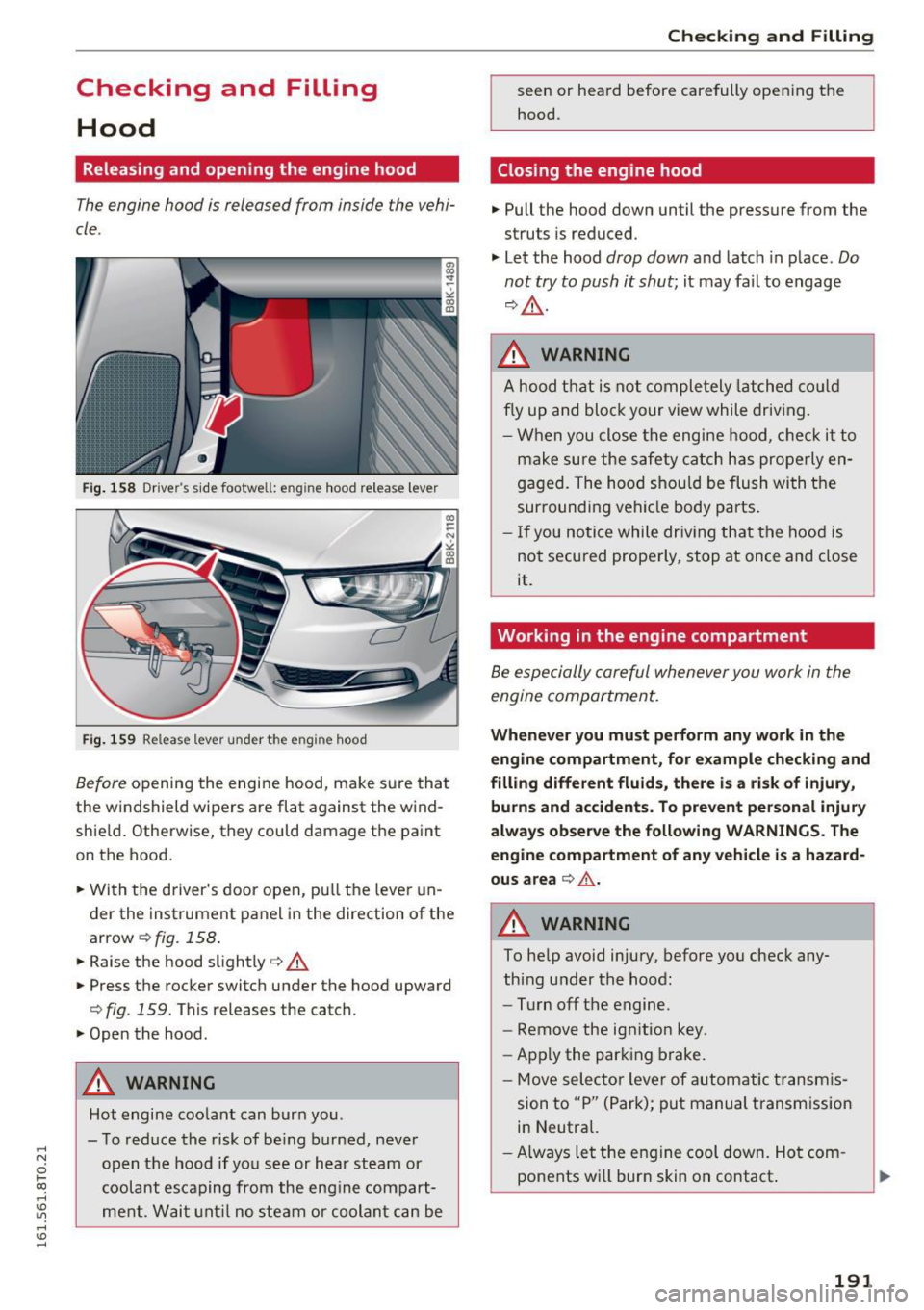
Fig. 158 Driver's side footwell: engine hood re lea se lever
Fig. 159 Release lever under the engine hood
Before opening the engine hood, make sure that
the windshield wipers are flat against the wind
shield. Otherwise, they could damage the paint
on the hood.
.. With the driver's door open, pull the lever un
der the instrument panel in the direction of the
arrow
¢ fig. 158.
.. Raise the hood slightly¢&.
.. Press the rocker switch under the hood upward
¢fig . 159. This releases the catch.
.. Open the hood.
A WARNING
Hot engine coolant can burn you.
- To reduce the risk of being burned, never
open the hood if you see or hear steam or
coolant escaping from the engine compart
ment. Wait until no steam or coolant can be
Checking and Filling
seen or heard before carefully opening the
hood.
Closing the engine hood
.. Pull the hood down until the pressure from the
struts is reduced .
.,. Le t the hood
drop down and latch in place. Do
not try to push it shut;
it may fail to engage
¢&, .
A WARNING
A hood that is not completely latched could
fly up and block your view while driving.
- When you close the engine hood, check it to
make sure the safety catch has properly en
gaged. The hood should be flush with the
surrounding vehicle body parts.
- If you notice while driving that the hood is
not secured properly, stop at once and close
it.
Working in the engine compartment
Be especially careful whenever you work in the
engine compartment.
-
Whenever you must perform any work in the
engine compartment, for example checking and
filling different fluids, there is a risk of injury, burns and accidents. To prevent personal injury
always observe the following WARNINGS. The
engine compartment of any vehicle is a hazard
ous area
¢ .&. .
A WARNING
-~
To help avoid injury, before you check any
thing under the hood:
- Turn off the engine.
- Remove the ignition key .
- Apply the parking brake.
- Move selector lever of automatic transmis-
sion to "P" (Park); put manual transmission
in Neutral.
-Always let the engine cool down. Hot com
ponents will burn skin on contact.
191
Page 195 of 264
,-1 N
0 1-CX)
,-1 I.Cl U"I
,-1 I.Cl ......
Checking and Filling
Engine compartment
Engine compartment
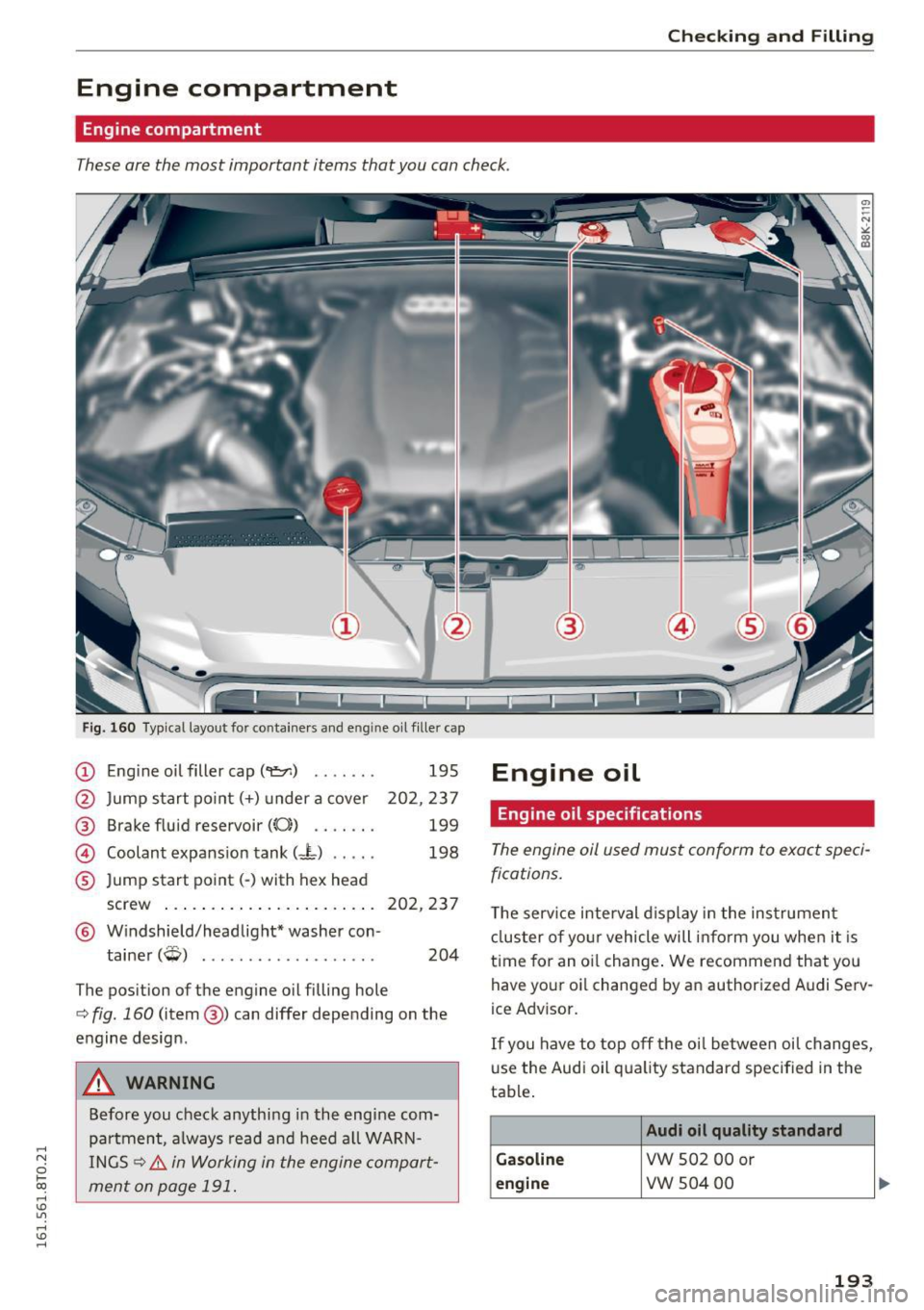
These are the most important items that you can check.
Fig. 160 Typical layout for containers and e ngin e oil fille r cap
(D Eng ine o il filler cap (
@ Brake fluid reservoir
((0) ...... .
@ Coolant expansion tank (- L) .... .
® Jump start point( -) with hex head
195
202,237
199
198
screw . . . . . . . . . . . . . . . . . . . . . . . 202, 237
@ Windshield/headlight* washer con-
tainer
(W) . . . . . . . . . . . . . . . . . . . 204
The position of the engine oil filling hole
c:> fig. 160 (item @) can differ depending on the
engine design .
A WARNING
Before you check anything in the engine com
partment, always read and heed all WARN
INGS
c:> &. in Working in the engine compart
ment on page 191.
Engine oil
Engine oil specifications
The engine oil used must conform to exact speci
fications.
T he serv ice interval display in the instrument
cluster of your vehicle will inform you when it is
time for an oi l change . We recommend that you
have your oi l changed by an authorized Audi Serv
ice Advisor.
If you have to top off the oil between oil changes,
use the Audi oil quality standard specified in the
table .
Audi oil quality standard
Gasoline
VW 502 00 or
engine vw 504 00
193
Page 196 of 264
Check ing and F illing
Using the proper engine oil is impo rtant for the
functionality and service life of the engine. Your engine was facto ry-filled with a h igh-quality oi l
which can usually be used throughout the entire
year.
@) Note
Your Limited New Vehicle War ranty does not
cover damage or malfunctions due to failure
to follow recommended maintenance and use
requirements as set forth in the Audi Owner's
Manual and Warran ty
& Maintenance booklet.
- Use only a high quality eng ine oil t hat ex-
p ressly complies with the Audi oil qua lity
standard specified for your vehicle's engine .
Using a ny o ther oil can cause serious engine
d am age.
- D o not mix any lubricants o r other addit ives
i nto the engine oil. Doing so ca n cause en
g ine damage.
(D Tips
I f you need to add oil and there is none availa
ble t hat meets the Audi o il quality standard
your eng ine requi res , you m ay ad d a tot al of
no more than 0.5 qu art /li ter o f a h igh-quality
"synthe tic"oil that meets t he following speci
fications.
- Vehicles w it h gasoline eng ine: AC EA A3 o r
API SM with a viscosity grade of SAE 0W-30,
SAE SW -30 or SAE SW-40.
- Fo r more information about en gine o il that
has been approve d for your ve hicle, please
contact eithe r you r a uthorized Aud i dea ler
or A udi C ustome r Relat ions at
1 (800) 822-2834 or visit our web site at
www .audiusa .com or www.aud icanada .ca .
Engine oil consumption
The engine in your vehicle depends on an ade
quate amoun t of oil to lubricate and cool all of
its moving parts .
In order to provide effective lubr ication and coo l
ing of in ternal engine components, all internal
combustion eng ines consume a certain amou nt
of oil. Oil co nsumption varies from engine to en
g ine and may change significant ly over the life of
194
th e engine. Typically, engines w ith a specified
break-in period (see
r=:> poge 177) consume more
o il dur ing the b reak-in per iod than they consume
after oil consumption has stabili zed .
U nder normal cond itions, the rate of oil con
sumption depends on the q ua lity and viscosity of
the oil, the RPM (revo lutions per m inute) at
which the engine is operated, the ambient tem perature and road condit ions. Further factors are
the amo unt of o il di lution from water condensa
t ion or fuel residue a nd the oxidation level of the
o il. As any engine is subject to wea r as mileage
builds up, the o il cons umption may increase ove r
t i me unt il repla ce m ent of wo rn components m ay
be come necessary .
With a ll these va riab les coming into p lay, no
sta ndard rate of o il cons umption can be estab
li sh ed or spec ified . T he re is no alte rn ative to reg
ul ar and frequen t checking of the oi l level, see
Note .
If the yellow engine oi l leve l wa rning symbo l Ill
in the instrument clus ter lights up , you sho uld
c h eck t he o il level as soon as possible
r=:> page 195 . Top off the oi l at your ea rliest con
venience
r=:> poge 195.
A WARNING
Before you check anyth ing in the engine com
partment, always read and heed all WARN
INGS
r=:> .&. in Working in the engine compart
ment on page 191.
@ Note
D riving wit h an insuffic ient oil level is like ly to
cause severe damage to the eng ine.
(D Tips
- The oil pressure warning display. is not
an indicator of the oil level. Do not rely on
it . Instead, check the oil level in your en
gine at regular intervals, preferably each
time you refuel, and always before going
on a long trip .
-If you have the impress io n your e ngine con
sumes excessive amou nts of oil, we recom-
mend th at yo u consult an authori zed A udi .,.