flat tire AUDI S6 2008 Owner's Manual
[x] Cancel search | Manufacturer: AUDI, Model Year: 2008, Model line: S6, Model: AUDI S6 2008Pages: 390, PDF Size: 88.42 MB
Page 330 of 390
lllffll,.___T_ ir_e _ s_ a_ n_ d _ w __ h_e _e_ l_ s _______________________________________________ _
& WARN ING (continued )
• All four wheels mu st be fitted with radial tires of the same type,
si ze (rolling cir cumference ) and the same tread pattern. Driving
with different tires redu ces vehicle handling and can le ad to a loss
of control.
• If the spare tire is not the same as the tires that are mounted
on the vehi cle -for e xample with winter tires -only use the spare
t ire for a short period of time and drive w ith extra care . Refit the
normal road wheel as soon as safely possible.
• Never drive faster than the maximum speed for whi ch the tires
on your vehicle are rated becau se t ires that are driven faster than
their rated speed c an fail suddenly .
• Overload ing tires cause heat build-up , sudden tire failure,
including a blowout and sudden deflation and loss of control .
• Tempe rature grades apply to t ires that are properly inflated and
not over or underinflated.
• Fo r techni cal reasons it is not always possible to use wheels
from other vehicles -in some cases not even wheels from the
same vehicle model .
• If you install wheel trim discs on the vehicle wheels , make sure
that the air flow to the brakes is not blo cked . Reduced airflow to
the brakes can them to overheat , increasing stopping distances
and causing a collision .
• Run flat tires may only be u sed on vehicles that were equipped
with them at the factory . The vehicle must have a chas sis designed
for run flat tires and a factory -installed tire pressure monitoring
system that indi cates a loss of tire pressure . In corre ct u se of run
flat tires can lead to vehicle damage or accidents . Check with an
authori zed Audi dealer or tire specialist to see if your vehicle can
be equipped w ith run flat tires . If run flat tires are used , they must
be installed on all four wheels . Mi xing tire types is not permitted.
0 Note
• For technical reasons, it is not ge nerally poss ible to use the
whee l rims from other vehicles. This can ho ld t rue for whee ls of the
same ve hic le type.
• I f the s pa re tire is diffe rent from the tires that you have mo unted
o n your veh icle ( for e xample w inter t ires or w ide pro file t ires), the n
use the spare tire for a short period of time on ly and drive with extra
ca re. R ep lace the flat t ire w ith th e ti re m atc hin g the o thers o n your
vehic le as soon as possib le.
• I f you should put different w hee ls and t ires o n you r ve hicle (e.g.
winter wheels and tires), you must be certain that the wheels and
t ires are co mpat ible w ith the tire pressure monit oring syst em.
Otherwise the system will register a ma lfunction and a fau lt
m essage w ill be d isplayed . For more info rmatio n, con tact your Aud i
dea ler.
0 Note
• When insta lling new tires, be carefu l not to damage the va lves or
t ire pressu re m oni toring sys te m sensors .
• N ever drive without the valve stem cap. The va lves could get
damaged.
• I f the sensors must be replaced, then the valve must also be
r ep laced at t he same t ime .
~ For the sake of the environment
Dispose of o ld tires i n acco rdance wit h the local requ ire men ts .•
Uniform tire quality grading
• Tr ead wear
• Tr action AA A B C
• T emperature A B C
Page 331 of 390
________________________________________________ T_ i _r_e _s_ a_n_ d_ w_ h_ e_e _ l_s __ llll
•
Quality grades can be found where applicable on the tire side wall
between tread shoulder and maximum section width =>
page 325,
fig. 244.
For example: Tread wear 200, Traction AA, Temperature A.
All passenger car tires must conform to Federal Safety Require
ments in addition to these grades .
Tread wear
The tread wear grade is a comparative rating based on the wear rate
of the tire when tested under controlled conditions on a specified
government test course.
For example, a tire graded 150 would wear one and one half (1 1/2)
times as well on the government course as a tire graded 100.
The relative performance of tires depends upon the actual condi
tions of the ir use, however, and may depart significantly from the
norm due to variations in driving habits, service practices and differ
ences in road characteristics and c limate .
Traction
The traction grades, from highest to lowest , are AA, A, Band C .
Those grades represent the tire 's ability to stop on wet pavement as
measured under controlled conditions on specified government
test surfaces of asphalt and concrete. A tire marked C may have
poor traction performance =>& .
Temperature
The temperature grades are A (the highest), B, and C, representing
the tire 's resistance to the generation of heat and its ability to dissi
pate heat when tested under controlled conditions on a specified
indoor laboratory test wheel.
Sustained high temperature can cause the material of the tire to
degenerate and reduce tire life, and excessive temperature can lead
to sudden tire failure =>& .
The grade C corresponds to a level of performance which all
passenger car tires must meet under the Federal Motor Vehicle Safety
Standard No. 109. Grades Band A represent higher leve ls of
performance on the laboratory test wheel than the minimum
required by law.
& WARNING
The traction grade assigned to this tire is based on straight-ahead
braking traction tests, and does not include acceleration,
cornering, hydroplaning or peak traction characteristics.
& WARNING
The temperature grade for this tire is established for a tire that is
properly inflated and not overloaded. Excessive speed, underinfla
tion, or excess ive loading, either separately or in combination, can
cause heat buildup and possible tire failure . •
Winter tires
Winter tires can improve vehicle handling on snow and
ice. At temperatures below 45 °F (7 °C) we recommend
changing to winter tires.
In some heavy snow areas, local governments may require true
winter or "snow" tires, those with very deeply cut tread. These tires
should only be used in pairs and be installed on all four wheels .
Make sure you purchase snow tires that are the same size and
construction type as the other tires on your vehicle.
If your vehicle is equipped with al l-wheel drive *, this will improve
traction during winter dr iving, even with the standard tires.
However, we strongly recommend that you always equip all four
wheels on your vehicle with correctly fi tted winter tires or all-season
tires, when winter road conditions are expected . T his also improves
the vehicle 's braking performance and reduces stopping distances.
Summer tires provide less grip on ice and snow.
Vehicle care I t •
Page 332 of 390
-~_T_ ir_e_ s_ a_ n_d _ w_ h_ e_e _l_s _________________________________________________ _
Winter tires (snow tires) must always be fitted on a ll four wheels .
Compati ble t ire press ure moni to ring senso rs m ust be installed o n
a ll four w inter t ires for the t ire pr essure mo nitoring system to func
tion p roper ly
~ page 327.
Ask you r au thori zed Aud i dealer o r qual ified w ork s hop f or per mitted
winter tire s izes . Use only radial winter tires.
Win ter tires lose their effec tivenes s whe n the trea d is wo rn down to
a depth of 0.1 57 inch (4 mm).
Only drive with winter tires unde r winter conditions. Summer t ires
ha ndle better when there is no snow or ice o n th e roads a nd th e
temperature is above 45 °F ( 7 °C).
If you ha ve a flat tir e, see notes on s pare w heel
~ page 325.
Please a lways reme mber t hat winte r ti res may have a lower speed
rating than the tires originally instal led on your vehic le at t he time
i t was ma nufactured. Please see~
page 326, "Speed rating (letter
code)" for a listing of the speed rating letter codes and the
m aximu m sp ee d at whic h th e t ires ca n be d riven .
T he speed rating letter code(~
page 316) is on the side wa ll of the
t ir e ~
page 325.
& WARNING
Winter tires have maximum speed limit s that may be lower than
your vehicle' s ma ximum speed. Always know the ma ximum speed
before driving off . Never drive faster than the speed permitted for
your specific winter tires . This will cause damage to the tires
leading to an accident and serious personal injury to you and your
passengers .
& WARNING
Driving faster than the ma ximum speed for whi ch the winter tires
on your vehicle were designed can cause tire failure including a
blowout and sudden deflation , loss of control , crashes and serio us
& WARNING (continued)
personal injuries . Have worn or damaged tires repla ced immedi
ately.
• Winter tires have maximum speed rating that may be lower
than your vehicle's maximum speed.
• Never drive faster than the speed for which the winter or other
tires installed on your vehicle are rated.
& WARNING
Always adjust your driving to the road and traff ic conditions .
Never let the good acceleration of the winter tires and all -wheel
drive tempt you into taking extra risks . Always remember:
• When braking, an all -wheel drive vehicle handles in the same
way as a front drive vehicle .
• Drive carefully and reduce your speed on icy and slippery roads,
even winter tires cannot help under black ice conditions .
q uieter, d o not wear as qu ickly a nd red uce fuel c onsu mp tion .•
Snow chains
S no w chains may b e fitte d only to t he fron t w hee ls, an d only to
certain tire sizes. Ask your authorized Aud i dea ler on which tire
sizes sn ow chai ns ca n be use d.
I f you are going to use snow chains, then you must instal l the m on
the front wheels at least.
T he snow chains mus t have low-pro file l inks a nd mus t not be thicke r
than 0.53 inch (13.5 mm), including the lock. .,,_
Page 334 of 390
-Tires and wheels
PW-------------------
possible with a torque wrench -preferably by an authorized Audi
dealer or qualified workshop. •
Low aspect ratio tires
Your Audi is factory-equipped with low aspect ratio tires . These tires
have been thoroughly tested and been selected specifically for your
model for their superb performance, road feel and hand ling under
a variety of driving conditions . Ask your authorized Audi dealer for
more details.
The low aspect ratio of these tires is indicated by a numeral of
55 or
less
in the tire's size designation. The numeral represents the ratio
of the tire's sidewa ll height in relat ion to its tread width expressed
in percentage. Conventional tires have a height/width ratio of 60 or
more.
The performan ce of low -aspect-ratio tires is particularly sensitive to
improper inflation pressure. It is therefore important that low
aspect ratio tires are inflated to the specified pressure and that the
inflation pressure is regularly checked and maintained. T ire pres
s ures should be checked at least once a month and always before a
long trip => page 379,
"Checking tire pressure".
What you can do to avoid tire and rim damage
Low aspect ratio tires can be damaged more easily by impact with
potho les, curbs, gullies or ridges on the road, particularly if the tire
is underinflated.
In order to minimize the occurrence of impact damage to the tires
of your vehicle, we recommend that you observe the following precautions:
• Always ma inta in recommended inflation pressures. Check your
tire pressure every 2,000 miles (3,000 km) and add air if necessary.
• Drive carefully on roads with potholes, deep gu llies or ridges.
The impact from driving through or over such obstacles can
damage your tires. Impact with a curb may also cause damage to
your tires . •
After any impact, immediately inspect your tires or have them
inspected by the nearest authorized Audi dealer. Replace a
damaged tire as soon as possible.
• Inspect your tires every 2,000 miles (3,000 km) for damage and
wear. Damage is not always easy to see. Damage can lead to loss of
air and underinflation, which could eventually cause tire failure. If
you believe that a tire may have been damaged, replace the tire as
soon as possib le.
• T hese tires may wear more quickly than others .
• Please also remember that, whi le these tires deliver respons ive
handling, they may ride less comfortably and make more noise than
other choices .
Reduced performance in winter /cold season
conditions
A ll tires are designed for certain purposes. The low aspect ratio,
u ltr a high performance tires originally installed on your vehic le are
intended for maximum dry and wet road performance and handling.
They are not suitable for cold, snowy or icy weather conditions. If
you drive under those circumstances, you should equip your vehic le
with all -season or winter tires , wh ich offer better traction under
those conditions. We suggest you use the recommended snow or all -season tires specified for your vehicle, or their equivalent .
Refer to=>
page 329for more detailed information regarding winter
tires. •
Page 339 of 390
_____________________________________________ W_ h_ a_t _d_ o_l _ d_o _ n_o_ w_ ? _ __._
& WARNING !continued)
• Never start or run the engine while the vehicle is supported by
the jack.
• If you must work under the vehicle, always use safety stands
specifically designed for this purpose.
• Never use the hexagonal socket in the handle of the screw
driver to loosen or tighten the wheel bolts .
• Always make sure the spare tire and even a flat tire are secured
in place and not loose , otherwise they could fly forward , causing
personal injury to passengers in the vehicle in an accident or
sudden maneuver. •
Tools
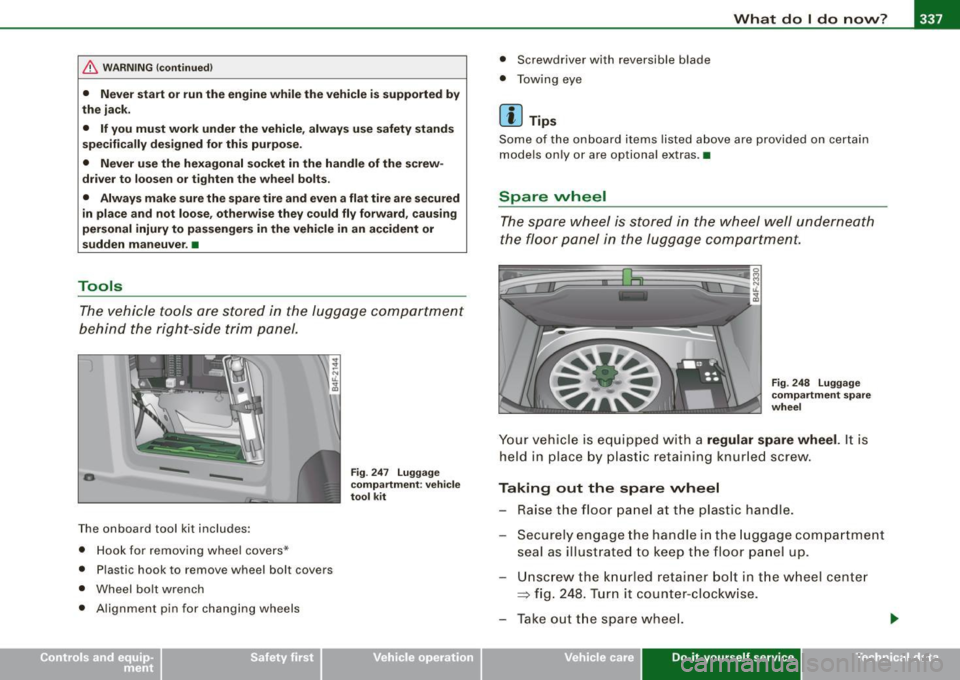
The vehicle tools are stored in the luggage compartment
behind the right-side trim panel.
-
T he onboard tool kit includes:
• Hook for removing wheel covers *
• Plastic hook to remove wheel bolt covers
• Wheel bolt wrench
• Alignment pin for changing wheels
Fig. 247 Luggage
compartment: vehicle
tool kit
• Screwdriver with reversible blade
• Towing eye
[ i ] Tips
Some of the on board items listed above are provided on certain
models only or are optional extras. •
Spare wheel
The spare wheel is stored in the wheel well underneath
the floor panel in the luggage compartment.
Fig. 248 Luggage
compartment spare
wheel
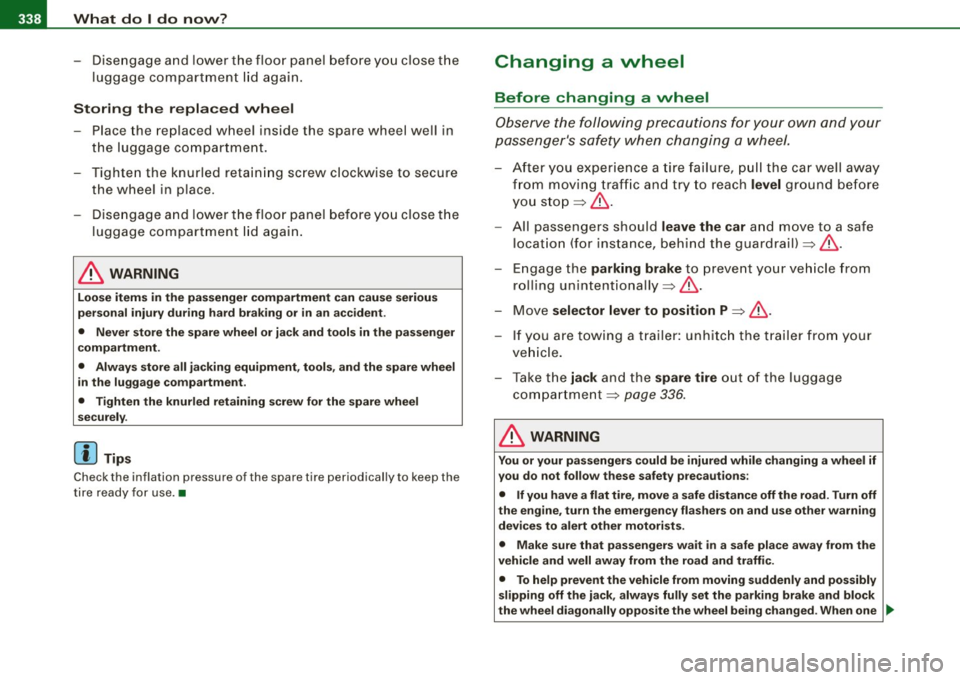
Your vehicle is equipped with a regular spare wheel. It is
held in place by plastic retaining knurled screw.
Taking out the spare wheel
- Raise the floor panel at the plast ic handle.
- Securely engage the handle in the luggage compartment
seal as illustrated to keep the floor panel up.
- Unscrew the knurled retainer bolt in the wheel center
~ fig. 248. Turn it counter-clockwise.
- Take out the spare wheel.
Vehicle care Do-it-yourself service Technical data
Page 340 of 390
11111.___W_ h_ a_ t_ d_o_ l_ d_ o _ n_ o_w _ ? ____________________________________________ _
- Disengage and lower the floor panel before you close the
luggage compartment lid again.
Storing the replaced wheel
- Place the replaced wheel inside the spare wheel well in
the luggage compartment .
Tighten the knurled retaining screw clockwise to secure the wheel in place.
- Disengage and lower the floor panel before you close the
luggage compartment lid again.
& WARNING
Loose items in the passenger compartment can cause serious
personal injury during hard braking or in an accident .
• Never store the spare wheel or jack and tools in the passenger
compartment.
• Always store all jacking equipment, tools, and the spare wheel
in the luggage compartment.
• Tighten the knurled retaining screw for the spare wheel
securely.
[ i] Tips
Check the inflation pressure of the spare tire periodically to keep the
tire ready for use. •
Changing a wheel
Before changing a wheel
Observe the following precautions for your own and your
passenger's safety when changing a wheel.
- After you experience a tire failure, pull the car well away
from moving traffic and try to reach level ground before
you stop :::;. & .
- All passengers should leave the car and move to a safe
location (for instance, behind the guardrail) :::;,& .
- Engage the parking brake to prevent your vehicle from
rol ling unintentionally :::;.& .
- Move selector lever to position P :::;. & .
-If you are towing a trailer: unhitch the trailer from your
vehicle.
- Take the jack and the spare tire out of the luggage
compartment:::;.
page 336.
& WARNING
You or your passengers could be injured while changing a wheel if
you do not follow these safety precautions:
• If you have a flat tire, move a safe distance off the road. Turn off
the engine, turn the emergency flashers on and use other warning
devices to alert other motorists.
• Make sure that passengers wait
in a safe place away from the
vehicle and well away from the road and traffic.
• To help prevent the vehicle from moving suddenly and possibly
slipping off the jack, always fully set the parking brake and block
the wheel diagonally opposite the wheel being changed. When one ...
Page 341 of 390
-------------------------------------------~W~h~a~t~d~o~l ~d~o~n~o~w~ ?::__fflll
•
& WARNING (continued)
front wheel is lifted off the ground, placing the Automatic Trans
mission in "P" {Park) will
not prevent the vehicle from moving.
• Before you change a wheel, be sure the ground is level and firm.
If necessary, use a sturdy board under the jack.
• After installing the spare wheel, make sure that you replace the
flat tire/wheel in its storage area properly and tighten the knurled
retaining screw securely. •
Changing a wheel
When you change a wheel, follow the sequence described
below step-by-step and in exactly that order.
1. Activate the vehicle jack mode (only vehicles with Adap
tive Air Suspension)~
page 184.
2. Remove the decorative wheel cover*. For more details
see also ~
page 340, "Decorative wheel covers" or
~ page 340, "Wheels with wheel bolt caps".
3. Loosen the
wheel bolts~ page 341.
4. Locate the proper mounting point for the jack and align
the jack below that point~
page 341.
5. Lift the car with the jack ~ page 341.
6. Remove the wheel with the flat tire and then install the
spare
~ page 343.
7. Tighten all wheel bolts lightly.
8.
Lower the vehicle with the jack.
9. Use the wheel bolt wrench and
firmly tighten all wheel
bolts~
page 341 .
10. Replace the decorative wheel cover*.
11. Deactivate the vehicle jack mode (only vehicles with
Adaptive Air Suspension)~
page 184.
& WARNING
Always read and follow all WARNINGS and information => & in
uRaising the vehicle" on
page 341 and=> page 344. •
After changing a wheel
A wheel change is not complete without the doing the
following.
- Store and secure the wheel you replaced in the spare
wheel well.
- Replace the tools and the jack in their proper location.
- Check the tire pressure on the spare wheel immediately
after mounting it.
- As soon as possible, have the
tightening torques on all
wheel bolts checked with a torque wrench. The correct
tightening torque is 90 ft lb (120 Nm).
- Have the flat tire
replaced as soon as possible.
[ i] Tips
• If you notice that the wheel bolts are corroded and difficult to
turn while changing a tire, they should be replaced before you check
the tightening torque.
• Drive at reduced speed until you have the tightening torques
checked .•
Do-it -yourself service
Page 344 of 390
lllftl.,___W_ h_ a _ t_d_ o_ l _d _o_ n_ o_ vv_ ? ______________________________________________ _
Fig. 253 Close-up:
proper positioning of
jack
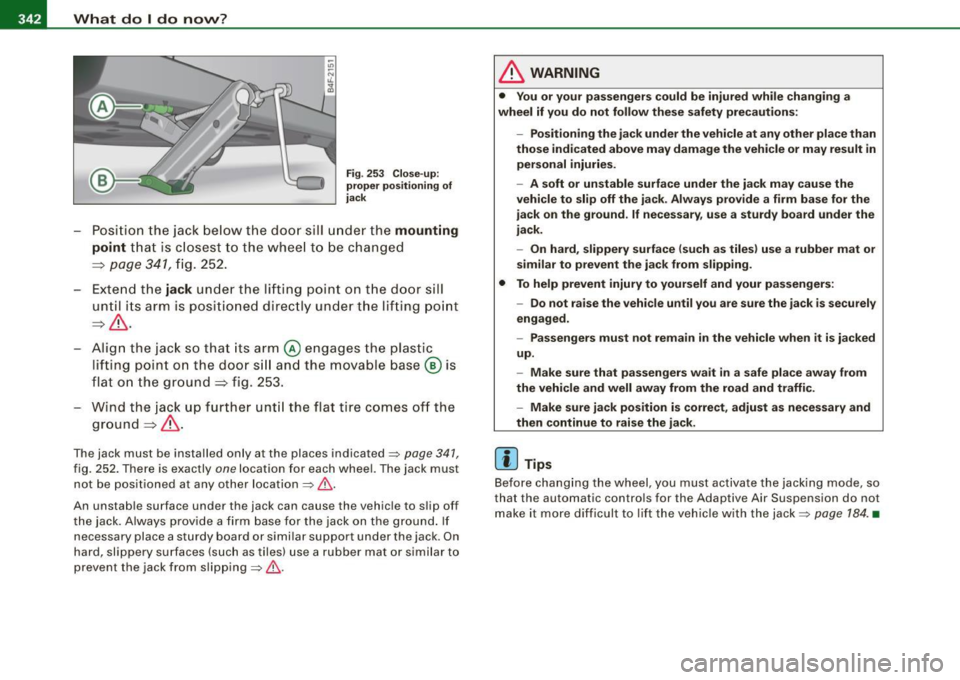
- Position the jack below the door sill under the mounting
point
that is closest to the wheel to be changed
:::::, page 341 , fig. 252.
Extend the
jack under the lifting point on the door sill
until its arm is pos itioned d irectly under the lifting point
:::::,& .
- Align the jack so that its arm @ engages the plastic
l ifting point on the door sill and the movable base@ is
flat on the ground :::::, fig. 253.
Wind the jack up further until the flat tire comes off the
ground :::::,& .
The jack must be installed only at the places indicated~ page 341,
fig. 252. There is exactly one location for each wheel. The jack must
not be positioned at any other location~&.
An unstable surface under the jack can cause the vehicle to slip off
the jack. Always provide a firm base for the jack on the ground. If
necessary place a sturdy board or similar support under the jack . On
hard, slippery surfaces (such as tiles) use a rubber mat or similar to
prevent the jack from slipping~&.
& WARNING
• You or your passengers could be injured while changing a
wheel if you do not follow these safety precautions:
-Positioning the jack under the vehicle at any other place than
those indicated above may damage the vehicle or may result in
personal injuries.
- A soft or unstable surface under the jack may cause the
vehicle to slip off the jack . Always provide a firm base for the
jack on the ground. If necessary, use a sturdy board under the
jack.
- On hard, slippery surface {such as tiles) use a rubber mat or
similar to prevent the jack from slipping.
• To help prevent injury to yourself and your passengers:
-Do not raise the vehicle until you are sure the jack is securely
engaged.
- Passengers must not remain in the vehicle when it is jacked
up.
- Make sure that passengers wait in a safe place away from
the vehicle and well away from the road and traffic.
- Make sure jack position is correct, adjust as necessary and
then continue to raise the jack.
[ i ] Tips
Before changing the wheel, you must activate the jacking mode, so
that the automatic controls for the Adaptive Air Suspension do not
make it more difficult to lift the vehicle with the jack ~
page 184. •
Page 346 of 390
-L___:W:..:..:. h.:.: a::.. t:...:: d:.:o:::....:. l..: d::. O ::::....: n:..:.:: O:..:W :.:..:. ? ____________________________________________ _
hub. Remove all dirt from these surfaces before remounting the
wheel. •
Tires with unidirectional tread design
Tires with unidirectional tread design must be mounted
with their tread pattern pointed in the right direction.
Using a spare tire with a tread pattern intended for use
in a specific direction
When using a spare tire with a tread pattern intended for use in a
specific direction, please note the following:
• The direction of rotation is marked by an arrow on the side of the
tire .
• If the spare tire has to be installed in the incorrect direction, use
the spare tire only temporarily since the tire will not be able to
achieve its optimum performance characteristics with regard to
aquaplaning, noise and wear.
• We recommend that you pay particular attention to this fact
during wet weather and that you adjust your speed to match road
conditions.
• Replace the flat tire with a new one and have it installed on your
vehicle as soon as possible to restore the handling advantages of a
unidirectional tire. •
Notes on wheel changing
Please read the information~ page 325, "New tires and replacing
tires and wheels " if you are going to use a spare tire which is
different from the tires on your vehicle.
After you change a tire:
• Check the tire pressure on the spare immediately after installa
tion . •
Have the wheel bolt tightening torque checked with a torque
wrench as soon as possible by your authorized Audi dealer or a qualified service station .
• With steel and alloy wheel rims, the wheel bolts are correctly
tightened at a torque of 90 ft lb (120 Nml.
• If you notice that the wheel bolts are corroded and difficult to
turn while changing a tire, they should be replaced before you check
the tightening torque.
• Replace the flat tire with a new one and have it installed on your
vehicle as soon as possible. Remount the wheel cover.
Until then, drive with extra care and at reduced speeds .
& WARNING
• If you are going to equip your vehicle with tires or rims which
differ from those which were factory installed, then be sure to read
the information
~ page 325, "New tires and replacing tires and
wheels".
• Always make sure the damaged wheel or even a flat tire and
the jack and tool kit are properly secured in the luggage compart ment and are not loose in the passenger compartment.
• In an accident or sudden maneuver they could fly forward,
injuring anyone in the vehicle .
• Always store damaged wheel, jack and tools securely in the
luggage compartment . Otherwise, in an accident or sudden
maneuver they could fly forward, causing injury to passengers in
the vehicle .
0 Note
Do not use commercially available tire sealants. Otherwise, the elec
trical components of the tire pressure monitoring system* will no
longe r work properly and the sensor for the tire pressure moni
toring system will have to be replaced by a qualified workshop. •
Page 374 of 390
-Alphabetical index ..,,,_.:_.__ ____ _...::.:...::..;.:___ ________________ _
A
A . ccessones ............. .... .... .. .
Adapter for cupholder ..... ...... ... . 368
103
Ad . A' S .
apt1ve 1r uspens1on .. .... ... .... 182
Automatic mode . . . . . . . . . . . . . . . . . 183
Description . . . . . . . . . . . . . . . . . . . . . 182
Dynamic mode . . . . . . . . . . . . . . . . . . 183
Jacking mode when changing a flat tire .
184
Lift mode . . . . . . . . . . . . . . . . . . . . . . . 183
Setting the driving modes .. .... ... 183
Standard mode . . . . . . . . . . . . . . . . . . 183
Trailer towing mode ... .... .... ... 184
Warning/indicator lights ....... .... 21
Adaptive Cruise Control . . . . . . . . . . . . . . 135
Changing speed .. ........... .... 138
Driver information ............... 142
Driver interven tion prompt ........ 146
Driving in traffic ...... .... ...... . 136
Driving program ...... .... .... ... 147
Error messages . . . . . . . . . . . . . . . . . . 145
Open road . . . . . . . . . . . . . . . . . . . . . . 136
Override . . . . . . . . . . . . . . . . . . . . . . . . 136
Request for driver to assume control 136
Save speed . . . . . . . . . . . . . . . . . . . . . . 137
Setting distance . . . . . . . . . . . . . . . . . 140
Setting time interval .. .. .......... 140
Settings . . . . . . . . . . . . . . . . . . . . . . . . 147
Specia l driving situations ......... 147
Status messages . . . . . . . . . . . . . . . . . 145
Switching on and off .. .... ... .... 137
System limits ...... .... .......... 147
Tempor arily turning off ... ...... .. 139
warning/indicator lights .... ...... . 143
Adaptive Light ......... ... .... .... ... 73
defective .......... .... ..... .. .... 37
Adding
Engine coolant ......... ... .... ...
305
Engine oil ... .. ...... ....... ..... 302
Windshield washer fluid .... .... ... 312
Additional accessories .... .... .... ... 368
Additives
Engine oil ... .. ..... .. ...... .....
302
Adjusting
Instrument cluster i llumination ......
16
Steering column electrically .... ... 123
Steering column manually ...... ... 122
Ad' . f Justing ront seats .. .... .... .... ... 87
Advanced Key ...... .. .... ........... 59 Care
........ ..... ....... ... .. ...
226
Child restraints .................. 236
Children ....... ....... .... ..... . 235
Components (front airbags) ........ 219
Danger of fitting a chi ld safety seat on the
front passenger seat .. ..... .. ...
214
Disposal ............ .. .... ...... 226
Fron t airbags ...... .... .... .. 216, 217
How do the front airbags work? . ... 221
How many airbags does my vehicle have?
219
How the Advanced Airbag System compo -
nents work together . . . . . . . . . . . . .
220
Important things to know ... ..... .. 212
Indicato r light ...... ... .. .... .... 223
Monitoring .... .... .... ...... .... 223
PASSENGER AIR BAG OFF light ..... 224
Repairs ..... .. .... .... ... ... ... . 226
Driver messages . . . . . . . . . . . . . . . . .
128 Safety instructions .... .... .... ... 225
Locking vehicle ................. .. 61 Side airbags ... .... .... ... ... ... . 228
START button ................... 126 Side curtain airbags (SIDEGUARD) .. 231
Starting engine ........ ..... .. ... 126 Weight-sensing mat .. ....... ..... 235
STOP button .... ... .... .... ...... 127 When must the system be inspected? .. .
Switching engine off ...... .... ...
127 223
Switching on ignition ...... .... ... 126 All Whee l Drive ... .... .... .......... 264
Unlocking vehicle ........... ...... 60 Alloy wheels . .... .... ....... .... ... 283
Air conditioning
See Climate controls ... .......... . 11 O
Airbag
Warning/indicator lights ..... ......
20
Airbag system ... ... .. .... .... .. 212, 229
Advanced Airbag System ...... .... 216
Advanced Airbag System components
219
All- whee l drive
Winter tires .... ........... .... ..
329
Alternator
See Generator . . . . . . . . . . . . . . . . . . . . 19
Anti -freeze
See Engine coolant system ...... .. 303
Anti-glare inside day-night mirror .... .. 82