fuel AUDI S6 2008 Workshop Manual
[x] Cancel search | Manufacturer: AUDI, Model Year: 2008, Model line: S6, Model: AUDI S6 2008Pages: 390, PDF Size: 88.42 MB
Page 319 of 390
Tires and wheels -_______________ _____.
Occ up ant loading and di stribution fo r vehicle no rmal load for various d esignated seating capa cities
Designated seating capacity, num
ber of occupants Vehicle normal load
, numb er of
occupants Occupant distribution in a normally
load
ed vehicle
5 3 2 in front,
1 in bac k seat •
Cold tire inflation pressure
Tire pressure affects the overall handling, performa nce and safe ty of a vehicle .
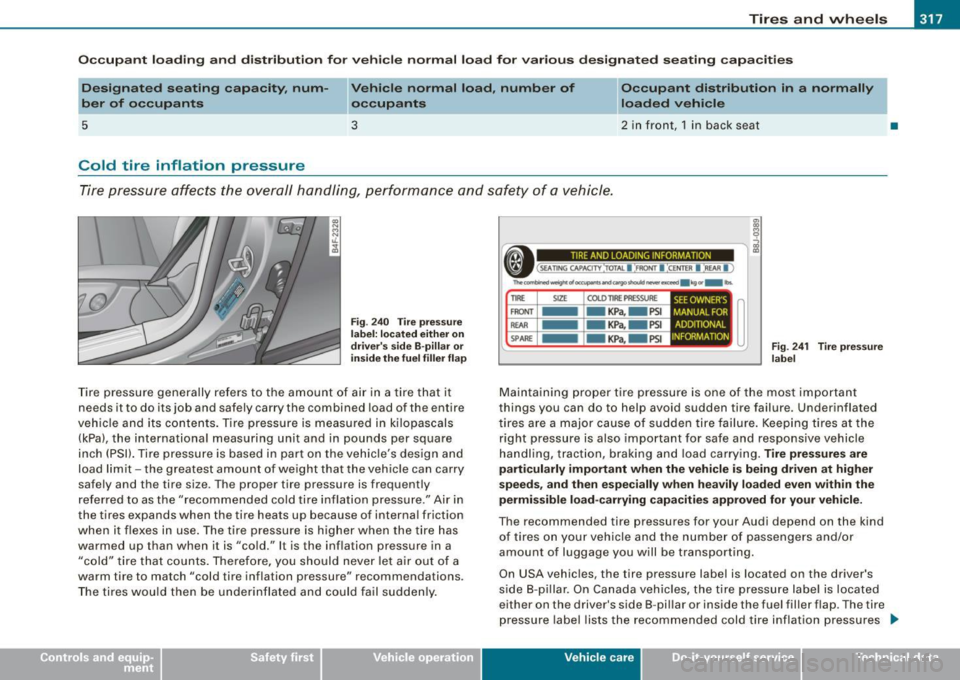
Fig. 2 40 Tire pre ssure
label: located either on
driver' s side B -pill ar or
in sid e the fuel filler flap
Ti re pressure ge nerally refe rs to the am ount of air in a tire tha t it
needs it to do its job and safely carry the combined load of the entire
veh icle and i ts contents. Tire pressu re is measured in kilopascals
(kPa ), the internationa l measuring uni t and in pounds per square
i nc h (PSI) . Tir e p ressu re is based in par t on the vehic le's design and
load l im it - the g reatest amoun t of wei ght that the vehic le ca n carry
safe ly and the tire size . The proper tire pressure is frequently
re ferr ed to as the "recommended cold t ire i nflation pressu re ." Air i n
the tires expands when the tire heats up because of internal friction
whe n it flexes i n use . The tire pres sure is h ig her whe n the tire has
wa rmed up than when it is "co ld." It is the inflation pressure in a
"c old" tire t hat co unts. The ref ore, y ou sho uld neve r let air out of a
warm tire to match "co ld tire inflation pressure" recommendations .
T he tires wo uld then be under inflated a nd cou ld fa il s ud den ly .
i
,,-, ~ ---------------- ixl
• (SEATING CAPAC ITY :roTAL I :FRO NT I :cENTER I :REAR I ) al
Thecombh,d""'91wclo«U,,..,.andco,-goshoulcl.......,""""' •1cg., -b.
TIRE AND LOADING INFORMATION
TIRE SIZE COLO TIRE PRESSURE
F RONT -KPa, -PSI
REAR -KPa, -PSI
SPARE -KPa, - PSI
MANUAL FOR
INFORMATION SEE OWNER'S I
ADDITIONAL
Fig . 241 Tire pr essure
label
M ain tain ing pr op er tire pressure i s one of th e m ost im portant
things you can do to help avoid sudden tire failure. Underinflated
t ires are a major cause of s udden tir e fail ure . K eeping tires at the
ri ght press ure is also impor tant for sa fe and r esponsive v ehicle
han dling, trac tion, b raki ng a nd l oad carryi ng .
Tire pressures are
particularly important when the vehicle is being driven at higher
speeds , and then especially when heavily loaded even within the
permissible load -carrying capacities approved for your vehicle.
T he recommended tire pressures for your Audi depend on the kind
of tires on your vehicle a nd the n umber of passengers an d/o r
amount of luggage you w ill be transporting.
On USA vehic les, the tire pressure label is located on the driver's
s id e B- pilla r. On Cana da v ehic les, the tire pressu re labe l is loca ted
either on the driver's side 8 -pillar or inside the fuel filler flap. The tire
pre ssure label lists the rec omm ended cold tire i nflatio n pre ssures _,,,
Vehic le care I I irechnical data
Page 320 of 390
-~_T_ ir_e_ s_ a_ n_d _ w_ h_ e_e _l_s _________________________________________________ _
for the vehicle at its maximum capacity weight and tires that were
on your vehic le at the time it was manufactured.
If you w is h t o improve co mfort w hen opera ting the vehicle a t
n ormal lo ad (up t o 3 o ccupant s), you can a djust ti re pre ss ure s to
tho se s pecified for norm al v ehi cle load . B efore operating the vehi cle
at m aximum lo ad , y ou must i ncreas e the t ire p re ss ure s to tho se
s pe cifi ed for m axim um vehicle lo ad
=> & .
Bear in mind that the tire pressure monitoring system can only
monitor the tire pressures you have stored. The system does not
recognize the load condition of your vehic le.
The effectiveness of the tire pressure monitoring system will be impaired if you store normal load pressures but then operate the
vehic le at its maximum load=>&. See the
illustration=>
page 317, fig. 240 for the location of the label
either on driver's side B -p illar or inside the fuel fi ller flap (color of
the actual label and exact location on the vehicle will vary slight ly).
Note that the fol lowing tab le is accurate at the time of going to
press and is subject to change . In the event of discrepanc ies, the tire
pressure label (on USA vehicles, the tire pressure label is located on
the dr iver's side B-pi llar; on Canada vehicles, the tire pressure labe l
is located either on the driver's side B-pillar or inside the fue l fi ller
fl ap) always takes precedence.
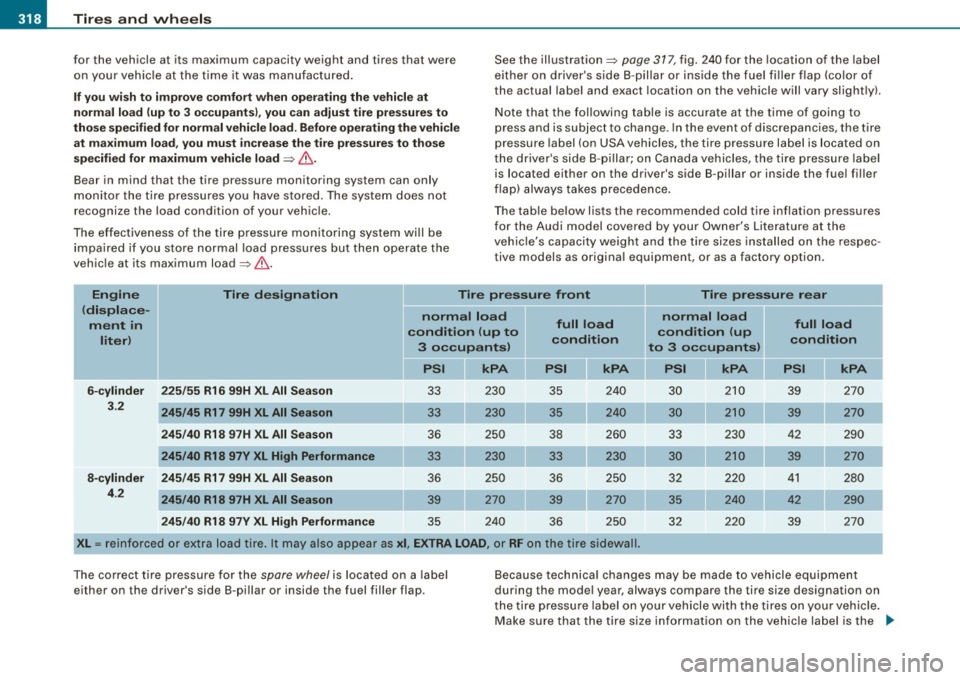
T he table below lists the recommended cold tire inflation pressures
for the Audi model covered by your Owner's Literature at the
vehic le's capacity weight and the tire sizes installed on the respec
tive models as origina l equipment, or as a factory option.
En gin e Tire des ig nation Tir e pr essur e fro nt Tir e p re ssur e rea r
( di spl ac e-
no rm al l oa d no rm al l oa d
m ent in
conditi on (up t o full lo
ad
condition (u p full lo
ad
lit er)
condition condition 3 occupants ) to 3 occ upant s)
PSI kPA kPA kPA
6-cylinder 225/5 5 R16 99H XL All Sea son 33 230 35 240
30 210
39 270
3.2
245 /45 R17 99H XL All Season 33 230 35 240 30 2 10 39 270
2 45 /40 R1 8 97 H XL All Season 36 250
38 260 33 230 42 290
245
/40 R18 97V XL Hi gh Performan ce 33 230 33 230 30 210
39 270
8
-c ylind er 245 /45 R17 99H XL All Sea son 36 250 36 250 32 220 41 280
4.2
245/40 R18 97 H XL All S eason 39 270 39 270 35 240 42 290
2
45 /40 R18 97V XL High Perf orma nce 35 240
36 250 32 220 39 270
X
L = reinforced or extra load t ire . It may also appea r as xi, EX TRA LOAD , or RF on the tire sidewall.
The correct t ire pressure for the
spare wheel is located on a label
either on the driver's side B-pillar or inside the fuel fil ler flap. Because technica
l changes may be made to vehicle equipment
during the mode l year, always compare the tire size designation on
the tire pressure label on your vehicle with the tires on your vehic le .
Make sure that the tire size information on the vehic le label is the _.,
Page 321 of 390
________________________________________________ T_ i _r_e _s_ a_n_ d_ w_ h_ e_e _ l_s __ lftlll
•
same as the size of the tires on the vehicle. This is especially impor
tant if the vehicle belongs to someone else or you bought the
vehicle with different rims/tires or you bought the vehicle as a previ
ously owned vehicle.
Remember, your safety and that of your passengers also depends
on making sure that load limits are not exceeded. Vehicle load
includes everybody and everything in and on the vehicle . These load
limits are technical ly referred to as the vehicle's Gross Vehicle
Weight Rating ("GVWR"l. The Gross Axle Weight Rating ("GAWR") is
the maximum load that can be applied at each of the vehicle's two
axles . The Gross Vehicle Weight Rating and the Gross Axle Weight
Rating are listed on the safety compliance sticker labe l located
either on the driver's side 8 -pillar or on the inside of the fuel fi ller
flap. The tire pressure labe l on your Audi lists the maximum
combined weight of a ll of the occupants and luggage or other cargo
that the vehic le can carry. For the location of the tire pressure label
~ page 317, fig . 240.
& WARNING
O verlo ading a vehicle can c ause los s of vehicle control , a crash or
o ther a ccident , seriou s pe rsonal inju ry, and e ven d eath .
• Carrying more weight than your v ehi cle wa s des igned to carr y
w ill p re v ent the veh icle fr om handli ng properly and in crea se the
ri sk of a lo ss of ve hicle control .
• The br ake s on a vehicle that h as been o verloa ded m ay not be
able to stop the veh icle with in a safe di sta nce .
• Tir es o n a veh icle th at ha s bee n ov erlo aded can fail sudd enl y
c au sin g loss of cont rol a nd a cra sh.
• Always mak e sure th at the total lo ad being tr ansported -
includin g the weight of a tra iler hit ch an d th e tongue weight of a
lo aded tr ailer -doe s not m ake the vehi cle he avier tha n the
v ehicle 's Gro ss V ehicle W eigh t Rating.
& WARNING
• Incorre ct t ire pre ssu re s a nd/o r unde rinflat ion can le ad to a
seriou s or fatal a ccident.
• Incorre ct t ire pr essure s and/or u nderi nflat ion cause in creased
tire wear and can affec t th e handling of the vehicl e.
• Inco rre ct t ire pr essur es and /or underinfl atio n ca n als o lead to
s udden tire failure , including a b lowout and sudden deflation ,
ca usin g lo ss of vehi cle co ntrol. •
Checking tire pressure
The correct tire pressure for the tires originally installed
on your vehicle is listed on the tire pressure label located
either on driver's side B-pillar or inside the fuel filler flap .
The recommended tire pressures are on the tire pressure label and
in the table~ page 317, "Cold tire inflation pressure". This means
that the pressure must be checked and adjusted when the tire has
not been driven for more than a couple of mi les (kilometers) at low
speeds during the previous three hours . Air in the tires expands
when the tire heats up as a result of internal fric tion as it flexes in
use. The tire pressure is higher when the tire has warmed up than
when it is "cold ."
It is the inflation pressure in a "cold" tire that counts . Therefore, you
should never let air ou t of a warm tire to match "Co ld tire inflation
pressure" recommendations~
page 317. The tires wou ld then be
underinflated and could fa il suddenly .
The tire pressure label on your Audi lists the recommended cold tire
inflation pressures for the new, original equipment tires that were
on your vehic le at the time it was manufactu red. For the location of
the labe l~
page 317, fig . 240.
Most tires lose air natural ly over time . They can a lso lose some air if
you drive over a pothole or hit a curb while parking. It is usually not ..,
Vehicle care I t •
Page 322 of 390
-~_T_ ir_e_ s_ a_ n_d _ w_ h_ e_e _l_s _________________________________________________ _
possible to see whether the radial tires used today are underinflated
just by looking at them.
Therefore, be sure to check tire pressures at least once a month and
always before going on a long trip. Make sure to take the number of
people and the amount of luggage into account when adjusting tire
pressure for a trip -even one that you would not consider to be
"long." See=>
page 321, "Tires and vehicle load limits" for more
important information.
Always use an accurate tire pressure gauge when checking and
adjusting inflation pressures . Check all of the tires and be sure not
to forget the spare tire. If the pressure in any tire is too high when
the tire is "cold," let air out of the tire slowly with the edge of the tire
gauge and keep checking the pressure until you reach the pressure
that is correct for the load (passengers and luggage) and kind of
driving you plan to do.
If the pressure in any tire is too low, note the difference between the
pressure in the cold tire and the pressure you need and add the air
that you need to reach the correct pressure for the vehicle load
(passengers and luggage) for the tires on your vehicle as listed on
the on your vehicle and in this manual and the kind of driving you
plan to do.
Never exceed the maximum inflation pressure listed on the tire
sidewall for any reason.
Remember that the vehicle manufacturer, not the tire manufacturer,
determines the correct tire pressure for the tires on your vehicle.
It is important to check the tire pressure when the tires are cold.
• Read the required tire pressure from the tire pressure label. On
USA vehicles, the tire pressure label is located on the driver's side
8-pillar . On Canada vehicles, the tire pressure label is located either
on the driver's side 8-pillar or inside the fuel filler flap.
• Turn the valve stem cap counter-clockwise to remove it from the
tire valve.
• Place the air pressure gauge on the valve. • The
tire pressures should only be checked and adjusted when
the tires are cold. The slightly raised pressures of warm tires must
not be reduced .
• Adjust the tire pressure to the load you are carrying.
• Reinstall the valve stem cap on the valve.
When should I check the tire pressure?
The correct tire pressure is especially important at high speeds. The
pressure should therefore be checked at least once a month and
always before starting a journey. Do not forget to check the tire pres
sure for the spare wheel =>
page 337.
When should I adjust the tire pressures?
Adjust the tire pressure to the load you are carrying. After changing
a wheel
or replacing wheels you have to adjust the tire pressures on
all wheels. In addition, you must then initialize the new tire pres
sures in the tire pressure monitoring system=>
page 42.
& WARNING
Incorrect tire pressures and/or underinflation can lead sudden tire
failure, loss of control, collision, serious personal injury or even
death.
• When the warning symbol I appears in the instrument
cluster, stop and inspect the tires.
• Incorrect tire pressure and/or underinflation can cause
increased tire wear and can affect the handling of the vehicle and
stopping ability .
• Incorrect tire pressures and/or underinflation can also lead to
sudden tire failure, including a blowout and sudden deflation,
causing loss of vehicle control.
• The driver is responsible for the correct tire pressures for all
tires on the vehicle. The applicable pressure values are located on a sticker on the driver's side 8-pillar or on the inside of the fuel
filler flap. .,_
Page 323 of 390
Tires and wheels -________________ lf:HIIII
•
& WARNING (continu ed )
• Only when all tires on the veh icle are filled to the correct pres
s ure , the tire pre ssure monitoring sy stem can work correctly .
• The use of incorrect tire pressure values can lead to accidents
or other damage. Therefore it i s es sential that the driver observe
the specified tire pre ssure values for the tires and the correct pres
s ures for the function of the tire pressure monitoring system.
• Alway s inflate tires to the recommended and correct tire pres
sure before driving off .
• Driving with underinflated tires bend more , letting them get
too hot re sulting in tread separation , sudden ti re failure and loss
of control.
• Ex cessive speed and /overloading can cause heat build -up ,
sudden tire failure and loss of control.
• If the tire pressure is too low or too high, the tires will wear
prematurely and the vehicle will not handle well .
• If the tire is not flat and you do not have to change a wheel
immediately , drive at reduced speed to the nearest service stat ion
to che ck the tire pressure and add air as required .
0 Note
Driving without valve stem caps can cause damage to the tire
valves. To preven t this, a lways make su re t hat facto ry instal led
va lve
stem caps on a ll whee ls are securely mounted on the va lve .
'£> For the sake of the environment
Underinflated t ires will a lso increase the fuel consumption. •
Tires and vehicle load limits
There are limits to the amount of load or weight that any vehicle and
any t ire can car ry. A vehicle that i s ove rlo aded wil l n ot hand le well and
is more difficu lt to stop . Overloading can not only lead to loss
o f ve h ic le control, but ca n also damage impor ta nt parts o f the
vehic le and can lead to sudden tire fa ilure, inc luding a blowout and
sudden defla tion that ca n cause the vehic le to cra sh .
Your sa fety and that o f your passe ngers also depe nds on mak ing
sure that load limits are not exceeded . Vehicle load includes every
b ody and everyth ing in and on t he veh ic le . T hese load lim its a re
technica lly referred to as the vehicle's
Gross Vehi cle We ight Rating
(" GVWR"l .
The "GVWR" includes the weight of the basic veh ic le, all factory
insta lled accesso rie s, a ful l tank of fuel , oil, coolant an d other fluids
p lus max imum load. T he ma xim um load inc ludes the number o f
passe ngers that the veh icle is intended to carry ("seat ing capacity")
w ith a n assu med we ight of 150 l bs (68 kg) fo r each passen ger at a
designated seating position and the total weight of any luggage in
the v ehicle. I f you tow a trailer, the we ig ht o f the tra ile r hi tch and t he
tongue weight of the loaded trailer must be includ ed as part of the
ve hicle l oad.
The
Gross Axle Weight Rating ("GAWR"l is t he maximum load that
can be applied at each of the vehicle's two ax le s.
The Gross Ve hicle We ig ht Rat ing and t he G ross A xle Weig ht Rat ing
are listed on the safety comp liance stic ker label located either on
t he d rive r's side 8 -p illar or on th e inside of the fuel fil ler fla p. You r
Audi has 5 seating positions, 2 in the front and 3 in the rear for total
seating ca paci ty of 5 . Each seating p ositi on has a safe ty be lt
=> page 202, "Safety belts" .
The fact that there is an upper limit to your veh icle's Gross Vehicle
W eight Rating m eans tha t the to tal weight o f whateve r is bein g
carried in the vehicle (including the weight of a trailer hitch and the
to ngue we igh t of the l oad ed trai ler) is li mit ed . The m ore passe ng ers
in the vehicle or passengers who are heavie r than the standard
we ig ht s assum ed mean that les s we ight ca n be ca rri ed as luggage.
The tire pressure labe l on your Audi also lists the maximum
com bined we ig ht of a ll of t he occ upa nts and luggage or other ca rg o
~
Vehicle care I t •
Page 328 of 390
-~_T_ ir_e_ s_ a_ n_d _ w_ h_ e_e _l_s _________________________________________________ _
holding, driving characteristics, and safety of the vehicle. The table
(~ page 37 7) lists specifications of the tires approved for the Audi
models covered by your Owner's Literature .
The tire pressure label located either on driver 's side 8 -pillar or
inside the fuel fi ller flap (~
page 317, fig. 241) lists the specifica
tions of the original equipment tires installed on your vehicle at the
time it was manufactured.
Federal law requires tire manufacturers to place standardi zed infor
mation on the sidewa ll of al l tires ~
page 325, fig. 244 . T his informa
tion identifies and describes the fundamenta l characteristics, the
quality grade of the tire and also provides a tire identification
number for safety standard certification and in case of a recall.
T ire spe cifi catio ns
Knowledge of tire specifications makes it easier to choose the
correct tires . Radial tires have the tire specifications ma rked on the
sidewall, for example :
P245 / 45 R 17 99 H XL
This contains the fo llowing information :
P Ind icates the tire is for passenger cars (where app licable)
24 5 Nominal tire width in mm of the tire from sidewall edge to side -
wall edge. In general , the larger the number , the wider the tire
45 Height/width ratio in percent (aspect ratio)
R Tire construction: Radial
17 Rim diameter code ( in inches)
99 L oad rating code
H Speed rat ing letter code
XL (or "xi ", "EXTRA LOAD", or "RF") indica tes that the tire is a"Rein
forced" or an "Extra Load" tire
M +S (or "M/S") Indicates that the tire has some mud and snow capa
bili ty
The tires could also have the information of direction of rota tion
~ page 313.
Ti re manuf acturing d ate
T he manufacturing date is a lso indicated on the t ire sidewa ll
(possibly on ly on the
inner side of the wheel!:
"DO T ... 2207 ... " means, for example, that the tire was produc ed in
the 22th week of 2007.
S peed rating (lett er cod e)
The speed rating letter code on the whee ls indicates the maximum
permissible road speeds~
& in "Winter tires" on page 329.
P up to 93 mph ( 150 km/h)
Q up to 99 mph (158 km/h)
R upto 106mph(170km/h)
S up to110mph(180km/h)
T upto118mph(190km/h)
U up to 124 mph (200 km/h)
H up to 130 mph (210 km/h)
V up to 149 mph (240 km/h)21
Z over 149 mph (240 km/h)21
W up to 168 mph (270 km/h)21
Y up to 186 mph (298 km/h)21
Your vehic le is normally factory equipped with tires, which possess
excellent driving characteristics and give your Audi op timum
driving comfort . An e lectron ic speed limiter~
page 30will normal ly
prevent your vehic le from going faster than the tire speed rati ng
~ & -
U.S. DOT Tire Ident ification Numb er (TIN ) and tire
m anuf acture d ate
This is the tire's "seria l number" . It begins with the letters "DOT"
and indicates that the tire meets al l federa l standards. The next two
numbers or letters ind icate the plant where it was manufactured,
and the last four numbers represent the week and year of manufac -
~
21 For tires w ith a maximum speed capab ility over 149 mph (240 km /h ), tire
manufacture rs som etim es us e th e lette rs "ZR."
Page 332 of 390
-~_T_ ir_e_ s_ a_ n_d _ w_ h_ e_e _l_s _________________________________________________ _
Winter tires (snow tires) must always be fitted on a ll four wheels .
Compati ble t ire press ure moni to ring senso rs m ust be installed o n
a ll four w inter t ires for the t ire pr essure mo nitoring system to func
tion p roper ly
~ page 327.
Ask you r au thori zed Aud i dealer o r qual ified w ork s hop f or per mitted
winter tire s izes . Use only radial winter tires.
Win ter tires lose their effec tivenes s whe n the trea d is wo rn down to
a depth of 0.1 57 inch (4 mm).
Only drive with winter tires unde r winter conditions. Summer t ires
ha ndle better when there is no snow or ice o n th e roads a nd th e
temperature is above 45 °F ( 7 °C).
If you ha ve a flat tir e, see notes on s pare w heel
~ page 325.
Please a lways reme mber t hat winte r ti res may have a lower speed
rating than the tires originally instal led on your vehic le at t he time
i t was ma nufactured. Please see~
page 326, "Speed rating (letter
code)" for a listing of the speed rating letter codes and the
m aximu m sp ee d at whic h th e t ires ca n be d riven .
T he speed rating letter code(~
page 316) is on the side wa ll of the
t ir e ~
page 325.
& WARNING
Winter tires have maximum speed limit s that may be lower than
your vehicle' s ma ximum speed. Always know the ma ximum speed
before driving off . Never drive faster than the speed permitted for
your specific winter tires . This will cause damage to the tires
leading to an accident and serious personal injury to you and your
passengers .
& WARNING
Driving faster than the ma ximum speed for whi ch the winter tires
on your vehicle were designed can cause tire failure including a
blowout and sudden deflation , loss of control , crashes and serio us
& WARNING (continued)
personal injuries . Have worn or damaged tires repla ced immedi
ately.
• Winter tires have maximum speed rating that may be lower
than your vehicle's maximum speed.
• Never drive faster than the speed for which the winter or other
tires installed on your vehicle are rated.
& WARNING
Always adjust your driving to the road and traff ic conditions .
Never let the good acceleration of the winter tires and all -wheel
drive tempt you into taking extra risks . Always remember:
• When braking, an all -wheel drive vehicle handles in the same
way as a front drive vehicle .
• Drive carefully and reduce your speed on icy and slippery roads,
even winter tires cannot help under black ice conditions .
q uieter, d o not wear as qu ickly a nd red uce fuel c onsu mp tion .•
Snow chains
S no w chains may b e fitte d only to t he fron t w hee ls, an d only to
certain tire sizes. Ask your authorized Aud i dea ler on which tire
sizes sn ow chai ns ca n be use d.
I f you are going to use snow chains, then you must instal l the m on
the front wheels at least.
T he snow chains mus t have low-pro file l inks a nd mus t not be thicke r
than 0.53 inch (13.5 mm), including the lock. .,,_
Page 350 of 390
111!1 Fuses and bulbs ..._ ____ .;__...;_;,;_ _______________________________ _
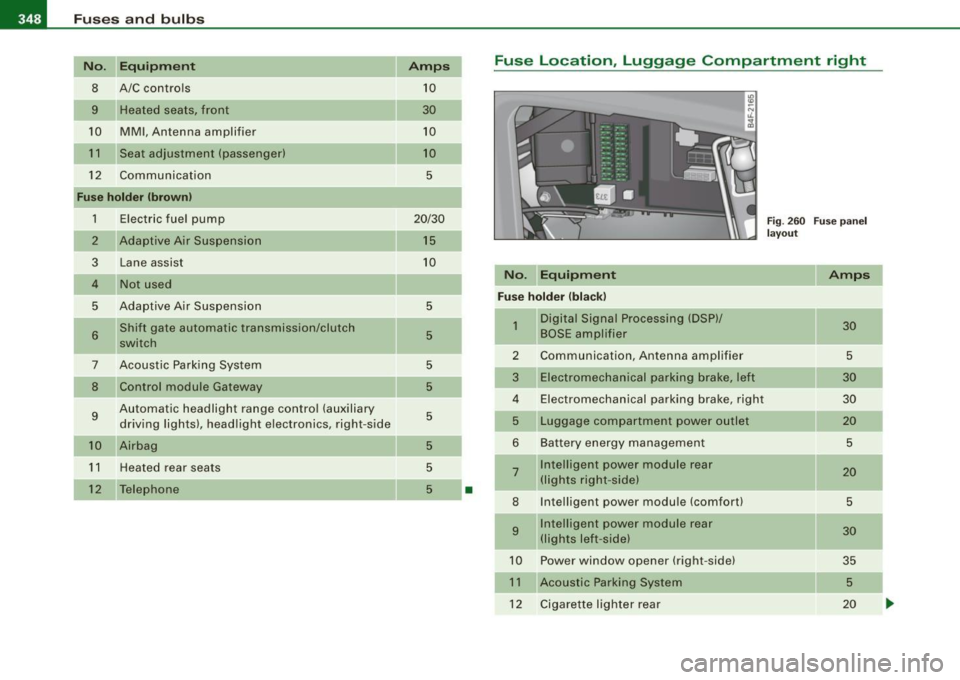
No. Equipm ent Amps
8 A/C controls 10
9 Heated seats, front 30
10
MMI , Antenna amplifier 10
11
Seat adjustment (passenger) 10
12
Communication 5
Fu se holder (b rown )
1 Electric fuel pump 20/30
2
Adaptive Air Suspension 15
3
Lane assist 10
4 Not used
5 Adaptive Air Suspension 5
6 Shift gate automatic transmission/clutch 5 switch
-
7 Acoustic Park ing System 5
8 Control module Gateway 5
9 Automatic headlight range contro l (auxiliary 5 driving lights), head light electronics, right -side
10 Airbag 5
11
Heated rear seats 5
12
Telephone 5 •
Fuse Location, Luggage Compartment r ight
No . Equipm ent
Fuse hold er (bl ack)
1 Digital Signal Processing (DSP)/
BOSE ampl ifier
2 Communication , Antenna amplifier
3 Electromechanical parking brake, l eft
4 Electromechanical parking brake, right
5 Luggage compartment powe r outlet
6 Bat tery energy management
7 Intelligent power module rear
(lights right -si de)
8 Intelligent power module (comfort)
9 Intelligent power module rear
(lights le ft-side)
10 Powe r window opener (right-side)
11 Acoustic Parking System
12 Cigarette lighter rear
Fig . 260 F use pa nel
l ay ou t
Amps
30
5
30
30
20
5
2 0
5
30
35 5
20
-
Page 363 of 390
_________________________________________________ G_ e_ n_ e_r _a _l_ i_n _f_o _ r_ m_ a_ t _i _o _ n __ lllll
v e hic le identificatio n number of your vehic le (p erforation) as well as
th e G ro ss V ehic le We ight Rat ing (GVWR) an d the Gro ss A xle We ig ht
R ating (GAWRl .
The high voltage warning label is located on the lock carrier.
The spark ignition system meets all requirements of the Canadian Interference -Ca using Equipment Regulations . •
Displaying Vehicle Identification
Number in the MMI
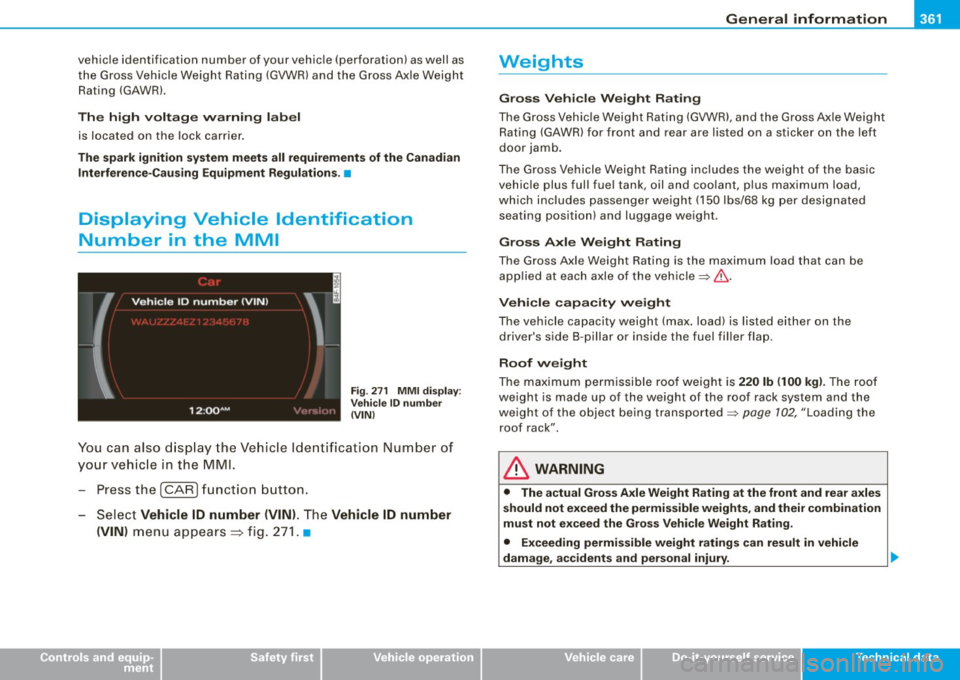
Fig . 2 7 1 MMI display :
Vehicle ID number
( VIN )
You c an also disp lay the Ve hic le I dentification Num be r of
y o ur vehi cle in t he MM I.
- Press the
I C A R I funct io n bu tton.
- Se lect
Vehicle ID number (VIN). T he Vehicle ID number
(VIN)
me nu a ppear s :::::;, fig . 271 . •
Controls and equip
ment Safety first Vehicle operation
Weights
Gross Vehicle Weight Rating
The G ross Ve hicle We ight Rating (GVWR), a nd the Gross A xle Weight
R ating (GAW R) for front and rear are l isted on a stic ker on the left
doo r jamb .
T he G ross Ve hicle We igh t R ating includes t he weight o f the bas ic
vehic le plus full fue l tank , oil and coo lant, p lus maximum load,
w hi ch includes passe nger we ight (1 50 lbs/68 kg per des ignat ed
seat ing position) and luggage weight .
Gross Axle Weight Rating
The Gross Axle Weight Rating is the maximum load that can be
ap plied at each axl e of the vehicle~ &.
Vehicle capacity weight
The vehic le capacity weig ht (max. load) is list ed e ither on the
driver's side B -pillar or ins ide the fuel fi ller flap.
Roof weight
The maxi mum pe rm is s ible roof we ig ht i s 220 lb (100 kg ). The ro of
we ight is made up of th e wei ght of t he roof rack system and the
we igh t of t he o bjec t being tra nspo rted ~ page
102, "Lo ading the
roo f rack".
& WARNING
• The actual Gross Axle Weight Rating at the front and rear axles
should not exceed the permissible weights , and their combination
must not exceed the Gross Vehicle Weight Rating.
• Exceeding permissible weight ratings can result in vehicle
damage , accidents and personal injury .
Vehicle care Do-it-yourself service Tec hn ica l da ta
Page 365 of 390
_____________________________________________________ D_a_ t_ a __ llll
Data
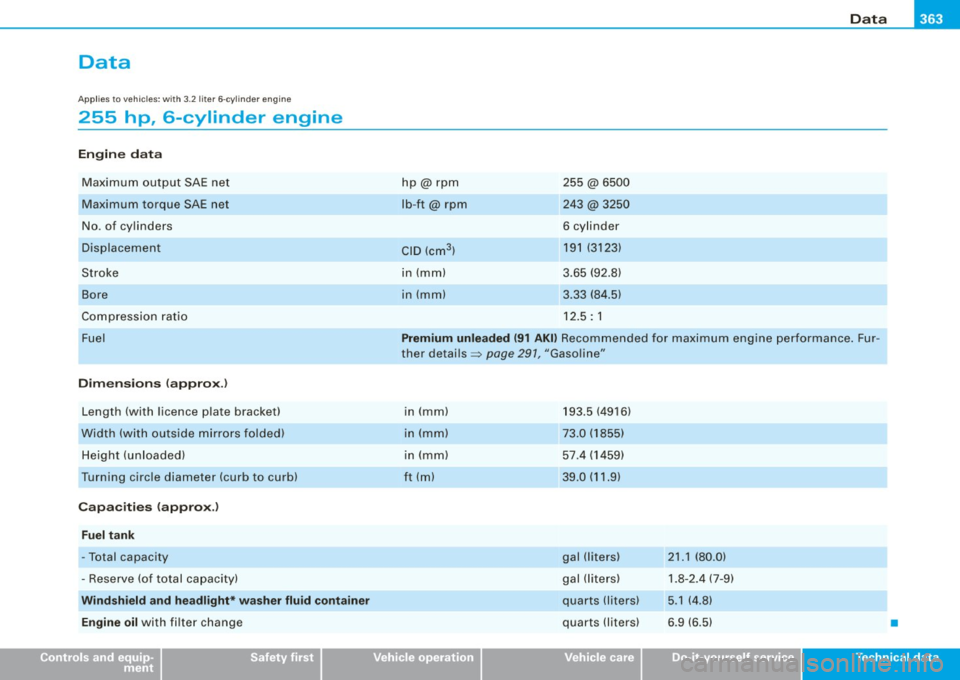
Ap plies to veh icles: wit h 3.2 lit er 6 -c ylinde r en gine
255 hp, 6-cylinder engine
En gin e da ta
Maximum output SAE net
Maximum torque SAE net
No . of cylinders
Displacement
Stroke
Bore
Compression ratio
Fuel
Dim ension s (app rox.)
Length (with licence plate bracket)
Width (with outside mirrors fo lded)
Height (unloaded)
Turning circle diameter (curb to curb)
Ca pac ities (a pprox.)
F u el t ank
-Total capacity
- Reserve (of total capacity)
Wind shi eld and he adli ght * was her fluid container
E ngine oil
with filter change
Controls and equip
ment Safety first
hp@rpm
lb-ft@ rpm
CID (cm
3
)
in (mm)
in (mm)
255@ 6500
243@3250
6 cylinder
191 (3123)
3.65 (92.8)
3.33 (84.5) 12.5 : 1
Premium unleaded (91 AKI) Recommended for maximum engine performance. Fur
ther details =>
page 297, "Gasoline"
in (mm)
in (mm)
in (mm)
ft (ml
193 .5 (49 16)
73.0 (1855) 57 .4 (1459)
39 .0 (11.9)
gal Oiters)
gal (liters)
quarts (liters)
quarts (liters ) 21.1 (80.0)
1 .8-2 .4 (7 -9)
5 .1 (4 .8)
6 .9 (6 .5)
•
Vehicle operation Vehicle care Do-it-yourself service Tec hn ica l da ta