wheel AUDI S6 2008 Workshop Manual
[x] Cancel search | Manufacturer: AUDI, Model Year: 2008, Model line: S6, Model: AUDI S6 2008Pages: 390, PDF Size: 88.42 MB
Page 276 of 390
___ T_ r _a_ il_e _r_ t_ o_ vv_ in__... g,_ __________________________________________________ _
Speed
The higher the speed, the more difficult it becomes for the driver to
control the rig. Do not drive at the maximum permissible speed. Reduce your speed even more if load, weather or wind conditions
are unfavorable -particularly when going downhi ll.
Reduce vehicle speed
im med ia tel y if the trailer shows the slightest
sign of swaying.
Do not try to s top the swayi ng by accelerating.
Observe speed limits. In some areas, speeds for vehicles towing
trai lers are lower than for regular vehicles .
Always apply brakes ear ly. When driving downhill, shift into a lower
gear to use the engine braking effect to slow the vehicle. Use of the
brakes a lone can cause them to overheat and fail.
C ool ant t emp era tur e
The coolant temperature gauge=> page 13 must be observed care
fully. If the needle moves close to the upper end of the scale, reduce
speed immed iately and/or turn off the air conditioner.
If the coolant temperature warning light in the instrument cluster
starts flashing
- F- , pull off the road, stop and let the engine idle for
about two minutes to prevent heat build-up.
& WARNING
A nyo ne n ot properly re str aine d in a moving vehi cle i s at a mu ch
g re ater ri sk in an accident . Never let any on e r ide in y our car who
is n ot pr operl y wea ring th e re stra ints pr ovided b y Audi . •
Trailer towing tips
Important to know
Your vehicle handles differently when towing a trailer because of
the additional weight and different weight distribution. Safety, performance and economy will greatly depend on how carefully you
l
oad your trailer and operate your r ig.
Before you actually tow your trailer, practice turning, stopping and
backing up in an area away from traffic . Keep practicing unti l you
have become comp letely familiar with the way your vehicle-trai ler
combination behaves and responds.
Back ing up is difficult and requires practice. Backing up with a
trailer generally requires steering action opposite to that when backing up your vehic le without a tra iler.
Ma intain a greater distance between your veh ic le and the one in
front of you . You will need more room to stop. To compensate for
the trai ler, you w ill need a larger than norma l turning radius.
When passing, remember that you cannot accelerate as fast as you nor mally wou ld because of the added load . Make su re you have
enough room to pass. After passing, allow plenty of room for your
trai ler befo re changing lanes again .
Avoid jerky starts, sharp turns or rapid lane changes.
[ i ] T ips
• Do not tow a trailer during the break -in period of your vehicle.
• I f you tow a trailer, your Audi may require more frequent main te
nance due to the extra load=>
page 366. •
Parking on a slope
Do not park on a slope with a trailer. If it cann ot be
avoi ded, do so only after d oing the followi ng:
When p arking :
-Apply the foot brake.
- Have someone p lace chocks under both the vehicle and
the trailer wheels. ._
Page 277 of 390
-Wit h chocks i n place, slowly release the brakes until the
wheel chocks absorb the load .
- Turn the wheels towards the curb.
- Apply the parking brake.
- Move the selector lever to
P.
Wh en r est arting aft er parking :
-Apply the foot brake.
- Start the engine.
- Move the selector lever to
D .
- Release the parking brake and slowly pull out and away
f rom the whee l chocks.
- Stop and have someone retrieve the wheel chocks .
[ i ) Tip s
If you move the selector lever of the automatic transmission to P
befor e applying th e parking brake and before blocking th e wheels ,
you may have to use more force later to move the lever out of the
P
position .
Controls and equip ment Safety first Vehicle operation
Tr
aile r t owing
Vehicle care Do-it-yourself service Technical data
Page 280 of 390
___ C_ le_ a _ n_i_n ~g _ a_ n_ d __ p_r _o _t _e _c_ t_ i_o _n ___________________________________________ _
Cleaning and protection
General information
Regular care preserves vehicle value.
Any automobile is exposed to industrial fumes, corrosive road salt,
muddy dog feet, etc . A well cared for Audi can look like new many
years a fter purchase. Regu lar a nd correct ca re will co ntribu te to
maintaining the beauty and value of your Audi.
Furthermore, good care may be a condition for substantiating a
war ranty claim should co rros ion damage or paint defect s occur .
Your authorized Audi dealer has a variety of dedicated vehicle- care
product s
and can adv ise whic h ones to use for clea ning the e xter ior
and interior of your vehicle.
Whethe r you use p roducts recommended by Audi or other c ommer
cia lly availab le cleaning agents , please make sure you apply them
correctly.
& WARNING
• Cleaning agents may be poisonous. Keep them out of the reach
of ch ildren .
• Heed all caution label s.
• Always read directions on the contai ner before using any
product. Follow the di rection s carefully .
• Most chemical cleaners are concentrated and have to be
d iluted.
• Use spot removing fluids only in well ventilated area s.
• Do not use gasoline , kerosene , die sel fuel , nail polish remover
or other volatile fluids . They may be toxic , flammable or hazardous
in other way s. Do not wash , wa x or dry the vehicle w ith the igni
tion on or the engine running.
& WARNING (continued )
• Do not clean the under side s of chassis , fenders , wheel cove rs,
etc . without protecting your hands and arms. You may cut yourself
on sharp -edg ed metal parts .
• Moisture and ice on brakes may impair braking effi ciency
=> page 261 , "General info rmation ". Test the brake s carefully each
time you wa sh the vehicle.
~ For the sake of the environment
Se lect only enviro nmenta lly friend ly c leaning products . Leftover
clean ing products should not disposed of in the household waste. •
Care of exterior
Washing
Frequen t washing pro tects the vehi cle.
Th e bes t protection against envi ronmental influences is frequent
washing and waxing . How often this is required depends on:
• Ho w much the vehic le is used
• Where the vehic le is parked (garage, in the open under trees,
etc.)
• T he seasonal and weather conditions
• Environmenta l influences
T he longer bird droppings, insects, tree resin, road and industrial
gri me, tar, soot, road salt and ot her materials rema in on the ve hicle
body, the more lasting their destruc tive effects will be . High temper
atu res caused by exp osu re to in tense s un ligh t inte nsify the c orro -
sive effect, particularly when humidity is high as well.
~
Page 281 of 390
_____________________________________________ C_ l_ e _a_ n_ in_ g_a _ n_d_ p_ r_ o_ t _e_ c_t _io _ n __ lJ!II
•
Under certain circumstances, weekly washing may be necessary.
Under other conditions , a monthly washing and waxing may be
adequate .
After the winter, the
underside of the vehicle should be thoroughly
washed, preferably in a professional car wash.
& WARNING
Always read and heed all WARNINGS and other information
~ page 278. •
Automatic car wash
The vehicle can be washed in almost any modern auto
matic car wash.
The vehicle paint is so durable that the vehicle can normally be
washed without problems in an automatic car wash . However, the
effect on the paint depends to a large extent on the design of the
facility, the filtering of the wash water , the type of wash and care
material, etc. If the paint has a dull appearance after going through
the car wash or is scratched , bring this to the attention of the oper
ator immediately . If necessary, use a different car wash .
Before going through a car wash, be sure to take the usual precau
tions such as closing the windows and power roof . Factory installed
antennas must not be removed.
If you have installed additional accessories on the vehicle - such as
spoilers, roof rack, etc. -it is best to ask the car wash operator if
these should be removed.
& WARNING
Always read and heed all WARNINGS and other information
~ page 278. •
Washing the vehicle by hand
A lot of water is needed when washing a vehicle by hand.
-Before you start washing, make sure you have read and
understood the WARNINGS =:>
& in "General informa
tion" on
page 278.
-First soak all dried dirt until it is soft, then rinse it off.
- As you clean your vehicle, start with the roof and work
your way down to the bottom, using a sponge, a sponge glove or a clean brush.
- Rinse the sponge or the sponge glove often, flushing it
clean each time.
- Use special car shampoo only for very persistent dirt.
- Rinse the car thoroughly with water.
- Use a chamois leather to gently w ipe the exterior dry.
Use a separate sponge for cleaning the wheels , door sills and other
regions exposed to road dirt. In this way, you will not scratch the
paint with coarse particles imbedded in the sponge the next time
you wash the car.
& WARNING
• Do not clean the underside of the chassis, fenders, wheel
covers, or other hard to reach parts without protecting your hands
and arms. You may cut yourself on sharp-edged metal parts.
• Always read and heed all WARNINGS and other information
~ page 278. _..
Vehicle care I t •
Page 285 of 390
_____________________________________________ C_ l_ e _a_ n_ in_ g_a _ n_d_ p_ r_ o_ t _e_ c_t _io _ n __ l"III
•
T he best way to remove snow from windows and mirrors is to use a
brush . Use a non -abrasive
pla stic ice scraper -better still, a spray
deicer -to remove
ice from w indows and mirrors .
The windows must not be cleaned with insect remover or wax since
these can inter fere with the function of the w inds hie ld w iper blades
(chatter).
Oil, grease o r sil icone residue can be removed with
glass cleaner or
s ilicone remover . However, wax residue requires the use of a
spec ially for mulated solvent . Please contact your Audi dealer for
advice on safe products for wax removal.
Windows should also be c leaned on the inside at regular interva ls .
Never dry windows with the same chamois that you use to dry
painted surfaces . Wax residue on the chamois can impair vision
t hrough the windows.
& WARNING
• The windshield mu st not be treated with water -repellent mate
rials. They c an incre ase gl are under poor v isibility conditions such
a s wetne ss, darkne ss, or when the sun i s low on the hori zon. In
addition , they can cause the wind shield wipers to chatter .
• Alway s read and heed all WARNINGS and other information
~ page 278.
0 Note
• Never use warm or hot water to remove snow and ice from
windows a nd mirrors . This cou ld cause the glass to crack.
• T o prevent damage to the wires of the rear defogger, do not p lace
any adhesive stickers on the inside of the rear window over the
wires .
• T o he lp prevent dirt from scratching the window, always scrape
in a forward direction -pushing the scraper away from you -never
back and forth. •
Weatherstrips
Complete car car e includes the we atherst rip s as well .
App ly a suitable rubbe r con ditioner to the weatherstr ips
f ro m time to tim e.
To be able sea l properly, the weatherstrips around the hood, doors,
rear lid, etc . must remain pliable. Spray the weatherstrips with sili
co ne or coat them w ith ta lcum powder or glycer ine to retain the
f lexibility of the rubber and to protect them against freezing in the
winte r.
& WARNING
Always read and heed all WARNINGS and other information
~ page 278.
[ i ] Tip s
Keep si licone sprays off the windshield to avoid wiper smear in
ra in .•
Cast (light) alloy wheels
Cast (light) alloy wheels require special care.
- Was h the wheels w ith a sponge or hose b rus h every
other week.
Fo r de ep cle aning af terwar ds, use only a dedicat ed
acid
free cast al lo y whee l c leaner.
R ub a co at of
liquid wax onto t he rims ever y thr ee mo nth .
Be su re t o r ea ch and t reat a ll pa rts of t he r im.
To preserve the decorative appearance of the cas t al loy wheels,
some special care is necessary . In addition to road dirt and salt,
Vehicle care I t •
Page 286 of 390
llffll __ C_ le_ a _ n_i_n ~g _ a_ n_ d __ p_r _o _t _e _c_ t_ i_o _n ___________________________________________ _
brake dust is also corrosive. If left on for too long, brake dust can
cause pitting.
Use on ly specia l
acid-free cleaners formulated for a lloy r ims . Safe
products are available at your Audi dealer. Never leave the cleaner
on the ri ms longer than specified on the label. If not rinsed of f
promptly, the acid contained in some c leaners can attack the
threads o n the wheel bo lts .
Never use abrasive or metal po lishing c leaning agents. If the protec
tive coating has been chipped, e.g . by kicked up road dirt, touch i t
up as soon as poss ible .
& WARNING
• Moisture and i ce on b rake s may affe ct b raking effi cien cy
~ page 261 , "General information ". Te st the brake s carefully ea ch
t ime you wa sh the vehi cle .
• Always read and heed all WARNINGS and other information
~ pag e 278. •
Body cavity sealing
The body cavity sealing does not nee d to be checked .
All body cavities which could be affected by corrosion have been
t horoughly pr otected a t the factory .
This sealing does not require any inspection or additional treat
ment . If any wax should seep out of the cavity when the ambient
temperature is high, it can be removed with a plastic scraper and a suitable solvent .
& WARNING
Solvents can be dangerous.
• Ben zine is fla mmab le and to xic . If you use be nzine fo r removing
the wax , keep sparks, f lame and lighted cigarettes away . Never
& W ARN ING (continued )
dump benz ine on the ground , into open streams or down sewage
dra in s.
• Be sure to observe all safety and env ironmental regulat ions .
Follow all in struction s on the cont ainer .
• Alway s read and heed all WARNINGS and other inform ation
~ page 278 .•
Chassis
Have the u nderc oating c hecked for dama ge from tim e to
time.
T he lower body shell of your Audi is also thoroughly protected
aga inst corrosion .
Any damage to the undercoat ing caused by road hazards shou ld be
repaired promptly.
& WARNING
Too much undercoating in the wrong place s can cau se a fire .
• Do not app ly addition al undercoating or rustproofing on or
near the exhaust manifold, exhau st pipe s, catalytic converter or
he at shield s. While dr iving , the sub stance used for underco ating
could overhe at and cau se a fire .
• Alwa ys read and heed all WARNINGS and other info rm ation
=> page278 .•
Page 292 of 390
___ C_ le_ a _ n_i_n ~g _ a_ n_ d __ p_r _o _t _e _c_ t_ i_o _n ___________________________________________ _
essential to have a long-lasting corrosion protection reapplied to al l
s urf aces, sea ms, joi nts a nd compo nents i n th e en gine c om par t
m ent .
& WARNING
Be aware: The engine compartment of any motor vehicle is a
potentially hazardous area.
• Before working in the engine compartment , be sure to read the
information
=> page 289.
• Before reaching into the front plenum panel, always remove the
ignition key . Otherwise, the windshield wipe r system could unin
tentionally be switched on , possibly causing personal in jury from
the moving wiper linkage .
• Never reach into the area around or touch the radiator fan . The
auxiliary fan is temperature controlled and can switch on suddenly
- even when the ignition is off.
• Do not wash, wax or dry the engine with the engine running .
Moving or hot parts could injure you .
• Do not clean the underside of the chassis , fenders, wheel
covers, or other hard to reach parts without protecting your hands
and arms. You may cut yourself on sharp -edged metal parts.
• Always read and heed all WARNINGS and other information
=> page 278 . •
Page 315 of 390
Tires a nd wh eels -
----------------
•
Tires and wheels
Tires
General notes
Tires may be the least appreciated and most abused parts
of a motor vehicle.
Tires may be the least appreciated and most abused parts of a
motor vehicle. Tires are, however, one of the most important parts
of a vehicle, particularly considering the comparative ly sma ll patch
of rubber on each tire that assures that all- important contact
between you, your vehicle and the road .
Maintaining the correct tire pressure, making sure that your vehicle
and its tires do not have to carry more weight than they can safely
handle, avoiding damage from road hazards and regu lar ly
inspecting tires for damage inc luding cuts , slashes irregular wear
and overa ll condition are the most important things that you can do
to help avoid sudden tire failure including tread separation and
b lowouts .
Avoiding dama ge
If you have to drive over a curb or similar obstacle, drive very slow ly
and as close as possible at a right angle to the curb.
A lways keep chemica ls includ ing grease, oil, gasoline and brake
f luid off the tires.
I nspec t the tires regularly for damage (cuts, cracks or blis ters, etc.l.
Remove any foreign bodies embedded in the treads.
Storing tires
Mark tires when you remove them to indicate the direction of rota
tion . This ensu res you to be ab le to mount them correctly when you
reinstal l them. When removed, the wheels or tires shou
ld be stored in a coo l, dry
and preferably dark place.
St ore t ires in a vertical posit ion if they a re not mounted on rims, in
a horizontal position if they are mounted on rims.
New tire s
New tires have to be broken in~&.
The tread dep th of new tires may va ry, according to the type and
make of tire and the tread pattern.
Hidden d ama ge
Damage to tires and rims is often not readily visible. If you notice
unusua l vibration or the vehicle pul ls to one side, this may indicate
that one of the tires has been damaged . The tires must be checked
immed iately by an authorized Audi dealer or qualified workshop .
Unidire ction al tir es
A unidirectio nal tire can be iden tif ied by arrows on the s idewa ll, that
point in the direction the tire is designed to rotate. You must follow
the specified direction of ro tation . This is necessary so that these
tires can deve lop their optimum characteristics regarding grip, road
noise, wear and hydroplaning resistance . For more information
~ page 344.
in. WARNING
Ne w tire s or tire s that are old , worn or damaged cann ot pro vide
m aximum cont rol and braking ability.
• New tire s tend to be slippe ry and m ust be broken in . To redu ce
the risk of losing control, a colli sion and seriou s per sonal injurie s,
drive with speci al care for t he fi rst 350 m ile s ( 560 km l.
• Driving with worn or damaged t ire s can lead to lo ss of co ntrol ,
s udd en tire failure , in clu ding a blowout a nd sudden deflation , .,,_
Vehicle care
I t •
Page 316 of 390
-~_T_ ir_e_ s_ a_ n_d _ w_ h_ e_e _l_s _________________________________________________ _
& WARNING (continued)
crashes and serious personal injuries . Have worn or damaged tires
replaced immediately.
• Tires age even if they are not being used and can fail suddenly,
especially at high speeds. Tires that are more than 6 years old can
only be used in an emergency and then with special care and at
low speed.
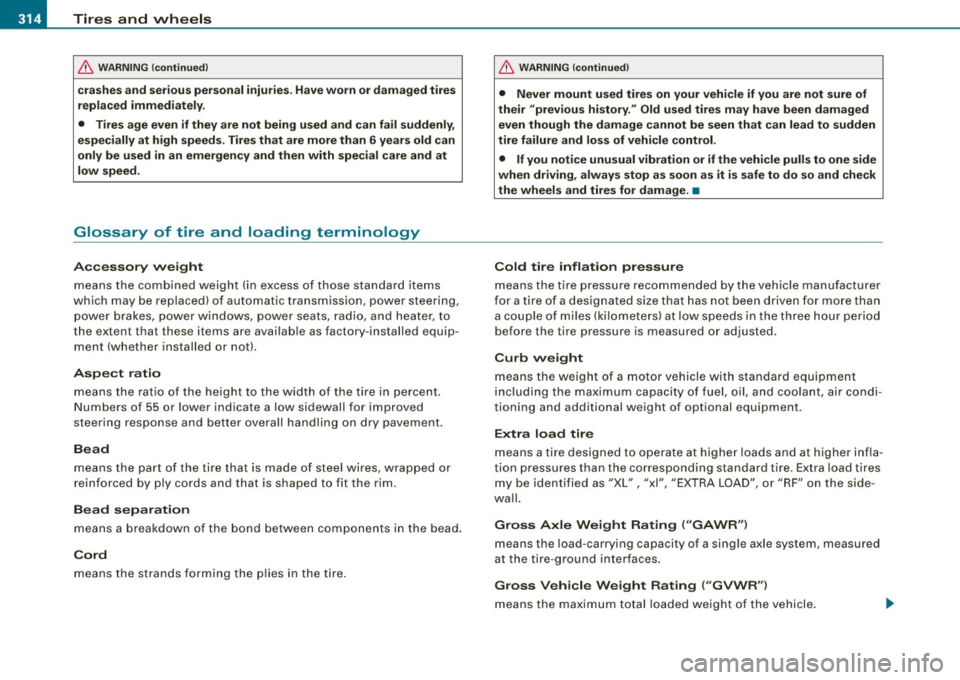
Glossary of tire and loading terminology
Accessory weight
means the combined weight (in excess of those standard items
which may be replaced) of automatic transmission, power steering,
power brakes, power windows, power seats, radio, and heater, to
the extent that these items are available as factory-installed equip
ment (whether installed or not).
Aspect ratio means the ratio of the height to the width of the tire in percent.
Numb ers of 55 or lower indicate a low sidewall for improved
steering response and better overall handling on dry pavement.
Bead
means the part of the tire that is made of steel wires, wrapped or reinforced by ply cords and that is shaped to fit the rim.
Bead separation means a breakdown of the bond between components in the bead.
Cord
means the strands forming the plies in the tire.
& WARNING (continued)
• Never mount used tires on your vehicle if you are not sure of
their "previous history." Old used tires may have been damaged
even though the damage cannot be seen that can lead to sudden
tire failure and loss of vehicle control.
• If you notice unusual vibration or if the vehicle pulls to one side
when driving, always stop as soon as it is safe to do so and check
the wheels and tires for damage . •
Cold tire inflation pressure
means the tire pressure recommended by the vehicle manufacturer
for a tire of a designated size that has not been driven for more than
a couple of miles (kilometers) at low speeds in the three hour period
before the tire pressure is measured or adjusted .
Curb weight means the weight of a motor vehicle with standard equipment
including the maximum capacity of fuel, oil, and coolant, air condi
tioning and additional weight of optional equipment.
Extra load tire
means a tire designed to operate at higher loads and at higher infla
tion pressures than the corresponding standard tire . Extra load tires
my be identified as "XL",
"xi", "EXTRA LOAD", or "RF" on the side
wall.
Gross Axle Weight Rating ("GAWR")
means the load-carrying capacity of a single axle system, measured
at the tire -ground interfaces .
Gross Vehicle Weight Rating ("GVWR"l
means the maximum total loaded weight of the vehicle.
Page 319 of 390
Tires and wheels -_______________ _____.
Occ up ant loading and di stribution fo r vehicle no rmal load for various d esignated seating capa cities
Designated seating capacity, num
ber of occupants Vehicle normal load
, numb er of
occupants Occupant distribution in a normally
load
ed vehicle
5 3 2 in front,
1 in bac k seat •
Cold tire inflation pressure
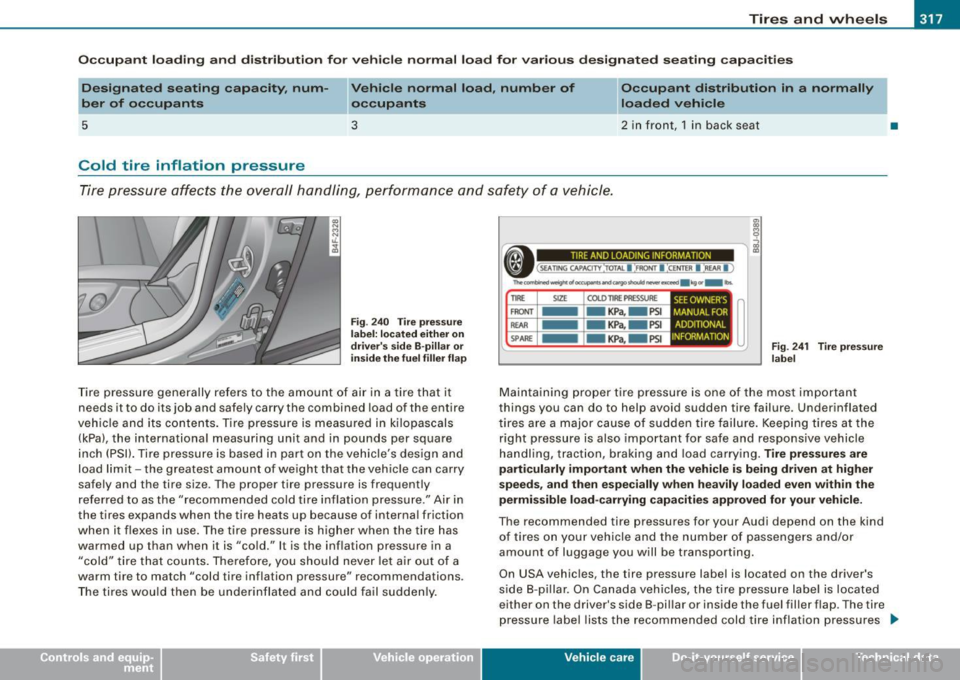
Tire pressure affects the overall handling, performa nce and safe ty of a vehicle .
Fig. 2 40 Tire pre ssure
label: located either on
driver' s side B -pill ar or
in sid e the fuel filler flap
Ti re pressure ge nerally refe rs to the am ount of air in a tire tha t it
needs it to do its job and safely carry the combined load of the entire
veh icle and i ts contents. Tire pressu re is measured in kilopascals
(kPa ), the internationa l measuring uni t and in pounds per square
i nc h (PSI) . Tir e p ressu re is based in par t on the vehic le's design and
load l im it - the g reatest amoun t of wei ght that the vehic le ca n carry
safe ly and the tire size . The proper tire pressure is frequently
re ferr ed to as the "recommended cold t ire i nflation pressu re ." Air i n
the tires expands when the tire heats up because of internal friction
whe n it flexes i n use . The tire pres sure is h ig her whe n the tire has
wa rmed up than when it is "co ld." It is the inflation pressure in a
"c old" tire t hat co unts. The ref ore, y ou sho uld neve r let air out of a
warm tire to match "co ld tire inflation pressure" recommendations .
T he tires wo uld then be under inflated a nd cou ld fa il s ud den ly .
i
,,-, ~ ---------------- ixl
• (SEATING CAPAC ITY :roTAL I :FRO NT I :cENTER I :REAR I ) al
Thecombh,d""'91wclo«U,,..,.andco,-goshoulcl.......,""""' •1cg., -b.
TIRE AND LOADING INFORMATION
TIRE SIZE COLO TIRE PRESSURE
F RONT -KPa, -PSI
REAR -KPa, -PSI
SPARE -KPa, - PSI
MANUAL FOR
INFORMATION SEE OWNER'S I
ADDITIONAL
Fig . 241 Tire pr essure
label
M ain tain ing pr op er tire pressure i s one of th e m ost im portant
things you can do to help avoid sudden tire failure. Underinflated
t ires are a major cause of s udden tir e fail ure . K eeping tires at the
ri ght press ure is also impor tant for sa fe and r esponsive v ehicle
han dling, trac tion, b raki ng a nd l oad carryi ng .
Tire pressures are
particularly important when the vehicle is being driven at higher
speeds , and then especially when heavily loaded even within the
permissible load -carrying capacities approved for your vehicle.
T he recommended tire pressures for your Audi depend on the kind
of tires on your vehicle a nd the n umber of passengers an d/o r
amount of luggage you w ill be transporting.
On USA vehic les, the tire pressure label is located on the driver's
s id e B- pilla r. On Cana da v ehic les, the tire pressu re labe l is loca ted
either on the driver's side 8 -pillar or inside the fuel filler flap. The tire
pre ssure label lists the rec omm ended cold tire i nflatio n pre ssures _,,,
Vehic le care I I irechnical data