battery capacity AUDI S6 2008 Owners Manual
[x] Cancel search | Manufacturer: AUDI, Model Year: 2008, Model line: S6, Model: AUDI S6 2008Pages: 390, PDF Size: 88.42 MB
Page 310 of 390
lffl __ C _h_ e_ c_k _in --== g'-- a_n _d_ f_il _li _n ..:::g:::..- ___________________________________________ _
With certain types of airbag deployment, the battery is discon
nected from the vehicle electrical system for safety reasons=>&. in
"Repair, care and disposal of the airbags" on
page 226.
Di sc o nnect ing the b attery t ermin als
Some vehic le functions (power window regulators, for example) are
lost if the battery terminals are disconnected. These func tions have
to be relearned after the battery terminals are connected again . To
prevent this, the battery should only be disconnected from the
vehic le electrical system when absolute ly necessary for repairs.
V ehicle s not driven for long period s
If you do not drive your vehicle over a period of several days or
weeks, electrical components are gradually cut back or switched off .
This reduces energy consumption and maintains starting capability
over a longer period =>
page 265.
Take into consideration that when you un lock your vehicle, some
convenience functions, such as the master key remote function or
power seat adjustment, may not be available. The convenience
functions will be availab le again when you turn on the ignition and
start the engine .
Winter oper ation
During the w inter months, battery capacity tends to decrease as
temperatures drop. This is because more power is also consumed
while s tarti ng, an d the headlights, rear wi ndow defogger, etc ., are
used more often.
Avoid unnecessary p ow er consumption, particularly in ci ty traffic or
when trave ling only short distances. Let your authorized Audi dea ler
check the capacity of the vehicle battery before winter sets in
=> page 310. A we ll charged battery wil l not on ly prevent starting
problems when the weather is cold, but wi ll also last longer.
[ i J Tips
If your vehicle is left standing for severa l weeks at extremely low
t empera tures, the vehicle ba ttery should be r emoved and stored where it will not freeze
. This will prevent it from being damaged and
having to be replaced .•
Working on the battery
B e espec ially caref ul when working on or near the battery.
Fi g. 23 7 Lugg age
compartm ent : B attery
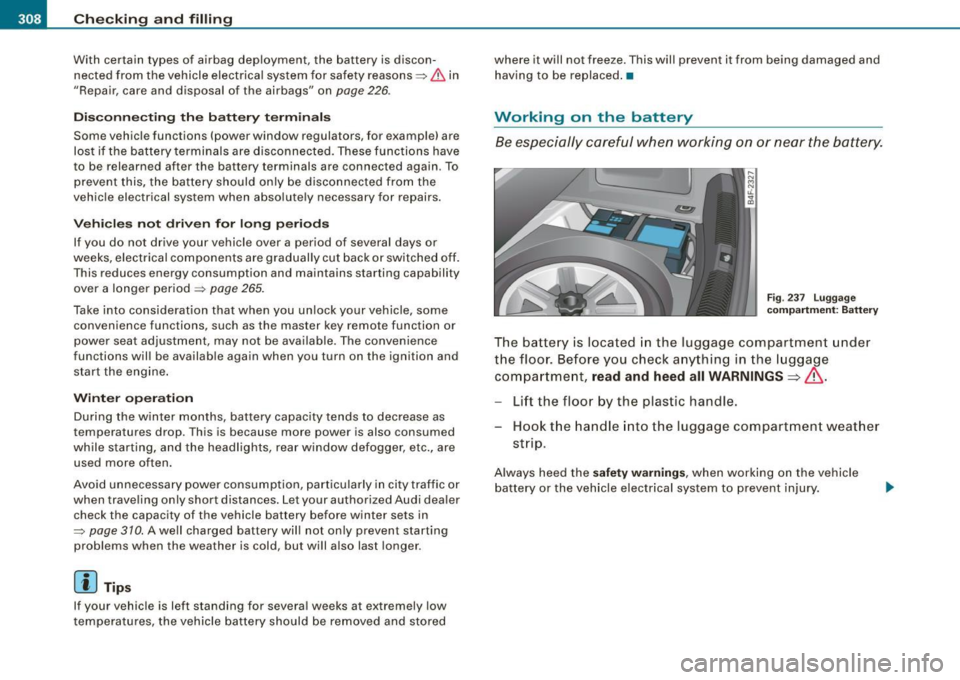
The battery is located in the luggage compartment under
the floor. Before you check a nything in the l uggage
com partme nt,
read and heed all WARNINGS=>& .
-Lift the floor by the plastic handle.
Hook t he hand le in to the luggage compartment weather
st rip.
Always heed the safety warnings , when working on the vehicle
ba ttery or the vehicle e lectrical system to prevent injury.
Page 313 of 390
Checking and filling Ill
--------------~-
•
-Now remove the clamps for the charging equipment.
- Close the red cover on the positive pole.
- Close the hood
~ page 297.
A discharged battery can freeze at temperatures of only O °C. Allow
a frozen battery to thaw completely before attempting to charge it
~ & .However, we recommend not using a thawed battery again
because the battery casing can be cracked due to ice formation and
can leak battery acid.
Battery charging (Maximum charging rate of 30
amps/14.8 Volt)
When charging at /ow voltages (e.g. with a trickle charger), the
battery cables do not have to be disconnected first. The battery caps
should
not be opened when charging a battery.
I t is not necessary to remove the battery from the luggage compart
ment.
Fast charging the battery (charging rate above 14.8
Volts)
For technical reasons do not use a battery charger that uses voltage
greater than 14.8 Volts to charge your vehicle's battery.
& WARNING
Charging a battery can be dangerous.
• Always follow the operating instructions provided by the
battery charger manufacturer when charging your battery.
• Never charge a frozen battery. It may explode because of gas
trapped in the ice. Allow a frozen battery to thaw out first.
• Do not reuse batteries which were frozen. The battery housing
may have cracked and weakened when the battery froze .
• Charge the battery in a well ventilated area. Keep away from
open flame or electrical spark. Do not smoke. Hydrogen gas gener
ated by the battery is explosive.
&_ WARNING (continued)
• To reduce the danger of explosion, never connect or disconnect
charger cables while the charger is operating.
• Battery acid that may spill during charging should be washed
off with a solution of warm water and baking soda to neutralize
the acid.
0 Note
Never use a fast charger as a booster to start the engine. This will
seriously damage sensitive electronic components, such as control
units, relays, radio, etc., as well as the battery charger. •
Battery replacement
The new battery must have the same specifications and
dimensions as the original equipment battery.
Intelligent energy management in your vehicle is responsible for
distributing the electrical energy throughout your vehicle
~ page 265. The intelligent energy management system will keep
the engine battery charged better then vehicles without this system.
To make sure the additional electrical energy is available once again
after you have changed the battery, we recommend that you install
batteries of the same type and manufacture only (the same as those
installed at the time your vehicle was delivered). Specifications are
listed on the battery housing. Your authorized Audi dealer will then
code the battery management control unit.
If it is not possible to use a battery of this type, the new battery must
have the same capacity, voltage (12 volts), amperage, construction
and plug sealing .
When installing the battery, make sure the ignition and all electrical
consumers are turned off.
~
Vehicle care I t •
Page 314 of 390
-Ch
ecking and filling
---=---------------
0 Not e
Make sure the ventilation hose on the side of the battery is
connected, otherwise fumes or battery acid can leak out.
mend your authorized Audi dea ler change the battery for you .
Batteri es contain sulfuric acid and lead and must always be
disposed of properly in compliance with all environmental regula
tions . Disposing of v ehicle batteries improperly is very dang erous to
t he environment. •
Windshield/headlight washer
container
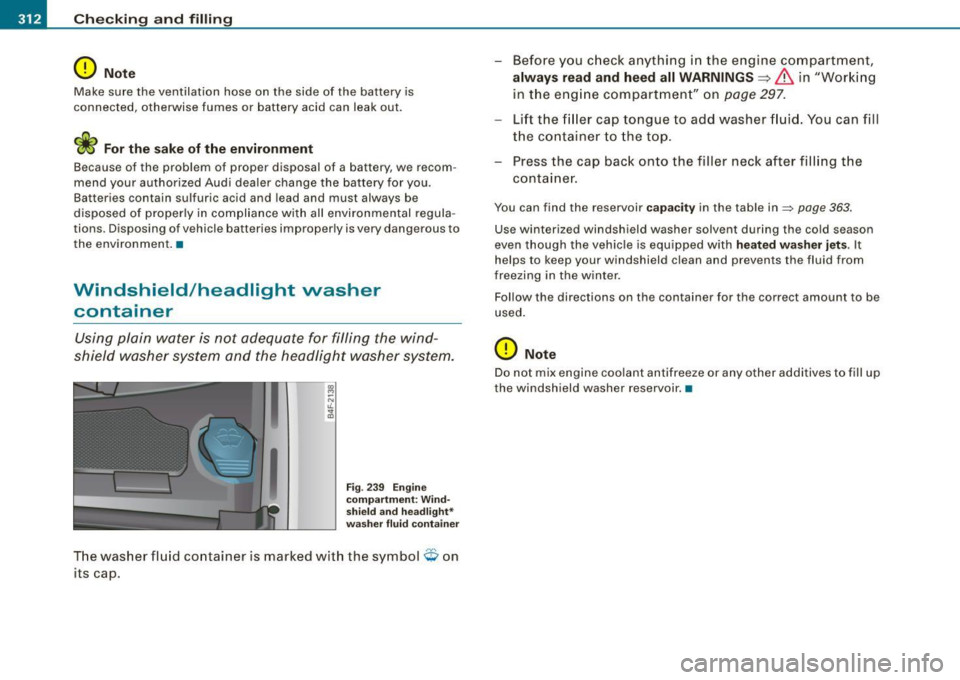
Using plain water is not adequate for filling the wind
shield washer system and the headlight washer system .
Fig. 239 E ngine
c omp artm ent : Wi nd
s h iel d and he adlight*
was her fluid c ont ain er
The washer fluid container is marked with the symbol O on
i ts cap. -
Before y ou c heck anything in the engine compartment,
a lway s read and heed all WARNINGS~ & in "Working
in t he eng ine compartment" on
page 297.
- Lift the filler cap tongue to add washer fluid . You can fill
the cont ainer to the top.
- Press the cap bac k on to the f iller neck after filling t he
container .
You can find the reservoir capacity in the tab le in~ page 363.
Use winterized windshield washer solvent during the co ld season
even though the vehic le is equ ipped with
he ated wa sher jets . It
helps to keep your windshield clean and prevents the fluid from
freezing in the winter .
Follow the directions on the container for the correct amount to be
used .
0 Note
Do not mix engine coo lant antifreeze or any other additives to fill up
the windshield washer reservoir. •
Page 317 of 390
Tires a nd wh eels -
----------------
•
Groove
means the space between two adjacent tread ribs.
Load ra ting (code)
means the maximum load that a tire is rated to carry for a given
inflation pressure. You may not find this information on all tires
because it is not required by law.
M ax im um l oad ra tin g
means the load rating for a tire at the maximum permissib le infla
tion pressure for that tire.
Ma ximum l oaded v ehi cle weigh t
means the sum of:
(a) Curb weight
(b) Accessory weight
(c) Vehic le capacity weight, and
(ct) Production options weight
M ax im um (p er mi ssibl e) infl ati on pr essur e
means the maximum cold inflation pressure to wh ich a tire may be
inflated. Also ca lled "maximum inflation pressure."
Normal occ upa nt wei ght
means 150 lbs. (68 kilograms) times the number of occupants
seated in the vehicle up to the to tal seating capacity of your vehicle.
O ccupant di stributi on
means distribution of occupants in a vehicle .
Outer di am eter
means the overall diameter of an inflated new tire.
O ve rall wi dth
means the linear distance between the exteriors of the sidewa lls of
an inflated tire, includ ing elevations due to labeling, decorations, or
protective bands or ribs.
Pl y
means a layer of rubber -coated para lle l cords.
P rodu ction opt io ns wei ght
means the combined weight of those installed regular production
options weighing over 5 lbs . (2.3 kg) in excess of those standard
i t ems wh ich they replace, not previously considered in curb weigh t
or accessory weight, including heavy duty brakes, ride levelers, roof
rack, heavy duty battery, and specia l trim .
Radi al p ly tire
means a pneumatic tire in which the ply cords that extend to the
beads are laid at substantially 90 degrees to the centerline of the
tread .
Reco mm ended infl ati on pr essu re
see => page 314, "Cold tire inflation pressure".
Rein force d tir e
means a tire designed to operate at higher loads and at higher infla
tion pressures than the corresponding standard tire. Reinforced
t ires my be identified as "XL", "xi", "EXTRA LOAD", or "RF" on the
sidewall.
R im
means a metal support for a tire or a tire and tube assembly upon
wh ich the t ire beads are seated.
Rim di amet er
means nominal diameter of the bead seat. If you change your whee l
size, you wi ll have to purchase new tires to match the new rim diam
eter .
Rim siz e de sig nation
means rim diameter and width.
Rim wid th
means nominal distance between rim flanges.
Vehicle care I t •
Page 353 of 390
Emergency situations Ill
-------------=--=----
•
Emergency situations
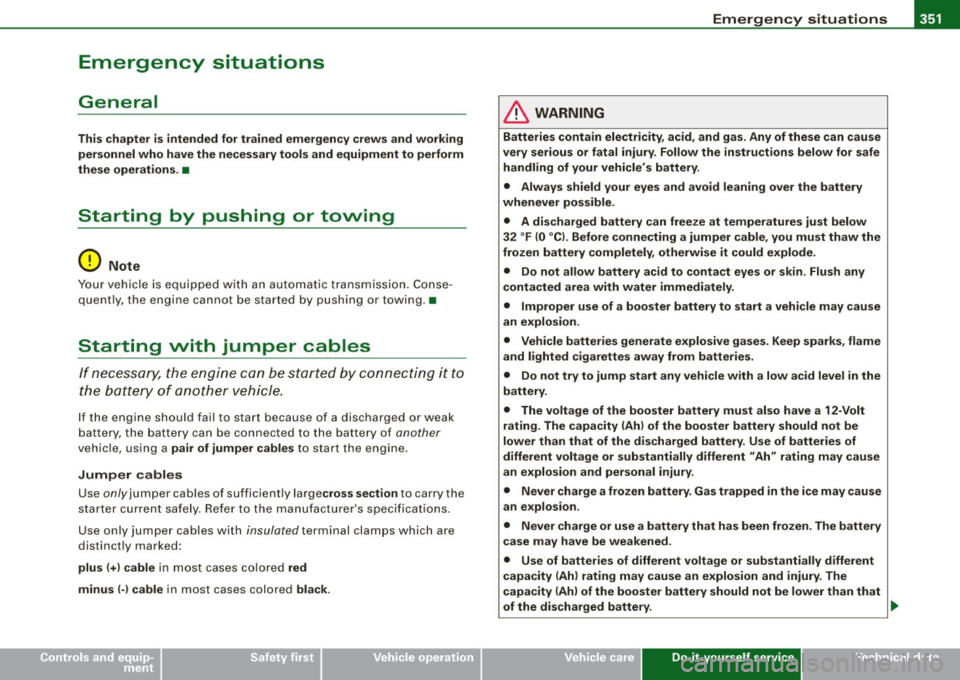
General
This chapter is intended for trained emergency crews and working
pe rsonnel who have the necessary tools and equ ipment to perform
these operations. •
Starting by pushing or towing
(D Note
You r ve hicle is eq uipped w ith an automatic trans missi on. C o nse
quent ly, the engine cannot be started by pushing or towing .•
Starting with jumper cables
If necess ary, the en gine can b e sta rted by conn ectin g it to
the battery of anothe r vehicle.
If th e engine should fail to start because of a discharged or weak
b at te ry, the batt ery ca n be co nnected t o the ba ttery of another
vehicle, using a
pair of jumper cables to start the engine .
Jumper cables
Use only jumper cables of sufficiently large cross section to carry the
s tarte r curre nt safely. Refer t o the manu fac tu rer 's specif ica tions.
Use only ju mper cabl es with insulated terminal clamps whic h are
distinct ly marked:
plus ( +l cable in mo st cas es c olored red
minus
(- 1 cable in most cases colored black .
& WARNING
Batteries contain electricity, acid , and gas. Any of the se can cause
very ser ious or fatal injury . Follow the instructions below for safe
handling of your vehicle 's battery .
• Always shield your eyes and avoid leaning over the battery
whenever possible .
• A discharged battery can freeze at temperatures just below
32 °F (0 °C l. Before connecting a jumper cable , you must thaw the
frozen battery completely , otherwise it could explode .
• Do not allow battery acid to conta ct eyes or skin. Flush any
contacted area with water immediately.
• Improper use of a booster battery to start a vehicle may cause
an explosion.
• Vehicle batteries generate explosive gases . Keep sparks , flame
and lighted c igarettes away from batteries.
• Do not try to jump start any vehicle with a low acid level in the
battery.
• The voltage of the booster battery must also have a 12-Volt
rating. The capacity (Ah l of the booster battery should not be
lower than that of the discharged battery . Use of batteries of
different voltage or substantially different "Ah" rating may cause
an explosion and personal injury .
• Never charge a frozen battery. Gas trapped in the ice may cause
an explosion.
• Never charge or use a battery that has been frozen . The battery
c ase may have be weakened .
• Use of batter ies of different voltage or substantially different
c apacity (Ah l rating may cause an explosion and injury . The
capacity (Ahl of the booster batte ry should not be lower than that
of the discharged battery. _..
Do-it-yourself service
Page 379 of 390
______________________________________________ A_ l_,_ p _h_ a_ b_e _t_i c_ a _ l _in _ d_e _ x __ ftllll
Proper disposal of drained engine oil 302
Recycling used engine oil ..... ..... 302
Un leaded fuel ..... ....... .... ... . 291
What should I do with an old battery?
311
EPC
See Electronic power control . .... ... 19
ESP
See Electronic stabilization program
(ESP) ..... ... .. .... .... ...... ... 19
Event Data Recorder (EDR) ... .... ..... 258
Expansion tank ...... ....... ........ 304
Exterior lighting in the mirror housing ... 73
Eyeglasses compartment ............. 108
F
Fan
Radiator .............. .......... 306
Fastening eyelets ...... .... .......... 97
Flat tire Changing ... ... ... .. .... ...... .. 338
Floor mats . . . . . . . . . . . . . . . . . . . . . . . . . 198
Fog lights .... .... .... ... .. .... .... .. 72
Fo lding master key with remote contro l . 48
Foot pedals ...... .. .... .... ..... ... 198
For the sake of the environment Gasoline fumes and the environment 293
Letting you r engine warm up ...... . 125
Reducing engine noise by early
upshifting .. ...... ..... .... ... .. 13
Refuel ing .... .... ....... .... .... 293
Controls and equip
ment Safety first
Saving
fuel by early upshifting .... .. 13
Usingtherearwindowdefogger .. .. 117
Front airbags
Description ......... .... .... .... . 216
How they work .... ........ ....... 221
Front arm rest adjusting . ...... .... .... ... .... ... 96
Storage compartment ... .... ..... .. 96
Front ashtray .... .... .... ........ ... 104
Front fog lights ..... ........ .... .... . 72
Front seats .. ............ .... ....... . 87
Adjusting ... ....... .... .... .... . 195
Child restraints in the front seat ... . 214
Fronta l collisions and the laws of physics
203
Fuel Additives ... .. ...... .... ..... .... 291
Blended gasoline .... ....... .... .. 291
Consumption ....... .... .... .... .. 40
Fi ller neck ......... .. ... .... .... . 292
Fuel gauge ... .. .... .... ...... .... 15
Gasoline .. .... ... .... .... .... ... 291
Gasoline additives ................ 292
Low fuel level .............. .... 15, 36
Octane rating .................... 291
Recommendation ....... ... ... ... 291
Refuel ling .............. ...... ... 293
Reserve .......................... 15
Tank capacity .... .... ... .... .... . 363
Un locking the fue l f iller flap by hand 295
Fuse arrangement ............. ...... 345 G
Garage door opener (HomeLink®) . .... . 186
Gas discharge lamps . .... ........... . 349
Gauges Engine coolant temperature .. .. .. . .. 13
Fuel gauge ..... .... .. .. . ... ...... 15
Speedometer ... .... ... .. .... ..... 15
Tachometer . .... .... .... .... ...... 14
Trip odometer ... .. .... .... ... .. .. . 15
General illustration Instruments and controls ... .. .... .. 11
Generator Warning/indicator lights ............ 19
G lossary of tire and loading terminology .. .
314
G love compartment ......... .... .... 107
cd changer ... .... .... .... .... ... 107
Valet key function .... .... .... ... .. 51
G love compartment -emergency unlocking
108
Gross Vehicle Weight Rating (GVWR) ... 361
H
Head restraints ... .... ..... ... ... ... 197
Adjusting .. .... .... ... .... .... ... 197
Front seats ... .... .... ... .... ..... 93
Installation and removal ............ 94
Rear seats .... .... .... .... ..... 94, 95
Headlight washer reservoir .. .... .... . 312
Vehicle operation Vehicle care Do-it-yourself service Technical data