catalytic converter AUDI S6 2008 Owners Manual
[x] Cancel search | Manufacturer: AUDI, Model Year: 2008, Model line: S6, Model: AUDI S6 2008Pages: 390, PDF Size: 88.42 MB
Page 31 of 390
0 Note
If you disconnect the battery terminals, no calculations can be
made for the service interval display during this time and no service
reminder will appear. Remember that observing the proper service
intervals is vitally important to extending the life of your vehicle,
particularly the engine , and maintaining its value. Even if the
mileage driven is low, the maximum period of one year from one
service to the next must not be exceeded. •
On-Board Diagnostic system (OBD)
Malfunction Indicator Lamp (MIL)
The Malfunction Indicator Lamp (MIU -in the instrument cluster
=> page 17, fig. 7 is part of the On-Board Diagnostic (OBD II) system.
The warning/indicator light illuminates when the ignition is
switched on and goes out after the engine starts and the idle has
stabilized. This indicates that the MIL is working properly.
If the light does not go out after the engine is started, or illuminates
while you are driving , a malfunction may exist in the engine system .
If the light starts flashing, the catalytic converter could be damaged.
Continue driving
with reduced power (avoiding sustained high
speeds and/or rapid accelerations) and have the condition
corrected. Contact your authorized Audi dealer.
If the light illuminates , the electronic speed limiter may also be
malfunctioning . For more information =>
page 30, "Electronic speed
limiter".
An improperly closed fuel filler cap may also cause the MIL light to
illuminate
=> page 293. •
Contro ls and eq uip
ment
Driver information display
On -Board Diagnostics
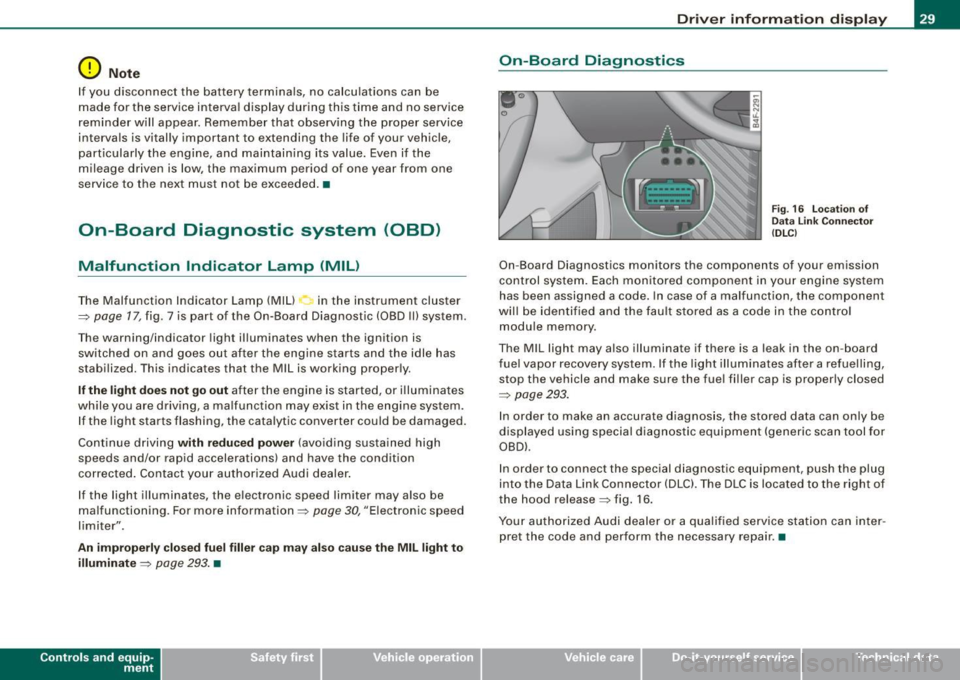
Fig. 16 Location of
Data Link Connector
(DLC)
On-Board Diagnostics monitors the components of your emission
control system. Each monitored component in your engine system
has been assigned a code. In case of a malfunction, the component
will be identified and the fault stored as a code in the control
module memory .
The MIL light may also illuminate if there is a leak in the on -board
fuel vapor recovery system. If the light illuminates after a refuelling,
stop the vehicle and make sure the fuel filler cap is properly closed
=>
page 293.
In order to make an accurate diagnosis, the stored data can only be
displayed using special diagnostic equipment (generic scan tool for
OBDl.
In order to connect the special diagnostic equipment, push the plug
into the Data Link Connector (DLC). The DLC is located to the right of
the hood release=> fig. 16.
Your authorized Audi dealer or a qualified service station can inter
pret the code and perform the necessary repair .•
Vehicle care I I irechnical data
Page 157 of 390
Automatic transmission -
------------------'
R -Reverse
The transmission will automatically select the lowest gear ratio
when you shift into reverse .
Select
R only when the vehicle is at a full stop and the engine is
running at idle speed::::;,
& in "Driving the automat ic transmission"
on
page 153 .
Before you move the se lector lever to R , press both the button in the
handle of the selector leve r
and the brake pedal at the same time .
When the ignition is on , the backup lights i lluminate when the
selector lever is moved into
R.
N -Neutral
The transmission is in neutral in this position . Shift to this position
for standing with the brakes applied=>
page 155.
When the vehicle is stationary or at speeds below 3 mph (5 km/h),
you must always apply the footbrake befor e and while moving the
lever out of
N.
D -Normal position for driving forward
Position Dis for norma l city and highway driving. It ranges from zero
to top speed and all six gears shift au tomatically, depending on
engine load, driving speed and automatica lly selected shift
programs. The gear engaged is shown in the right of the display
::::;, page 154, fig. 151.
When the vehicle is stationary or at speeds below 3 mph (5 km/h),
you must always apply the foot brake before and while moving the
lever to
D out of N .
In certain circumstances i t may be advantageous to temporarily
switch to the manual shift program to manua lly se lect gear ratios to
match specific driving conditions::::;,
page 157.
S -Sport position
Se lect this position for spor tier performance . In this position, the
transmission will not upshift as soon, allowing the vehicle to use the
Con tro ls and eq uip
ment
increased power available at higher engine speeds to achieve live
lier acceleration.
When the vehicle is stationary or at speeds below 3 mph (5 km/h),
you must always apply the foot brake before and while moving the lever to
S out of N.
& WARNING
Read and follow all WARNINGS ::::;, & in "Driving the automatic
transmission" on
page 153 .
0 Note
Coasting downhill with the transmission in N and the engine not
running will result in damage to the automatic transmission and
possibly the catalytic converter. •
Applies to ve hic les: with 6-spee d autom atic trans mission
Automatic Shift Lock (ASL)
The Automatic Shift Lock safeguards you against acciden
tally shifting into a forward or the reverse gear and
causing the vehicle to move unintentionally.
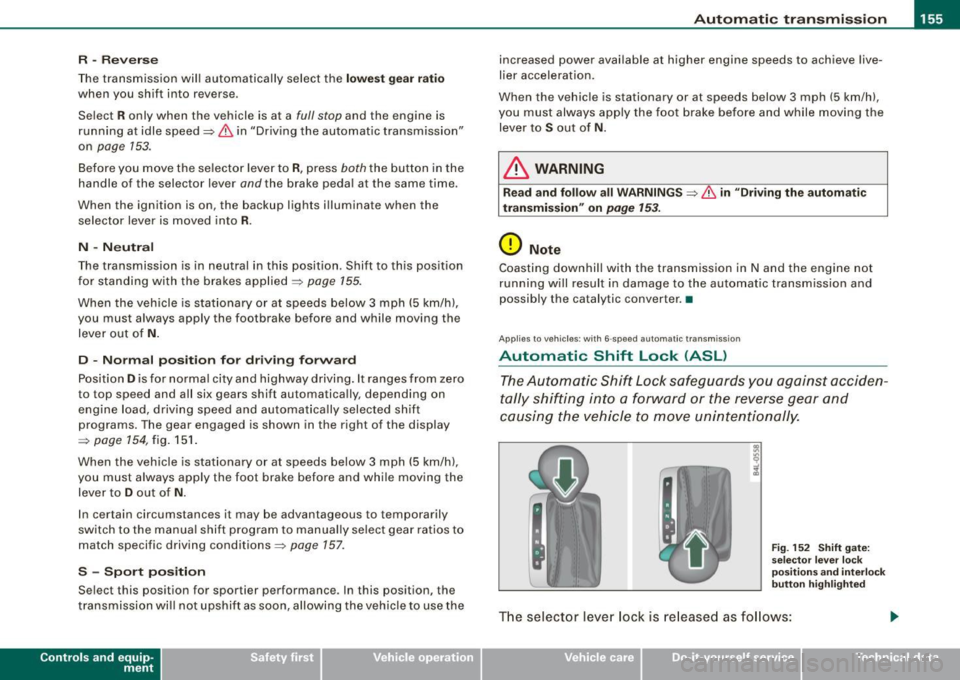
Fig. 152 Shift gate:
selec tor leve r loc k
positions and interlock
button highlight ed
The selector lever lock is released as follows:
Vehicle care I I irechnical data
Page 164 of 390
• ..__A_ u_ t _o_ m_ a_ t_ i_ c _ t_r _a _n_ s_ m_ is_ s_i o _ n ________________________________________________ _
Before you move the selector lever to R, press both, the button in the
handle of the selector lever
and the brake pedal at the same time .
When the ignition is on, the backup lights illuminate when the
selector lever is moved into R.
N -N eutr al
Sh ift to this position for standing with brakes applied=> page 762.
When the vehicle is stationary or at speeds below 3 mph (5 km/h),
you must always apply the footbrake before and while moving the
lever out of
N .
Do not use N for coasting downhill.
D -Normal dr iving po sition f or forward
Depending on the load on the engine, vehicle speed and the
dynamic control program, the transm ission will select the
optimal
gear ratio.
In certain circumstances it may be advantageous to temporarily
switch to the manua l shift program to manually select gear ratios to
match specific driving conditions=>
page 164.
When the vehicle is s tationary or at speeds below 3 mph (5 km/h),
you must always apply the footbrake before and while moving the
lever to
D ou t of N.
S -Spor t p osition
Select this position for sportier performance. In this position, the
transmission wil l not upshift as soon, allowing the vehicle to use the
increased power avai lable at higher engine speeds to achieve live
lier acceleration.
When the vehicle is stationary or at speeds below 3 mph (5 km/h),
you must always apply the foot brake before and whi le moving the
lever to
S out of N .
& WARNING
Re ad a nd follo w all WARNIN GS=> & in "Dr iv ing th e multitr oni c®"
on
page 160 .
0 Note
Coasting downhill with the transm ission in N and the engine not
operating will result in damage to the automatic transmission and
possibly the catalytic converter. •
Applies to vehicles: with multitronic® Continuous ly Variable Transmission (CVT)
Automatic Shift Lock (ASL)
The Automatic Shift Lock safeguards you against acciden
tally shifting in to a forward or the reverse gear and
causing the vehicle to move unintentionally.
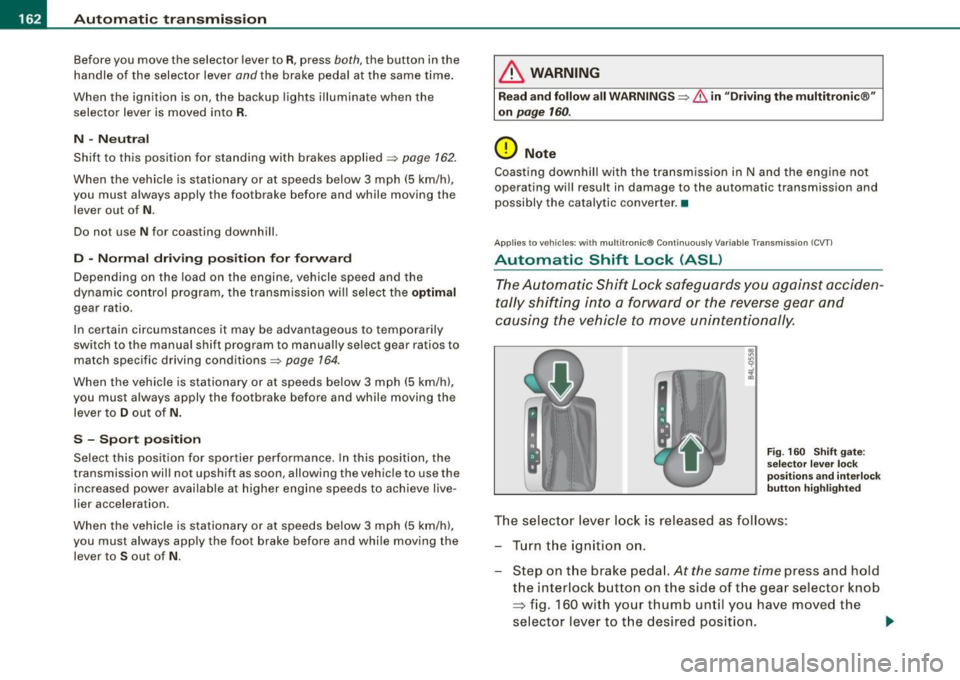
F ig . 160 Shift gate:
se lect or l ever loc k
pos it ions a nd int erl ock
butt on high lighted
The selector lever l ock is rel eased as f ollows :
T u rn the ignition on .
Step on the brake peda l.
At the same time press and hold
the interlock button on the side of the gear selector knob
=> fig. 160 with your thumb until you have moved the
selector lever to t he desired position.
~
Page 270 of 390
___ D_ r_iv _ in_... g"'- a_ n_ d_ e_ n_ v_i_r _o _n_ m_ e_n_ t _______________________________________________ _
New brake pads
--
Remember that new brake pads do not have a full braking
effect during the first 250 miles (400 kilometers) after they
are installed .
New brake pads have to be "burnished in" before they have optimal
grab =>& .
During the break -in period, you should avoid putting severe loads
on the brakes . Severe loads include, for examp le, sudden hard
braking, in particular at very high speeds or, for example, on moun
tain passes.
& WARNING
New brake pads don't have the best stopping power and must be
"broken-in" during the initial 100 to 150 miles (150 to 200 kilome
ters) of normal city driving. You can compensate for this by
pressing the brake pedal more firmly . This also applies later when
new pads are installed.
:J
Catalytic converter
It is very important that your emission control system
(catalytic converter) is functioning properly to ensure that
your vehicle is running in an environmentally sound
manner.
- Always use lead-free gasoline:=> page 291, "Fuel supply".
- Never run the tank down all the way to empty.
- Never put too much motor oil in your engine ==>
page 302,
"Adding engine oil 't=:;r\11
•
Never try to push- or tow-start your vehicle.
The catalytic converter is an efficient "clean-up" device built into the
exhaust system of the vehicle. The catalytic converter burns many
of the po llutants in the exhaust gas before they are released into the
atmosphere.
The exclusive use of unleaded fuel is critically important for the life
of the catalytic converter and proper functioning of the engine.
& WARNING
• Do not park or operate the vehicle in areas where the hot
exhaust system may come in contact with dry grass, brush, fuel
spill or other material which can cause a fire .
• Do not apply additional undercoating or rustproofing on or
near the exhaust manifold, exhaust pipes, catalytic converter or
heat shields. During driving, the substance used for undercoating
could overheat and cause a fire .
0 Note
• Be aware that just one tank filling with leaded fuel will alr eady
seriously degrade the performance of the catalytic converter.
• Do not exceed the correct engine oil level=>
page 302.
• Do not drive until the fuel tank becomes completely empty. The
engine could misfire. Unburned fuel could also get into the exhaust
system and this could cause the catalytic converter to overheat.
• Do not turn off the ignition while the vehicle is moving.
• Do not continue to operate your vehicle under these conditions,
as otherwise fuel can reach the catalytic converter. This could result
in overheating of the converter, requiring its replacement .
• To assure efficient operation of the Emission Control System:
- Have your vehicle maintained properly and in accordance with
the service recommendations in your Maintenance
& Warranty
booklet. •
Page 273 of 390
The engine and catalytic converter have to reach their optimal oper
ating temperature to reduce fuel consumption and noxious emis
sions effectively.
Just after starting, a cold engine in a mid -size car only achieves a
fuel economy of 6-8 miles per gallon (30-40 1/100km) . After about a
half a mile, fuel economy climbs to 12 mpg (201/100 kml. After about
2.5 miles (4 km), the engine is at its proper operating temperature
and fuel economy has reached a normal level. So you can see that
you should avo id short tr ips whenever possible.
The outside temperature is also critical in this regard. Your car
consumes more fuel in the winter than in the summer. •
Controls and equip ment Safety first Vehicle operation
Driving
and environment
Vehicle care Do-it-yourself service Technical data
Page 286 of 390
llffll __ C_ le_ a _ n_i_n ~g _ a_ n_ d __ p_r _o _t _e _c_ t_ i_o _n ___________________________________________ _
brake dust is also corrosive. If left on for too long, brake dust can
cause pitting.
Use on ly specia l
acid-free cleaners formulated for a lloy r ims . Safe
products are available at your Audi dealer. Never leave the cleaner
on the ri ms longer than specified on the label. If not rinsed of f
promptly, the acid contained in some c leaners can attack the
threads o n the wheel bo lts .
Never use abrasive or metal po lishing c leaning agents. If the protec
tive coating has been chipped, e.g . by kicked up road dirt, touch i t
up as soon as poss ible .
& WARNING
• Moisture and i ce on b rake s may affe ct b raking effi cien cy
~ page 261 , "General information ". Te st the brake s carefully ea ch
t ime you wa sh the vehi cle .
• Always read and heed all WARNINGS and other information
~ pag e 278. •
Body cavity sealing
The body cavity sealing does not nee d to be checked .
All body cavities which could be affected by corrosion have been
t horoughly pr otected a t the factory .
This sealing does not require any inspection or additional treat
ment . If any wax should seep out of the cavity when the ambient
temperature is high, it can be removed with a plastic scraper and a suitable solvent .
& WARNING
Solvents can be dangerous.
• Ben zine is fla mmab le and to xic . If you use be nzine fo r removing
the wax , keep sparks, f lame and lighted cigarettes away . Never
& W ARN ING (continued )
dump benz ine on the ground , into open streams or down sewage
dra in s.
• Be sure to observe all safety and env ironmental regulat ions .
Follow all in struction s on the cont ainer .
• Alway s read and heed all WARNINGS and other inform ation
~ page 278 .•
Chassis
Have the u nderc oating c hecked for dama ge from tim e to
time.
T he lower body shell of your Audi is also thoroughly protected
aga inst corrosion .
Any damage to the undercoat ing caused by road hazards shou ld be
repaired promptly.
& WARNING
Too much undercoating in the wrong place s can cau se a fire .
• Do not app ly addition al undercoating or rustproofing on or
near the exhaust manifold, exhau st pipe s, catalytic converter or
he at shield s. While dr iving , the sub stance used for underco ating
could overhe at and cau se a fire .
• Alwa ys read and heed all WARNINGS and other info rm ation
=> page278 .•
Page 293 of 390
•
Fuel supply and filling your fuel tank
Gasoline
Fuel supply Using the right fuel helps keep the environment clean and
prevents engine damage.
Fuel r ecomm end ati on
The fuel recommended for your vehic le is unl eade d prem ium grade
gaso line . See also ~
page 363, "Data". Audi recommends using TOP
T IER Detergent Gasoline with a minimum octane rating of 91 AKI (95
RON). For more information on TOP TIER Detergent Gaso line, please
go to the official website (www.toptiergas .com).
The recommended gasoline octane rating for your engine can also be found on a label located on the inside of the fuel fille r flap. This
rating may be specified as AK I or RON .
Your vehic le may also be operated us ing unleaded regular gasoline
with a minimum octane rating of 87 AKl/91 RON . However, using 87
AKl/9 1 RON octane fuel will slightly reduce engine performance.
Use unle ad ed ga so line only . Unleaded gaso line is avai lable
throughout the USA, Canada, and in most European countries. We
recommend that you do not take your vehicle to areas or countr ies
where un leaded gasoline may not be available .
For more information on refueling your vehicle, see~
page 292.
Octane ra tin g
Octane rating indicates a gaso line's ability to resist engine
damaging "knock" caused by premature ignition and detonation.
Therefore, buying the correct grade of gaso line is very important to
help prevent possible engine damage and a loss of engine perfor
mance.
F ue l supply and fillin g you r fu el tank
Gasoline most common ly used in the United States and Canada has
the following octane ratings that can usua lly be found on the filler
pump:
• Premium Grade : 91 -96 AKI
• Regular Grade: 87 -90 AKI
Explanation of the abbreviations:
AKI = Anti Knock Index= (R +M)/2 = (RON +MON)/2
RON = Research Octane Number
MON
= M otor Octane Number .
0 Note
• Do not use any fue l with octane ratings lower than 87 AKI or 91
RON otherwise expensive engine damage will occur .
• Do
not use leaded gasoline. The use of leaded gasoline w ill
severe ly damage your vehicle's catalytic converter and its abi lity to
control exhaust emissions. •
Blended gasoline
Use of g aso line containing alco hol or M TB E ( meth yl
t er tiary butyl e ther )
You may use unleaded gasoline blended with alcohol or MTBE
(commonly referred to as oxygenates) if the blended mixture meets
the follow ing criteria:
Bl end of g asoline m eth anol (wood al coho l or methyl alc oh ol)
• Anti-knock index must be 87 AKI or higher .
• Blend must contain no more than 3% methanol.
• Blend must contain more than 2% co-solvents.
Vehicle care I t •
Page 368 of 390
___ C_ o_n_ s_ u_m _ e_ r_ ln_ f_ o _r _m _ a_ t_ i_o _n ______________________________________________ _
standards. Therefore, vehicles built for the U.S .A. and Canada differ
from vehicles sold in other countries.
If you plan to take your vehicle outside the continental limits of the
United States or Canada, there is the possibility that
• unleaded fuels for vehicles with catalytic converter may not be
available;
• fuel may have a considerably lower octane rating. Improper fuel
may cause engine damage;
• service may be inadequate due to lack of proper service facilities,
tools or testing equipment;
• replacement parts may not be readily available .
• Navigation systems for vehicles built for the U.S.A. and Canada
will not necessarily work in Europe , and may not work in other coun
tries outside of North America.
0 Note
Audi cannot be responsible for mechanical damage that could
result from inadequate fuel , service or parts availability .•
Audi Service Repair Manuals and
Literature
Audi Official Factory Service Manuals are published as soon as
possible after model introduction. Service manuals are available
from :
Audi Technical Literature Ordering Center
Call toll -free:
Tel.: 1 (800) 544-8021
(from 8:00 AM to 8:00 PM, EST, Monday through Friday)
or access their website www.audi.ddsltd.com on the Internet to
order repair manuals and other Audi literature. •
Maintenance
General
Your vehicle has been designed to help keep maintenance require
ments to a minimum. However, a certain amount of regular mainte
nance is still necessary to assure your vehicle 's safety, economy and
reliability. For detailed vehicle maintenance consult your Mainte
nance & Warranty booklet .
Under difficult operating conditions, for example at extremely low
outside temperatures, in very dusty regions, when towing a trailer
very frequently, etc., some service work should be performed
between the intervals specified. This applies particularly to:
• oil changes , and
• cleaning or replacing the air filter.
~ For the sake of the environment
By regularly maintaining your vehicle, you help make sure that emis
sion standards are maintained, thus minimizing adverse effects on
the environment. •
Important considerations for you and your
vehicle
The increasing use of electronics, sophisticated fuel injection and
emission control systems, and the generally increasing technical
complexity of today's automobiles, have steadily reduced the scope
of maintenance and repairs which can be carried out by vehicle
owners. Also, safety and environmental concerns place very strict
limits on the nature of repairs and adjustments to engine and trans
mission parts which an owner can perform.
Maintenance, adjustments and repairs usually require special tools,
testing devices and other equipment available to specially trained .,_
Page 376 of 390
llffl __ A_ l..:,. p _ h_ a_ b_e _t_ic _ a_l _in _ d_e_ x ____________________________________________ _
Brake system . . . . . . . . . . . . . . . . . . . . . . . 306
Anti-lock brake system . . . . . . . . . . . . . 22
Brake fluid . . . . . . . . . . . . . . . . . . . . . . 306
Brake fluid specifications for refill and replacement . . . . . . . . . . . . . . . . . . . 307
Brake pads . . . . . . . . . . . . . . . . . . . . . . 268
Electromechanical parking brake ... 129
General information .............. 261
How does moisture or road salt affect the brakes? ....................... 261
Malfunction ........ ... ...... .... . 32
Warning/indicator lights ........... 23
Worn brake pads symbol . . . . . . . . . . . 37
Break -in period . . . . . . . . . . . . . . . . . . . . . 267
Brake pads . . . . . . . . . . . . . . . . . . . . . . 268
Tires .... ... .. .... .... .......... 267
Bu lbs ... .... .. ... ...... ....... .... 349
Bumper cover Caution when parking near a parking bar -
rier or curb ...... ... .... .... ... 130
C
Ca lifornia Proposition 65 Warning 298
Battery specific . . . . . . . . . . . . . . . . . . 310
Capacities ......................... 363
Car care ................. .... .... .. 278
Interior .......... .... .... ...... . 285
Plastic and vinyl .. .... ........... 282
Weatherstrips ....... ........ .... 283
Care of exterior .... ....... .......... 278
Cargo area
See Loading the luggage compartment ..
199 Cargo net
.... .... ... ........ ...... .. 98
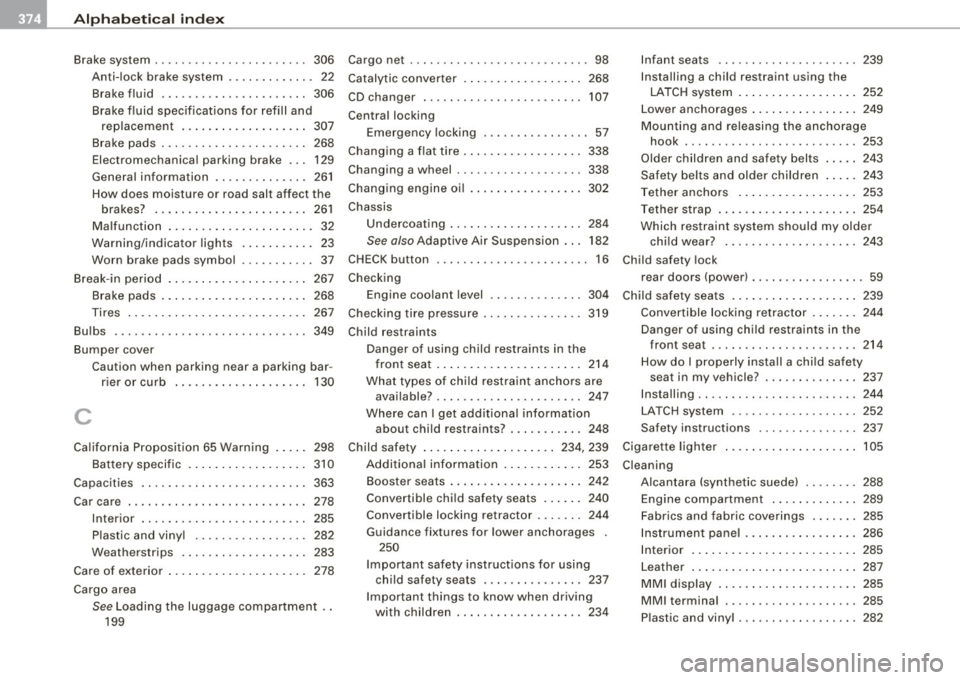
Catalytic converter . ........ .... .... . 268
CD changer . . . . . . . . . . . . . . . . . . . . . . . . 107
Central locking Emergency locking . . . . . . . . . . . . . . . . 57
Changing a flat tire ........ .... ... ... 338
Changing a wheel .... .. ..... .. .. .... 338
Changing engine oi l ....... .... ... ... 302
Chassis Undercoating ... .. .... .... .... ... 284
See also Adaptive Aar Suspension . . . 182
CHECK button . . . . . . . . . . . . . . . . . . . . . . . 16
Checking Engine coolant level .............. 304
Checking tire pressure .. ........... .. 319
Child restraints Danger of using child restraints in the front seat ......... ... .... ...... 214
What types of chi ld restraint anchors are
available? . .... ..... ...... .... .. 247
Where can I get additional information
about child restraints? ...... ... .. 248
Child safety ...... ...... .... ... . 234, 239
Additional information ............ 253
Booster seats ................. ... 242
Convertible chi ld safety seats .. .... 240
Convertible locking retractor ....... 244
Guidance fixtures for lower anchorages
250
Important safety instructions for using
child safety seats .... ...... ... .. 237
Important things to know when driving with children ................... 234 Infant
seats ... .... .... ....... .. . 239
Install ing a child restraint using the
LATCH system .. ...... ..... .. ... 252
Lower anchorages ... .. .... .... ... 249
Mounting and releasing the anchorage
hook . ............ ....... .... .. 253
Older children and safety belts ..... 243
Safety belts and older children ..... 243
Tether anchors .. ...... .... ...... 253
Tether strap ... .... .... ...... .... 254
Which restraint system should my older
chi ld wear? ....... ........... .. 243
Child safety lock
rear doors {power) . .... ........ .... 59
Child safety seats .. .... ...... .... ... 239
Convertible locking retractor .. ..... 244
Danger of using child restraints in the
front seat ...................... 214
How do I properly install a child safety
seat in my vehicle? .... ... .... ... 237
Installing .. .. .. .... .... ... .... ... 244
LATCH system ....... ........ .... 252
Safety instructions ............... 237
Cigarette I ig hter . . . . . . . . . . . . . . . . . . . . 105
Cleaning Alcantara {synthetic suede) . ....... 288
Engine compartment ...... .... ... 289
Fabrics and fabric coverings . ...... 285
Instrument panel ....... ........ .. 286
Interior ........... .... .......... 285
Leather ... .... .................. 287
MMI display .............. .... ... 285
MMI terminal .. .... .... ... .... ... 285
Plastic and vinyl ... .... .... .... ... 282
Page 378 of 390
llffl __ A_l.:,. p _h_ a_ b_e _t _ic _ a_l _in _ d_e _x ____________________________________________ _
Driver seat
See Seating position . . . . . . . . . . . . . . 194
Driver's seat . . . . . . . . . . . . . . . . . . . . . . . . 88
Driver's seat memory . . . . . . . . . . . . . . . . . 91
Activating remote control key .. ... .. 92
Recalling a seat posit ion ...... .... . 91
Storing a seat position . ........ .... 91
Driving messages ...... .... .... .... .. 30
Driving safely .... .... .... ...... .... 192
Driving time . ...... .. .... .... .... .... 40
Dup licate key ........... .... ... .... .. 48
DVD player for navigation system . . . . . . 99
Dynamic shift program .............. 163
E
Easy entry feature 124
Electric seat adjustment
S ee Power seat . . . . . . . . . . . . . . . . . . . 88
Electromechanica l parking brake
Emergency braking .. ...... ...... . 131
Malfunction ...... .... .... ....... 131
Operation . . . . . . . . . . . . . . . . . . . . . . . 129
Parking . . . . . . . . . . . . . . . . . . . . . . . . . 130
Rel easing and app lying .... ... .... 129
Starting off with a trailer ... ..... .. 131
Warning /indicator ligh ts ... .... .... 23
Electronic differential lock (EDU
How the system works . . . . . . . . . . . . 259
Warning /indicator lights ....... .... 22
Electronic immobilizer . ... .... .. . .. 15, 51
Electronic power contro l
(EPC) warning/indicator light ...... .. 19 Electronic stabili
zation program (ESP)
How the system works . ...... ..... 258
Wa rning/indicator lights ......... .. 19
Emergency braking . . . . . . . . . . . . . . . . . 131
Emergency closing Power sunroof ......... .... ... . 68, 69
Emergency flasher . . . . . . . . . . . . . . . . . . . 73
Wa rning/indicator lights ..... ...... 20
Emergency locking of doors ....... ... . 57
Emergency starting .. ... .... .... .... 351
Emergency towing ..... .... .... ... .. 354
Energy management ... .. .... .... ... 265
Battery power . . . . . . . . . . . . . . . . . . . 266
Driver notification 266
Engine Compartment . .... .... .... .... .. 298
Coolant ......................... 303
Hood ... .. .... .... .... .... .... .. 296
Starting ...... ........ .... .. 124, 125
Starting with jumper cables .. ..... 351
Stopping ........................ 126
Engine compartment Safety instructions .... ...... ..... 297
Working the engine compartment .. 297
Engine coolant system ........ .... ... 303
Adding coolan t ..... ........ .... . 305
Checking coo lant level .. ....... ... 304
Check ing the engine coolant level .. 304
Malfunction ......... .... .. .. .... . 33
Radiator fan ...... .. .. .... .... ... 306
Engine coolant temper .ature
Temperature gauge ...... ...... ... 13
Engine data .. ... ... .. .... .... ...... 363 Engine hood
Clos ing ... .... ... ... ... .. .... ... 297
How to release the hood . . . . . . . . . . 296
Engine oi l ..... ... .... .... .. .. ..... . 299
Adding ... .... .... .... .... ... ... 302
Additiv es .. ...... ..... .. .. .... ... 302
Changing . ....... .... ... .. ...... 302
Checking the engine oil level . .... .. 301
Indications and conditions requiring extra
checking .. ...... .... .......... 301
Oil consumption ... .... .... .... .. 300
Oil grades . ...... ... ... .... ..... . 299
Recommended oil che ck in tervals .. 301
Specif ication and viscosity .. .. .. ... 299
Engine oil leve l ... .... .... .. .. ..... .. 37
Engine oil pressure Malfunction .. .. .. .... .... .... .... 34
Eng ine oi l sensor defective .... .... .... 37
Environment Break -in period ........ ..... ..... 267
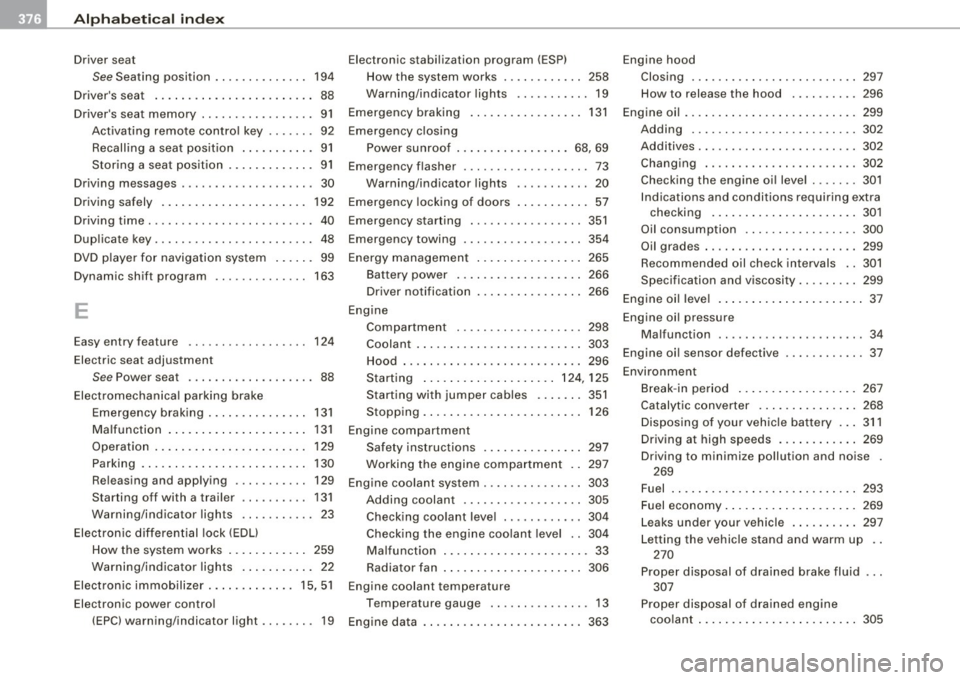
Catalytic converter .... .... ..... .. 268
Disposing of your vehicle battery .. . 311
Driving a t high speeds ............ 269
Driv ing to minimize pollution and noise .
269
Fuel .... .. .... .... .............. 293
Fuel economy ...... .... .. .. .... .. 269
Leaks under your vehicle ....... ... 297
Letting the vehicle stand and warm up ..
270
Proper disposal of drained brake fluid 307
P roper disposal o f drained engine
coo lant ..... .. .. .... .... ....... 305