ESP AUDI S6 2009 Owners Manual
[x] Cancel search | Manufacturer: AUDI, Model Year: 2009, Model line: S6, Model: AUDI S6 2009Pages: 398, PDF Size: 43 MB
Page 298 of 398
Fuel supply and filling your fuel tank
Blend of gasoline and ethanol (grain alcohol or ethyl alcohol}
• Anti-knock index must be 87 AKI or higher.
• Blend must not contain more than 10% ethanol.
Blend of gasoline and MTBE
• Anti-knock index must be 87 AKI or higher.
• Blend must contain not more than 15% MTBE.
Seasonally adjusted gasoline
Many gasoline grades are blended to perform especially well for
winter or summer driving. During seasonal change -over, we suggest
that you fill up at busy gas stations where the seasonal adjustment
is more likely to be made in time.
0 Note
• Methanol fuels which do not meet these requirements may
cause corrosion and damage to plastic and rubber components in
the fuel system.
• Do not use fuels that fail to meet the specified criteria in this
chapter.
• If you are unable to determine whether or not a particular fuel
blend meets the specifications, ask your service station or its fuel
supplier.
• Do not use fuel for which the contents cannot be identified.
• Fuel system damage and performance problems resulting from
the use of fuels different from those specified are not the responsi
bility of Audi and are not covered under the New Vehicle or the
Emission Control System Warranties.
• If you experience a loss of fuel economy or driveability and
performance problems due to the use of one of these fuel blends,
we recommend that you switch to unblended fuel. •
Gasoline additives
A major concern among many auto manufacturers is carbon
deposit build-up caused by the type of gasoline you use.
Although gasoline grades differ from one manufacturer to another,
they have certain things in common. All gasoline grades contain
substances that can cause deposits to collect on vital engine parts,
such as fuel injectors and intake valves. Although most gasoline
brands include additives to keep engine and fuel systems clean,
they are not equally effective.
Audi recommends using TOP TIER Detergent Gasoline. For more
information on TOP TIER Detergent Gasoline, please go to the offi
cial website (www.toptiergas.com).
After an extended period of using inadequate fuels, carbon deposit
build-ups can rob your engine of peak performance.
(D Note
Damage or malfunction due to poor fuel quality is not covered by
the Audi New Vehicle Limited Warranty. •
Fuel tank
Fuel filler neck
The fuel filler neck is located on the right rear side panel behind the
fuel filler flap.
If the power locking system should fail, you can still open the flap
manually - for detailed instructions see=>
page 299.
You can find the fuel tank capacity of your vehicle in Technical Data
=> page 369. .,_
Page 300 of 398
Fuel supply and filling your fuel tank Refuelling procedure
- Insert the fuel nozzle from the gasoline pump into the
fuel filler neck as far as it will go.
- Select a medium refuelling rate so that the nozzle switches off automatically when the tank is full.
Putting the fuel cap back on
- After filling your tank, twist the fuel filler cap clockwise
until you hear a definite click.
Close the fuel filler flap.
To avoid fuel spilling or evaporating from the fuel tank always close
fuel filler cap properly and completely. An improperly closed fuel
filler cap may also cause the MIL lamp=>
page 27to come on.
& WARNING
Improper refueling or handling of fuel can cause fire, explosion
and severe burns.
• Fuel is highly flammable and can cause severe burns and other
injuries.
• Failure to shut the engine off while refueling and/or to insert
the pump nozzle fully into the fuel filler neck could cause fuel to spray out of filler neck or to overflow. Fuel spray and overflowing
fuel can cause a fire.
• Never use a cellular telephone while refueling . The electromag
netic radiation can cause sparks that can ignite fuel vapors and
cause a fire.
• Never get back into your vehicle while refueling. If in excep
tional circumstances you must get back in your vehicle while refu
eling, make certain that you close the door and touch metal to
discharge static electricity before touching the filler nozzle again.
Static electricity can cause sparks that can ignite fuel vapors
released during refueling .
& WARNING (continued)
• Never smoke or have an open flame anywhere in or near your
vehicle when refueling or filling a portable fuel container.
• For your safety, we strongly recommend that you do not travel
with a portable fuel container in your vehicle. The container, full or
empty may leak and could cause a fire, especially in a crash.
• If, under exceptional circumstances, you must transport a
portable fuel container, please observe the following:
-Never fill a portable fuel container while it is anywhere in or
on the vehicle (for example, in the luggage compartment, or on
the trunk). Static electricity can build up while filling and can
ignite fuel vapors causing a fire.
- Always place a portable fuel container on the ground before
filling.
- Always keep the filler nozzle completely inside the portable
container before and during filling.
- If filling a portable container made of metal, the filler nozzle
must always be in contact with the container. This will help
prevent static electricity from discharging and cause a fire.
- Never spill fuel inside the vehicle or luggage compartment. Fuel vapors are highly flammable .
- Always observe local and state/provincial laws regarding the
use, storage and transportation of fuel containers.
- Make certain the fuel container meets industry standards
(ANSI / ASTM F852-86l.
0 Note
If any fuel has spilled onto the car, it should be removed immedi -
ately to prevent damage to the paint. _.,
Page 303 of 398
_____________________________________________ C_ h_ e .=....= c..:..k :..:.in :....:..:= g:.....= a..:..n .:....:d::......:. f.:..:il .:..:li ..:..n ::.:g:!....-_IJIII
•
Closing the engine hood
- Pull the hood down until the pressure from the struts is
reduced .
- Let the hood
drop down and latch in place. Do not try to
push it shut;
it may fail to engage => &.
& WARNING
A hood that is not completely latched could fly up and block your
view while driving.
• When you close the engine hood, check it to make sure the
safety catch has properly engaged. The hood should be flush with
the surrounding vehicle body parts.
• If you notice while driving that the hood is not secured prop
erly, stop at once and close it. •
Working in the engine compartment
Be especially careful whenever you work in the engine
compartment.
Whenever you must perform any work in the engine compartment,
for example checking and filling different fluids, there is a risk of injury, burns and accidents. To prevent personal injury always
observe the following WARNINGS. The engine compartment of any
vehicle is a hazardous area
~ & .
& WARNING
To help avoid injury, before you check anything under the hood :
• Turn off the engine.
• Remove the ignition key.
• Apply the parking brake .
& WARNING (continued)
• Move selector lever to "P" (Park).
• Always let the engine cool down. Hot components will burn
skin on contact.
• To reduce the risk of being burned, never open the hood if you
see or hear steam or coolant escaping from the engine compart
ment. Wait until no steam or coolant can be seen or heard before
carefully opening the hood.
• Keep children away from the engine compartment .
• Never spill fluids on hot engine components. They can cause a
fire.
• Never touch the radiator fan. The auxiliary electric fan is
temperature controlled and can switch on suddenly.
• Never open the coolant reservoir cap when the engine is still
warm . The coolant system is pressurized and hot coolant could
spray out.
• Protect your face, hands and arm from steam or hot engine
coolant by placing a thick rag over the cap when you open the
coolant reservoir.
• If work on the fuel system or the electrical system is necessary :
- Always disconnect the battery.
- Never smoke or work near heaters or open flames . Fluids in
the engine compartment could start a fire.
- Keep an approved fire extinguisher immediately available.
• To avoid electrical shock and personal injury while the engine
is running or being started, never touch:
- Ignition cables
- Other components of the high voltage electronic ignition system.
• If you must perform a check or repair with the engine running: -First, fully apply the parking brake, move selector lever to "P"
(Park). .,
Vehicle care
I t •
Page 310 of 398
lffl __ C _h_ e_ c_k _in --== g'-- a_n _d_ f_il _li _n ..:::g:::..- ___________________________________________ _
models; 60% for Canadian models). This mixture both assures the
necessary frost protection and protects metal components in the
engine's cooling system from corrosion and scaling. It also raises
the boiling point of the coolant.
Do not reduce the concentration of the coolant in the summer by
adding plain water.
Th e pro port io n of coo la nt additi ve mu st be at
lea st 50 % but n ot mor e th an 60 %
to maintai n ant ifreeze protection
and cooling efficiency. If the coolant frost protection is too low , the
coolant could free ze and damage the veh icle heating and engine
cooling system .
For year-round driving , antifreeze is added at the factory for temper
atures down to:
• -31 °F ( -35 °c1 usA
• - 40 °F ( - 40 °C) Canada.
You can mix the
Gl 2+ + coolant additive with other additives (G12+
or G12). Always check w ith your authorized Audi dealer.
& WARNING
B efo re you che ck anyt hing in th e eng ine compartmen t, alway s
re ad a nd he ed all WARN ING S~
& in " Working in the engine
c ompar tm ent " on
page 30 1.
0 Not e
• Before winter sets in, have the coolant checked to see if the
coo lant additive in your vehicle is sufficient to meet the climate
conditions. This is especia lly important if you live in a region where
the winter is extremely cold . If necessary, increase the proportion of
coolant additive to 60%.
• When adding coolan t additive to your coo ling system,
remember:
-We recommend using only coolant additive
G12+ + (check the
label) for your vehicle. This coolant additive is avai lable at autho
riz ed Audi dealers. Other types of antifreeze can significantly reduce corrosion protection. The resulting corrosion can cause a
loss of coolant and serious engine damage.
• Do not add any type of radiator leak sealant to your vehicle's
engine coolan t. Adding radiator repair fluid may adversely affect the
function and performance of your cooling system and could result
in damage not covered by your New Vehicle Limited Warranty. •
Checking the engine coolant level
The engine coolant level can be checked with a quick
glance.
F ig . 2 42 E ngin e
com partm ent : Cool ant
ex pans io n tank
Before you check anything in the engine compartment,
alw ays read and h eed all WARNINGS ~ & in "Working in
the eng ine compartment" on page 301.
- Turn off the ignition.
- Read the e ngine coo lant level from the coo lant expan -
sion tank~ fig. 242. With a cold engi ne, the coolant level
sho uld be between the "min" and "max" markings. W hen
the engine is warm, the level may be slightly above the
"max" marking .
The location of the coolant expansion tank can be seen in the
engine compartment illustration~
page 302.
Page 314 of 398
-Checking
and filling
---=---------------
checked by a service facility . The electrolyte level should also be
checked each time the battery is charged
~ page 314.
Have the battery checked when you take your vehicle in for service.
You are well advised to replace a battery that is older than 5 years.
With certain types of airbag deployment, the battery is discon nected from the vehicle electrical system for safety reasons~
& in
"Repair, care and disposal of the airbags" on
page 229.
Disconnecting the battery terminals
Some vehicle functions (power window regulators, for example) are
lost if the battery terminals are disconnected . These functions have
to be relearned after the battery terminals are connected again . To
prevent this, the battery should only be disconnected from the
vehicle electrical system when absolutely necessary for repairs.
Vehicles not driven for long periods
If you do not drive your vehicle over a period of several days or
weeks, electrical components are gradually cut back or switched off.
This reduces energy consumption and maintains starting capability
over a longer period
~ page 269.
Take into consideration that when you unlock your vehicle, some
convenience functions , such as the master key remote function or
power seat adjustment, may not be available. The convenience
functions will be available again when you turn on the ignition and
start the engine.
Winter operation
During the winter months, battery capacity tends to decrease as
temperatures drop . This is because more power is also consumed
while starting, and the headlights, rear window defogger, etc., are
used more often.
Avoid unnecessary power consumption, particularly in city traffic or
when traveling only short distances. Let your authorized Audi dealer
check the capacity of the vehicle battery before winter sets in
~ page 314. A well charged battery will not only prevent starting
problems when the weather is cold , but will also last longer .
[ i] Tips
If your vehicle is left standing for several weeks at extremely low
temperatures, the vehicle battery should be removed and stored
where it will not freeze. This will prevent it from being damaged and
having to be replaced. •
Working on the battery
Be especially careful when working on or near the battery.
Fig. 244 Luggage
compartment : Battery
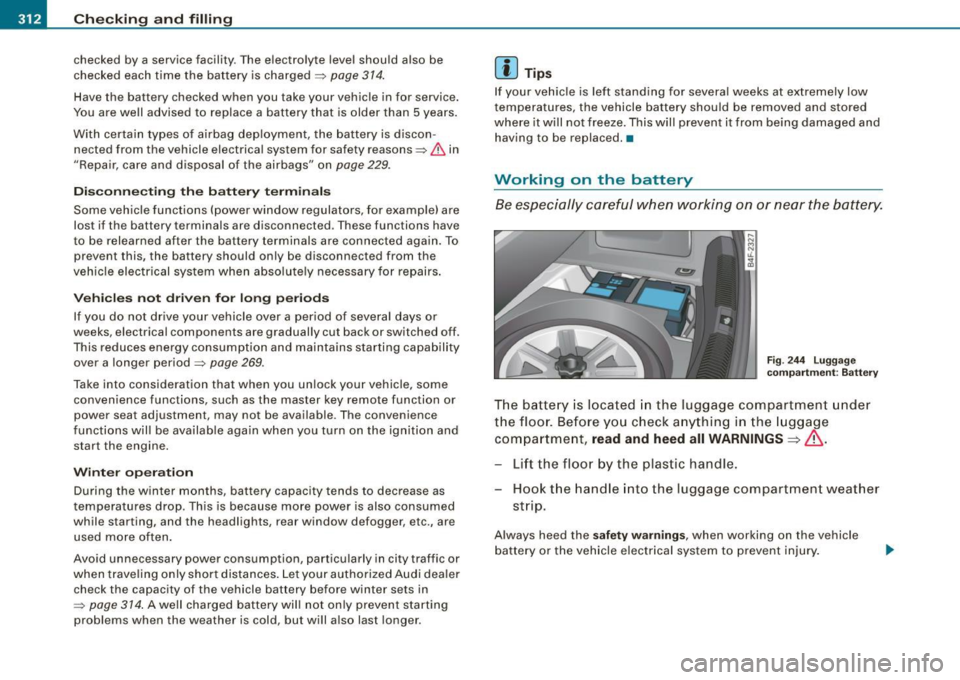
The battery is located in the luggage compartment under
the floor. Before you check anything in the luggage
compartment,
read and heed all WARNINGS=>& .
Lift the floor by the plastic handle.
Hook the handle into the luggage compartment weather
strip.
Always heed the safety warnings, when working on the vehicle
battery or the vehicle electrical system to prevent injury.
Page 317 of 398
Checkin g and fillin g -
--------------~-
•
-Now remove the clamps fo r the charging eq uipment.
- Close t he red cover on the positive pole.
- Close the hood~
page 301.
A discharged battery can freeze at temperatures of only O °C. A llow
a frozen battery to thaw completely before attempting to charge it
~ & .However, we recommend not using a thawed battery again
because the battery casing can be cracked due to ice formation and
can leak battery acid.
Batt ery c harg ing (Ma ximum ch arging rate of 30
a mps /14 .8 Volt )
When charging at /ow voltages (e.g. with a trickle charg er), the
ba ttery cables do not have to be disconnected first. The battery caps
should
not be opened when charging a battery.
I t is not necessary to remove the battery from the luggage compart
ment .
Fa st cha rging the batt ery (chargi ng ra te ab ove 14 .8
Volt s)
For technical reasons do not use a battery charger that uses vo ltage
greater than 14.8 Volts to charge your vehic le's battery.
& WARNING
C harging a battery can be d angerou s.
• Alwa ys follo w the oper ating instruct ions pro vided b y the
battery charger manuf acturer when charging your b attery .
• Neve r charge a frozen battery. It m ay explode be cau se of gas
tr apped in the i ce. Allow a frozen battery to thaw out fir st.
• Do not reuse batteries wh ich were fro zen. The battery housing
m ay hav e crac ked and wea kened when the b atte ry fro ze .
• Charge the battery in a well ventilated area. Keep away from
open fla me or ele ctri cal s par k. Do not smok e. Hydrogen ga s gener
ated by the battery is explo sive.
&_ W ARN ING (c ontinued )
• To redu ce the danger of explo sion, never connect or d isconnect
c h ar ger cable s while the charger is ope rat ing .
• Batte ry acid that may spill durin g charging should be w ashed
off with a sol ution of warm water and b aking soda to neutralize
the acid .
0 Note
Never use a fast charger as a booster to start the engine . This wi ll
seriously damage sensitive electronic components, such as control
units, re lays, radio, etc ., as well as the battery charger. •
Battery replacement
The new battery must have the same specifications and
dimensions as the original equipment battery.
Intelligent energy management in your vehicle is responsib le for
distributing the e lectrica l energy throughout your vehicle
~ page 269 . The intelligent energy management system will keep
the engine battery charged better then vehicles without this system.
To make sure the additional electrical energy is availab le once again
after you have changed the battery, we recommend that you insta ll
batteries of the same type and manufacture only (the same as those
insta lled at the t ime your vehicle was de livered). Specif ications are
listed on the battery housing . Your authorized Audi dealer wi ll then
code the battery management con trol unit.
I f it is not possib le to use a battery of this type, the new battery must
have the same capacity, voltage (12 volts), amperage, construction
and p lug sealing .
When installing the battery, make sure the ignition and all electrical consumers are tur ned off.
~
Vehicle care I t •
Page 320 of 398
-~_T_ ir_e_ s_ a_ n_d _ w_ h_ e_e _l_s _________________________________________________ _
& WARNING (continued)
crashes and serious personal injuries . Have worn or damaged tires
replaced immediately.
• Tires age even if they are not being used and can fail suddenly,
especially at high speeds. Tires that are more than 6 years old can
only be used in an emergency and then with special care and at
low speed.
Glossary of tire and loading terminology
Accessory weight
means the combined weight (in excess of those standard items
which may be replaced) of automatic transmission, power steering,
power brakes, power windows, power seats, radio, and heater, to
the extent that these items are available as factory-installed equip
ment (whether installed or not).
Aspect ratio means the ratio of the height to the width of the tire in percent.
Numb ers of 55 or lower indicate a low sidewall for improved
steering response and better overall handling on dry pavement.
Bead
means the part of the tire that is made of steel wires, wrapped or reinforced by ply cords and that is shaped to fit the rim.
Bead separation means a breakdown of the bond between components in the bead.
Cord
means the strands forming the plies in the tire.
& WARNING (continued)
• Never mount used tires on your vehicle if you are not sure of
their "previous history." Old used tires may have been damaged
even though the damage cannot be seen that can lead to sudden
tire failure and loss of vehicle control.
• If you notice unusual vibration or if the vehicle pulls to one side
when driving, always stop as soon as it is safe to do so and check
the wheels and tires for damage . •
Cold tire inflation pressure
means the tire pressure recommended by the vehicle manufacturer
for a tire of a designated size that has not been driven for more than
a couple of miles (kilometers) at low speeds in the three hour period
before the tire pressure is measured or adjusted .
Curb weight means the weight of a motor vehicle with standard equipment
including the maximum capacity of fuel, oil, and coolant, air condi
tioning and additional weight of optional equipment.
Extra load tire
means a tire designed to operate at higher loads and at higher infla
tion pressures than the corresponding standard tire . Extra load tires
my be identified as "XL",
"xi", "EXTRA LOAD", or "RF" on the side
wall.
Gross Axle Weight Rating ("GAWR")
means the load-carrying capacity of a single axle system, measured
at the tire -ground interfaces .
Gross Vehicle Weight Rating ("GVWR"l
means the maximum total loaded weight of the vehicle.
Page 321 of 398
________________________________________________ T_ i _r_e _s_ a_n_ d_ w_ h_ e_e _ l_s __ lftlll
•
Groove
means the space between two adjacent tread ribs.
L oad ra ting (code)
means the maximum load that a tire is rated to carry for a given
inflation pressure. You may not find this information on all tires
because it is not required by law.
M ax im um l oad ra tin g
means the load rating for a tire at the maximum permissib le infla
tion pressure for that tire.
Ma ximum l oaded v ehi cle weigh t
means the sum of:
(a) Curb weight
(b) Accessory weight
(c) Vehic le capacity weight, and
(ct) Production options weight
M ax im um (p er mi ssibl e) infl ati on pr essur e
means the maximum cold inflation pressure to wh ich a tire may be
inflated. Also ca lled "maximum inflation pressure."
Normal occ upa nt wei ght
means 150 lbs. (68 kilograms) times the number of occupants
seated in the vehicle up to the to tal seating capacity of your vehicle.
O ccupant di stributi on
means distribution of occupants in a vehicle .
Outer di am eter
means the overall diameter of an inflated new tire.
O ve rall wi dth
means the linear distance between the exteriors of the sidewa lls of
an inflated tire, includ ing elevations due to labeling, decorations, or
protective bands or ribs.
Pl y
means a layer of rubber -coated para lle l cords.
P rodu ction opt io ns wei ght
means the combined weight of those installed regular production
options weighing over 5 lbs . (2.3 kg) in excess of those standard
i t ems wh ich they replace, not previously considered in curb weigh t
or accessory weight, including heavy duty brakes, ride levelers, roof
rack, heavy duty battery, and specia l trim .
Radi al p ly tire
means a pneumatic tire in which the ply cords that extend to the
beads are laid at substantially 90 degrees to the centerline of the
tread .
Reco mm ended infl ati on pr essu re
see => page 318, "Cold tire inflation pressure".
Rein force d tir e
means a tire designed to operate at higher loads and at higher infla
tion pressures than the corresponding standard tire. Reinforced
t ires my be identified as "XL", "xi", "EXTRA LOAD", or "RF" on the
sidewall.
R im
means a metal support for a tire or a tire and tube assembly upon
wh ich the t ire beads are seated.
Rim di amet er
means nominal diameter of the bead seat. If you change your whee l
size, you wi ll have to purchase new tires to match the new rim diam
eter .
Rim siz e de sig nation
means rim diameter and width.
Rim wid th
means nominal distance between rim flanges.
Vehicle care I t •
Page 323 of 398
Tires and wheels -_______________ _____.
Occupant loading and distribution for vehicle normal load for various designated seating capacities
Designated seating capacity, num
ber of occupants Vehicle normal load
, number of
occupants Occupant distribution in a normally
loaded vehicle
5 3
2 in front,
1 in back seat
Cold tire inflation pressure
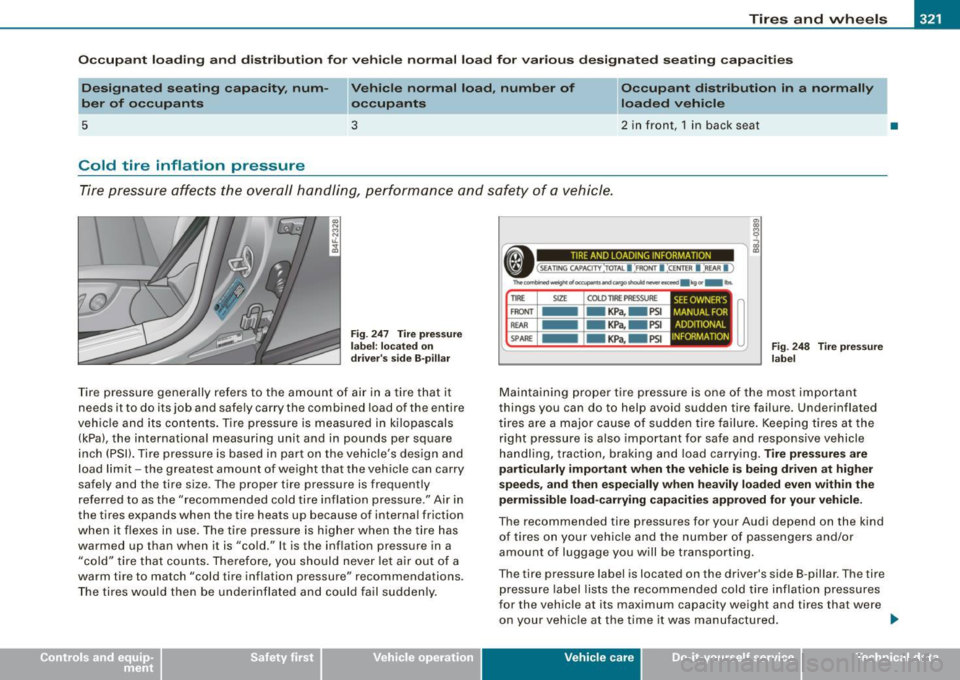
Tire pressure affects the overall handling, performance and safety of a vehicle.
Fig. 247 Tire pressure
label: located on
driver's side B-pillar
Tire pressure generally refers to the amount of air in a tire that it
needs it to do its job and safely carry the combined load of the entire
vehicle and its contents. Tire pressure is measured in kilopascals
(kPa), the international measuring unit and in pounds per square
inch (PSI). Tire pressure is based in part on the vehicle's design and
load limit -the greatest amount of weight that the vehicle can carry
safely and the tire s ize . The proper tire pressure is frequently
referred to as the "recommended cold tire inflation pressure ." Air in
the t ires expands when the tire heats up because of internal friction
when it flexes in use. The tire pressure is higher when the tire has
warmed up than when it is "cold." It is the inflation pressure in a "cold" tire that counts. Therefore, you should never let air out of a
warm tire to match "cold tire inflation pressure " recommendations .
The tires would then be underinflated and could fail suddenly.
i
,,-,~ ---------------- ixl
• (SEATING CAPACITY :roTAL I :FRONT I :cENTER I : REAR I ) al
Thecombh,d""'91wclo«U,,..,.andco,-goshoulcl.......,""""' •1cg., -b.
TIRE AND LOADING INFORMATION
TIRE SIZE COLO TIRE PRESSURE
FRONT -KPa, -PSI
REAR -KPa, - PSI
SPARE -KPa, - PSI
MANUAL FOR
INFORMATION SEE OWNER'S I
ADDITIONAL
Fig. 248 Tire pressure
label
Maintaining proper tire pressure is one of the most important
things you can do to help avoid sudden tire failure . Underinflated
tires are a major cause of sudden tire failure. Keeping tires at the
right pressure is also important for safe and responsive vehicle
handling, traction, braking and load carrying.
Tire pressures are
particularly important when the vehicle is being driven at higher
speeds, and then especially when heavily loaded even within the
permissible load-carrying capacities approved for your vehicle.
The recommended tire pressures for your Audi depend on the kind
of tires on your vehicle and the number of passengers and/or
amount of luggage you will be transporting.
The tire pressure label is located on the driver's side B -pillar. The tire
pressure label lists the recommended cold tire inflation pressures
for the vehicle at its maximum capacity weight and tires that were
•
on your vehicle at the time it was manufactured. _,,,
Vehicle care I I irechnical data
Page 324 of 398
-Tires and wheels
PW-------------------
If you wish to improve comfo rt when operating the vehicle at
normal load (up to 3 occupants) , you can adjust tire pressures to
those spec ified for normal vehi cle load . Before operating the vehi cle
at maximum load, you must in crease the tire pressures to those
specified for ma ximum vehi cle load =>
&.
Bear in mind that the tire pressure monitoring system can on ly
m onito r the t ire pressures you have stored. The syste m does not
recognize the load condition of your vehic le .
The effect iveness of the tir e pr essure moni toring syste m will be
impaired if you store normal load pressures but then operate the
veh ic le a t its ma ximum load=>& . See the
illustrat ion=>
page 321, fig. 247 for the location of the label
on driver's sid e 8-pi llar (c olor of the actual label and exac t loca tion
on the veh ic le wi ll vary slight ly) .
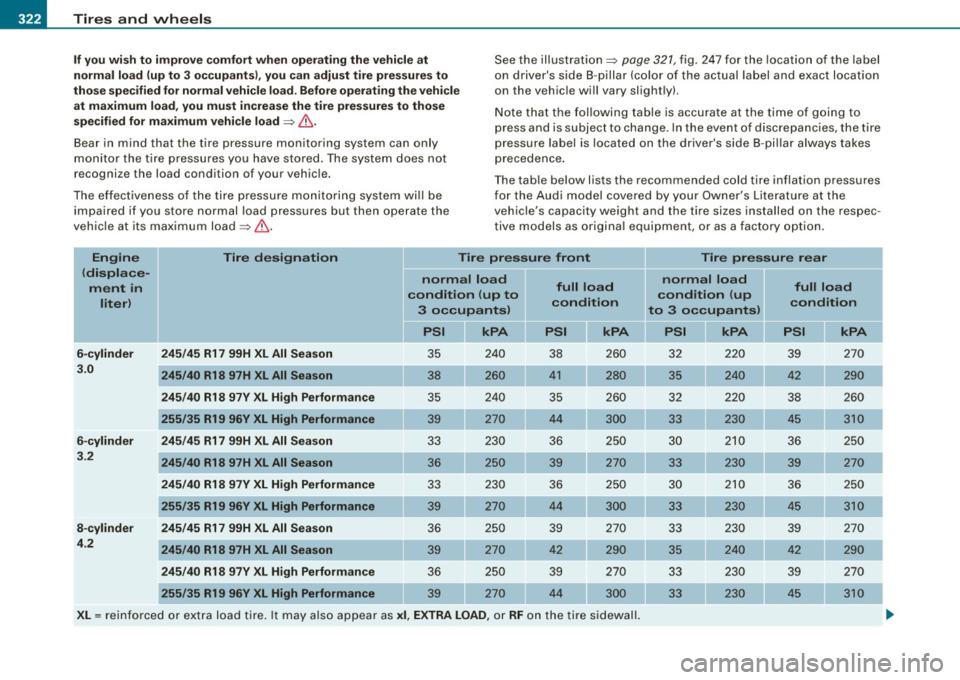
N ote that the fol lowing tab le is accurate at the time of going to
press and is subject to cha nge . In the eve nt of d iscrepa nc ies, t he tire
pressure label is located on the driver's side 8 -pi llar always takes
p recedence .
T he tab le below lists the recommended cold tire inflation pressures
fo r th e A udi m odel co ve red by you r Owner 's Litera ture at the
vehic le's capacity weight and the tire sizes installed on the respec
t ive mode ls as o rigi nal equipment, o r as a fac to ry o ption.
Engine Tire designation Tire pressure front Tire pressure rear
(displace- normal load normal load
ment in condition (up to full load
condition (up full load
liter ) condition
condition
3 occupants) to 3 occupants)
PSI kPA
PSI kPA
PSI kPA PSI
kPA
6-cylinder
245/45 R17 99H XL All Season 35 240 38 260 32 220 39 270
3 .0
245/40 R18 97H XL All Season 38 41 280 35 240 290
245 /40 R18 97V XL High Performance
35 240
35 260 32 220 38 2 60
255 /35 R19 96V XL High Performance 39 270 44 300 33 230 45 3 10
6 -cylinder 245 /45 R17 99H XL All Season 33 230 36 250 3 0 210 36 250
3 .2
245/40 R18 97H XL All Season
36 250 39 270 33 230 39 270
245 /40 R18 97V XL High Performance 33 230 36 250 3 0 21 0 36 250
255 /35 R19 96V XL High Performance 39 270 44 300 33 230 45 310
8 -cylinder 245 /45 R17 99H XL All Season
36 250 39 270
33 230 39 270
4 .2
245/40 R18 97H XL All Season 39 270 42 290 35 2 40 42 2 90
245 /40 R18 97V XL High Performance 36 250 39 270 33 230 39 270
255 /35 R19 96V XL High Performan ce
39 270
44 300 33 230 45 310
XL= reinforce d or ex tra load tire . It may als o ap pear as xi, EXTRA LOAD, or RF o n the tire s ide wall.