brake fluid AUDI S6 2009 User Guide
[x] Cancel search | Manufacturer: AUDI, Model Year: 2009, Model line: S6, Model: AUDI S6 2009Pages: 398, PDF Size: 43 MB
Page 284 of 398
___ C_ le_ a _ n_i_n ~g _ a_ n_ d __ p_r _o _t _e _c_ t_ i_o _n ___________________________________________ _
Cleaning and protection
General information
Regular care preserves vehicle value.
Any automobile is exposed to industrial fumes, corrosive road salt,
muddy dog feet, etc . A well cared for Audi can look like new many
years a fter purchase. Regu lar a nd correct ca re will co ntribu te to
maintaining the beauty and value of your Audi.
Furthermore, good care may be a condition for substantiating a
war ranty claim should co rros ion damage or paint defect s occur .
Your authorized Audi dealer has a variety of dedicated vehicle- care
product s
and can adv ise whic h ones to use for clea ning the e xter ior
and interior of your vehicle.
Whethe r you use p roducts recommended by Audi or other c ommer
cia lly availab le cleaning agents , please make sure you apply them
correctly.
& WARNING
• Cleaning agents may be poisonous. Keep them out of the reach
of ch ildren .
• Heed all caution label s.
• Always read directions on the contai ner before using any
product. Follow the di rection s carefully .
• Most chemical cleaners are concentrated and have to be
d iluted.
• Use spot removing fluids only in well ventilated area s.
• Do not use gasoline , kerosene , die sel fuel , nail polish remover
or other volatile fluids . They may be toxic , flammable or hazardous
in other way s. Do not wash , wa x or dry the vehicle w ith the igni
tion on or the engine running.
& WARNING (continued )
• Do not clean the under side s of chassis , fenders , wheel cove rs,
etc . without protecting your hands and arms. You may cut yourself
on sharp -edg ed metal parts .
• Moisture and ice on brakes may impair braking effi ciency
=> page 265 , "General info rmation ". Test the brake s carefully each
time you wa sh the vehicle.
~ For the sake of the environment
Se lect only enviro nmenta lly friend ly c leaning products . Leftover
clean ing products should not disposed of in the household waste. •
Care of exterior
Washing
Frequen t washing pro tects the vehi cle.
Th e bes t protection against envi ronmental influences is frequent
washing and waxing . How often this is required depends on:
• Ho w much the vehic le is used
• Where the vehic le is parked (garage, in the open under trees,
etc.)
• T he seasonal and weather conditions
• Environmenta l influences
T he longer bird droppings, insects, tree resin, road and industrial
gri me, tar, soot, road salt and ot her materials rema in on the ve hicle
body, the more lasting their destruc tive effects will be . High temper
atu res caused by exp osu re to in tense s un ligh t inte nsify the c orro -
sive effect, particularly when humidity is high as well.
~
Page 303 of 398
_____________________________________________ C_ h_ e .=....= c..:..k :..:.in :....:..:= g:.....= a..:..n .:....:d::......:. f.:..:il .:..:li ..:..n ::.:g:!....-_IJIII
•
Closing the engine hood
- Pull the hood down until the pressure from the struts is
reduced .
- Let the hood
drop down and latch in place. Do not try to
push it shut;
it may fail to engage => &.
& WARNING
A hood that is not completely latched could fly up and block your
view while driving.
• When you close the engine hood, check it to make sure the
safety catch has properly engaged. The hood should be flush with
the surrounding vehicle body parts.
• If you notice while driving that the hood is not secured prop
erly, stop at once and close it. •
Working in the engine compartment
Be especially careful whenever you work in the engine
compartment.
Whenever you must perform any work in the engine compartment,
for example checking and filling different fluids, there is a risk of injury, burns and accidents. To prevent personal injury always
observe the following WARNINGS. The engine compartment of any
vehicle is a hazardous area
~ & .
& WARNING
To help avoid injury, before you check anything under the hood :
• Turn off the engine.
• Remove the ignition key.
• Apply the parking brake .
& WARNING (continued)
• Move selector lever to "P" (Park).
• Always let the engine cool down. Hot components will burn
skin on contact.
• To reduce the risk of being burned, never open the hood if you
see or hear steam or coolant escaping from the engine compart
ment. Wait until no steam or coolant can be seen or heard before
carefully opening the hood.
• Keep children away from the engine compartment .
• Never spill fluids on hot engine components. They can cause a
fire.
• Never touch the radiator fan. The auxiliary electric fan is
temperature controlled and can switch on suddenly.
• Never open the coolant reservoir cap when the engine is still
warm . The coolant system is pressurized and hot coolant could
spray out.
• Protect your face, hands and arm from steam or hot engine
coolant by placing a thick rag over the cap when you open the
coolant reservoir.
• If work on the fuel system or the electrical system is necessary :
- Always disconnect the battery.
- Never smoke or work near heaters or open flames . Fluids in
the engine compartment could start a fire.
- Keep an approved fire extinguisher immediately available.
• To avoid electrical shock and personal injury while the engine
is running or being started, never touch:
- Ignition cables
- Other components of the high voltage electronic ignition system.
• If you must perform a check or repair with the engine running: -First, fully apply the parking brake, move selector lever to "P"
(Park). .,
Vehicle care
I t •
Page 312 of 398
--~C~h.!. e~ c~k ~in ~ g~ a~n ~d~ f~il ~li~ n~gL ___________________________________________ _
& WARNING (continued )
• Antifreeze is poi sonous. Alway s store antifreeze in its original
container and well out of the rea ch of children.
• If you drain the coolant , it must be caught and safely stored in
a proper container clea rly marked "poi son ".
0 Note
• Coo lant po llutes the env ironment and could cause an engine
fire . Excess coolant will be forced out through the pressure relief
valve in the cap when the engine becomes hot.
• If, in an emergency, on ly wa ter ca n be added, the correc t rati o
between water and antifreeze=>
page 307 must be restored as soon
as possible .
~ For the sake of the environment
Drained coolant should not be reused. Always dispose of used
co olant whi le observ ing all e nvir o nmen tal regula tions .•
Radiator fan
The radi ator fan s wit ches on automa tically by i tsel f.
The radiator fan is driven by t he engine v ia the V -belt. The v iscous
clutch regulates the speed of the fan according to the temperature
of the coo lant .
An aux iliary e lectric radiator fan* switches on and off depending on
c oo lant temperature and other vehicle opera tin g co ndi tions.
After you switch the engine off, the aux iliary fan can continue
running for up to 10 minutes -even with the ignition off. It can even
switc h on again later by itself=>&, if
• the temperature of the engine coolant rises due to the heat
bui ld-up fr om the eng ine in the engine c ompartmen t, or •
the engine compartment heats up because the vehicle is parked
in in tense s un ligh t.
& WARNING
• To reduce the ri sk of personal injury never touch the radiator
fan .
• The auxiliary e lectric fan is temperature controlled and can
switch on suddenly even when the engine is not running .
• The au xiliary radiator fan switches on automatic ally when the
engine coolant reaches a ce rtain temperature and will continue to
run until the coolant temperature d rops .•
Brake fluid
Checking brake fluid level
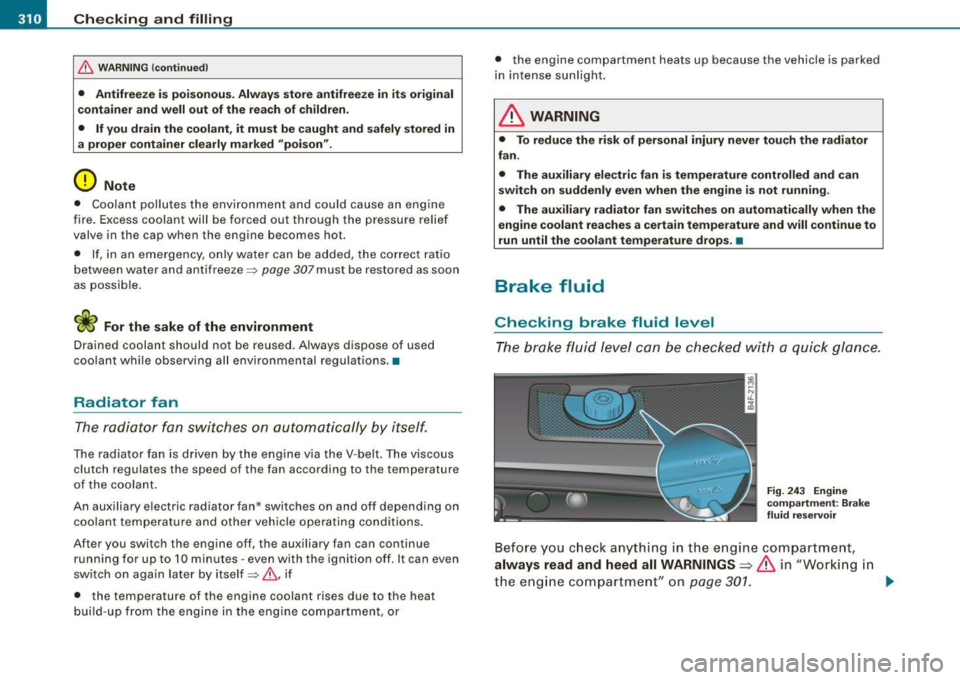
T he brak e fluid level can be checked wit h a quick glance.
F ig . 243 Engine
c o mp artment : B ra ke
fluid re servoir
Befo re you c heck anything in the e ngi ne compartme nt,
always read and heed all WARNINGS=> & in "Working in
t h e e ngin e com part ment" on
page 30 1. ~
Page 313 of 398
Checkin g and fillin g Ill
--------------~-
•
-Read the brake fluid level from the brake fluid reservoir
~ fig. 243. The brake fluid level must be between the
"MIN" and "MAX" markings.
The brake fluid reservoir is located at the rear partition of the engine
compartment on the left side=> page 302.
The fluid level may drop slightly after some time due to the auto
matic adjustment of the brake pads . This is not cause for alarm.
If the brake fluid level falls considerably below the "MIN" mark, the
brake warning/indicator l ight (U.S. models:
BRAKE , Canadian models:
CCD> l will come on=> page 22 and=> page 30. Do not continue to
operate the vehicle . The complete brake syste m shou ld be thor
oughly checked by an authorized Audi dealer or other qualified
facility and the cause corrected. If the brake fluid level is too low, the
brake warning/indicator light will illuminate . Contact an authorized
Audi dea ler
immedi ately. •
Changing brake fluid
Have the brake fluid changed by an experienced techni
cian.
Brake fluid absorbs moisture from the air. If the water content in the
brake fluid is too high, corrosion in the brake system may result
after a period of time . The boiling po int of the brake fluid will also
decrease considerably and decrease braking performance.
T herefore, the brake fluid must be changed
ever y two yea rs. Always
use new brake fluid which conforms to Federa l Motor Veh ic le Stan
dard "FMVSS 116 DO T 4".
The brake fluid reservoir can be difficult to reach, therefore, we recommend that you have the brake fluid changed by your autho
rized
Audi deal er. Your dealer has the co rrect tools, the right brake
fluid and the know-how to do this for you.
& WARNING
• Bra ke fluid i s poi sonou s. It m ust be stor ed only in the closed
or iginal container out of the reach of children!
• Brake f ailur e can result fr om old or in approp riat e bra ke fluid .
Ob serve the se pre cauti ons:
- Use o nly br ake fluid that me ets SAE specifi cation
J 1703 and
c onfo rm s t o Fed eral Mo to r V ehicle Standard 116 . Alway s check
w ith your auth oriz ed A udi de aler t o m ake sure you are usin g
the correct b rake flu id . The corre ct ty p e of brake flu id i s al so
indi cate d on the br ake fl uid r eservo ir .
- The brake f luid mu st be new . Heav y use of the brake s can
ca us e a va por lo ck if the brake fluid is left in the sy stem too
long. Thi s ca n seriou sly affect th e effic iency of the brake s as
well as your safe ty. T his co uld r esult i n an a ccide nt.
0 No te
Brake fluid wil l damage the paint of your vehicle .
'£> For the sake of the environm ent
Because of the problem of proper disposal of brake fluid as well as
the special too ls required and the necessary expertise, we recom
mend that you have the brake fluid changed by your authorized Audi
dea ler. •
Battery
General information
Under norm al operating conditions, the battery in your Audi does
not need any maintenance . With high outside temperatures or long
daily drives we recommend that you have the electrolyte level ._
Vehicle care I t •
Page 330 of 398
-~_T_ ir_e_ s_ a_ n_d _ w_ h_ e_e _l_s _________________________________________________ _
Tire pr essure
Inco rrect tire pressure causes prematu re wear and can cau se
sudden tire blow-out. For this reason, tire pressure must be checked
at least once a month
~ page 323 .
Driving style
Dr iv ing fa st around curves, heavy acceleration and hard brak ing
increase tire wear.
Rotating tire s for more even wear
For all four t ires on your vehic le to have the same service life, we
recommend that the front and rea r tires are rotat ed acc ord ing to the
tire manufacturer 's suggested tire rotation intervals. Please
remembe r the f ollo wi ng :
• Tire rotat ion i nterva ls m ay d iffer from the vehic le serv ice inte r
vals outl ined in your Maintenance and Warranty Book let.
• The longer one tire is used in one location on the vehicle, t he
more it wears at certain points; the refo re, we recommend that you
f ollow the tire manu facturer's sug ges ted t ire rotat ion i nte rvals.
• Vehicles with fro nt-w hee l dr ive e xper ience more tread wear on
the front wheels compared to all -wheel drive (quattro®l .
• Please rotate tires as sh ow n~
page 32 7, fig. 250 .
• Extra care must be taken when rotating direction -specific tires
~ pag e 349 .
Wheel balancing
T he w hee ls o n new v ehic les are balanced. However, various s itua
tions during everyday driving can cause them to become unba l
anc ed, resu lti ng in vib rati ons yo u ca n us ually feel thro ugh t he
steer ing whee l.
U nba la nce d w heels must b e re ba lance d to avoid e xcessive wea r on
steering, suspension and tires. A whee l must a lso be reba lanced
when a new tire is installed.
Incorrect wheel alignment
Incorrect w hee l al ig nm ent ca n cau se e xcess ive ti re wea r, impa iring
t h e s afety of th e veh ic le. If t ires s how excessive w ear, have the
w hee l a lig nme nt checke d by a n autho rize d Aud i deale r or qualifie d
wo rkshop.
All Wheel Drive
Vehic les with quattro® must always have tires of the same size,
co nstruct ion an d tread ty pe. For deta ils see ~
page 268.
& WARNING
Sudden tire failure can lead to loss of control , a crash and serious
personal injury !
• Never drive a vehicle when the tread on any tire is worn down
to the wear indicators.
• Worn tires are a safety hazard , they do not grip well on wet
roads and increase your risk of "hydroplaning " and loss of control.
• Always keep chemicals that can cause tire damage , such as
grease, oil, gasoline and brake fluid away from tires .
• Tires age even if they are not being used and can fail suddenly ,
especially at high speeds. Tires that are more than 6 years old can
only be used in an emergency and then with special care and at
lower speeds .
• Never mount used tires on your vehicle if you are not sure of
their "previous history. " Old used tires may have been damaged
even though the damage cannot be seen that can lead to sudden
tire failure and loss of vehicle control . •
Page 382 of 398
-Alphabetical index
---=--------------------------------
A
A . ccessones . . . . . . . . . . . . . . . . . . . . . . . . 374
Adapter for cupholder . . . . . . . . . . . . . . . . 95
Adaptive Air Suspension .. .... ... .... 184
Automatic mode . . . . . . . . . . . . . . . . . 185
Description . . . . . . . . . . . . . . . . . . . . . 184
Dynamic mode . . . . . . . . . . . . . . . . . . 185
Jacking mode when changing a flat tire .
186
Lift mode . . . . . . . . . . . . . . . . . . . . . . . 185
Setting the driving modes .. .... ... 185
Standard mode . . . . . . . . . . . . . . . . . . 185
Trailer towing mode ... .... .... ... 186
Warning/indicator lights ........... 20
Adaptive Cruise Control . . . . . . . . . . . . . . 127
Changing speed .. ........... .... 131
D. . f . river in ormat1on . . . . . . . . . . . . . . . 135
Driver interven tion prompt ........ 138
Driving in traffic ...... .... ...... . 128
Driving program ...... .... .... ... 139
Error messages . . . . . . . . . . . . . . . . . . 137
Open road . . . . . . . . . . . . . . . . . . . . . . 128
Override 128
Request for driver to assume control 128
Save speed . . . . . . . . . . . . . . . . . . . . . . 130
Setting distance . . . . . . . . . . . . . . . . . 133
Setting time interval .. .. ....... ... 133
Settings . . . . . . . . . . . . . . . . . . . . . . . . 139
Specia l driving situations .. .. .. ... 140
Status messages . . . . . . . . . . . . . . . . . 137
Switching on and off .. .... .... ... 130
System limits ...... .... .......... 140
Temporarily turning off ... ..... ... 132
warning/indicator lights .... ..... .. 135
Adaptive Light . . . . . . . . . . . . . . . . . . . . . . . 66
defective ......................... 36
Adding
Engine coolant ................ ...
309
Engine oil ... .. ...... ....... ..... 306
Windshield washer fluid .. ...... ... 316
Additional accessories .... .... .... ... 374
Additives
Engine oil
Adjusting
. .. .. ..... .. .... .... ... 306
Instrument cluster i llumination ...... 16
Steering column electrically .. ... .. 115
Steering column manually ......... 114
How many airbags does my vehicle have?
222
How the Advanced Airbag System compo -
nents work together . . . . . . . . . . . . .
223
Important things to know ... .... ... 215
Indicator light .... .... ........... 226
Monitoring .... .... .... ...... .... 226
PASSENGER AIR BAG OFF light ..... 227
Repairs ..... .. .... .... .......... 229
Safety instructions .. ...... .... ... 228
Side airbags . .... .... ............ 231
Side curtain airbags .. ....... .. ... 234
Weight -sensing mat .... ... .... ... 239
When must the system be inspected? . ..
226
All Wheel Drive ... .... .... .. . .... .. . 268
Ad' . f Justing ront seats .. .... .... .... ... 80 All h 1 oy w ee s ....................... 287
Air conditioning
See Climate controls ... ...... ... . .
102
Airbag
Warning/indicator lights ..... ......
18
Airbag system . ... .... ........ .. 215, 232
Advanced Airbag System .......... 219
Advanced Airbag System components ..
222
Care ...... .... .... .... .... .... .. 229
Child restraints .................. 240
Children .. .... ..... .. .... .... ... 239
Components (front airbags) .. ... ... 222
Danger of fitting a child safety seat on the
front passenger seat . .... .... ...
217
Disposal . . . . . . . . . . . . . . . . . . . . . . . . 229
Front airbags ....... .... ... .. 219,220
How do the front aiirbags work? .... 224
All- whee l drive
Winter tires
A lternator
333
Malfunction ......... ... .. .... .... 30
Anti -freeze
See Engine coolant system ...... ..
307
Anti-glare inside day-night mirror .... .. 75
Anti -lock brake system
How the ABS system works . .... ...
266
Warning/indicator lights ...... ... ... 21
Anti -Slip Regulation System (ASR)
How the system works . . . . . . . . . . . .
264
Anti-theft systems
Anti -theft alarm system .. ...... ....
54
Electronic immobilizer ............. 44
Tilt sensors ....................... 55
Page 383 of 398
Alphab eti ca l ind ex 111111
-------------------------------------=--------
Ashtray
Fron t . ..... ... .. .... .... ..... .. .. 96
Rear . ...... .. ..... ... ... .... ... .. 97
ASR How th e Anti -Slip Regulation Syst em
works ... .. ... .... .... ... .... .. 264
Ast erisk
What does it mean when something is marked with an asterisk? ... .. ...... 6
Audi Parking System Acoustic parking system tips .. .... . 181
Adjusting the chimes -option 1 ..... 180
Adjusting the chimes -option 2 . ... . 181
General Information . ..... .. .... .. 169
Notes on distance information ..... 179
Parking next to obstacles .... . ... .. 178
rear ..... .. .... .... .... .... .... . 169
rear , with rear -vi ew camera ... .... . 171
Rear -vi ew camera -parking mode 1 175
Rear-view camera -parking mode 2 . 177
Rear-view camera (Rear View) ...... 173
Rear-view camera coverage area .... 175
Rear-view camera tips .......... ... 182
Specia l parking situations . ... .... . 178
Audi Parking Syst em (rear)
Adjusting the chimes .... .... .... . 170
Audi Service Repair Manuals and Literature 372
AUTO mode AC climate controls ... .... ... .... . 105
Auto Safety Hotline ... .. .... .... .... . 203
Auto -Ch eck Control . ...... .. .... .... .. 28
Automatic belt retractor .... .... .... .. 209
Controls and equip ment Safety first Automatic car wash
See Washing ..
... .... ...... ...... 283
Automatic Shift Lock (ASU ...... .. 157, 164
Automatic transmission 6-speed automatic transmission .... 155
Automatic Shift Lock (ASU .. .. . 157, 164
Driving ....... .. ... .. ... .... .... . 155
Dynamic shift program ...... ...... 158
Emergency release for selector lever 161
Emergency release for selector lever (multitronic®) .. .... .... .... .... 168
Fail-safe mode ... .... .... .... 160,167
Ignition key safety lock .. .... ..... . 117
Kick -down .... ....... .... ... . .... 158
Manual shift program ... .... .... .. 159
multitronic® .... .... ...... .. ... .. 161
Selector lever .. .. .. . ... ... .. . 156, 163
Sh ift buttons . ... ..... ... .... 160 , 167
Steering wh eel with t iptronic® . 160, 167
Average speed .. ....... .... .... .... .. 38
Avoid damaging the vehicle ... ..... ... 273
B
Battery . .... .... ..... .. ... ... .. ... . 311
Battery location inside the luggage compartment .. . .. .. .... .... .... 312
Charging . ...... ........ ..... .... 314
Important warnings when working on the battery ..... ...... .. ...... .... . 312
Jump star ting ... ... ... ..... .. .... 357
Low ... .. .... .. . .. .. .... .. .... .. 269
Replacing the battery ...... .. ... .. 315
State of charge . .... .. ...... .. .... 269 Voltage
.... ... .. .. .. .... .... .. . .. 35
Winter opera tion . .... .... .... .... 311
Working on the battery .... ... ... .. 312
Before driving ... .... .... .. . ... .... . 195
Blended gasoline . ...... ...... .... ... 295
Body cavity sealing ... .. ... ..... ... .. 288
Booster seats ... .. .. .... .... ...... .. 246
How do I properly install a booster seat in my veh icle? . .... .... ... ... ... .. 246
Safety instructions .... .... .... ... . 246
Brake assistant .. .. ... ... .... ...... . 267
Brake booster .. .. ... ... .... . ... ..... 266
Brake fluid Changing the brake fluid ... .... .... 311
Checking the brake fluid level .. ... . 310
Reservoir .. .... .... ... .... .... ... 310
What is the correct brake fluid level? 310
What should I do if the brake fluid warning
light comes on? . .... .... .... ... . 310
Brake light Defective ... .. .... .... .... ... .. .. . 25
Brake system .... ... ..... ... .... .... 310
Anti-lock brake system . .. . .. .. ... .. 21
Brake fluid . ... .. .. .... .. . ... ... .. 310
Brake f luid specifications for refill and
replacement . .... .... ...... .... . 311
Brake pads ..... .. .... ...... ..... 272
Electromechanical parking brake .... 121
General information .. .... .... ... . 265
How does moisture or road salt affect the brak es? . ........ ........ ...... . 265
Malfunction . .... .... .... .... ..... 30
Vehicle operation Vehicle care Do-it-yourself service Technical data
Page 387 of 398
______________________________________________ A_ l.:.. p _h_ a_ b_e _t_i c_ a _ l _in _ d_e _ x __ _
Environment
Break -in period ... ... . .. .. ..... ... 271
Catalytic converter .... ...... ...... 272
Dispos ing of your vehic le battery ... 315
Driving at high speeds .... .... ... . 273
Dr iving to minimi ze pollution and noise .
273
Fuel ............................ 297
Fuel economy .... .... .... ....... . 273
Leaks under your vehicle ... .. ... .. 301
Letting the vehicle stand and warm up .
274
Proper disposal of drained brake fluid 311
Proper disposal of drained engine coolant ........................ 309
Proper disposa l of drained engine oil 306
Recycling used engine oi l .. .. .. .... 306
Un leaded fuel .................... 295
What should I do with an old battery?
315
EPC
See E lectronic power control ........ 18
ESP
See E lectronic stabi lizat ion p rogram
(ESP) ... ..... ...... .... ..... .... 18
Event Data Recorder (EDR) . ...... .... . 262
Expansion tank ... ... .... ..... .. .... 308
Exterior lighting in the mirror housing ... 66
E yeglasses compartment .... .... .... . 100
Controls and equip
ment Safety first
F
Fan
Radiator .... .... .... .... ...... .. 310
Fastening eyelets .................... 90
Flat tire
Changing .... .... .... .... .... ... 344
Floor mats ......................... 200
Fog lights ...... .... .... ...... ... .. .. 65
Fo lding master key with remote contro l . 41
Foot pedals ........................ 200
For the sake of the e nvi ro nmen t
Gaso line fu mes and the environment 297
Letting your eng ine warm up ...... . 1 17
Reducing engine noise by ear ly
upshif ting ....................... 12
Re fuel ing ..... ... .... .... .... .... 297
Savi ng fuel by early upshifti ng .. .... 12
Using the rear window de fogger ... . 108
Front airbags Description .... ..... .. .... .... ... 219
How they work .... .... .... ....... 224
Front arm rest adjusting . .... ..... .. .... .... .... . 88
Storage compartment .............. 88
Front ashtray .... .... .... .... .... ... . 96
Front fog lights . .... .... .... .... ..... 65
F ront seats .. ............ .... ....... . 80
Adjusting ....................... 197
Child restraints in the front seat .... 217
F ronta l coll isions and the laws of physics
206 Fuel
Additives .. .... .... ... .... .... ... 295
Blended gasoline ...... .... .... ... 295
Consumption ........... .... ...... 38
Fi ller neck .... .... .... ... .... .... 296
Fuel gauge . ...... .... ... .... .... . 14
Gas oline ...... .... ... .... .... ... 295
Gaso li n e additives ..... ... .... .... 296
Low fuel level ..... .... ... .... .. 14, 3 4
Octane rating .. ...... .... .... .... 295
Recommendation .. .... ... .... .... 295
Refuelling .... .... .... ... .... .... 297
Reserve ... .... ... .... ... ... ...... 14
Tank capacity ..... ... .... ...... .. 369
Un locking the fue l filler flap by hand 299
Fuse ar rangement . ....... ... .... .... 35 1
G
Ga rage door opener (Homelink®) ..... . 188
Gas discharge lamps ... ... .... ... ... . 355
Gauges Engine coolant temperature .... ..... 12
Fuel gauge ... ... ....... . .... ..... 14
Speedometer . .... .... ... .... ..... 14
Tachometer ....................... 13
Tr ip odometer .. ....... .... .... .... 14
General illustration Instruments and controls . .... .... .. 11
G lossary of tire a nd loading termi nology . . .
318
G love compartment ... .. .... .... ..... 99
cd change r ... .... .... .... .... .... 99
Valet key function .... .... .... ... .. 44
Vehicle operation Vehicle care Do-it-yourself service Technical data
Page 394 of 398
___ A_ l..:,. p _ h_ a_ b_e _t_ic _ a_l _in _ d_e_ x ____________________________________________ _
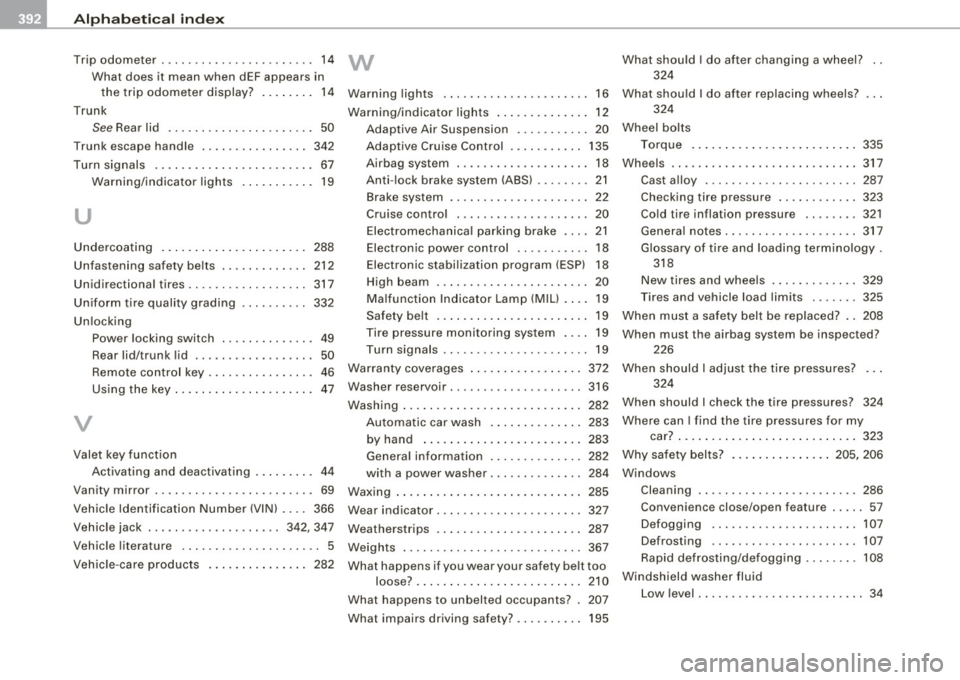
Trip odometer .... ...... .. ... ..... ... 14
What does it mean when dEF appears in the trip odometer display? ........ 14
Trunk
See Rear lid ...................... 50
Trunk escape handle ...... ...... .... 342
Turn signals ............. .... .... ... 67
Warning/indicator lights ........... 19
u
Undercoating . . . . . . . . . . . . . . . . . . . . . . 288
Unfastening safety belts .. .... ..... .. 212
Unidirectional tires .................. 317
Uniform tire quality grading .......... 332
Unlocking
Power locking switch . . . . . . . . . . . . . . 49
Rear lid/trunk lid .. ........ .... .... 50
Remote control key . . . . . . . . . . . . . . . . 46
Using the key ... .. .... .... ...... .. 47
V
Valet key function
Activating and deactivating .. ..... .. 44
Vanity mirror ........................ 69
Vehic le Identification Number (VIN) .... 366
Vehicle jack .. ........ ... .... ... 342, 347
Vehicle literature ..................... 5
Vehic le-care products . . . . . . . . . . . . . . . 282
w What should I do after changing a wheel?
324
Warning lights 16 What should I do after replacing whee ls?
Warning/indicator lights ... ..... .. .... 12 324
Adaptive Air Suspension . . . . . . . . . . . 20 Wheel bo lts
Adaptive Cruise Control . . . . . . . . . . . 135 Torque ..... ...... .... .......... 335
Airbag system . . . . . . . . . . . . . . . . . . . . 18 Wheels ............................ 317
Anti-lock brake system (ABS) .. ... ... 21 Cast alloy ... ... .. ... ... .. .... ... 287
Brake system .. ... .... ...... ...... 22 Checking tire pressure .. ........ .. 323
Cruise contro l ... ..... ........ .... 20 Co ld tire inflation pressure ........ 321
Electromechanica l parking brake .... 21 General notes .................. .. 317
Electronic power control .. ..... ... . 18 G lossary of tire and loading terminology .
Electronic stabilization program (ESP) 18 318
High beam . . . . . . . . . . . . . . . . . . . . . . . 20 New tires and wheels ............. 329
Malfunction Indicator Lamp (MIU . ... 19 Tires and vehicle load limits ....... 325
Safety belt . . . . . . . . . . . . . . . . . . . . . . . 19 When must a safety belt be replaced? . . 208
Tire pressure monitoring system .... 19
Turn signals ...................... 19
Warranty coverages ...... .... .... ... 372
Washer reservoir .................... 316 When must the airbag system be inspected?
226
When should I adjust the tire pressures?
324
Washing ........ ....... ...... .... .. 282 When should I check the tire pressures? 324
Automatic car wash .............. 283 Where can I find the tire pressures for my
by hand ...... ..... ............. 283 car? ... .. .... .................. 323
General information .............. 282 Why safety belts? .. ...... .... ... 205, 206
with a power washer ... ........ ... 284 Windows
Wax ing ........... ................. 285 Cleaning ........................ 286
Wear indicator .... ....... ...... .... .
Weatherstrips ... ....... ...... .... . .
Weights ..... ........ .... ......... . 327
287
367 Convenience close/open feature
..... 57
Defogging ...... ..... .... .... ... 107
Defrosting . . . . . . . . . . . . . . . . . . . . . . 107
Rapid defrosting/defogg ing ........ 108
What happens if you wear your safety belt too
loose? .. ... .. .... .... .... .... .. 21
o Windshield washer fluid
What happens to unbelted occupants? . 207 Low
level .............. .... ... .... 34
What impairs driving safety? ..... ..... 195