coolant AUDI S6 2009 User Guide
[x] Cancel search | Manufacturer: AUDI, Model Year: 2009, Model line: S6, Model: AUDI S6 2009Pages: 398, PDF Size: 43 MB
Page 303 of 398
_____________________________________________ C_ h_ e .=....= c..:..k :..:.in :....:..:= g:.....= a..:..n .:....:d::......:. f.:..:il .:..:li ..:..n ::.:g:!....-_IJIII
•
Closing the engine hood
- Pull the hood down until the pressure from the struts is
reduced .
- Let the hood
drop down and latch in place. Do not try to
push it shut;
it may fail to engage => &.
& WARNING
A hood that is not completely latched could fly up and block your
view while driving.
• When you close the engine hood, check it to make sure the
safety catch has properly engaged. The hood should be flush with
the surrounding vehicle body parts.
• If you notice while driving that the hood is not secured prop
erly, stop at once and close it. •
Working in the engine compartment
Be especially careful whenever you work in the engine
compartment.
Whenever you must perform any work in the engine compartment,
for example checking and filling different fluids, there is a risk of injury, burns and accidents. To prevent personal injury always
observe the following WARNINGS. The engine compartment of any
vehicle is a hazardous area
~ & .
& WARNING
To help avoid injury, before you check anything under the hood :
• Turn off the engine.
• Remove the ignition key.
• Apply the parking brake .
& WARNING (continued)
• Move selector lever to "P" (Park).
• Always let the engine cool down. Hot components will burn
skin on contact.
• To reduce the risk of being burned, never open the hood if you
see or hear steam or coolant escaping from the engine compart
ment. Wait until no steam or coolant can be seen or heard before
carefully opening the hood.
• Keep children away from the engine compartment .
• Never spill fluids on hot engine components. They can cause a
fire.
• Never touch the radiator fan. The auxiliary electric fan is
temperature controlled and can switch on suddenly.
• Never open the coolant reservoir cap when the engine is still
warm . The coolant system is pressurized and hot coolant could
spray out.
• Protect your face, hands and arm from steam or hot engine
coolant by placing a thick rag over the cap when you open the
coolant reservoir.
• If work on the fuel system or the electrical system is necessary :
- Always disconnect the battery.
- Never smoke or work near heaters or open flames . Fluids in
the engine compartment could start a fire.
- Keep an approved fire extinguisher immediately available.
• To avoid electrical shock and personal injury while the engine
is running or being started, never touch:
- Ignition cables
- Other components of the high voltage electronic ignition system.
• If you must perform a check or repair with the engine running: -First, fully apply the parking brake, move selector lever to "P"
(Park). .,
Vehicle care
I t •
Page 309 of 398
___________________________________________ C_ h_e _c_ k_ i_n _g _ a_n _d_ f_il _li _n _g __ lll
•
T he engine oil must be changed according to the intervals specified
in your Warranty
& Maintenance book le t. This is very important
because the lubricating properties of oi l diminish gradually during
normal vehicle use .
Under some circumstances the engine oil should be changed more
frequently. Change oil more often if you drive most ly short
distances, opera te the vehic le in dusty areas or under predomi
nant ly stop-and-go traffic conditions, or have your vehicle where
t emperatures remain below free zing for extended periods.
Detergent additives in the oil wil l make fresh oi l look dark after the
engine has been running for a sh ort time . This is normal and is not
a reason to chan ge the oi l more often than recommended.
Because of the problem of proper disposal, along with the specia l
t ools and necessary expertise requ ired, we strongly recommend
that you have your oi l changed by an authorized
Audi de aler or a
qualified se rvice statio n.
If you choo se to change your oil yourself , please note the following
important information:
& WARNING
To reduce the risk of per sonal injury if you mu st ch ange the engine
o il in you r veh icle your self :
• Wear eye protection.
• To reduce the ri sk of burns from hot engine oil , let the eng ine
c ool down to the touch.
• Wh en remo ving the oil dra in plug with your fingers , stay a s far
aw ay as po ssible. Alway s keep your forearm parallel to the ground
to help prevent hot oil from ru nning do wn your arm .
• Drain t he o il into a container designed for thi s purpo se , one
large enough to hold at lea st the total amount of oil in your eng ine.
• Engine oil i s poi sonous . K eep it well out of the rea ch of children .
& WAR N IN G ( continued )
• Continuous contact with used engine oil i s harmful to your
sk in. Al way s prote ct your skin b y was hing oil off thorough ly w ith
soap and water .
0 Note
Never mix oil additives with your engine oil. These additives can
damage your engine and adversely affect your Aud i Limited New
Vehicle Warranty.
can properly dispose of the used oil.
• Always dispose of used engine oil properly. Do not dump it on
garden soil, wooded areas, into ope n strea ms or down sewage
drains .
• Recycle used engine oil by taking it to a used engine oil collec
tion facility in your area, or contact a service station. •
Engine cooling system
Coolant
The engine coolan t per for ms two functions: i t kee ps the
engine from ove rhe ating and it prot ects the e ngine from
freezing in the winter.
The cooling system is sea led and general ly requires litt le attention.
The coo ling system has been fi lled at the fac tory with a per manent
coolant which does not need to be changed. The coo lant consists of
a m ixture of water and the manufacturer's glycol -b asedco olant
additive G 12++ antifreeze with anti corrosion additives (50% for USA .-,
Vehicle care I t •
Page 310 of 398
lffl __ C _h_ e_ c_k _in --== g'-- a_n _d_ f_il _li _n ..:::g:::..- ___________________________________________ _
models; 60% for Canadian models). This mixture both assures the
necessary frost protection and protects metal components in the
engine's cooling system from corrosion and scaling. It also raises
the boiling point of the coolant.
Do not reduce the concentration of the coolant in the summer by
adding plain water.
Th e pro port io n of coo la nt additi ve mu st be at
lea st 50 % but n ot mor e th an 60 %
to maintai n ant ifreeze protection
and cooling efficiency. If the coolant frost protection is too low , the
coolant could free ze and damage the veh icle heating and engine
cooling system .
For year-round driving , antifreeze is added at the factory for temper
atures down to:
• -31 °F ( -35 °c1 usA
• - 40 °F ( - 40 °C) Canada.
You can mix the
Gl 2+ + coolant additive with other additives (G12+
or G12). Always check w ith your authorized Audi dealer.
& WARNING
B efo re you che ck anyt hing in th e eng ine compartmen t, alway s
re ad a nd he ed all WARN ING S~
& in " Working in the engine
c ompar tm ent " on
page 30 1.
0 Not e
• Before winter sets in, have the coolant checked to see if the
coo lant additive in your vehicle is sufficient to meet the climate
conditions. This is especia lly important if you live in a region where
the winter is extremely cold . If necessary, increase the proportion of
coolant additive to 60%.
• When adding coolan t additive to your coo ling system,
remember:
-We recommend using only coolant additive
G12+ + (check the
label) for your vehicle. This coolant additive is avai lable at autho
riz ed Audi dealers. Other types of antifreeze can significantly reduce corrosion protection. The resulting corrosion can cause a
loss of coolant and serious engine damage.
• Do not add any type of radiator leak sealant to your vehicle's
engine coolan t. Adding radiator repair fluid may adversely affect the
function and performance of your cooling system and could result
in damage not covered by your New Vehicle Limited Warranty. •
Checking the engine coolant level
The engine coolant level can be checked with a quick
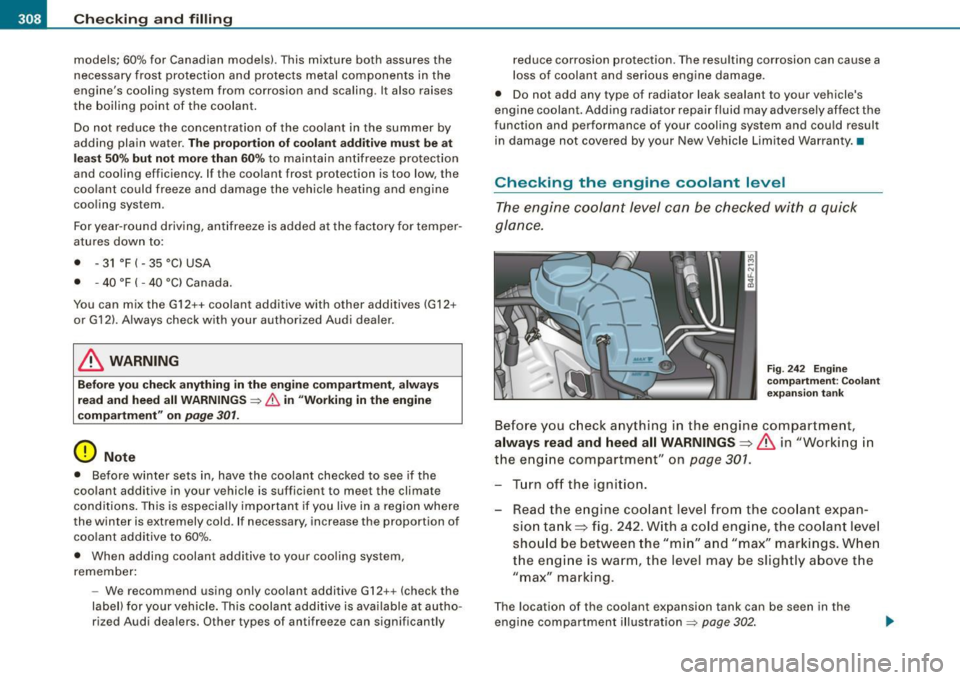
glance.
F ig . 2 42 E ngin e
com partm ent : Cool ant
ex pans io n tank
Before you check anything in the engine compartment,
alw ays read and h eed all WARNINGS ~ & in "Working in
the eng ine compartment" on page 301.
- Turn off the ignition.
- Read the e ngine coo lant level from the coo lant expan -
sion tank~ fig. 242. With a cold engi ne, the coolant level
sho uld be between the "min" and "max" markings. W hen
the engine is warm, the level may be slightly above the
"max" marking .
The location of the coolant expansion tank can be seen in the
engine compartment illustration~
page 302.
Page 311 of 398
_____________________________________________ C_h_ e_ c_k _in ~ g_ a_n _d_ f_il _li _n ~g __ lfflll
•
T o obtain an accurate reading, the engine must be switched off .
The expansion tank in your vehic le is equipped with an e lectric
coolant level sensor.
When the coolant level is too low, the warning light in the Auto
Check System ~
page 37 will blink until you add coo lant and the
level has been restored to normal. Even though there is an electric
coolant level sensor, we still recommend you check the coo lant level
from time to time .
Coolant loss
Coolant loss may indicate a leak in the cooling system. In the event
of coolant loss, the cooling system should be inspected immedi
ately by your authorized Audi dealer . It is not enough merely to add
coo la nt.
In a sealed system, losses can occur only if the boiling point of the
coolant is exceeded as a result of overheating .
0 Note
Do not add any type of radiator leak sealant to your vehicle's engine
coolant . Adding radiator repair fluid may adversely affect the func
tion and performance of your cooling system and could result in
damage not covered by your New Vehicle Limited Warranty. •
Adding coolant
Be very careful when adding engine coolant.
Before you check anything in the engine compartment,
always read and heed all WARNINGS~ & in "Working in
the engine compartment" on
page 301.
- Turn off the engine.
- Let the engine cool down. Place
a thick rag over the coolant expansion tank
~ page 308, fig. 242 and carefully twist the cap counter
clockwise ~& .
Add coolant.
- Twist the cap on again
tightly .
Replacement engine coolant must conform to exact specifications
~ page 307, "Coolant". Even in an emergency, if coolant additive
G12++ , G12 + or G12 is not availab le, do not use a different additive .
Use plain water instead until you can get the correct add itive and
can restore the correct ratio. This shou ld be done as soon as
possible.
If you have lost a considerab le amount of coolant, then you should
add cold antifreeze and cold water only when the engine is cold .
A lw ays use
new engine coolant when refilling.
Do not fill coolant above the "MAX" mark. Excess coolant will be
forced out through the pressure relief valve in the cap when the
eng ine becomes hot.
& WARNING
• The cooling system is under pressure and can get very hot.
Reduce the risk of scalding from hot coolant by following these
steps.
-Turn off the engine and allow it to cool down .
- Protect your face , hands and arms from escaping fluid and
steam by covering the cap with a large , thick rag.
- Turn the cap slowly and very carefully in a counter-clockwise
direction while applying light , downward pressure on the top
of the cap.
- To avoid being burned, do not spill antifreeze or coolant on
the exhaust system or hot engine parts. Under certain condi-
tions , the ethylene glycol in engine coolant can catch fire . ...
Vehicle care
I t •
Page 312 of 398
--~C~h.!. e~ c~k ~in ~ g~ a~n ~d~ f~il ~li~ n~gL ___________________________________________ _
& WARNING (continued )
• Antifreeze is poi sonous. Alway s store antifreeze in its original
container and well out of the rea ch of children.
• If you drain the coolant , it must be caught and safely stored in
a proper container clea rly marked "poi son ".
0 Note
• Coo lant po llutes the env ironment and could cause an engine
fire . Excess coolant will be forced out through the pressure relief
valve in the cap when the engine becomes hot.
• If, in an emergency, on ly wa ter ca n be added, the correc t rati o
between water and antifreeze=>
page 307 must be restored as soon
as possible .
~ For the sake of the environment
Drained coolant should not be reused. Always dispose of used
co olant whi le observ ing all e nvir o nmen tal regula tions .•
Radiator fan
The radi ator fan s wit ches on automa tically by i tsel f.
The radiator fan is driven by t he engine v ia the V -belt. The v iscous
clutch regulates the speed of the fan according to the temperature
of the coo lant .
An aux iliary e lectric radiator fan* switches on and off depending on
c oo lant temperature and other vehicle opera tin g co ndi tions.
After you switch the engine off, the aux iliary fan can continue
running for up to 10 minutes -even with the ignition off. It can even
switc h on again later by itself=>&, if
• the temperature of the engine coolant rises due to the heat
bui ld-up fr om the eng ine in the engine c ompartmen t, or •
the engine compartment heats up because the vehicle is parked
in in tense s un ligh t.
& WARNING
• To reduce the ri sk of personal injury never touch the radiator
fan .
• The auxiliary e lectric fan is temperature controlled and can
switch on suddenly even when the engine is not running .
• The au xiliary radiator fan switches on automatic ally when the
engine coolant reaches a ce rtain temperature and will continue to
run until the coolant temperature d rops .•
Brake fluid
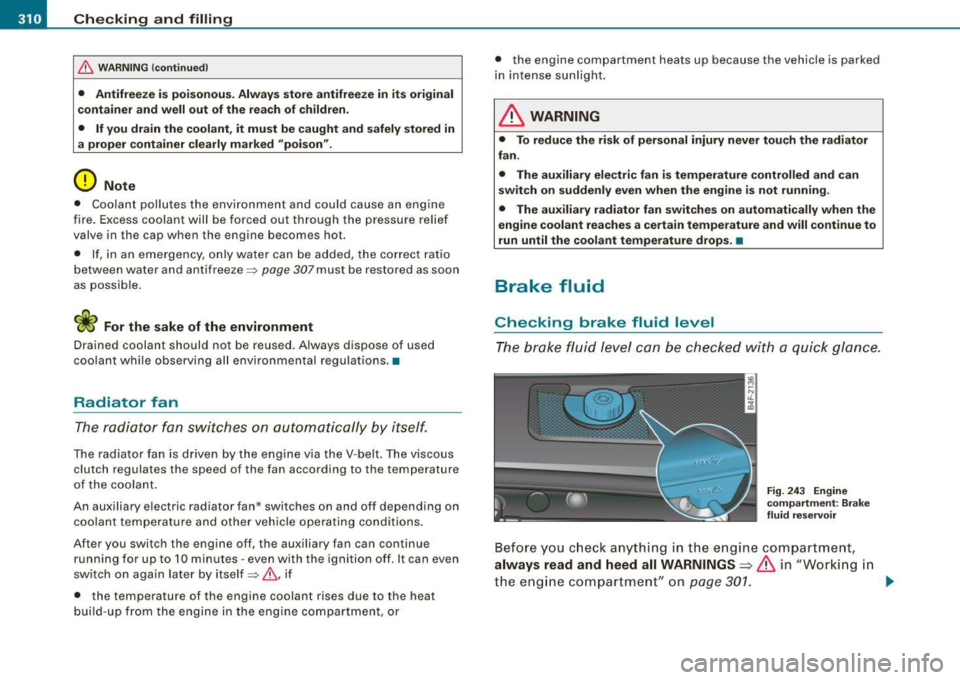
Checking brake fluid level
T he brak e fluid level can be checked wit h a quick glance.
F ig . 243 Engine
c o mp artment : B ra ke
fluid re servoir
Befo re you c heck anything in the e ngi ne compartme nt,
always read and heed all WARNINGS=> & in "Working in
t h e e ngin e com part ment" on
page 30 1. ~
Page 318 of 398
___ C_h_ e_ c_k _in --=:: g;__ a_n _d_ f_il _li _n ..:g:a.- ___________________________________________ _
0 Note
Make sure the ventilation hose on the side of the battery is
connected, otherwise fumes or battery acid can leak out.
mend your authorized Audi dea ler change the battery for you.
Batteries contain sulfuric acid and lead and must always be
disposed of properly in compliance with all environmental regula
tions . Disposing of vehicle batteries improperly is very dangerous to
t he environment. •
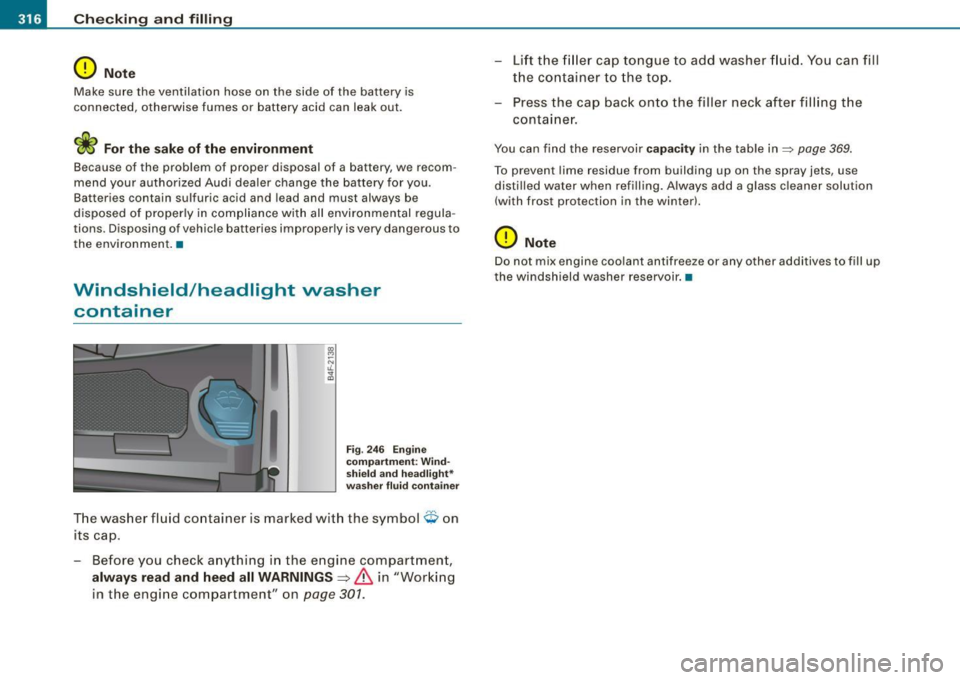
Windshield/headlight washer
container
Fig . 246 Engine
compartment: Wind
s hie ld and headlight*
washer fluid container
The washer fluid container is marked with the symbol O on
its cap.
- Before you check anything in the engine compartment,
always read and heed all WARNINGS :::> & in "Working
in the engine compartment" on page
301 .
-Lift the fille r cap tongue to add washer fluid. You can fill
the container to the top.
- Press the cap back onto the filler neck after filling the
container.
You can find the reservoir capacity in the table in=> page 369.
To prevent lime residue from building up on the spray jets, use
distilled water when refilling. Always add a gla ss cleaner solution
(with frost protection in the winter).
0 Note
Do not mix engine coolant antifreeze or any other additives to fill up
the windshield washer reservoir.•
Page 320 of 398
-~_T_ ir_e_ s_ a_ n_d _ w_ h_ e_e _l_s _________________________________________________ _
& WARNING (continued)
crashes and serious personal injuries . Have worn or damaged tires
replaced immediately.
• Tires age even if they are not being used and can fail suddenly,
especially at high speeds. Tires that are more than 6 years old can
only be used in an emergency and then with special care and at
low speed.
Glossary of tire and loading terminology
Accessory weight
means the combined weight (in excess of those standard items
which may be replaced) of automatic transmission, power steering,
power brakes, power windows, power seats, radio, and heater, to
the extent that these items are available as factory-installed equip
ment (whether installed or not).
Aspect ratio means the ratio of the height to the width of the tire in percent.
Numb ers of 55 or lower indicate a low sidewall for improved
steering response and better overall handling on dry pavement.
Bead
means the part of the tire that is made of steel wires, wrapped or reinforced by ply cords and that is shaped to fit the rim.
Bead separation means a breakdown of the bond between components in the bead.
Cord
means the strands forming the plies in the tire.
& WARNING (continued)
• Never mount used tires on your vehicle if you are not sure of
their "previous history." Old used tires may have been damaged
even though the damage cannot be seen that can lead to sudden
tire failure and loss of vehicle control.
• If you notice unusual vibration or if the vehicle pulls to one side
when driving, always stop as soon as it is safe to do so and check
the wheels and tires for damage . •
Cold tire inflation pressure
means the tire pressure recommended by the vehicle manufacturer
for a tire of a designated size that has not been driven for more than
a couple of miles (kilometers) at low speeds in the three hour period
before the tire pressure is measured or adjusted .
Curb weight means the weight of a motor vehicle with standard equipment
including the maximum capacity of fuel, oil, and coolant, air condi
tioning and additional weight of optional equipment.
Extra load tire
means a tire designed to operate at higher loads and at higher infla
tion pressures than the corresponding standard tire . Extra load tires
my be identified as "XL",
"xi", "EXTRA LOAD", or "RF" on the side
wall.
Gross Axle Weight Rating ("GAWR")
means the load-carrying capacity of a single axle system, measured
at the tire -ground interfaces .
Gross Vehicle Weight Rating ("GVWR"l
means the maximum total loaded weight of the vehicle.
Page 327 of 398
Tires and wheels -
----------------
•
& WARNING (continu ed )
• The driver is respon sible for the correct tire pres sures for all
tire s on the vehicle . The applicable pre ssure values are located on
a sticker on the driver 's side B-pillar .
• Only when all tires on the veh icle are filled to the correct pre s
sure , the tire pressure monitoring system can work correctly .
• The use of incorre ct t ire pressure values can lead to a ccidents
or other damage. Therefore it is essential that the driver observe
the specified tire pressure values for the tires and the correct pre s
sures for the function of the tire pressure monitor ing system.
• Always inflate tires to the recommended and corre ct tire pres
sure before driving off.
• Driving with underinflated tires bend more , letting them get
too hot resulting in tread separation, sudden tire failure and loss
of control.
• Excessive speed and /overloading can cause heat build-up ,
sudden tire failure and loss of control.
• If the tire pre ssure is too low or too high, the tires will wear
prematurely and the vehicle will not handle well .
• If the tire is not flat and you do not have to change a wheel
immed iately , drive at reduced speed to the nearest service stat ion
to check the tire pres sure and add air as required.
0 Note
Dr iving w ithout valve s tem caps can cause damage to the t ire
valves . To prevent this, a lways make sure that factory installed valve
stem caps on a ll whee ls are securely mounted o n the va lve.
For the sake of the environment
Unde rin fla ted tires will a lso increase the f uel c onsump tion .•
Tires and vehicle load limits
There are limits to the amount of load or weight that any vehic le and
any t ir e can carry. A veh icle that is overloaded w il l not handle wel l
and is more difficu lt to stop. Overloading can not only lead to loss
o f veh ic le control, but ca n also damage impor ta nt parts of the
vehic le and can lead to sudden tire failure, inc luding a blowout and
sudde n defla tion that can cause the vehic le to crash .
Your sa fety and that o f your passen gers also depends on mak ing
sure that load limits are not e xceeded. Vehicle load includes every
body and everythi ng in and on the veh ic le. T hese load lim its a re
technica lly referred to as the vehicle's
Gross Vehi cle We ight Rating
(" GVWR") .
T he "GVWR" includes the weight of the basic vehic le, all factory
insta lled acces so ries, a ful l ta nk of fuel, oil, coolant an d othe r flui ds
p lus maximum load. The maximum load inc ludes the number o f
p asse ngers that the vehicle is inte nded t o carry ("sea ting capacity")
w ith an assu med we ight o f 150 l bs (68 kg) fo r each passe nger at a
designated seating position and the total weight of any luggage in
t he vehicle. If you tow a trailer, the we ig ht o f the tra iler h itch an d th e
tongue weight of the loaded trailer must be included as part of the
ve hicle l oad.
The
Gross Axle Weight Rating !"GAWR") is t he maximum load that
can be applied a t each of the vehicle's two ax les.
The Gross Veh icle Weig ht Rating and t he G ross Axle Weig ht Rat ing
are listed on the safety comp liance sticker labe l located on the
d river 's s ide B -pi llar . Y o ur Au di h as 5 s eating positi ons, 2 i n the fro nt
and 3 in the rear for total seating capacity of 5 . Each seating position
has a safe ty bel t~
page 205, "Safe ty belts".
The fact that th ere is an upper limit to your vehicle's Gross Vehicle
Weight Rating means that the total weight of whatever is being
carried in the vehic le (includ ing the we ight of a trai ler hitch and the
tong ue weight of the loaded trai ler) is limited. The more passengers
i n the v ehicle or pass engers wh o are heavie r than t he sta nd ard
we ights assumed mean that less weight can be ca rried as luggage . .,_
Vehicle care I t •
Page 369 of 398
_________________________________________________ G_ e_ n_ e_r _a _l_ i_n _f_o _ r_ m_ a_ t _i _o _ n __ PII
vehicle identification number of your vehicle (perforation) as well as
the Gross Vehicle Weight Rating (GVWR) and the Gross Axle Weight
Rating (GAWRl.
The high voltage warning label is located on the lock carrier.
The spark ignition system complies with the Canadian standard ICES-002. •
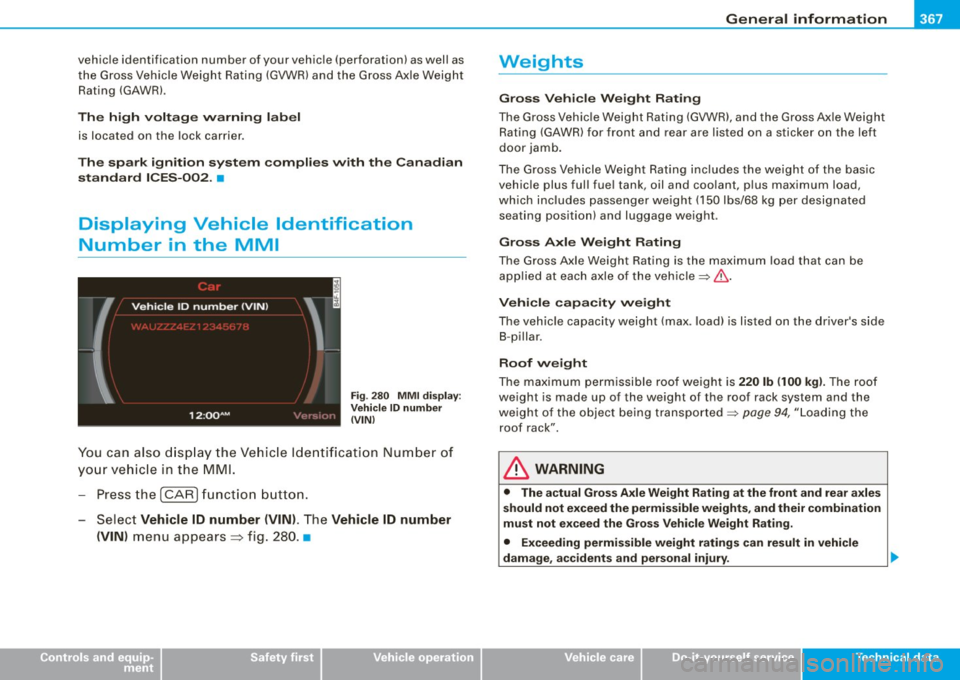
Displaying Vehicle Identification
Number in the MMI
Fig. 280 MMI display:
Vehicle ID number
(VIN)
You can also display the Vehicle Identification Number of
your vehicle in the MMI.
- Press the
(CARI function button.
- Select
Vehicle ID number (VIN). The Vehicle ID number
(VIN)
menu appears=> fig. 280. •
Controls and equip
ment Safety first Vehicle operation
Weights
Gross Vehicle Weight Rating
The Gross Vehicle Weight Rating (GVWR), and the Gross Axle Weight
Rating (GAWR) for front and rear are listed on a sticker on the left
door jamb.
The Gross Vehicle Weight Rating includes the weight of the basic
vehicle plus full fuel tank, oil and coolant, plus maximum load,
which includes passenger weight (150 lbs/68 kg per designated
seating position) and luggage weight .
Gross Axle Weight Rating
The Gross Axle Weight Rating is the maximum load that can be
applied at each axle of the vehicle~&.
Vehicle capacity weight
The vehicle capacity weight (max. load) is listed on the driver's side
8-pi Ila r.
Roof weight
The maximum permissible roof weight is 220 lb (100 kg). The roof
weight is made up of the weight of the roof rack system and the
weight of the object being transported
~ page 94, "Loading the
roof rack".
& WARNING
• The actual Gross Axle Weight Rating at the front and rear axles
should not exceed the permissible weights, and their combination
must not exceed the Gross Vehicle Weight Rating.
• Exceeding permissible weight ratings can result in vehicle
damage, accidents and personal injury.
Vehicle care Do-it-yourself service Tec hn ica l da ta
Page 376 of 398
___ C_ o_n_ s_ u_m _ e_ r_ ln_ f_o _r_m _ a_ t_ i_o _n ______________________________________________ _
& WARN ING (continued )
• The engine compartment of any motor vehicle is a potentially
hazardous area . Never rea ch into the area around or to uch the
radiator fan . It is temperature controlled and can sw itch on
suddenly -even when the engine is off and the ignition key has
been removed . The radiator fan switches on automatically when
the coolant reaches a certain temperature and will continue to run until the coolant tempe rature drops .
• Always remove the ignition key before anyone gets under the
vehi cle .
• Always support your vehicle with safety stands if it is neces
sary to work underneath the vehicle . The jack suppl ied with the
vehicle is not adequate for this purpose and could collap se
causing serious personal injury .
• If you must work underneath the vehicle with the wheels on
the ground, always make sure the veh icle is on level ground , that
the wheels are always securely blocked and that the engine
cannot be sta rted .
• Always make sure the tr ansmission selector lever (automatic
transmission) is in "P" (Park position ) and the p ark brake is firmly
applied.
W For the sake of the environment
• Cha ng ing the e ngin e sett ings will a dverse ly aff ect em iss ion
levels. This is detrimenta l to the environment and increases fuel
co nsump tion .
• Always observe environmenta l regu lations when disposing of
o ld eng ine oil, u sed bra ke flu id, d irty eng ine coo la nt, spent batter ies
or worn out tires.
• Undeployed airbag modul es and pretensioners might be classi
fied as Perchlorate Material -specia l handling may apply, see
www .d tsc.ca .gov/ hazardouswaste/pe rc h lora te . W hen t he vehicle or
parts of the restraint s ystem including airbag modules safety be lts
with pre tensio ners are sc ra p pe d, a ll ap pl ica ble laws and reg ula- tions must be observed. Your authorized Audi dea
ler is familiar with
t hese requi reme nts and we reco mmend th at you h ave your dealer
perform th is serv ice for you. •
Additional accessories,
modifications and parts replacement
Additional accessories and parts
replacement
A lways consult an author ized Audi dea ler before
pur chasin g access orie s.
Y our vehicle incorporates the latest safety design featu res ensuring
a hi gh standa rd of active a nd passive sa fety .
T his saf ety could be com promised by non -approved changes to th e
vehic le . Fo r thi s reason, i f parts have to be replaced, p lease obse rve
th e fo llow ing po ints wh en insta lling add it io na l acc essories:
Approved Audi accessories and genuine Audi parts are avai lable
from autho rized Audi dea lers .
T hese dealers also have the necessary faci lities, tools and trained
spec ia lists to ins tal l the part s and accessorie s prope rly.
& WARNING
Using the wrong spare parts or using non -approved accessories
can cause serious personal injury.
• Use only accessorie s expressly approved by Audi and genuine
Audi spare parts
• These parts and accessories have been specially designed to
be used on your vehicle .
• Never install accessories such as telephone cradles or
beverage holders on airbag covers or within the airbag deploy-