roof AUDI S6 2009 User Guide
[x] Cancel search | Manufacturer: AUDI, Model Year: 2009, Model line: S6, Model: AUDI S6 2009Pages: 398, PDF Size: 43 MB
Page 97 of 398
& WARNING ! continued )
• Never exceed the maximum permi ssible load carrying capa city
of the roof of you r vehicle , the p ermi ssible axle w eight s and th e
permis sible tot al w eight of your vehicle~
page 367 , "Weight s".
• Alwa ys drive slo wly, av oid sudden brak ing and maneuver s
when tran sporting cargo on the roof of your vehicle.
<£> For the sake of the environment
Sometimes it may be easier to leave a roof rack insta lled even
though you are not using it. Due to the increased a ir resistance your
veh icle wi ll unnecessarily use more fuel. Remove the roof rack if you
a re no t going to use it .•
Cupholder
Cupholder in center console
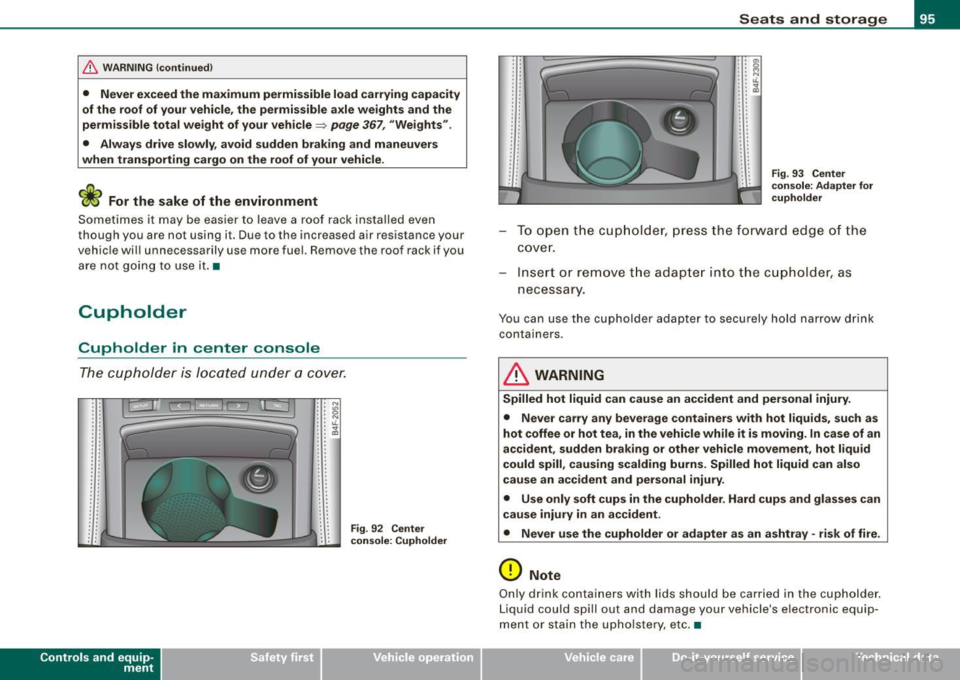
The cupholder is located under a cover.
Con tro ls and eq uip
ment
• • N . . "' •• 0 : : N •. u.
: : ~
.. . .
.. . .
Fi g. 92 Ce nte r
c on sole : Cuphold er
.. . .
.
. . .
Seats and storag e
• • O'I •• 0 : : ~ : : IL
: : ~ . . . .
.
' .. . .
. .
.
. . .
F ig . 9 3 C enter
co nsol e: Ad apt er for
c uph old er
To open t he cup hol de r, pr ess the f orwar d edg e of th e
cove r.
Inse rt or remove t he adap te r into the c upholder, as
necess ary.
You can use the cupholder adapter to securely hold narrow drink
containers.
& WARNING
Spilled hot liquid can cause an accident and per sonal injury .
• Never car ry any beverage con tainers with hot liquids , su ch a s
hot coffee or hot tea , in the vehicle while it is mov ing . In ca se of an
accident , su dden braking or other vehi cle m ovement , hot liquid
could spill , cau sing scald ing burns. Spilled hot liquid c an als o
c au se an ac cident and per sonal injury .
• Use only soft cup s in the cupholder . Hard cups and glasses can
c au se inju ry in a n ac cident .
• Never use th e cupholder or adapter as an a shtray -risk of fire.
0 Note
Only d rink containers with lids should be carried in the cupholder.
Liquid could spill out and damage your vehicle's electronic equip
ment or stain the upho lstery, etc. •
Vehicle care I I irechnical data
Page 101 of 398
![AUDI S6 2009 User Guide 0 Note
To avoid damaging the socket, only use plugs that fit properly.
[ i] Tips
When the engine is off and accessories are still plugged in and are
on, the vehicle battery](/img/6/57595/w960_57595-100.png "AUDI S6 2009 User Guide 0 Note
To avoid damaging the socket, only use plugs that fit properly.
[ i] Tips
When the engine is off and accessories are still plugged in and are
on, the vehicle battery")
0 Note
To avoid damaging the socket, only use plugs that fit properly.
[ i] Tips
When the engine is off and accessories are still plugged in and are
on, the vehicle battery can still be drained. •
Storage
General overview
There are numerous places to store items in your vehicle.
Glove compartment
Storage compartment in roof
Coat hooks
Storage compartment in the trunk
& WARNING
~ page 99
~ page 100
~ page 101
~ page 91
• Always remove objects from the instrument panel. Any items
not stored could slide around inside the vehicle while driving or
when accelerating or when applying the brakes or when driving
around a corner.
• When you are driving make sure that anything you may have
placed in the center console or other storage locations cannot fall
out into the footwells. In case of sudden braking you would not be
able to brake or accelerate.
• Any articles of clothing that you have hung up must not inter
fere with the driver's view. The coat hooks are designed only for
lightweight clothing. Never hang any clothing with hard, pointed
or heavy objects in the pockets on the coat hooks. During sudden
Con tro ls and eq uip
ment
Seats and storage
& WARNING !continued)
braking or in an accident -especially if the airbag is deployed -
these objects could injure any passengers inside the vehicle. •
Glove compartment
The media player is in the glove compartment.
To open glove compartment
Fig. 99 Unlocking
button for glove
compartment
Press the button ::V => fig. 99 (arrow) - the lid opens auto
matically.
To close glove compartment
Push the glove compartment lid up unt il the lock
engages.
In the glove compartmen t lid you will find a place to store a pen and
a pad of paper.
CD changer*
The CD changer for the radio system and the Navigation drive* is located in the glove compartment . How to change CDs is described
in the pertinent Owner's Manual.
tJ,,,
Vehicle care I I irechnical data
Page 102 of 398
• ..__S_ e_a _ t_ s_ a_ n_ d_ s_t _o _r_ a-' g==- e ________________________________________________ _
& WARNING
To reduce the risk of personal injury in an accident or sudden stop,
always keep the glove compartment closed while driving.
[ i J Tips
Should you not be able to open the glove compartment as
described, make sure the valet key function is not activated
=> page 44. •
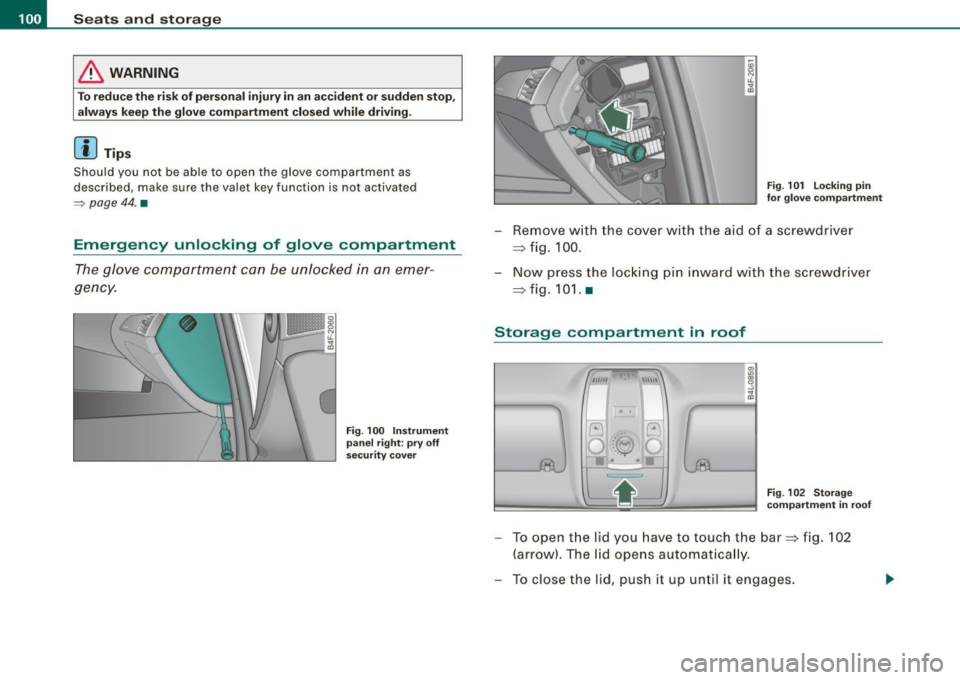
Emergency unlocking of glove compartment
The glove compartment can be unlocked in an emer
gency.
Fig. 100 Instrument
panel right : pry off
security cover
Fig. 101 Locking pin
for glove compartment
- Remove with the cover with the aid of a screwdriver
=> fig. 100.
- Now press the locking pin inward with the screwdriver
::::>fig.101. a
Storage compartment in roof
,IIIIJI \}\\\\,
. '
"'--~
Fig. 102 Storage
compartment in roof
- To open the lid you have to touch the bar=> fig. 102
(arrow). The lid opens automatically.
- To close the lid, push it up until it engages.
Page 105 of 398
_________________________________________________ w_ a_ r_ m __ a_n_ d_ c_ o_ld __ _
energy are temporarily cut bac k or switched off~ page 269 .
Hea tin g sys tems in particu lar requi re a g rea t dea l of energy. If yo u
not ice, for example, that the seat * or rear w indow heating is not
heati ng, they have bee n tempora rily cu t bac k or switche d off by
energy management . These systems are avai lable a gain as soon as
the energy balance has been resto re d.
& WARNING
Reduced visibility is dangerous and can cause accidents .
• For safe driving it is very important that all windows be free of
ice , snow and condensation.
• Completely familiarize yourself with the proper use and func
tion of the heating and ventilation system and especially how to defog and defrost the windows .
• Never use the windshield wiper /washer system in freezing
weather until you have warmed the windshield first , using the
heating and ventilation system. The washer solution may freeze
on the windshield and reduce visibility.
0 Note
• I f you suspect that the air conditioner has been damaged, turn
on ECO N and con tac t an autho riz e d Aud i deale r to hav e the system
inspected .
• R epairs to the A udi air co nd it io ner requ ir e sp ecia l te chni cal
know ledge and special tools . Contact an authorized Audi dealer for
assista nce .
[ i J Tips
• Kee p th e air in ta ke s lots (in fron t of the w inds hield) free from i ce,
snow and debris in order to maintain the proper function of the
cl im ate c ontro l sy ste m.
Controls and equip
ment
• T he air flowing out of the vents and throughout the vehic le's
en tire int er ior is discha rge d at the rear o f the vehicle . Make sure th at
the outlet s lots are not covered by clothin g, etc .
• Climate c ontro l wor ks mo st e ffec tively if th e windo ws and the
sunroof are closed . However, if the interior of a park ed vehicl e is
e xt re me ly hot fro m the su n's rays , briefly open ing the windows can
speed up the cooling process .•
I • •
Page 115 of 398
Warm and cold -
----------------
In this way you have the opportunity to have the air flow from the
center vents a little warmer or cooler, depending on the time of year.
A little cooler in the summer and a little warmer in the winter. •
Applies to vehicles: with solar roof
Solar blower fan /solar roof
With sufficient sunlight, the ventilation fan continues to
operate with solar energy to bring in fresh air after the
ignition has been switched off.
- Switch solar operation to on .
The fan motor is operated by solar energy through the solar roof
after the ignition is turned off . Please make certain that vents ©
and © are open to achieve optimal ventilation=>
page 108.
The ventilation operates only with the sunroof closed or in the tilted
position .
If the vehicle was switched off in the recirculation mode, the air
conditioning automatically switches to fresh air operation.
Solar operation is not activated at low temperatures. •
Controls and equip
ment I • •
Page 204 of 398
lffl)..,___D_ r_iv _i_ n""' g::;._ S_ a_f _e _ly =---------------------------------------------------
& WARNING
Improperly stored luggage or other items can fly through the
vehicle causing serious personal injury in the event of hard braking or an accident. To help reduce the risk of serious personal injury:
• Always put objects, for example, luggage or other heavy items
in the luggage compartment.
• Always secure objects in the luggage compartment using the
tie-down eyelets and suitable straps.
& WARNING
Heavy loads will influence the way your vehicle handles. To help
reduce the risk of a loss of control leading to serious personal
injury :
• Always keep in mind when transporting heavy objects, that a
change in the center of gravity can also cause changes in vehicle
handling:
-Always distribute the load as evenly as possible.
- Place heavy objects as far forward in the luggage compart-
ment as possible.
• Never exceed the Gross Axle Weight Rating or the Gross
Vehicle Weight Rating specified on the safety compliance sticker on the left door jamb. Exceeding permissible weight standards
can cause the vehicle to slide and handle differently.
• Please observe information on safe driving~
page 194.
& WARNING
To help prevent poisonous exhaust gas from being drawn into the
vehicle, always keep the rear lid closed while driving.
• Never transport objects larger than those fitting completely
into the luggage area because the rear lid cannot be fully closed.
& WARNING (continued)
• If you absolutely must drive with the rear lid open, observe the
following notes to reduce the risk of poisoning :
- Close all windows,
- Close the power roof*,
- Open all air outlets in the instrument panel,
- Switch off the air recirculation,
- Set the fresh air fan to the highest speed.
& WARNING
Always make sure that the doors, all windows, the power roof*
and the rear lid are securely closed and locked to reduce the risk
of injury when the vehicle is not being used.
• After closing the rear lid, always make sure that it is properly
closed and locked .
• Never leave your vehicle unattended especially with the rear lid
left open. A child could crawl into the vehicle through the luggage
compartment and close the rear lid becoming trapped and unable
to get out . Being trapped in a vehicle can lead to serious personal
injury.
• Never let children play in or around the vehicle.
• Never let passengers ride in the luggage compartment. Vehicle
occupants must always be properly restrained in one of the
vehicle's seating positions.
[ i] Tips
• Air circulation helps to reduce window fogging. Stale air escapes
to the outside through vents in the trim panel, on the left side of the
luggage compartment. Be sure to keep these slots free and open.
• The tire pressure must correspond to the load -see the tire pres
sure sticker on the fuel filler door.•
Page 220 of 398
___ A_ ir_ b_ a-g _ s_y _s_ t_ e_ m _________________________________________________ _
as defin ed i n th e el ectron ic contro l u n it=> page 227, "PASSE NGER
AI R BAG OFF lig ht".
A lwa ys rem em ber, a c hild safet y se at or infant carr ier installe d on
the front seat may be str uck and k nocked o ut of po sition by t he
rap id ly in fla ting passe nger's air bag in a fron tal colli sion . The airb ag
cou ld great ly re duce the effectivene ss of the ch ild restrain t and
e ve n seri ous ly injure the chi ld dur ing in flatio n.
For th is reason, and beca use the bac k seat is the safest plac e for
chi ldren -wh en prop erly rest rained acc ording to th eir age and size
- we strong ly recommend that ch ildren a lways sit in the bac k se at
=> p age 238, "Ch ild Safe ty ".
& WARNING
A child in a rearward -facing child safety seat installed on the front
passenger seat will be ser iously injured and can be killed if the
front airbag inflates - even with an Advanced Airbag System .
• The inflating airbag will hit the child safety seat or infant
carrier with great force and will smash the child safety seat and
child against the backrest , center arm rest , door or roof .
• Always install rear -facing child safety seats on the rear seat .
• If you must install a rearward facing child safety seat on the
front passenger seat because of exceptional circumstances and
the PASSENGER AIR BAG OFF light does not come on and stay on ,
immediately install the rear-facing child safety seat in a rear
seating position and have the airbag system inspected by your
Audi dealer .
• Forward-facing child safety seats installed on the front
passenger's seat may interfere with the deployment of the airbag
and cause serious personal injury to the child .
& WARNING
If, in exceptional circumstances, you must install a forward-facing
child restraint on the front passenger's seat:
& WARNING (continued)
• Always make sure the forward-facing seat has been designed
and certified by its manufacturer for use on a front seat with a
passenger front and side airbag .
• Never put the forward-facing child restraint up against or very
near the instrument panel.
• Always move the passenger seat into its rearmost position in
the seat's fore and aft adjustment range, as far away from the
airbag as possible before installing the forward-facing child
restraint. The backrest must be adjusted to an upright position .
• Make sure that the PASSENGER AIR BAG OFF light comes on
and stays on all the time whenever the ignition is switched on.
& WARNING
To reduce the risk of serious injury , make sure that the PASSENGER
AIR BAG OFF light will be displayed whenever a child restraint is
installed on the front passenger seat and the ignition is switched
on.
• If the PASSENGER AIR BAG OFF light does not stay on , perform
the checks described
=> page 226, "Monitoring the Advanced
Airbag System" .
• Take the child restraint off the front passenger seat and install
it properly at one of the rear seat positions if the PASSENGER AIR
BAG OFF light does not stay on.
• Have the airbag system inspected by your Audi dealer immedi
ately .
• Always carefully follow instructions from child restraint manu
facturers when installing child restraints .
& WARNING
If, in exceptional circumstances, you must install a forward or
rearward-facing child restraint on the front passenger's seat :
Page 223 of 398
Airbag syst em -----------------=~-
When a person is detected on the front passenger seat, weighing
more than the to tal weight of a child t hat is about 1 year old
restrained in one of the rear-facing or forward -facing infant
restraints (listed in Federa l Motor Vehicle Safety Standard
208 with
which the Advanced Airbag System in your vehicle was certified), the front airbag on the passenger side may or may not deploy .
The
PA SSENGER AIR BAG OFF light comes on when the e lectronic
control unit detects a total weight on the front passenger seat that
requires the front a irbag to be turned off . If the
PA SSENGER AIR BAG
O FF
light does not come on, the front airbag on the passenger side
has not been tu rned off by the contro l u nit and can dep loy if the
control unit senses an impact that meets the conditions stored in its
memory .
I f the total weight on the front passenger seat is more than that o f
a typical
1 year -old, but less than the we ight of a small adult, the
front airbag on the passenger side may dep loy (the
PA SS ENGER AIR
BAG OFF
l ight does not come on).
For example , the airbag may deploy if :
• a small ch ild that is heavier than a typ ical 1 year-o ld child is on
the front passenger seat (regardless of whether the child is in one
of the child sa fety seats listed ~
page 240),
• a child who has outgrown child res traints is on the front
passenger seat.
I f the front passenger airbag is turned off, the
PASSENGER AIR BAG
O FF
light in the cen ter of the instrument panel wi ll co me on and stay
on .
T he front airbag on the passenge r side may
not deploy (the
PAS SEN GER AIR BAG OFF light does not illuminate and stay lit) if:
• a small adult or teenager is on the front passenger seat
• a passenger who is not sitting upright with their back against a
non -reclined backrest with their feet on the vehicle floor in front of
the seat is on the front passenger seat.
I f the front passenger airbag dep loys, the Federal Standard requires
the airbag t o meet the "low risk" deployment criteria to help reduce
Controls and equip
ment Safety first Vehicle operation
the risk of injury through interaction with the airbag
. "Low risk"
dep loyment occurs in those crashes that ta ke place at l ower decel
erations as defined in the electronic contro l unit .~
page 226
Al way s remembe r:
Even though your vehicle is equipped with
Advanced Airbags, the safes t place for chi ldren is properly
restrained on the back seat. Please be sure to read the important
informat ion in t he sections tha t follow a nd be sure to heed a ll of the
WARNINGS.
& WARNING
To reduce the risk of injury when an airbag inflates , always wear
s afety belts prope rly.
• If you are unrestrained , leaning forward , sitt ing s ideways or out
of position in any w ay, your risk of injury i s mu ch higher .
• You will al so receive se riou s injurie s and could even be killed if
you are up against the airbag or too clo se t o it when it inflate s -
even with an Advanced Airbag=>
page 215 .
& WARNING
A child in a rearward -facing child safety seat in stalled on the front
pa ssenge r seat will be ser iou sly injured and can be killed if the
front airb ag inflate s -even with an Advanced Airbag System .
• Although the Advan ced Airbag S ystem in your vehicle is
de signed to turn off the front airbag when a rearward -fa cing child
restraint h as been in stalled on the front pa ssenger seat , nobod y
c an ab solutely guarantee that deployment i s impo ssible in all
c onceivable situations that may happen during the useful life of
your vehicle .
• The inflating airbag will hit the ch ild s afety seat or inf ant
c arrier with great force and will smash the chi ld safety seat and
c hild ag ain st the ba ckre st, center a rm re st, door , or roof .
• Alway s in stall rearward -facing child re straint s on the b ack
seat .
Vehicle care Do-it-yourself service Technical data
Page 227 of 398
Airbag system -----------------=---=---
or the lower parts of the body. Front airbags suppl em ent the three
poi nt s afet y be lts o nly in s ome fro ntal c oll isi ons i n whi ch the v ehicl e
deceleration is hi gh enough to d eploy the airbags .
Front airbags will not deploy:
• if the ignition is switched off when a crash occurs,
• i n sid e collisi ons,
• in r ear- e nd collisions ,
• in ro llovers,
• when the cras h de celer ation me asured b y th e a ir bag sy stem i s
l ess than the minimum threshold nee ded for airbag dep loyment as
r egi stere d by t he ele ctronic control un it.
The front passenger airbag also will not deploy :
• when the front pa ssen ger s eat i s not o cc up ied,
• wh en the weig ht on th e front pass enger seat as se nsed by t he
Advan ced A irb ag System indi cate s that the fr ont air b ag on the
p as se n ge r sid e h as to be turned off b y the e lectronic cont rol unit
(the PASSENGER AIR BAG OFF l ig ht co me s on and sta y s on ).
& WARNING
Sitting in the wrong position can increase the risk of serious injury
in crashes .
• To reduce the risk of injury when the airbags inflate , the driver
and passengers must always sit in an upright position , must not
lean against or place any part of their body too close to the area
where the airbags are located .
• Occupants who are unbelted , out of position or too close to the
airbag can be seriously injured by an airbag as it unfolds with
great force in the blink of an eye
~ page 217.
Controls and equip ment Safety first
Vehicle operation
& WARNING
A child in a rearward-facing child safety seat installed on the front
passenger seat will be seriously injured and can be killed if the
front airbag inflates - even with an Advanced Airbag System .
• The inflating airbag will hit the child safety seat or infant
carrier with great force and will smash the child safety seat and
child against the backrest , center arm rest , door or roof.
• Always install rear-facing child safety seats on the rear seat .
• If you must install a rearward facing child safety seat on the
front passenger seat because of exceptional circumstances and
the PASSENGER AIR BAG OFF light does not come on and stay on, immediately install the rear-facing child safety seat in a rear
seating position and have the airbag system inspected by your
Audi dealer .
& WARNING
Objects between you and the airbag will in crease the risk of injury
in a crash by interfering with the way the airbag unfolds or by
being pushed into you as the airbag inflates .
• Never hold things in your hands or on your lap when the vehicle
is in use.
• Never transport items on or in the area of the front passenger
seat. Objects could move into the area of the front airbags during
braking or other sudden maneuvers and become dangerous
projectiles that can cause serious personal injury if the airbags
inflate .
• Never place or attach accessories or other objects (such as
cupholders , telephone brackets, large, heavy or bulky objects) on
the doors, over or near the area marked "AIRBAG " on the steering
wheel , instrument panel , seat backrests or between those areas
and yourself . These objects could cause injury in a crash , espe-
cially when the airbags inflate . ...
Vehicle care Do-it-yourself service Technical data
Page 236 of 398
___ A_ ir_b _a_ g;:::;_ s--:.. y_s _t _e _m _________________________________________________ _
& WARNING (continued)
-Never carry any objects or pets in the deployment space
between them and the airbags or allow children or other
passengers to travel in this position .
• Always use the built-in coat hooks only for lightweight
clothing. Never leave any heavy or sharp-edged objects in the
pockets that may interfere with side airbag deployment and can
cause personal injury in an accident .
• Always prevent the side airbags from being damaged by heavy
objects knocking against or hitting the sides of the seatbacks.
• The airbag system can only be triggered once . If the airbag has
been triggered, the system must be replaced by an authorized
Audi dealership .
• Damage (cracks, deep scratches etc.) to the original seat covers
or to the seam in the area of the side airbag module must always
be repaired immediately by an authorized Audi dealer.
• If chi ldren are seated improperly, their risk of injury increases
in the case of an accident:::::,
page 238, "Child Safety".
• Never attempt to modify any components of the airbag system
in any way.
• In a side collision , side airbags will not function properly if
sensors cannot correctly measure increasing air pressure inside
the doors when air escapes through larger, unclosed openings in
the door panel.
-Never drive with interior door trim panels removed.
- Never drive when parts have been removed from the inside
door panel and the openings they leave have not been properly
closed.
- Never drive when loudspeakers in the doors have been
removed unless the speaker holes have been properly closed .
- Always make certain that openings are covered or filled if
additional speakers or other equipment is installed in the
inside door panels .
& WARNING (continued)
-Always have work on the doors done by an authorized Audi
dealer or qualified workshop . •
Side curtain airbags
Description of side curtain airbags
The side curtain airbag system can provide supplemental
protection to properly restrained occupants.
B
Fig. 216 Side curtain
airbags , driver 's side:
location
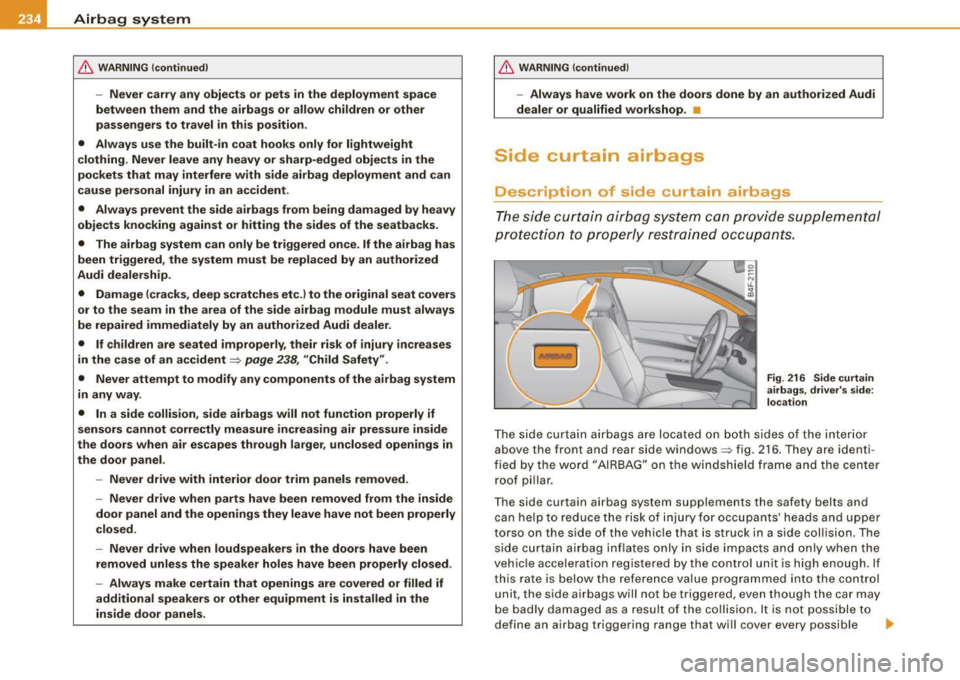
The side curtain airbags are located on both sides of the interior
above the front and rear side windows:::::, fig. 216. They are identi
fied by the word "AIRBAG" on the windshield frame and the center
roof pillar.
The side curtain airbag system supplements the safety belts and can help to reduce the risk of injury for occupants' heads and upper
torso on the side of the vehicle that is struck in a side collision. The
side curtain airbag inflates only in side impacts and only when the
vehicle acceleration registered by the control unit is high enough. If
this rate is below the reference value programmed into the control
unit, the side airbags will not be triggered, even though the car may
be badly damaged as a result of the collision. It is not possible to
define an airbag triggering range that will cover every possible ..,