ABS AUDI S6 2009 Owner's Manual
[x] Cancel search | Manufacturer: AUDI, Model Year: 2009, Model line: S6, Model: AUDI S6 2009Pages: 398, PDF Size: 43 MB
Page 278 of 398
ll}JI __ T_ r _a_ il_e _r_ t_ o_ vv_ in__... g,_ __________________________________________________ _
Trailer towing
Driving with a trailer
General information
Your Audi was designed primarily for passenger transpor
tation.
If you plan to tow a trailer, please remember that the additional load
wi ll affect durability, economy and performance.
Trai ler towing not on ly p laces more stress on the vehicle, it a lso ca lls
for more concentration from the driver.
For this reason, always fol low the operating and driving instructions
provided and use common sense.
0 Note
If you are going to tow a trai ler, you must activate the trailer opera
tion mode =>
page 186, "Towing a trailer".
Technical requirements
Tra iler hitch
Use a weight-carrying hitch conforming to the gross trailer weight .
The hitch must be suitable for your vehicle and trailer and must be
mounted secure ly on the ve hicle's chass is at a
technically sound
location. Use only a trailer hitch with a removable ball mount.
Always check with the trai ler hitch manufacturer to make sure that
you are using the correct hitch .
Do not use a bumper hit ch.
The hitch must be installed in such a way tha t it does not interfere
with the impact-absorbing bumper system. No modifications should be made to the vehic le exhaust and brake systems. From time to time, check that all hitch mounting bolts remain securely
fastened.
When you are no
t towing a trailer, remove the traile r hitch ball
mount. This prevents the hitch from causing damage shou ld your
vehic le be struck from behind=>& .
Traile r br akes
If your trailer is equipped with a braking system, check to be sure
that it conforms to al l regu lations .
The trai ler hydraulic brake system must no t be direct ly connected to
the vehicle's hydraulic brake system.
Safet y chains
Always use safety chains between your vehicle and the trailer.
Trailer light s
Trailer lights must meet a ll regulations. Be sure to check with your
Audi dealer for correc t wiring, sw itches and relays .
Mirrors
If you are unable to see the traf fic behind you using the regu lar
outside mirrors, then you
must install extended mirrors. It is impor
tant that you
always have c lear vision to the rear.
& WARNING
After rem oving the tr aile r hitch , do not store it in your vehi cle. In
ca se of sudde n braking , the hit ch co uld fl y for ward and injure you
or your p asseng ers. a
Page 281 of 398
-Wit h chocks i n place, slowly release the brakes until the
wheel chocks absorb the load .
- Turn the wheels towards the curb.
- Apply the parking brake.
- Move the selector lever to
P.
Wh en r est arting aft er parking :
-Apply the foot brake.
- Start the engine.
- Move the selector lever to
D .
- Release the parking brake and slowly pull out and away
f rom the whee l chocks.
- Stop and have someone retrieve the wheel chocks .
[ i ) Tip s
If you move the selector lever of the automatic transmission to P
befor e applying th e parking brake and before blocking th e wheels ,
you may have to use more force later to move the lever out of the
P
position .
Controls and equip ment Safety first Vehicle operation
Tr
aile r t owing
Vehicle care Do-it-yourself service Technical data
Page 291 of 398
_____________________________________________ C_ l_ e _a_ n_ in_ g_a _ n_d_ p_ r_ o_ t _e_ c_t _io _ n __ lR
•
Care of interior
MMI display
- Clean th e MMI display with a soft c lean cloth and an LCD
cl eane r.
The MM I disp lay can be cleaned with a professional ly available "LCD
cleaner". The cloth should be s lightly dampened with the c leaning
fluid to clean the display.
0 Note
T o avoid scra tching the MMI display, you should never c lean it dry .•
MMI terminal
- First clean the MMI terminal with a brush to remove dust
from the housing.
- T hen wipe the MMI terminal wit h a clea n, soft, s lig htly
damp cloth .
The MMI terminal shou ld be c leaned with a brush first so that no
dirt is trapped between the buttons and the housing. We recom
mend giving the MM I terminal a final wipe with a c loth moistened
with water and dish washing dete rgent.
0 Note
To prevent damage, make sure that no flu id ever gets into the M MI
terminal. •
Aluminum trim
Use only neutral-pH products to remove spots and deposits from
a lum inum surfaces . C hro me care products an d alka line cleaners
wi ll attack aluminum surfaces and can damage them over time.
& WARNING
Always read and heed all WARNINGS and other information
~ page 282 .•
Fabrics and fabric coverings
Fabrics and fabric coverings (e.g . seats, door trim panels, etc.l
shou ld be c leaned at regular intervals with a vacuum cleaner . This
re moves surface dirt partic les which could become embedded in
the fabric through use. Steam cleaners shou ld not be used, because
t he steam tends to push the d irt deeper into the fabric and lock it
there.
Normal cl eaning
Genera lly, we recommend using a soft sponge or a lint -free
microf iber c loth to the clean fabric . Brushes should on ly be used for
carpets and floor mats, since other fabric surfaces could be harmed
by brushes.
Norma l surface stains can be cleaned using a commercially avail
able foam cleaner. Spread the foam on the surface of the fabric with
a soft sponge and work it in gent ly. Do not saturate the fabric . Then
pat the foam dry using absorbent, d ry cloths (e.g. microfiber cloth)
and vacuum it a fter it has dried completely .
Cleaning stains
Stains caused by beverages (e.g. coffee, fruit juice, etc.) can be
treated with a mild detergent so lution . Apply the detergent so lution
with a sponge. In the case of stubborn stains, a detergent paste can be applied direct ly to the stain and worked into the fabric. After -.,.
Vehicle care I t •
Page 292 of 398
___ C_ le_ a _ n_i_n ~g _ a_ n_ d __ p_r _o _t _e _c_ t_ i_o _n ___________________________________________ _
wards, use copious amounts of clean water to remove the
rema ining detergen t. App ly the wa ter w ith a damp cloth or sponge
and pat the fabric dry with an absorbent, dry c loth.
Stains from choco late or makeup should have detergent paste (e.g .
ox -ga ll soap) rubbed into them. A fterwards, remove the soap w it h
water (damp sponge).
A lcoh ol can be us ed t o t rea t sta ins fro m grease, oil, lipstick o r a ba ll
point pen. Melted grease or dye must be patted off using absorbent
ma te ri al. It may be neces sary to retreat the a reas w ith de tergent
paste and water .
In the case of genera l soiling of the upho lstery and cover material,
we recommend h ir ing a specialis t that has the equ ip m ent to c lea n
the seat covers and other fabric surfaces by shampooing and spray
e xt rac tion.
& WARNING
Always read and heed all WARNINGS and the information
~ page 282 .
[ i] Tips
Open Ve lcro fasteners on your clothing can damage the seat cover.
Please make sure that Velcro fas tene rs a re c losed .•
Plastic parts and instrument panel
A lways use a clean cloth mo iste ned in cl ear wa ter to clean these
areas . For persistent dirt use an Audi approved
solvent-free plastic
cleaner/ protectant.
in. WARNING
Solvents can change the properties of some plastics and make it
harder for the airbag to deploy.
& WARNING (continued )
• Never clean the instrument panel or the surface of airbag
modules with cleaning products that contain solvents .
• Products containing solvents will make the surface of this part
porou s.
• Serious injuries can result if plastic parts come loose when the
airbag is deployed .
• Alway s read and heed all WARNINGS and other information
~ page 282.
0 Note
Cleaning agents containing so lvents wil l attack the material and can
c hange t he way it behave s.•
App lies to vehicles: with natu ra l l eathe r
Natural leather
Aud i mak es gr eat effo rts to main ta in the p roperties ,
n atu ra l look an d fee l of interior le athe r.
General
We offe r ma ny diff erent typ es of leather on our v ehicles . M ost ar e
different types of nappa leather, which has a smooth surface and
comes in va rious co lors .
T he intens ity o f the color de termi nes t he visua l character ist ics a nd
appearance. If the surface of the leather has a typica l natural look,
th en the leathe r is a nappa leather t hat has bee n l eft in a re lat ive ly
natural condition. This leather offers particu lar ly good comfort and
b reathes well. Fi ne vei ns, closed g ra ins, ins ect bit es, ski n folds, a nd
subt le variations in color remain visib le. These character istics
dem onstrate tha t the mate rial is natural.
Natura l nappa leather is not covered by a color finis h. It is therefo re
more sens itive to so iling and wea r, which is something you need to ...
Page 294 of 398
___ C_ le_ a _ n_i_n ~g _ a_ n_ d __ p_r _o _t _e _c_ t_ i_o _n ___________________________________________ _
Cleaning spots
- Remove fresh water-based spots (such as coffee, tea,
juices, blood) with an absorbent cloth or paper towel.
- Remove fresh
grease or oil-based spots (such as butter,
mayonnaise, chocolate) with an absorbent cloth or paper
towel, or use the cleaner from the leather care kit if the
spot has not yet penetrated into the surface of the
leather.
- Use an oil/grease dissolving spray, if
oil/grease spots
have dried on.
- Remove specific kinds of spots (ballpoint pen, felt
marker, fingernail polish, water-based paint, shoe polish,
etc.) with a spot remover specifically formulated for leather.
Leather care
- Every half year use an approved leather care product
(available from your Audi dealer) to care for the leather.
- Apply the product very sparingly.
- Wipe it off with a damp cloth.
If you have any questions about cleaning and caring for the leather
in your vehicle, it is best to contact your authorized Audi dealer, who
will be glad to help you and tell you about our full range of leather
care products, such as:
• Leather cleaning and care kit
• Creams to care for colored leather
• Spot removers for ballpoint pens, shoe polish, etc .
• Oil/grease dissolving spray
• New and upcoming products.
& WARNING
Always read and heed all WARNINGS and other information
=> page 282.
0 Note
• Never use chemical solvents (e.g. lighter fluid, turpentine),
waxes, shoe polish or similar products on the leather surfaces in
your Audi.
• To avoid damage, have stubborn stains removed by a commer
cial cleaning specialist. •
Applies to ve hicle s : with A lc a nt ara up ho lst ery
Cleaning Alcantara ® (synthetic suede)
Removing dust and dirt
- Moisten a cloth, squeeze out excess water and wipe down
the seat surfaces.
Removing stains
- Moisten a cloth with lukewarm water or with diluted
ethyl (rubbing) alcohol.
- Dab at the stain. Start at the outside and work inwards.
- Once the stain is no longer visible, use a soft dry cloth or
tissue to soak up the moisture.
Do not use leather cleaning products on Alcantara .
You may use a suitable shampoo for removing dust and dirt.
Dust and grit in the pores and seams can scratch and damage the
surface . If the car is left standing in the sun for long periods , the
Alcantara should be protected against direct sunlight to prevent it .,.
Page 313 of 398
Checkin g and fillin g Ill
--------------~-
•
-Read the brake fluid level from the brake fluid reservoir
~ fig. 243. The brake fluid level must be between the
"MIN" and "MAX" markings.
The brake fluid reservoir is located at the rear partition of the engine
compartment on the left side=> page 302.
The fluid level may drop slightly after some time due to the auto
matic adjustment of the brake pads . This is not cause for alarm.
If the brake fluid level falls considerably below the "MIN" mark, the
brake warning/indicator l ight (U.S. models:
BRAKE , Canadian models:
CCD> l will come on=> page 22 and=> page 30. Do not continue to
operate the vehicle . The complete brake syste m shou ld be thor
oughly checked by an authorized Audi dealer or other qualified
facility and the cause corrected. If the brake fluid level is too low, the
brake warning/indicator light will illuminate . Contact an authorized
Audi dea ler
immedi ately. •
Changing brake fluid
Have the brake fluid changed by an experienced techni
cian.
Brake fluid absorbs moisture from the air. If the water content in the
brake fluid is too high, corrosion in the brake system may result
after a period of time . The boiling po int of the brake fluid will also
decrease considerably and decrease braking performance.
T herefore, the brake fluid must be changed
ever y two yea rs. Always
use new brake fluid which conforms to Federa l Motor Veh ic le Stan
dard "FMVSS 116 DO T 4".
The brake fluid reservoir can be difficult to reach, therefore, we recommend that you have the brake fluid changed by your autho
rized
Audi deal er. Your dealer has the co rrect tools, the right brake
fluid and the know-how to do this for you.
& WARNING
• Bra ke fluid i s poi sonou s. It m ust be stor ed only in the closed
or iginal container out of the reach of children!
• Brake f ailur e can result fr om old or in approp riat e bra ke fluid .
Ob serve the se pre cauti ons:
- Use o nly br ake fluid that me ets SAE specifi cation
J 1703 and
c onfo rm s t o Fed eral Mo to r V ehicle Standard 116 . Alway s check
w ith your auth oriz ed A udi de aler t o m ake sure you are usin g
the correct b rake flu id . The corre ct ty p e of brake flu id i s al so
indi cate d on the br ake fl uid r eservo ir .
- The brake f luid mu st be new . Heav y use of the brake s can
ca us e a va por lo ck if the brake fluid is left in the sy stem too
long. Thi s ca n seriou sly affect th e effic iency of the brake s as
well as your safe ty. T his co uld r esult i n an a ccide nt.
0 No te
Brake fluid wil l damage the paint of your vehicle .
'£> For the sake of the environm ent
Because of the problem of proper disposal of brake fluid as well as
the special too ls required and the necessary expertise, we recom
mend that you have the brake fluid changed by your authorized Audi
dea ler. •
Battery
General information
Under norm al operating conditions, the battery in your Audi does
not need any maintenance . With high outside temperatures or long
daily drives we recommend that you have the electrolyte level ._
Vehicle care I t •
Page 314 of 398
-Checking
and filling
---=---------------
checked by a service facility . The electrolyte level should also be
checked each time the battery is charged
~ page 314.
Have the battery checked when you take your vehicle in for service.
You are well advised to replace a battery that is older than 5 years.
With certain types of airbag deployment, the battery is discon nected from the vehicle electrical system for safety reasons~
& in
"Repair, care and disposal of the airbags" on
page 229.
Disconnecting the battery terminals
Some vehicle functions (power window regulators, for example) are
lost if the battery terminals are disconnected . These functions have
to be relearned after the battery terminals are connected again . To
prevent this, the battery should only be disconnected from the
vehicle electrical system when absolutely necessary for repairs.
Vehicles not driven for long periods
If you do not drive your vehicle over a period of several days or
weeks, electrical components are gradually cut back or switched off.
This reduces energy consumption and maintains starting capability
over a longer period
~ page 269.
Take into consideration that when you unlock your vehicle, some
convenience functions , such as the master key remote function or
power seat adjustment, may not be available. The convenience
functions will be available again when you turn on the ignition and
start the engine.
Winter operation
During the winter months, battery capacity tends to decrease as
temperatures drop . This is because more power is also consumed
while starting, and the headlights, rear window defogger, etc., are
used more often.
Avoid unnecessary power consumption, particularly in city traffic or
when traveling only short distances. Let your authorized Audi dealer
check the capacity of the vehicle battery before winter sets in
~ page 314. A well charged battery will not only prevent starting
problems when the weather is cold , but will also last longer .
[ i] Tips
If your vehicle is left standing for several weeks at extremely low
temperatures, the vehicle battery should be removed and stored
where it will not freeze. This will prevent it from being damaged and
having to be replaced. •
Working on the battery
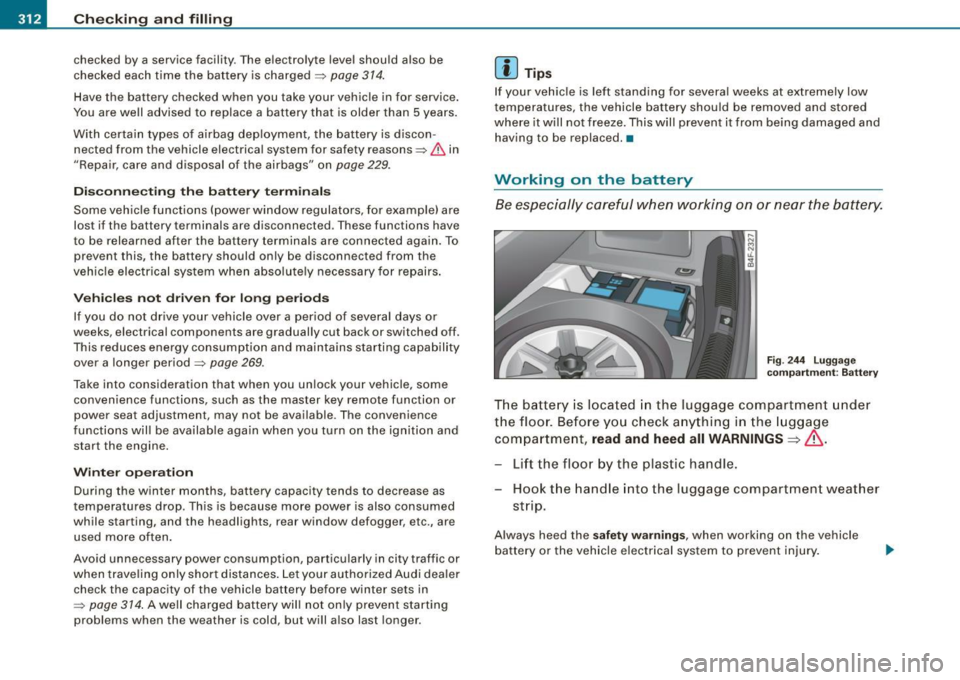
Be especially careful when working on or near the battery.
Fig. 244 Luggage
compartment : Battery
The battery is located in the luggage compartment under
the floor. Before you check anything in the luggage
compartment,
read and heed all WARNINGS=>& .
Lift the floor by the plastic handle.
Hook the handle into the luggage compartment weather
strip.
Always heed the safety warnings, when working on the vehicle
battery or the vehicle electrical system to prevent injury.
Page 339 of 398
Tires and wheels -
----------------------
Tire pressure indicator appears
The tire pressure indicator in the instrument cluster
informs you if the tire pressure is too low or if there is a
sys tem malfunc tion.
en
~ 0 ..:, ;g
0 g 0 ..:, ;g
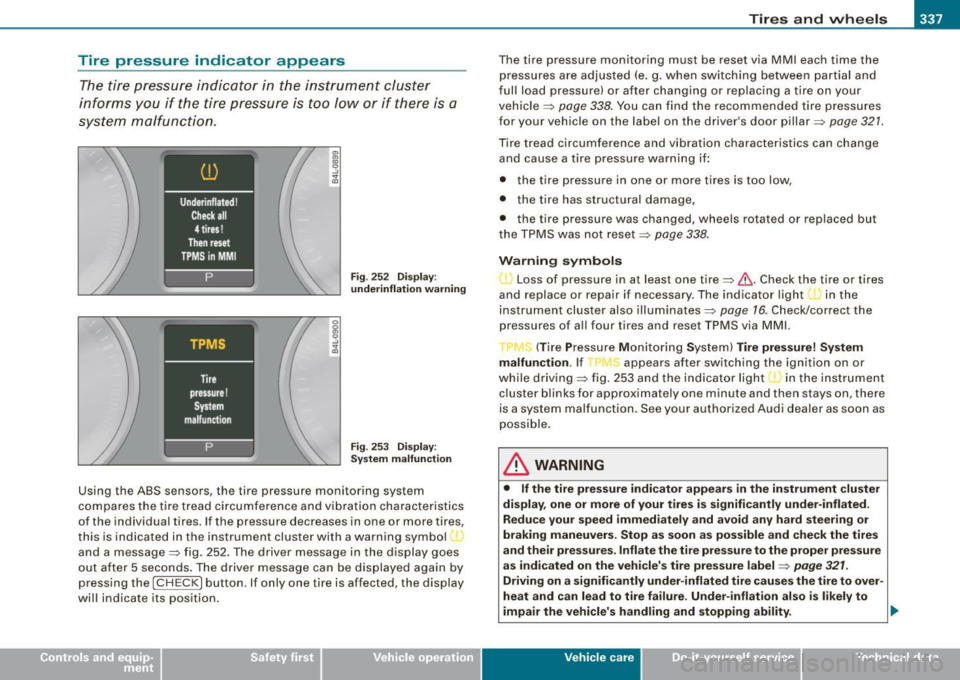
F ig . 25 2 Displa y:
underinflation warning
Fig . 253 Displ ay :
Sy stem malfunction
Using th e ABS sensors , th e t ire pr essur e monitoring system
c o m pares the tire tread ci rcu mference and vi bration character istics
of the individua l tires . If the pressure decreases in one or mor e tires,
th is is ind icated in the inst rumen t cl uster w ith a warning symbol,
and a message=> fig. 252. The driver message in the display goes
ou t af ter 5 sec onds. T he driver message can be dis pl ayed again by
pressing the [ CH ECK ] button. If only on e tire is affected, the display
will indicate its position . T
he tire pressure monitoring must be reset via MMI each time the
press ures are adjus ted (e .g . when swi tchi ng between par tial and
fu ll load pressu re) or after changing or replacing a tire on your
veh icle =>
page 338. You ca n find the recom mended tir e pres sures
for your vehicle on the label on the driver's door pillar=>
page 32 1.
Tire tread circumference and vibration characteristics can change
and cause a tire pressure war ning if:
• the tire pressu re in one or more t ires is too low,
• t he tire has st ructura l damage,
• the tire pressure was changed, wheels rotated or replaced but
t he TP MS was no t r eset =>
pag e 338 .
Warning symbols
• ~ Loss of pressur e in at le ast one tire=>&. Check the tire or tires
and replace or repair if necessary . T he indicator light in the
i nstrument cluster also illu mi nat es =>
page 16 . Che ck/cor rect th e
p ressures of al l four t ires and reset TPM S via MMI.
T (Ti re Pre ssure Mo nitorin g System)
Tire pressure! System
malfunction .
If appears after switch ing the ign it ion on or
w hi le drivi ng => fig . 253 an d the i ndica tor lig ht in th e in stru ment
c luster blinks for approximately one minute and the n stays on, there
i s a sy stem malfunction . See your authorized Au di d ealer as soon a s
possible .
& WARNING
• If the tire pressure indicator appears in the instrument cluster
display, one or more of your tires is significantly under -inflated.
Reduce your speed immediately and avoid any hard steer ing or
braking maneuvers. Stop as soon as possible and check the tires
and their pressures. Inflate the tire pressure to the proper pressure
as indicated on the vehicle's tire pressure label =>
page 321.
Driving on a significantly under-inflated tire causes the tire to over
heat and can lead to tire failure . Under- inflation also is l ikely to
impair the vehicle's handling and stopping ability .
~
Vehicle care I I irechnical data
Page 340 of 398
___ T_ i_ r_e _s_ a_ n_ d_ w_ h_ e_ e _ ls _________________________________________________ _
& WARNING (con tinued )
• The driver is respon sible for maintaining th e correct tire pres
s ures . You must check the tire pre ssure s regularly .
• Under certain conditions (such as a sporty driving style , winter
cond itions or unpaved roads ), the pressure monitor indicator may
be delayed.
• Ask your authorized Audi dealer if run -flat tires may be used on
your vehicle. Your vehicle registration becomes invalid if you use
the se tires when not permitted. Damage to your vehicl e or acci
dents could also result .
• To ensure a p roper TPMS -function use Audi relea sed tires
which are marked with "AO " or "RO " on the tire sidewall
=> page 331 .
[ i ] Tips
• The tire pressure monitoring system stops work in g when there
is an ES P/ABS malfunct ion.
• Using snow chains may resu lt in a system ma lfunction. •
Reset tire pressure monitoring system
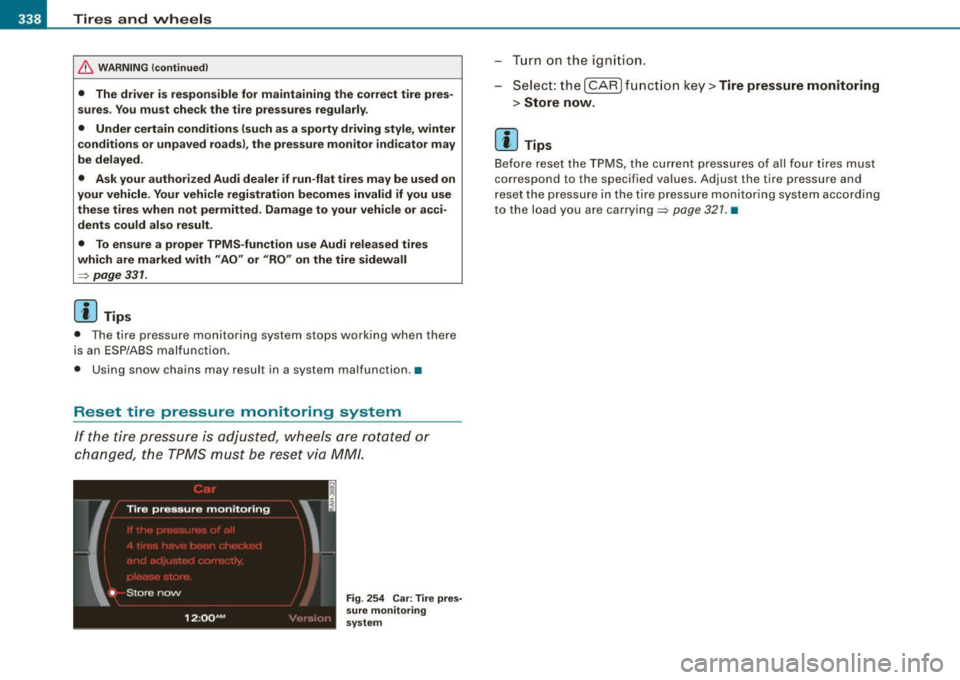
If the tire pressur e is adju sted , whee ls are rotated or
c hang ed, the T PMS must be reset vi a MM/ .
Fig. 254 Car : Tire pre s
sure m onitoring
sys tem
T ur n on th e i gni tio n.
- Selec t: the [ CA R) f un ctio n k ey>
Tire pressure monitoring
> Store now .
[ i ] Tips
Befor e reset t he TPMS, the c urrent pressur es o f all four t ires must
correspond to the speci fied values. Adjust the tire pressure and
r ese t th e press ure i n t he tire p ress ure moni tori ng system accord ing
to the load you are carry ing=>
page 321. •
Page 382 of 398
-Alphabetical index
---=--------------------------------
A
A . ccessones . . . . . . . . . . . . . . . . . . . . . . . . 374
Adapter for cupholder . . . . . . . . . . . . . . . . 95
Adaptive Air Suspension .. .... ... .... 184
Automatic mode . . . . . . . . . . . . . . . . . 185
Description . . . . . . . . . . . . . . . . . . . . . 184
Dynamic mode . . . . . . . . . . . . . . . . . . 185
Jacking mode when changing a flat tire .
186
Lift mode . . . . . . . . . . . . . . . . . . . . . . . 185
Setting the driving modes .. .... ... 185
Standard mode . . . . . . . . . . . . . . . . . . 185
Trailer towing mode ... .... .... ... 186
Warning/indicator lights ........... 20
Adaptive Cruise Control . . . . . . . . . . . . . . 127
Changing speed .. ........... .... 131
D. . f . river in ormat1on . . . . . . . . . . . . . . . 135
Driver interven tion prompt ........ 138
Driving in traffic ...... .... ...... . 128
Driving program ...... .... .... ... 139
Error messages . . . . . . . . . . . . . . . . . . 137
Open road . . . . . . . . . . . . . . . . . . . . . . 128
Override 128
Request for driver to assume control 128
Save speed . . . . . . . . . . . . . . . . . . . . . . 130
Setting distance . . . . . . . . . . . . . . . . . 133
Setting time interval .. .. ....... ... 133
Settings . . . . . . . . . . . . . . . . . . . . . . . . 139
Specia l driving situations .. .. .. ... 140
Status messages . . . . . . . . . . . . . . . . . 137
Switching on and off .. .... .... ... 130
System limits ...... .... .......... 140
Temporarily turning off ... ..... ... 132
warning/indicator lights .... ..... .. 135
Adaptive Light . . . . . . . . . . . . . . . . . . . . . . . 66
defective ......................... 36
Adding
Engine coolant ................ ...
309
Engine oil ... .. ...... ....... ..... 306
Windshield washer fluid .. ...... ... 316
Additional accessories .... .... .... ... 374
Additives
Engine oil
Adjusting
. .. .. ..... .. .... .... ... 306
Instrument cluster i llumination ...... 16
Steering column electrically .. ... .. 115
Steering column manually ......... 114
How many airbags does my vehicle have?
222
How the Advanced Airbag System compo -
nents work together . . . . . . . . . . . . .
223
Important things to know ... .... ... 215
Indicator light .... .... ........... 226
Monitoring .... .... .... ...... .... 226
PASSENGER AIR BAG OFF light ..... 227
Repairs ..... .. .... .... .......... 229
Safety instructions .. ...... .... ... 228
Side airbags . .... .... ............ 231
Side curtain airbags .. ....... .. ... 234
Weight -sensing mat .... ... .... ... 239
When must the system be inspected? . ..
226
All Wheel Drive ... .... .... .. . .... .. . 268
Ad' . f Justing ront seats .. .... .... .... ... 80 All h 1 oy w ee s ....................... 287
Air conditioning
See Climate controls ... ...... ... . .
102
Airbag
Warning/indicator lights ..... ......
18
Airbag system . ... .... ........ .. 215, 232
Advanced Airbag System .......... 219
Advanced Airbag System components ..
222
Care ...... .... .... .... .... .... .. 229
Child restraints .................. 240
Children .. .... ..... .. .... .... ... 239
Components (front airbags) .. ... ... 222
Danger of fitting a child safety seat on the
front passenger seat . .... .... ...
217
Disposal . . . . . . . . . . . . . . . . . . . . . . . . 229
Front airbags ....... .... ... .. 219,220
How do the front aiirbags work? .... 224
All- whee l drive
Winter tires
A lternator
333
Malfunction ......... ... .. .... .... 30
Anti -freeze
See Engine coolant system ...... ..
307
Anti-glare inside day-night mirror .... .. 75
Anti -lock brake system
How the ABS system works . .... ...
266
Warning/indicator lights ...... ... ... 21
Anti -Slip Regulation System (ASR)
How the system works . . . . . . . . . . . .
264
Anti-theft systems
Anti -theft alarm system .. ...... ....
54
Electronic immobilizer ............. 44
Tilt sensors ....................... 55