service AUDI S6 2009 Workshop Manual
[x] Cancel search | Manufacturer: AUDI, Model Year: 2009, Model line: S6, Model: AUDI S6 2009Pages: 398, PDF Size: 43 MB
Page 308 of 398
___ C_h_ e_ c_k _in --== g'-- a_n _d_ f_il _li _n ..:::g:::..- ___________________________________________ _
Oil l ev el within r ange
©
- You must add oil. Afterwards, the oil level should be
within range @.
The oil level needs to be checked at regular intervals. The best times
to do this are whenever you refuel and prior to long tr ips.
Depending on the way the vehicle is driven and the operating condi
tions, oil consumption can be up to 1 quart per 1 .200 miles (1 liter
per 2.000 km) . Consumption may be higher within the first 3 .000
miles (5.000 km) .•
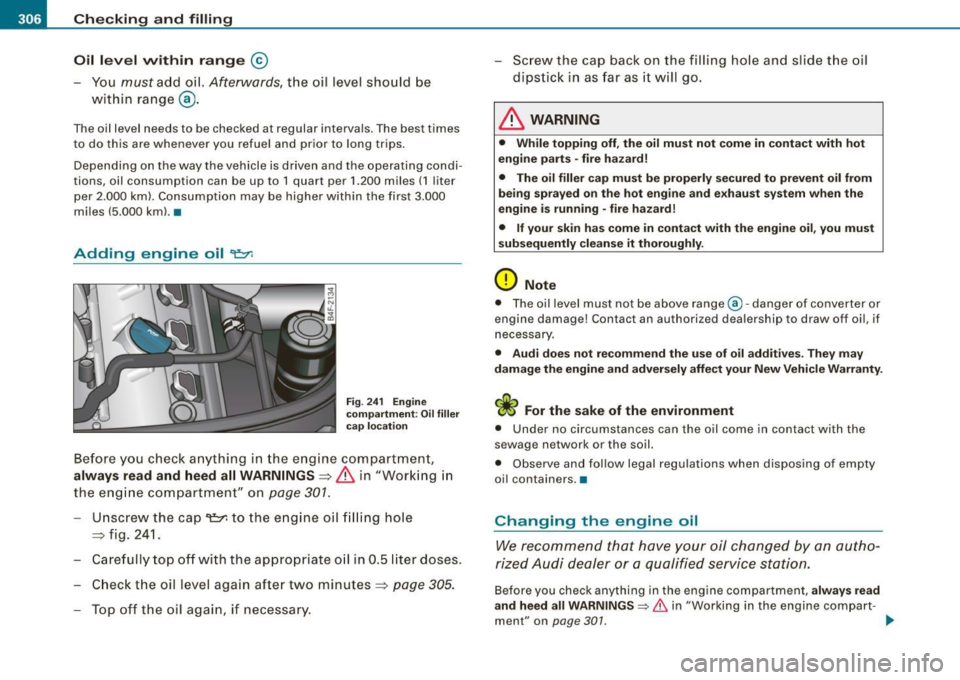
Adding engine oil "l=:7:
Fig . 2 41 Engine
co mp artm ent: Oil filler
ca p loc ation
Before you check anything in the e ngine compartment,
alw ay s read and h eed all WARNINGS ==> & in "Work ing in
the engi ne compartment" on page 301.
- Unscrew the cap
Carefully top off with the approp riate o il in 0.5 liter doses .
- Check the oil level again after two minutes
==> page 305.
- Top off the oil agai n, if necessary . - Sc
rew the cap back on the filling hole and slide the oil
dipstick in as far as it will go .
& WARNING
• Whil e topping o ff, the oil mu st not come in cont act with h ot
eng ine p arts -fire haza rd!
• The o il filler cap mu st be properly se cured to pr event oil from
b ei ng spr ayed on th e hot engi ne and e xhau st sy stem when the
engine i s running · fire ha zard !
• If y our skin has com e in contac t with the eng ine oil, you mu st
s ub sequently clean se it thoroughly.
0 Not e
• The oil level must not be above range @- danger of converter or
engine damage! Contact an authori zed dealership to draw off oi l, if
necessary.
• Audi do es not re comm end the use of oil add it ives. They may
d a mage the engi ne and adversely affe ct you r New Vehicle W arra nty.
cj? For the sake of the environment
• Under no circumstances can the oil come in co ntact with the
sewage network or the soil.
• Observe and follow legal regulations when disposing of empty
oi l containers. •
Changing the engine oil
We recommend that have your oil changed by an autho
rized Audi dealer or a qualified service station.
Before you check anything in the engine compartment, a lways r ead
a nd h eed all W ARNIN GS=:>
& in "Working in the engine compart-
ment" on
page 301 . .,_
Page 309 of 398
___________________________________________ C_ h_e _c_ k_ i_n _g _ a_n _d_ f_il _li _n _g __ lll
•
T he engine oil must be changed according to the intervals specified
in your Warranty
& Maintenance book le t. This is very important
because the lubricating properties of oi l diminish gradually during
normal vehicle use .
Under some circumstances the engine oil should be changed more
frequently. Change oil more often if you drive most ly short
distances, opera te the vehic le in dusty areas or under predomi
nant ly stop-and-go traffic conditions, or have your vehicle where
t emperatures remain below free zing for extended periods.
Detergent additives in the oil wil l make fresh oi l look dark after the
engine has been running for a sh ort time . This is normal and is not
a reason to chan ge the oi l more often than recommended.
Because of the problem of proper disposal, along with the specia l
t ools and necessary expertise requ ired, we strongly recommend
that you have your oi l changed by an authorized
Audi de aler or a
qualified se rvice statio n.
If you choo se to change your oil yourself , please note the following
important information:
& WARNING
To reduce the risk of per sonal injury if you mu st ch ange the engine
o il in you r veh icle your self :
• Wear eye protection.
• To reduce the ri sk of burns from hot engine oil , let the eng ine
c ool down to the touch.
• Wh en remo ving the oil dra in plug with your fingers , stay a s far
aw ay as po ssible. Alway s keep your forearm parallel to the ground
to help prevent hot oil from ru nning do wn your arm .
• Drain t he o il into a container designed for thi s purpo se , one
large enough to hold at lea st the total amount of oil in your eng ine.
• Engine oil i s poi sonous . K eep it well out of the rea ch of children .
& WAR N IN G ( continued )
• Continuous contact with used engine oil i s harmful to your
sk in. Al way s prote ct your skin b y was hing oil off thorough ly w ith
soap and water .
0 Note
Never mix oil additives with your engine oil. These additives can
damage your engine and adversely affect your Aud i Limited New
Vehicle Warranty.
can properly dispose of the used oil.
• Always dispose of used engine oil properly. Do not dump it on
garden soil, wooded areas, into ope n strea ms or down sewage
drains .
• Recycle used engine oil by taking it to a used engine oil collec
tion facility in your area, or contact a service station. •
Engine cooling system
Coolant
The engine coolan t per for ms two functions: i t kee ps the
engine from ove rhe ating and it prot ects the e ngine from
freezing in the winter.
The cooling system is sea led and general ly requires litt le attention.
The coo ling system has been fi lled at the fac tory with a per manent
coolant which does not need to be changed. The coo lant consists of
a m ixture of water and the manufacturer's glycol -b asedco olant
additive G 12++ antifreeze with anti corrosion additives (50% for USA .-,
Vehicle care I t •
Page 314 of 398
-Checking
and filling
---=---------------
checked by a service facility . The electrolyte level should also be
checked each time the battery is charged
~ page 314.
Have the battery checked when you take your vehicle in for service.
You are well advised to replace a battery that is older than 5 years.
With certain types of airbag deployment, the battery is discon nected from the vehicle electrical system for safety reasons~
& in
"Repair, care and disposal of the airbags" on
page 229.
Disconnecting the battery terminals
Some vehicle functions (power window regulators, for example) are
lost if the battery terminals are disconnected . These functions have
to be relearned after the battery terminals are connected again . To
prevent this, the battery should only be disconnected from the
vehicle electrical system when absolutely necessary for repairs.
Vehicles not driven for long periods
If you do not drive your vehicle over a period of several days or
weeks, electrical components are gradually cut back or switched off.
This reduces energy consumption and maintains starting capability
over a longer period
~ page 269.
Take into consideration that when you unlock your vehicle, some
convenience functions , such as the master key remote function or
power seat adjustment, may not be available. The convenience
functions will be available again when you turn on the ignition and
start the engine.
Winter operation
During the winter months, battery capacity tends to decrease as
temperatures drop . This is because more power is also consumed
while starting, and the headlights, rear window defogger, etc., are
used more often.
Avoid unnecessary power consumption, particularly in city traffic or
when traveling only short distances. Let your authorized Audi dealer
check the capacity of the vehicle battery before winter sets in
~ page 314. A well charged battery will not only prevent starting
problems when the weather is cold , but will also last longer .
[ i] Tips
If your vehicle is left standing for several weeks at extremely low
temperatures, the vehicle battery should be removed and stored
where it will not freeze. This will prevent it from being damaged and
having to be replaced. •
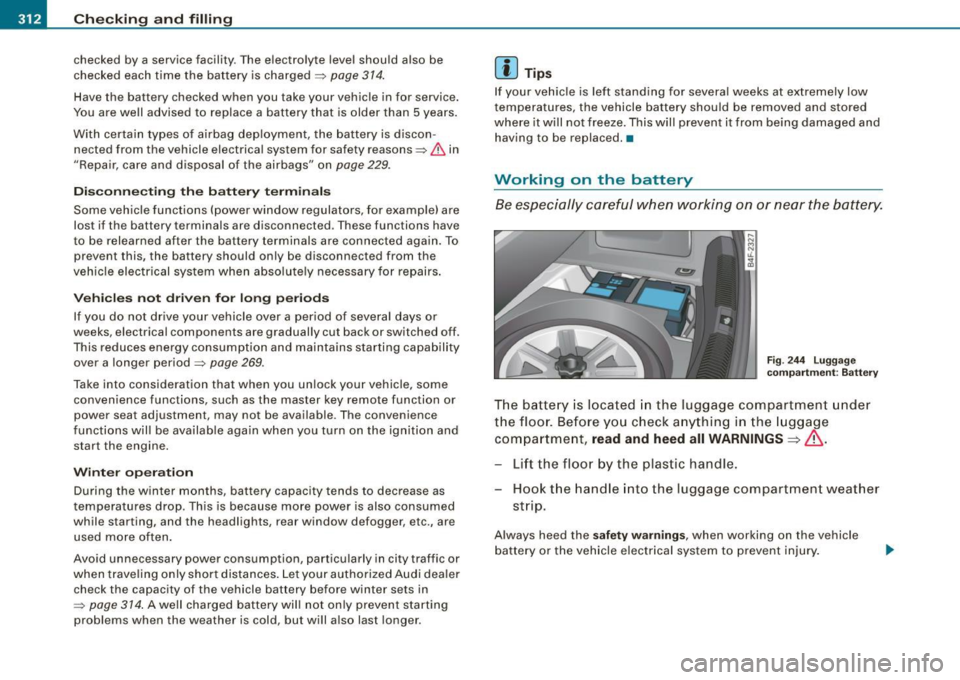
Working on the battery
Be especially careful when working on or near the battery.
Fig. 244 Luggage
compartment : Battery
The battery is located in the luggage compartment under
the floor. Before you check anything in the luggage
compartment,
read and heed all WARNINGS=>& .
Lift the floor by the plastic handle.
Hook the handle into the luggage compartment weather
strip.
Always heed the safety warnings, when working on the vehicle
battery or the vehicle electrical system to prevent injury.
Page 327 of 398
Tires and wheels -
----------------
•
& WARNING (continu ed )
• The driver is respon sible for the correct tire pres sures for all
tire s on the vehicle . The applicable pre ssure values are located on
a sticker on the driver 's side B-pillar .
• Only when all tires on the veh icle are filled to the correct pre s
sure , the tire pressure monitoring system can work correctly .
• The use of incorre ct t ire pressure values can lead to a ccidents
or other damage. Therefore it is essential that the driver observe
the specified tire pressure values for the tires and the correct pre s
sures for the function of the tire pressure monitor ing system.
• Always inflate tires to the recommended and corre ct tire pres
sure before driving off.
• Driving with underinflated tires bend more , letting them get
too hot resulting in tread separation, sudden tire failure and loss
of control.
• Excessive speed and /overloading can cause heat build-up ,
sudden tire failure and loss of control.
• If the tire pre ssure is too low or too high, the tires will wear
prematurely and the vehicle will not handle well .
• If the tire is not flat and you do not have to change a wheel
immed iately , drive at reduced speed to the nearest service stat ion
to check the tire pres sure and add air as required.
0 Note
Dr iving w ithout valve s tem caps can cause damage to the t ire
valves . To prevent this, a lways make sure that factory installed valve
stem caps on a ll whee ls are securely mounted o n the va lve.
For the sake of the environment
Unde rin fla ted tires will a lso increase the f uel c onsump tion .•
Tires and vehicle load limits
There are limits to the amount of load or weight that any vehic le and
any t ir e can carry. A veh icle that is overloaded w il l not handle wel l
and is more difficu lt to stop. Overloading can not only lead to loss
o f veh ic le control, but ca n also damage impor ta nt parts of the
vehic le and can lead to sudden tire failure, inc luding a blowout and
sudde n defla tion that can cause the vehic le to crash .
Your sa fety and that o f your passen gers also depends on mak ing
sure that load limits are not e xceeded. Vehicle load includes every
body and everythi ng in and on the veh ic le. T hese load lim its a re
technica lly referred to as the vehicle's
Gross Vehi cle We ight Rating
(" GVWR") .
T he "GVWR" includes the weight of the basic vehic le, all factory
insta lled acces so ries, a ful l ta nk of fuel, oil, coolant an d othe r flui ds
p lus maximum load. The maximum load inc ludes the number o f
p asse ngers that the vehicle is inte nded t o carry ("sea ting capacity")
w ith an assu med we ight o f 150 l bs (68 kg) fo r each passe nger at a
designated seating position and the total weight of any luggage in
t he vehicle. If you tow a trailer, the we ig ht o f the tra iler h itch an d th e
tongue weight of the loaded trailer must be included as part of the
ve hicle l oad.
The
Gross Axle Weight Rating !"GAWR") is t he maximum load that
can be applied a t each of the vehicle's two ax les.
The Gross Veh icle Weig ht Rating and t he G ross Axle Weig ht Rat ing
are listed on the safety comp liance sticker labe l located on the
d river 's s ide B -pi llar . Y o ur Au di h as 5 s eating positi ons, 2 i n the fro nt
and 3 in the rear for total seating capacity of 5 . Each seating position
has a safe ty bel t~
page 205, "Safe ty belts".
The fact that th ere is an upper limit to your vehicle's Gross Vehicle
Weight Rating means that the total weight of whatever is being
carried in the vehic le (includ ing the we ight of a trai ler hitch and the
tong ue weight of the loaded trai ler) is limited. The more passengers
i n the v ehicle or pass engers wh o are heavie r than t he sta nd ard
we ights assumed mean that less weight can be ca rried as luggage . .,_
Vehicle care I t •
Page 329 of 398
Tires and wheels -_______________ _____.
5. Determine the combined weight of
luggage and cargo being loaded on th e
vehicle. That weight may not safely exceed the available cargo and luggage load capacity calculated in Step 4.
6. If your vehicle will be towing a trailer, load from your trailer will be transferred
to your vehicle. Consult this manual to determin e how this reduces the avail
able cargo and luggage load capacity of
your vehicle.
- Check the tire sidew all (~
page 329,
fig . 251) to determine the designated
load rating for a specific tire . •
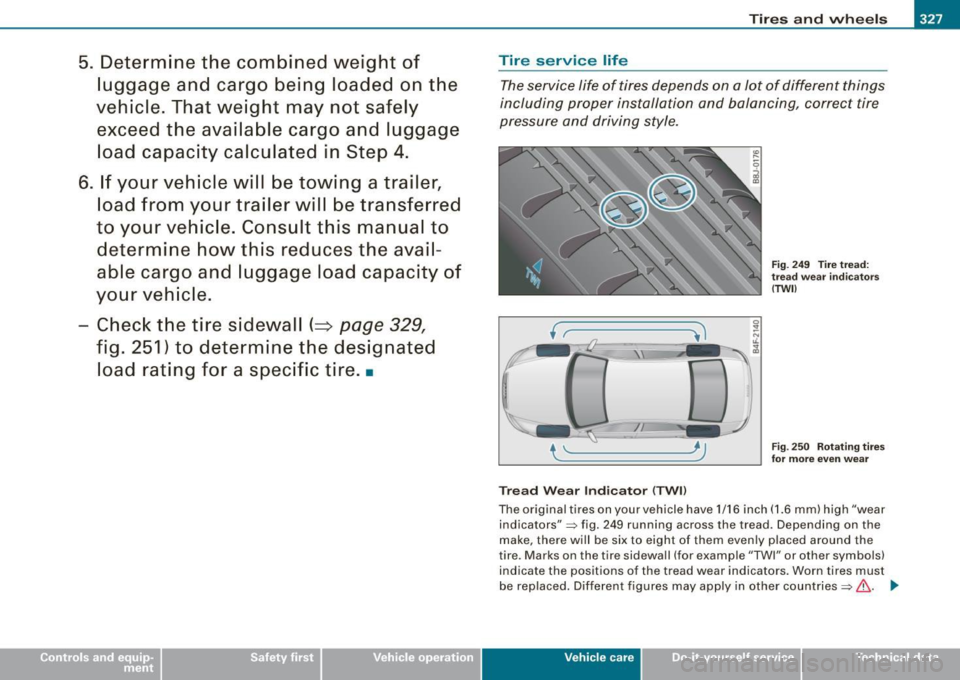
Tire service life
The ser vic e life of ti res depends on a lo t o f different things
inclu ding p roper i nstallation and bal ancing, correc t tire
pressu re a nd drivi ng style .
Tread Wear Ind icator (TWll
Fig . 249 Tire tread:
tre ad we ar indi cato rs
(TWll
Fig . 2 50 Rot ating tire s
for mo re even wear
The or iginal tires on your vehicle have 1 /16 inch ( 1.6 mm) high " wea r
indicators"=> fig. 249 running across the tread. Depending on the
make, the re wil l be six to eight of them even ly p la ced a rou nd the
t ire . Marks on the tire sidewa ll (for example "TWI" or other symbols)
indicate the positions of the tread wear indicators. Worn tire s must
be r eplaced. Di fferen t fi gures may apply in other countries ::::>,& . .,_
Vehic le care I I Technical data
Page 330 of 398
-~_T_ ir_e_ s_ a_ n_d _ w_ h_ e_e _l_s _________________________________________________ _
Tire pr essure
Inco rrect tire pressure causes prematu re wear and can cau se
sudden tire blow-out. For this reason, tire pressure must be checked
at least once a month
~ page 323 .
Driving style
Dr iv ing fa st around curves, heavy acceleration and hard brak ing
increase tire wear.
Rotating tire s for more even wear
For all four t ires on your vehic le to have the same service life, we
recommend that the front and rea r tires are rotat ed acc ord ing to the
tire manufacturer 's suggested tire rotation intervals. Please
remembe r the f ollo wi ng :
• Tire rotat ion i nterva ls m ay d iffer from the vehic le serv ice inte r
vals outl ined in your Maintenance and Warranty Book let.
• The longer one tire is used in one location on the vehicle, t he
more it wears at certain points; the refo re, we recommend that you
f ollow the tire manu facturer's sug ges ted t ire rotat ion i nte rvals.
• Vehicles with fro nt-w hee l dr ive e xper ience more tread wear on
the front wheels compared to all -wheel drive (quattro®l .
• Please rotate tires as sh ow n~
page 32 7, fig. 250 .
• Extra care must be taken when rotating direction -specific tires
~ pag e 349 .
Wheel balancing
T he w hee ls o n new v ehic les are balanced. However, various s itua
tions during everyday driving can cause them to become unba l
anc ed, resu lti ng in vib rati ons yo u ca n us ually feel thro ugh t he
steer ing whee l.
U nba la nce d w heels must b e re ba lance d to avoid e xcessive wea r on
steering, suspension and tires. A whee l must a lso be reba lanced
when a new tire is installed.
Incorrect wheel alignment
Incorrect w hee l al ig nm ent ca n cau se e xcess ive ti re wea r, impa iring
t h e s afety of th e veh ic le. If t ires s how excessive w ear, have the
w hee l a lig nme nt checke d by a n autho rize d Aud i deale r or qualifie d
wo rkshop.
All Wheel Drive
Vehic les with quattro® must always have tires of the same size,
co nstruct ion an d tread ty pe. For deta ils see ~
page 268.
& WARNING
Sudden tire failure can lead to loss of control , a crash and serious
personal injury !
• Never drive a vehicle when the tread on any tire is worn down
to the wear indicators.
• Worn tires are a safety hazard , they do not grip well on wet
roads and increase your risk of "hydroplaning " and loss of control.
• Always keep chemicals that can cause tire damage , such as
grease, oil, gasoline and brake fluid away from tires .
• Tires age even if they are not being used and can fail suddenly ,
especially at high speeds. Tires that are more than 6 years old can
only be used in an emergency and then with special care and at
lower speeds .
• Never mount used tires on your vehicle if you are not sure of
their "previous history. " Old used tires may have been damaged
even though the damage cannot be seen that can lead to sudden
tire failure and loss of vehicle control . •
Page 334 of 398
-Tires and wheels
PW-------------------
& WARNING (continued)
• Run flat tires may only be used on vehicles that were equipped
with them at the factory. The vehicle must have a chassis designed
for run flat tires. Incorrect use of run flat tires can lead to vehicle
damage or accidents. Check with an authorized Audi dealer or tire
specialist to see if your vehicle can be equipped with run flat tires.
If run flat tires are used, they must be installed on all four wheels.
Mixing tire types is not permitted.
0 Note
• For technical reasons , it is not generally possible to use the
wheel rims from other vehicles. This can hold true for wheels of the
same vehicle type .
• If the spare tire is different from the tires that you have mounted
on your vehicle (for example winter tires or wide profile tires), then
use the spare tire for a short period of time only and drive with extra
care. Replace the flat tire with the tire matching the others on your
vehicle as soon as possible.
• Never drive without the valve stem cap. The valves could get
damaged.
~ For the sake of the environment
Dispose of old tires in accordance with the local requirements. •
Uniform tire quality grading
• Tread wear
• Traction AA A B C
• Temperature A B C
Quality grades can be found where applicable on the tire side wall between tread shoulder and maximum section width~
page 329,
fig. 251 .
For example: Tread wear 200, Traction AA, Temperature A.
All passenger car tires must conform to Federal Safety Require
ments in addition to these grades.
Tread wear
The tread wear grade is a comparative rating based on the wear rate
of the tire when tested under controlled conditions on a specified
government test course .
For example , a ti re graded 150 wou Id wear one and one half (1 1 /2)
times as well on the government course as a tire graded 100.
The relative performance of tires depends upon the actual condi
tions of their use, however, and may depart significantly from the
norm due to variations in driving habits, service practices and differ
ences in road characteristics and climate.
Traction
The traction grades, from highest to lowest, are AA, A, Band C.
Those grades represent the tire's ability to stop on wet pavement as
measured under controlled conditions on specified government
test surfaces of asphalt and concrete. A tire marked C may have
poor traction performance
~ & .
Temperature
The temperature grades are A (the highest), B, and C, representing
the tire's resistance to the generation of heat and its ability to dissi pate heat when tested under controlled conditions on a specified
indoor laboratory test wheel.
Sustained high temperature can cause the material of the tire to
degenerate and reduce tire life, and excessive temperature can lead
to sudden tire failure~& .
The grade C corresponds to a level of performance which all
passenger car tires must meet under the Federal Motor Vehicle
Safety Standard No. 109. Grades Band A represent higher levels of
performance on the laboratory test wheel than the minimum
required by law. .,_
Page 345 of 398
What do I do now? 111111 _______________________________ ....:..:..:..:..:.:..:--=.:..::....:.....:.:...::..___;__ _ __,J
& WARNING !continued)
• Never start or run the engine while the vehicle is supported by
the jack.
• If you must work under the vehicle, always use safety stands
specifically designed for this purpose.
• Never use the hexagonal socket in the handle of the screw
driver to loosen or tighten the wheel bolts.
• Always make sure the spare tire and even a flat tire are secured
in place and not loose, otherwise they could fly forward, causing
personal injury to passengers in the vehicle in an accident or
sudden maneuver. •
Tools
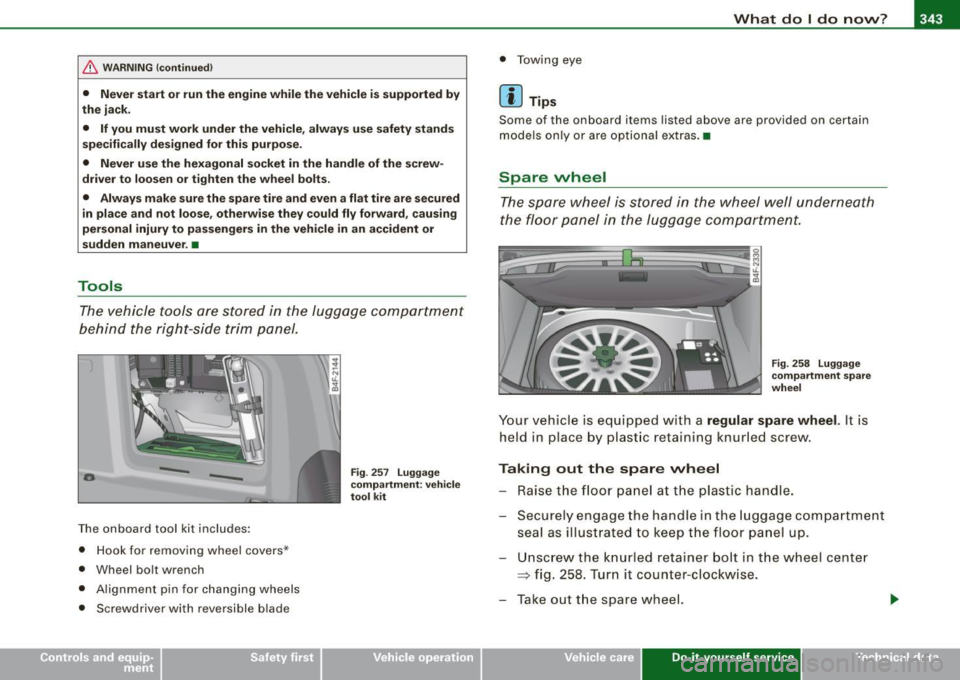
The vehicle tools are stored in the luggage compartment
behind the right-side trim panel.
-
-
The onboard tool kit includes:
• Hook for removing wheel covers *
• Wheel bolt wrench
• Alignment pin for changing wheels
• Screwdriver with reversible blade
Fig. 257 Luggage
compartment: vehicle
tool kit
• Towing eye
[ i] Tips
Some of the on board items listed above are provided on certain
models only or are optional extras.•
Spare wheel
The spare wheel is stored in the wheel well underneath
the floor panel in the luggage compartment.
Fig. 258 Luggage
compartment spare
wheel
Your vehicle is equipped with a regular spare wheel. It is
held in place by plastic retaining knurled screw.
Taking out the spare wheel
- Raise the floor panel at the plastic handle.
- Securely engage the handle in the luggage compartment
seal as illustrated to keep the floor panel up.
Unscrew the knurled retainer bolt in the wheel center
=> fig. 258. Turn it counter-clockwise.
- Take out the spare wheel.
Vehicle care Do-it-yourself service irechnical data
Page 347 of 398
_______________________________________________ W_ h_ a_t _ d_ o_ l _d _o_ n_ o _ w_ ? __ IIII
•
& WARNING (continued)
front wheel is lifted off the ground, placing the Automatic Trans
mission in "P" {Park) will
not prevent the vehicle from moving.
• Before you change a wheel , be sure the ground is level and firm.
If necessary, use a sturdy board under the jack.
• After installing the spare wheel, make sure that you replace the
flat tire/wheel in its storage area properly and tighten the knurled
retaining screw securely. •
Changing a vvheel
When you change a wheel, follow the sequence described
below step-by-step and in exactly that order.
1. Act ivate the vehicle jack mode (only vehicles with Adap
tive Air Suspension) ~
page 186.
2. Remove the decorative wheel cover*. For more details
see also ~
page 346, "Decorative wheel covers".
3. Loosen the
wheel bolts ~ page 346.
4. Locate the proper mounting point for the jack and align
the jack below that point~
page 347.
5. Lift the car with the jack~ page 347.
6. Remove the wheel with the flat tire and then install the
spare
~ page 348.
7. Tighten all wheel bolts lightly.
8.
Lower the vehicle with the jack.
9. Use the wheel bolt wrench and
firmly tighten all wheel
bolts
~ page 346.
10. Replace the decorative wheel cover*.
11. Deactivate the veh icle jack mode (only vehicles with
Adaptive Air Suspension)~
page 186.
& WARNING
Always read and follow all WARNINGS and information => & in
"Raising the vehicle" on
page 347 and => page 349. •
After changing a vvheel
A wheel change is not complete without the doing the
following.
- Store and secure the wheel you replaced in the spare
wheel well.
- Replace the tools and the jack in their proper location.
-Check the tire pressure on the spare wheel immediately
after mounting it.
- As soon as possible, have the
tightening torques on all
wheel bolts checked with a torque wrench. The correct
tightening torque is 90 ft lb (120 Nm).
- Have the flat tire
replaced as soon as possible.
[ i] Tips
• If you notice that the wheel bolts are corroded and difficult to
turn while changing a tire, they should be replaced before you check
the tightening torque.
• Drive at reduced speed until you have the tightening torques
checked. a
Do-it-yourself service
Page 349 of 398
_____________________________________________ W_ h_ a_t _d_ o_l _ d_o _ n_o_ w_ ? _ __._
& WARNING !continued)
• Do not loosen the wheel bolts more than one turn before you
raise the vehicle with the jack . - You risk an injury.
[ i J Tips
• Never use the hexagonal socket in the handle of the screwdriver
to loosen or tighten the wheel bolts .
• If a wheel bolt is very tight, you may find it easier to loosen by
carefully pushing down on the end of the wheel bolt wrench with
one foot only . As you do so, hold on to the car to keep your balance
and take care not to slip .•
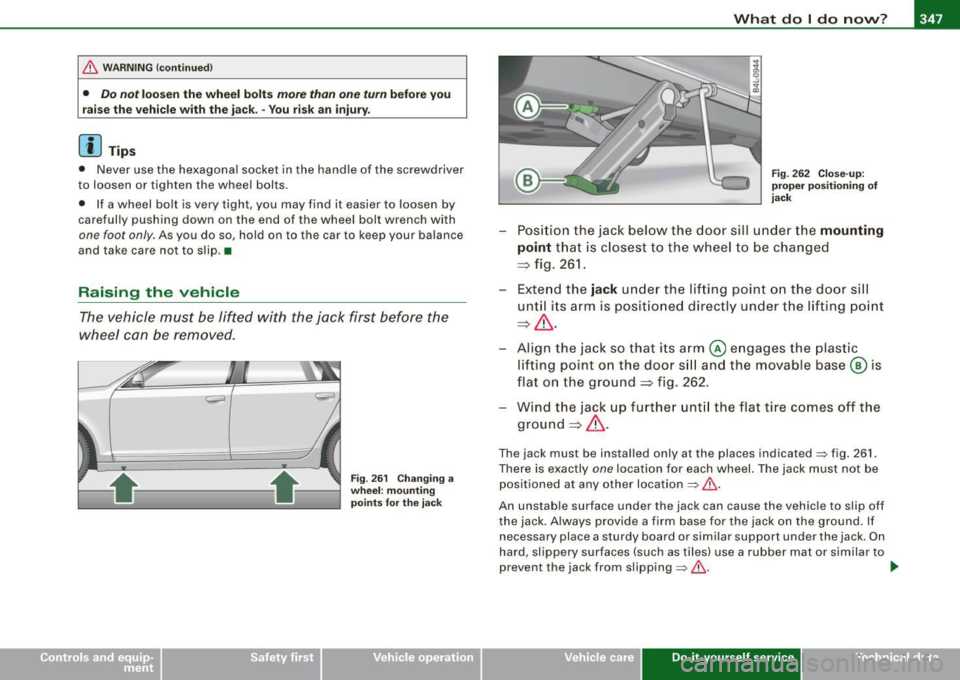
Rais ing the vehicle
The vehicle must be lifted with the jock first before the
wheel con be removed.
Fig. 261 Changing a
wheel: mounting
points for the jack Fig
. 262 Close-up:
proper positioning of
jack
- Position the jack below the door sill under the mounting
point
that is closest to the wheel to be changed
:::;, fig. 261 .
- Extend the
jack under the lifting point on the door sill
until its arm is positioned directly under the lifting point
:::;, & .
- Align t he jack so that its arm @ engages the plastic
lifting point on the door sill and the movable base@ is
flat on the ground :::;, fig. 262.
- Wind the jack up further until the flat tire comes off the
ground :::;,& .
The jack must be installed only at the places indicated=> fig. 261.
There is exactly
one locat ion for each wheel. The jack must not be
positioned at any other location
=> & .
An unstable surface under the jack can cause the vehicle to slip off
the jack . Always provide a firm base for the jack on the ground. If
necessary place a sturdy board or similar support under the jack. On
hard, slippery surfaces (such as tiles) use a rubber mat or similar to
prevent the jack from slipping=> &. .,_
Vehicle care Do-it-yourself service Technical data