ECU AUDI S6 2010 Service Manual
[x] Cancel search | Manufacturer: AUDI, Model Year: 2010, Model line: S6, Model: AUDI S6 2010Pages: 368, PDF Size: 86.82 MB
Page 303 of 368

__________________________________________________ T_i_ r _e _s_ a_ n_ d_ w_ h_e_ e _ l_s __ _
• Adjust the tire press ure to the load you are ca rry ing .
• Reins tall the valve s te m ca p on the v alve .
When should I check the tire pressure?
The cor rect tire p ress ure is especially importa nt a t hi gh s peeds . The
pressu re s ho ul d therefore be c hecked at least once a month and
always befor e sta rt ing a jou rney . Do not fo rget to ch eck the tire pr es
sure for the spare wheel=>
page 317.
When should I adjust the tire pressures?
Adjust t he tire pressure to the loa d you are ca rry ing . After chan ging a
w hee l or replac ing w heels yo u hav e to adjust the t ire press ures on all
w heels. I n add it io n, you m ust then store th e new t ire pressures in the
t ire press ure moni toring system *=>
page 31 4.
& WARNING
Incorrect tire pressures and /or underinflation can lead sudden tire
failure , loss of control , collision , serious personal injury or even
death .
• When the warning symbol appears in the instrument
cluster, stop and inspect the tires. • Incorrect tire pressure and/or underinflation can cause
increased tire
wear and can affect the handling of the vehicle and
stopping ability.
• Incorrect tire pressures and /or underinflation can also lead to
sudden tire failure , including a blowout and sudden deflation ,
causing loss of vehicle control.
• The driver is responsible for the correct tire pressures for all
tires on the vehicle. The applicable pressure values are located on
a sticker on the driver 's side 8-pillar.
• Only when all tires on the vehicle are filled to the correct pres
sure, the tire pressure monitoring system* can work correctly .
• The use of incorrect tire pressure values can lead to accidents or
other damage . Therefore it is e ssential that the driver observe the
Safety first
& WARNING (co ntinued )
specified tire pressure values for the tires and the correct pres
sures for the function of the tire pres sure monitoring system*.
• Always inflate tires to the recommended and correct tire pres
sure before driving off.
• Driving with underinflated tires bend more , letting them get
too hot re sulting in tread separation, sudden tire failure and loss
of control.
• Excessive speed and /overloading can cause heat build-up,
sudden tire failure and loss of control.
• If the tire pressure is too low or too high, the tires will wear
prematurely and the vehicle will not handle well.
• If the tire is not flat and you do not have to change a wheel
immediately, drive at reduced speed to the nearest service station
to check the tire pressure and add air as required .
0 Note
Driv ing witho ut valve stem caps can cause damage to the t ir e valves.
T o preven t this, a lways make sure th at fa ct o ry insta lled va lve stem
caps on all wheels are s ecure ly m ou nted on t he v alve .
<£> For the sake of the environment
Under infla ted ti res will also increase t he fue l cons umption .•
Tires and vehicle load limits
Th ere a re limits to the amo unt of load or weight that a ny vehicle and
any tire can ca rry . A veh icle t hat is overloaded w ill not handle well and
is mo re diffic ult to s top . Ove rloading can no t only lead to loss of
vehicle contro l, but can also damage important parts o f the ve hicle
a nd can le ad t o sud de n tir e fa ilure, incl uding a blowout and su dden
deflation t hat can cause the vehicle to crash . .,_
Vehicle care Technical data
Page 319 of 368

What do I do now? I'll ______________________________ ____::..:..:..:..::..::....::..::.....::.....:::...::,_ __ __,J
& WARNING (continued)
• Never start or run the engine while the vehicle is supported by
the jack.
• If you must work under the vehicle, always use safety stands
specifically designed for this purpose.
• Never use the hexagonal socket in the handle of the screw
driver to loosen or tighten the wheel bolts.
• Always make sure the spare tire and even a flat tire are secured
in place and not loose, otherwise they could fly forward, causing
personal injury to passengers in the vehicle in an accident or
sudden maneuver. •
Tools
The vehicle tools are stored in the luggage compartment
behind the right-side trim panel.
-
The onboard tool kit includes:
• Hook for removing wheel covers*
• Wheel bolt wrench
• Alignment pin for changing wheels
• Screwdrive r with reve rsible blade
Fig. 225 Luggage
compartment: vehicle
tool kit
Vehicle OP-eration
• Towing eye
[ i] Tips
Some of the onboard items listed above are provided on certain
models only or are optional extras. •
Spare wheel
The spare wheel is stored in the wheel well underneath
the floor panel in the luggage compartment.
Fig. 226 Luggage
compartment spare
wheel
Your vehicle is equipped with a regular spare wheel. It is held
in place by plastic retaining knurled screw .
Taking out the spare wheel
- Raise the floor panel at the plastic handle.
- Securely engage the handle in the luggage compartment
seal as illustrated to keep the floor panel up.
Unscrew the knurled retainer bolt in the wheel center
=> fig. 226. Turn it counter-clockwise.
- Take out the spare wheel.
Vehicle care Do-it-yourself service iTechnical data
Page 320 of 368
,.,___W_ h _a_t _ d _ o_ I_ d_ o_ n_o _w_ ? ____________________________________________ _
- Disengage and lower the floor panel before you close the
luggage compartment lid again.
Storing the replaced wheel
-Place the replaced wheel inside the spare wheel well in the
luggage compartment.
Tighten the knurled retaining screw clockwise to secure
the wheel in place.
- Disengage and lower the floor panel before you close the
luggage compartment lid again.
& WARNING
Loose items in the passenger compartment can cause serious
personal injury during hard braking or in an accident.
• Never store the spare wheel or jack and tools in the passenger
compartment.
• Always store all jacking equipment, tools, and the spare wheel
in the luggage compartment.
• Tighten the knurled retaining screw for the spare wheel
securely.
[ i] Tips
Check the inflation pressure of the spare tire periodically to keep the
tire ready for use.•
Changing a wheel
Before changing a wheel
Observe the following precautions for your own and your
passenger's safety when changing a wheel.
- After you experience a tire failure, pull the car well away
from moving traffic and try to reach
level ground before
you stop :::> & .
- All passengers should
leave the car and move to a safe
location (for instance, behind the guardrail) :::>& .
- Engage the
parking brake to prevent your vehicle from
rolling unintentionally:::> &.
- Move
selector lever to position P :::> & .
- If you are towing a trailer: unhitch the trailer from your
vehicle.
- Take the
jack and the spare tire out of the luggage
compartment:::>
page 316.
& WARNING
You or your passengers could be injured while changing a wheel if
you do not follow these safety precautions:
• If you have a flat tire, move a safe distance off the road. Turn
off the engine, turn the emergency flashers on and use other
warning devices to alert other motorists.
• Make sure that passengers wait in a safe place away from the
vehicle and well away from the road and traffic.
• To help prevent the vehicle from moving suddenly and possibly
slipping off the jack, always fully set the parking brake and block
the wheel diagonally opposite the wheel being changed. When
one front wheel is lifted off the ground, placing the Automatic
~
Page 321 of 368

_____________________________________________ W __ h_a_ t_ d_o_ I_ d_o _ n_ o_ w _ ? __ _
& WARN ING (con tinued)
Trans missio n in "P " (Pa rk) w ill not pre ve nt the vehicle from
mo ving .
• Befo re you ch an ge a wheel , be s ure the ground i s le ve l an d
firm . If ne cess ary, us e a sturdy b oard und er the jack.
• Aft er in st a llin g the sp are wheel , make sure that you repl ace
the flat tire /wheel in it s storage area prop erly and tight en the
knurled ret ain ing s crew se cu rel y.•
Changing a wheel
When you change a wheel, follow the sequence described
below step-by-step and in exactly that order .
1. Activate the vehicle jack mode (only vehicles with Adaptive
Air Suspension) =>
page 168.
2. Remove the decorative wheel cover *. For more details see
also =>
page 320, "Decorative wheel covers" .
3 . Loosen the
wheel bolts => page 320.
4. Locate the proper mo unti ng point for the jack and align
the jack below that point=>
page 321.
5. Lift the car with the jack => page 321.
6. Remove the wheel with the flat tire and then install the
spare =>
page 322.
7. Tighten all wheel bolts lightly.
8 .
Lower the vehicle with the jack.
9. Use the wheel bolt wrench and
firmly t ighten all wheel
bolts =>
page 320.
10. Replace the decorative wheel cover *.
Safety first
1 1. Deactivate the vehicle jack mode (only vehicles with
Adaptive Air Suspens ion)=>
page 168 .
& WARNING
Alwa ys re ad and f ollow all WARNINGS and information ~ & in
" Ra ising the vehicl e" on pag e
321 and ~ pag e 323. •
After changing a wheel
A wheel change is not complete without the doing the
following .
-Store and secure the wheel you replaced in the spare
wheel well .
- Replace the tools and the jack in the ir proper location.
- Check the tir e pr essur e on the spare wheel immediately
after mounting it .
- As soon as possib le, have the
tighten ing torques on a ll
wheel bolts checked with a torque wrench . The correct
tightening torque is 90 ft lb (120 Nm) .
- Have the flat tire
replaced as soon as possible.
[ i ] Tips
• If you not ic e that the wheel bolts are corroded and difficu lt to turn
wh ile chang ing a tire, they should be replaced before you check the
tightening torque .
• Drive at reduced speed until you have the tighten ing torques
checked. •
Vehicle care Do-it-yourself service Technical data
Page 324 of 368
-What do I do now? .,,,.,__ ______________ _
An unstable surface under the jack can cause the vehicle to slip off the
jack. Always provide a firm base for the jack on the ground .
If neces
sary place a sturdy board or similar support under the jack. On hard,
slippery surfaces (such as tiles) use a rubber mat or similar to prevent
the jack from slipping=> &.
& WARNING
• You or your passengers could be injured while changing a
wheel if you do not follow these safety precautions:
-Positioning the jack under the vehicle at any other place than
those indicated above may damage the vehicle or may result in
personal injuries.
- A soft or unstable surface under the jack may cause the
vehicle to slip off the jack. Always provide a firm base for the
jack on the ground. If necessary, use a sturdy board under the
jack.
- On hard, slippery surface (such as tiles) use a rubber mat or
similar to prevent the jack from slipping.
• To help prevent injury to yourself and your passengers:
- Do not raise the vehicle until you are sure the jack is securely
engaged.
- Passengers must not remain in the vehicle when it is jacked
up.
- Make sure that passengers wait
in a safe place away from the
vehicle and well away from the road and traffic.
- Make sure jack position is correct, adjust as necessary and
then continue to raise the jack. •
Taking the wheel off/installing the spare
Follow these instructions step-by -step for changing the
wheel
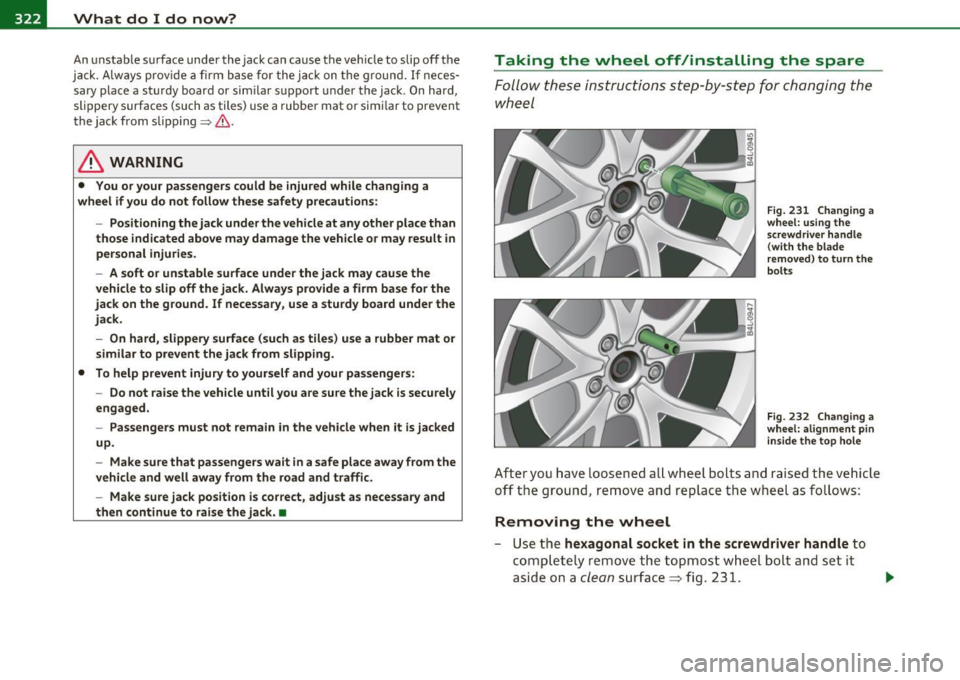
Fig. 231 Changing a
wheel: using the
screwdriver handle
(with the blade
removed) to turn the
bolts
Fig. 232 Changing a
wheel: alignment pin inside the top hole
After you have loosened all wheel bolts and raised the vehicle
off the ground, remove and replace the wheel as follows:
Removing the wheel
- Use the hexagonal socket in the screwdriver handle to
completely remove the topmost wheel bolt and set it
aside on a
clean surface => fig. 231.
Page 326 of 368
lffll.___W __ h_a_ t_ d_ o_ I_ d_o_ n_ o_w _ ? _____________________________________________ _
• Have the wheel bolt tightening torque checked with a torque
wrench as soon as possible by your authorized Audi dealer or a qual ified service station.
• With steel and alloy wheel rims, the wheel bolts are correctly
tightened at a torque of 90
ft lb (120 Nm).
• If you notice that the wheel bolts are corroded and difficult to
turn while changing a tire, they should be replaced before you check
the tightening torque.
• Replace the flat tire with a new one and have it installed on your
vehicle as soon as possible. Remount the wheel cover.
Until then, drive with extra care and at reduced speeds.
& WARNING
• If you are going to equip your vehicle with tires or rims which
differ from those which were factory installed, then be sure to
read the information =>
page 305, "New tires and replacing tires
and wheels".
• Always make sure the damaged wheel or even a flat tire and
the jack and tool kit are properly secured in the luggage compart
ment and are not loose in the passenger compartment.
• In an accident or sudden maneuver they could fly forward,
injuring anyone in the vehicle.
• Always store damaged wheel, jack and tools securely in the
luggage compartment. Otherwise, in an accident or sudden
maneuver they could fly forward, causing injury to passengers in
the vehicle. •
Page 335 of 368

Emergency situations --------------=----Efffll
Connect POSITIVE (+) to POSITIVE (+) (red)
- Open the red cover on the posi tive po le ~ page 332,
fig . 238.
1. Connect one e nd of the pos itive cable (red) on the
jump
start bolt~
page 332, fig. 239 © (Bolts under red cover
= "positive") of the vehicle to be started @.
2 . Connect the other end to the pos itive terminal @ of the
booster battery ®·
Connect NEGATIVE(-) to NEGATIVE(-)
(black)
3 . Connec t one end to the negative te rmi nal @ of the
booster battery ®·
4. Conn ect t he other end o f the n ega tive cabl e (black) to t he
jump start bolt© (Bolts w it h hex head = "n egat ive") of
the vehic le to be s tarte d
@.
Starting the engine
- Start the engine of t he vehicle w ith the booster battery.
Run the engi ne at a moderate speed.
- Start e ng ine w it h discharged ve hicle battery in the usu al
ma nner .
- If the engine fai ls to star t: do no t ke ep the s tar ter
crank ing for lo nger than 10 secon ds. W ait for abou t
30 seco nds and then t ry again .
- Wi th engine running, remove jum per cable s from bot h
v eh icle s in t he exact
re vers e order.
- C lose the re d cove r on the positive pole.
Safety first
T he battery is vented to the outside to prevent gases from entering
t he ve hicl e inter ior. Make su re t hat t he ju mper clamps are we ll
connected with the ir
metal parts in full contact with the battery
terminals .
& WARNING
To avoid serious per sonal injury and damage to the vehicle, heed
all warnings and instructions of the jumper cable manufacturer . If
in doubt, call for road service .
• Jumper cables must be long enough so that the vehicles do not
tou ch.
• When connecting jumper cables , make sure that they cannot
get caught in any moving part s in the engine compartment .
• Before you che ck anything in the engine compartment , always
read and heed all WARNINGS~
page 269, "Engine compart
ment ".
0 Note
Improper hook-up of j umper cab les can ruin the generator.
• Always co nnect POSITIVE(+) to POSI TIVE(+), and NEGATIV E(- )
to NEGA TIVE( -) ground post of the battery manager cont rol unit.
• Check that all screw p lugs on the battery ce lls are sc rewed in
firmly. If not, tighten p lugs prior to connecting clamp on negative
battery terminal.
• Please note that the proced ure for connecting a jumper cable as
described above applies specifically to t he case of your vehicle being
jump started . When you a re giving a jump start to another vehicle, do
not connect the negative( -) cab le to the nega tive (-) te rm inal on the
discharged battery©~
page 332, fig. 239. Instead, securely
c onne ct the negative (- ) cab le to ei ther a so lid met al componen t th at
is f irm ly bolted to the eng ine b lock or to the eng ine b lock itself. If the
ba ttery tha t is bei ng charged does not ven t to t he ou tside, escap ing
battery gas could ignite and explode! •
Vehicle care Do-it-yourself service Technical data
Page 338 of 368
lffll.,___E_ m_ e_r-=g :.. e_ n_c -=y '-- s_i_t _u _a _ t_ i_ o _ n_ s ____________________________________________ _
-Attach the winch hoo k to the rear towline eye previously
i n stalled.
[I) Tips
Check carefu lly to make s ure the hook -up is secure before moving the
car up the flatbed truck ramp .•
Lifting vehicle
Lifting with workshop hoist and w ith floor
jack
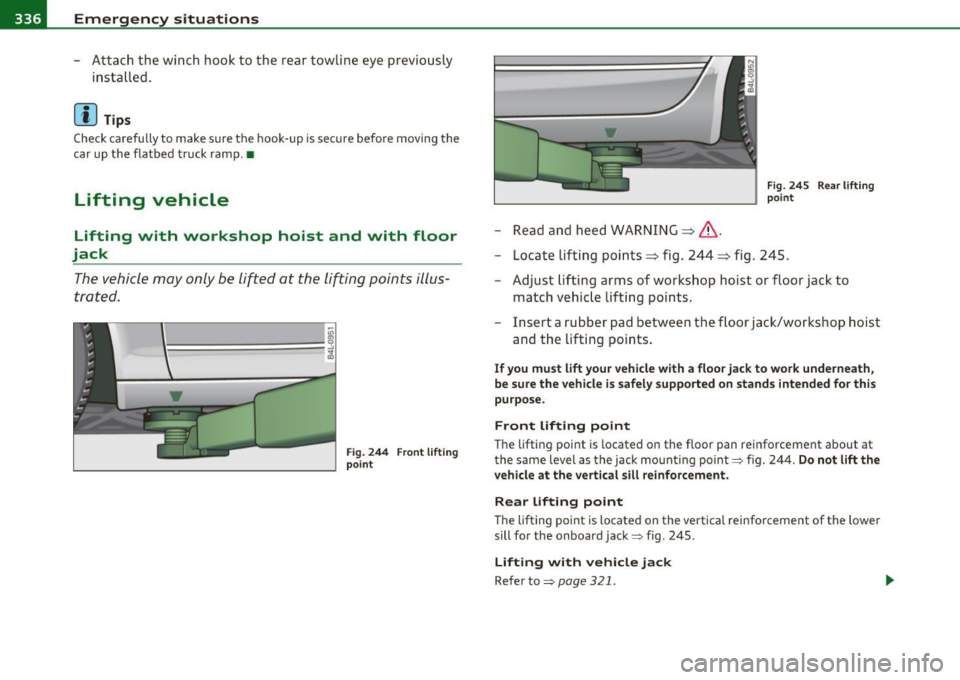
The vehicle may only be lifted at the lifting points illus
trated.
~ ~
\ == ============= ~ ;_
Fig. 244 Fron t lift ing
p oi nt
- Read and heed WAR NIN G ~ & .
Fig. 24 5 Rear li fting
p o int
- Loca te lifting points ~ fig. 244 ~ fig . 2 45 .
- Adjust lifting arms of workshop hoist or floor jack to
match vehic le lift ing poi nts.
- Insert a rubber pad between the floor jac k/wo rks hop hoist
and t he lift ing poi nts .
If you must lift your vehicle with a floor jack to work underneath ,
be sure the vehicle is safely supported on stand s intended for this
purpose .
Front lifting point
The lifti ng point is located o n the floor pan re inforcement about at
t he same level as the jack mount ing point=> fig. 244 .
Do not lift the
vehicle at the verti cal sill reinforcement .
Rear lifting point
The lifting point is located on the vertica l reinforcement of the lower
sill for the onboard jack=> fig. 245 .
Lifting with vehicle jack
Refer to=> page 321.
Page 348 of 368
___ C_ o_n_ s _ u_m_ e_ r_ I_ n_ f_o _r_ m_ a_ t_io _ n _____________________________________________ _
& WARNING (conti nu ed )
• The engine compartment of any motor veh icle is a potentially
hazardous area . Never reach into th e area around or touch the
radiator fa n. It is temperature controlled and can switch on
s uddenly -even when the engine is off and the ignition key has
been remo ved. The radiator fan switches on autom atically when
the coolant rea ches a certain temperature and will continue to run
until the coolant tempe rature drops.
• Always remove the ignition key before anyone gets under the
vehicle.
• Always support your vehicle with safety stands if it i s neces sary
to work unde rne ath the vehicle. The jac k supplied with the vehicle
is not adequate for thi s purpose and could collap se cau sing
serious personal injury.
• If you must work underneath the vehicle w ith the wheels on
the ground , always ma ke sure the vehicle is on level ground , th at
the whe els are alway s securely blocked and that the engine cannot
be started .
• Always make sure the transmi ssion selector l ever (automatic
tran smission) is in "P" (Park position ) and the par k brake is firmly
applied.
W For the sake of the environment
• Changing the engine settings will adversely affect e miss io n levels.
Th is is detrimenta l to the environment and increases fuel consump
ti on.
• Always observe enviro nmental regulations when disposing of old
eng ine o il, use d brake fl uid, dirt y engine coo lant, s pent ba tt er ies or
worn out t ires.
• Undep loyed a irbag modules and pretens ioners migh t be classified
as Perchlorate Mater ia l -spec ial handling may apply, see
www.dts c.ca .g ov/h azar douswas te/pe rchlo ra te . When the veh icle or
parts of the rest raint system including a irbag modu les sa fety belts
w ith pretens ioners are sc rapped, all applicable laws and regulat io ns must be observed
. Your authorized Aud i dealer is familiar with these
re qui remen ts and we recomme nd that you have your dealer perfo rm
this serv ice for you .•
Additional accessories,
modifications and parts
replacement
Additional accessories and parts
replacement
A lway s con sul t an autho rized Audi dealer before
purchasi ng a ccess ories.
Your vehicle incorporates the latest safety design feat ures ens uring a
hig h stand ard of active and passive s afe ty.
T hi s safety co uld be compromised by no n-app roved changes to the
vehicle. Fo r this reason, if parts have to be replace d, p lease observe
the following points when installing addit ional accessories :
Approved Audi accessories and genuine Aud i parts are available from
a u thor ized Aud i deal ers.
T hese dea lers a lso have the necessary fac ilities, tools and tra ined
speci alists to inst all the parts and ac cessor ies p ro p er ly.
& WARNING
Using the wrong spar e parts or u sing non-approved ac ce ss ories
can cause damage to the vehicle and serious personal injury .
• Use only acces sories expressly approved by Audi and genuine
Audi spare parts
• The se parts and acces sorie s have been specially designed to be
used on your vehicle . _,.
Page 355 of 368

Alphabetical index -________________ fWI
Energy management ...... .. .. ..... 96
Fan .................... ... ... .. 100
Heated seats, front .............. . 103
Key coded setting ........ ...... ... 96
Recirculation mode (automatic) .. ... 104
Recommended sett ings ............ 96
Residual heat ..................... 99
Setting the temperature ............ 99
Switching air cooling on/off .... ... .. 99
Synchronization . ... .............. lOS
Turning on and off ....... ...... .. .. 99
Using climate control economically .. 102
Clock ................ .... .. .... .... . 9
Closing Power sunroof ... .. ... ... .. .. . .... S4
Coat hooks ........... ..... .... ... ... 9S
Cold ti re inflation pressure ..... .. ..... 297
Compass mirror ........ ...... .. .... .. 73
Compliance . ... ................ .... 347
Consumer Information . . . . . . . . . . 183, 344
Contacting NH TSA .... .............. 183
Continuously Variable Transmission (CVT)
See multit ronic ® ................. 152
Convenience key .................... . 47
Dr iver messages ....... ... .. .. ... . 112
Locking vehicle ...... ....... .. .... . 49
START button ............. .. ... .. 110
Starting engine .. ............. .. . 110
S TOP button ............ .. .. .... . 111
Switching eng ine off .............. 111
Switching on ignition ......... .. ... 110
Unlocking vehicle ................ .. 48
Convertible child safety seats ..... .... 223
Controls and equip
ment Safety first
Convert
ible lock ing retractor
Activating ............... .. ...... 229
Deactivating ..................... 230
Us ing to secure a chi ld safety seat .. 227,
229
Coolant system ..................... 284
Cooling System Expans ion tank ..... .. .. ... .... .. 284
Cruise control Changing speed ..... ... .......... 117
Presetting your speed ... .......... 117
Switching off . .. ................. 117
Switching on .................. .. 116
Warning/indicator lights ........ .. . 16
See also Adaptive Cruise Control .... 119
Cruising range ... ................ .... 34
(upholder .... ............. .. .. . 89,90
D
Damp ing
See Adaptive A ir Suspens ion ...... .. 166
Data . .... ....................... .. 341
Data record er .. . .... .. ... .......... 240
Date display ......................... . 9
Daytime running lights . . . . . . . . . . . . 58, 59
Declaration of compl ia nee
Adaptive Cruise Contro l ... ......... 347
Audi side assist .. .. . .. ...... .. ... 347
Cell phone package . .............. 347
Convenience key .... .. .. .. .. ..... 347
E lectronic immobilizer ............ 347 Homelink
® universal remote control . 347
Remote control key .. ....... ... ... 34 7
def What does this mean when it appears in
the trip odometer disp lay? .. .. ..... 10
Defective light bulb warn ing ......... .. 21
Defrosting/defogging the windows .. .. . 100
Defrosting/defogging w indows ........ 101
Determining correct load limit ....... .. 302
Digital clock . ........ ................ 9
Digital compass ..................... 73
Digital speedometer .................. 21
Dimensions ............ ... .. .. ..... 339
Dipstick Reading the dipstick properly ....... 281
Distance control system
See Adaptive Cruise Control ... .. .. . 119
Doors Power ch ild safety lock .. ....... .... 47
Driver information system ............. 19
Digital speedometer ............... 21
Driver information messages ........ 24
Open door or rear lid warning . ....... 21
Outs ide temperature display ........ 20
Sound system disp lay .............. 20
Driver seat
See Seating position .............. 176
Driver's seat ... .... .. .... ........... 76
Driver's seat memory ................. 79
Activating remote control key ....... 80
Recalling a seat pos it ion . ... ..... ... 79
Storing a seat position .. ....... .... 79
Vehicle operation Vehicle care Do-it-yourself service Technical data