heating AUDI S6 2012 User Guide
[x] Cancel search | Manufacturer: AUDI, Model Year: 2012, Model line: S6, Model: AUDI S6 2012Pages: 298, PDF Size: 74.43 MB
Page 197 of 298

functions will be available again when you
switch on the ignition and start the engine.
With the engine turned off
If you listen to the radio, for example, with
the eng ine turned off or use othe r MM I fu nc
tions, the battery is being discha rged.
I f starting capability is jeopardized due to en
e rgy consumpt ion, the fo llow ing warning ap
pears in the MMI disp lay :
Plea se start the eng ine soon or th e sys tem
w ill b e turn ed off .
The warning ind icates that the system will be
turned off automatically after 3 m inutes . If
you wish to cont inue us ing the functions , you
have to start the engine.
With the engine running
Although electrical energy is generated when
the vehicle is be ing driven, the battery can be
come discharged . Th is happens mostly when
little energy is be ing generated and a great
deal consumed and the battery's state of
charge is no t optimal.
To br ing the energy balance back into equili
b rium, consumers which require especially
l arge amounts of energy are tempo rarily cut
back or swit ched off. Heating systems in par
ticular requ ire a g reat dea l o f energy. If you
notice, fo r example, that the heated seats* or
the heated rear window are not heating, they have been temporari ly cut back or switched
off. These systems will be ava ilab le again as
soon as the energy balance has been restored.
You will a lso notice that engine idle speed has
been increased slightly . This is norma l and not
a cause for concern . By increasing engine idle
speed the add itiona l energy required is gener
ated and the battery is charged.
Int ellig ent technolog y 195
•
•
Page 199 of 298
Catalytic converter
It is very important that your emission control system (catalytic converter) is function
ing properly to ensure that your vehicle is run
ning in an environmentally sound manner .
.. Always use lead-free gasoline¢ page 215,
Fuel supply.
.,. Never run the tank down all the way to
empty.
.,. Never put too much motor oil in your en-
gine
¢ page 225, Adding engine oil~-
.,. Never try to push- or tow-start your veh icle.
The catalytic converter is an eff icient "clean
up" device built into the exhaust system of
the vehicle . The catalytic converter burns
many of the pollutants in the exhaust gas be
fore they are released into the atmosphere.
The exclusive use of unleaded fuel is critically
importa nt for the life of the cata lytic convert
e r and proper functioning of the engine.
A WARNING
-
- Do not park or operate the vehicle in
areas where the hot exhaust system may
come in contact with dry grass, brush,
fuel spill or other material which can cause a fire.
- Do not apply additional undercoating or
rustproofing on or near the exhaust
man ifold, exhaust pipes, catalytic con
verter or heat shields. During driving, the
substance used for undercoating cou ld
overheat and cause a fire.
0 Note
- Be aware that just one tank filling with
leaded fuel will already seriously de
grade the performance of the catalytic
converter.
- Do not exceed the correct engine oil level
¢ page 225.
-Do not drive until the fuel tank becomes
completely empty. The eng ine could mis
fire . U nburned fuel could a lso get i nto
Dri vin g and en vironm ent 197
the exhaust system and this cou ld cause
the catalytic converter to overheat .
- Do not swi tch off the ignit ion while the
vehicle is mov ing.
- Do not continue to ope rate your veh icle
unde r these conditions, as othe rwise fuel
can reach the catalytic converter. This
co uld result in overheating o f the con
verter, requir ing its replacement .
- To assure efficient operation of the Emis
sion Control System:
- H ave your vehicle maintained prope rly
and in accordance w ith the se rv ice rec
ommendat ions in you r Warranty &
M aintenance boo klet.
- L ack of prope r maintenance as we ll as
improper use of the vehi cle w il l impair
the function of the em ission contro l
system and could lead to damage .
@ For the sake of the environment
Even when the Emiss ion Control System is
operat ing properly, the exha ust gas can
have a sul fur -li ke exhaust gas smell under
some operating states . This depends on
the sulfur content of the fuel being used .
Using a different brand of fue l may help,
or filling the tank with lead-free super
grade gasoline .
Avoid damaging the
vehicle
When you are drivi ng on poo r roads, or over
c ur bs, s teep ramps, etc., ma ke certai n that
low -lying parts s uch as spoilers and exhaust
system pa rts do not bottom o ut and get dam
aged.
T h is is espec ially true for veh icles w ith low
s lung chassis (spor ts chassis)* and fully load
ed vehicles. •
•
Page 201 of 298
Avoid full throttle
Driving at moderate speeds saves fuel and
improves your mileage.
"" Try and keep well below your car's maxi-
mum speed.
Accelerating gently reduces fuel consump tion, engine wear, and does not disturb the
environment.
F ue l consumption, exhaust emissions and en
g ine noise increase disproportionately at high
speeds. If you drive at approximately three
quarters of top speed, fuel consumption will be reduced by one half. Never drive faster
than the posted speed limit and weather con
d itions permit .
Reducing unnecessary idling
Even when your car is just idling it burns up
fuel.
"" Shut the engine off when you are not driv
ing the vehicle.
"" Do not warm up the veh icle by letting the
engine run at idle .
It makes sense to shut
off the engine in traff ic
jams, when waiting for trains to pass at ra il
road crossings, or at traffic lights that have
l ong wa its on red. Turning the engine
off fo r
just
30-40 seconds saves more fue l than is
bu rned starting the eng ine again .
It takes a long time for the engine to warm up
fu lly when it is running at idle. However, wear
and nox ious em issions are especially high
when the engine is warming up. So you should
drive away as soon as you start the engine and
avoid running at high rpms while the engine is
still warming up .
(D Note
Do not leave engine idling unattended af
ter starting . If warning lights should come
on to indicate improper operation, they
wou ld go unheeded. Extended idling also
produces heat, which cou ld result in over-
Dri vin g and en vironm ent 199
'
heating o r othe r damage to the veh icle or
other p roperty .
Regular maintenance
A badly tuned engine unnecessarily wastes a
lot of fuel.
"" Have your veh icle serviced at reg ular i nter-
vals.
By having your veh icle regu la rly serviced by an
Audi dealer he lps to ensu re that it runs prop
erly and economically. The condition of your
vehicle not only affects its sa fety and ability to
hold its value, it a lso affects
fuel con sump
tion .
Check your oil e ach t ime you fill your tank .
The amount of o il used is re lated to eng ine
load and speed .
It is normal for the oil consumption of a new
engine to reach its lowest value after a certa in
mileage has been driven .
You must drive your veh icle about 3,000 m iles
(5,000 kilometers) before you can properly
assess oil consumpt ion.
This also app lies to fue l consumption and en
gine output.
(U) Note
- Have your vehicle maintained properly
and in accordance with the service rec
ommendations in your Warranty
& Ma in
tenance booklet . Lack of proper mainte
nance as well as improper use of the ve
hicle will impair the function of the
em iss io n cont ro l system and cou ld lead
to damage.
- Do not alter or remove any component of
the Emission Control Sys tem unless ap
proved by the manufacture r.
- Do not alter or remove any device, such
as heat shie lds, swit ches, ign it ion w ires,
valves, which are designed to p rotec t
your vehicle's Emission Control System
and other important vehicle compo
nents .
•
•
Page 216 of 298

214 Cleaning and protection
-When cleaning your safety belts, inspect
them for damage.
If you discover dam
age, see your Audi dealer .
- Always read and heed all WARNINGS and
other information
c> page 204.
Engine compartment
Be especially careful when cleaning the en
gine compartment.
Always switch off the ignition before clean
ing the engine
c> .&..
Plenum panel
Remove leaves from the plenum pane l in front
of the windsh ield under the engine compart
ment. This prevents the water dra in ho les
from becoming blocked, and it prevents de
bris from entering the vehicle interior through
the heating and venti lation ducts .
Corrosion protection
The engine compartment and transmission
have been corrosion -protected at the factory.
Good ant i-corrosion treatment is very impor
tant, particularly in the winter. If the veh icle
is frequent ly driven on salt treated roads , the
enti re engine compartment and plenum panel
should be tho roughly cleaned at the end of
winter and retreated to prevent sa lt damage.
At the same time, the underside of the vehicle
should be washed as we ll.
If the engine compartment is cleaned at any
time with grease removing solutions
1l, or if
you have the engine washed, the anti-corro sion treatment is a lmost always removed as
well. It is therefore essential to have a long lasting corrosion protection reapplied to all
surfaces, seams, joints and components in the
engine compartment .
1l Use o nly the co rrect cle anin g so lu ti on s. Ne ver use gas
o lin e or d ie se l fuel.
A WARNING
Be aware: The eng ine compartment of any
motor vehicle is a potentially hazardous
area .
- Before work ing in the engine compart
ment, be sure to read the information
c> page 220.
-Before reach ing into the front panel, al
ways sw itch off the ignition . Otherwise,
the windshield wiper system could unin
tentionally be switched on, possibly
causing personal injury from the moving
wiper linkage .
- Never reach into the area around or
touch the radiator fan. The auxiliary fan
is temperature controlled and can sw itch
on suddenly -even when the ignition is
off.
- Do not wash, wax or dry the engine with
the engine running . Moving or hot parts
could injure you.
- Do not clean the underside of the chas
sis, fenders, wheel covers, or other hard
to reach parts without protecting your hands and arms . You may cut yourself on
sharp-edged metal parts.
-Always read and heed all WARNINGS and
other information
c> page 204.
Page 229 of 298
Engine cooling system
Coolant
The engine coolant performs two functions: it
keeps the engine from overheating and it pro
tects the engine from freezing in the winter .
The cooling system is sealed and generally re
quires little attention .
The cooling system has been filled at the fac
tory with a permanent coolant which does not
need to be changed. The coolant consists of a
mixture of water and the manufacturer's gly
col-based coolant additive G12++ antifreeze
with anticorrosion additives (50% for USA
models; 60% for Canadian models). This mix
ture both assures the necessary frost protec
tion and protects metal components in the
engine's cooling system from corrosion and
scaling. It also raises the boiling point of the
coolant.
Do not reduce the concentration of the cool
ant in the summer by adding plain water.
The
proportion of coolant additive must be at
least 50% but not more than 60%
to main
tain antifree ze protection and cooling efficien
cy. If the coolant frost protection is too low,
the coolant could freeze and damage the vehi
cle heating and engine cooling system.
For year-round driving, antifreeze is added at
the factory for temperatures down to:
- -31 °F ( -3 5 °C) USA
- -40 °F ( - 40 °C) Canada.
You can mix the G12 ++ coolant additive with
other additives (G12+ or G12). Always check
with your authorized Audi dealer.
& WARNING
Before you check anything in the engine
compartment, always read and heed all
WARNINGS
~ .&. in Working in the engine
compartment on page 220.
(D Note
- Before winter sets in, have the coolant
checked to see if the coolant additive in
Checking and filling 22 7
your vehicle is sufficient to meet the cli
mate conditions. This is especially impor
tant if you live in a region where the win
ter is extremely cold. If necessary, in
crease the proportion of coolant additive
to 60% .
- When adding coolant additive to your
cooling system, remember :
- We recommend using only coolant ad
ditive G12++ (check the label) for your
vehicle. This coolant additive is availa
ble at authorized Audi dealers. Other
types of antifreeze can significantly re
duce corrosion protection. The result
ing corrosion can cause a loss of cool
ant and serious engine damage.
- Do not add any type of radiator leak seal
ant to your vehicle's engine coolant.
Adding radiator repair fluid may adverse
ly affect the function and performance of
your cooling system and could result in
damage not covered by your New Vehicle
Limited Warranty.
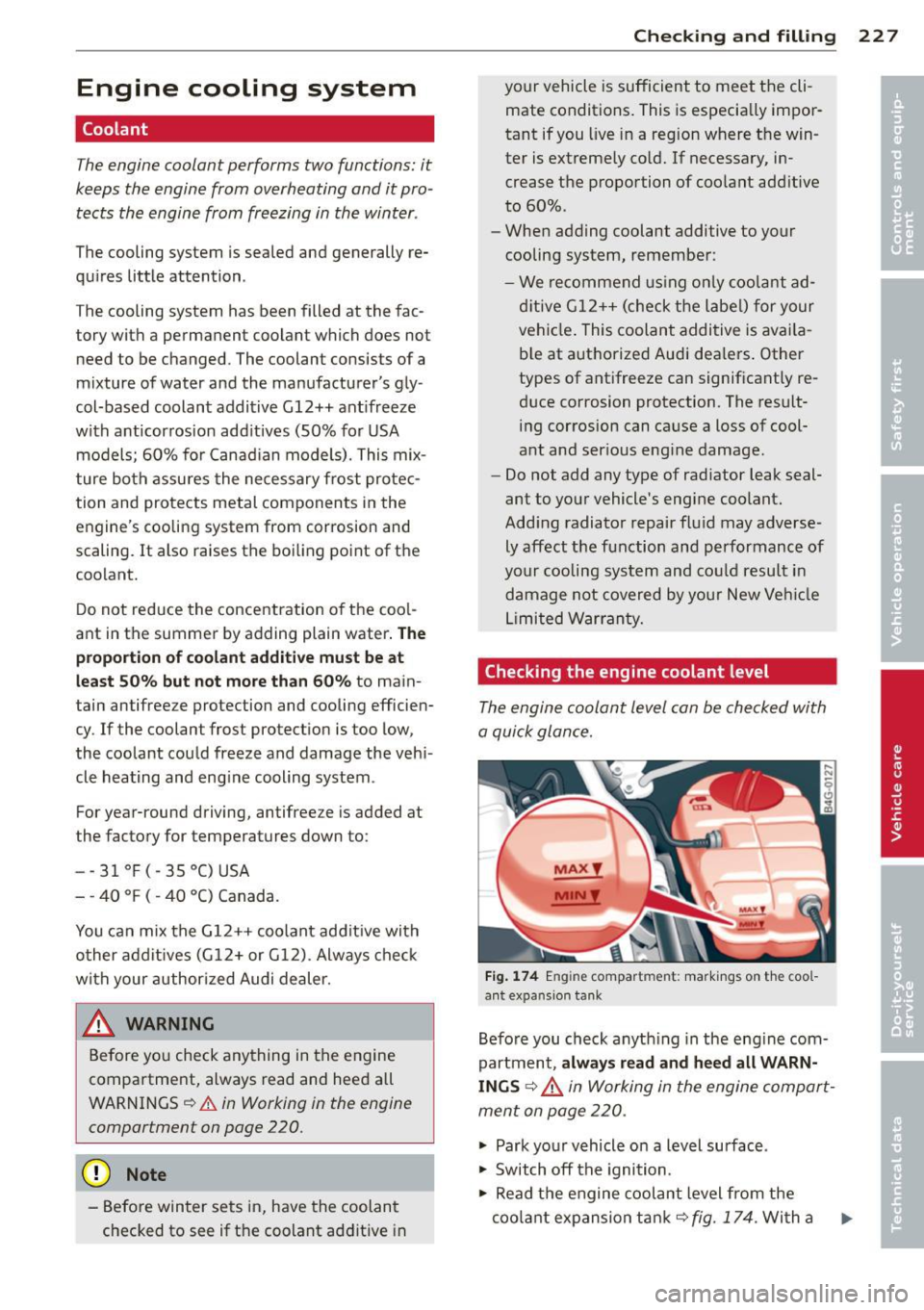
Checking the engine coolant level
The engine coolant level can be checked with
a quick glance.
M AX f
MINf
Fig.174 Engine compar tment: markings on the coo l
an t expa nsion tank
Before you check anything in the engine com
partment,
always read and heed all WARN
INGS ¢.&, in Working in the engine compart
ment on page 220 .
"' Park your vehicle on a level surface .
"' Switch off the ignition.
"' Read the engine coolant level from the
coolant expansion tank~
fig. 174. With a
Page 266 of 298
264 Fuses and bulbs
Fuses and bulbs
Fuses
Replacing fuses
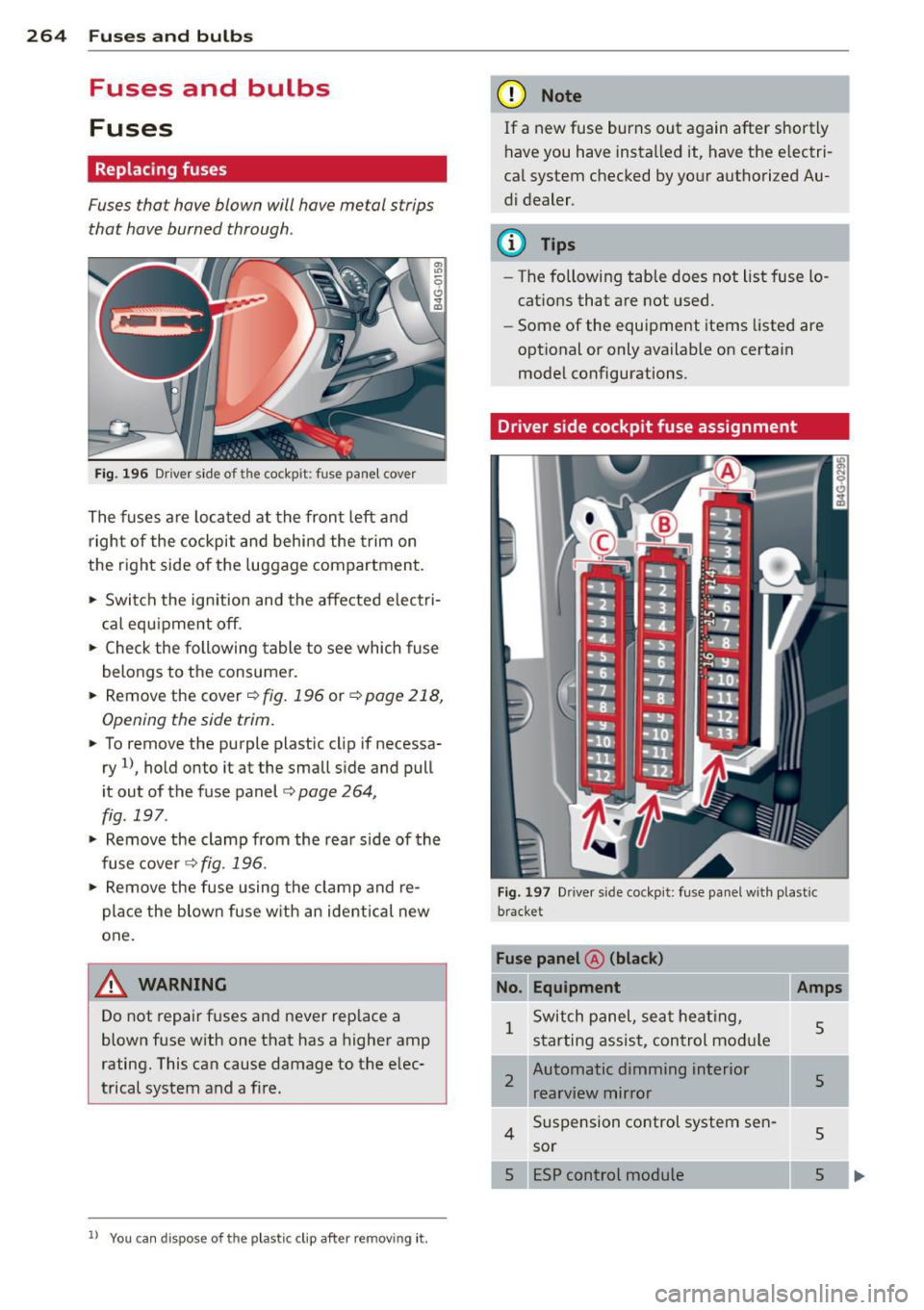
Fuses that have blown will have metal strips
that have burned through.
Fig. 196 Driver side of the cockpit: fuse panel cover
The fuses are located at the front left and
right of the cockpit and behind the trim on
the right side of the luggage compartment.
• Switch the ignition and the affected electri
cal equ ipment off.
• Check the following table to see which fuse
belongs to the consumer.
• Remove the cover ¢
fig. 196 or¢ page 218,
Opening the side trim.
• To remove the purple plastic cl ip if necessa
ry
ll, hold onto it at the small side and pull
it out of the fuse panel
c:> page 264,
fig. 197 .
• Remove the clamp from the rear side of the
fuse cover <>
fig. 196 .
• Remove the fuse using the clamp and re
place the blown fuse w ith an ident ical new
one.
A WARNING
Do not repair fuses and never replace a
blown fuse with one that has a higher amp
rating. This can cause damage to the elec
trical system and a fire.
ll You can dis pose of the plastic clip after re moving it.
(D Note
If a new fuse burns out again after shortly
have you have installed it, have the electri
cal system checked by your authorized Au
di dealer .
(D Tips
-The following table does not list fuse lo
cations that are not used.
- Some of the equipment items listed are
optional or only available on certain
model configurations.
Driver side cockpit fuse assignment
Fig. 197 Drive r side cockpit: fuse panel with plastic
bracket
Fuse panel @ (black)
No. Equipment Amps
1
Switch panel, seat heating,
5 starting assist, control module
2
Automatic dimming interior
s rearview mirror
4
Suspension control system sen-
5 sor
ESP control module
5
Page 293 of 298
_______________________________ I~ n~ d:::: e~x 291
Rear window heating (automatic climate
control) . . . . . . . . . . . . . . . . . . . . . . . . . . . . 67
Rear window heating (climate cont rol) . . . 65
Recirculation mode (automatic climate
control) . . . . . . . . . . . . . . . . . . . . . . . . . . . . 66
Recirculation mode (climate control) . ... 64
Refue lling ......................... 217
Remote control
Garage door opener (Homelink ®) .. .. . 120
Unlocking and locking ........ .. .... . 34
Remote rear lid release ............... 36
R . l epair manua s ............ .... .. .. . 278
Repairs Airbag system ........... .... .. .. .
158
Replacing Fuses .... .. .. ................ .... 264
Light bulbs .............. .... .. ... 267
Tires and wheels ......... .. .. .. .. . 247
Windshield wiper blades ... .. .. .. .. .. 47
Reporting Safety Defects ............. 131
Reset button . . . . . . . . . . . . . . . . . . . . . . . . 26
Retractor .. .. ............. .... .. .. . 136
Rims (cleaning) ................ .. ... 209
Roof rack .................... ... ... . 57
L oading .. ..... ........... ... ... ... 58
Roof weight .... .. .... .... . .. .. .. .. 58
s
SAFE ...... ... ................ .... . 26
Safe driving habits ................. . 123
Safety belt position . . . . . . . . . . . . . . . . . 13 7
Safety belt height adjustment .. .. .. . 139
Safety belts worn by pregnant women . 138
Safety belt pretens ioner . . . . . . . . . . . . . . 140
Service and disposal ........... .... 140
Safety belt pretensioners Pre sense 187
Safety belts . ... ............ ... .. ... 136
cleaning 213
Danger to passengers who do not wear a
safety belt . . . . . . . . . . . . . . . . . . . . . . . 134
Fastening .. .. .. ......... .. .. .. ... 136
H eight adjustment .. .. .... .. .. .. .. . 139
Improperly worn ............ .. .... 139
Not worn ................ ... ... .. 134
Safety belt position ....... .. .. .. .. . 13 7 Safety
instructions . ......... ..... .. 136
Securing child safety seats .......... 179
Spec ia l considerations for pregnant
women ... .. .. .. ................. 138
Unfastening . .. .. .... ............. 138
Warning/indicator light ............ . 133
Warning light . . . . . . . . . . . . . . . . . . . . . . 17
Why YOU MUST wear them .......... 133
Worn properly ... .. . .......... .... 135
Safety belt tens ioner
drive select ...... .. ..... ........... 95
Safety be lt warning light ............. 133
Safety compliance sticker ........ .. .. 274
Safety equ ipment .. .... ............. 123
Safety features for occ upant restraint and
protection . ... .... ... .... ........ .. 123
Safety gu idelines
Seat adjustment . . . . . . . . . . . . . . . . . . . . SO
Safety instructions
E . ngme compartment .............. . 220
for side curtain airbags ............ . 166
for using child safety seats ......... . 172
for using safety belts ........... .. . . 136
Monitoring the Advanced Airbag Sys-
tem ...... .. .. .. .. . .............. 157
Safety systems Warning/indicator lights ........... .. 18
Seat adjustment Controls .. .. .. .. .... ............. . 51
Driver's seat . . . . . . . . . . . . . . . . . . . . . . . SO
Front passenger's seat ............. .. 51
Front seats . . . . . . . . . . . . . . . . . . . . . . . . SO
Head restrai nts . . . . . . . . . . . . . . . 52, 12 7
Safety guidelines ..... ......... .... . SO
Seat belts WhyYOUMUSTwearthem .......... 133
Seat heating/ventilation (automatic cli -
mate control) ... .. .. ............... . 67
Seat heating (climate con trol) . . . . . . . . . . 65
Seating position
Driver ....... ... .. ..... .......... 124
Front passenger .................. . 125
How to adjust the front seats ...... .. 125
Incorrect seat position .......... .... 127
Occupants ... .... .. . .. .......... .. 124
Rear passengers .. .. . .......... .. .. 126
Seat memory . . . . . . . . . . . . . . . . . . . . . . . 53 •
•
Page 296 of 298
29 4 Index
Safety belt . . . . . . . . . . . . . . . . . . . . . . . . 17
Turn signa ls . .. . ...... ... .. .. .... .. 22
War ning/Ind icator lights
A irbag system . . . . . . . . . . . . . . . 1S4, 155
PASSENGER A IR BAG OFF .. .. .. .... . 1S5
Warranty coverages ............. .... 278
Washer reservoir ....... ... .. .. .... . 234
Washing .. .... ........... .. .. .... . 204
Automat ic ca r wash ................ 205
by hand ......... ....... ... .. .... . 205
with a power washer ...... .. .... .. . 206
Waxing ........................... 207
Wear indicator ..................... 245
Weights . .. .. ............. .. .. .. .. . 274
What happens if you wear your safety belt
too loose? ......................... 137
What happens to unbelted occupants? .. 134
What impairs driving safety? . .. .. .. .. . 124
What should I do after changing a
wheel? .. .. .. ... .... ...... ... ... .. . 242
What should I do after replacing wheels? 242
Wheel bol ts
Torq ue . .. .... ........... ........ . 252
Wheels ... .. ................ ... ... 235
Cast alloy .. .................. ... . 209
Check ing tire pressure .............. 241
Cold t ire in flat ion p ressu re . .. .. .... . 239
General notes ............ .. .. .. .. . 235
Glossary of tire and loading termino lo-
gy . ..... .. ... .. ..... ... .. .. .... . 236
New tires and wheels .... .. .. .. .. ... 246
Tires and vehicle load lim its .. .. .. ... 243
When must a safety belt be rep laced? . . 136
When must the airbag system be inspect -
ed? ... .. .. .. .. . .... ...... ... ... .. . 154
When should I ad just the tire pressures? 242
When shou ld I check the tire pressures? . 242
Where are lower anchorages located? ... 183
Where can I find the tire pressures for my
car? . ... .... ... . ...... ... .. .. .... . 24 1
Why safety bel ts? . . . . . . . . . . . . . . 133, 134
W indows
Cleaning ..................... ... . 208
defrost ing (automatic climate control) . 67
defrost ing (cl imate control) .. .. .. .... 65 Windsh
ie ld
Cleaning . ..... .. .. ... ..... ... .. .. . 46
defrosting (automatic cli mate control) . 67
defrosting (climate control) . . . . . . . . . . 6S
Windsh ie ld washer system ............ 46
Washer fl u id level . . . . . . . . . . . . . . . . . . 21
Washer reservoir .... .. ..... .... . .. 234
Windsh ie ld wipers
Folding up .... .. ............. ..... 4 7
Indicator light ... ............. .. .. . 21
Rep lacing windsh ield wiper b lades . ... . 47
Switching on/off ... .... .... ... .. .. . 46
Winter operation Battery . .. .. .. .. .. ... ........ .. .. 230
Cooling system ... ............. .... 22 7
Defrost ing windows (automatic climate
control) ... .... .. .. ... ..... ... .. .. . 67
Defrosting windows (climate control) .. 65
Seat heating (automat ic climate control) 67
Seat heating (climate control) . . . . . . . . 65
Steering wheel heat ing .............. 68
Tires ............................ 193
Windows ........................ 208
Winter tires . .... ................... 250
All-wheel drive . .. ............. .... 250
X
Xenon-Lights . . . . . . . . . . . . . . . . . . . 41, 267