transmission AUDI S6 2012 User Guide
[x] Cancel search | Manufacturer: AUDI, Model Year: 2012, Model line: S6, Model: AUDI S6 2012Pages: 298, PDF Size: 74.43 MB
Page 109 of 298
Driving the automatic transmission
Applies to vehicles: with tiptronic
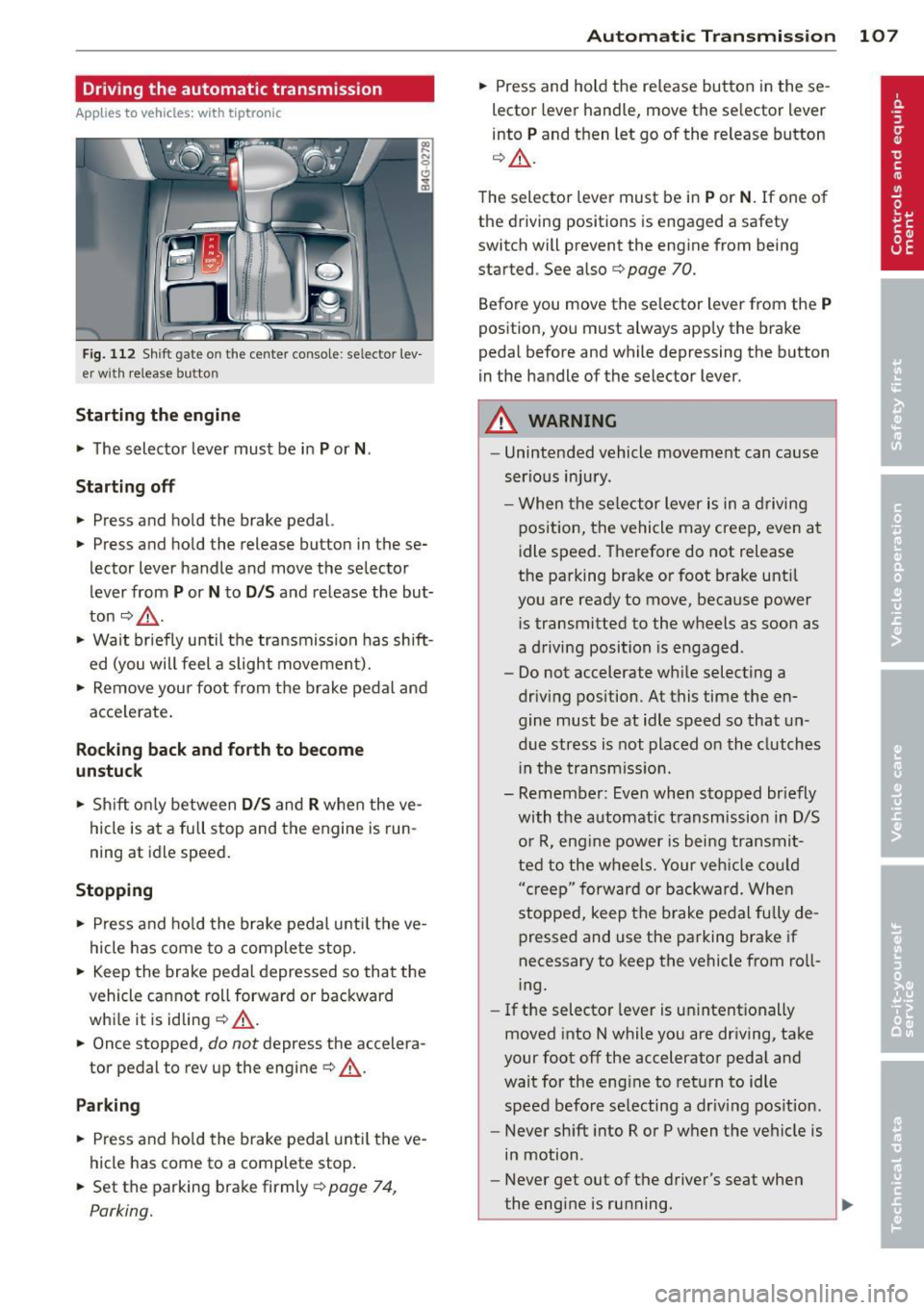
Fig. 112 Shift gate on the center conso le: selector lev
er w ith release button
Startin g the engine
~ The selector lever must be in P or N.
St arting off
~ Press and hold the brake pedal.
~ Press and hold the release button in these
lector lever handle and move the selector
lever from
P or N to D /S and release the but
ton
c:> _& .
~ Wait briefly until the transmission has shift
ed (you will feel a slight movement).
~ Remove your foot from the brake pedal and
acce lerate .
Rocking back and forth to become
un stu ck
~ Shift on ly between D /S and R when the ve
hicle is at a fu ll stop and the engine is run
ning at idle speed.
St opping
~ Press and ho ld the brake pedal unti l the ve
hicle has come to a complete stop.
~ Keep the brake pedal depressed so that the
vehicle cannot roll forward or backward
whi le it is idling
c:> .&._ .
~ Once stopped, do not depress the accelera
tor pedal to rev up the engine
c:> .&._ .
Park ing
~ Press and ho ld the brake pedal unti l the ve
hicle has come to a complete stop .
~ Set the parking brake firmly r=;,page 74,
Parking.
Automatic Tra nsmi ssi on 10 7
~ Press and hold the re lease button in these
lector lever handle, move the se lector lever
into
P and then let go of the release button
q A .
The selector lever must be in P or N . If one of
the driving positions is engaged a safety
switch will prevent the engine from being
started . See also
r=;, page 70.
Before you move the se lector lever from the
P
position, you must always app ly the brake
pedal before and while depressing the button
in the handle of the selector lever.
A WARNING
- Unintended vehicle movement can cause
serious injury .
- When the se lector lever is in a d riving
position, the vehicle may creep, even at
idle speed. Therefore do not release
the parking brake or foot brake until
you are ready to move, because power
i s transmitted to the wheels as soon as
a driving position is engaged.
- Do not accelerate while selecting a
driv ing position. At this time the en
gine must be at idle speed so that un
due stress is not placed on the clutches
i n the transmiss io n.
- Remember: Even when stopped br iefly
with the automatic t ransmission in D/S
o r R, eng ine power is bei ng transmit
ted to the wheels. Your veh icle cou ld
"creep" forward or backward. Whe n
stopped, keep the b rake pedal fully de
pressed and use the parking brake if
necessary to keep the vehicle from ro ll
i ng.
- If the selector lever is un intent ionally
moved into N while you are driving, take
your foot off the accelerator peda l and
wait for the eng ine to retu rn to idle
speed before selecting a dr iv ing pos ition.
- Never sh ift into R or P when the vehicle is
in motion .
- Never get out of the driver's seat when
the eng ine is ru nning.
Page 110 of 298
108 Automatic Transmission
-If you must g et out of the vehicle, move
the selector lever securely into the P po
sition and apply the parking brake f irmly.
-If the engine must remain running, never
have any driving position engaged when
checking under the hood. Make sure the
selector lever has securely engaged and
is locked in P with the parking brake
firmly set
r:!;> page 214, Engine compart
ment.
Otherwise, any increase in engine
speed may set the vehicle in motion,
even with the parking brake applied.
Selector lever posit ions
Appl ies to vehicles: with tiptronic
This section describes the selector lever posi
tions and driving ranges.
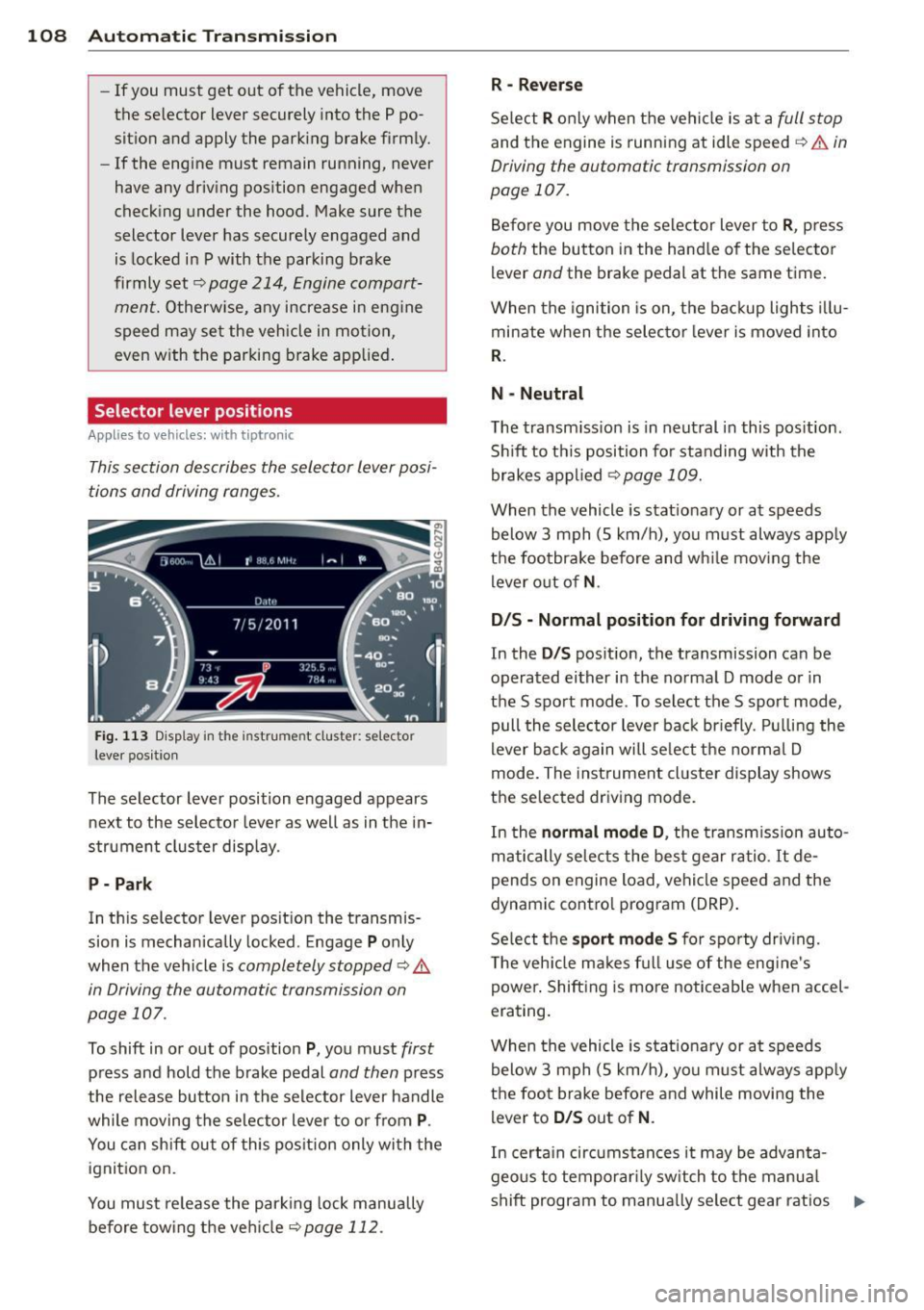
Fig. 113 Display in the instrume nt cluster: se lector
lever pos itio n
The selector lever position engaged appears
next to the selector lever as well as in the in
strument cluster display.
P - Park
In this selecto r lever position the transmis
sion is mechanically locked . Engage
P only
when the vehicle is
completely stopped ¢ A
in Driving the automatic transmission on
page 107 .
To shift in or out of position P, you must first
press and hold the brake pedal and then press
the release button in the selector lever handle
while moving the selector lever to or from
P.
You can shift out of this position only with the
ignition on.
You must release the parking lock manually
before towing the vehicle
<:!;>page 112.
R -Reverse
Select R only when the vehicle is at a full stop
and the engine is running at idle speed r:!;> ,& in
Driving the automatic transmission on
page 107.
Before you move the selector lever to R, press
both the button in the handle of the selector
l ever
and the brake pedal at the same time.
When the ignition is on, the backup lights illu
minate when the selector lever is moved into
R.
N - Neutral
The transmission is in neutral in this position .
Shift to this position for standing with the
brakes applied
<:!;>page 109.
When the vehicle is stationary or at speeds
below 3 mph (5 km/h), you must always apply
the footbrake before and while moving the
lever out of
N.
D/S - Normal position for driving forward
In the D/S position, the transmission can be
operated either in the normal D mode or in
the S sport mode . To select the S sport mode,
pull the selector lever back briefly. Pulling the
lever back again will select the normal D
mode. The instrument cluster display shows
the selected driving mode.
In the
normal mode D , the transmission auto
matically selects the best gear ratio.
It de
p ends on engine load, vehicle speed and the
dynamic control program (DRP).
Select the
sport mode S for sporty driving.
The vehicle makes full use of the engine's
power. Shifting is more noticeable when accel
erating.
When the vehicle is stationary or at speeds
below 3 mph (5 km/h), you must always apply
the foot brake before and while moving the
lever to
D/S out of N .
In certain circumstances it may be advanta
geous to temporarily switch to the manual
shift program to manually select gear ratios .,..
Page 111 of 298

to match specific driving conditions
¢page 110.
A WARNING
Read and follow all WARNINGS ¢.& in
Driving the automatic transmission on
page 107.
(D Note
Coasting downhill with the transmission in
N and the engine not running will resu lt in
damage to the automatic transmiss ion
and possibly the catalytic converter.
Automatic Shift Lock (ASL)
Appl ies to vehicles: with tiptro nic
The Automatic Shift Lock safeguards you
against accidentally shifting into a forward or
the reverse gear and causing the vehicle to
move unintentionally .
I
Fig. 114 Shift gate selector lever lock pos itions and
inte rlock butto n highlighted
The selector lever lock is released as follows :
• Turn the ignition on.
• Step on the brake peda l.
At the same time
press and hold the interlock button on the
side of the gear selector knob¢
fig. 114
with your thumb until you have moved the
selector lever to the desired position .
Automatic selector lever lock
"' N 0 0 (!)
cb
The selector lever is locked in the P and N po
sitions when the ignition is turned on. To
move the lever from these positions the driver
must depress the brake pedal. As a reminder
to the driver, the following warning appears in
Automatic Transmission 109
the instrument cluster display when the selec
tor is in
P and N :
When stationary apply footbrake while se
lecting gear
A time delay element prevents the selector
lever from locking when it is moved through
the
N posi tion (going from R to D/S ). The
locking element will lock the selector lever if
the lever is left in N (Neutral) for more than
approximately 1 second, without the brake
pedal being pressed .
At speeds above abo ut 3 mph (5 km/h) the
Automatic Shift Lock is automatically deacti
vated in the
N position .
Interlock button
The lock button on the selecto r lever prevents
the lever from being accidentally shifted into
certain positions. Pressing this button deacti
vates the selector lever lock. Depending on
the direction of the shift, the selector lever
locks at different positions . The positions are
highlighted in the illustration¢
fig. 114.
Kick-down
App lies to vehicles: wit h tiptro ni c
The kick-down feature allows the vehicle to
generate maximum acceleration .
When you press the accelerator pedal beyond
the resistance point that is reached at full
throttle, the transmission will select a lower
gear ratio based on vehicle speed and engine
RPM. The engine RPM will be controlled to
produce maximum vehicle acceleration as
long as you continue to press the accelerator
pedal beyond this resistance point .
_&. WARNING
Be careful when using the kick-down fea
ture on slippery roads. Rapid acceleration
may cause the vehicle to skid .
-
Page 112 of 298

110 Autom atic Tran smi ssi on
Dynamic shift program (DSP)
Appli es to vehicles: with tiptronic
The automatic transmission is electronically
controlled .
The transmission is self adapting and will au
t oma tically
select the best shift program suit
ed to the driving conditions and driving style .
The transmission will se lect one of the
econo
my programs when you drive at a steady
speed or a gradually changing speed without
heavy acceleration . This achieves optimum
fuel efficiency, with early upsh ifting and de
layed downshifting.
The transmission will automatically select the
s po rty shift programs when you drive at high
er speeds, or w ith heavy acceleration and fre
quent ly changing speeds. Upshifts are de layed
to make f ull use of eng ine power. Downsh ift
i ng takes p lace at higher engine speeds than
in the economy programs.
The se lection of the most suitable shift p ro
gram is a cont inuous, automati c process. The
driver can also make the t ransmission switch
to a sporty prog ram by
quic kly pressing down
the gas pedal.
This causes the transmission to shift down to
a lower gear to achieve rap id acceleration, e.g.
for qu ickly passing another veh icle. You do not
need to press the gas peda l into the kick-down
range. After the transmission has upshifted,
the original program is selected according to
your driving style.
An additional shift program allows the automatic transmission to select the proper gear
for uphill and downhill gradients.
This keeps the transmission from shifting up
a nd down unnecessari ly on hills. The trans
mission will shift down to a lower gear when
the driver presses the brake pedal on a down
h ill gradient. This makes use of the braking ef
fect of the eng ine without the need to shift
down manually .
Manual shift program
Applies to vehicles: wit h tiptronic
Using the manual shift program you can
manually select gears .
Fig . 115 Center conso le: sh ift ing the t iptron ic ma nual
l y
Fig . 1 16 D isp lay: manual sh ift prog ra m , se lected gear
hi ghlighted
Switching to manual shift program
.,. Push the selector lever to the rig ht from D/
5 . As soon as the transmission has sw itched
over, the se lected gear appears in the dis
p lay.
To u pshift
.,. Push the selector lever forward to the plus
position
0 ¢ fig .. 115 .
To down shift
.,. Push the lever to the minus pos ition 0 -
When accelerating, the transmission will au
tomatica lly shift into the next gear before the
engine reaches its maximum RPM.
If you apply a light throttle whe n accelerat-
ing, tiptronic wi ll automatically shift from 1st
to 2nd gear to save fuel. If you apply a heavy
throttle, the transmission wi ll stay in 1st gear .,.
Page 113 of 298

until near maximum RPM is reached, or until
the driver shifts into 2nd gear.
I f yo u take your foot off the accelerator pedal
when dr iving down a steep incline, tiptronic
will downshift from the selected gear into the
next lower gear until it reaches 1st gear,
based on road speed and engine RPM. Auto
matic downshifting is interrupted as soon as
you apply the throttle again.
@ Tips
- When you shift into the next lower gear,
the transmission will downshift only
when there is no possibility of over-rev
v ing the engine.
- When the kick-down comes on, the
transmission will shift down to a lower
gear, depending on vehicle and engine
speeds.
- tiptron ic is inoperative when the trans
mission is in the fail-safe mode .
Steering wheel with tiptronic
Applies to vehicles: with tiptro nic steer ing wheel
The shift buttons on the steering wheel allow
the driver to shift gears manually.
Fig. 117 Steering wheel: Sh ift buttons
• To downshift, touch the button on the left
0-
• To upsh ift, touch the button on the right
0-
The shift buttons are activated when the se
lector lever is in
D/S or in the manual shift
program (tiptronic).
Automatic Transmission 111
Of course, you can continue to use the manual
shift program with the selector lever on the
center console.
Transmission malfunction
Applies to vehicles : wit h tipt ro ni c
[O] Transmission : please press the brake ped
al and select the position again
Press the brake pedal and select the desired
selector lever position again. You can then
continue driving.
[O] Transmis sion hot: please modify driving
style
T he tran smission temperature has increased
s ig nificantly due to the sporty driving manner .
Dr ive in a less sporty manner until the tem
perature returns to the normal range and the
indicator light switches of.
[O] Transmission malfunction: You can con
tinue driving
T here is a system malfunction in the transmis
sion. You may cont inue driving. Drive to your
a uthor ized Audi dea le r or qualified repair fa
cility soon to have the malfunction corrected.
[O] Transmission malfunction: Limited driv
ing functionality
There is a system malfunction in the transmis
s ion. The transmission is switching to emer
gency mode. This mode on ly shifts into cer
tain gears or will no longer shift at all. The en
gine may sta ll. Drive to your authorized Audi
dealer or qualified repair facility immediately
to have the malfunction corrected .
[O] Transmission malfunction: Stop and shift
to P
Do not continue dr iving. Select the P selector
lever position and see your authorized Audi
dealer or qualified repair facility for assis
tance.
(D Note
If the transmission switches to emergency
mode, you should take the vehicle to an
IJll>
Page 114 of 298

112 Automatic Transmission
authorized Audi dealership as soon as pos
sible to have the condition corrected.
Emergency release of the selector lever
Applies to vehicles: with tiptro nic
If the vehicle's power supply foils, the selec
tor lever can be released in on emergency.
Fig. 118 Emergency release for selecto r lever
> To reach the emergency release mechanism,
remove the ashtray insert*.
> loosen and remove the small cap in the
ashtray mount
~ fig . 118 .
> You now have access to a bolt. Using a
screwdriver or similar, press the bolt down
and hold it down.
> Now press the interlock and move the selec-
tor lever to the
N position.
The selector lever can only be moved from the
P position if the ignition is turned on. If the
vehicle has to be pushed or towed if the power
supply fails (e.g. battery is discharged), the
selector lever must first be moved to the
N
position using the emergency locking device.
Page 194 of 298

192 Intelligent technology
freezing conditions ice) on the brake pads. A
few careful brake applications should dry off
the brake pads or remove any ice coatings.
The effectiveness of the brakes can be reduced
when the vehicle is driven on a salt-covered
road and the brakes are not used . Here too
,
you should clean off accumulated salt coating
from brake discs and pads with a few careful
applications of the brake
Q & .
Corrosion
There may be a tendency for dirt to build up
on the brake pads and corrosion to form on
the discs if the car is not driven regularly or
only for short trips with little use of the brakes.
If the brakes are not used frequently, or if cor
rosion has formed on the discs, it is advisable
to clean off the pads and discs by braking
f irmly a few times from a moderately high
speed
Q & .
Faults in the brake system
If you should notice a sudden increase in
brake pedal travel, then one of the two brake
circuits may have failed
Q & .
Low brake fluid level
Malfunctions can occur in the brake system if
the brake fluid level is too low. The brake fluid
level is monitored electronically.
Brake booster
The brake booster works with vacuum pres
sure which is created only when the engine is
running
Q & .
Brake lining wear status
Brake lining wear may be checked by visual in
spection of the condition of the brake pads
through the openings in the wheel. If neces
sary, the wheel may be removed for this in
spection
Q page 258, Changing a wheel.
WARNING
- You should perform braking maneuvers
for the purpose of cleaning the brake system only if road conditions permit.
Other road users must not be put at risk -
you may cause an accident!
- Before descending a steep grade, reduce
speed and shift transmission into a lower
gear or lower driving range. Do not ride
the brakes or hold the pedal down too
long or too often . This could cause the
brakes to get hot and diminish braking
efficiency.
- Do not "ride the brakes" by resting your
foot on the pedal when you do not intend
to brake. This may cause the brakes to
overheat, premature wear and increased
stopping distance.
- Under certain climatic and operating
conditions such as passing through wa
ter, driving in heavy rain or after washing
the vehicle, the effectiveness of the brakes can be reduced. In winter, ice can
accumulate on the brake pads, linings,
discs and drums. Carefully apply brakes
for a test. Brakes will dry and ice coat
ings will be cleaned off after a few care
ful brake applications.
- Driving for an extended period of time on
salt-covered roads without using your brakes can also affect braking efficiency.
Clean off accumulated salt coating from
brake discs and pads with a few careful
brake applications.
- If you damage the front spoiler, or if you
install a different spoiler, be sure the air
flow to the front brakes is not obstruct
ed. Otherwise the brake system could
overheat reducing the effectiveness of
the entire brake system.
- Failure of one brake circuit will impair
the braking capability resulting in an in
creased stopping distance. Avoid driving
the vehicle and have it towed to the near
est Audi dealer or qualified workshop.
- Never let the vehicle roll to a stop with
the engine shut off.
- If the brake booster is not working, for
example when towing your vehicle, or
because the brake booster has somehow
been damaged, the brake pedal must be
~
Page 205 of 298
different weight distribution. Safety, perform
ance and economy w ill greatly depend on how
carefu lly you load yo ur trailer and operate
your rig.
B efore you actua lly tow your trailer, practice
turning, stopping and backing up in a n area
away from traffic. Keep practicing until you
have become comp letely fam iliar with the way
your veh icle- trailer comb inat ion behaves and
responds .
Backing up is d ifficu lt and requires practice .
Backing up with a tra iler genera lly requires
steer ing action opposite to that when backing
up your vehicle without a trailer .
M aintain a g reater distance between your ve
hi cle and the one in front of you. You will need
more room to stop. To compensate for the
trailer, you will need a larger than norma l
turn ing radius.
When passing, remember that yo u cannot ac
celerate as fast as you normally would be
cause of the added load . Make s ure you have
e nough roo m to pass . After passing, allow
p lenty of room fo r your tra ile r befor e chang
in g la nes aga in.
Avoid jerky sta rts, sharp turns or rapid lane
cha nges.
(D Tips
- Do not tow a tra iler during the break- in
period of you r vehicle.
- If you t ow a trailer, your A udi may re
quire more frequent maintenance due to
the ext ra load
¢ page 2 78 .
Parking on a slope
Do not park on a slope with a trailer. If i t can
not be avoided, do so only after doing the fol
lowing:
When parking:
.. Apply the foot b rake .
.. Have someone place chocks under both the
vehicle and the trailer wheels.
Trailer towin g 203
.. W ith chocks in place, slowly release t he
brakes unt il the whee l choc ks absorb the
load .
.. Turn the whee ls towards t he curb .
.. App ly the parking brake.
.. Select the
P selector lever position .
When restarting after parking:
.. App ly the foot brake.
.. Sta rt the engine .
.. Select the
D/S selector lever position.
.. Release the park ing brake and s low ly pull
out a nd away from the wheel c hocks .
.. Stop and have someone retr ieve the wheel
chocks .
(D Tips
If you move the selector leve r of the auto
matic transmission to
P before applying
the p arking bra ke a nd before blo cking the
whee ls, y o u m ay h ave t o use more fo rce
lat er to move the lever out of the
P p osi
tion .
•
•
Page 216 of 298

214 Cleaning and protection
-When cleaning your safety belts, inspect
them for damage.
If you discover dam
age, see your Audi dealer .
- Always read and heed all WARNINGS and
other information
c> page 204.
Engine compartment
Be especially careful when cleaning the en
gine compartment.
Always switch off the ignition before clean
ing the engine
c> .&..
Plenum panel
Remove leaves from the plenum pane l in front
of the windsh ield under the engine compart
ment. This prevents the water dra in ho les
from becoming blocked, and it prevents de
bris from entering the vehicle interior through
the heating and venti lation ducts .
Corrosion protection
The engine compartment and transmission
have been corrosion -protected at the factory.
Good ant i-corrosion treatment is very impor
tant, particularly in the winter. If the veh icle
is frequent ly driven on salt treated roads , the
enti re engine compartment and plenum panel
should be tho roughly cleaned at the end of
winter and retreated to prevent sa lt damage.
At the same time, the underside of the vehicle
should be washed as we ll.
If the engine compartment is cleaned at any
time with grease removing solutions
1l, or if
you have the engine washed, the anti-corro sion treatment is a lmost always removed as
well. It is therefore essential to have a long lasting corrosion protection reapplied to all
surfaces, seams, joints and components in the
engine compartment .
1l Use o nly the co rrect cle anin g so lu ti on s. Ne ver use gas
o lin e or d ie se l fuel.
A WARNING
Be aware: The eng ine compartment of any
motor vehicle is a potentially hazardous
area .
- Before work ing in the engine compart
ment, be sure to read the information
c> page 220.
-Before reach ing into the front panel, al
ways sw itch off the ignition . Otherwise,
the windshield wiper system could unin
tentionally be switched on, possibly
causing personal injury from the moving
wiper linkage .
- Never reach into the area around or
touch the radiator fan. The auxiliary fan
is temperature controlled and can sw itch
on suddenly -even when the ignition is
off.
- Do not wash, wax or dry the engine with
the engine running . Moving or hot parts
could injure you.
- Do not clean the underside of the chas
sis, fenders, wheel covers, or other hard
to reach parts without protecting your hands and arms . You may cut yourself on
sharp-edged metal parts.
-Always read and heed all WARNINGS and
other information
c> page 204.
Page 238 of 298
236 Tires and wheels
-Never mount used tires on yo ur vehicle if
you are not sure of their "previous histo
ry." Old used tires may have been dam
aged even though the damage cannot be
seen that can lead to sudden tire failure
and loss of vehicle control.
Glossary of tire and loading terminology
Accessory weight
means the comb ined weight (in excess of
those standard items which may be rep laced)
of automatic transmission, power steering, power brakes, power windows, power seats,
radio, and heater, to the extent that these
items are availab le as factory -installed equip
ment (whether installed or not) .
Aspect ratio
means the ratio of the he ight to the w idth of
the tire in percent. Numbers of 55 or lower in
dicate a low sidewall for improved steering re
sponse and better overall handling on dry
pavement.
Bead
means the part of the tire that is made of
steel wires, wrapped o r reinforced by ply cords
and that is shaped to fit the r im.
Bead separation
means a breakdown of the bond between
components in the bead.
Cord
means the strands forming the plies in the
tire.
Cold tire inflation pressure
means the tire pressure recommended by the
vehicle manufacturer for a tire of a designated size that has not been driven for more than a
couple of miles (kilometers) at low speeds in
the three hour period before the tire pressure
is measured or adjusted. -
If you notice unusual vibration or if the
veh icle pulls to one side when driv ing, a l
ways stop as soon as it is safe to do so and check the wheels and tires for dam
age.
Curb weight
means the weight of a motor vehicle w ith
standard equipment including the maximum
capacity of fuel, oil, and coolant, air condi
tioning and additional weight of optiona l
equipment.
Extra load tire
means a t ire design to operate at h igher loads
and at higher inflation pressures than the cor
responding standard tire. Extra load tires may
be identified as "XL", "xl", "EXTRA LOAD", or
"R F" on the sidewall .
Gross Axle Weight Rating ( "GAWR ")
means the load-carrying capacity of a s ingle
axle system, measured at the tire-ground in
terfaces .
Gross Vehicle Weight Rating ("GVWR")
means the maximum total loaded weight of
the vehicle.
Groove
means the space between two adjacent tread
ribs .
Load rating (code)
means the maximum load that a tire is rated
to carry for a given inflation pressure. Yo u
may not find this information on all tires be
cause it is not required by law.
Maximum load rating
means the load rating for a tire at the maxi
mum permissib le inflation pressure for that
tire.