lock AUDI S6 2012 Manual PDF
[x] Cancel search | Manufacturer: AUDI, Model Year: 2012, Model line: S6, Model: AUDI S6 2012Pages: 298, PDF Size: 74.43 MB
Page 232 of 298
230 Check ing and filling
Before you check anything in the engine com
partment,
always r ea d and heed all W ARN
INGS
¢ A in Working in the engine compart
ment on page 220.
• Read the brake fluid leve l from the brake
fluid reservoir
¢ fig. 175. The brake fluid
l evel must be between the
"MIN" and
"MAX" markings .
The location of the brake fluid reservoir can be
seen in the engine compartment illustration
co page 222.
The fl uid level may drop slightly after some
time due to the automatic adjustment of the brake pads . This is not cause for alarm .
I f the b rake fluid level falls
considerably be
l ow the "MIN" mark, the brake wa rning/indi
cator light- (U.S.
models) ;II (Canadian
models) will come on
¢ page 14. Do not con
tinue to operate the vehicle. The comp lete
brake system shou ld be thoroughly checked
by an authorized Audi dealer or other quali
fied fac il ity and the cause corrected. If the
brake fluid level is too low, the brake warn ing/
i ndicator light w ill illuminate. Contact an au
thor ized Audi dealer
imm ediatel y.
Changing brake fluid
Have the brake fluid changed by an experi
enced technician .
Brake fluid absorbs moistu re from the a ir . If
the water content in the brake fluid is too
h igh, corrosion in the brake system may result
after a per iod of t ime . The bo iling po int of the
b rake fluid w ill also decrease considerably and
dec rease braking per formance.
Therefore, the brake flu id must be changed
ev ery tw o y ear s. Always use new b rake fluid
which confo rms to Fede ral Motor Vehicle
Standard "FMVSS 1 16 DO T 4".
The brake flu id rese rvoi r can be difficult to
r each, therefo re , we re commend that yo u
have the brake fl uid changed by yo ur a utho r
ized
Audi dealer. Your dea ler has the correct tools, the
right brake flu id and t he know -how
to do this for you.
A WARNING
-- Brake flu id is poisonous. It must be stor-
ed only in the closed or igina l container
out of the reach of children!
- Brake failure can resu lt from o ld or inap
propriate brake f lu id. Observe these pre
cautions:
- Use only brake f luid that meets SA E
spe cifi cation
J 17 03 and conforms to
Federa l Motor Vehicle Standard 1 16 .
Always chec k with your authorized A udi
dealer to make sure yo u are using the
correct brake fluid. The cor rect type of
brake flu id is also ind icated on the
brake f lu id reservoir.
- The brake fluid must be new. Heavy use
of the brakes can cause a vapor lock if
the brake fluid is left i n the system too
long . This can se riously affect the effi
c iency of the brakes as well as your
safety . T h is i:ou ld result in an ai;i;ident.
(D Note
Brake fluid will damage the pai nt of you r
vehicle .
@ For the sake of the environment
Because of the prob lem of proper disposal
of brake fluid as well as the spec ial too ls
r equired and the necessary expertise, we
r ecommend that yo u have the brake flu id
changed by yo ur autho rized Aud i dea le r.
Battery
General information
Under normal operat ing cond itions, the bat
te ry in your Audi does not need any ma inte
nance. With
high outside temperatures or
long da ily drives we recommend that you have
the e lectrolyte leve l che cked by a se rv ice fa
c il ity. The electroly te leve l should also be
chec ked each time the battery is cha rged
¢ page 233 .
Page 244 of 298
24 2 T ire s and wheel s
If the pressure in any tire is too low, note the
difference between the pressure in the cold
tire and the pressure you need and add the air
that you need to reach the correct pressure for
the vehicle load (passengers and luggage) for
the tires on your veh icle as listed on the on
your veh icle and in this manual and the k ind
of dr iving you p lan to do.
Ne ver exceed the m aximum inflat ion pres
s ur e liste d on th e tir e si dewall for any r ea
son.
Remember that the vehicle manufacturer, not
the tire manufacturer, determ ines the correct
tire pressure for the tires on your vehicle .
It is important to check the tire pressure when
the tires are cold.
- Read the required ti re p ressure from the tire
pressure label. The tire pressure labe l is lo
cated on the driver's side 8-p illar.
- Turn the valve stem cap counter-clockwise
to remove it from the tire valve.
- Place the air pressu re ga uge on the valve.
- T he tire pressures sho uld on ly be chec ked
and adjusted when the tires are cold. The
slightly raised pressures of warm tires must
not be reduced .
- Adjust the tire pressure to the load you are
carrying .
- Reinsta ll the va lve stem cap on the valve.
When should I ch eck the tire pressur e?
The correct tire pressure is especially impor
tant at high speeds. The pressure should
therefo re be checked at least once a month
and a lways befo re start ing a journey. Do no t
forget to check the tire pressure for the spare
wheel
¢ page 257 .
When should I adju st the tire p res sures?
Adjust the tire p ressu re to the load you are
carry ing. After changing a wheel
or replacing
wheels you have to adjust the tire pressures
on all wheels . In addition, you must then
store the new tire pressures in the tire pres
sure monitoring system*¢
page 253.
_& WARNING
Incorrect tire pressures and/or underinfla
tion can lead sudden tire fa ilure, loss of
control, collision, serious personal injury
or even death.
- When the warn ing symbol
[I) appears in
the instrument cluster, stop and inspect
the t ires.
- Inco rrect tire pressure and/or underinfla
tion can cause increased tire wear and
can affect the hand ling of the vehicle and
s topping abi lity.
- I nco rrect tire pressures and/or unde rin
f lation can a lso lead to sudden t ire fail
ure, including a blowou t and sudden de
flation, ca us ing loss of veh icle contro l.
- The drive r is responsible for the co rrec t
tire pressures for all tires on the veh icle.
The applicable pressure values are loca t
ed on a sticker on the driver's s ide 8 -pil
lar.
- On ly when all tires on the vehicle are fil
led to the correct pressure, the tire pres
sure mon itoring* system can work cor
rectly.
- The use of incorrect tire pressure va lues
can lead to acc idents or other damage.
Therefore it is essential that the driver
observe the spec ified t ire pressure values
for the tires and the correct pressures for
the function of the t i re p ress ure monito r
ing system*.
- Always inflate tires to the recommended
and correct t ire pressure before dr iv ing
off.
- Driving with underinf lated tires bend
mo re, letting them get too hot resulting
in tread separation, s udde n tire f ailure
and loss of cont ro l.
- Excessive speed and/overloading can
cause heat build- up, sudden tire failure
and loss of cont ro l.
- I f the tire pressure is too low or too high,
the t ires will wear prema turely and the
vehicle wi ll not handle well. ..,
Page 251 of 298
Driving with different tires reduces vehi
cle handling and can lead to a loss of
control.
- If the spare tire is not the same as the
tires that are mounted on the vehicle -
for example with winter tires -only use
the spare tire for a short period of time
and drive with extra care. Refit the nor
mal road wheel as soon as safely possi
ble.
- Never drive faster than the maximum
speed for which the tires on your vehicle
are rated because tires that are driven
faster than their rated speed can fail
suddenly.
- Overloading tires cause heat build-up,
sudden tire failure, including a blowout
and sudden deflation and loss of control.
- Temperature grades apply to tires that
are properly inflated and not over or un
deri nflated.
- For technical reasons it is not always
possible to use wheels from other vehi
des -in some cases not even wheels
from the same vehicle model.
- If you install wheel trim discs on the ve
hicle wheels, make sure that the air flow
to the brakes is not blocked. Reduced air
flow to the brakes can them to overheat, increasing stopping distances and caus
ing a collision.
- Run flat tires may only be used on vehi
cles that were equipped with them at the
factory. The vehicle must have a chassis designed for run flat tires . Incorrect use
of run flat tires can lead to vehicle dam
age or accidents. Check with an author
ized Audi dealer or tire specialist to see if
your vehicle can be equipped with run flat tires. If run flat tires are used, they
must be installed on all four wheels. Mix
ing tire types is not permitted.
- For technical reasons, it is not generally
possible to use the wheel rims from oth
er vehicles. This can hold true for wheels
of the same vehicle type.
Tires and wheels 249
- If the spare tire is different from the
tires that you have mounted on your ve
hicle (for example winter tires or wide
profile tires), then use the spare tire for a
short period of time only and drive with
extra care. Replace the flat tire with the
tire matching the others on your vehicle
as soon as possible .
- Never drive without the valve stem cap .
The valves could get damaged.
@) For the sake of the environment
Dispose of old tires in accordance with the
local requirements.
' Uniform tire quality grading
-Tread wear
- Traction AA A B C
- Temperature ABC
Quality grades can be found where applicable
on the tire side wall between tread shoulder
and maximum section width
c:> page 246,
fig. 182.
For example: Tread wear 200, Traction AA,
Temperature A.
All passenger car tires must conform to Feder
al Safety Requirements in addition to these
grades.
Tread wear
The tread wear grade is a comparative rating
based on the wear rate of the tire when tested
under controlled conditions on a specified
government test course.
For example, a tire graded 1S0 would wear
one and one half (11/2) times as well on the
government course as a tire graded 100.
The relative performance of tires depends
upon the actual conditions of their use, how
ever, and may depart significantly from the
norm due to variations in driving habits, serv
ice practices and differences in road character-
istics and climate. .,.. •
•
Page 253 of 298
The speed rating letter code (c::> page 23 7) is
on the side wall of the tire
c::> page 246.
A WARNING
Winter tires have maximum speed limits
that may be lower than your vehicle's max
imum speed . Always know the maximum
speed before driving off. Never drive faster
than the speed permitted for your specific
winter tires . This will cause damage to the
tires leading to an accident and serious
personal injury to you and your passen
gers.
A WARNING
Driving faster than the maximum speed
for which the winter tires on your vehicle
were designed can cause tire failure in cluding a blowout and sudden deflation,
loss of control, crashes and serious per
sonal injuries . Have worn or damaged tires
replaced immediately.
- Winter tires have maximum speed rating
that may be lower than your vehicle's
maximum speed .
- Never drive faster than the speed for
which the winter or other tires installed
on your vehicle are rated .
A WARNING
Always adjust your driving to the road and
traffic conditions. Never let the good ac
celeration of the winter tires and all-wheel
drive tempt you into taking extra risks . Al
ways remember :
- When braking, an all-wheel drive vehicle
handles in the same way as a front drive
vehicle.
- Drive carefully and reduce your speed on
icy and slippery roads, even winter tires
cannot help under black ice conditions.
@l For the sake of the environment
Use summer tires when weather condi
tions permit. They are quieter, do not wear
as quickly and reduce fuel consumption.
-
Tires and wheels
Snow chains
Snow chains may be fitted only to the front
wheels , and only to certain tire sizes. Ask your
authorized Audi dealer on which tire sizes
snow chains can be used.
If you are going to use snow chains, then you
must install them on the front wheels at
least.
The snow chains must have low-profile links
and must not be thicker than 0.4 inch
(10,S mm) , including the lock.
Remove wheel center covers and trim discs
before putting snow chains on your vehicle
c::> (]) . For safety reasons cover caps must then
be fitted over the wheel bolts. These are avail
able from authorized Audi dealers.
A WARNING ,..__
Using the wrong snow chains for your vehi
cle or installing them incorrectly can in
crease the risk of loss of control leading to
serious personal injury.
- Snow chains are available in different
sizes . Always make sure to follow the in
structions provided by the snow chain manufacturer .
- When driving with snow chains never
drive faster than the speed permitted for
your specific snow chains .
- Always observe local regulations.
(D Note
- Remove snow chains before driving on
roads not covered with snow to avoid
damaging tires and wearing the snow
chains down unnecessarily.
- Snow chains, which come into direct con
tact with the wheel rim, can scratch or
damage it. Therefore, make sure that the
snow chains are suitably covered . Check
the position of the snow chains after
driving a few yards and correct if neces
sary. Follow the instructions from the
snow chain manufacturer when doing so. ..,.
251
•
•
Page 259 of 298
Vehicle tool kit
Vehicle tool kit and jack
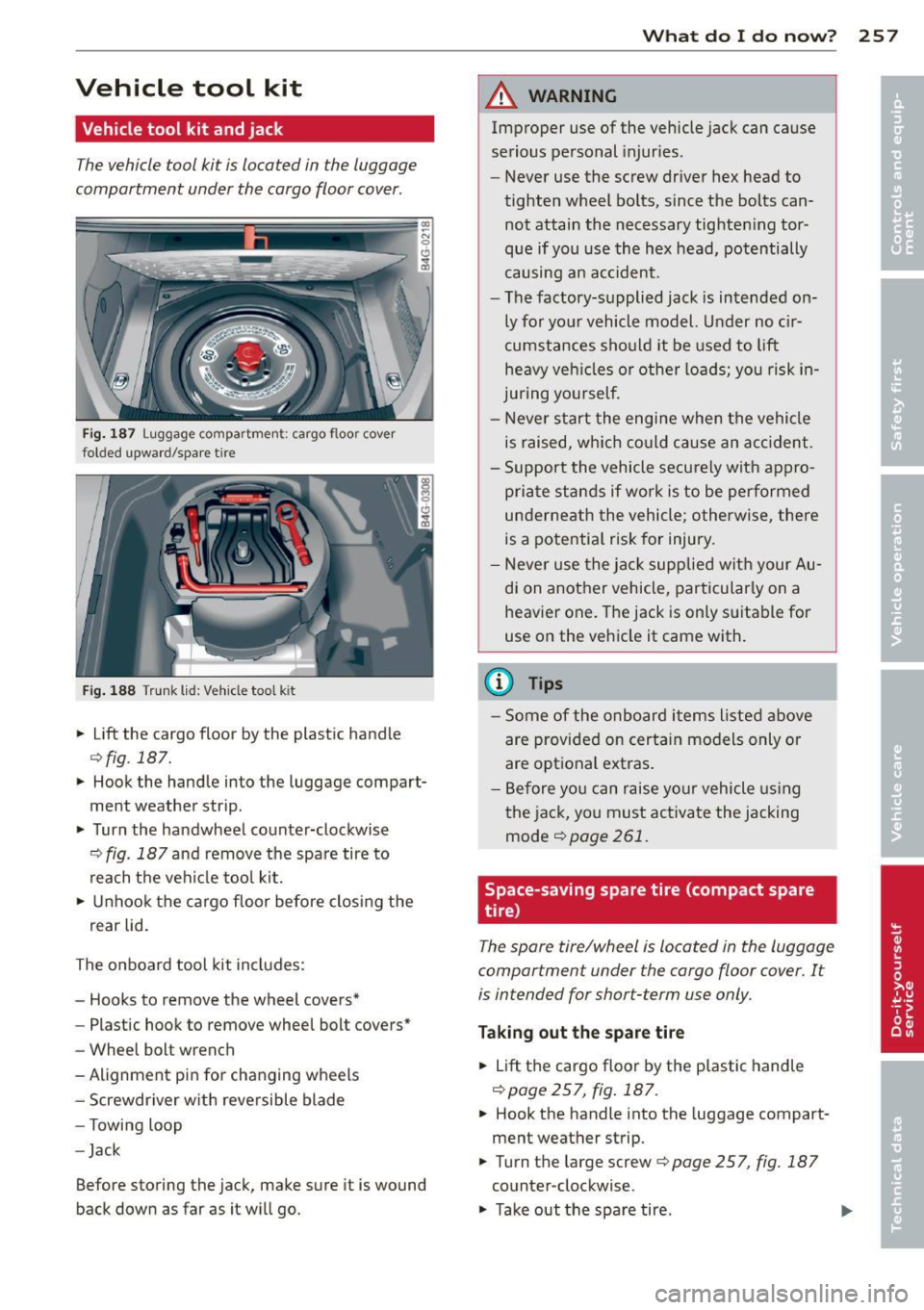
The vehicle tool kit is located in the luggage
compartment under the cargo floor cover .
Fig. 187 Luggage co mpa rtmen t: ca rgo f loo r cover
fol ded upwar d/spare t ire
Fig . 188 Trunk lid : Vehicle too l ki t
.. Lift the cargo floo r by the plastic handle
c:> fig . 187.
.. Hook the handle in to the luggage compar t
ment weather strip .
.. Turn the handwheel counter-clockwise
c:> fig . 187 and remove the spare tire to
reach the vehicle too l kit.
.,. Unhook the ca rgo floor before closing the
rear lid.
The onboard tool kit includes:
- Hooks to remove the wheel covers*
- Plastic hook to remove wheel bolt covers*
- Wh eel bolt wrench
- Alignment pin for changing wheels
- Screwdriver w ith reversible blade
- T owing loop
- Jack
Before stor ing the jack, m ake sure it is wound
back down as far as it will go.
What do I d o now ? 257
A WARNING
Im proper use of the vehicle jack can cause
serious personal injur ies.
- Never use the screw driver hex head to
tighten wheel bolts, since the bolts can
not attain the necessary tighten ing tor
que if you use the hex head, potentially
causing an accident .
- The factory-supplied jack is intended on
ly for yo ur vehicle model. Under no c ir
cumstances should it be used to lift heavy veh icles or other loads; you risk in
ju ring yo urself.
- Never start the engine when the vehicle
is raised, wh ich could cause an acc ident.
- Support the vehicle securely with appro
priate stands if work is to be performed
underneath the vehicle; otherwise, there
is a potentia l risk for injury.
- Never use the jack supplied wit h your Au
di on another vehicle, particularly on a
heavier one. The jack is only s uitable for
use on the vehicle it came with.
(D Tips
- Some of the onboard items listed above
are provided on certain models only or
are optional ext ras .
- Before yo u can raise your vehicle using
the jack, you must activate the jacking
mode
c:!) page 261.
Space-saving spare tire (compact spare
tire )
The spare tire/wheel is located in the luggage
compartmen t under the cargo floor cover . It
is intended for short-term use only.
T a king out th e spare tir e
.. Lift t he cargo floor by the p lastic handle
<=) page 257, fig . 187 .
.. Hook the handle into the luggage compart
ment weather strip.
.. Turn the large screw ¢
page 257, fig. 187
counter-clockwise .
.,. Take out the spare tire .
Page 261 of 298
• Move select or lever to p osition P q ,& .
• If you are towing a trailer, unhitch the trail
er from your veh icle.
• Take the
jack and the spare t ir e out of the
luggage compartment
q page 257,
q page 257.
A WARNING
You or your passengers cou ld be injured
while changing a whee l if you do not fol
low these safety precautions:
- If you have a f lat t ire, move a safe dis
tance off the road. Turn off the eng ine,
turn the emergency f lashers on and use
other warning devices to alert o ther mo
torists.
- Make su re that passengers wait in a safe
pla ce away from the ve hicle and well
away from the road and traffic.
- T o help preven t the veh icle from mov ing
sudden ly and possibly slipping off the
jack, always fully set the parking brake
and block the whee l diagonally opposite
the wheel being changed . When one
front wheel is lifted off the ground, plac
ing the Automat ic Transm iss ion in "P"
(Park) will
not prevent the vehicle from
moving.
- Before you change a wheel, be sure the ground is level and fi rm. If necessa ry,
use a sturdy board under the jack.
- After installing the spa re wheel, make
sure that you replace the flat tire/whee l
in its sto rage area properly and tighten
the kn u rled re taining screw securely.
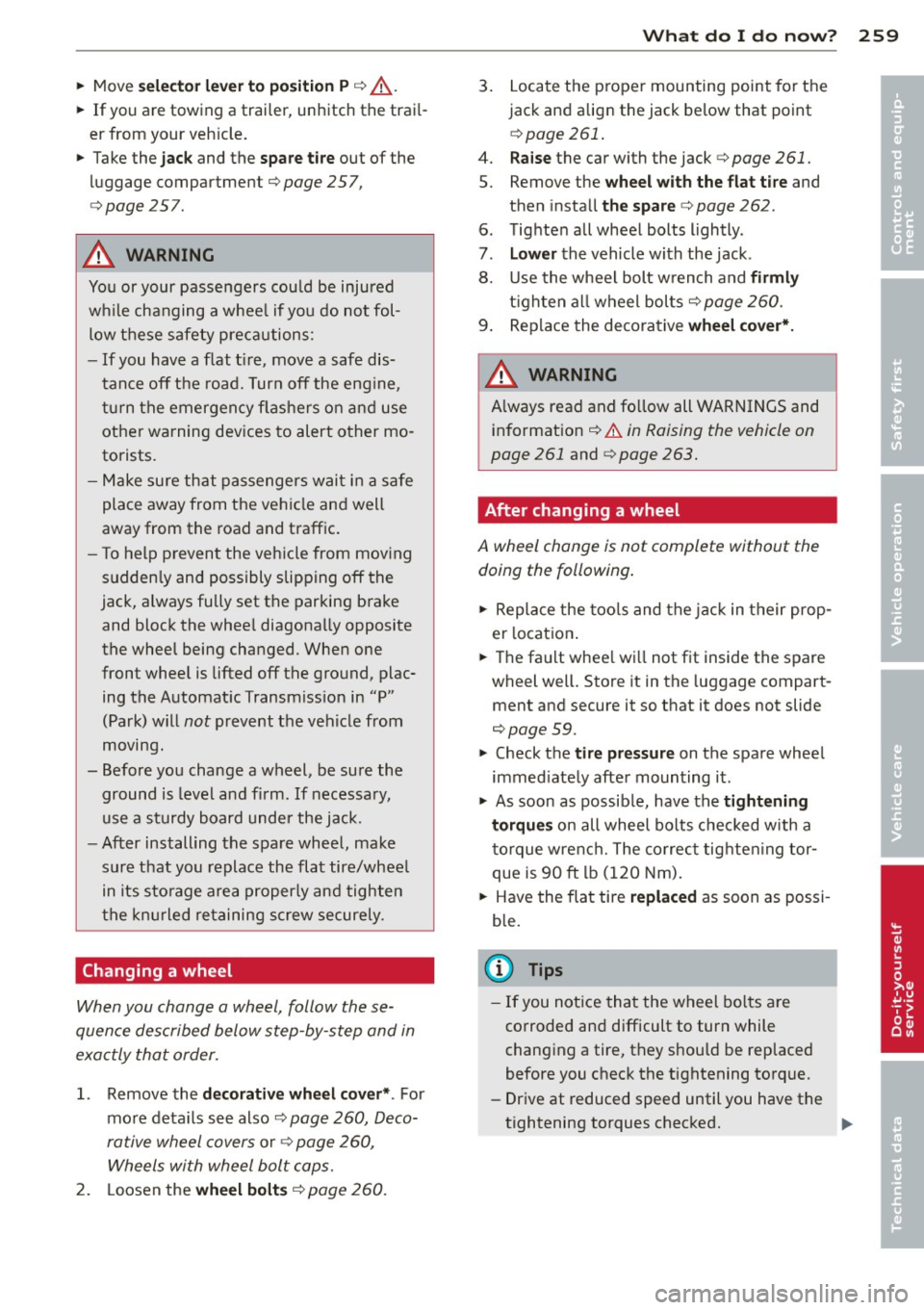
Changing a wheel
When you change a wheel, follow the se
quence described below step-by-step and in
exa ctly that order .
-
1. Remove the decorati ve wheel cov er* . For
mo re deta ils see also
Q page 260, Deco
rative wheel covers
o r q page 260,
Wheels with wheel bolt caps.
2 . Loosen the wheel b olts q page 260.
What do I do now? 259
3. Locate the proper mounting point for the
4.
5.
6.
7.
8.
9 .
jack and align the jack below that point
q page 261.
Raise the car with the jack q page 261.
Remove the wheel with the flat tire and
then insta ll
th e spare c> page 262.
Tighte n all wheel bolts lightly.
Lower the vehicle wi th the jack.
U se the wheel bolt w rench and
firmly
t ighten a ll wheel bolts q page 260 .
Replace the decora tive wheel co ver*.
A WARNING
A lways read and fo llow all WARNINGS and
informat ion¢
& in Raising the vehicle on
page 261
and r::> page 263.
After changing a wheel
A wheel change is not complete without the
doing the following .
• Replace the too ls and the jac k in their prop
er locat ion .
• The fault whee l wi ll not fit inside the spare
wheel well. Store it in the luggage compart
ment and secure it so that it does not slide
r::>page 59.
• Check the tire pressure on the spare wheel
immed iate ly after mounting it.
• As soon as possib le, have the
tightening
torqu es
on all wheel bolts c hec ked with a
t o rque wrenc h. The co rrec t tighte ning tor
que is
90 ft lb (120 Nm).
• Have the flat tire
replaced as soon as possi
b le.
(D Tips
- I f you not ice that the wheel bo lts a re
corroded and difficult to turn while
changing a tire, they should be rep laced
before you check the tightening torque.
- Drive at reduced speed until you have the
tightening torques checked. ..,_
•
•
Page 262 of 298
260 What do I do now?
-After changing a wheel, the tire pressure
i n a ll four ti res must be checked/cor rect
ed and t he tire pressure mo nitor ing indi
cator m ust b e stored in the MMI
Q page255 .
Decorative wheel covers
Applies to vehicl es: with decorative wheel covers
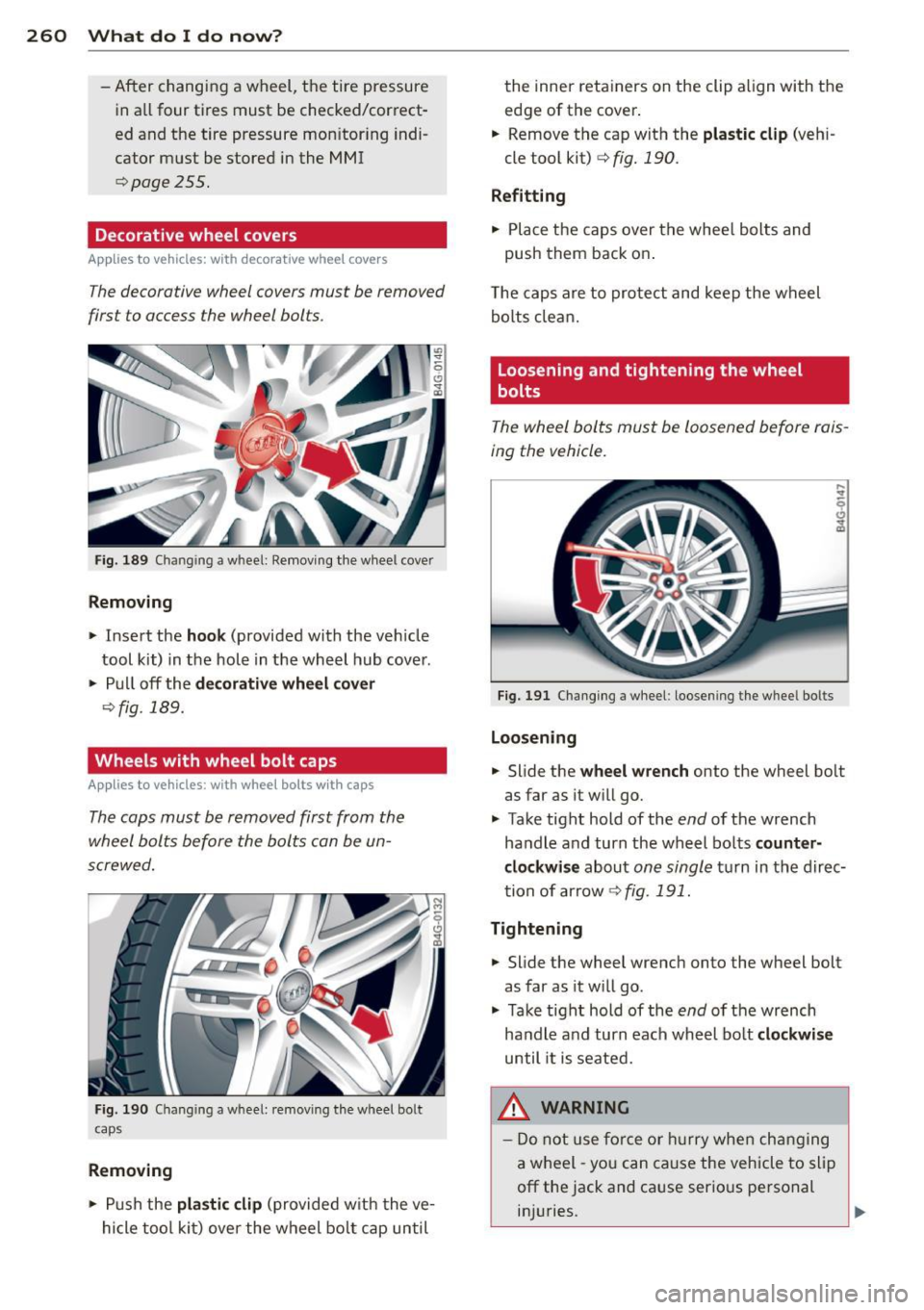
The decorative wheel covers must be removed
first to access the wheel bolts .
Fig. 189 Chan ging a w hee l: R em ovin g the whee l cove r
Removing
.. Inse rt the
hook (provided with the ve hicle
tool kit) in the hol e in the wheel hub cove r .
.. Pull off the
decorative wheel cover
c> fig. 189.
Wheels with wheel bolt caps
Applies to vehicles: with wheel bolts with caps
The caps must b e removed first from the
wheel bol ts before the bol ts can be u n
s cre wed.
Fig . 19 0 Chang ing a w hee l: remov ing t he w heel bo lt
caps
Removing
" Push the
plastic clip (provide d w ith the ve
hicle too l ki t) over the w heel bo lt ca p un til the inner
reta iners on the clip a lign with t he
edge of the cover .
.. Remove the cap with the
plastic clip (veh i
cle tool kit)
c> fig. 190.
Refitting
.. Pla ce t he caps over t he whee l bolts and
push them back o n.
T he cap s are to pro te ct and kee p the w heel
b olts clean .
Loosening and tightening the wheel
bolts
T he wheel bol ts mu st be loosened befo re rais
ing the vehicle .
Fig. 191 Cha ng ing a w heel: loosenin g th e w hee l bol ts
Loosening
.. Slide the
wheel wrench ont o the wheel bo lt
as far as it w ill go.
.. Take tight hold of the
end of the wrench
ha ndle a nd turn th e wheel bo lts
counter
clockwise
about on e single tu rn in the dire c
tion of ar row
c> fig. 191.
Tightening
.. Slide the wheel wrenc h onto the wheel bolt
as far as it w ill go .
" Take tig ht hold of the
end of the wr ench
ha ndle a nd turn each wh eel bo lt
clockwise
until it is seate d .
.8_ WARNING
- Do n ot u se forc e or hurry whe n ch ang ing
a w heel -yo u can ca us e the vehicle to sli p
off the jack and ca use ser io us pe rso nal
i njur ies.
Page 268 of 298
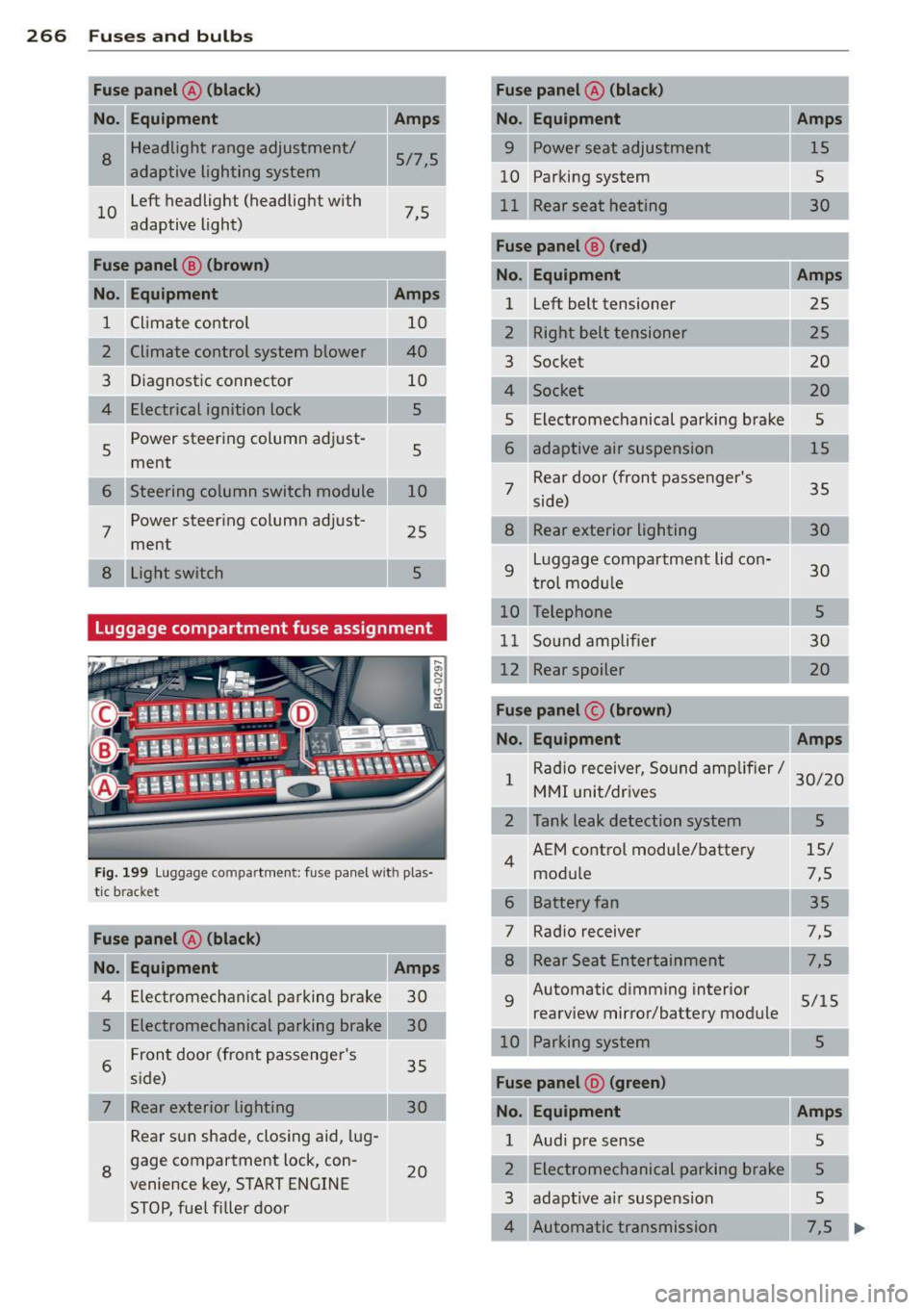
266 Fuses a nd bulb s
Fuse panel @ (black )
No . Equ ipment Amps
=
8
Headlight range adjustment/
5/7,5
adaptive lighting system
10 Left headlight (headlight with
7,5
adaptive light)
Fuse p anel
@ (brown )
No .II Equ ipm ent
II Amp s
1 Climate control 10
2 Climate control system blower 40
3 Diagnostic connector 10
4 Electrical ignition lock 5
5 Power steering column adjust-
ment
5
Steering column switch module 10
7 Power steer
ing column adjust-
ment 25
8 Light switch
Luggage compartment fuse assignment
Fig. 199 Luggage compartment: fuse panel with plas·
tic bracket
Fuse panel @ (bl ack )
No. II Equipment
I[ Amp s
4 E lectromechanical parking brake 30
5 Electromechanical parking brake 30
6 Front door (front passenger's
35
side)
7 Rear exterior lighting Rear sun shade, closing aid, lug
s gage compartment lock, con
venience key, START ENGINE
STOP, fuel filler door 30
20
-Fuse pane
l@ (blac k) I
No. Equipm ent Amps
=· 9 Power seat adjustment 15
10 Parking system
s
30
Fus e pane l
B (red)
No . Equipment Amps
1 Left belt tensioner
25
Right belt tensioner 25
3 Socket 20
20
Electromechanical parking brake
5
adaptive air suspension 15
7 Rear door (front passenger's
35
side)
Rear exterior lighting 30
9
Luggage compartment lid con-
30
t rol module
10 Telephone 5
11 Sound amp lifier 30
12 Rear spoiler 20
Fuse pane l c (b rown )
No. Equipment Amps
1 Rad
io receiver, Sound amplif ier/
30/20
MMI unit/dr ives
2 Tank leak detection system 5
AEM control module/battery 15/
4
module 7,5
6 Battery fan 35
Rad io receiver
7,5
7,5
9
Automatic dimming interior
5/15
rearview mirror/battery module
Parking system 5
Fu se pan el o (gre en)
No. Equipment Amps
1 Audi pre sense 5
2 Electromechanical parking brake 5
3 adaptive a
ir suspension
5
Automatic transmission 7,5
...
Page 272 of 298

2 70 Emergency situations
-When connecting jumper cables, make
sure that they cannot get caught in any
moving parts in the engine compart
ment.
- Before you check anything in the engine
compartment, always read and heed all
WARNINGS c:>
page 214, Engine com
partment.
(D Note
Improper hook-up of jumper cables can ru
in the generator.
-Always connect POSITIVE(+) to POSI TIVE(+), and NEGATIVE( -) to NEGATIVE
( - ) ground post of the battery manager
control unit.
- Check that all screw plugs on the battery
cells are screwed in firmly . If not, tighten
plugs prior to connecting clamp on nega
tive battery terminal.
- Please note that the procedure for con
necting a jumper cable as described
above applies specifically to the case of
you r vehicle being jump started. When
you are giving a jump start to another ve
hicle, do
not connect the negative(-) ca
ble to the negative(-) terminal on the
discharged battery@c:>
fig. 201. In
stead, securely connect the negative(-)
cable to either a solid metal component
that is firmly bolted to the engine block
or to the engine block itself. If the bat
te ry that is being charged does not vent
to the outside, escaping battery gas
could ignite and explode!
Emergency towing
with commercial tow
truck
General hints
Your Audi requires special handling for tow
tng.
The follow ing information is to be used by
commercia l tow truck operators who know
how to operate their equipment safely.
-Never tow your Audi. Towing will cause
damage to the engine and transmission .
- Never wrap the safety chains or winch ca
bles around the brake lines.
- To prevent unne cessary damage , your Audi
must be transported with a flat bed truck.
- To load the vehicle on to the flat bed, use
the towing loop found in the vehicle tools
and attach to the front or rear anchorage
c:>page 270 and c:>page 271.
.&_ WARNING
=
A vehicle being towed is not safe for pas-
-
sengers. Never allow anyone to ride in a
vehicle be ing towed, for any reason.
Front towing loop
Only install the front towing loop when it is
needed.
Fig. 202 Front bumpe r: cove r
Fig. 203 Front bumper: installing the towing loop
There are threads located behind the right
s ide of the front bumper where a towing loop
can be installed. The threads are located be
hind a cover.
.,. Remove the tow ing loop from the vehicle
tool kit.
Page 276 of 298

2 7 4 General information
General information
Explanation of
technical data
Some of the technical data listed in this man
ual requires further explanation .
The technical data for your vehicle is listed in
the charts starting on
r:::> page 2 76. This sec ·
tion provides general information, notes and restrictions which apply to this data .
Vehicle identification
The key data is given on the vehicle identifica·
tion number (VIN) plate and the vehicle data
sticker.
Fig. 209 Veh icle Ide ntific atio n Number (VlN) p late: lo
cation on driver 's sid e das h panel
Fig. 210 Th e vehicle identi fication label -inside the
luggage co mpa rtmen t
The Vehicle Identification Number (VIN)
is located on the driver's side so that it is visi
b le from the outside through the windshield
r:::> fig . 209. You can also display the Vehicle
Identification Number of your vehicle in the
MMI. Select: Function button
ICAR ! > Car sys
tems
> VIN number . The
vehicle identification label
is located in the luggage compartment in the
spare wheel wel l.
The label¢
fig. 210 shows the following vehi
cle data :
(D Production control No .
@ Vehicle identification No.
® Type code number
@ Type designation/engine output in Kilo·
watts
® Engine and transmission code letter
@ Paint No./Interior
(f) Optional equipment No.'s
Vehicle data 2 to 7 are also found in your War·
ranty
& Maintenance booklet.
The safety compliance sticker
is you r assurance that your new vehicle com
plies with all applicable Federal Motor Vehicle
Safety Standards which were in effect at the
time the vehicle was manufactured . You can
find this sticker on the left door jamb.
It
shows the month and year of production and
the ve hicle ident ification number of your vehi ·
cle (perforation) as well as the Gross Vehicle
Weight Rating (GVWR) and the Gross Axle
Weight Rating (GAWR) .
The high voltage warning label
is located on the lock carr ier .
The spark ignition system complies with
the Canadian standard ICES-002.
Weights
Gross Vehicle Weight Rating
The Gross Vehicle Weight Rating (GVWR), and
the Gross Axle Weight Rating (GAWR) for
front and rear are Listed on a sticker on the
left door jamb.
The Gross Vehicle Weight Rating includes the
weight of the basic vehicle plus full fuel tank,
oi l and coolant, plus maximum load, wh ich in·
eludes passenger weight (lSO lbs/68 kg per
Ill>