warning light AUDI S6 2013 Owners Manual
[x] Cancel search | Manufacturer: AUDI, Model Year: 2013, Model line: S6, Model: AUDI S6 2013Pages: 306, PDF Size: 76.92 MB
Page 241 of 306
Battery replacement
The new battery must have the same specifi
cations and dimensions as the original equip
ment battery.
Intell igent energy management in your vehi
cle is respons ible for d istributing the electri
cal energy throughout your vehicle
~ page 197. The intel ligent energy ma nage
ment system w ill keep the eng ine batte ry
charged be tte r than vehicles w ithout t his sys
tem . To make sure the additional e lectrical en
ergy is available once again after you have
changed the battery, we recommend that you
install batteries of the same type and man u
facture only (the same as those installed at
the time your vehicle was delivered). Specifi
cations a re listed on the battery hous ing . Your
author ized dealer must code the battery in
the energy management system to enable you
to use the energy managemen t fu nctions co r
rectly a fter replacing the battery .
The new battery must have the same capacity,
voltage (12-vo lts), a mperage, construct ion
and p lug sealing.
When installing the battery , make sure the ig
n ition and all e lectr ica l cons umers are sw itch
ed off.
CD Note
Make sure the ventilation hose on the s ide
of the battery is connected, ot herwise
fumes or battery ac id can leak out.
- Vehicles with the Start-Stop-System* are
equipped with a specia l cycle-proof AGM
batte ry. Insta lling a different type of
batte ry can c ause prob lems in the vehi
cle electrical system . When rep lacing the
vehicle battery, always insta ll one with
the same specifications as the original battery.
@ For the sake of the environment
Because of the problem of proper disposa l
of a battery, we recommend your author
ized Aud i dea ler change the battery for
you. Batter ies contain sulf uric ac id and
Checkin g and fillin g 239
lead and must always be disposed o f prop
erly in compliance with a ll environmental
regulations. Disposing of vehicle batter ies
i mproperly is very dangerous to the envi
ronment.
Windshield/headlight
washer container
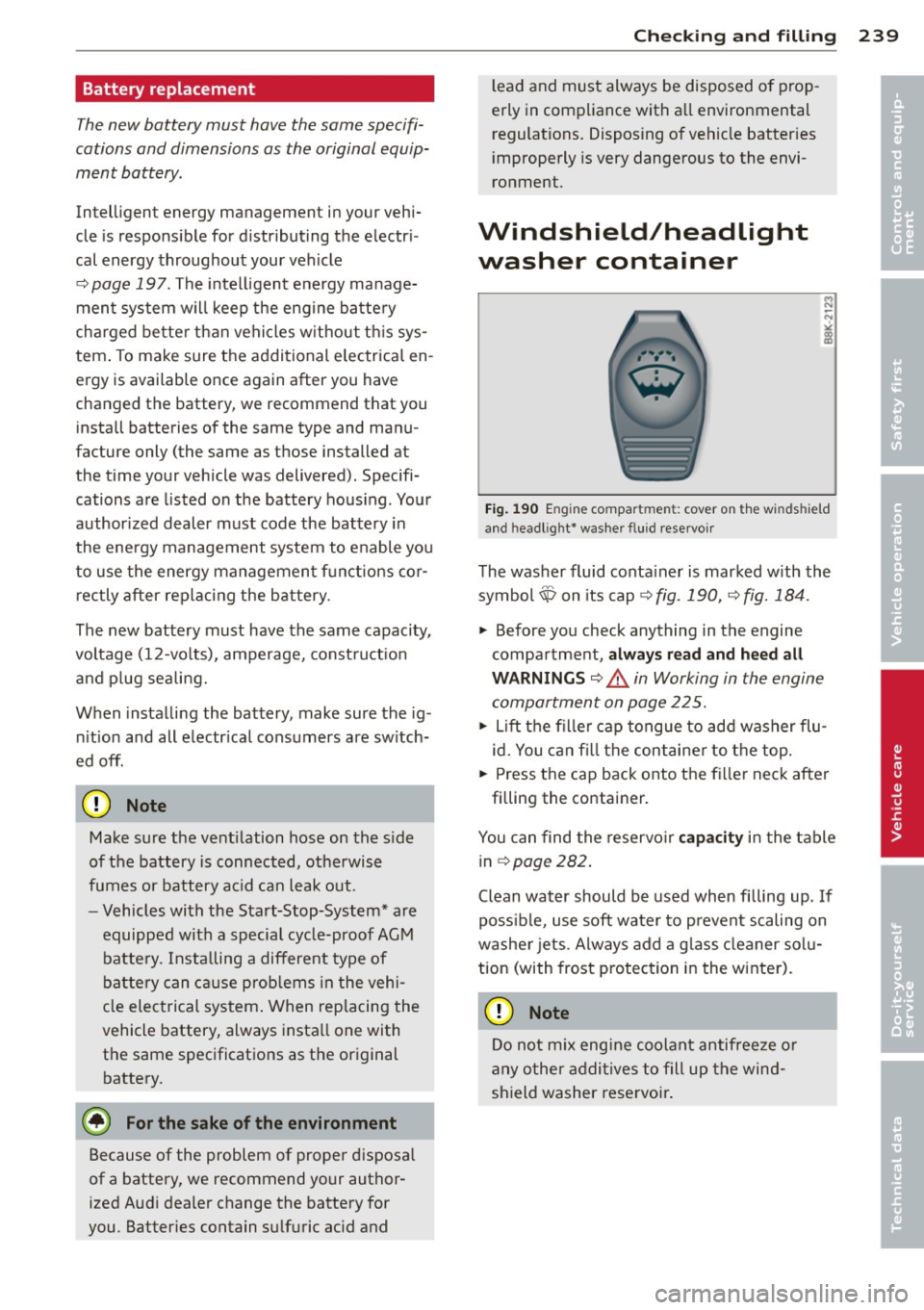
Fi g. 1 90 Engine compar tment: cover on th e windshield
and headl ig ht* washe r flu id reservo ir
The washer fluid conta iner is marked w ith the
symbol ~ on its cap
~ fig . 190, ~fig. 184.
... Before you check anything in the engine
compartment,
always r ead and heed all
WARNINGS ¢ _& in Working in the engine
compartment on page 225.
... Lift the fil le r cap tongue to add washer flu
id. You can fi ll the containe r to the top.
... Press the cap back onto the fi lle r neck after
filling the container.
You can find the reservo ir
cap acit y in the table
in
¢ page 282.
Clean water should be used when filling up. If
poss ible, use soft wa ter to prevent scaling on
washer jets . Always add a g lass cleaner solu
tion (with frost protection in the winter).
CD Note
Do not mix engine coo lant antifreeze or
any o ther additives to fill up t he wind
sh ield washer reservoir .
•
•
Page 249 of 306
the time it was manufactured. For the
l ocation of the labe l¢
fig . 191.
Most ti res lose a ir naturally over time. They
can also lose some a ir if you drive ove r a pot
hole or hit a curb while parking . It is usua lly
not possib le to see whether the radia l tires
used today are underinflated just by looking
at them.
Therefore, be sure to check tire pressures at
l east once a month and always before going
on a long trip. Make sure to take the number
of people and the amount of luggage into ac
count when adjusting tire pressure for a trip -
even one that you would not consider to be
"long ." See ¢
page 248, Tires and vehicle
load limits
for more important information .
Always use an accurate tire pressure gauge
when check ing and adjusting inflation pres
sures . Check all of the t ires and be sure not to
forget the spare t ire. If the p ressure in any tire
i s too high when the tire is "cold," le t air out
of the ti re slowly with t he edge of the t ire
ga uge and keep checking the pressure un til
you reach the press ure that is correct for the
l oad (passengers and luggage) and kind of
driving you plan to do .
I f the p ressure in any tire is too low, note the
d ifference between the pressure in the cold
tire and the pressure yo u need and add the a ir
that you need to reach the correct pressure for
the vehicle load (passengers and luggage) for
the t ires on your vehicle as listed on the on
your veh icle and in this manua l and the kind
of dr iv ing yo u pla n to do .
Never e xceed the ma ximum inflation pres
sure listed on the t ire s ide wall for any rea
son.
Remember that the vehicle manufacturer, not
the t ire manufacturer, determ ines the correct
tire pressure for the t ires on your vehicle .
It is important to check the tire pressure when
the tires are cold .
- Read the requ ired ti re press ure from the tire
pressure label. The tire pressure labe l is lo
cated on the driver's side B-pi llar .
Tire s an d wheel s 24 7
- Turn the va lve stem cap counter -clockw ise
to remove it from the tire va lve .
- Place the ai r pressure gauge on the va lve.
- The tire pressures should o nly be checked
a nd ad justed when the tires are co ld. The
slightly raised pressures of warm tires must
not be reduced.
- Adjust the tire pressure to the load you are
carrying.
- Reins tall the valve stem cap on t he va lve.
When should I check the tire pressure?
The correct tire pressure is especially impor
tant at high speeds . The pressure should
the refore be checked at least once a month
and always before sta rting a jo urney. Do not
f o rge t to chec k the ti re p ressu re fo r the sp are
whee l
q page 262.
When should I adjust the tire pressures?
Adjust the t ire pr essure to the load you a re
ca rrying. After chang ing a whee l
or replacing
whee ls yo u have to adjust the ti re p ressu res
on all whee ls. In addition, yo u m ust then
store the new tire pressures in the tire pres
s u re monito ring system*
q page 258.
A WARNING
Incorrect tire pressures and/or underinfla
tion can lead sudden tire fa ilure, loss of
control, collision, serious personal injury
or even death.
- When the warning symbol
RI] appears in
the instrument cluster, stop and inspect
the t ires.
- Incorrect tire pressure and/or underinfla
tion can cause increased tire wear and
can affect the handli ng of the vehicle and
stopping ability.
- Incorrect tire pressures and/or underin
f lation can a lso lead to sudden t ire fail
ure, including a blowout a nd sudden de
f lation, ca u sing loss of veh icle cont ro l.
- T he drive r is responsib le for the co rrect
tire pressures for all tires on the ve hicle.
Th e appli cable pressure values are locat
ed on a sticker o n the dr iver's s ide B-pil-
la~
~
•
•
Page 261 of 306
When the malfunction indicator is illuminat
ed, the system may not be able to detect or
signal low tire pressure as intended. TPMS
malfunctions may occur for a variety of rea
sons, including the installation of replace ment or alternate tires or wheels on the vehi
cle that prevent the TPMS from function ing
properly . Always check the TPMS malfunction
tellta le after replacing one or more tires or
wheels on your vehicle to ensure that the re
placement or alternate tires and wheels allow
the TPMS to continue to function properly.
Tire pressure indicator appears
Applies to vehicles: with tire pressure monitoring system
The tire pressure indicator in the instrument
cluster informs you if the tire pressure is too
low or if there is a system malfunction.
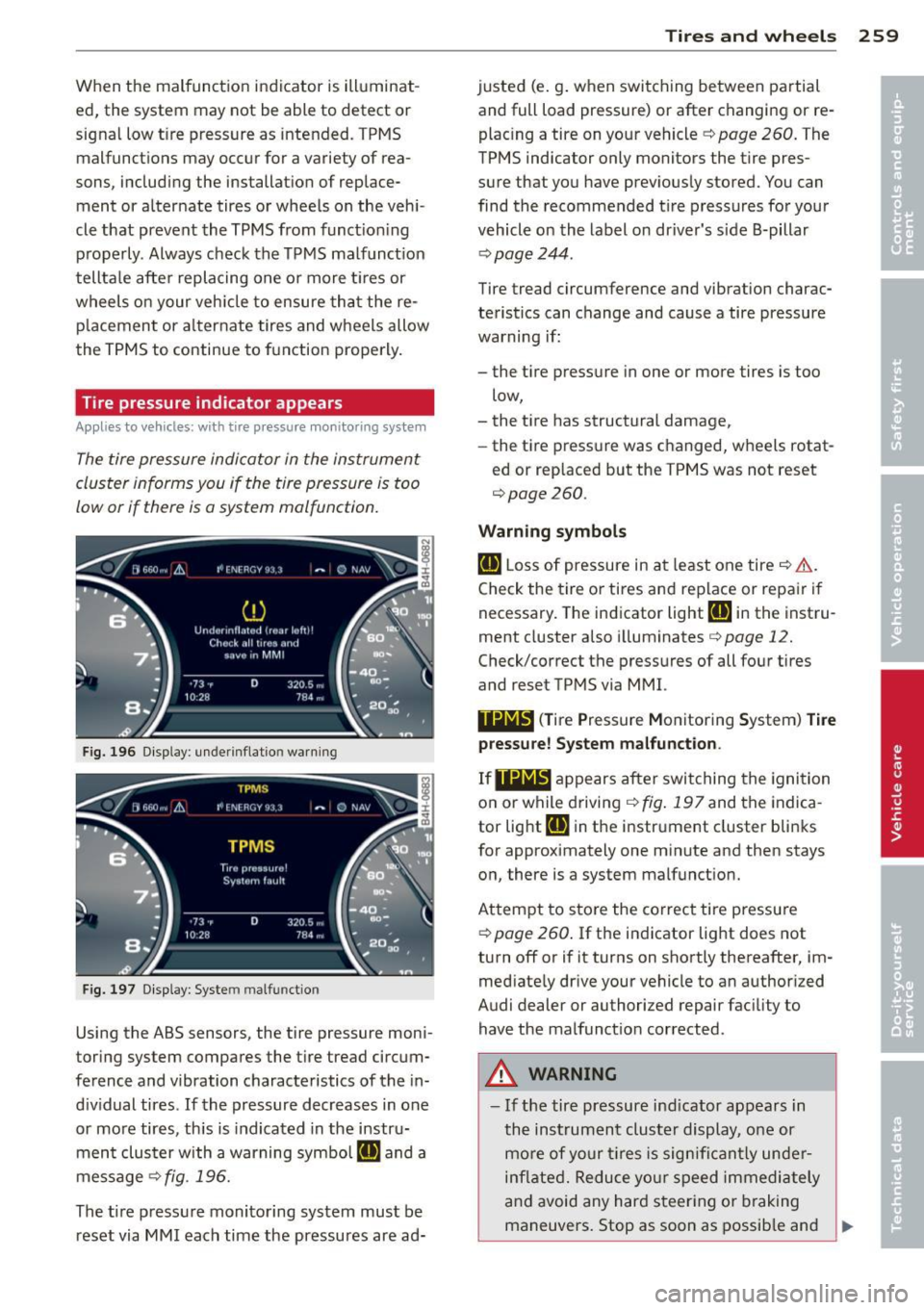
Fig. 196 Display : underinflatio n warning
Fig. 197 Display : Syste m malfun ctio n
Using the ABS sensors, the tire pressure moni
toring system compares the tire tread circum
ference and vibration characteristics of the in
dividual tires . If the pressure decreases in one
or more tires , th is is indicated in the instru
ment cluster with a warning symbol
RE and a
message
¢fig . 196.
The tire pressure monitoring system must be
reset via MMI each time the pressures are ad-
Tires and wheels 259
justed (e.g. when switching between partial
and full load pressure) or after changing or re
plac ing a tire on your vehicle¢
page 260. The
TPMS indicator only monitors the tire pres
sure that you have previously stored. You can
find the recommended tire pressures for your
vehicle on the label on dr iver's side B-pillar
~page 244.
Tire tread circumference and vibration charac
teristics can change and cause a tire pressure
warning if :
- the tire pressure in one or more tires is too
low,
- the tire has structural damage,
- the tire pressure was changed, wheels rotat-
ed or replaced but the TPMS was not reset
¢page 260.
Warning symbols
RE Loss of pressure in at least one tire¢.&. .
Check the tire or tires and replace or repair if
necessary. The indicator light
RE in the instru
ment cluster also illuminates
¢ page 12.
Check/correct the pressures of all four tires
and reset TPMS via MMI.
11;;~, ( T ire Pressure Monitoring System) Tire
pressure! System malfunction.
If11NIS, appears after switching the ignition
on or while driving¢
fig. 197 and the indica
tor light
RE in the instrument cluster blinks
for approximately one minute and then stays
on, there is a system malfunction.
Attempt to store the correct tire pressure
¢
page 260 . If the indicator light does not
turn off or if it turns on shortly thereafter, im
mediately drive your vehicle to an authorized
Audi dealer or authorized repair facility to have the malfunction corrected .
A WARNING
-If the tire pressure ind icator appears in
the instrument cluster display, one or
more of your tires is significantly under
inflated. Reduce your speed immediately
and avoid any hard steering or braking
maneuvers. Stop as soon as possib le and .,.
Page 266 of 306
264 What do I do now?
&_ WARNING
You or your passengers could be injured
while changing a wheel if yo u do n ot fol
low t hese safety precautions:
- If you have a flat t ire, move a safe dis
tance
off the road. Turn off the engine,
turn the emergency flashers on and use other warning dev ices to alert other mo
torists.
- Make sure that passengers wait in a safe
place away from the vehicle and well
away from the road and traff ic.
- T o help p revent the veh icle from mov ing
sudden ly and possibly slipping off the
ja ck, always fully set the parking b rake
and bloc k the whee l diagona lly opposite
the whee l being changed. When one
front whee l is lifted off the gro und, plac
ing the Automat ic Transmiss ion in P
(Park) will
not prevent the vehicle from
moving.
- Before you change a wheel, be sure the
ground is level and firm. If necessary,
use a sturdy board under the jack.
- Always store the vehicle tool kit, the jack
and the replaced t ire i n the luggage com
partment
¢ page 132.
Before chang ing the wheel, yo u m ust acti
vate the jacking mode, so that the auto mat ic cont rols for the Adaptive Air S us
pens ion* do not make it more difficult to
lift the vehicle with the jack
c> page 266.
Changing a wheel
When you change a wheel, follow these
quence described below step-by-step and in
exactly that order .
1. Activate the vehicle jack mode*
~page 266.
-
2. Remove the decorative wheel cov er* . For
mo re details see also ¢
page 265, Deco
rative wheel covers
or c> page 265,
Wheels with wheel bolt caps.
3 . L oosen the wheel bolts¢ page 265.
4. Locate the proper mounting point for the
jack and alig n the jack below that point
¢ page 266 .
5.
Raise the car with the jack¢ page 266.
6. Remove the wheel with the flat tire and
then insta ll
the s pare ¢page 267.
7. Tighten all whee l bolts lightly.
8 . Lower the vehicle with the jack .
9. Use the wheel bolt wrench and firmly
t igh ten al l w heel bo lts¢ page 265.
10. Rep lace the decorat ive wh eel co ver* .
11. Deactivate the vehicle jack mode* in the
MMI:
ICARI f u nction button > (Car )* sys
tems
control button > Se rvicing & chec ks
> A ir susp .: jac k mode > Off .
The vehicle jack mode * switches off automati
ca lly at speeds above
6 mph (1 0 km/h) .
&_ WARNING ,.__
Always read and follow all WARNINGS and
i nformat ion¢ &.
in Raising the vehicle on
page 266
and c> page 268.
After changing a wheel
A wheel change is not complete without the doing the following.
.,. Always store the vehicle tool kit, the jack *
and the rep laced tire in the luggage com
partment
¢ page 132.
.,. Check t he ti re pressu re on the spare whee l
immed iate ly after mounting it .
.,. As soon as possib le, have the
tightening
torques
on all whee l bolts checked with a
t o rque wrenc h. The co rrect tighte ning tor
que is 90 ft lb (120 Nm).
.,. Have the flat tire
replaced as soon as possi
b le.
(D Tips
- If you not ice th at the wheel bo lts a re
co rroded and difficult to turn while
changing a tire, they should be rep laced
before you check the tightening torque.
- Drive at reduced speed until you have the
tightening torques checked .
ll-
Page 275 of 306
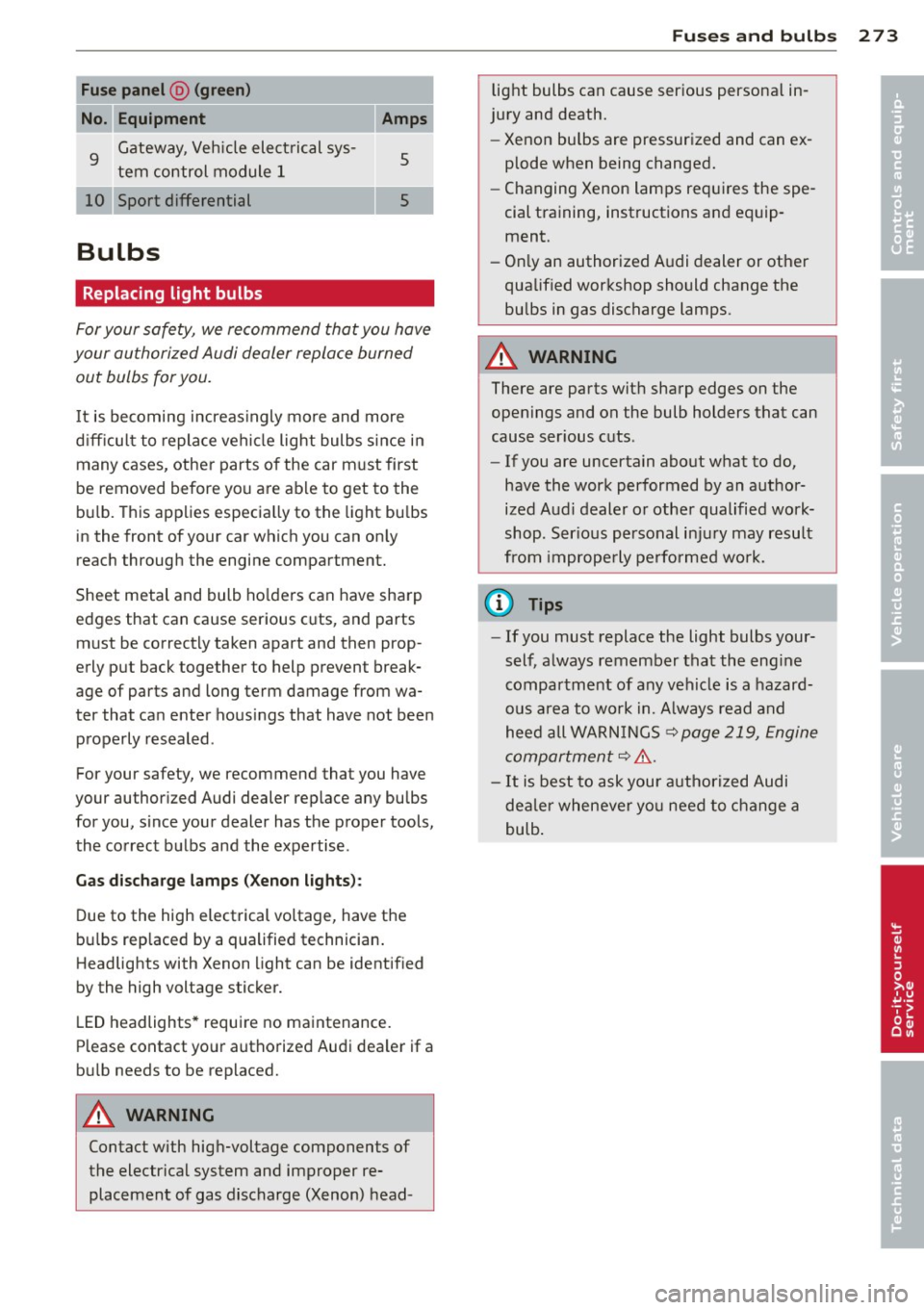
Fuse panel @ (green )
Equipment
9 Gateway, Veh
icle electrical sys
tem control module 1
10 Sport differential
Bulbs
Replacing light bulbs Amps
5
5
For your safety, we recommend that you have
your authorized Audi dealer replace burned out bulbs for you.
It is becoming increas ingly more and more
d iff icu lt to replace vehicle light bulbs since in
many cases, other parts of the car must first
be removed before you are able to get to the
bu lb. Th is applies especially to the light bu lbs
in the front of your car which you can on ly
reach through the engine compartment.
Sheet metal and bulb ho lders can have sharp
edges that can cause serious c uts, and parts
must be correctly taken apart and then prop
erly put back together to help prevent break
age of parts and long term damage from wa
ter that can enter hous ings that have not been
properly resealed .
For your safety, we recommend that you have
your authorized Audi dealer replace any bulbs for you, since your dealer has the proper tools,
the correct bulbs and the expertise.
G as discharg e la mps (X enon light s):
Due to the high electrical voltage, have the
bulbs rep laced by a qualified technician .
Headlights with Xenon light can be identified
by the high voltage sticker.
LED headlights * require no maintenance .
P lease contact your authorized Audi dealer if a
bu lb needs to be replaced.
A WARNING
Contact with high-voltage components of
the electrical system and improper re
placement of gas discharge (Xenon) head-
Fu ses and bulb s 273
light bulbs can cause serious personal in
jury and death.
- Xenon bulbs are pressurized and can ex
plode when being changed.
- Changing Xenon lamps requires the spe
cial tra ining, instructions and equip
ment.
- On ly an authorized A udi dealer or other
qualified workshop should change the bulbs in gas discharge lamps.
A WARNING
There are parts with sharp edges on the
openings and on the bulb holders that can
cause ser ious cuts.
- If you are uncertain about what to do,
have the work performed by an author
ized Audi dealer or othe r qualified work
shop. Ser ious personal in jury may result
from imprope rly performed wo rk.
Q) Tips
- If you must replace the light bulbs your
self, always remember that the eng ine
compartment of any vehicle is a hazard
ous area to work in. A lways read and
heed all WARN INGS
~page 219, Engine
compartment
Q & .
-It is best to ask your authorized Audi
dealer whenever yo u need to change a
bulb .
•
•
-
Page 276 of 306
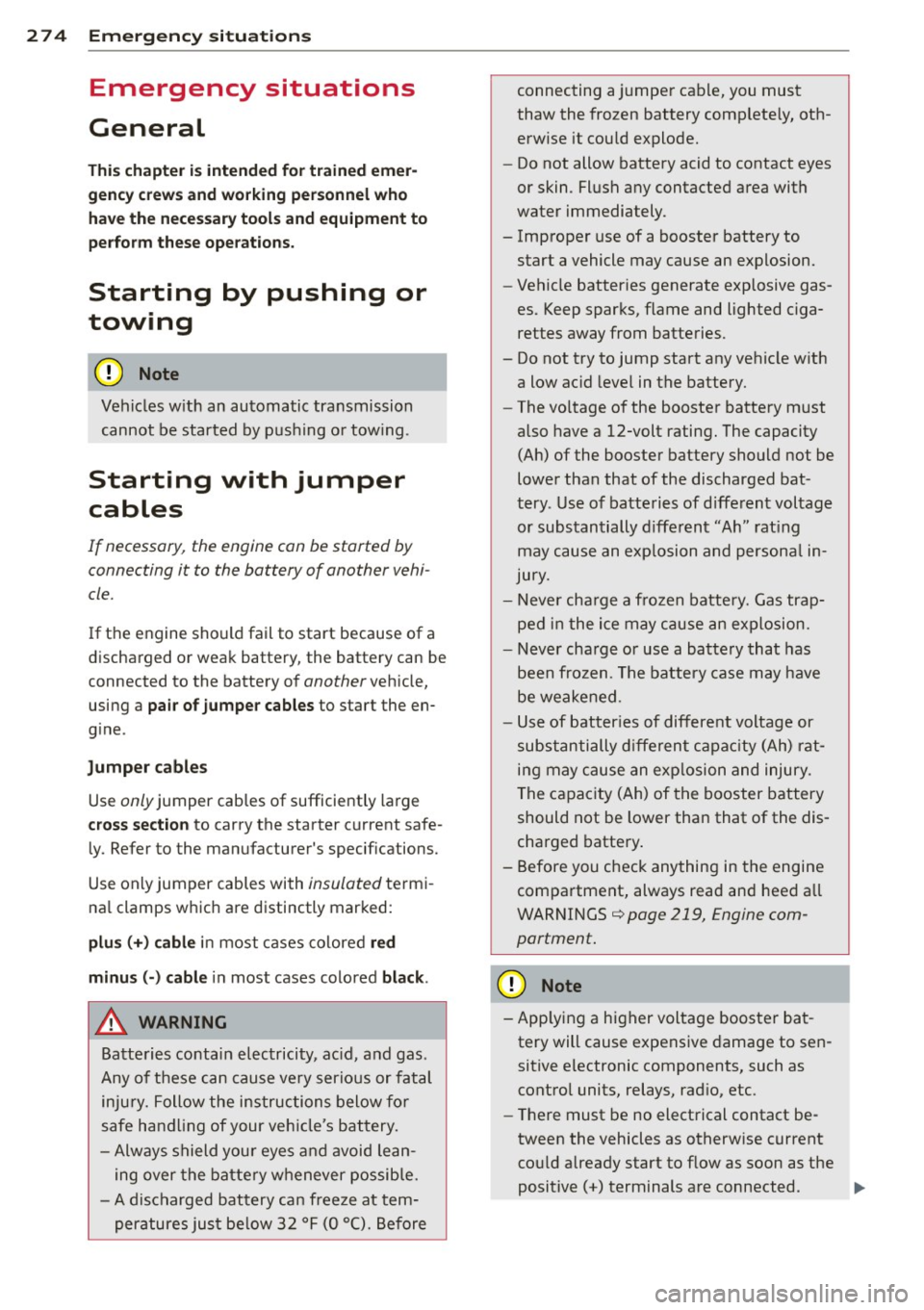
2 7 4 Emergency situations
Emergency situations
General
This chapter is intended for trained emer
gency crews and working personnel who
have the necessary tools and equipment to
perform these ope rations.
Starting by pushing or
towing
Q;) Note
Vehicles w ith an automatic transmission
cannot be started by pus hing o r tow ing.
Starting with jumper
cables
If necessary, the engine can be started by
connecting it to the battery of another vehi
cle.
If the engine should fail to start because of a
discharged or weak battery, the battery can be
connected to the battery of
another veh icle,
using a
pair of jumpe r cables to start the en
g ine .
Jumper cables
Use only jumper cables of sufficiently large
cross section to carry the starter current safe
ly. Refer to the manufacturer's specif ications.
Use only jumper cables with
insulated termi
na l clamps which are distinctly marked:
plus(+) cable in most cases colored red
minu s(-) cable
in most cases colored black .
A WARNING
Batteries contain electricity, acid, and gas.
Any of these can cause very serious or fatal
inju ry. Follow the instructions below for
safe handling of your veh icle's battery.
- Always shield you r eyes and avoid lean
ing over the battery whenever possible.
- A discharged battery can freeze at tem
peratures just be low 32 °F (0 °C). Before connecting a
jumper cable, you must
thaw the frozen battery complete ly, oth
erwise it could explode.
- Do not allow battery acid to contact eyes
or skin . Flush any contacted area with
water immediately .
- Improper use of a booster battery to start a vehicle may cause an explosion.
- Vehicle batteries generate explosive gas
es. Keep sparks, flame and lighted ciga
rettes away from batteries.
- Do not try to jump start any vehicle with a low acid level in the battery.
- The vo ltage of the booster battery must
also have a 12-volt rating. The capacity
(Ah) of the booster battery should not be
lower than that of the discharged bat
tery . Use of batteries of d ifferent voltage
or substantially different "Ah" rating
may cause an exp losion and personal in
jury.
- Never charge a frozen batte ry. Gas trap
ped in the ice may cause an explosion.
- Never charge or use a battery that has
been frozen. The battery case may have
be weakened.
- Use of batter ies of different voltage or
substantially different capacity (Ah) rat
ing may cause an exp losion and injury.
The capacity (Ah) of the booster battery
should not be lower than that of the dis
charged battery.
- Before you check anything in the engine
compartment, always read and heed a ll
WARNINGS
¢page 219, Engine com
partment.
«I) Note
-Applying a higher voltage booster bat
tery will cause expensive damage to sen
sitive electronic components, such as
contro l units, relays, rad io, etc .
- There must be no electrical contact be
tween the vehicles as otherwise current
could already start to flow as soon as the
positive(+) terminals are connected. ..,_
Page 292 of 306
29 0 Index
A
Accessories . ...... ..... ... .. .. .... . 28 7
Active lane ass ist . . . . . . . . . . . . . . . . . . . . 91
Activating and deactivating . . . . . . . . . . . 92
C leaning came ra area ... .. .. .. .. .. . 211
Descr ipt ion ... ........... .. .. .... .. 9 1
I nstrument cluster indicator light . . . . . 92
Messages . . . . . . . . . . . . . . . . . . . . . . . . . 92
Notes on instrument cluster display . . . . 92
Setting the steering wheel vibrat ion . . . . 93
AC (automatic cl imate control) . .. .. .. .. 67
AC (climate control) . . . . . . . . . . . . . . . . . . 65
Adaptive air suspension/sport . ... .. .. . . 98
Adapt ive cruise control . . . . . . . . . . . . . . . . 82
C leaning sensors/cameras .. .. .. .... . 211
Messages ............... .. .. .. .. .. 89
Request for driver intervention . . . . . . . . 8 7
Stop-and-go traffic . . . . . . . . . . . . . . . . . 86
Adapt ive Lig ht (defective) ... .. .. .... .. 22
Adding Eng ine coolant ............. .. .... . 233
Eng ine oil .. ..... ........... ... .. . 230
W indshield washer fluid .. ... .. .. .. . 239
Additives Eng ine oil ............... .. .. .. .. . 230
Ad justing
Air distribution (automatic climate con-
trol) ..... .. ... .. ..... ... .. .. .... .. 68
air distribution (climate control) . .... .. 65
Front seats . . . . . . . . . . . . . . . . . . . . . . . . 50
Instrument illum inat ion ... .. .. .. .. . .
44
Steer ing column electrically .. .. .. .. . . 70
Steer ing column manually ..... .. .... 70
Tempe ratu re (automat ic climate control) 68
Tempe ratu re (climate control) .. .. .. . . 65
A irbag system . . . . . . . . . . . . . . . . . 145, 166
Advanced Airbag System . . . . . . . . . . . . 149
Advanced Airbag System components . 153
Care ....... .......... ...... ... .. . 161
C hi ldren . ............... .. .. .... . 173
C hi ld restra ints ........... .. .. .. .. . 173
Components (front airbags) . .... ... . 153
Danger of fitting a child seat on the front
passenger seat . . . . . . . . . . . . . . . . . . . . 147
Disposa l ..... ........... .. .. .... . 161
Front airbags . . . . . . . . . . . . . . . . 149, 151
H ow do the front airbags work? . .... . 155 How many a
irbags does my vehicle
have? . ... .... .. .. ... .. ..... ... .. 153
How the Advanced Airbag System com -
ponents work together ......... .... 155
Important safety instructions on the
knee airbag system ................ 164
Important things to know . .. .. .. .. .. 145
Knee airbags . .. .. .......... ...... . 162
Monito ring .. .. . .. ............ .. .. 15 7
PASS ENG ER A IR BAG OFF light ... .. .. 158
Repairs ... .... .. .. ... .. . .... ... .. 161
Safety instr uctions . .. .. ..... .... . .. 160
Side airbags ..... .. ... ..... ... .. .. 165
S ide curtain airbags ............ .... 168
Warning/ind icator lights ........ .... . 19
Warning/Indicator lights ....... .... 157
When must the system be inspected? 157
Aircraft Transporting your vehicle ..... .. .. .. 278
All-wheel drive .. .. ............. .... 196
Win ter tires . .. . .. ............ .. .. 255
Alloy wheels .. .. .. .......... ...... . 213
Alternator . . . . . . . . . . . . . . . . . . . . . . . . . . 17
Amb ience lighting ................ ... 44
Anti-freeze
refer to Eng ine coolant ............ . 232
Anti- lock braking system . ..... ... .. .. 192
Warning/ind icator lights ........ .... . 20
An ti-s lip reg ulation ............. .. .. 192
Anti-theft systems Electronic immob ilizer ............. .. 32
Ashtray . ... .... .. .. ... .. ..... ... .. . 56
Audi braking guard
refer to b rak ing guard .......... .... . 82
Audi drive select
refer to drive select ............... .. 98
Audi Serv ice Repair Manuals and Litera-
ture ... .... .... .. ............. .... 285
A UTO
a ut omatic climate contro l . . . . . . . . . . . . 68
Automatic headlights ... .... ... .. .. . 41
climate control ... .. ... ..... ... .. .. . 65
A uto Lock .. .... ... ................ . 33
Automat ic be lt retractor ........... .. 139
A utomatic car wash . .... ..... ... .. .. 209
Page 293 of 306
Automatic climate control Air vents ... ..... ..... ... .. .. .. .... 68
Automatic recirculation . . . . . . . . . . . . . . 69
Operation . . . . . . . . . . . . . . . . . . . . . . . . . 67
Setup ... .. ................. .. .... 69
synchron izing ............... ... ... . 68
Automatic Shift Lock (ASL) . ... .. .. .. . 106
Automatic t ransmission
Automatic Sh ift Lock (ASL) . .. .. .. .. . 106
D nvrng .. .. ............. .. .. .. .. . 10 7
Emergency mode . ..... ... .. .. .. .. . 110
Emergency release . . . . . . . . . . . . . . . . . 1 11
Kick-dow n .. .. .... .... ... .. .. .. ... 110
Manual shift program ..... .. .. .. .. . 109
multitronic ® . . . . . . . . . . . . . . . . . . . . . . 105
Selector lever . . . . . . . . . . . . . . . . . . . . . 105
S tron ic ® ...... ........... ... ... .. 105
tiptronic . . . . . . . . . . . . . . . . . . . . . . . . . 105
Automatic wipers .......... .... .. .... 46
Auto Safety Hotline ........ .. .. .. .. . 134
Average consumption ............ .... . 24
Average speed . . . . . . . . . . . . . . . . . . . . . . . 24
Avoid damaging the vehicle .. .. .. .. .. . 200
B
Battery ... ... ............. ...... .. 235
C ha rging ................... ... ... 237
I mportan t war nings ...... .. .. .. .. . 236
Ju mp s tarting . ........... .. .. .. ... 274
L ocat ion ... ... .. ..... ... .. .. .. ... 236
l ow ..... .. .. .. ... . .... ... .. .. ... 197
Replacing the battery .. ... .. .. .. .. . 239
State of charge ........... .. .. .. ... 197
W inter operation ......... .. .. .. .. . 235
Working on the battery .... .. .. .. .. . 236
B efore driving . ... .. .... ... .. .. .. ... 126
B lended gasoline . ............. ... .. 220
Blower (automatic climate control) . . . . . . 68
B lower ( climate con trol) . . . . . . . . . . . . . . . 65
Body cav ity sealing .......... ... ... .. 214
Booster seats . .. .. ..... ... .. .. .. ... 180
B rake fl uid
Changing the brake fl uid ... .. .. .. .. . 235
C heck ing the bra ke fluid level . .. .. .. . 234
What is the cor rect brake fl uid leve l? .. 234
What should I do if the bra ke fl uid warn-
ing light comes on? ....... .. .. .. .. . 234
Inde x 291
Brake system
Anti- lock b raking system ..... ... .. .. . 20
B rake assist system .. .. ..... ... .. .. 192
Brake booster .. .. ................. 195
Brake fluid .. .. .. .... ............. 234
B rake fluid specifications fo r refill and re -
placeme nt .. .. .. .. . .. .... .... .. .. 235
B ra ke light defective . . . . . . . . . . . . . . . . 22
Br ake pads . . . . . . . . . . . . . . . . . . . . . . . 199
El ec tromech an ic al par king br ake . .. .. . 74
Fl uid reservo ir ... .. .. .. ...... ... .. 23 4
How does moist ure or roa d salt affect the
brakes? ... .. .. .... . ... ...... ... .. 194
Warning/ind icator lights ........ .... . 15
Worn brake pads symbol . . . . . . . . . . . . . 20
braking gu ard
Set tings . ... .. .... . ... ...... ... .. . 89
B rak ing guard ..... .. ................ 82
Messages . .. .. .. .... ........... .. . 89
Break-in per iod .. .. .. ............... 199
B rake pads .. .. .. .... ... .... .... .. 199
T ires ........ ... .. ..... .......... 199
Bu lbs . ... .. .. .... .. . .. .. ..... ... .. 273
C
Cali forn ia Proposition 65 Warn ing ... .. 226
Battery specific .... . .. ..... ... .. .. 237
Capacities . . . . . . . . . . . . . . . . . . . . . . . . . 282
E ngine o il . .. .. .. ................. 227
Car care .... .. .. .. ................. 208
Exterior . . . . . . . . . . . . . . . . . . . . . . . . . . 208
Inter ior ... .. .. .. .. . .. .... .... .. .. 214
Car carrier Transporting your vehicle ....... .. .. 278
Cargo area . ... .... .. . .. ... .... ... .. 132
Cargo ne t . . . . . . . . . . . . . . . . . . . . . . . . . . . 62
Catalytic converter ... . ... .... ... .. .. 200
Center armre st
Cockpit ... .. .. .. ................. . 52
Central lock ing .. .... ... ....... ...... 33
E mergency locking .. ... ....... .... .. 37
Certification . . . . . . . . . . . . . . . . . . . . . . . 288
Ch ang ing a wheel .. .... ......... .... 263
Changi ng engine oil .. ... ....... .... . 231
Chassis (undercoating) . . . . . . . . . . . . . . . 214
•
•
Page 294 of 306

292 Index
Checking Engine coolant level ................ 232
Tire pressure . ............. ... .... . 246
Ch ild restra ints
Danger of using child restra ints in the
front seat . . . . . . . . . . . . . . . . . . . . . . . . 147
Where can I get additional information
about child restraints and their use? .. 189
Child restraint system anchors ... .... . 185
Child safety .. .. . .......... .. .. .... . 171
Convertible locking retractor .. .. .. .. . 182
Important safety instructions for us ing
chi ld safety seats ......... .. .. .... . 175
I mportant things to know when dr iving
with chi ldren . ............... .... . 171
Tether anchors ............ ... .... . 188
Tether straps ..................... 188
Child safety lock Rear doors .............. .. .. .... .. 38
Child safety seats .......... .... .... . 177
Booster seats . .......... ... .. .. ... 180
Convertible ch ild seats .... .. .. .. .. . 178
Convertible locking retractor .. .. .. ... 182
H ow do I proper ly install a child safety
seat in my vehicle? ...... .. .. .. .. .. . 175
I nfant seats .............. ... .... . 177
I nstalling . ............... ... .... . 182
Installing a child restraint using the
LATCH system ................ .... . 187
LATCH system ............ .... ..... 187
Lower anchorages ............ ..... 186
Mounting and releasing the anchorage
hook .. .. .. ... .... ...... ... ... .. . 187
Safety instructions . . . . . . . . . . . . . . . . . 17 5
Unused safety belts on the rear seat .. 177
Cigarette lighter . . . . . . . . . . . . . . . . . . . . . 56
C leaning
Head-up Display .............. .... . 215
Matte finish paint ............ .... . 210
C leaning and protection ..... .. .. .. .. . 208
A lcantara (synthet ic suede) .......... 218
Engine compartment ....... .... ... . 219
Exhaust tail pipes .......... ... .... . 214
Fabrics and fabric coverings .. .. ..... 215
Instrument panel ............. ..... 216
Interior . . . . . . . . . . . . . . . . . . . . . . . . . . 214
Leather . . . . . . . . . . . . . . . . . . . . . . . . . . 217
MMI display/controls .. ... ... .. .. ... 214 Plastic
and vinyl . .............. .... 212
Plastic parts . . . . . . . . . . . . . . . . . . . . . . 216
Safety be lts ... .. ................ . 218
trim strips ................... .... 212
Trim strips ................... .... 212
Cleaning the Head-up Display ......... 215
Climate control Air vents . . . . . . . . . . . . . . . . . . . . . . . . . . 66
Climate controls . .. ............. .. .. . 64
Climate control (four-zone)
Operation ..... .. .. .............. .. 67
Climate control (three-zone) Operation . . . . . . . . . . . . . . . . . . . . . . . . . 65
Clock ...... .... .................... 27
Closing Sliding/tilting sunroof ............... 40
Cold tire inflation pressure ........ .. .. 244
Coming home ....................... 43
Compact spare tire ................. . 262
Compartments . . . . . . . . . . . . . . . . . . . . . . 57
Compliance ..... .. .. .............. . 288
Consumer Information . . . . . . . . . . 134, 285
Consumption (fuel) ............. .... . 24
Contacting NHTSA .............. .... 134
Convenience key . .. ... ........... ... . 35
Starting the engine ............ .... . 71
Stopping the engine (START ENGINE
STOP button) . . . . . . . . . . . . . . . . . . . . . . 73
Switching the ignition on ........ ... . 71
Unlocking and locking vehicle .... .. .. . 35
Convertib le child safety seats ..... .... 178
Convertible locking retractor Activating ... .. .. .. ..... ...... .. .. 184
Deact ivating . .. .. ... ....... ... .. .. 184
Using to secure a child safety seat 1.82, 184
Coolant
refer to Engine coolant ............. 232
Cooling mode (automatic climate control) 67
Cooling mode (climate control) . . . . . . . . . 65
Cruise contro l
Changing speed .. ............. .... . 80
Presetting your speed .............. . 80
Switching off . . . . . . . . . . . . . . . . . . . . . . 80
Switching on . . . . . . . . . . . . . . . . . . . . . . . 79
Warning/ind icator lights ........... .. 23
(upholder .. .... ............... ..... 57
Page 295 of 306
Curve light ... ... ... ...... ... .. .. .... 98
Cylinder on demand System ........... 26
D
Data ...... ... ................ .. .. . 282
Data recorder . .... ..... ... ... ... ... 192
Date display . ................. .. .... 27
Daytime running lights ................ 41
Declaration of compliance Adaptive cruise control . ... .. .. .. .. . 288
Audi side assist .. ..... ... ... ... .. . 288
Ce ll phone package ................ 288
Conven ience key .......... .. .. .. .. . 288
Electron ic immobilizer .............. 288
Homelink ® universal remote contro l .. 288
Remote control key ......... .. .. .. . 288
DEF What does this mean when it appears in
the trip odometer d isplay? ... .. .. .. .. 27
D efective light bulb warning . . . . . . . . . . . 22
Defrosting (w indows)
automatic climate control .. .. .. .. .. .. 68
climate cont ro l . . . . . . . . . . . . . . . . . . . . . 66
Determi ning correct load limit ... .. ... 249
D imensions . ... .... .... ... .. .. .. ... 281
D imm ing the rearview mir ror .......... 48
Distance . . . . . . . . . . . . . . . . . . . . . . . . . . . 24
D oor/rear lid warning . . . . . . . . . . . . . . . . . 23
Doors Powe r child safety lock . . . . . . . . . . . . . . 38
Driver information system
CD/radio display . . . . . . . . . . . . . . . . . . . . 23
Door/rear lid warning . . . . . . . . . . . . . . . 23
Efficiency program . . . . . . . . . . . . . . . . . . 25
E xte rio r tempe ratu re d isplay ... .. .. .. 23
On-boa rd compute r . . . . . . . . . . . . . . . . . 24
Driver seating position ............... 127
d rive select . ... ... ..... ... .. .. .. .... 98
adaptive air s uspension/spo rt ... .. .. .. 98
Adaptive dampers . . . . . . . . . . . . . . . . . . 98
Curve light . . . . . . . . . . . . . . . . . . . . . . . . 98
Eng ine sound ............ .... .. .. .. 98
Safety bel t tensioner . . . . . . . . . . . . . . . . 98
Sport different ial . . . . . . . . . . . . . . . . . . . 98
Driving safe ly . .... ..... ... .. .. .. ... 126
Dr iving through water ............... 201
Inde x 293
Driving time . ..... .. . .. .. ..... ... .. . 24
D uplicate key . . . . . . . . . . . . . . . . . . . . . . . 31
D ust filter
refer to Pollutant filter .............. 64
E
Easy entry feature . . . . . . . . . . . . . . . . . . . . 71
E fficiency program . .. .. ......... .. .. . 25
F uel economy messages .......... .. . 26
Other equipment ... . ... ...... ... .. . 26
E lectrical accessories (sockets) . . . . . . . . . 56
E lectro-mechan ica l power assist ... .. .. 196
El ectromech anica l pa rking brake
E mergency bra king .. .. ... .... ... .. . 76
Operation . . . . . . . . . . . . . . . . . . . . . . . . . 7 4
Pa rking ... .. .... ... .. .. ..... ... .. . 75
Re leas ing and closing .......... .. .. . 74
Starting assist ... .... ......... .. .. . 75
Starting from rest ................. . 75
Starting off w ith a trailer . . . . . . . . . . . . . 76
Warning/ind icator lights .... ...... .. . 16
E lectronic differential lock ( EDL) ..... .. 192
Warning/ind icator lights ........ .. .. . 20
E lectronic immob ilizer . . . . . . . . . . . . 27, 32
E lectronic power control (EPC)
warning/indicator light . . . . . . . . . . . . . . 21
E lectronic speed limiter .......... .. .. . 30
El ectronic Stab iliz ation Contro l (E SC) . .. 192
Warning/ind icator lights ..... ... .. .. . 19
Emergency actuat ion
Doors ....... ... .. ................ 37
Power sunroof . .. ............. .. .. . 40
Emergency brak ing . .. ........... .... . 76
Emergency flasher .... .. .. ..... ... .. . 42
Warning/ind icator lights ..... ... .. .. . 23
E mergency re lease
Se lector lever . . . . . . . . . . . . . . . . . . . . . 111
Emergency starti ng ................. 274
Emergency towing ... . .. .. ..... ... .. 276
Emergency un lock ing
Rea r lid . . . . . . . . . . . . . . . . . . . . . . . . . . . 38
Emergency warning triangle .......... 261
Energy management .. .. .. ..... ... .. 197
Engine Compartment .. .. .. ........... .... 22 7
Coolant ... .. .. .. .... ............. 232
•
•