warning light AUDI S6 2013 Owners Manual
[x] Cancel search | Manufacturer: AUDI, Model Year: 2013, Model line: S6, Model: AUDI S6 2013Pages: 306, PDF Size: 76.92 MB
Page 215 of 306
A WARNING ,~
Always read an d heed all WARNINGS and
other information
c> page 208.
Touch-up paint
/\1inor paint damages should be touched up
immediately.
~ Use either a touch-up paint stick or spray
paint to cover minor scratches and nicks .
Your Audi dea ler has touch -up paint for minor
scratches and stone chips. Scratches shou ld
be touched up soon after they occ ur to pre
vent corrosion.
I f a spot starts to rust, however, a simple
touch-up job w ill not be enough . The affected
surface must be sanded smooth and coated
with an anti-r ust primer before the painted
finish can be restored.
The number for the original vehicle paint can be found on the vehicle identification labe l
c:::>poge280.
A WARNING
Always read and heed all WARNINGS and
other information
c> page 208.
Windows
Clear vision to all sides.
C lean all windows regularly to remove road
fi lm and car wash wax b uildup .
~ Remove s now from windows using a br ush.
~ U se a plast ic ice scraper to remove ice from
windows and mirro rs .
~ Remove other residue on the windows with
a spray -on glass cleaner.
~ Wipe the windows dry with a clean p iece of
cloth or kitchen paper towel.
The best way to remove snow from windows and mirrors is to use a brush . Use a non-abra
sive
plastic ice sc raper -better still, a spray
de icer -to remove
ice from windows and mir
rors .
Cleaning and protec tion 213
Oil, grease o r silicone residue can be removed
with
gla ss cleane r or silicone remove r. How
ever, wax res idue requires the use of a spec ia l
l y formulated solvent. Please contact your
Audi dealer for adv ice on safe products for
wax removal.
Windows should also be cleaned on the inside
at reg ular intervals.
Never dry windows with the same chamois
that you use to dry painted surfaces . Wax resi
due on the chamois can impa ir v is ion through
the windows .
A WARNING
-Always read and heed all WARNINGS and
other information
c> page 208.
-The windsh ield must not be treated w ith
water-repellent materials. They can in crease glare unde r poor v is ibility condi
tions such as wetness, da rkness, or when
the sun is low on the hor izon. In addi
tion, they can ca use the w indshie ld w ip
ers to ch att er.
0 Note
- Never use warm or hot wate r to remove
snow and ice from windows and mirro rs.
T his could cause the glass to crack.
- To p revent damage to the w ires of the
rear defogger, do not place any adhesive
sti ckers on the ins ide of the rear w indow
over the wires.
- T o help p revent dirt from scra tching the
w indow, always sc rape in a forwa rd di
rection -pushing the sc raper away from
you -never back and forth .
Cast (light) alloy wheels
Cost (light) alloy wheels require special care.
~ Wash the wheels w ith a sponge or hose
b ru sh eve ry other week.
~ For deep clean ing a fterw ards, use on ly a
dedicated
acid-free c ast alloy wheel cleaner.
~ Rub a coat of liquid wa x onto the rims every
three month. Be sure to reach and treat all
parts of the rim.
•
•
Page 216 of 306
214 Cleaning and protec tio n
To preserve the deco rative appearance of the
cast a lloy whee ls , some specia l care is neces
sary. In addit ion to road dirt and sa lt, brake
dust is also corros ive. If left on for too long,
brake dust can cause pitt ing.
Use only specia l
acid-free cleaners formulated
for a lloy rims. Safe products are available at
your Aud i dealer. Never leave the cleaner on
the r ims longer than spec ified on the label. If
not rinsed off promptly, the acid conta ined in
some cleaners can attack the threads on the
wheel bolts.
Never use abras ive or metal polishing clean
ing agents . If the protective coating has been
ch ipped, e .g . by k icked up road dirt, touch it
up as soon as poss ible.
A WARNING
- Moisture and ice on brakes may affect
braking efficiency
Q page 194, General
information .
Test the brakes caref ully
each time you wash the vehicle.
- Always read and heed all WARNINGS and
other information ¢
page 208.
-
Body cavity sealing
The body cavity sealing does not need to be
checked.
A ll body cavities wh ich could be affected by
corrosion have been thoroughly protected at
the facto ry.
This sealing does not require any inspection or
addit ional treatment . If any wax should seep
out of the cav ity when the ambient tempera
ture is high, it can be removed w it h a plastic
scrape r and a suitab le solven t.
A WARNING
So lvents can be dange rous.
- Benzine is flammable and toxic.
If you
use benzine for removing the wax, keep
sparks, flame and lighted cigarettes
away. Never dump benzine on t he
ground, into open streams or down sew
age drains. -
Be s ure to observe all safety and environ
mental regulat ions. Follow all instruc
tions on the container .
- Always read and heed all WARNINGS and
other information
Q page 208.
Chassis
Hove the undercoating checked for damage
from time to time .
The lower body shell of your Aud i is also thor
oughly protected against corrosion .
Any damage to the undercoat ing ca used by
road hazards should be repaired prom ptly.
A WARNING
r----
Too much undercoating in the wrong p la-
ces can cause a fire.
- Do not app ly additional under coating or
r u stp roof ing on or nea r the exhaust
manifold, exhaust pipes, catalytic con
verter or heat shields . While driving, the
substance used fo r undercoating could
overheat and cause a fire.
-
- Always read and heed a ll WARNINGS and
other information
Q page 208.
Exhaust tail pipes
Road salt and other corrosive materials will
damage the material in the exhaust tail pipes
if they are not cleaned regular ly. Do not clean
the tail pipes with wheel cleaner, pa int polish,
chr ome polish or other ab rasive clea ners.
Clean the tail pipes with ca r c are products
t h at are suitable fo r stainless steel.
Your authorized Aud i dea ler can provide clean
ing produc ts tha t have been tested and ap
proved for yo ur vehicle .
Care of interior
Infotainment components
The MMI/RSE* display may be cleaned wit h a
soft clot h and commercia lly-available "LCD
cleaner ". The clot h should be coated lightly ..,
Page 220 of 306
218 Clea ning and protec tio n
- Leat her cleaning and care kit
- Creams to care for colored leather
- Spot removers for ballpo int pens, shoe pol-
ish , etc .
- Oil/grease dissolving spray
- New and upcoming products.
A WARNING
Always read and heed all WARNINGS and
other information
~ page 208.
{[) Note
-Never use chemical solvents (e.g. lighter
fluid, turpentine), waxes, shoe pol ish or
s imilar products on the leather surfaces
in your Audi.
- To avoid damage, have stubborn stai ns
removed by a commerc ial cleaning spe
cia list.
Cleaning Alcantara ® (synthetic suede)
App lies to vehicles : wit h Alca nta ra up holstery
R em oving dust and dirt
"" Moisten a cloth, squeeze out excess water
and w ipe down the seat s urfaces .
Removing st ains
... Moisten a cloth w ith lukewarm water or
with diluted
e thyl (rubb ing) alcoho l.
"" Dab at the stain. Start at the outside and
wor k inwards.
... Once t he stain is no longer v isib le, use a
soft dry cloth or tissue to soak up the mois
ture .
Do not use leather cleaning produc ts on Al
cantara .
You may use a suitable shampoo for removing
dust and dirt. Dust and grit in the pores and seams can
scratch and damage the surface .
If the car is
l eft stand ing in the sun for long periods , the
A lcantara covers sho uld be p rotected against
d irect sunlight to prevent it from fading.
Slight color variations wi ll deve lop in normal u
se and are not an indication of material dete
rioration.
(D Note
- N ever use chemica l so lvents (e.g. lighte r
fluid, tu rpentine), waxes , shoe polish o r
simi lar products on A lcantara ® surfaces .
- To avoid damage, have stubborn sta ins
removed by a commercial cleaning spe
cialist .
- Do not use b rushes, stiff sponges or sim
ilar ly abrasive cleaning aids.
Safety belts
Only well-maintained safety belts work relia
bly when needed.
... Keep belts clean.
... For cleaning, use a mild soap and water so l
ution. Let belts dry thorough ly and away
from direct sunlight.
... Do not allow inertia ree l safety b elts to re
tract before they are completely dry.
.,. Check the condition of your safety belt s reg
ularly .
Heavily so iled safety be lts may not retract
properly.
A WARNING ,_
Damaged safety belts can break in a crash.
- Anyth ing that might damage your safety
be lts could mean that you and your pas
senge rs would not be adequately pro
tected in a n accident.
- Safety belt performance depends on cor
rect insta llation . Never remove be lts
from the veh icle to clean them .
- Do not use chemical clean ing agents,
bleach or dyes . T hey have corrosive prop
ert ies which weaken the webb ing .
- When clean ing your safety belts, inspect
them for damage. If you discover dam
age, see yo ur Audi dealer.
- Always read and heed all WAR NINGS and
other info rmation
~ page 208 .
Page 227 of 306
Checking and filling Engine hood
Releasing the engine hood
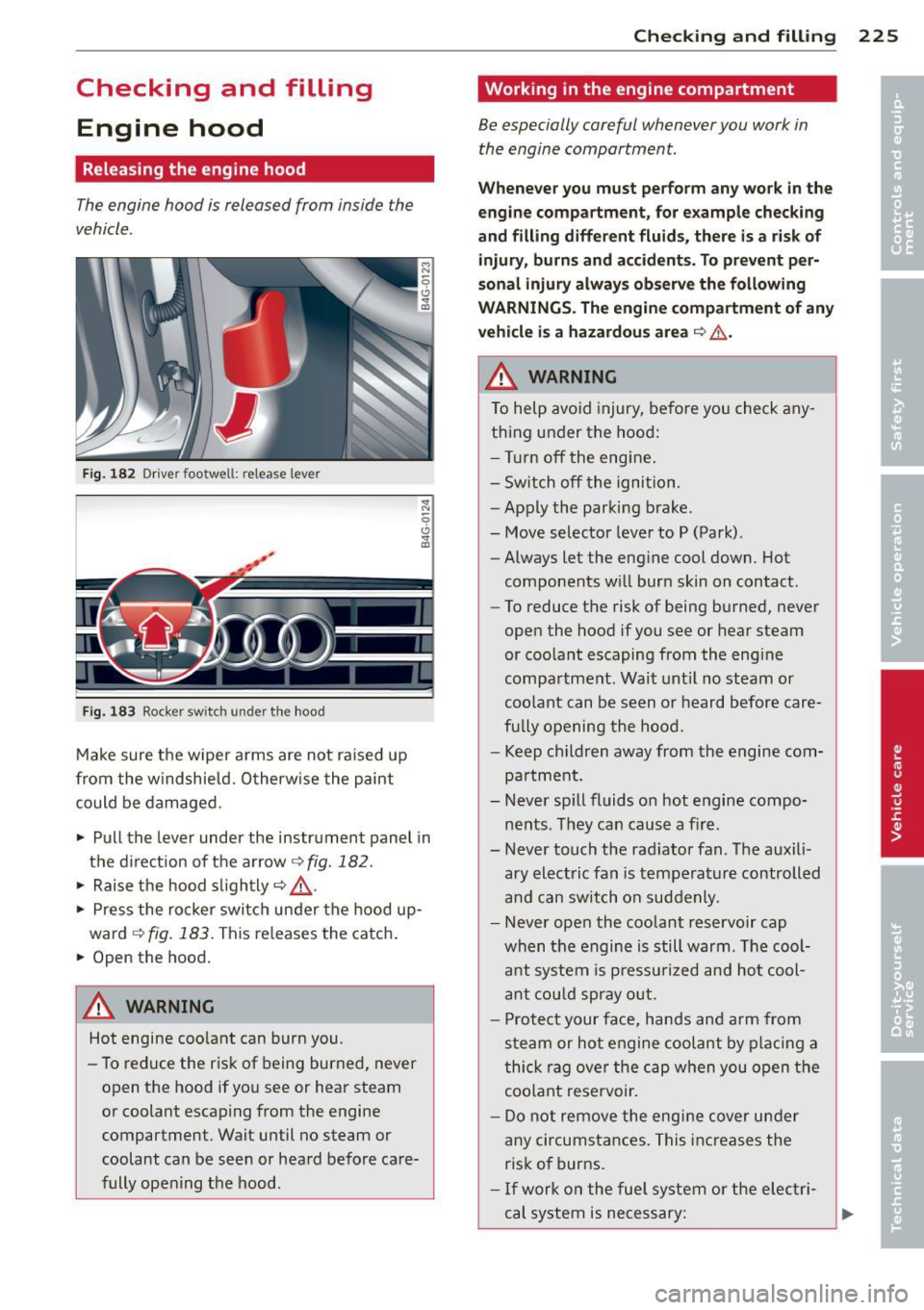
The engine hood is released from inside the
vehicle .
Fig. 182 Dr iver footwell: release leve r
Fig. 183 Rocker switch under the hood
Make sure the wiper arms are not raised up
from the w indshield. Otherw ise the paint
could be damaged.
.. Pull the lever under the instrument panel in
the d irect ion of the arrow
<=> fig. 182.
.. Raise the hood slightly <=>_& .
.. Press the rocke r switc h under the hood up
ward
<=> fig. 183 . This re leases the catch .
.. Open the hood .
A WARNING
Hot engine coo lant can burn you.
- To reduce the r isk of being burned, never
open the hood if you see or hear steam
or coolant escaping from the engine
compartment . Wait until no steam or
coolant can be seen or heard before care
fully opening the hood.
Checkin g and fillin g 225
Working in the engine compartment
Be especially careful whenever you work in
the engine compartment.
Wh ene ve r y ou must perform an y wo rk in the
eng ine com pa rtm ent , for e xample checking
a nd filling diff ere nt fluids, th ere is a risk of
inju ry, burn s and accid ent s. To pr event per
so nal injury alwa ys observe the foll owing
WARNING S. The engin e compartment of an y
v e hicle i s a h az a rdou s are a
<=> ,&.
h WARNING
To help avoid injury, be fore yo u check any
thing under the hood:
- Turn off the engine .
- Sw itch off the ignition .
- Apply the parki ng brake.
- Move selector leve r to P (Park) .
- Always let the engine cool down. Hot
components w ill burn skin on contact .
- To reduce the risk of being burned, never
open the hood if you see or hear steam
or coo la nt escaping from the engine
compa rtment. Wait unt il no steam or
coolant can be seen o r heard before care
fu lly opening the hood.
- Keep ch ildren away from the engine com
pa rtment.
- Never sp ill fluids on hot engine compo
nents . They can cause a fire .
- Never touch the rad iator fan. The auxili
ary electric fan is temperat ure controlled
a nd can sw itch on suddenly .
- Never open the coolant reservoir cap
when the engine is still warm . The cool
a nt system is p ressu rized and hot cool
a nt cou ld spray o ut.
- Protect your face, hands and arm from
steam or hot engine coolant by plac ing a
thick rag ove r the cap when you open the
coo lant rese rvoir.
- Do not remove the engine cover under
any circumstances. This inc reases the
ris k of burns.
- If work on the fue l system o r the elec tri
cal system is necessary:
Page 229 of 306
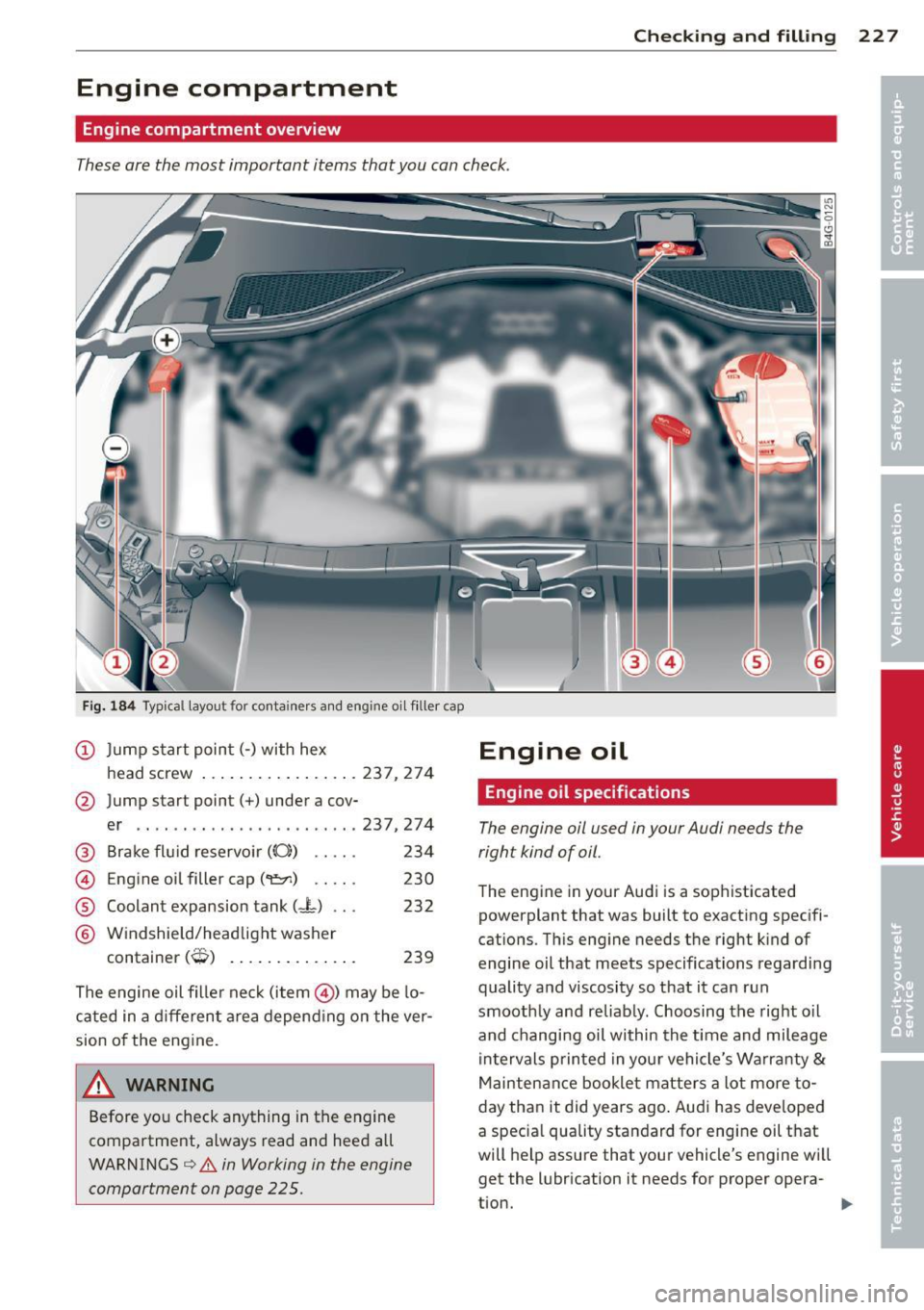
Checking and filling 22 7
Engine compartment
Engine compartment overview
These are the most important items that you can check.
Fig. 184 Typical layout for conta iners and engine o il filler cap
@ Jump start poin t(-) with hex
head screw .. .............. . 237,274
@ Jump start point(+) under a cov-
®
©
®
©
er .. .. ... ..... ...... ...... 237,274
Brake fluid r eservo ir
((0)) . . . . . 234
Eng ine oil filler cap
("1:::r.) . . . . . 230
Coolant expansion tank
(-L) .. .
Windshield/headlight washer
t . ('"') con ainer O ......... .... .
232
239
The engine oil filler neck (item@) may be lo
cated in a different area depending on the
ver
sion of the eng ine.
Before you check anything in the engine
compartment, always read and heed all
WARNINGS
c::> &. in Working in the engine
compartment on page 225.
Engine oil
Engine oil specifications
The engine oil used in your Audi needs the
right kind of oil.
The engine in your Audi is a sophisticated
powerplant that was built to exacting specifi
cations. This eng ine needs the right kind of
engine oil that meets specifications regardi ng
quality and viscosity so that it can run smoothly and reliably. Choosing the right oil
and changing oil within the time and mileage
intervals p rinted in you r vehicle's Warranty
&
Maintenance booklet matters a lot more to
day than it did years ago . Audi has developed
a special quality standard for engine oil that
will hel p assure that your vehicle's engine will
get the lubrication it needs for proper opera
tion.
Page 235 of 306
the level may be slightly above the "max"
marking .
The location of the coolant expansion tank
can be seen in the engine compartment illus
tration ¢ page 22 7.
To obtain an accurate reading, the engine must be switched
off.
The expansion tank in your vehicle is equipped
with an electric coolant level sensor.
When the coolant level is too low, the warning
light in the Auto-Check System ¢page 16will
illuminate until you add coolant and the level
has been restored to normal. Even though
there is an electric coolant level sensor , we
still recommend you check the coolant level
from time to time.
Coolant loss
Coolant loss may indicate a leak in the cooling
system. In the event of coolant loss, the cool
ing system should be inspected immediately
by your authorized Audi dealer.
It is not
enough merely to add coolant.
In a
sealed system, losses can occur only if
the boiling point of the coolant is exceeded as
a result of overheating.
& WARNING
The cooling system is under pressure and
can get very hot. Reduce the risk of scald
ing from hot coolant by following these
steps.
- Turn
off the engine and allow it to cool
down.
- Protect your face, hands and arms from
escaping fluid and steam by covering the
cap with a large, thick rag.
- Turn the cap slowly and very carefully in
a counter-clockwise direction while ap
plying light, downward pressure on the
top of the cap.
- To avoid being burned, do not spill anti freeze or coolant on the exhaust system or hot engine parts . Under certain condi
tions, the ethylene glycol in engine cool
ant can catch fire .
Checking and filling 233
@ Note
Do not add any type of radiator leak seal
ant to your vehicle's engine coolant. Add
ing radiator repair fluid may adversely af
fect the function and performance of your
cooling system and could result in damage not covered by your New Vehicle limited
Warranty .
Adding coolant
Be very careful when adding engine coolant.
Before you check anything in the engine com
partment,
always read and heed all WARN
INGS ¢ & in Working in the engine compart
ment on page 225 .
.,. Turn
off the engine .
.,. let the engine cool down.
.,. Place a thick rag over the coolant expansion
tank ¢ fig .
187 and carefully twist the cap
counter-clockwise ¢&_ .
.,. Add coolant.
.,. Twist the cap on again tightly.
Replacement engine coolant must conform to
exact specifications ¢ page
2 32, Coolant. We
recommend using only coolant additive G12+
+, G13 or in an emergency G12+. Do
not use a
different additive. In an emergency use plain
water until you can get the correct additive
and can restore the correct ratio. This should
be done as soon as possible.
If you have lost a considerable amount of
coolant, then you should add cold antifreeze
and cold water only when the engine is cold.
Always use new engine coolant when refilling.
Do not fill coolant above the "MAX" mark. Ex
cess coolant will be forced out through the pressure relief valve in the cap when the en
gine becomes hot.
A WARNING
- The cooling system is under pressure and
can get very hot. Reduce the risk of
II-
•
•
Page 236 of 306
234 Checking and filling
scalding from hot coolant by following
these steps .
- Turn off the eng ine and a llow it to cool
down.
- Protect your face, hands and arms from escaping flu id and steam by cover ing
the cap with a large, thick rag .
- Turn the cap slowly and very carefully
i n a counter-clockwise direction while
apply ing l ight, downwa rd p ress ure on
the top of the cap .
- To avo id being burned, do not sp ill an
tifreeze or coolant on the exhaust sys
tem or hot engine parts . Under certain
conditions, the ethylene glyco l in en
gine coolant can catch f ire .
- Antifreeze is poisonous . Always store an
tifreeze in its or iginal container and we ll
out of the reach of children .
- If you drain the coolant, it must be
caught and safely stored in a proper con
tainer clear ly marked "poison".
@ Note
- Coolant po llutes the env ironment and
could cause an engine fire . Excess coo l
ant will be forced out through the pres
sure re lief valve in the cap when the en
gine becomes hot.
- If, in an emergency, on ly water can be
added, the correct ratio between water
and antifreeze
c::> page 232 must be re
stored as soon as possible .
@ For the sake of the environment
Drained coolant should not be re used. Al
ways dispose of used coolant while observ
ing all environmental regulat ions .
Radiator fan
The radiator fan switches on automatically by
itself
An auxiliary e lectr ic radiator fan switches on
and off depending on coolant temperature
and other vehicle operating cond itions. After you switch the engine off, the aux
iliary
fan can cont inue running for up to 10 minutes
- even w it h the ignition off. It can even switc h
on again later by itself
c::> .&. , if
- the temperatu re of the engine coo lant rises
due to the heat build-up from the engine in
the engine compartment, or
- the engine compartment heats up because
the vehicle is parked in intense sunlight.
A WARNING
-- To reduce the risk of persona l injury nev-
er touch the radiator fan.
- The a uxiliary electric fan is temperat ure
contro lled and can sw itch on suddenly
even when the engine is not running.
- The auxiliary radiator fan switches on a u
tomatically when the engine coo lant
reaches a certain temperature and will
continue to run until the coolant temper
ature drops .
Brake fluid
Checking brake fluid level
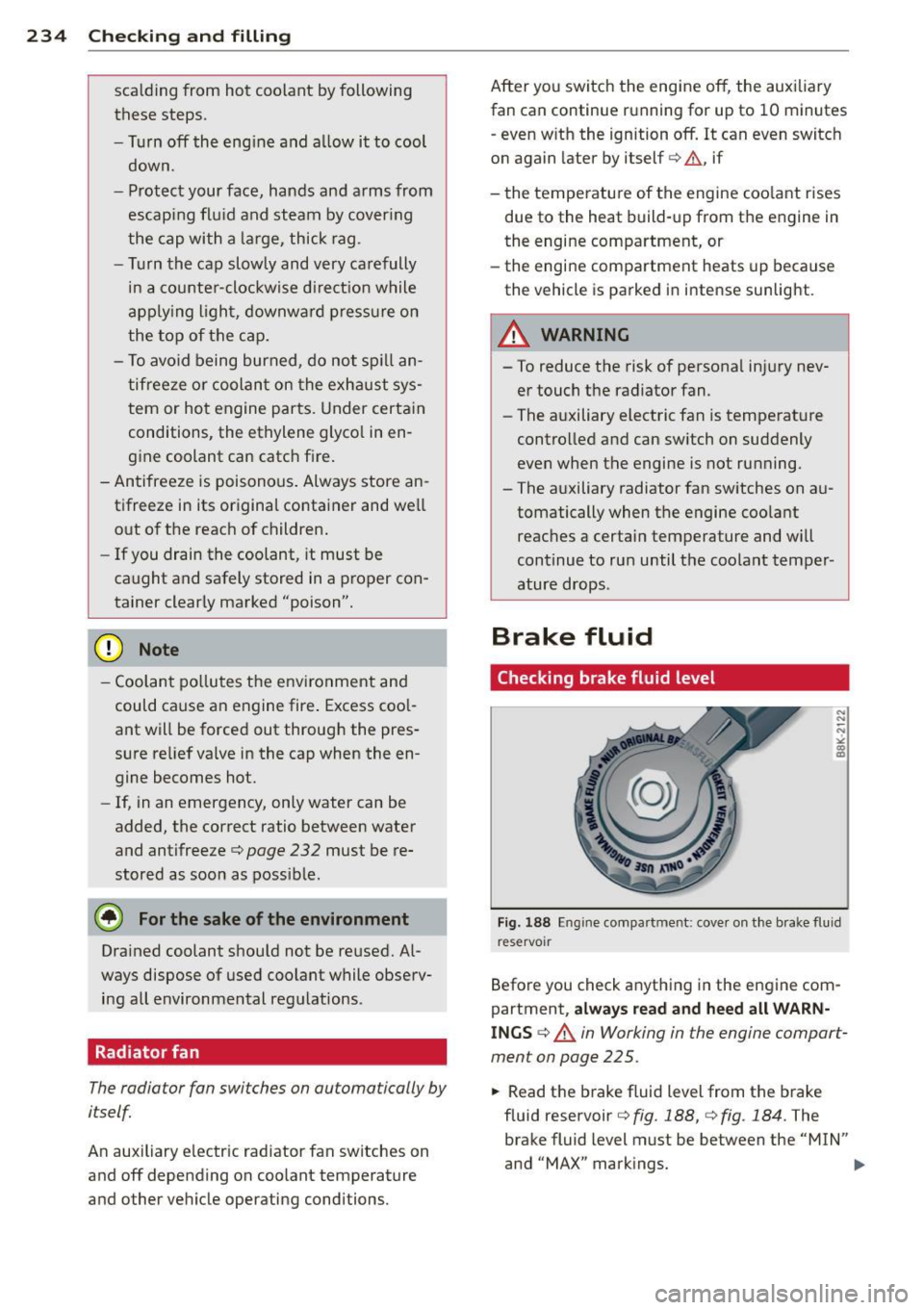
Fig. 1 88 En gin e compa rtme nt: cove r on t he brake fluid
reservoi r
Before you check anything in the engine com
partment,
always read and heed all WARN
INGS c:> A in Working in the engine compart
ment on page 225.
.,. Read the brake fluid level from the brake
fluid reservoir
c::> fig. 188, c:> fig . 184. The
brake fluid level must be between the "MIN"
and "MAX" markings.
IJ>
Page 237 of 306
The location of the brake fl uid reservo ir can be
seen in the engine compartment illustration
c::> page227.
The fl uid level may drop slightly after some
time due to the automatic adjustment of the
brake pads. This is not cause for alarm .
If the brake fluid level falls considerably be
l ow the "MIN" mark, the bra ke wa rning/ind i
cator light
1111 (U .S . models)/ . (Canadian
models) will come on
c::> page 15. Do not con
tinue to operate the vehicle. The comp lete
brake system sho uld be thoroughly checked
by an author ized Audi dealer or other quali
fied fac ility and the cause corrected . If the
brake fluid level is too low, the brake warn ing/
i ndicator light w ill illuminate . Contact an au
thor ized Audi dealer
imm ediately .
Changing brake fluid
Have the brake fluid changed by an experi
enced technician .
Brake fluid absorbs moisture from the a ir. If
the water content in the brake fluid is too
h igh, corrosion in the brake system may result
after a per iod of t ime . The bo iling po int of t he
brake fluid w ill also decrease consider ably and
dec rease b raking per formance.
Therefore, the brake flu id must be changed
ever y two years . Always use new b rake fluid
whi ch confo rms to Fede ral Motor Vehicle
Standard "FMVSS 1 16 DO T 4".
The brake flu id rese rvoir ca n be difficult to
r eac h, therefo re , we re commend that yo u
have the brake fl uid changed by y our autho r
i z ed
Audi dealer . Your deale r has the correct
too ls, the right brake fluid and the know -how
to do this for you .
A WARNING
-Brake fluid is po isonous . It must be stor
ed only in the closed orig inal container
out of t he reac h of children!
- Brake fa ilure can result from old o r inap
propr iate brake fluid. Observe these pre
caut ions:
Checkin g and fillin g 235
-Use only brake f luid that meets SAE
spec ificat ion
J 1703 and conforms to
Federal Motor Ve hicle Standard 116.
Always check with your autho rized Audi
dealer to make sure yo u are using the
correct brake fluid . The correct type of
brake f lu id is also ind icated on the
brake flu id rese rvoi r.
- The bra ke fluid must be new. Heavy us e
of the brakes can cause a vapo r lock if
the b ra ke fluid is left i n the system too
l ong . This can se riously affec t the effi
ciency of the b rakes as well as your
safety . This co uld resu lt in an accident.
(D Note
B rak e fluid wi ll damage the pa int o f you r
vehicle .
~ For the sake of the environment
Because o f the p rob lem of pro per disposal
of bra ke fluid as well as the spe cial too ls
r equired an d the necessary exper tise, we
r ecommend that yo u have the brake flu id
changed by yo ur authorized Aud i dea le r.
Battery
General information
U nder normal ope ra ti ng cond itions , the bat
te ry in yo ur Audi doe s not need any ma inte
nance. With
high outside tempera tures or
l ong daily drives we recommend that you have
the e lectrolyte level checked by a service fa
c ili ty. The electrolyte leve l should a lso be
checked each t ime the battery is charged
c:> page 237.
Have the battery checked when yo u take your
vehicle in for service. You are well advised to
replace a batte ry that is older than 5 years .
Wi th certain types of airbag deployment, the
battery is disconnected from the vehicle elec
trical system for safety reasons
c> & in Re
pair , care and disposal of the airbags on
page 161.
~
•
•
Page 238 of 306
236 Check ing and filling
Di sconnect ing the batt ery terminal s
Some vehicle functions (power window regu
l ators, for example) are lost if the battery ter
minals are disconnected . These functions have
to be re learned after the battery terminals are
connected again. To prevent this, the battery
should only be disconnected from the vehicle
electrical system when absolutely necessary
for repairs .
Vehicles not dri ven fo r lo ng period s
If you do not drive your vehicle over a period
of several days or weeks, electrical compo
nents are gradually cut back or switched off.
This reduces energy consumption and main
tains starting capab ility over a longer period
¢ page 19 7 . Some of the convenience func
tions may not operate, such as the inte rior
lights or powe r seat adjustme nt. The conven
ience functions will be ava ilable again when
you switch on the ignition and start the en
gine.
Winter operati on
During the winter months, battery capacity
tends to decrease as tempe ratures drop . This
is because more powe r is also consumed while
start ing, and the headlights, rear window de
fogger, etc., are used more often.
Avoid unnecessary power consumption, par
ticularly in c ity traffic or when trave ling on ly
short distances. Let your authorized Audi
dea ler check the capacity of the vehicle bat
tery before winter sets in
¢ page 237. A well
charged battery w ill not only prevent starting
prob lems when the weather is cold, but will
also last longer .
(D Tips
If your vehicle is left standing for several
weeks at extremely low temperatures, the
veh icle battery should be removed and
sto red where it will not freeze. This w ill
prevent it from being damaged and hav ing
t o be replaced.
Working on the battery
Be especially careful when working on or near
the battery.
The battery is located in the luggage compart
ment under the floor. Before you check any
th ing in the luggage compartment,
read and
h ee d all WARNINGS
¢ ,&,
Always heed the safet y warnings , when work
ing on the vehicle battery or the vehicle e lec
trical system to prevent injury.
The following WARNINGS are very
important wh en wor king on the battery :
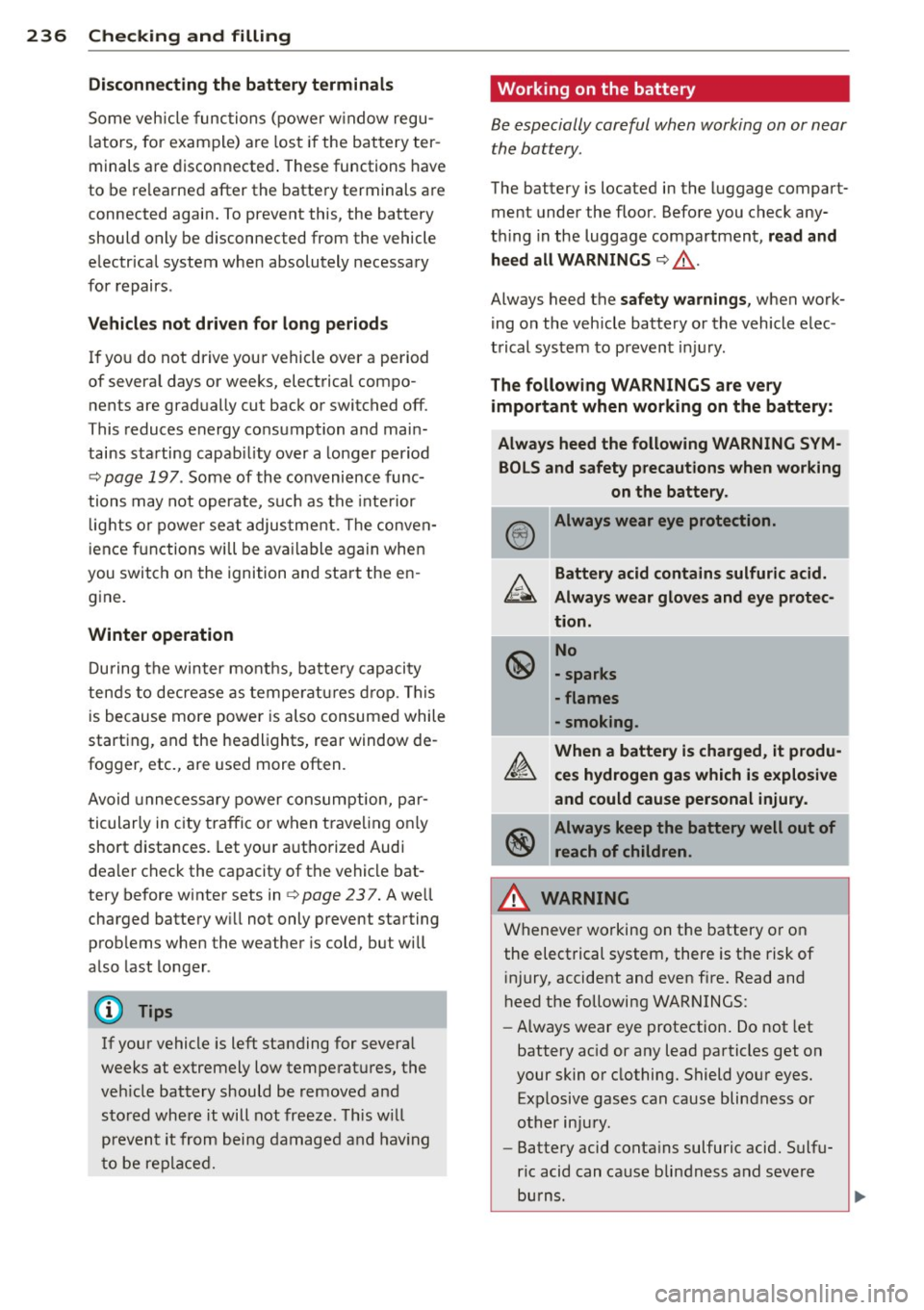
Alway s heed the following WARNING S YM
BOLS and safety prec autions when working
on the battery .
®
Always wear eye protection.
Battery acid contain s sulfuric acid.
Alwa ys wear glove s and ey e protec
tion.
No
- sparks
-flames
- smoking .
1
When a b atter y is charged, it pr odu
ces hydrogen gas which i s ex plosive
and could cau se per sonal injury.
Always keep the battery well out of reach of children .
.&_ WARNING ~
Whenever working on the battery or on
the electrical system, there is the risk of
i njury, accident and even fire. Read and
heed the following WARNINGS:
- Always wear eye protection. Do not let
battery ac id or any lead particles get on
your skin or clothing. Shield your eyes. Exp losive gases can cause blindness or
other inju ry.
- Battery acid conta ins sulfuric acid. Sulfu
ric acid can cause blindness and severe
burns.
Page 239 of 306
-Always wear gloves and eye protection.
Do not tilt the battery because acid
could leak out of the ventilation open
ings .
- If you get battery acid in your eyes or
on your skin, immediately rinse with
cold water for several minutes and get
medical attention.
- If you should ingest any battery acid,
seek medical attention immediately.
- Do not expose the battery to an open
flame, electric sparks or an open light .
- Do not smoke.
- Do not interchange the positive and neg-
ative cables .
- When working on the battery, be sure
not to short-circuit the terminals with
tools or other metal objects. This would cause the battery to heat up very quickly,
which could lead to damage or explosion
and personal injury .
- When a battery is charged, it produces
hydrogen gas which is explosive and
could cause personal injury .
- Always keep the battery well out of the
reach of children .
- Before work is done on the electrical sys
tem, disconnect the negative ground ca
ble.
- Before performing any work on the elec trical system, switch off the engine and
ignition as well as any electrical equip
ment. The negative cable on the battery
must be disconnected.
If you are just go
ing to replace a light bulb, then it is
enough to switch off the lights.
- Before disconnecting the battery , switch
off the anti-theft alarm system! Other
wise you will set off the alarm.
- When disconnecting the battery, first
disconnect the negative cable and then
the positive cable.
- Before reconnecting the battery, make
sure all electrical consumers are switch
ed off. Reconnect the positive cable first
and then the negative cable. Never inter
change the cables - this could start a fire!
Checking and filling 237
- Never charge a frozen or a thawed-out
battery . It could explode! If a battery has
frozen, then it must be replaced. A dis
charged battery can freeze over at 32 °F
(0 oc).
-Make sure the vent hose is always attach
ed to the opening on the side of the bat
tery .
- Never use batteries which are damaged.
There is the danger of an explosion! Al
ways replace a damaged battery .
A WARNING
California Proposition 65 Warning:
- Battery posts, terminals and related ac
cessories contain lead and lead com
pounds, chemicals known to the State of
California to cause cancer and reproduc
tive problems . Wash hands after han
dling .
(D Note
-Do not disconnect the vehicle battery
when the ignition is on or when the en
gine is running, otherwise, you will dam
age electronic components in the electri
cal system.
- If your vehicle is going to stand for a
long period of time without being driven,
protect the battery from "freezing", oth
erwise it will be damaged and will then
have to be replaced.
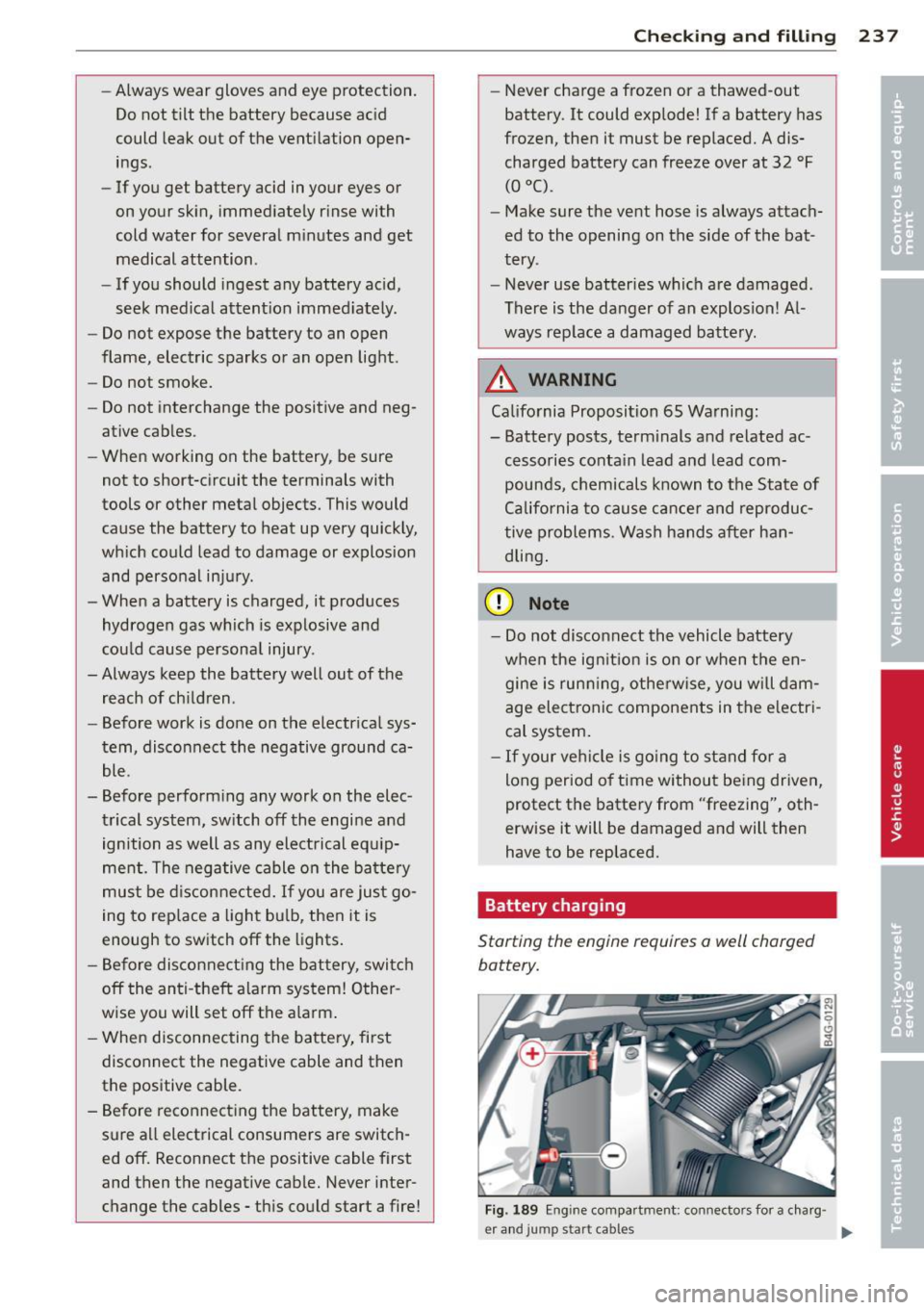
Battery charging
Start ing the engine requires a well charged
battery.
Fig . 189 Eng in e compart ment : co nnecto rs for a charg ·
e r and jump st art cable s
1111>