air condition AUDI S6 2013 User Guide
[x] Cancel search | Manufacturer: AUDI, Model Year: 2013, Model line: S6, Model: AUDI S6 2013Pages: 306, PDF Size: 76.92 MB
Page 173 of 306
Child Safety
Important things to know
Introduction
The rear seat is generally the safest place in a
collision .
The physical principles of what happens when
your veh icle is in a crash app ly also to chi ldren
~ page 13 7, What happens to occupants not
wearing safety belts? .
But unlike adu lts and
teenagers, their muscles and bones are not
fu lly developed . In many respects children are
at greater risk of serious injury in crashes than
ad ults.
Because children's bod ies a re not fu lly deve l
oped, they require restraint systems especial l y designed for their size, weight, and body
structure. Many co untries and all states of the
United States and provinces of Canada have
laws requ iring the use of approved ch ild re
straint systems for infants and small children .
In a fronta l crash at a speed of 20 -35 mph
(30-56 km/h) the forces acting on a 13-pound
(6 kg) infa nt w ill be more than 20 t imes the
weight of the child . T his means the weight of
the child would suddenly be more than
260 pounds ( 120 kg). Under these conditions,
on ly an appropr ia t e chi ld restraint properly
used can reduce the risk of ser ious injury .
Ch ild restra ints, like adult safety belts, must
be used properly to be effective. Used improp
erly, they can increase the risk of ser ious in
jury in an accident.
Consult the ch ild safety seat manufacture r's
instr uctions in order to be sure the seat is
right fo r you r ch ild's size ~
page 175 , Impor
tant safety instructions for using child safety
seats.
Please be sure to read and heed all of
the impo rtant informat ion and WARNINGS
about ch ild safety, Advanced A irbags, and the
i nstallation of child rest raints in this chapter .
There is a lot you need to know about the Ad
vanced A irbags in your vehicle and how they
wo rk when infants and children in child re-
Child Sa fet y 1 71
stra ints are on the front passenge r seat . Be
ca use of the large amount of important infor
mation, we cannot repeat it a ll here . We urge
you to read the detailed information in th is
owner 's manua l about a irbags and the Ad
vanced Airbag System in your vehicle and the
very important information about transport
ing children on the front passenge r seat .
Please be sure to heed the WARN INGS -they
are ex tremely importa nt for yo ur safety and
the safety o f you r passengers, especially in
f ants and small chi ldren .
.A, WARNING
-Accident statistics have shown that c hil
dren a re generally safer in the rear seat
area than in the front seating position.
Always restrain any child age 12 and un der in the rea r.
- All vehicle occupants and especially chil
dren must be restrai ned p roperly when
eve r riding in a vehicle . An unr est rained
or improperly restrained chi ld could be
in ju red by str iking the interio r or by be
ing ejected from the vehicle during a
sudden maneuve r or impac t. An un re
strained or improper ly restrai ned ch ild is
also at greater risk of injury o r death
through contact with an inflating airbag.
- A suitable chi ld restraint properly instal
led and used at one of the rear seat ing
positions p rov ides the highest degree of
protection for infants and small children
in most accident situations.
A WARNING
Ch ildren on the front seat of any car even
with Advanced Airbags ca n be ser iously in
ju red or even kil led when an a irbag in
fla tes. A child in a rearwar d-fac ing ch ild
safety seat installed on t he front passen
ger seat will be ser iously injure d and ca n
be killed i f the front airbag inflates .
- T he infla ting air bag will h it the ch ild
safety sea t or i nfan t carrie r wi th great
force and will smash the child safe ty seat
an d child against the bac krest , center
armrest, or door .
•
•
Page 197 of 306
freezing conditions ice) on the brake pads. A
few careful brake applications sho uld d ry
off
the brake pads or remove any ice coatings.
When you are driving at h igher speeds wit h
the windshield wipers on, the brake pads will briefly touch the brake discs in regular inter
va ls so as to improve reaction t ime when brak
ing on wet surfaces. You the driver w ill not no
tice anything.
The effectiveness of the brakes can be reduced
when the vehicle is dr iven on a salt -covered
road and the brakes are not used . Here too,
you should clean
off accumulated salt coat ing
from brake discs and pads with a few careful
applications of the brake
¢ ,&..
Cor ro sion
There may be a tendency for dirt to bui ld up
on the brake pads and corrosion to form on
the discs if the car is not dr iven regularly or
only for short trips with little use of the brakes .
If the brakes are not used frequently, or if cor rosion has formed on the discs, it is advisable
to clean
off the pads and discs by braking
f irmly a few times from a moderately high
speed ¢,&. .
Fa ult s in the b rake system
If you should notice a sudden increase in
brake pedal travel, then one of the two brake
circu its may have failed
c> ,&..
Lo w brak e flu id le vel
Malfunctions can occur in the brake system if
the brake fluid level is too low . The brake fluid
level is monitored electronically.
Brake boo ste r
The brake booster works with vacuum pres
sure which is created only when the engine is
running ¢ ,&. .
Brake lining w ear statu s
Brake lining wear may be checked by vis ual in
spection of the condition of the brake pads
through the openings in the whee l. If neces-
Int ellig ent technolog y 195
sary, the wheel may be removed for this in
spection ¢
page 263 , Changing a wheel.
A WARNING
- You should perform braking maneuvers
for the purpose of cleaning the brake
system only if road conditions permit.
Other road users must not be put at risk -
you may cause an accident!
- Before descend ing a steep grade, reduce
speed and sh ift transmission into a lower
gear or lower dr iving range . Do not ride
the brakes or hold the pedal down too
long o r too often . Th is could cause the
brakes to get hot and diminish braking
efficiency .
- Do not "ride the brakes" by rest ing you r
foot on the pedal when you do not intend
to brake . This may cause the brakes to
overheat, p remature wear and increased
stopping distance.
- Under certain cl imatic and operating
conditions such as passing thro ugh wa
ter, dr iv ing in heavy rain or after washing
the vehicle, the effectiveness of the brakes can be reduced . In winter, ice can
accumu late on the brake pads, lin ings,
discs and drums . Carefully app ly brakes
for a test. Brakes will dry and ice coat
ings w il l be cleaned
off after a few care
fu l brake applicat ions.
- Driving for an extended period o f time on
salt- covered roads wi thout using your
brakes can a lso affect braking efficiency .
Clean
off accum ulated salt coating from
brake discs and pads with a few careful
brake applications.
- If you damage the front spoiler, or if you
install a different spoiler, be sure the air
f low to the front brakes is not obstruct
ed. Otherw ise the brake system could
overheat reducing the effectiveness of
the entire brake system.
- Failure of one brake circuit will impair
the braking capab ility result ing in an in
creased stopping distance . Avoid driving
the vehicle and have it towed to the near-
est A udi dealer or qualified wo rkshop.
~
•
•
Page 202 of 306
200 Driving and en vir onm ent
Catalytic converter
It is very important that your emission con
trol system (catalytic converter) is function
ing properly to ensure that your vehicle is run
ning in an environmentally sound manner .
• Always use lead-free gasoline¢ page 220,
Fuel supply.
• Never run the tank down all the way to
empty .
• Never put too much motor oil in your en-
gine ¢
page 230, Adding engine oil~-
., Never try to push- or tow -start your veh icle.
The catalytic converter is an eff ic ient "clean
up" device built into the exhaust system of
the vehicle. The catalytic converter burns many of the pollutants in the exhaust gas be
fore they are released into the atmosphere.
The exclusive use of unleaded fuel is critically
important for the life of the cata lytic conve rt
e r and proper functioning of the engine.
& WARNING
-
- Do not park o r operate the vehicle in
areas where the hot exhaust system may
come in contact with dry grass, brush,
fuel spill or other material which can cause a fire.
- Do not apply additional undercoating or
rustproofing on or near the exhaust
man ifold, exhaust p ipes, catalytic con
verter or heat shields . During driving, the
substance used for undercoating could
overheat and cause a fire .
@ Note
-Be aware that just one tank filling with
leaded fuel will already seriously de
grade the performance of the catalytic
conve rter .
- Do not exceed the correct engine oil level
¢ page 230.
-Do not drive until the fuel tank becomes
completely empty. The eng ine could mis
fire . U nburned f uel could a lso get into the exhaust system and this co
uld cause
the cata lytic converter to overheat .
- Do not switch off the ignition while the
vehicle is moving .
- Do not continue to ope rate your veh icle
under these conditions, as otherwise fuel
can reach the catalytic converter. This
cou ld result in overheating of the con
verter, requir ing its replacement.
- To assure efficient operation of the Emis
sion Control System:
- H ave your vehicle maintained properly
and in accordance w it h the service rec
ommendat ions in your Warranty &
M ain tenance book let.
- L ack of prope r maintenance as we ll as
improper use of the vehi cle will impair
the function of the em iss ion contro l
system and could lead to damage .
@ For the sake of the environment
Even when the Emiss ion Control System is
operat ing proper ly, the exha ust gas can
have a sul fur -li ke exhaust gas smell under
some operating states . This depends on
the sulfur content of the fuel being used .
Using a different brand of fue l may help,
or f il li ng the tank with lead-free super
grade gasoline .
Avoid damaging the
vehicle
When you are d rivi ng on poor roads, or over
c u rbs, steep ramps, etc., ma ke certai n that
low- ly ing parts s uch as spoilers and exha ust
system parts do not bottom o ut and get dam
aged.
T his is espe cially true for ve hicles with low
s lung chassis (spor ts chassis)* and fully load
ed vehicles .
Page 204 of 306
202 Driving and environment
Avoid full throttle
Driving at moderate speeds saves fuel and
improves your mileage.
.,. Try and keep well below your car's maxi-
mum speed.
Accelerating gently reduces fuel consump
tion, engine wear, and does not disturb the
environment.
Fu el consumption, exhaust emissions and en
gine noise increase disproportionately at high
speeds. If you drive at approximately three
quarters of top speed, fuel consumption will
be reduced by one half. Never drive faster
than the posted speed limit and weather con
ditions permit .
Reducing unnecessary idling
Even when your car is just idling it burns up
fuel.
.,. Shut the engine off when you are not driv
ing the vehicle .
... Do not warm up the veh icle by letting the
engine run at idle .
The idling phase is automat ically reduced for
vehicles w ith the Start/Stop system .
It is effi
cient to switch
off the engine in vehicles with
out the Start-Stop-System when stopped at
railroad crossings and long red lights . Turning
the engine
off for just 30-40 seconds saves
more f uel than is burned by starting the en
gine again.
It takes a long time for the engine to wa rm up
fully when it is running at idle. However, wear
and noxious emissions are especially high
when the engine is warming up. So you should
drive away as soon as you start the engine and
avoid running at high rpms while the engine is
still warming up.
([) Note
Do not leave engine idling unattended af
ter starting. If warning lights should come
on to indicate improper operation, they would
go unheeded. Extended idling also
produces heat, which could result in over
heating or other damage to the veh icle or
other property .
Regular maintenance
A badly tuned engine unnecessarily wastes a
lot of fuel.
.,. Have your vehicle serviced at regu la r inter-
vals .
By having your veh icle reg ularly se rviced by an
Audi dealer he lps to ensure that it runs prop
erly and economically. The condition of your
vehicle not only affects its safety and ability to
ho ld its value, it also affects
fuel consump
tion .
Check your oil each time you fill your tank.
The amou nt of oi l used is related to engine
load and speed.
It is normal for the oil consumption of a new
engine to reach its lowest value after a certain
mileage has been driven .
You must drive your veh icle about 3,000 miles
(5,000 kilometers) before you can properly
assess oil consumpt ion.
This also app lies to fuel consumption and en
gine output .
(D Note
-Have your veh icle ma inta ined properly
and in accordance with the service rec
ommendations in your Warranty
& Main
tenance booklet. Lack of proper ma inte
nance as well as improper use of the ve
hicle will impair the function of the
em ission control system and could lead
to damage.
- Do not alter or remove any component of
t he Emission Control System unless ap
proved by the manufacturer .
- Do not alter or remove any device, such
as heat shields, switches, ignition wires,
valves, which are designed to protect
your vehicle's Emission Control System
Page 210 of 306
208 Cleaning and protection
Cleaning and protect ion
General information
Regular core preserves vehicle value .
Any automobile is exposed to industrial
fumes, corrosive road salt, etc. A well cared
for Audi can look like new many years after
purchase . Regular and correct care w ill con
tr ibute to maintaining the beauty and value of
your Aud i.
Furthermore, good care may be a condition
for substantiating a warranty claim should
corrosion damage or paint defects occur.
Your author ized Audi dealer has a variety of
dedicated vehicle-care products and can ad
vise which ones to use for cleaning the exter i
or and interior of your vehicle .
Whether you use products recommended by
Audi or other commercially available clean ing
agents, please make sure you apply them cor
rectly .
A WARNING
-Cleaning agents may be poisonous. Keep
them out of the reach of children.
- Heed all caut ion labels.
- Always read directions on the container
before using any product . Follow the di
rect ions carefu lly.
- Most chemical cleaners are concentrated
and have to be diluted.
- Use spot removing fluids only in well
ventilated areas.
- Do not use gasoline, kerosene, d iesel
fuel, nail pol ish remover or other volatile
fluids. They may be toxic, flammable or
hazardous in other ways. Do not wash,
wax or dry the vehicle with the ignit ion
on or the engine running.
- Do not clean the undersides of chassis,
fenders, wheel covers, etc. without pro
tecting your hands and arms. You may cut yourself on sharp-edged metal parts. -
Moisture and ice on brakes may impair
brak ing eff ic iency
c::> page 194 , General
information.
Test the brakes carefully
each time you wash the vehicle .
@ For the sake of the environment
Select only environ mentally friendly clean
ing products. Leftover cleaning products
should not disposed of in the household
waste .
Care of exterior
Washing
Frequent washing protects the vehicle .
The best p rotection against environmental in
fluences is
frequent washing and waxing . How
often this is required depends on:
- How much the veh icle is used
- Where the vehicle is parked (garage, in the
open under trees, etc.)
- The seasona l and weather conditions
- Environmental influences
T he longer b ird droppings, insects, tree resin,
road and industria l gr ime, tar, soot, road salt
and other materials remain on the vehicle body, the more lasting their destructive ef
fects will be . High temperatures caused by ex
posure to intense sunlight intensify the corro
sive effect, particularly when humidity is high as well.
Under certain circumstances,
weekly washing
may be necessary. Under other conditions, a
monthly washing and waxing may be ade
quate .
After the winter, the underside of the vehicle
should be thoroughly washed, preferably in a
professional car wash.
Vehicles with matte finish paint
c::> page 210.
A WARNING
-A lways read and heed all WARNINGS and
other information
c::> page 208.
Page 230 of 306
228 Check ing and filling
Modern engine lubrication has taken a quan
tum leap in the last few years. Many synthetic
oils ava ilable today provide better engine lu
brication that can outlast traditional petrole
um-based oils, making them a smart choice
for use throughout the life of your Audi .
Whether you use synthetic or petroleum
based engine oil, the oil that you use must
conform to Audi 's oil quality standard
VW 502 00 to he lp keep your vehicle's engine
running smoothly and help prevent the for
mat ion of harmfu l deposits, sometimes called
"s ludge ," that ove r time can lead to expensive
repairs .
At the time of pr int ing , engine o ils available in
the U .S . and Canada that meet the exacting
specifications of Audi oi l standard VW 502 00
a re synthetic engine oils. This does not mean,
however, that every syn thetic engine oil will
meet Audi oil standard VW 502 00. So always
be sure that you use an approved oil.
To help prevent the format ion of harmful de
posits use only oi l with the fo llowing specifi
cations printed on the oil container :
Audi oil standard VW 502 00
O il container labe ls may carry the specif ica
tion s ingly or in comb inat ion with other des ig
nations and oil qua lity standards .
Visco sity
Engine oi ls are graded accord ing to their vis
cosity. The proper viscosity grade oil for your
engine depends on cl imactic or seasonal con
d itions where you drive. You can use oil with a
viscosity grade of SA E SW40 across all tem
pe ratu re ranges for normal driving conditions .
However, if eng ine o il viscos ity grade
SAE SW40 is no t ava ilable, you can a lso use
viscosity grade SAE SW-30 or SAE OW -40 as
long as it meets Audi o il quality standard
VW 502 00 specifications .
Because engine oil that meets the Audi oil
standard may not be available everywhere
when you need it, we strongly recommend
that you always carry with you an ext ra quart (
li te r) of oil that exp ress ly con forms to the
VW 502 00 spec ification, in case you have to
top
off the oil while on the road.
Only if the level of the o il is a t or be low the
minimum mark -and no oi l that expressly
conforms to Audi oil standard VW 502 00
specifications is available - may you top
off
with a high quality engine o il, preferab ly syn
thet ic-based, tha t mee ts ACEA A3 or API SM
specifications, but even then , only in v iscosity
grades SAE SW-40 , SAE SW-30, o r
SAE OW-40. However, during the ent ire time
betwee n oil change intervals, never top
off
with more than a total of 0.5 q t/lite r engine
o il that does no t conform to Audi o il specifica
tion VW 502 00.
For more informa tion about eng ine oi l that
has been approved for your veh icle, please
contact e ither yo ur authorized Aud i dealer or
Audi C ustome r Re lations at 1 (800) 822 -2834
or visit our web site at www .audiusa.com or
www.aud icanada .ca. Here you w ill also find a
current list of oils (manufacturers, brand
names e tc.) tha t conform to Audi oil s tanda rd
vw 502 00 .
Changing the engine oil
The eng ine oi l and oil fi lter must be changed
according to the mileage (kilometers) and
time intervals specified in your ve hicle's War
ranty
& Maintenance booklet. Do not exceed
these intervals -harmful deposits from old
engine oil ca n reduce eng ine performance and
can lead to expensive engine repa irs .
Changi ng the oil at the recommended inter
vals is so very important because the lubricat ing proper ties of oil decrease gradually during
normal veh icle use . If you are not sure when
you have your oil changed, ask your author ized Audi Serv ice Adv isor.
Under some circumstances the engine oil
shou ld even be changed more frequent ly .
Change oil more often if you drive mostly
sho rt distances, operate the ve hicle in dusty
areas o r most ly unde r stop-and-go t raff ic con-
ditions, o r when you use your vehi cle where .,..
Page 247 of 306
Tires an d wheel s 245
you have stored. The system does not recog
nize the load condition of your vehicle.
The effectiveness of the ti re pressu re monitor
ing sys tem* will be impaired if you store nor
mal load pressures but then operate the vehi
cle at its maximum load¢,& .
See the illustration ¢
fig. 191 for the location
of the label on dr iver's side B-pillar (co lor of
the actual labe l and exact location on the ve
hicle wi ll vary slig htly) .
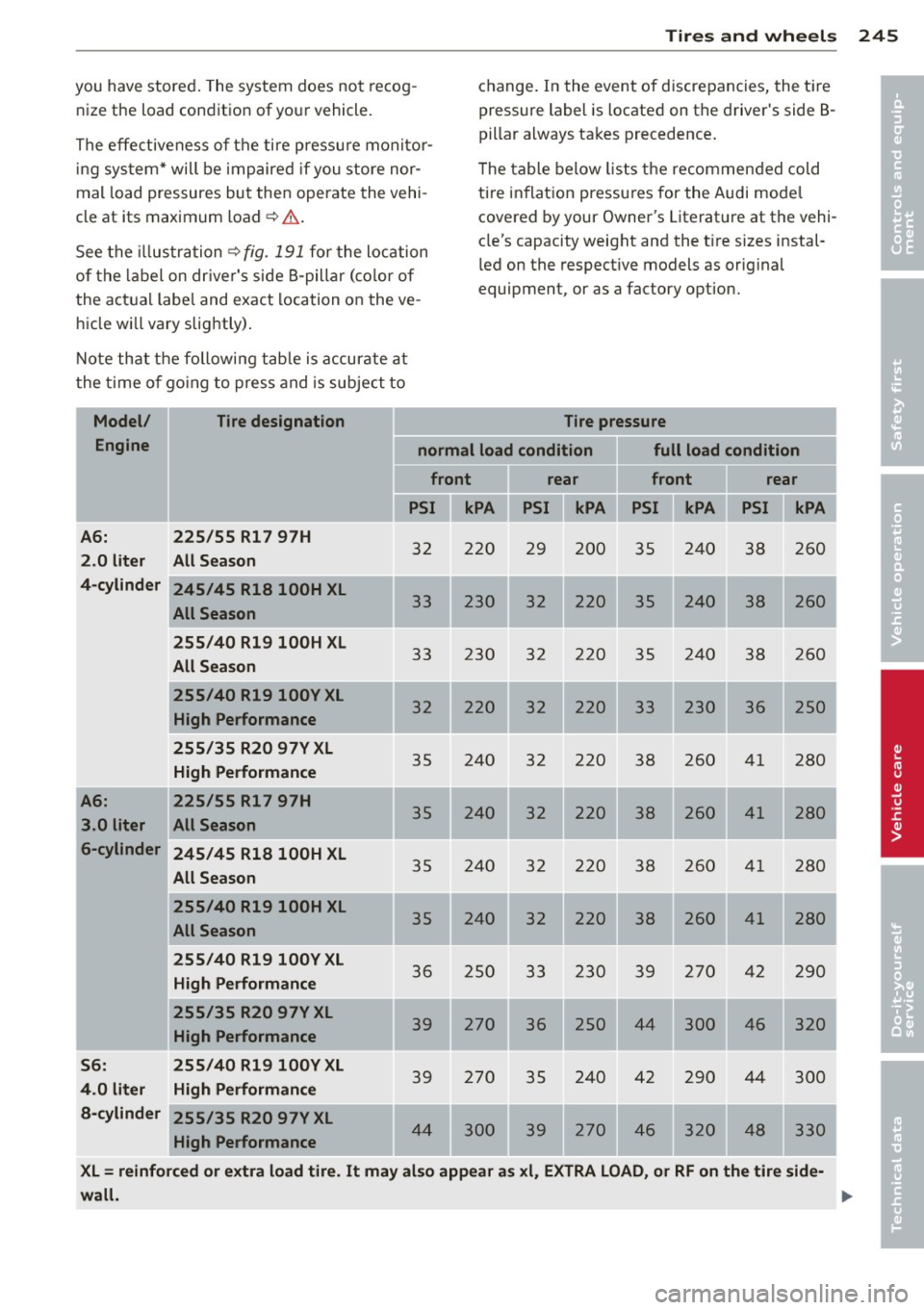
Note that the fo llowing tab le is accurate a t
the t ime o f go ing to press and is subject to
I Model / II Tire de signation
c h ange. In the event of discrepancies, the ti re
pressure label is located on the driver's side B
pillar always takes precedence .
T he table below lists the recommended cold
ti re inflat ion pressures for the Audi mode l
covered by your Owner's Literat ure at the vehi
cle's capacity weight and the t ire sizes instal
l ed on the respective models as orig inal
equipment, or as a factory option.
Tire pressure
Engine normal load condition full load condition
A6: 2 .0 lit er
4 -cylinder
A6: 3.0 liter
-
225 /5 5 Rl 7 97H
All Season
245 /45 Rl8 l0OH XL
All Season
255 /40 Rl 9 l00H XL
All S eason
255 /40 Rl9 l0OY XL
High Performance
255 /35 R20 97Y XL
High Perfo rmance
225 /55 Rl 7 97H
All Season
6-cylinder 245 /45 Rl8 l00H XL
All Seaso n
255 /40 Rl9 l0OH XL
All Season
255 /40 Rl9100Y XL
High Performance
255 /35 R20 97V XL
High Performance
S6: 255 /40 Rl 9100YXL
4.0
liter High P erformance
a -cy lind er
255 /35 R20 97V XL
High Performance front
PSI
ll kPA
32 220
230
33 230
32 220
35 240
35 240
35 240
35 240
36 250
39 270
39 270
44 300
rear front rear
PSI
ll kPA PSI ll kPA PSI ll kPA
29 200 35 240 38 260
32 220 35 240
38 260
32 220 35 240
38 260
32 220 33 230 36 250
32 220 38 260 41 280
32 220 38 260 41 280
32 220 38 260 41 280
32 220 38 260 41 280
33 230 39 270 42 290
36 250 44 300 46 320
35 240 42 290 44 300
39 270 46 320 48 330
XL= reinfor ced or extra load tire . It may al so appear a s xl , EXTRA LOAD , or RF on the tire side-
'
I
l
J
•
I
wall. ..,.
•
•
Page 253 of 306
Unbalanced whee ls must be rebalanced to
avoid excessive wea r on steering, suspension
and tires. A wheel must a lso be rebalanced
when a new tire is installed .
Incorrect wheel alignment
Incorrect whee l alignment can cause exces
sive tire wear, impairing the safety o f the vehi
cle. If tires show excess ive wear, have the
wheel alignment checked by an authorized
Audi dealer or qualified workshop .
All-wheel d rive
Vehicles w ith quattro ® must always have tires
of the same size, construction and tread type .
F or detai ls see
r=!:> page 196 .
A WARNING
Sudden tire failure can lead to loss of con
trol, a crash and serious persona l injury!
- Never drive a veh icle when the tread on
any tire is worn down to the wear indica
tors.
- Worn tires are a safety hazard, they do not grip well on wet roads and increase
your risk of"hydrop lan ing" and loss of
co ntrol.
- Always keep chemicals that can cause
tire damage, such as grease, oil , gasoline
and brake fluid away from t ires.
- Tires age eve n if they are not be ing used
and can fail suddenly, especially at high
speeds. T ires that are more than 6 years
o ld can only be used in an emergency
and then with spe cial care a nd at lower
s peeds.
- Never mount used ti res on yo ur vehicle if
yo u a re not s ure of their "prev ious histo
ry." Old used ti res may have been dam
aged even though the damage cannot be
seen that can lead to s udden tire failure
and loss of vehicle control. Tires and wheels 251
New tires and replacing tires and wheels
New tires and wheels have to be broken in
.
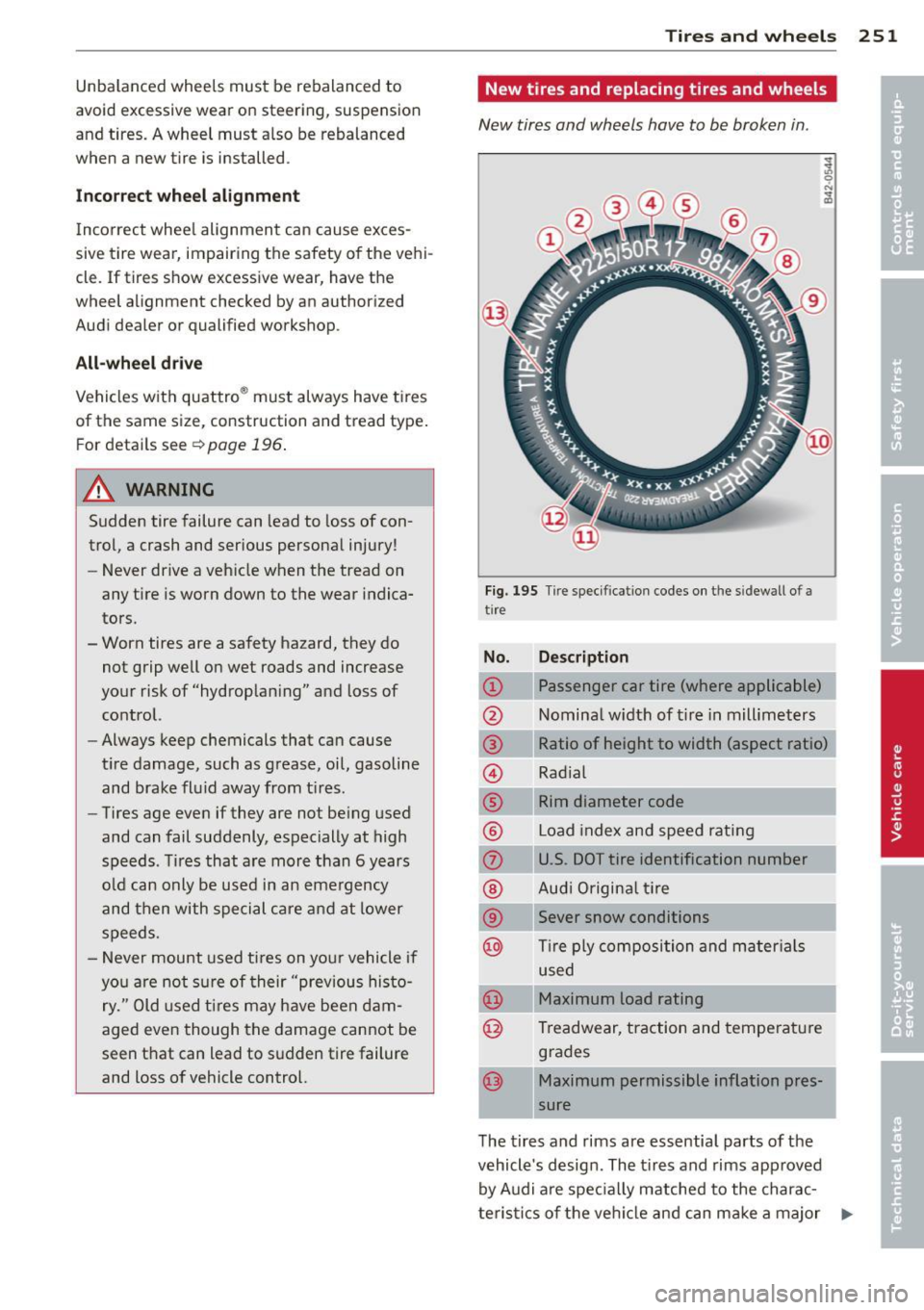
Fig. 19 5 Tir e spec ificat io n codes on t he s idewall o f a
tire
No. De sc ription
CD Passenger car tire (where applicable)
@ Nomina l w idth of t ire in mill imeters
® Ratio of height to width (aspect ratio)
© Rad ial
® Rim diameter code
® Load index and speed rating
(f) U.S. DOT tire identification number
® Aud i Origina l tire
® Sever snow conditions
@ T ire ply composition and mater ials
used
@ Maximum load rating
@ Treadwear, traction and temperat ure
grades
@ Maximum permissible inflation pres-
sure
T he tires and rims are essential parts o f the
vehicle's design . The ti res and rims app roved
by Audi a re spec ia lly matched to the charac
teris tic s of the ve hicl e and can m ake a major .,.
•
Page 254 of 306
252 Tire s and wheel s
contribution to good road ho lding and safe
handling when in good condition and properly
inflated
¢ ,& .
We recommend that all work on tires and
wheels be perfo rmed by an authorized Audi
dea ler. They are familiar with recommended
proced ures and have the necessary spec ial
too ls and spare parts as well as the proper fa
cilities for disposing of the old tires.
Authorized Audi dealers have the necessary information about techn ica l requ irements for
installing or changing tires and r ims.
Re placing t ires and whe els
Tires sho uld be rep laced at least in pairs and
not individua lly (for examp le both front tires
or both rear tires together).
Be sure to read and heed the information to
the tire pressure monitoring system*
¢page 258.
Always buy rep lacement radial tires that have
the same specifications as the tires approved
for your vehicle by Audi. Replacement t ires
must always have the same load rating speci
fication as the original equipment or approved
optional tires listed in the table
c:> page 244.
Aud i-approved specification ti res are specially
matched to your vehicle and its load limits,
and can contribute to the important road ho ld
ing, driving characteristics, and safety of the
vehicle. The table
(c:> page 244) lists spec ifica
tions of the tires approved for the Audi mod
els covered by your Owner's Literature .
The tire pressure labe l located on driver's side
B-pillar
(c:> fig. 192) lists the specifications of
the orig inal equipment tires installed on your
vehicle at the time it was manufactured.
Federal law requires tire manufacturers to
place standard ized information on the s ide
wall of all tires
c:> fig. 195. This information
ident ifies and describes the fundamental
characterist ics, the quality grade of the tire
and a lso provides a tire ident ificat ion number
fo r safety standa rd cert ificat ion and in case of
a recall.
Tir e spe cification s
Knowledge o f ti re specifications ma kes it eas
ier to choose the correct tires. Radial ti res
have the tire specifications marked on the
sidewa ll, for examp le:
255 /40 R 19 100 H XL
Th is conta ins the following information:
P Indicates the tire is for passenger cars
(where app licab le)
2 55 Nominal tire w idth in mm of the tire
from sidewall edge to sidewall edge. In general, the larger the number, the wider
the tire
40 Height/w idth ratio in percent (aspect ra-
t io)
R Tire construct ion: Radial
19 Rim diameter code (in inches)
100 Load rating code
H Speed ra ting letter code
XL (or "xl", "E XTRA LOAD" or "RF") Indica tes
that the t ire is a "Reinfo rced" or an "Ext ra
Load" t ire
M+S (or "M/5") Indicates that the ti re has
some mud and snow capabi lity
The tires could also have the information of
direction of rotat io n
¢ page 240.
Tire manufacturing d ate
The manufacturing date is also indicated on
the tire sidewall (possibly on ly on the
inner
s ide of the wheel):
"DOT ... 2212 ... " means, for example, the tire
was produced in the 22nd week of 2012.
Spe ed rating (le tte r cod e)
The speed rating letter code on the whee ls in
dicates the maximum permissible road speeds
c:> & in Winter tires on page 256.
p up to 93 mph (150 km/h)
Q u p to 99 mp h (158 km/h)
R up to 106 mph ( 170 km/h)
s up to 110 mph (180 km/h)
T up to 118 mph (190 km/h)
u up to 124 mph (200 km/h)
H up to 130 mph (210 km/h)
Page 256 of 306
254 Tires and wheels
-If the spare tire is not the same as the
tires that are mounted on the vehicle -
for example with winter tires -only use
the spare tire for a short period of time
and drive with extra care. Refit the nor
mal road wheel as soon as safely possi
ble.
- Never drive faster than the maximum
speed for which the tires on your vehicle
are rated because tires that are driven
faster than their rated speed can fail
suddenly.
- Overloading tires cause heat build-up,
sudden tire failure, including a blowout
and sudden deflation and loss of control.
- Temperature grades apply to tires that
are properly inflated and not over or un
derinflated.
- For technical reasons it is not always
possible to use wheels from other
vehicles -in some cases not even wheels
from the same vehicle model.
- If you install wheel trim discs on the ve
hicle wheels, make sure that the air flow
to the brakes is not blocked. Reduced air
flow to the brakes can them to overheat,
increasing stopping distances and caus
ing a collision.
- Run flat tires may only be used on
vehicles that were equipped with them
at the factory. The vehicle must have a
chassis designed for run flat tires. Incor
rect use of run flat tires can lead to vehi
cle damage or accidents. Check with an
authorized Audi dealer or tire specialist
to see if your vehicle can be equipped
with run flat tires. If run flat tires are
used, they must be installed on all four
wheels. Mixing tire types is not permit
ted.
- For technical reasons, it is not generally
possible to use the wheel rims from oth
er vehicles. This can hold true for wheels
of the same vehicle type.
- If the spare tire is different from the
tires that you have mounted on your ve- hicle (for example winter tires or wide
profile tires), then use the spare tire for a
short period of time only and drive with
extra care. Replace
the flat tire with the
tire matching the others on your vehicle
as soon as possible.
- Never drive without the valve stem cap.
The valves could get damaged.
@ For the sake of the environment
Dispose of old tires in accordance with the
local requirements.
Uniform tire quality grading
-Tread wear
- Traction AA A B C
- Temperature ABC
Quality grades can be found where applicable
on the tire side wall between tread shoulder
and maximum section width
~fig. 195.
For example: Tread wear 200 , Traction AA,
Temperature A.
All passenger car tires must conform to Feder
al Safety Requirements in addition to these
grades .
Tread wear
The tread wear grade is a comparative rating
based on the wear rate of the tire when tested
under controlled conditions on a specified
government test course.
Fo r example, a tire graded 150 would wear
one and one half (1 1/2) times as well on the
government course as a tire graded 100.
The relative performance of tires depends
upon the actual conditions of their use, how
ever, and may depart significantly from the
norm due to variations in driving habits, serv
ice practices and differences in road character
istics and climate.
Traction
The traction grades, from highest to lowest,
are AA, A, Band
C. Those grades represent the
tire's ability to stop on wet pavement as ..,.