lock AUDI S6 2013 Owner's Manual
[x] Cancel search | Manufacturer: AUDI, Model Year: 2013, Model line: S6, Model: AUDI S6 2013Pages: 306, PDF Size: 76.92 MB
Page 49 of 306
rain sensor function. Check your
windshield wiper blades regularly.
- The washer fluid nozzles of the wind
shield washer system are heated at low
temperatures when the ignition is on.
- When stopping temporarily, e.g. at a traffic light , the set speed of the wind
shield wipers is automatically reduced by
one speed.
Replacing windshield wiper blades
Wip er blad es in good condition h elp keep the
windshield clear.
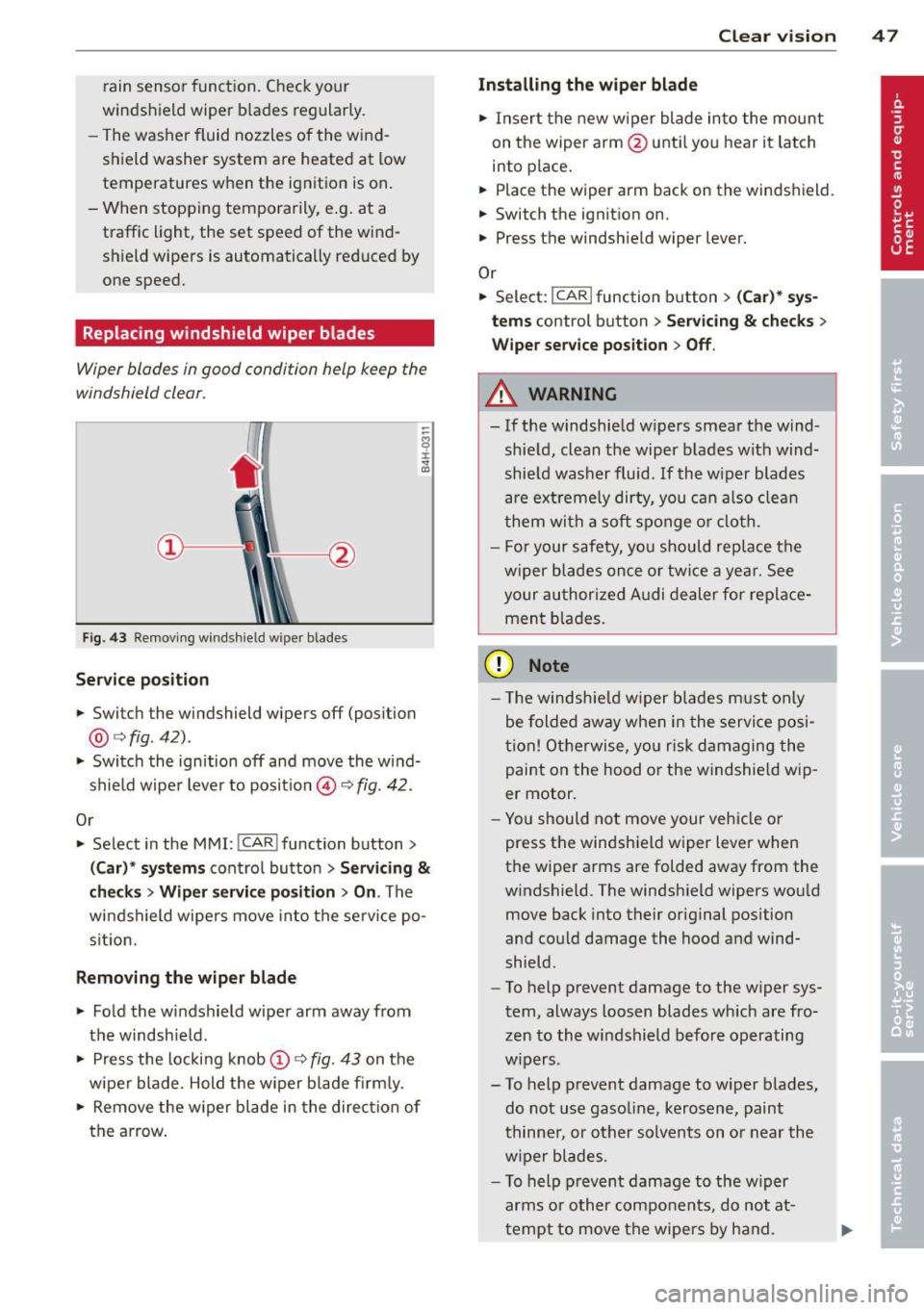
Fig. 43 Removing winds hield w iper bla des
Service position
.. Switch the windshield wipers off (position
@ ¢fig . 42) .
.. Switch the ignition off and move the wind
shield wiper lever to position @¢
fig. 42 .
Or
.. Select in the MMI:
!CAR ! function button>
(Car)* systems control button > Servicing &
checks > Wiper service position > On . The
windshield wipers move into the service po
sition.
Removing the wiper blade
.,. Fold the windshield wiper arm away from
the windshield .
.,. Press the locking knob@¢
fig. 43 on the
wiper blade . Hold the wiper blade firmly.
.. Remove the wiper blade in the direction of
the arrow.
Clear vision 4 7
Installing the wiper blade
.. Insert the new wiper blade into the mount
on the wiper arm @until you hear it latch
i nto place.
.. Place the wiper arm back on the windshield.
.. Switch the ignition on.
.. Press the windshield wiper lever.
Or .. Select:
I CAR ! function button > (Car)* sys
tems
control button > Servicing & checks >
Wiper service position > Off.
.&_ WARNING
- If the windshield wipers smear the wind
shield, clean the wiper blades with wind
shield washer fluid. If the wiper blades
are extremely dirty, you can also clean
them with a soft sponge or cloth.
- For your safety, you should replace the
wiper blades once or twice a year. See
your authorized Audi dealer for replace
ment blades.
(D Note
- The windshield wiper blades must only
be folded away when in the service posi
tion! Otherwise, you risk damaging the
paint on the hood or the windshield wip
er motor.
- You should not move your vehicle or
press the windshield wiper lever when
the wiper arms are folded away from the
windshield. The windshield wipers would move back into their original position
and could damage the hood and wind
shield .
- To help prevent damage to the wiper sys
tem, always loosen blades which are fro
zen to the windshield before operating
wipers .
- To help prevent damage to wiper blades, do not use gasoline, kerosene, paint
thinner, or other solvents on or near the
wiper blades .
- To help prevent damage to the wiper
arms or other components, do not at
tempt to move the wipers by hand.
Page 50 of 306
48 Clear vis ion
@ Tips
- Commercial hot waxes applied by auto
matic car washes affect the cleanability
of the windshield.
- You can also use the service position, for
example, if you want to protect the
winds hield from icing by using a cover.
- You cannot activate the service position
when the hood is open.
Mirrors
Adjusting the exterior mirrors
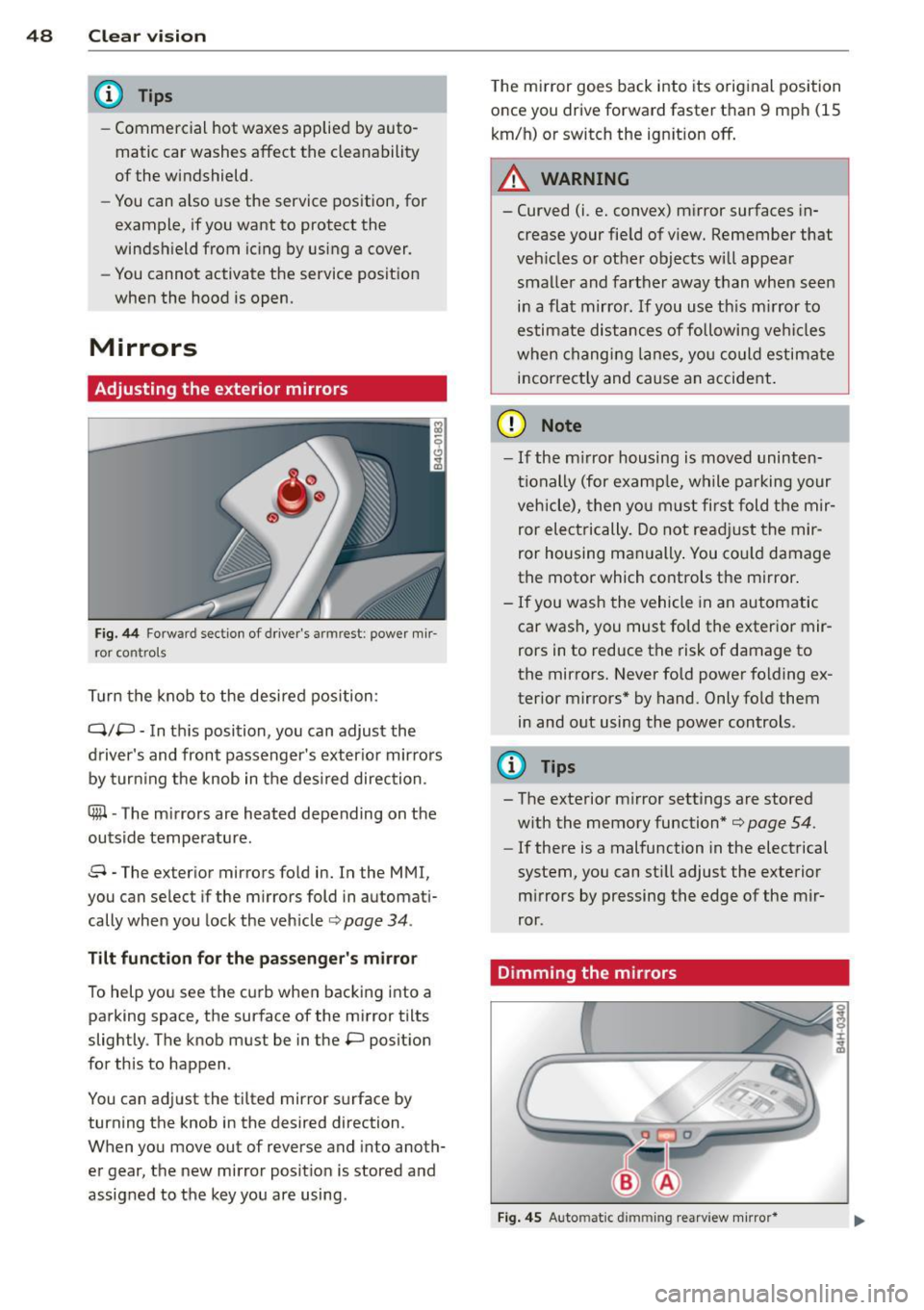
Fig. 44 Forwa rd section of drive r's arm rest: power m ir
ro r cont ro ls
T urn the knob to the desired position :
Q/P -In th is position, you can adjust the
d river's and front passenger's exter io r mirrors
by tur ning the knob in t he des ired direction.
® -The m irrors are heated depending on t he
outside temperature .
8 -The exterior mirrors fo ld in. In the MMI,
you can se lect if the m irrors fold in automat i
cally when you lock the vehicle ¢ page
34 .
Tilt funct ion for the pa ssenger' s mi rro r
To help yo u see the c urb when bac king into a
parking space, the surface of the mirror tilts
slightly . The knob must be in the P posit ion
for this to happen .
You can ad just the ti lted mirror s urface by
turning the knob in the desired direction .
When you move out of reverse and into anoth
er gear, the new mirror posit ion is stored and
assigned to the key yo u are using. T
he mi rror goes back i nto its orig inal position
o nce you drive forward faster than 9 mph (15
km/h) or switch the ign ition off .
A WARNING
--
- Curved (i.e. conve x) mirror surfaces in
crease your fie ld of view. Remember that
veh icles o r ot he r objects will appea r
smalle r and farther away t han when seen
in a flat mirror. If you use th is m irror to
estimate distances of followi ng ve hicles
when c hang ing lanes, y ou could estimate
i n correct ly and cause an accide nt.
(D Note
- If the m irror housing is moved uninten
ti onally (for examp le, w hile pa rking your
veh icle), then yo u must first fold t he mir
ror electrically. Do not re adj ust the mir
ror housing man ually . You co uld damage
the motor which controls the mirror .
-If you wash the vehicle in an automatic
car was h, you must fo ld the exter ior mir
rors in to reduce the risk of damage to
the mirro rs. Never fold power folding ex
terior mirrors* by hand. Only fo ld them
in and out using the power controls.
{I) Tips
- The exterior m irror settings are stored
w ith the memory function*
¢ page 54.
- If there is a malfunction in the electrical
system, you can sti ll adjust the exterior
m irrors by pressing the edge of the mir
ror.
Dimming the mirrors
Fi g. 4 5 Auto matic d immin g rearv iew mirro r*
Page 55 of 306
Adjusting the armrest
• To adjust the angle, raise the armrest from
the start ing position detent by detent.
• To bring the armrest back into its origina l
position, lift it above the top position and
then fold it back down.
Opening the storage compartment
• Press the button -arrow- upward.
Please note that the driver's arm movements
may be restricted w ith the armrest fo lded
down. For this reason, the armrest should not
be folded down when driving in c ity traffic.
Head restraints
Front head restraint s
Applies to vehicles : with adj ustable head restraints
Head restraints that are adjusted according
to body size, along with the seat belt, offer
effective protection.
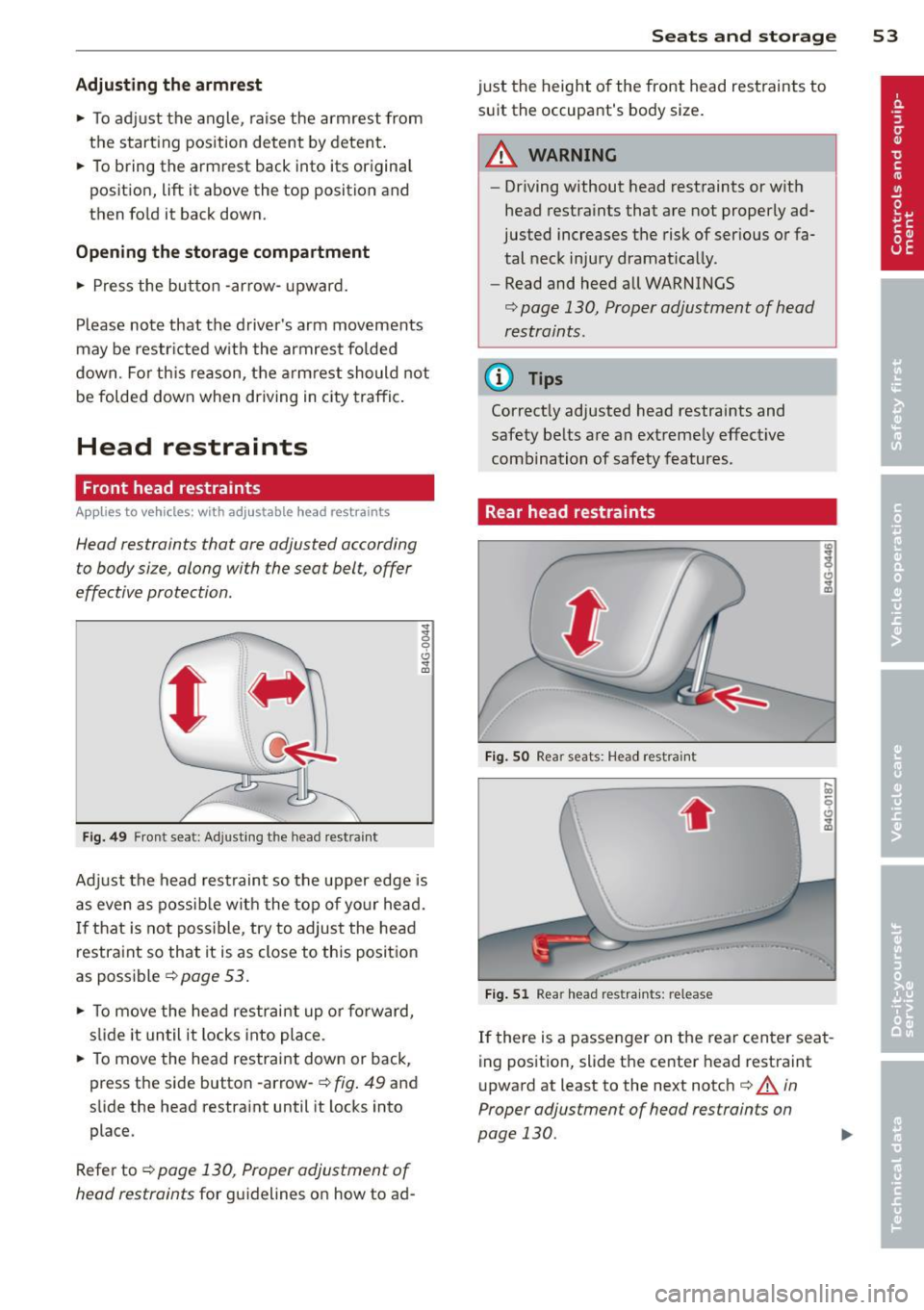
Fig. 49 Front seat: Ad justing t he head restraint
Adjust the head restraint so the upper edge is
as even as possible with the top of your head.
I f that is not possible, try to adjust the head
restra int so that it is as close to this position
as possible
¢ page 53.
• To move the head restraint up or forward,
s lid e it until it locks into place.
• To move the head restraint down or back,
press the side button -arrow-¢
fig. 49 and
slide the head restraint until it locks into
place.
Refer to ¢
page 130, Proper adjustment of
head restraints
for gu idelines on how to ad-
Seats and storage 53
just the height of the front head restraints to
suit the occupant's body size.
A WARNING
- Driving without head restraints or with
head restraints that are not properly ad
justed increases the risk of serious or fa
tal neck injury dramat ically.
- Read and heed all WARNINGS
¢ page 130, Proper adjustment of head
restraints .
(D Tips
Correctly adjusted head restraints and
safety belts are an extremely effect ive
combination of safety features.
Rear head restraints
Fig. 50 Rear seats: Head restraint
Fig. 51 Rea r head res tra ints : release
If there is a passenger on the rear center seat
ing position, slide the center head restraint
upward at least to the next notch ¢
A in
Proper adjustment of head restraints on
page 130 .
Page 56 of 306
54 Seats and storage
Adjusting the head restraints
.. To move the head restraint up, hold it at the
sides with both hands and slide it upward
until you feel it lock into p lace .
.. To move the head restraint down, press the
button -arrow- ¢
fig. 50 and slide the head
restraint downward .
Removing the head restraints
.. Move the head restraint upward as far as it
can go .
.. Press the release¢
fig. 51 with the me
chanical key¢
page 32 and the button
-arrow-
¢ fig . SO. Pull the head restraint out
of the backrest at the same ti me
c> _& .
Installing the head restraints
.. Slide the posts on the head restraint down
into the guides until you feel the posts lock
into place.
.. Press the button -arrow-¢
fig. SO and slide
the head restraint all the way down . You
should not be able to pull the head restraint
out of the backrest .
So that the driver can have a better view to
the rear, the head restraints should be pushed
down completely when the rear seats are not
occupied.
.&_ WARNING
- Only remove the rear seat head restraints
when necessary in order to install a child
seat. Install the head restraint again im
mediately once the child seat is removed.
Driving without head restra ints or with
head restraints that are not properly ad
justed increases the risk of serious or fa
tal neck injury dramatically .
- Read and heed all WARNINGS
i=>page 130.
Seat memory
Description
Ap plies to vehicles: with memo ry function
The memory function allows you to quickly
and easi ly sto re and recall personal seating profiles for
the driver and front passenger*.
The memory function is operated through the
master key and the memory buttons in the
driver's/front passenger's* doors.
T he driver's seating profile is stored and as
signed to the master key each time the vehicle
is locked . The seating profile is reca lled auto
matically when the vehicle is unlocked. If two
people use one vehicle, it is recommended
that each person always uses "their own" master key .
Two seating profiles can be stored in each of
the driver's/front passenger's* doors. Once
stored, these seating profiles can be recalled at any time.
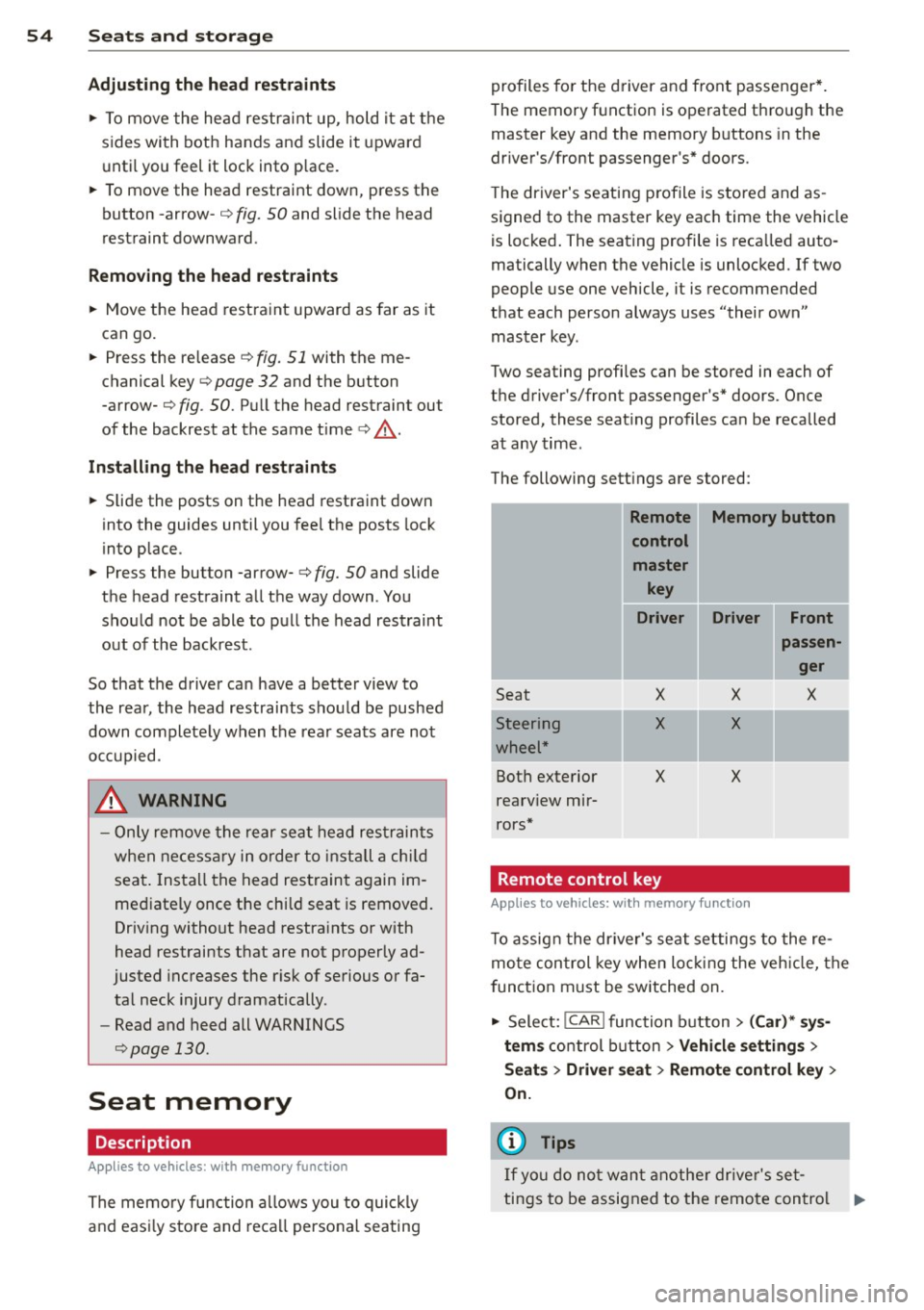
The following sett ings are stored:
- --Remote Memory button
control
master key
Driver Driver Front
I
passen
ger
Seat
-Steering
wheel*
Both exterior
rearv iew mir
rors*
X
X
X
Remote control key
X
X
X
Applies to vehicles: wi th memory fun ctio n
X
-
To assign the driver's seat settings to the re
mote control key when locking the vehicle, the
f unction must be switched on.
.. Select:
!CAR ! function button> (Car)* sys
tems
control button > Vehicle settings >
Seats > Driver seat > Remote control key >
On.
(D Tips
If you do not want another driver's set-
tings to be assigned to the remote control .,.
Page 58 of 306
56 Seats and storage
Ashtray
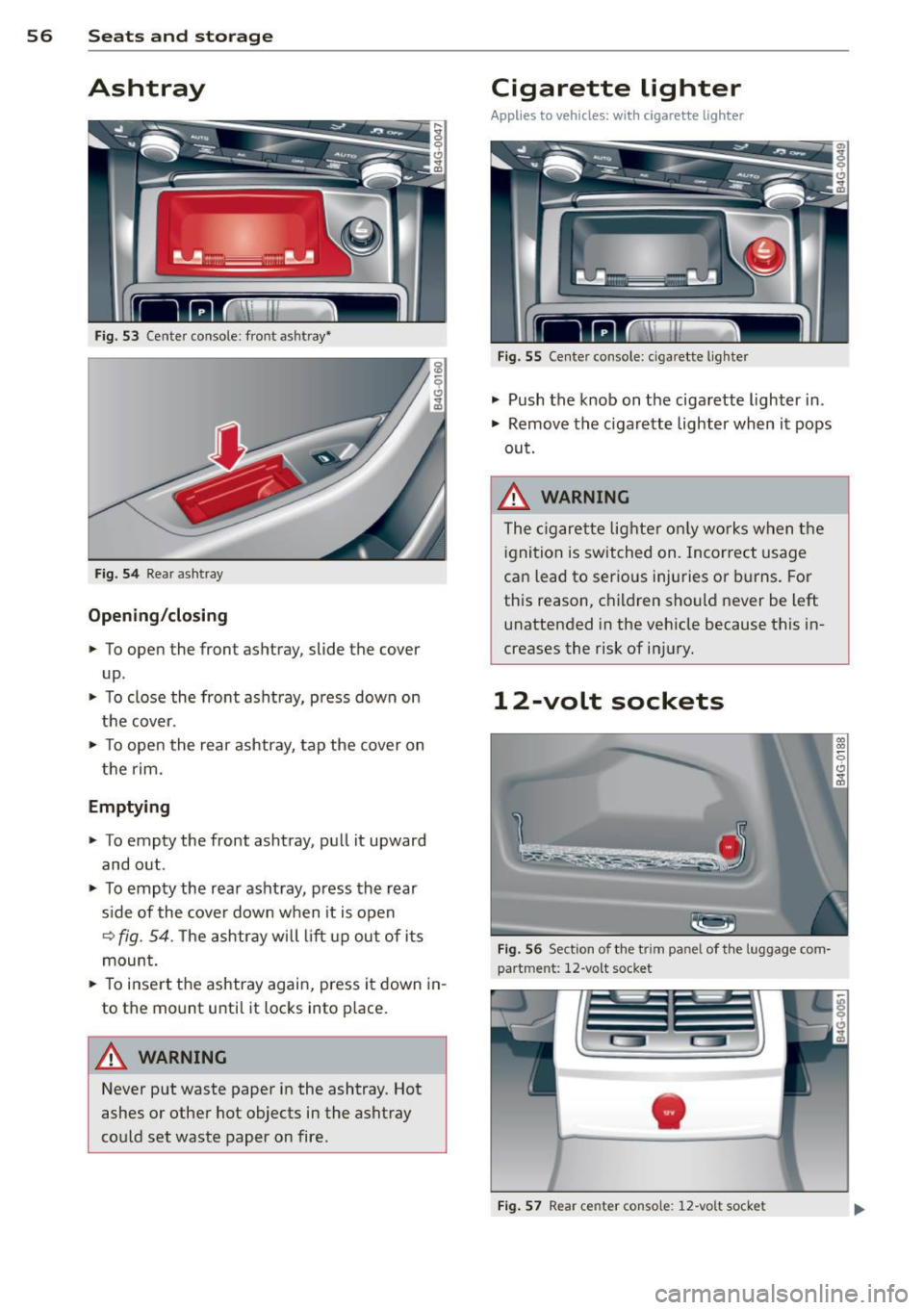
Fig. 53 Center console: front ashtray~
Fig. 54 Rear ashtray
Opening /clo sing
.. To open the front ashtray, slide the cover
up .
.. To close the front ashtray, press down on
the cover .
.. To open the rear ashtray, tap the cover on
t h e rim.
Emptying
.. To empty the front ashtray, pull it upward
and out .
.. To empty the rear asht ray, press the rear
s ide of the cover down w hen it is open
Q fig. 54. T he ashtray will lift up out of its
mount.
.. To i nse rt t he ashtray again, press it down in
to the mount until it locks into p lace.
_&. WARNING
Never put waste paper in the ashtray. Hot
ashes or other hot objects in the ashtray
could set waste paper on fire.
Cigarette lighter
Applies to vehicles: wit h cigaret te lighter
Fig . 55 Ce nter console: cigarette lighter
.. Push the knob on the cigarette lighter in .
.. Remove the cigarette lighter when it pops
out.
_&. WARNING
The cigaret te lig hter on ly works w hen t he
i gnition is switched on. Incorrect usage
can lead to ser ious injuries or b urns. For
this reason, children should never be left
unattended in the veh icle because this in
creases the risk of inj ury .
12-volt sockets
Fig. 56 Sect io n of the tr im pane l of th e luggage com·
part men t: 12 -vo lt socket
•
F ig . 5 7 Rear center console: 12 -vo lt socket
Page 60 of 306
58 Seats and storage
vehicle movement, hot liquid could spill,
causing scalding burns. Spilled hot liquid
can also cause an accident and personal
injury .
- Use only soft cups in the cupholder. Hard
cups and glasses can cause injury in an
accident .
- Never use the cupholder or adapter as an
ashtray- risk of fire.
([) Note
Only drink containers with lids should be
carried in the cupholder. Liquid could spill
out and damage your vehicle's electronic
equipment or stain the upholstery, etc.
Cooled glove compartment
Ap plies to vehicles: with coole d glove compa rtm ent
The cooled glove compartment only functions
when the AIC system is switched on.
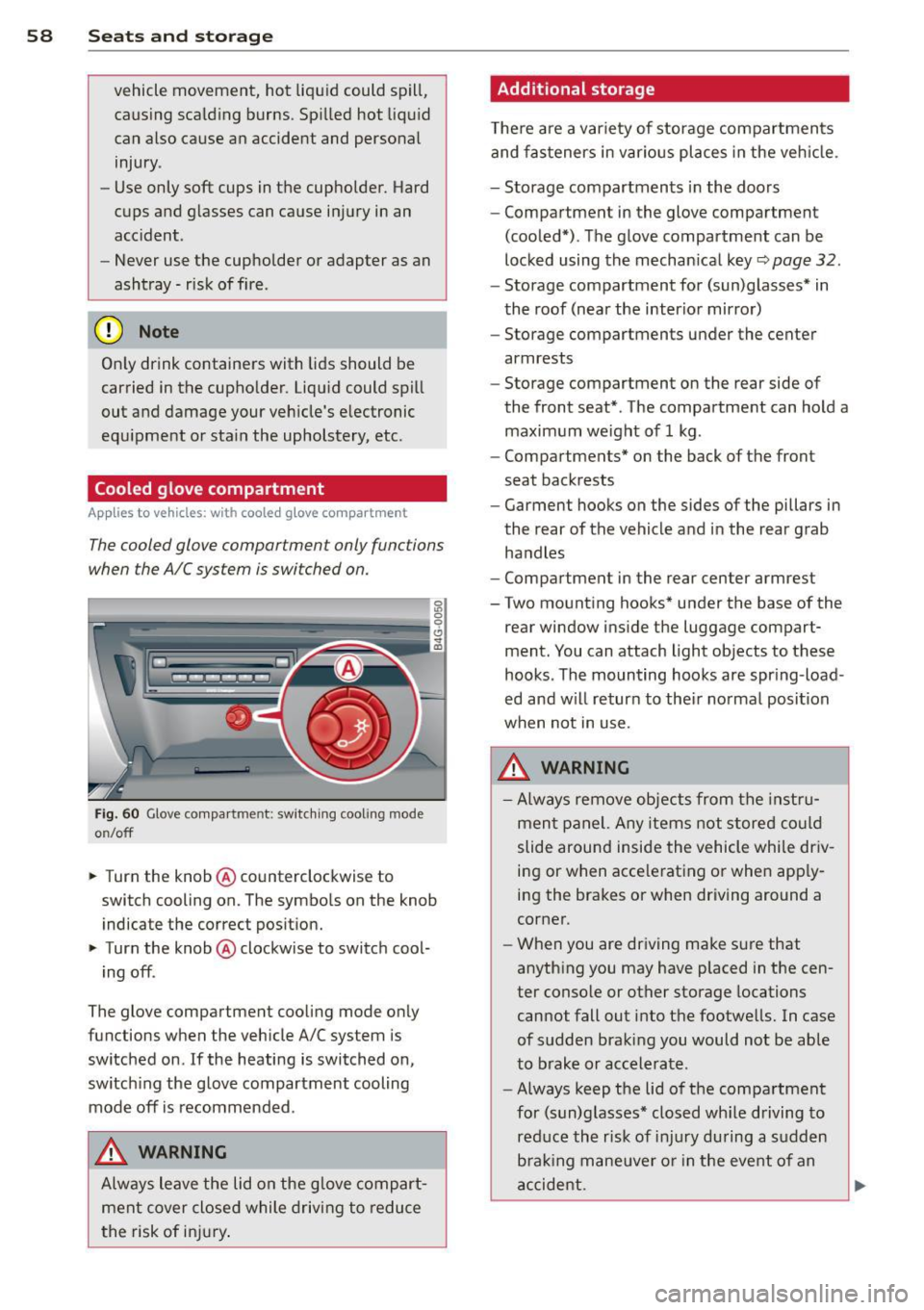
Fig. 60 Glove compa rtment: switc hing cooling mode
o n/off
~ Turn the knob@ counterclockwise to
switch cooling on. The symbols on the knob
indicate the correct position.
~ Turn the knob @ clockwise to switch cool-
ing off .
The glove compartment cooling mode only
functions when the vehicle A/C system is
switched on .
If the heating is switched on,
switching the glove compartment cooling
mode
off is recommended .
_& WARNING
Always leave the lid on the glove compart
ment cover closed while driving to reduce
th e risk of injury.
Additional storage
Ther e are a variety of storage compartments
and fasteners in various places in the vehicle.
- Storage compartments in the doors
- Compartment in the glove compartment
(cooled*) . The glove compartment can be
locked using the mechanical key
r::;, page 32.
-Storage compartment for (sun)glasses* in
the roof (near the interior mirror)
- Storage compartments under the center
armrests
- Storage compartment on the rear side of
the front seat* . The compartment can hold a
maximum weight of 1 kg .
- Compartments* on the back of the front
seat backrests
- Garment hooks on the sides of the pillars in
the rear of the vehicle and in the rear grab
handles
- Compartment in the rear center armrest
- Two mounting hooks* under the base of the
rear window inside the luggage compart
ment. You can attach light objects to these
hooks . The mounting hooks are spring -load
ed and will return to their normal position
when not in use.
_& WARNING
- Always remove objects from the instru
ment panel. Any items not stored could
slide around inside the vehicle while driv
ing or when accelerating or when apply
ing the brakes or when driving around a
corner.
- When you are driving make sure that
anything you may have placed in the cen
ter console or other storage locations
cannot fall out into the footwells. In case
of sudden braking you would not be able
to brake or accelerate.
- Always keep the lid of the compartment
for (sun)glasses* closed while driving to
reduce the risk of injury during a sudden
braking maneuver or in the event of an
accident.
-
Page 63 of 306
-Never exceed the maximum permissible
load carry ing capacity of the roof of your
vehicle, the permissible axle weights and
the permissible total weight of your vehi cle
c;, page 280, Weights.
@ For the sake of the environment
As a result of the increased wind resistance created by a roof rack, your vehicle is
using fue l unnecessarily. So remove the
roof rack after using it.
Luggage compartment
Loading luggage compartment
Luggage items must be stowed securely.
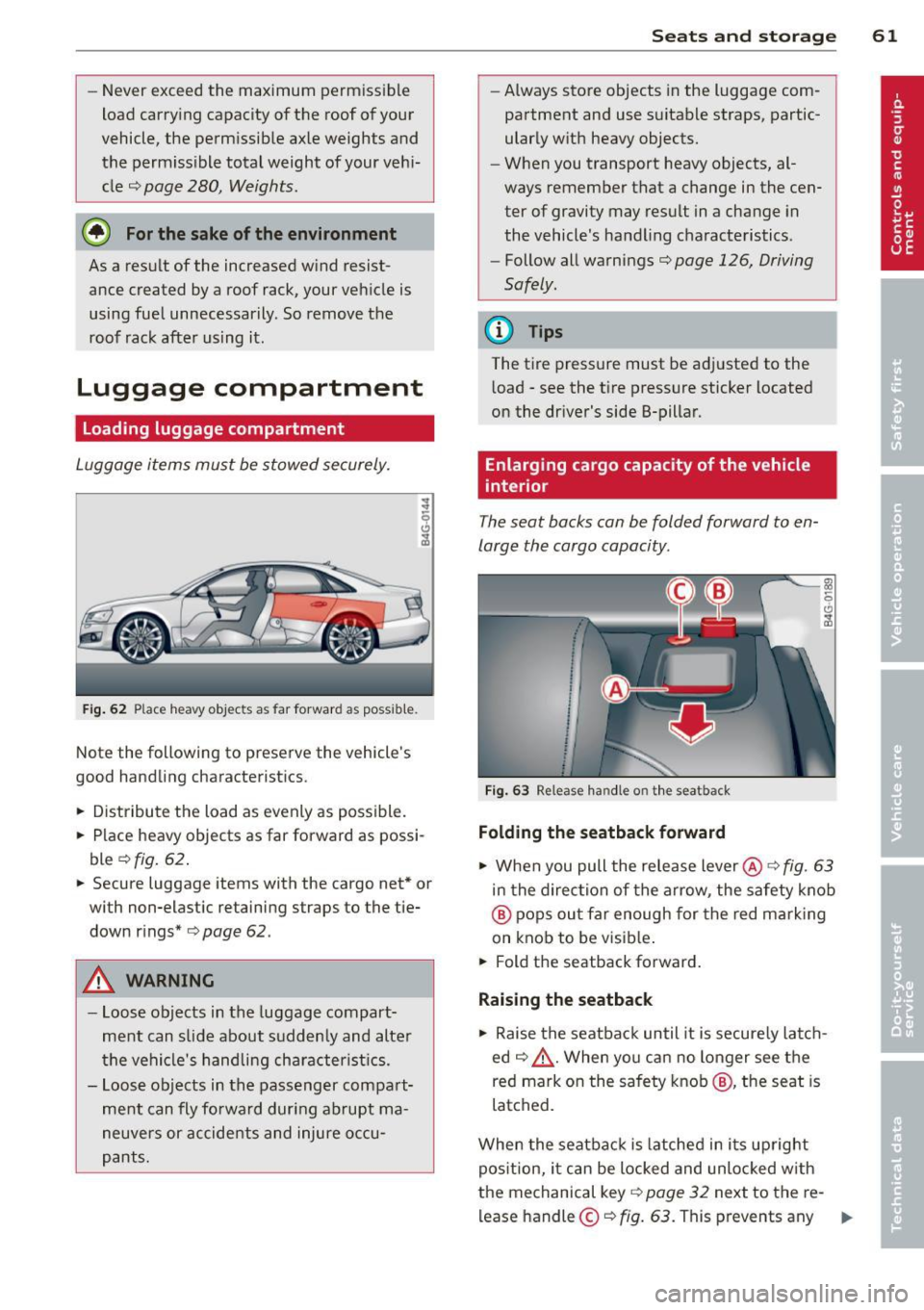
Fig. 62 Place heavy objects as far forward as possib le.
Not e the following to preserve the vehicle's
good handling characteristics.
.. Distribute the load as evenly as possible.
.. Place heavy objects as far forward as possi
ble
c;, fig. 62 .
.. Secure luggage items with the cargo net* or
with non-elastic retaining straps to the tie down rings*
c;, page 62.
A WARNING
- Loose objects in the luggage compart
ment can slide about suddenly and alter
the vehicle's handling characterist ics.
- Loose objects in the passenger compart
ment can fly forward during abrupt ma
neuvers or accidents and injure occu
pants.
Seats and storage 61
-Always store objects in the luggage com
partment and use suitable straps, partic
ularly with heavy objects.
- When you transport heavy objects, al
ways remember that a change in the cen
ter of gravity may result in a change in
the vehicle's handling characteristics.
- Follow all warnings
c;, page 126, Driving
Safely.
(D Tips
The tire pressure must be adjusted to the
load - see the t ire pressure sticker located
on the driver's side 8-pillar.
Enlarging cargo capacity of the vehicle
interior
The seat backs can be folded forward to en
large the cargo capacity.
Fig. 63 Release handle on th e seatback
Folding the seatback forward
.. When you pull the release lever @ ¢ fig. 63
in the direction of the arrow, the safety knob
@ pops out far enough for the red marking
on knob to be visib le .
.. Fold the seatback forward.
Raising the seatback
.. Raise the seatback until it is securely la tch
ed
c;, ,&_ . When you can no longer see the
red mark on the safety knob@, the seat is
latched.
When the seatback is latched in its upright
position, it can be locked and unlocked w ith
the mechanical key
c;, page 32 next to the re-
leas e handle @c>
fig. 63. This prevents any ...,
Page 64 of 306
62 Seats and storage
entry from the vehicle interior into the lug
gage compartment.
The luggage compartment can on ly enlarged
when the seatback is unlocked .
A WARNING
-
-The backrest must a lways be securely
latched so that the safety belt of the cen
ter seating pos ition can work properly to
help protect the occupant.
- The backrest must be securely latched in
position so that no items contained in
the luggage compartment can slide for
ward upon sudden braking .
-Always check whether the latch is fully
engaged by p ulling the seatback for
ward .
- Never allow safety belts to become dam
aged by being caught in door or seat
hardware .
- Torn or frayed safety belts can tear and
damaged belt hardware can break in a
c rash . Inspect the be lts periodically .
Belts showing damage to webbing, bind
ings, b uckles, or retractors mus t be re
placed .
W Note
- If you move the front sea t back when the
r ear seat bac krest is fo lded fo rward, yo u
could damage the head restraints on t he
r e ar seat.
- Slide the belt guide on th e outside safety
b elt all the way up before folding the
ba ckrest b ack fo rward. Make su re the
seat belt is no t pinched or dam aged
when the rear seat backrest if folded back . Other objects shou ld be removed
from the rear seat bench to protect the
seatback from damage.
Tie-downs and cargo net
The cargo net* prevents small objects from
sliding .
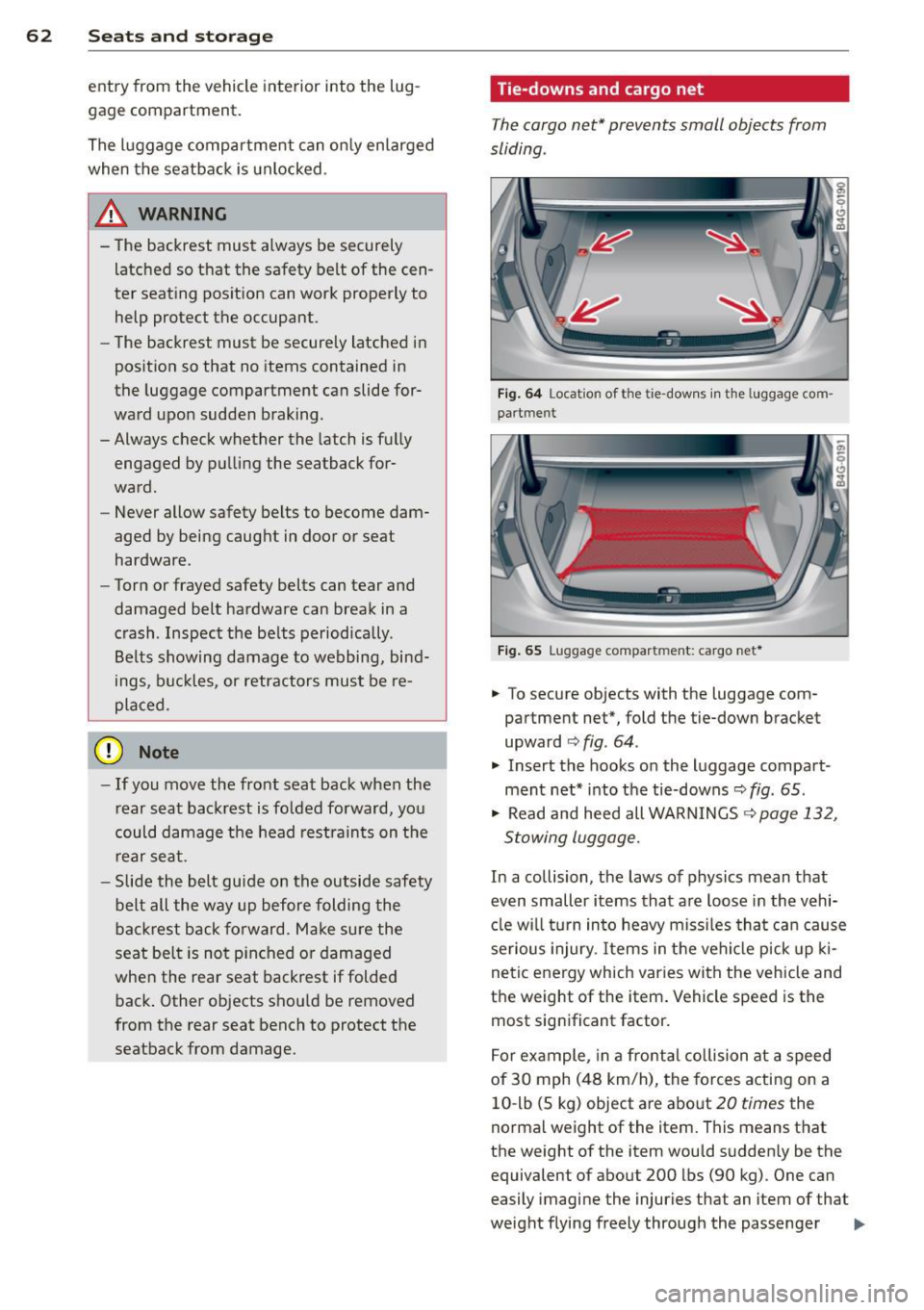
Fig . 6 4 Locat io n of t he ti e-dow ns in the lu ggage com
pa rt m en t
Fig. 65 Lugga ge compart men t: cargo net *
.. To secure objects with the luggage com
partment net*, fold the tie-down bracket
upward
c:> fig . 64 .
.. Insert the hooks on the luggage compart
ment net * into t he tie-downs~
fig . 65 .
.. Read and heed all WARNINGS ~ page 132,
Stowing luggage.
In a collision, the laws of physics mean that
even smaller items that a re loose in the vehi
cl e w ill turn in to heavy m iss iles tha t ca n cause
serious injury. Items in the veh icle p ick up ki
ne tic energy which varies with the vehicle and
the weight of the item . Vehicle speed is the
most sign ificant factor.
F o r ex ample, in a fro nta l collision at a speed
of 30 mph (48 km/h), the forces acting on a
10 -lb (5 kg) object are abo ut
20 times the
norma l weight of the item. This means that
the weight of the item wou ld sudden ly be the
equivalent of about 200 lbs (90 kg) . One can
easily imagi ne the injuries that an item of that
weight flying freely through the passenger ..,.
Page 67 of 306
Warm and cold 65
Three-zone climate control
Operation
Applies to vehicles: with three-zone climate control
We recommend pressing the !AUTOI button and setting the temperature to 72 °F (22 °C).
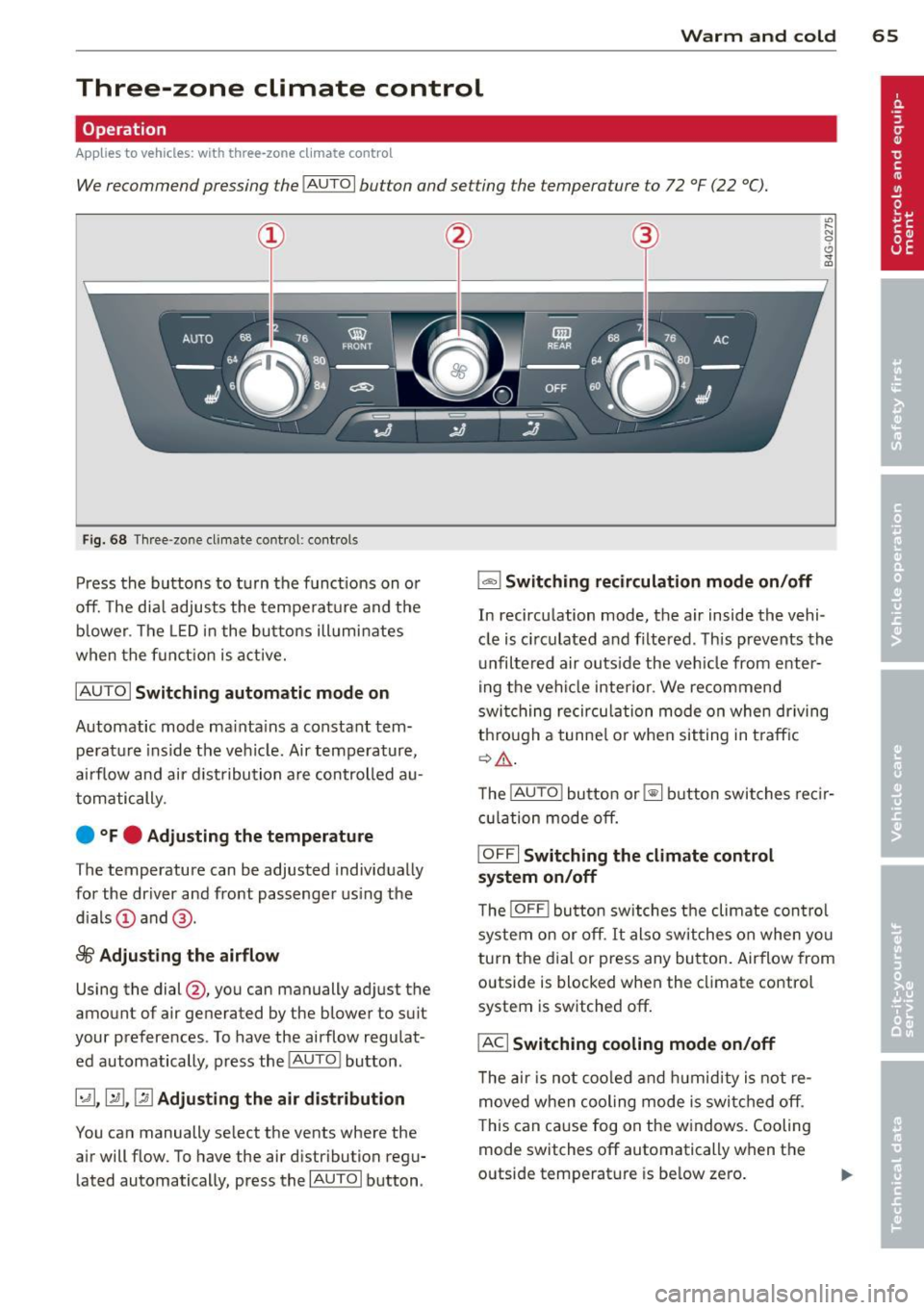
F ig. 68 Three -zone cl imate control : controls
Press the buttons to turn the funct ions on or
off. The dial adjusts the temperature and the
blower . The LED in the buttons illuminates
when the funct ion is active.
IAUTO I Switching automatic mode on
Automatic mode mainta ins a constant tem
peratu re inside the vehicle. Air temperature,
airflow and air d istribution are controlled au
tomatically.
e °F e Adjusting the temperature
The temperature can be adjusted individually
for the driver and front passenger using the
d ials (!) and @.
~ Adjusting the airflow
Using the dial@, you can manually adjust the
amount of air generated by the blower to suit
your preferences . To have the airflow regulat
ed automatically, press the
! AUTO ! button.
~. rill, [2] Adjusting the air distribution
You can manually se lect the vents where the
air will flow. To have the air distribution regu lated automatically, press the
!AUTOI button .
l""" I Switching recirculation mode on/off
In recirculation mode, the air inside the vehi
cle is circulated and filtered. This prevents the
unfiltered air outside the veh icle from enter
ing the vehicle interior . We recommend
switching recirculation mode on when dr iving
through a tunnel or when sitting in traffic
~.& -
The !AUTO ! button or~ button switches recir
cu lation mode off.
I OFFI Switching the climate control
system on/off
The ! O FF! button switches the climate con trol
system on or off.
It also switches on when yo u
turn the dial or press any button. Airflow from
outside is blocked when the climate control
system is switched off.
IACI Switching cooling mode on/off
The air is not coo led and humidity is not re
moved when cooling mode is switched off .
This can cause fog on the w indows. Cooling
mode switches off automatically when the
outside temperature is be low zero.
Page 69 of 306
Warm and cold 67
Four-zone automatic climate control
Operation
Applies to vehicles: with four -zone a utomat ic climate control
We recommend pressing the IAUTOI button and setting the temperature to 72 °F (22 °C).
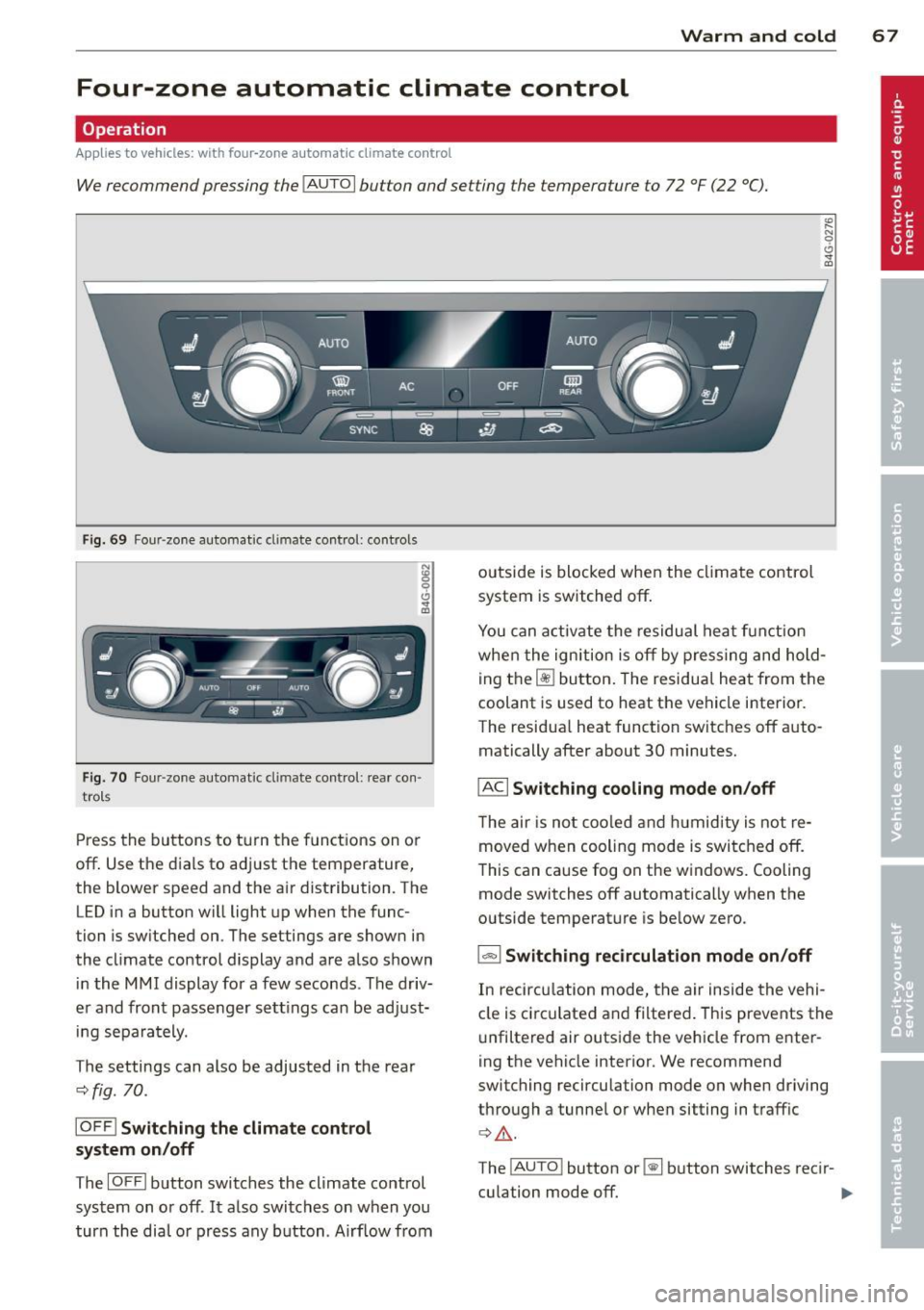
F ig. 69 Four -zone automat ic climate control: controls
Fig. 70 F our -zone automat ic climate control: rear con·
trols
Press the buttons to turn the functions on or
off. Use the dials to adjust the temperature,
the blower speed and the air distribution. The
LED in a button will light up when the func
tion is switched on. The settings are shown in
the climate control display and are also shown in the MMI display for a few seconds . The driv
er and front passenger settings can be adjust·
ing separately.
The settings can also be adjusted in the rea r
<::>fig.
70.
IOFF l Switching the climate control
system on/off
The IOFFI button switches the climate control
system on or off .
It also switches on when you
turn the dial or press any button. Airf low from outside is blocked when the
climate control
system is switched off.
You can activate the residual heat funct ion
when the ignition is off by pressing and hold
ing the ~ button. The residual heat from the
coolant is used to heat the vehicle interior.
The residua l heat function switches off auto
matically after about 30 minutes.
IACI Switching cooling mode on /off
T he air is not coo led and humidity is not re
moved when cooling mode is switched off.
This can cause fog on the windows. Cooling
mode switches off automatically when the
outside temperature is below zero.
1- 1 Switching recirculation mode on/off
In recircu lation mode, the air inside the vehi
cle is circ ulated and filtered. This prevents the
unfiltered air outside the vehicle from enter
ing the vehicle interior. We recommend
switching recirculation mode on when driving
through a tunnel or when sitting in traffic
¢ Li). .
The !AUTO ! button or~ button switches recir-
culation mode off. .,..