lock AUDI S6 2013 Workshop Manual
[x] Cancel search | Manufacturer: AUDI, Model Year: 2013, Model line: S6, Model: AUDI S6 2013Pages: 306, PDF Size: 76.92 MB
Page 182 of 306
180 Child Safety
-Always move the front passenger seat in
to the rearmost position of the passen
ger seat's fore and aft adjustment range,
and as far away from the airbag as possi
ble before installing the child restraint .
- Always make sure that nothing prevents
the front passenger's seat from being
moved to the rearmost position in its
fore and aft adjustment range.
- Always make sure the backrest is in an
upright position .
- Never place or use any electrical device
(such as a laptop, CD player, electronic
games device or power inverter) on the
front passenger seat if the device is con
nected to the 12-volt socket or the ciga
rette lighter socket.
- If a seat heater has been retrofitted or
otherwise added to the front passenger
seat, never install any child restraint sys
tem on this seat.
- Make sure that there are no wet objects
(such as a wet towel) and no water or
other liquids on the front passenger seat
cushion.
- Never place objects on the seat (such as
a laptop, CD player, electronic games de
vice or power inverter). These may influ
ence the electrical capacitance measured by the capacitive passenger detection
system and can also fly around in an acci dent and cause serious personal injury.
- Make sure that the
PASSENGER AIR BAG
OFF
light comes on and stays on all the
time whenever the ignition is switched
on.
- If the
PASSENGER AIR BAG OFF light
does not come on and stay on, immedi
ately install the forward-facing child seat
at a seating position on the rear seat and
have the airbag system inspected by your
authorized Audi dealer.
- Take the child restraint off the front pas
senger seat and install it properly at one
of the rear seat positions if the
PASSEN
GER AIR BAG OFF
light does not stay on
whenever the ignition is switched on.
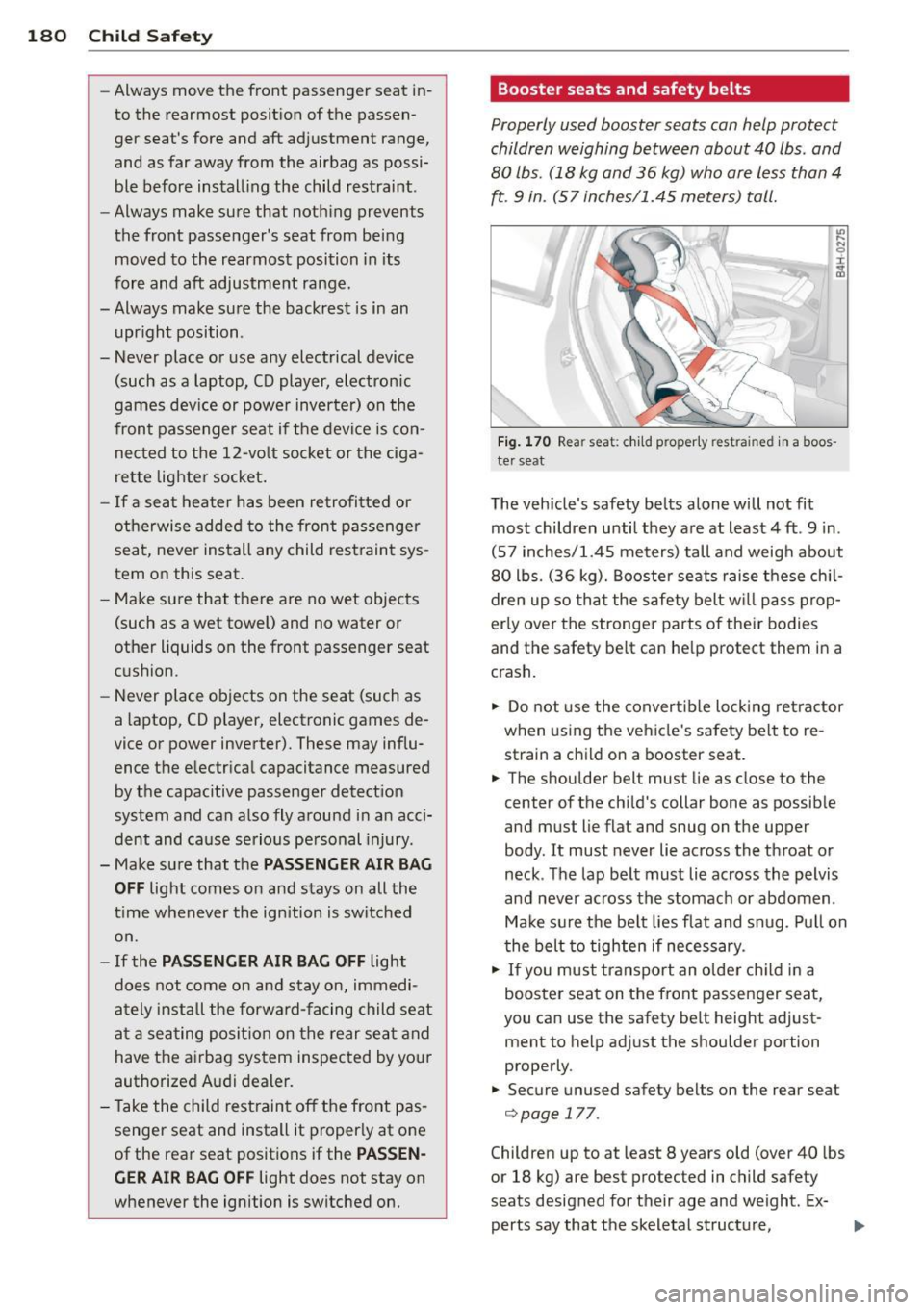
Booster seats and safety belts
Properly used booster seats can help protect
children weighing between about 40 lbs . and
80 lbs . (18 kg and 36 kg) who are less than 4
ft. 9 in. (57 inches/1.45 meters) tall.
Fig. 170 Rea r seat : child p rop erly res trained in a boos
te r se at
The vehicle's safety belts alone will not fit
most children until they are at least 4 ft . 9 in .
(57 inches/1.45 meters) tall and weigh about
80 lbs.
(36 kg). Booster seats raise these chil
dren up so that the safety belt will pass prop
erly over the stronger parts of their bodies
and the safety belt can help protect them in a
crash.
"" Do not use the convertible locking retractor
when using the vehicle's safety belt to re
strain a child on a booster seat.
"" The shoulder belt must lie as close to th e
center of the child's collar bone as possible
and mu st lie flat and snug on the upper
body.
It must never lie across the throat or
neck . The lap belt must lie across the pelvis
and never across the stomach or abdomen .
Make sure the belt lies flat and snug . Pull on
the belt to tighten if necessary .
"" If you must transport an older child in a
booster seat on the front passenger seat,
you can use the safety belt height adjust
ment to help adjust the shoulder portion
properly .
"" Secure unused safety belts on the rear seat
¢page 177.
Children up to at least 8 years old (ove r 40 lbs
or 18 kg) are best protected in child safety
seats designed for their age and weight . Ex-
perts say that the skeletal structure, ..,.
Page 184 of 306
182 Child Saf ety
- Never let a child ride in the cargo area of
your vehicle .
- Always remember that a chi ld leaning
forward, sitt ing s ideways or out of posi
t ion in any way during an acc ident can be
struck by a deploying airbag . This will re
sult in serious personal injury or death .
- If you must install a booster seat on the
front passenger seat because of excep
t ional circumstances the
PASSENGER
AIR BAG OFF
light must come on and
stay on, whenever the ignition is sw itch
ed on.
- If the PASSENGER AIR BAG OFF light
does not come on and s tay on, perform
the chec ks described ¢
page 157, Moni
toring the Advanced Airbag System.
- T ake the child rest raint off the front p as
senger seat and install it properly at one
of the rea r seat positions if the
PASS EN·
GER AIR BAG OFF
light does not stay on
whenever the ignition is switched on .
- Always read and heed all WARNINGS whenever using a child rest rained in ave
hicle is being used
¢ page 136, Safety
belts,¢ page 145, Airbag system
and
¢ page 171, Important things to know.
Installing a child safety
seat
Securing a child safety seat using a
safety belt
Safety belts for the rear seats and the front
passenger can be locked with the convertible
locking re tractor to properly secure child
safety seats.
The safety belts emergency locking retractors
for the rear seats safety belts and for the
fro nt passenger's seat safety belt have a con
vertible locking retracto r for child restra ints .
The safety belt must be locke d so that belt
webbing can not unreel. The ret ractor ca n be
activ ated to lock the safety be lt and p revent
the safety belt webbing from loosening up
d ur ing normal driv ing . A child sa fe ty seat can
on ly be proper ly installed whe n the safety belt is loc
ked so that the chi ld and child sa fety
seat wi ll stay in place.
Alw ays remember: Even tho ugh yo ur vehicle is
equipped wi th an A dvan ced Airbag system, all
c hi ldren, especially those 1 2 years and young
er, sho uld always ride in the back seat prope r
l y restra ined fo r the ir age and size.
A WARNING
Improperly installed ch ild safety seats in
crease the risk of serious personal injury
and death in a co llision.
- Always make sure that the safety belt re
tractor is locked when insta lling a child
safety seat. A n un locked safety belt re
trac to r cannot hold the child safety seat
in place dur ing norma l driving o r in a
crash.
- Always buckle the child safety seat firmly
in place even if a ch ild is not si tt ing in it.
A loose child sa fe ty se at can fly aroun d
du ring a s udden stop or in a collision .
- Always make sure that the rear seat
backres t to wh ich the center rear safety
belt * is attache d is sec urely latched
wheneve r the rea r ce nter safety belt is
be ing used to secure a child rest raint.
- If the backrest is not securely la tc h ed,
the child and the child restraint will be
thrown forward together with the back
rest and will strike parts of the vehicle
interior. The child can be seriously in
jured or killed.
- Never install rear-facing child safety
seats or infant ca rr ie rs o n the front pas
senger seat . A child will be serious ly in
jured and can be killed when the passen
ge r airbag inflates.
- The infla ting airbag will h it the ch ild
safety seat or infant carrie r w ith gr eat
for ce and will smas h the child safe ty seat
a nd child ag ai nst t he back res t, cen ter
a rmrest, doo r or roof.
- Always inst all rear-fa cing ch ild safety
se ats or in fa nt c arrie rs on the re ar se at.
Page 186 of 306
184 Child Saf ety
time whenever the ignition is switched
on.
- If the
PASSENGER A IR BAG OFF li g ht
does not come on an d stay on, immedi
ately install the rear-facing child safety
seat in a rear seating position and have
the a irbag system inspected by your Audi
dealer .
Activating the convertible locking
retractor
Use the convertible locking retractor to se
cure a child restraint.
A lways heed the child safety seat manufactur
er's instructions when install ing a ch ild re
straint in your vehicle. To activate the conver
tib le locking retractor:
,. Place the child restraint on a seat, prefera
bly on the rear seat .
,. Slow ly pull the be lt
all the wa y out .
,. Route it around or thro ugh the ch ild re
stra int be lt path¢ &.
,. Push the child sa fety seat down wit h your
f ull weight to get the safety belt rea lly tight .
,. Inse rt the be lt tongue into the buckle for
that seating position.
,. Gu ide the safety belt back into the retractor
until the belt lies flat and snug on the child
safety seat .
,. You should hear a "click ing" noise as the
belt w inds bac k into the ine rtia reel. Test the
conve rtible locking retractor by pull ing on
the belt . Yo u should no longe r be able to
pull the belt out of the ret ractor . The con
vertib le locking retractor is now activated .
,. Make sure that the red re lease button is fac
ing away from the ch ild restra int so that it
can be unbuck led quickly .
,. Pull on the be lt to make sure the safety belt
is properly t ight and fastened so that the
seat can not move forward or sideways more
t h an one i nch (2.5 cm).
A WARNING
Using the wrong child restraint or an im
p roperly installed chi ld restraint can cause
se rious pe rsonal injury or death i n a c rash .
- Always make sure that the safety belt re-
tractor is loc ked when insta lling a child
safety seat. A n un locked safety belt re
tracto r cannot hold the child safety seat
in place dur ing no rma l driving o r in a
crash.
- Always buckle the child safe ty seat firmly
in pl ace even if a ch ild is not si tt ing in it.
A loose child safety seat can fly around
du ring a s udden stop or in a crash .
- Always make sure the se at b ackrest to
which the child res traint is installed is in
an upright pos ition and securely latche d
into place and cannot fold fo rward. Oth
erwise, the seatback with the child sa fety
seat attached to it could fly forward in
the event of a n accident or other emer
gency si tuation.
- Always read and heed all WAR NINGS
wheneve r us ing a child restrained in ave
h icle is being used~
page 171. Special
p reca utions apply w hen insta lling a child
s afety sea t on the front passenger seat
¢ page 147, Child restraints on the front
seat -some important things to know.
-
Deactivating the convertible locking
retractor
The convertible locking retractor for child re
straints will be deactivated automatically when the belt is wound all the way bock into
the retractor.
,. Press the red b utton on the safety belt
buckle. The be lt tong ue will pop o ut of the
buckle.
,. Guide the safety be lt a ll the way back into
its stowed position .
Always let the safety be lt retract completely
into its stowed position. The safety belt can
now be used as an ordinary safety belt w ith
out the convertible locking retracto r fo r child
r est raints .
...
Page 187 of 306
If the convertible locking retracto r shou ld be
activated inadvertently, the safety belt must be unfastened and guided comp letely back in
to its stowed position to deac tivate th is fea
ture. If the co nver tible locking retractor is not
deactivated, the safety belt will gradually be
come tighter and u ncomfortable to wear .
A WARNING
Improperly insta lled child safety seats in
crease the risk of ser ious personal inju ry
and death in a collision.
- Never unfasten the safety belt to deacti
vate the convert ible lock ing ret ra ctor for
child restrain ts w hile the veh icle is mov
ing. You would not be rest rained and
cou ld be seriously injured in an accident.
- Always read and heed all WARN INGS
whenever using a child rest rained in ave
hicle is being used
c:!) page 171. Spec ial
precautions apply when installing a ch ild
safety seat on the front passenger seat
c:!) page 147, Child restraints on the front
seat -some important things to know.
LATCH Lower
anchorages and tethers
for children
Child Restraint System anchors and how
are they related to child safety
To provide a s impler and more pract icable way
to attach the child restraint on the vehicle
seat, Federa l regu lations require specia l lower
anchorages in vehicles and devices on new
chi ld restraints to attach to the vehicle ancho
rages.
The combination of the tether anchorages and
the lowe r anchorages is now generally called
the
LAT CH system for " Lower Anchorages and
T ethers for Children."
F orward-facing child restraints manufactured
after September 1, 1999, are requi red by U .S.
federal regulations to comply with new chi ld
head movement performance requirements.
Child Sa fet y 185
These new performance req uirements make a
tether necessary on most new child seats.
Installing a ch ild restra int that requires a top
tether without one can seriously impair the
performance of the child restraint and its abil
ity to protect the child in a collision . Insta lling
a chi ld restraint that requires a top tether
without the top tether may be a violat ion of
sta te law.
Child restraint manufacturers offer LA TCH
l ower anchorages on their child seats w ith
hook-on or push-on connectors attached to
adjustable st raps.
In addition to the LATCH lower anchorages,
these chi ld restraint systems usually require
the use of tether straps to he lp keep the child
restraint f irmly in place .
A WARNING
Improper installat ion of child restra ints
will increase the r isk of injury and death in
a crash .
-Always follow the instructions provided
by the manufacturer of the child re
straint you intend to install in your vehi
cle.
- Never install a child restraint without a
properly attached top tether strap if the
child restraint manufacturer's instruc
tions require the top tether st rap to be
used .
- Improper use of child restraint LATC H
lower anchorage points can lead to injury
in a collision. The LATCH lowe r anchorage
points are designed to withstand on ly
those loads imposed by correctly fitted
child restraints.
- Never mo unt two child restraint systems
on one LATCH lower anchorage point.
- Never secure or attach any luggage or
other item to the LATCH lower anchorag
es.
-
•
•
Page 189 of 306
proper installation of the child restraint
and proper use of the lower anchorages
or safety belts in your vehicle.
- Never secure or attach any luggage or
other items to the LATCH lower ancho
rages.
- Always read and heed the important in formation about child restraints in this chapter and WARNINGS
¢ page 171,
Child Safety.
Installing a child restraint with LATCH
lower anchorages
Whenever you install a child restraint always
follow the child restraint manufacturer's in
structions.
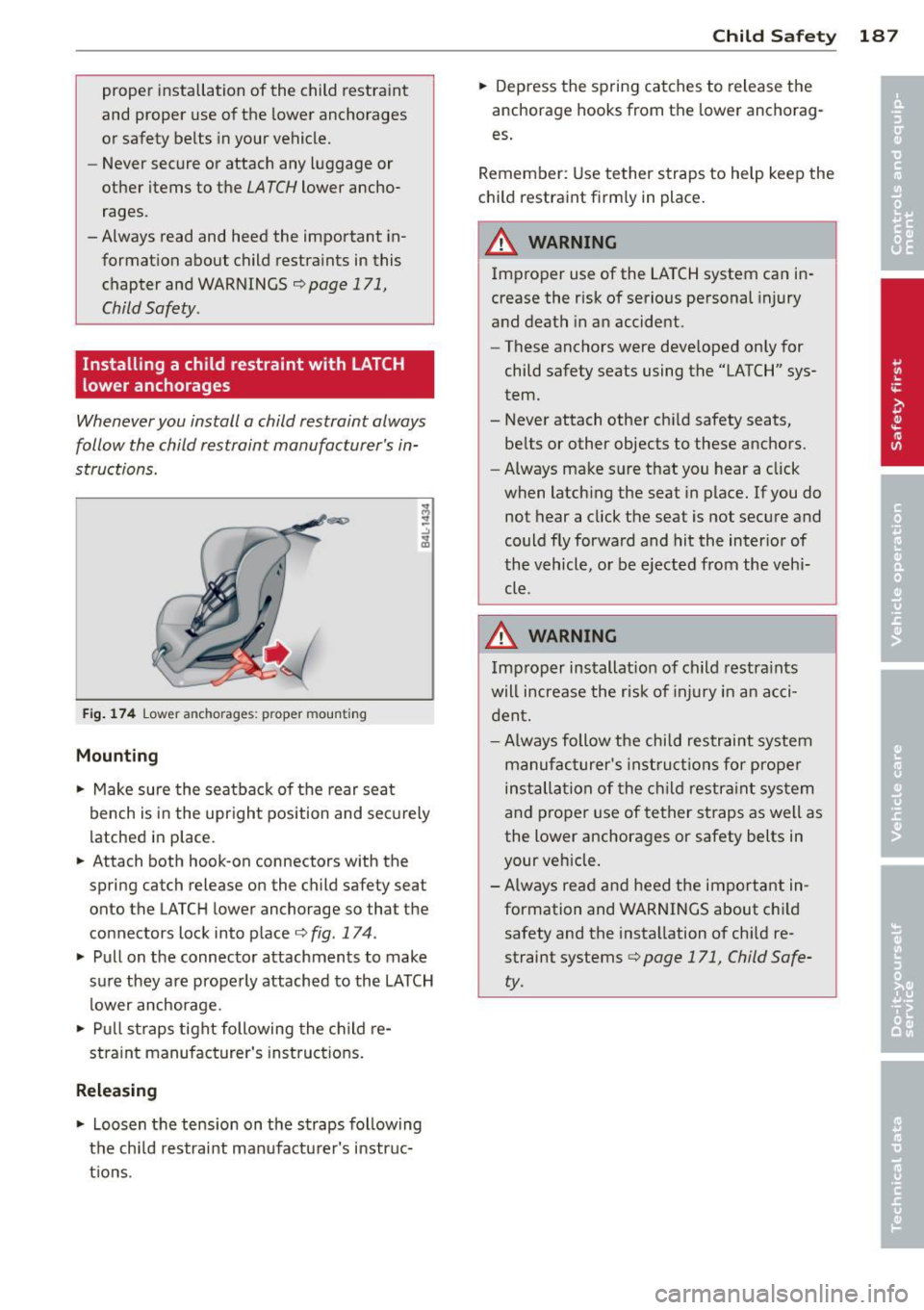
Fig.174 Lowe r an ch ora ges: prop er m ounting
Mounting
.. Make sure the seatback of the rear seat
bench is in the upright position and securely
latched in place.
.. Attach both hook-on connectors with the
spring catch release on the child safety sea t
on to the LATCH lower anchorage so that the
connectors lock into place
¢ fig . 174 .
.. Pull on the connector attachments to make
sure they are properly attached to the LATCH lower anchorage .
.. Pull straps tight following the child re
straint manufacturer's instructions.
Releasing
.. Loosen the tension on the straps following
the child restraint manufacturer's instruc
tions .
Child Safety 18 7
.. Depress the spring catches to release the
anchorage hooks from the lower anchorag
es.
Remember: Use tether straps to help keep the
child restraint firmly in place.
& WARNING ~
Improper use of the LATCH system can in-
crease the risk of serious personal injury
and death in an accident.
- These anchors were developed only for
child safety seats using the "LATCH" sys
tem.
- Never attach other child safety seats, belts or other objects to these anchors.
- Always make sure that you hear a click
when latching the seat in place. If you do
not hear a click the seat is not secure and
could fly forward and hit the interior of
the vehicle, or be ejected from the veh i
cle .
& WARNING
Improper installat ion of child restraints
will increase the risk of injury in an acci
dent.
- Always follow the child restraint system
manufacturer's instructions for proper
installation of the child restraint system
and proper use of tether straps as well as
the lower anchorages or safety belts in
your vehicle .
-Always read and heed the important in formation and WARNINGS about child safety and the installation of child re
straint systems¢
page 171, Child Safe
ty .
-
Page 195 of 306
ESC includes and/or works together with the
anti-lock brake system (ABS) , brake assist sys
tem, anti -slip regulation (ASR) , electronic dif
ferential lock (E DL) and e lectronic interaxle
d ifferential lock*. ESC is swi tched on all the
time. In certain situat ions when you need less
traction , you can switch off ASR by pressing
the button
[ru ~ fig . 177 . Be sure to switch
ASR on again when you no longer need less
traction.
Anti-lock braking system (ABS)
ABS prevents the wheels from locking up
when braking. The vehicle can still be steered even during hard braking . Apply steady pres
sure to the brake pedal. Do not pump the ped
al. A puls ing in the brake pedal indicates that
the system is he lping you to brake the vehicle.
Brake assist system
The brake assist system can decrease brak ing
d istance.
It increases braking power when the
driver presses the brake pedal quickly in emer
gency situations. You must press and hold the
brake pedal until the situation is over . In
vehicles with adaptive cruise control* , the
brake assist system is more sensitive if the
d istance detected to the vehicle ahead is too
small.
Anti-slip regulation (ASR)
ASR reduces engine power when the drive
wheels begin to spin and adapts the force to
the road condit ions. This makes it eas ier to
s tart, accelerate and drive up hills.
Electronic differential lock (EDL)
The EDL brakes wheels that are spinn ing and
transfers the drive power to the other drive
wheel or whee ls if the vehicle is equipped with
all-whee l drive*. This function is available up
to about 75 mph (120 km/h).
I n extreme cases , EDL automatically switches
off to help keep the brake on the braked wheel
from overheating. EDL wi ll switch on again au
tomatically when conditions have returned to
normal.
Intelligent technology 193
Electronic interaxle differential lock*/
selective wheel torque control*
The electronic interaxle differential lock (front
whee l drive) or the se lective wheel torque
cont rol (all-wheel dr ive) operates when dr iv
ing through curves . The front wheel on the in
s ide of the curve or both wheels on the inside
of the curve are braked selectively as needed .
T his min imizes sliding in the front wheels and
allows for more precise driving through
curves . Th e applicable system may no t acti
vate when driv ing in wet or snowy conditions.
A WARNING
-
-ESC, ABS, ASR, EDL and the electronic in
teraxle differential lock function* cannot
overcome the laws of physics. This is es
pecially important on slippery or wet
roads . If the systems begin acting to sta
bilize your vehicle, you should immedi
ately change your speed to match the
road and traffic conditions. Do not let
the increased safety provided by these
systems tempt you to t.;1ke risks. Doing
so will increase the risk o f a loss of vehi
cle control, collision and serious personal
injuries.
-Always adapt your speed to road, traffic
and weather conditions . The risk of los
ing control of the vehicle increases when
driving too fast, espec ially through
curves and on slippery or wet roads, and
when dr iving too close to vehicles up
ahead . ESC, ABS, the brake assist sys
tem, EDL, ASR and the elec tronic inter
axle differential lock function* cannot
prevent collisions .
- Always accelerate with special care on
even, smooth surfaces such as those that
are wet or covered with ice and snow.
The drive wheels can spin even with
these assistance systems that cannot al
ways he lp to red uce the risk of loss of ve -
hicle control. .,.
•
•
Page 209 of 306
@ Tips
If you move the selector lever of the auto
mat ic transm ission to P before app lying
the parking brake and before blocking the
wheels, you may have to use more force later to move the lever out of the P posi
tion .
Trailer towin g 207
•
•
Page 211 of 306
Automatic car wash
The vehicle can be washed in almost any
modern automatic car wash .
The vehicle paint is so durable that the vehicle
can normally be washed without problems in
an automatic car wash. However, the effect on
the paint depends to a large extent on the de
sig n of the fac ility, the filte ring of the wash
water, the type of wash and care mater ial , etc.
If the paint has a dull appearance afte r go ing
through the car wash or is scratched, bring
this to the attention of the operator immedi
ately. If necessary, use a different car wash.
Before going through a ca r wash, be s ure to
take the usual precautions such as closing the
windows and power roof. Factory installed an
tennas must not be removed.
If you have installed additional accessories on
the vehicle -such as spoilers, roof rack, etc. -
it is best to ask the car was h operator if these
should be removed .
A WARNING
Always read and heed a ll WARNINGS and
other information
¢ page 208.
CD Note
- Before washing the vehicle in an auto
matic car wash, please make sure to re
tract the exterior m irrors to prevent
them from being damaged. Power fo ld
i ng exter ior mirrors* must not be folded
i n or out by hand . Always use the electri
ca l power control.
- Compare the width of your vehicle with the width of the tunnel at the fac ility.
Washing the vehicle by hand
A lot of water is needed when washing a vehi
cle by hand.
.,. Before you start washing, make sure you
have read and understood the WARNINGS
¢ fr. .
Cleaning and protec tion 209
.,. First soak all dried dirt unti l it is soft, then
rinse it off.
.,. As you clean your vehicle, start w ith the
roof and work your way down to the bottom,
using a sponge, a sponge glove or a clean
brush .
.,. Rinse the sponge or the sponge glove often,
flushing it clean each time.
.,. Use spec ial car shampoo only fo r
very per
sistent d irt.
.,. Rinse the car thoroughly w ith water.
.,. Use a chamois leather to gent ly wipe the ex -
terior dry .
Use a separate sponge for cleaning the
whee ls, door s ills and other regions exposed
to road dirt. In this way, you wi ll not scratch
the paint with coarse particles imbedded in
the sponge the next time you wash the car.
A WARNING
- Wash your vehicle only when the ignition
is switched off to reduce the risk of a
crash .
- Always read and heed all WARNINGS and
other information
¢ page 208 .
CD Note
-Never try to remove dirt, mud or dust if
the surface of the veh icle is dry. Never
use a dry cloth or sponge, s ince this
could scratch your vehicle's paint or win
dows .
- Never wash your car in bright sunlight.
Drops of wate r act as magn ifying lenses
and may damage yo ur paint .
- When you wash your car in the winter: if you rinse your vehicle with a hose, be careful not to aim the stream of water
directly at locks, or at door or hatch
openings - they can freeze shut.
- Never use sponges designed to remove
insects, or any kitchen scouring sponges
or similar p rod ucts. They can damage
your paint finish .
- Never use a dry cloth or sponge to clean
the headlights . Only use wet cloths o r •
•
Page 217 of 306
when the cleaning solution when cleaning the
display .
The MMI/RS E* contro ls must be cleaned firs t
with a brush so that dirt does no t ente r the
unit or enter between the buttons and the
housing . Then wiping the controls with a cloth
dampened with dish detergent and water is
recommended.
(D Note
- To avoid scratching the disp lay, you
shou ld never clean it dry.
- To prevent damage, make sure fl uids do
not enter the controls .
Head-up Display
Applies to vehicles: with Head-up Display
The Head-up Display may be cleaned with a
damp cloth. The cloth should be free from
dust and lint, like a m icrofiber cloth for exam
ple.
(D Note
- To prevent scratches, do not clean the
display when it is dry.
- To prevent damage, make sure that flu
i ds do not enter the disp lay.
Aluminum trim
Use only n eutral -pH products to remove spots
and depos its from alum inum surfaces .
Chrome ca re produ cts and alkaline cleaners
will a ttac k alum in um s urfaces and can dam
age them over time.
A WARNING
Always read and heed a ll WARNINGS and
other information
~ page 208 .
Fabrics and fabric coverings
Fabrics and fabric coverings (e .g. seats, door
tr im panels, etc.) should be cleaned at reg ular
intervals with a vacuum cleaner. T his removes
surface dirt particles which could become em bedded in the fabr ic through use. Steam
Cleaning and protec tion 215
cleaners sho uld not be used, beca use the
steam tends to p ush the dirt deeper into the
fabric and lock it there .
Normal cleaning
Generally, we recommend using a soft sponge
o r a lint-free microfibe r cloth to the clean fab
ric. Brushes shou ld only be used for carpets
and floor mats, since other fabr ic surfaces
could be harmed by brushes.
Norma l surface stains can be cleaned using a
commercially availab le foam cleaner . Spread
the foam on the s urface of t he fabric with a
soft sponge and work it in gently. Do not satu
rate the fabric. T hen pat the foam dry us ing
absorbent, dry cloths (e.g. m icrofiber cloth)
and vacuum it after it has dried completely.
Cle aning sta in s
Stains caused by beverages (e .g. coffee, fr uit
juice, etc.) can be treated with a mild deter
gent solution. Apply the detergent solution
with a sponge. In the case of stubborn stains,
a detergent paste can be applied directly to
the stain and worked into the fabric. After
wards, use copious amounts of clean water to remove the rema ining de terge nt. App ly the
water wit h a damp cloth or sponge and pat
the fabric dry with an absorbent, dry cloth .
Stai ns from choco late or ma keup should have
de tergent paste (e.g. ox-gall soap) rubbed in
to them. Afterwa rds, remove the soap wi th
wa ter (damp sponge) .
Alcohol can be used to treat stai ns from
grease, o il, lipstick or a ballpoin t pen. Melted
grease o r dye mus t be patted
off using ab
sorbent mater ia l. It may be necessary to re
treat the areas with detergent paste and wa
ter .
In the case of genera l soiling of the upho ls
tery and cover material, we recommend hir ing
a specia list t hat has the eq uipment to clean
the seat covers and other fabric surfaces by
shampooing and spray extraction. •
•
Page 219 of 306
and can damage the leather surface as well as
weaken seams .
The leather sho uld be cleaned reg ularly as
needed. After having been used for a re latively
l ong time, your leather seats will acquire a
rich aged finish. This is a characteristic of nat
ura l leather and a sign of true quality .
I n o rder to maintain the va lue of th is natura l
p roduct over the life of your vehicle, you
should follow the recommendations below :
(D Note
-To keep yo ur leather from bleach ing out,
do not a llow it to be exposed to bright
sunlight for long periods of time. If you
have to leave the vehicle parked outside
for long periods, cover the leather to
protect it from d irect exposure to sun
light.
- Sharp objects on clothing, such as zip
pers, rivets or sharp pieces on be lts can
leave permanent scratches or scrape
marks on the surface of the leather .
- After each time you clean the leather and
at regu lar inte rva ls, use a leather preser
vat ive creme that conta ins UV-blockers
and that wor ks into the leather. This
c reme will no urish and moistur ize the
l eather, helping i t to brea the and stay
supple .
It also helps to b uild up a protec
tive coating on the s urface .
- Clean the lea ther every 2 -3 months,
and clean any areas that get soiled.
- Remove fresh mar ks made by ba llpoint
pens, ink, lipstick, shoe polish, e tc. as
soon as possib le .
- Preserve the colo r of the lea ther as need
ed by using a special colored leather care
creme to to uch up areas of uneven co lor.
Cleaning and protec tion 217
Cleaning and caring for leather
upholstery and trim
App lies to vehicles : with natural lea ther
Natural leather requires special care and at
tention .
Normal cleaning
.. Clean so iled areas with a slightly moistened
cotton or woolen cloth .
More stubborn dirt
.. More st ubborn dirt can be removed using a
cloth saturated with a mild soap solut ion (2
tablespoons mild liquid soap).
.. Never allow the soap solution to saturate
the leather, and make certain that no water soaks into the seams.
.,. Wipe off the soap so lution with a soft, dry
cloth.
Cleaning spots
.. Remove fresh wat er-based spots (such as
coffee, tea, juices, blood) with an absorbent
cloth or pape r towel.
.. Remove fresh
greas e or oil-ba sed spot s
(such as bu tte r, mayonnaise, chocola te) with
an absorbent cloth or paper towel, or use
the cleaner from the leather care kit if the
spot has not yet penetrated into the surface
of the leather.
.. Use an oil/grease dissolving spray, if
oil/
grease spot s ha ve dried on.
.. Remove specific k inds of spots (ballpoint
pen, felt marker, fingerna il polish, water
based pa int, shoe po lish, etc.) with a spot
remover specifically fo rmu lated for leather.
Leather care
.. Every half year use an approved leather care
product (available from your Audi dealer) to
care for the leather .
.,. App ly the product very spar ingly.
.. Wipe it off with a damp clot h.
If you have any q uestions about clean ing and
caring for the leather in your vehicle, it is best
to contact you r authorized Audi dea ler, who
will be g lad to help you and tell you abo ut o ur
full range of leather care prod ucts, such as : .,..
•
•