roof AUDI S6 2013 Owner's Manual
[x] Cancel search | Manufacturer: AUDI, Model Year: 2013, Model line: S6, Model: AUDI S6 2013Pages: 306, PDF Size: 76.92 MB
Page 211 of 306
Automatic car wash
The vehicle can be washed in almost any
modern automatic car wash .
The vehicle paint is so durable that the vehicle
can normally be washed without problems in
an automatic car wash. However, the effect on
the paint depends to a large extent on the de
sig n of the fac ility, the filte ring of the wash
water, the type of wash and care mater ial , etc.
If the paint has a dull appearance afte r go ing
through the car wash or is scratched, bring
this to the attention of the operator immedi
ately. If necessary, use a different car wash.
Before going through a ca r wash, be s ure to
take the usual precautions such as closing the
windows and power roof. Factory installed an
tennas must not be removed.
If you have installed additional accessories on
the vehicle -such as spoilers, roof rack, etc. -
it is best to ask the car was h operator if these
should be removed .
A WARNING
Always read and heed a ll WARNINGS and
other information
¢ page 208.
CD Note
- Before washing the vehicle in an auto
matic car wash, please make sure to re
tract the exterior m irrors to prevent
them from being damaged. Power fo ld
i ng exter ior mirrors* must not be folded
i n or out by hand . Always use the electri
ca l power control.
- Compare the width of your vehicle with the width of the tunnel at the fac ility.
Washing the vehicle by hand
A lot of water is needed when washing a vehi
cle by hand.
.,. Before you start washing, make sure you
have read and understood the WARNINGS
¢ fr. .
Cleaning and protec tion 209
.,. First soak all dried dirt unti l it is soft, then
rinse it off.
.,. As you clean your vehicle, start w ith the
roof and work your way down to the bottom,
using a sponge, a sponge glove or a clean
brush .
.,. Rinse the sponge or the sponge glove often,
flushing it clean each time.
.,. Use spec ial car shampoo only fo r
very per
sistent d irt.
.,. Rinse the car thoroughly w ith water.
.,. Use a chamois leather to gent ly wipe the ex -
terior dry .
Use a separate sponge for cleaning the
whee ls, door s ills and other regions exposed
to road dirt. In this way, you wi ll not scratch
the paint with coarse particles imbedded in
the sponge the next time you wash the car.
A WARNING
- Wash your vehicle only when the ignition
is switched off to reduce the risk of a
crash .
- Always read and heed all WARNINGS and
other information
¢ page 208 .
CD Note
-Never try to remove dirt, mud or dust if
the surface of the veh icle is dry. Never
use a dry cloth or sponge, s ince this
could scratch your vehicle's paint or win
dows .
- Never wash your car in bright sunlight.
Drops of wate r act as magn ifying lenses
and may damage yo ur paint .
- When you wash your car in the winter: if you rinse your vehicle with a hose, be careful not to aim the stream of water
directly at locks, or at door or hatch
openings - they can freeze shut.
- Never use sponges designed to remove
insects, or any kitchen scouring sponges
or similar p rod ucts. They can damage
your paint finish .
- Never use a dry cloth or sponge to clean
the headlights . Only use wet cloths o r •
•
Page 212 of 306
210 Cleaning and protec tio n
sponges to prevent scratches. It is best
to use soapy water .
- You should remove debris (such as in
sects) from the headlight lenses on a
regular basis, for example when refuel
ing your vehicle. Never clean the head
lights w ith a dry cloth or sponge. Use a
wet cloth or sponge. It is best to use
soapy water .
@) For the sake of the environment
Only wash the vehicle in facilit ies specially
designed for that purpose. Th is w ill reduce
the risk of d irty water contaminated w ith
oil from entering the sewer system . In
some areas, wash ing vehicles outs ide of
these facilities is prohib ited.
Washing your vehicle with a power
washer
Cleaning the exterior of your car with a high
pressure power washer is safe as long as you
observe a few simple rules.
• Before using the power w asher , make sure
yo u have read and understood the WARN
INGS
q A in General information on
page 208.
• Always fo llow the operating instructions for
the power washer.
• Make sure that the jet o n the spray hose
produces a "fan shaped spray" .
• Do
not hold the spray nozzle too close to
soft materia ls .
Keep a d istance from soft materials such as
rubber hoses or insulat ing mater ial as we ll as
sensors and camera lenses.
When cleaning t he vehicle wit h a power wash
er
always fo llow the operating instructions .
This applies particularly to the operating pres
sure and the spraying distance . Do not po int
the spray direc tly at the sea ls around the s ide
windows, aro und t he doors, on the re ar lid or
on the sunroof* . Likew ise, do not point it di
rectly at tires, r ubber hoses, ins ulation mate
rial or sensors
q page 211. Hold the spray nozzle at least 1.3 ft (0.4 m) away from the
vehicle.
Do no t use a high-pressu re power was her to
remove snow and ice .
Do not use a jet which sprays water in a d irect
st ream o r one that has a rotating je t.
Water temperature should not exceed 140 °F
(60 °() .
A WARNING ,..__
Neve r wash t ires with a jet that sprays wa
ter in a direct stream. This could cause in
v is ible d amage to the t ires and weaken
them, even if the spray is from a relative ly
l ong distance and for a short time . Dam
aged and wea kened tires can fail a nd cause
accidents and personal in jury.
(D Note
To avoid damaging yo ur vehicle, a lw ays
make sure tha t the re is sufficien t distance
between the spray head and soft materia ls
li ke rubber hoses, plast ic parts and sound
deaden ing mater ia ls as well as sensors
and camera lenses. Never a im the spray
head at the same point fo r a long time.
This also app lies to cleaning headlights
and paint ed bumpers . Remembe r: t he
closer the no zzle is to the surfa ce of the
m at erial , the gre ater t he s tress on the ma
terial.
Caring for vehicles with matte finish
paint
Applies to vehicles: wit h matte finish paint
Vehicles with matte finish paint require spe
cial care due to the characteristics of the
paint.
Washing by hand
T o avoid damaging the pain t when was hing,
fi rst remove dust and la rge particles from
yo ur vehicle . Insects, grease spots and finger
prints are best removed with a
special cleaner
for matte finish pa int .
1111>
Page 216 of 306
214 Cleaning and protec tio n
To preserve the deco rative appearance of the
cast a lloy whee ls , some specia l care is neces
sary. In addit ion to road dirt and sa lt, brake
dust is also corros ive. If left on for too long,
brake dust can cause pitt ing.
Use only specia l
acid-free cleaners formulated
for a lloy rims. Safe products are available at
your Aud i dealer. Never leave the cleaner on
the r ims longer than spec ified on the label. If
not rinsed off promptly, the acid conta ined in
some cleaners can attack the threads on the
wheel bolts.
Never use abras ive or metal polishing clean
ing agents . If the protective coating has been
ch ipped, e .g . by k icked up road dirt, touch it
up as soon as poss ible.
A WARNING
- Moisture and ice on brakes may affect
braking efficiency
Q page 194, General
information .
Test the brakes caref ully
each time you wash the vehicle.
- Always read and heed all WARNINGS and
other information ¢
page 208.
-
Body cavity sealing
The body cavity sealing does not need to be
checked.
A ll body cavities wh ich could be affected by
corrosion have been thoroughly protected at
the facto ry.
This sealing does not require any inspection or
addit ional treatment . If any wax should seep
out of the cav ity when the ambient tempera
ture is high, it can be removed w it h a plastic
scrape r and a suitab le solven t.
A WARNING
So lvents can be dange rous.
- Benzine is flammable and toxic.
If you
use benzine for removing the wax, keep
sparks, flame and lighted cigarettes
away. Never dump benzine on t he
ground, into open streams or down sew
age drains. -
Be s ure to observe all safety and environ
mental regulat ions. Follow all instruc
tions on the container .
- Always read and heed all WARNINGS and
other information
Q page 208.
Chassis
Hove the undercoating checked for damage
from time to time .
The lower body shell of your Aud i is also thor
oughly protected against corrosion .
Any damage to the undercoat ing ca used by
road hazards should be repaired prom ptly.
A WARNING
r----
Too much undercoating in the wrong p la-
ces can cause a fire.
- Do not app ly additional under coating or
r u stp roof ing on or nea r the exhaust
manifold, exhaust pipes, catalytic con
verter or heat shields . While driving, the
substance used fo r undercoating could
overheat and cause a fire.
-
- Always read and heed a ll WARNINGS and
other information
Q page 208.
Exhaust tail pipes
Road salt and other corrosive materials will
damage the material in the exhaust tail pipes
if they are not cleaned regular ly. Do not clean
the tail pipes with wheel cleaner, pa int polish,
chr ome polish or other ab rasive clea ners.
Clean the tail pipes with ca r c are products
t h at are suitable fo r stainless steel.
Your authorized Aud i dea ler can provide clean
ing produc ts tha t have been tested and ap
proved for yo ur vehicle .
Care of interior
Infotainment components
The MMI/RSE* display may be cleaned wit h a
soft clot h and commercia lly-available "LCD
cleaner ". The clot h should be coated lightly ..,
Page 231 of 306
temperatures stay below freezing point for l ong periods.
Detergent add itives in the o il w il l make fresh
oil look dark after the eng ine has been run
ning fo r a short time . This is norma l and is not
a reason to change the oi l more often than
recommended.
D am ag e or m alfun ction s due to lack of
ma intenanc e
It is essential that you change your oil at the
r ecommended inte rva ls using only engine o il
t hat complies wi th A udi oi l standard
VW 502 00 . Your Limited New Vehicle War
ranty does not cover damage or malfunctions
d ue to fa ilure to fo llow recommended mainte
nance and use requ irements as set forth in
the Audi Owner's Manua l and Warranty
&
Maintenance book let . Your dea ler will have to
deny warranty coverage u nless you present to
the dea ler p roof in the fo rm of Serv ice or Re
pa ir Orde rs that all s chedu led maintenance
wa s pe rformed in a t imely manner .
Engine oil consumption
The engine in your vehicle dep ends on an ade
quate amount of oil to lubricate and cool all
of its moving parts.
In o rder to provide effective lubrication and
cool ing of i nternal engine components, a ll in
ternal comb ustion eng ines consume a cert ain
amo unt of o il. Oil cons umption varies from
engine to engine and may change significantly
over the life of the engine. Typ ica lly, engines
with a specified break-in per iod (see
¢
page 199) consume more oil during the
break-in per iod than they consume after oil
consumption has stabilized .
Under norma l conditions, the rate of oil con
sumpt ion depends on the quality and viscosity
of the oil, the RPM (revo lutions per m inute) at
which the engine is operated, the amb ient
temperature and road condit ions. Furthe r fac
tors ar e the amount of o il d ilution from wate r
condensation or fuel residue and the ox ida
tion level of the oi l. As any engine is s ubje ct to
Checkin g and fillin g 229
wear as m ileage builds up, the oil consump
tion may increase over time until replacement
of worn components may become necessary.
Wi th a ll these variab les coming into p lay, no
standard rate of oil consumpt ion can be es
tablished or specified. There is no alternative
to regular and frequent check ing of the o il lev
el, see
Note .
If the yellow engine oil leve l warning symbo l
in the instrument cluster
II li ghts up, you
sho uld check the oil leve l as soon as possib le
¢
page 230. Top off the oil at your earliest
convenience ¢
page 230.
A WARNING
Before you check anythi ng i n the engine
com partment, always read a nd heed all
WARNINGS¢ .&.
in Working in th e engine
c ompartment on page 225.
(D Note
D riving w ith an insufficient o il level is like
ly to cause sever e damage to the engine .
(D Tips
- The oil pressure warning display. is
not an indicator of the oil le vel. Do not
rely on it . Instead, check the oil level in
your engine at regu lar intervals, pref
erably ea ch time you refuel, and always
before going on a long trip .
-If you have the impression yo ur engi ne
c ons umes ex ce ss ive amoun ts of o il, we
recommend that you consul t your Au di
de aler to have the cause of your concern
properly diagnosed . Keep in mind that
the accurate meas urement of o il con
sumption requires great care and may
take some t ime. Y our Audi dea ler has in
struct ions about how to measure oil con
sumption accurately.
-
•
•
Page 241 of 306
Battery replacement
The new battery must have the same specifi
cations and dimensions as the original equip
ment battery.
Intell igent energy management in your vehi
cle is respons ible for d istributing the electri
cal energy throughout your vehicle
~ page 197. The intel ligent energy ma nage
ment system w ill keep the eng ine batte ry
charged be tte r than vehicles w ithout t his sys
tem . To make sure the additional e lectrical en
ergy is available once again after you have
changed the battery, we recommend that you
install batteries of the same type and man u
facture only (the same as those installed at
the time your vehicle was delivered). Specifi
cations a re listed on the battery hous ing . Your
author ized dealer must code the battery in
the energy management system to enable you
to use the energy managemen t fu nctions co r
rectly a fter replacing the battery .
The new battery must have the same capacity,
voltage (12-vo lts), a mperage, construct ion
and p lug sealing.
When installing the battery , make sure the ig
n ition and all e lectr ica l cons umers are sw itch
ed off.
CD Note
Make sure the ventilation hose on the s ide
of the battery is connected, ot herwise
fumes or battery ac id can leak out.
- Vehicles with the Start-Stop-System* are
equipped with a specia l cycle-proof AGM
batte ry. Insta lling a different type of
batte ry can c ause prob lems in the vehi
cle electrical system . When rep lacing the
vehicle battery, always insta ll one with
the same specifications as the original battery.
@ For the sake of the environment
Because of the problem of proper disposa l
of a battery, we recommend your author
ized Aud i dea ler change the battery for
you. Batter ies contain sulf uric ac id and
Checkin g and fillin g 239
lead and must always be disposed o f prop
erly in compliance with a ll environmental
regulations. Disposing of vehicle batter ies
i mproperly is very dangerous to the envi
ronment.
Windshield/headlight
washer container
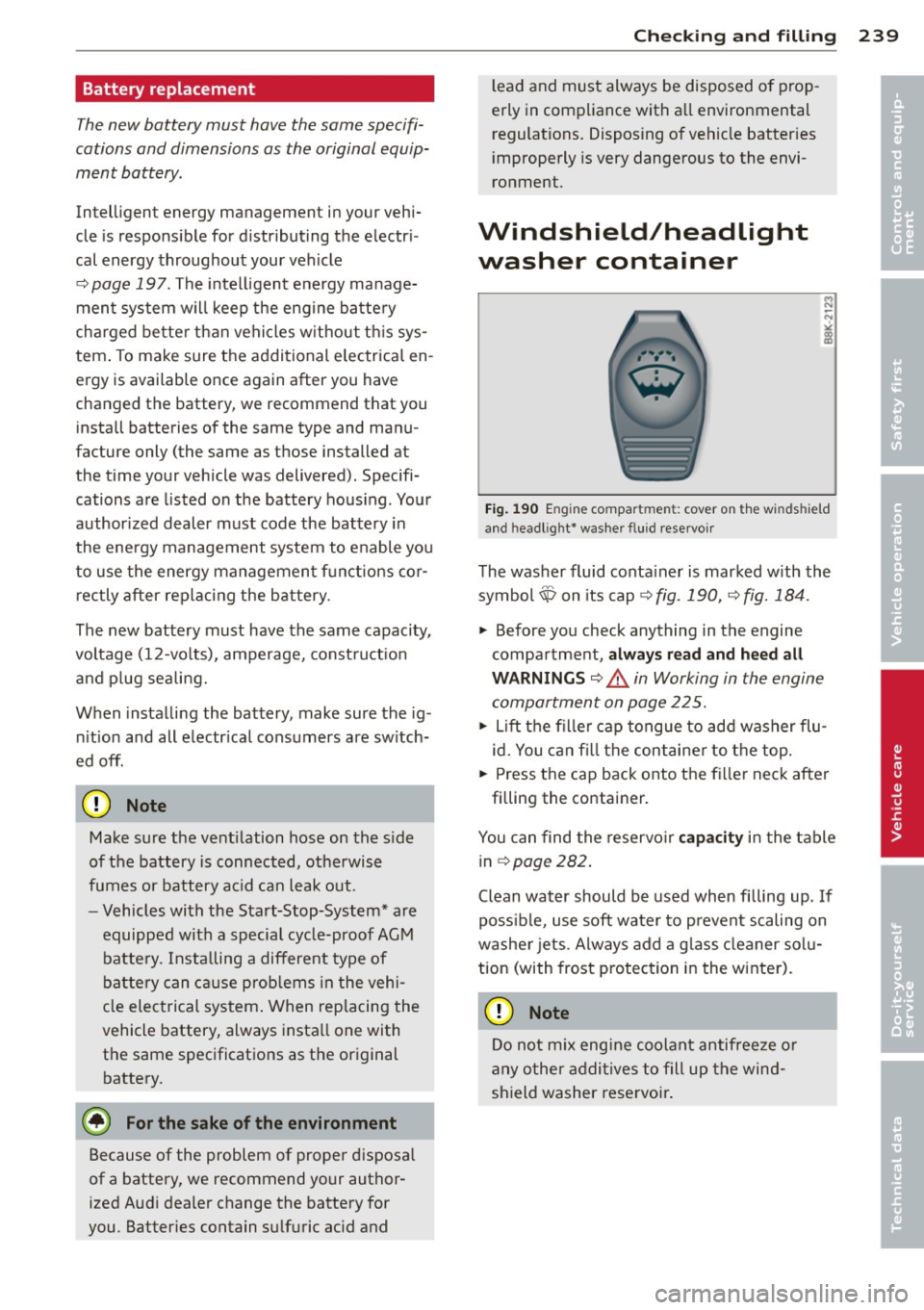
Fi g. 1 90 Engine compar tment: cover on th e windshield
and headl ig ht* washe r flu id reservo ir
The washer fluid conta iner is marked w ith the
symbol ~ on its cap
~ fig . 190, ~fig. 184.
... Before you check anything in the engine
compartment,
always r ead and heed all
WARNINGS ¢ _& in Working in the engine
compartment on page 225.
... Lift the fil le r cap tongue to add washer flu
id. You can fi ll the containe r to the top.
... Press the cap back onto the fi lle r neck after
filling the container.
You can find the reservo ir
cap acit y in the table
in
¢ page 282.
Clean water should be used when filling up. If
poss ible, use soft wa ter to prevent scaling on
washer jets . Always add a g lass cleaner solu
tion (with frost protection in the winter).
CD Note
Do not mix engine coo lant antifreeze or
any o ther additives to fill up t he wind
sh ield washer reservoir .
•
•
Page 244 of 306
242 Tire s and wheels
Groove
means the space between two adjacent tread
ribs .
Load rating (code)
means the maximum load that a tire is rated
to carry for a given inflation pressure. You
may not find this informat ion on all tires be
cause it is not req uired by law.
Maximum load rating
means the load rating for a t ire at the max i
mum permissible inflation pressure for that
tire.
Maximum loaded vehicle weight
means the sum of:
(a) Curb weight
(b) Accessory weight
(c) Vehicle capacity we ight, and
(d) Production options weight
Maximum (permissible) inflation pressure
means the maximum cold inflation pressure
to which a tire may be inflated. Also called
"maximum inflation pressure ."
Normal occupant weight
means 150 lbs. (68 kilograms) times the
number of occupants seated in the vehicle up
to the total seating capacity of your vehicle .
Occupant distribution
means distribution of occupants in a vehicle.
Outer diameter
means the overa ll diameter of an inflated new
tire.
Overall width
means the linear distance between the exteri
ors of the sidewalls of an inflated tire, includ
ing elevations due to labeling, decorations, or
protective bands o r ribs .
Ply
means a layer of rubber-coated parallel cords.
Production options weight
means the combined weight of those insta lled
regular production options weighing over 5
lbs. (2.3 kg) in excess of those standard items
which they replace, not previously considered
in curb weight or accessory we ight, including
heavy duty brakes, ride levelers, roof rack,
heavy duty battery, and special tr im .
Radial ply tire
means a pneumat ic tire in which the ply cords
that extend to the beads are laid at substan
t ia lly 90 degrees to the center line of the
tread .
Recommended inflation pressure
see<=> page 241, Cold tire inflation pressure.
Reinforced tire
means a t ire design to operate at higher loads
and at h igher inflation pressures than the cor
responding standa rd tire. Reinforced tires
may be identified as "XL" "xl" "EXTRA LOAD"
' ' '
or "RF" on the sidewa ll.
Rim
means a metal support for a tire or a tire and
tube assembly upon which the tire beads are
seated.
Rim diameter
means nom inal d iameter of the bead seat. If
you change your wheel s ize, you will have to
purchase new tires to match the new rim di
ameter.
Rim size designation
means r im diameter and width .
Rim width
means nominal distance between rim flanges.
Sidewall
means that portion of a tire between the
t read and bead.
Page 273 of 306
Fuse panel@ (black )
No. Equipment Amps
= = 7 Audi adaptive cruise control 10
8
Airbag control module, front
5
passenger's seat sensor system
Gateway 5
Homelink (garage door opener),
10 night vision system control
5
module
Image processing (Audi active
11 lane assist, Audi adaptive cruise
10
control)
12 Steering 5
1 13 Terminal 15 in the luggage com-
15
partment
14 Terminal 15 in the
instrument
30
panel (front passenger's side)
15 Terminal 15 engine 15
16 Starter 40
Fuse panel
B (brown)
No. Equipment Amps
1 Gateway 5
2 Climate control 10
3 ESC control module 10
Front door (driver's side) 30
s
Power seat adjustment (driver's
7,5
seat)
6 Steering 35
7 Sunroof 20
8
Rear door control module (driv-
15
er's side)
9 Lumbar support (Front passen
-
5
ger seat)
11 Sunroof, rear spoiler (Sportback) 20
12 Driver door control module
15
Fuse panel
c (red)
No. Equipment Amps
2 Fuel pump 25
3 Brake light sensor/brake pedal
sensor system 5/5
4 Engine acoustics 7,5
Fuses and bulbs
-Fuse panel © (red)
No.
u Equipment
5 Rear door
control module (driv-
er's side)
6 Left
rear seat
Horn
Windshield wiper
9 Light/rain sensor
10 L
umbar support (driver seat)
11 Front passenger door control
module
12 Right rear door control modu le
Front passenger side cockpit fuse
assignment Amps
30
7,5 15
30 5
5
15
15
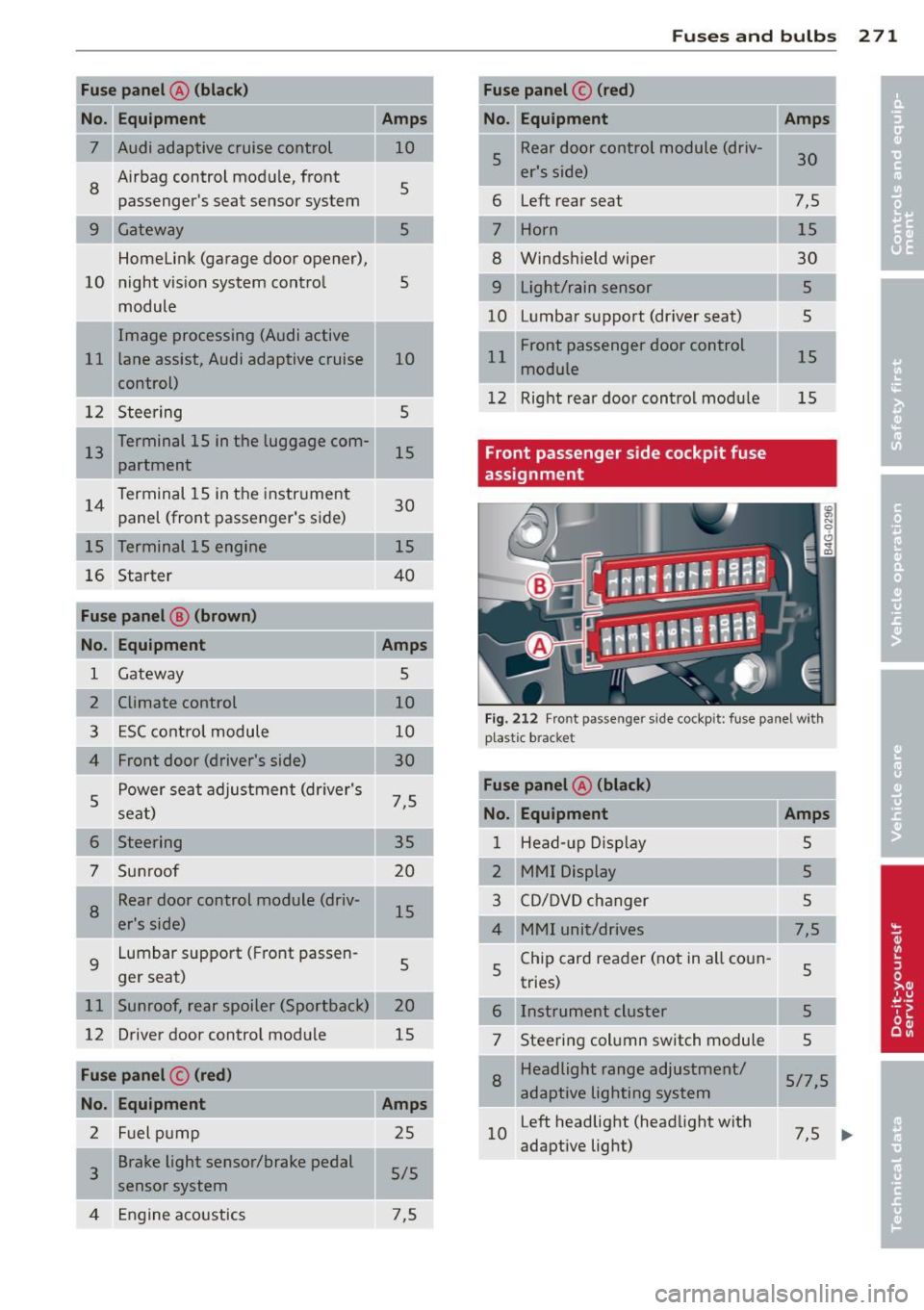
Fig. 212 Front passenger side cockpit: fuse panel wit h
p last ic bracket
Fuse panel A (black)
No. Equipment
Amps
1 Head-up Display 5
2 MMI Display 5
3 CD/DVD changer 5
4 MMI unit/drives
7,5
5 Chip card reader (not in all coun
-
5
tries)
6 Instrument cluster
5
7 Steering column switch module
5
8
Headlight range adjustment/
5/7,5
adaptive lighting system
10 Left
headlight (headlight with
7,5
adaptive light)
I
271
...
Page 283 of 306
designated seating position) and luggage
weight~&. .
Gros s Axle W eight Rating
The G ross Axle Weight Rating is the maximum
l oad tha t can be applied at each axle of the
vehicle
q .&. .
Vehicle capacit y weight
The vehicle capac ity we ight (max. load) is list
ed either on the dr iver's side B-pillar or inside
the fuel filler flap.
Roof weight
The max imum perm issible roof weight is
220 lb (100 kg ). The roof weight is made up
of the weight of the roof rack system and the
weight of the object be ing transported
q page 60, Loading the roof rack .
.&, WARNING
- T he ac tual Gross Axle Weight Rat ing at
the front and rear axles shou ld not ex
ceed the permiss ible weights, and their
combination must not exceed the Gross
Vehicle Weight Rat ing .
- Exceeding permissib le weight ratings can
result in vehicle damage, accidents and
personal injury.
CD Note
- The vehicle capacity weight figures apply
when the load is distributed evenly in the
vehicle (passengers and luggage). When
transporting a heavy load in the luggage
compartment, carry the load as near to
the rear axle as possib le so that the veh i
cle's handling is not impa ired.
- Do not exceed the maximum permissible
axle loads or the max imum gross vehicle
weight. Always remember that the vehi
cle's handling will be affected by the ex
tra load. Therefore, adjust you r speed ac
cord ingly.
- Always observe loca l regu lations.
-
G ene ral in formation 28 1
Dimensions
The specifications refer to the basic model.
Differences may occur depending on the mod
el type and options ordered, for example, tire
sizes.
CD Note
When driving up steep ramps, on rough roads, over curbs, etc. it is important to re
member that some parts of your vehicle,
such as spoilers or exhaust system compo nents, may be close to the ground . Be
careful not to damage them .
•
•
Page 288 of 306
28 6 Con sum er Inf ormation
comp lexity of today's automobi les, have
steadi ly reduced the scope of maintenance
and repairs which can be carried out by vehicle
owners.
Also, s afety an d e nvir onm ent al con
cerns place very strict limits on the nature of repairs and adjustments to engine and trans
miss ion pa rts which an owner can perform .
Maintenance, adjustments and repa irs usua lly
require special tools, testing devices and oth
er equipment avai lab le to specially trained
workshop personnel in order to assure proper
performance, reliab ility and safety of the vehi
cle and its many systems .
Improper ma intenance, adjustments and re
pa irs can impair the operation and reliab ility
of your vehicle and even void your vehicle war ranty. Therefo re , proof of servici ng in accord
ance w it h the ma intenance sched ule may be a
condition for upholding a possible warranty
claim made within the warran ty period.
Above all, operational safety can be adve rsely
affected, creating unnecessary risks for you
and your passengers.
If in doubt about any serv icing, have it done
by your author ized Audi dealer or any other
p roperly equipped and qualified workshop .
We strong ly urge you to give your authorized
Audi dealer the opportunity to perform all
schedu led maintenance and necessary repairs .
Your dea ler has the facilities, or iginal parts
and tra ined spec ialists to keep your vehicle
running properly .
Performing lim it e d m aint en anc e y ourself
The fo llowing pages describe a limited num
ber of procedures which can be performed on
you r vehicle with ordinary too ls, shou ld the
need arise and trained personnel be unavaila
ble. Before performing any of these proce
dures, always thoroughly read all of the app li
cable text and ca refully follow the instruc
tions given. Always rigorously obse rve the
WARNINGS p rovided .
Before you ch eck anything in th e engin e
compartme nt, alway s read an d heed all WARNINGS
¢ & a
nd ¢ & in Working in the
engine comportment on page 225 .
A WARNING
--Serious personal in jury may occur as a re-
sult of improperly performed mainte nance, adjustments or repa irs.
- Always be extremely careful when work
ing on the vehicle. Always follow com
monly accepted safety pract ices and gen
eral common sense. Never r isk personal
in jur y.
- Do not attempt any of the maintenance,
checks or repairs descr ibed o n the fol
lowing pages if you are not fu lly fam iliar
with these or other procedures with re spect to the vehi cle, or are uncerta in how
to proceed .
- Do not do any work withou t the proper
too ls and equipment . Have the necessary
work done by your authorized A udi deal
er or anothe r properly equipped and
qualified workshop.
- The engine compar tment o f any motor
vehicle is a potentially hazardous area. Never reach into the area around or
touch the rad iator fan. It is temperature
control led and can sw itch on suddenly -
even when the engine is off . The radiator
fan switches on automatically when the
coo lant reaches a ce rtain temperature
and will cont inue to ru n until the coo lant
tempera ture drops.
- Always sw itch off the ignition before any
one gets under the vehicle.
- Always support your veh icle with safety
s tands if it is necessary to work under
neath the vehicle. The j ack s upp lied with
the vehicle is not adequate for this pur
pose and cou ld co llapse causing serio us
pe rsonal injury .
- If you must work underneath the vehicle
with the wheels on the ground, a lways
make sure the vehicle is on leve l ground,
that the wheels are a lways secure ly
blocked and that t he engine cannot be
started .
Page 294 of 306

292 Index
Checking Engine coolant level ................ 232
Tire pressure . ............. ... .... . 246
Ch ild restra ints
Danger of using child restra ints in the
front seat . . . . . . . . . . . . . . . . . . . . . . . . 147
Where can I get additional information
about child restraints and their use? .. 189
Child restraint system anchors ... .... . 185
Child safety .. .. . .......... .. .. .... . 171
Convertible locking retractor .. .. .. .. . 182
Important safety instructions for us ing
chi ld safety seats ......... .. .. .... . 175
I mportant things to know when dr iving
with chi ldren . ............... .... . 171
Tether anchors ............ ... .... . 188
Tether straps ..................... 188
Child safety lock Rear doors .............. .. .. .... .. 38
Child safety seats .......... .... .... . 177
Booster seats . .......... ... .. .. ... 180
Convertible ch ild seats .... .. .. .. .. . 178
Convertible locking retractor .. .. .. ... 182
H ow do I proper ly install a child safety
seat in my vehicle? ...... .. .. .. .. .. . 175
I nfant seats .............. ... .... . 177
I nstalling . ............... ... .... . 182
Installing a child restraint using the
LATCH system ................ .... . 187
LATCH system ............ .... ..... 187
Lower anchorages ............ ..... 186
Mounting and releasing the anchorage
hook .. .. .. ... .... ...... ... ... .. . 187
Safety instructions . . . . . . . . . . . . . . . . . 17 5
Unused safety belts on the rear seat .. 177
Cigarette lighter . . . . . . . . . . . . . . . . . . . . . 56
C leaning
Head-up Display .............. .... . 215
Matte finish paint ............ .... . 210
C leaning and protection ..... .. .. .. .. . 208
A lcantara (synthet ic suede) .......... 218
Engine compartment ....... .... ... . 219
Exhaust tail pipes .......... ... .... . 214
Fabrics and fabric coverings .. .. ..... 215
Instrument panel ............. ..... 216
Interior . . . . . . . . . . . . . . . . . . . . . . . . . . 214
Leather . . . . . . . . . . . . . . . . . . . . . . . . . . 217
MMI display/controls .. ... ... .. .. ... 214 Plastic
and vinyl . .............. .... 212
Plastic parts . . . . . . . . . . . . . . . . . . . . . . 216
Safety be lts ... .. ................ . 218
trim strips ................... .... 212
Trim strips ................... .... 212
Cleaning the Head-up Display ......... 215
Climate control Air vents . . . . . . . . . . . . . . . . . . . . . . . . . . 66
Climate controls . .. ............. .. .. . 64
Climate control (four-zone)
Operation ..... .. .. .............. .. 67
Climate control (three-zone) Operation . . . . . . . . . . . . . . . . . . . . . . . . . 65
Clock ...... .... .................... 27
Closing Sliding/tilting sunroof ............... 40
Cold tire inflation pressure ........ .. .. 244
Coming home ....................... 43
Compact spare tire ................. . 262
Compartments . . . . . . . . . . . . . . . . . . . . . . 57
Compliance ..... .. .. .............. . 288
Consumer Information . . . . . . . . . . 134, 285
Consumption (fuel) ............. .... . 24
Contacting NHTSA .............. .... 134
Convenience key . .. ... ........... ... . 35
Starting the engine ............ .... . 71
Stopping the engine (START ENGINE
STOP button) . . . . . . . . . . . . . . . . . . . . . . 73
Switching the ignition on ........ ... . 71
Unlocking and locking vehicle .... .. .. . 35
Convertib le child safety seats ..... .... 178
Convertible locking retractor Activating ... .. .. .. ..... ...... .. .. 184
Deact ivating . .. .. ... ....... ... .. .. 184
Using to secure a child safety seat 1.82, 184
Coolant
refer to Engine coolant ............. 232
Cooling mode (automatic climate control) 67
Cooling mode (climate control) . . . . . . . . . 65
Cruise contro l
Changing speed .. ............. .... . 80
Presetting your speed .............. . 80
Switching off . . . . . . . . . . . . . . . . . . . . . . 80
Switching on . . . . . . . . . . . . . . . . . . . . . . . 79
Warning/ind icator lights ........... .. 23
(upholder .. .... ............... ..... 57