height AUDI S6 2014 User Guide
[x] Cancel search | Manufacturer: AUDI, Model Year: 2014, Model line: S6, Model: AUDI S6 2014Pages: 304, PDF Size: 76.32 MB
Page 184 of 304
182 Child Safety -Always follow the manufacturer's in
structions provided with the child safety
seat or infant carrier.
- Always move the front passenger seat in
to the rearmost position of the passen
ger seat's fore and aft adjustment range,
and as far away from the airbag as possi ble before installing the child restraint .
- Always make sure that nothing prevents
the front passenger's seat from being
moved to the rearmost position in its
fore and aft adjustment range.
-Always make sure the backrest is in an
upright position.
- Never place or use any electrical device (such as a laptop, CD player, electronic
games device, power inverter or seat
heater for child seats) on the front pas
senger seat if the device is connected to
the 12-volt socket or the cigarette light
er socket.
- If a seat heater has been retrofitted or
otherwise added to the front passenger
seat, never install any child restraint sys
tem on this seat.
- Make sure that there are no wet objects
(such as a wet towel) and no water or
other liquids on the front passenger seat
cushion.
- Never place objects on the seat (such as
a laptop, CD player, electronic games de
vice, power inverter or seat heater for child seats). These may influence the
electrical capacitance measured by the
capacitive passenger detection system
and can also fly around in an accident
and cause serious personal injury.
- Make sure that the
PASSENGER AIR BAG
OFF
light comes on and stays on all the
time whenever the ignition is switched
on.
- If the
PASSENGER AIR BAG OFF light
does not come on and stay on, immedi
ately install the forward-facing child seat
at a seating position on the rear seat and have the airbag system inspected by your
authorized Audi dealer. -
Take the child restraint off the front pas
senger seat and install it properly at one
of the rear seat positions if the
PASSEN
GER AIR BAG OFF
light does not stay on
whenever the ignition is switched on.
Booster seats and safety belts
Properly used booster seats can help protect
children weighing between about 40 lbs. and
80 lbs. (18 kg and 36 kg) who are less than 4
ft. 9 in . (57 inches/1 .45 meters) tall.
"' ....
"' 0 ±
o5
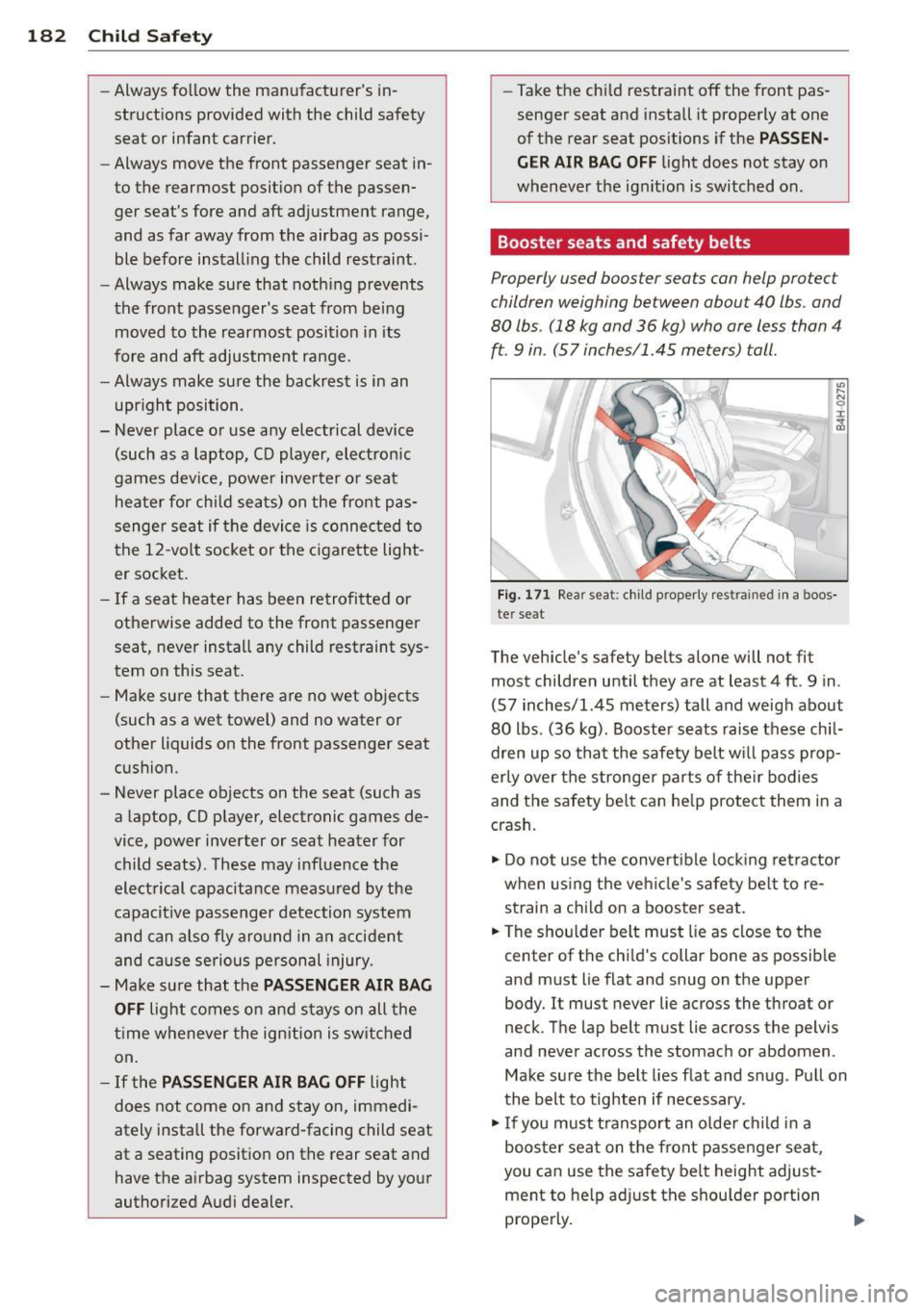
Fig. 171 Rear seat: child properly restrained in a boos
te r seat
The vehicle 's safety belts alone will not fit
most children until they are at least 4 ft . 9 in.
(57 inches/1.45 meters) tall and weigh about
80 lbs. (36 kg). Booster seats raise these chil
dren up so that the safety belt will pass prop
erly over the stronger parts of their bodies
and the safety belt can help protect them in a
crash.
.,. Do not use the convertible locking retractor
when using the vehicle's safety belt to re
strain a child on a booster seat.
.. The shoulder belt must lie as close to the
center of the child's collar bone as possible
and must lie flat and snug on the upper
body. It must never lie across the throat or
neck . The lap belt must lie across the pelvis
and never across the stomach or abdomen .
Make sure the belt lies flat and snug. Pull on
the belt to tighten if necessary .
.,. If you must transport an older child in a
booster seat on the front passenger seat,
you can use the safety belt height adjust
ment to help adjust the shoulder portion
properly. ..,.
Page 209 of 304
Make sure that the cooling system has enough
fluid.
Tire pressure
When towing a trailer, inflate the tires of your
vehicle to the cold tire pressure listed under
"Full load" on the label located on the driver's
side B-pillar (visible when the door is open).
Inflate trailer tires to trailer and tire manufac
turers' specifications.
Lights
Check to make sure both vehicle and trailer
lights are working properly.
Safety chains
Be sure trailer safety chains are properly con
nected from the trailer to the hitch on the ve
hicle. Leave enough slack in the chains to per
mit turning corners . When you install safety
chains, make sure they will not drag on the
road when you are driving.
The chains should cross under the trailer
tongue to prevent it from dropping in case of
separation from the hitch.
Adjusting the Audi drive select
Make sure the vehicle is on a level surface be
fore hitching up the trailer and before adjust
ing the tongue weight. The vehicle must be in
auto or comfort driving mode and not raised
qpage 100, ~CD .
Make sure that the vehicle is lowered. In Info
tainment, select:
ICARI function button> Low
er
control button.
If you must drive under poor road conditions,
you can raise the vehicle
after coupling the
trailer or
after adjusting the tongue weight
qpage 102.
- Changes in temperature or load can af
fect the height of the vehicle .
- Always select
auto or comfort mode.
Otherwise, the tongue load specified for
your vehicle will no longer be applicable.
Trailer towing
Driving instructions
Driving with a trailer always requires extra
care and consideration .
To obtain the best possible handling of vehicle
and trailer, please note the following:
... Do not tow a loaded trailer when your car it
self is not loaded.
... Be especially careful when passing other
vehicles.
... Observe speed limits .
... Do not drive at the maximum permissible
speed.
... Always apply brakes early .
... Monitor the temperature gauge.
Weight distribution
Towing a loaded trailer with an empty car re
sults in a highly unstable distribution of
weight. If this cannot be avoided, drive at very
low speeds only to avoid the risk of losing
steering control.
A "balanced" rig is easier to operate and con
trol. This means that the tow vehicle should
be loaded to the extent possible and permissi
ble, while keeping the trailer as light as possi
ble under the circumstances. Whenever possi
ble, transfer some cargo to the luggage com
partment of the tow vehicle while observing
tongue load requirements and vehicle loading
considerations.
Speed
The higher the speed, the more difficult it be
comes for the driver to control the rig. Do not
drive at the maximum permissible speed. Re
duce your speed even more if load, weather or
wind conditions are unfavorable -particularly
when going downhill .
Reduce vehicle speed
immediately if the trail
er shows the slightest sign of swaying .
Do not
try to stop the swaying by accelerating.
Observe speed limits. In some areas, speeds
for vehicles towing trailers are lower than for
regular vehicles . ..,..
207
•
•
Page 243 of 304
-Never mount used tires on yo ur vehicle if
yo u are not sure of their "previous histo
ry." Old used tires may have been dam
aged even though the damage cannot be
seen that can lead to sudden tire failure
and loss of vehicle control.
- If you notice unusual vibration or if the
vehicle pulls to one side when d riving, al
ways stop as soon as it is safe to do so
and check the wheels and tires for dam
age .
(D Note
Please note that summe r and wi nte r tires
are designed for the cond itions that are
Glossary of tire and loading terminology
Accessory weight means the comb ined weight (in excess of
those sta ndard items which may be rep laced)
of au toma tic transmission, power steer ing ,
power brakes, power windows, power seats,
radio, and heater, to the extent that these
items are availab le as factory-installed equip
ment (whether installed or not) .
Aspect ratio
means the rat io o f the height to the w idth of
the tire in percent . Numbers of 55 or lower in
dicate a low sidewall for improved steering re
sponse and better overa ll handling on dry
pavement .
Bead
means the part of the t ire t hat is made o f
steel wires, wrapped or reinforced by ply cords
and that is shaped to fit the r im.
Bead separation
means a b reakdown of the bond between
components in the bead .
Cord means the strands forming the plies in the
tire.
Tire s an d wheel s 241
typica l in those seasons . Aud i recommends
using winter tires during the winter
months . Low temperatures signif icant ly
dec rease the e lasticity of summer t ires,
which affects tract ion and brak ing ability.
If summer t ires are used i n very co ld tem
peratures, cracks ca n form o n the tread
bars , res ulting in perma nen t tire damage
that can cause loud driving noise and un
bala nced ti re s. Audi i s not respon sible for
th is type of damage .
Cold tire inflation pressure
means the t ire p ress ure recommended by t he
vehicle manufacture r fo r a tire o f a des ignated
s ize t hat has not bee n driven for more than a
coup le o f miles (k ilometers) at low speeds in
the three hour period before the tire press ure
is m easured or adjusted.
Curb weight
me ans the we ight of a motor ve hicle with
st andard equipmen t incl ud ing the max imum
capacity of fuel, oi l, and coolant, air condi
tioning and additional weig ht of optiona l
equipment.
Extra load tire
means a t ire design to oper ate a t higher load s
and at higher inflation pressures than the cor
responding standa rd tire . Extra load tires may
be identified as "XL", "x l", "EXTRA LOAD", o r
"RF" on the sidewal l.
Gross Axle Weight Rating ("GAWR")
me ans the load-ca rry ing capac ity of a single
axle system , measured at the tire -ground in
te rfaces.
Gross Vehicle Weight Rating ( "GVWR ")
mea ns the maximum total loaded we ight of
the ve hicl e. .,..
•
•
Page 253 of 304
unbalanced, resulting in vib rations you can
usually feel through the steering wheel.
Unba lanced wheels mus t be rebalanced to
avoid excessive wea r on s teer ing, suspens ion
and tires. A wheel must a lso be rebalanced
when a new tire is installed.
Incorrect wheel alignment
Inco rrect whee l alignment can cause exces
sive tire wea r, impair ing t he safety of the veh i
cle. If t ires show excess ive wear, have the
wheel alignment checked by an authorized
Audi dealer or qualified workshop.
All-wheel d rive
Ve hicles w it h quattro must always have tires
of the s ame s ize, construction and tread type.
F or detai ls see
¢ page 198 .
A WARNING
Sudden tire failure can lead to loss of con
trol, a crash and serious persona l injury!
- Never drive a veh icle when the tread on
any t ire is worn down to the wear indica
tors.
- Worn tires are a safety hazard , they do
not grip well on wet roads and increase
your risk of"hydrop lan ing" and loss of
co ntrol.
- Always keep chemicals that can cause
tire damage, such as grease, oil, gasoline
and brake fluid away from tires.
- Tires age even if they are not being used
and can fail suddenly, especially at high
speeds. Tires that are more than 6 years
old can only be used in an emergency
and then with special care and at lower
sp eeds.
- Never mount used tires on yo ur vehicle if
yo u are not sure of their "previous histo
ry." Old used ti res may have been dam
aged even though the damage cannot be
seen that can lead to s udden tire failure
and loss o f vehicle control.
Tires and wheels 251
New tires and replacing tires and wheels
New tires and wheels have to be broken in.
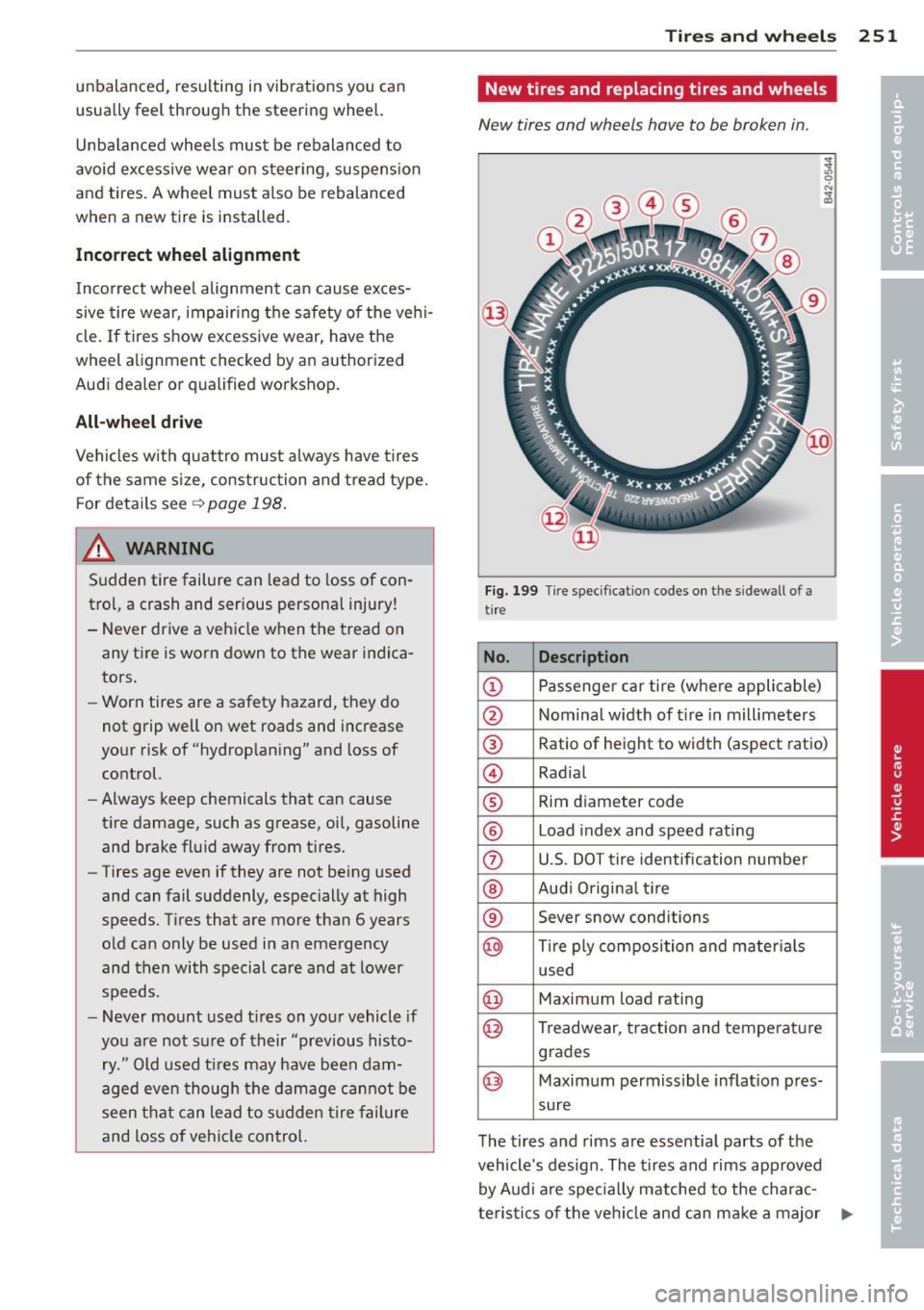
Fig. 199 Tire spec ification codes on the s idewall of a
tire
No . Description
@ Passenger car tire (where applicable)
@ Nominal w idth of t ire in millimeters
@ Ratio of height to width (aspect ratio)
© Rad ial
® Rim diameter code
® Load index and speed rati ng
0 U.S. DOT tire identification number
® Audi Original tire
® Sever snow conditions
@ Tire ply composition and ma terials
used
@ Maximum load rating
@ Treadwear, traction and tempe rat ure
grades
@ Maximum permissible inflation pres-
sure
T he tires and rims are essential parts of the
vehicle's design . The ti res and rims approved
by Audi a re spec ia lly matched to the charac
teris tics of the ve hicl e and can m ake a major .,.
Page 254 of 304
252 Tire s and wheel s
contribution to good road ho lding and safe
handling when in good condition and properly
inflated
¢ ,& .
We recommend that all work on tires and
wheels be perfo rmed by an authorized Audi
dea ler. They are familiar with recommended
proced ures and have the necessary spec ial
too ls and spare parts as well as the proper fa
cilities for disposing of the old tires.
Authorized Audi dealers have the necessary information about techn ica l requ irements for
installing or changing tires and r ims.
Re placing t ires and whe els
Tires sho uld be rep laced at least in pairs and
not individua lly (for examp le both front tires
or both rear tires together).
Be sure to read and heed the information to
the tire pressure monitoring system*
¢page 258.
Always buy rep lacement radial tires that have
the same specifications as the tires approved
for your vehicle by Audi. Replacement t ires
must always have the same load rating speci
fication as the original equipment or approved
optional tires listed in the table
c:> page 244.
Aud i-approved specification ti res are specially
matched to your vehicle and its load limits,
and can contribute to the important road ho ld
ing, driving characteristics, and safety of the
vehicle. The table
(c:> page 244) lists spec ifica
tions of the tires approved for the Audi mod
els covered by your Owner's Literature .
The tire pressure labe l located on driver's side
B-pillar
(c:> page 244, fig. 196) lists the speci
f ications of the orig inal equipment tires in
stalled on your veh icle at the time it was man
ufactured.
Federal law requires t ire manufacturers to
p lace standard ized information on the s ide
wall of all tires
c:> fig. 199. This information
i dent ifies and describes the fundamental
characterist ics, the quality grade of the tire
and a lso provides a tire ident ificat ion number f
or sa fety standard ce rtification and in case of
a reca ll.
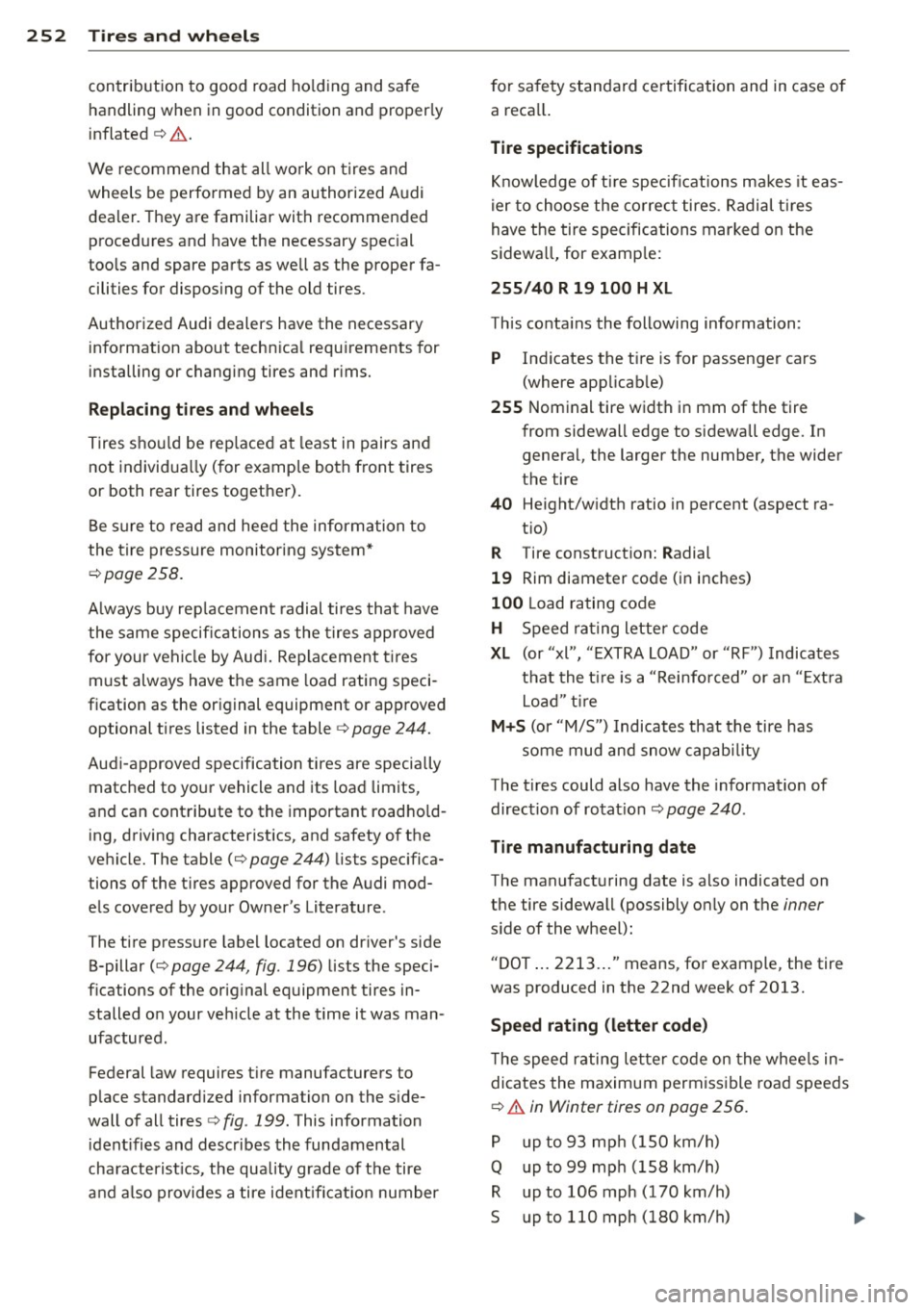
Tire specifications
Knowledge of ti re specificat ions makes it eas
ier to choose the correct tires. Radial ti res
have the tire specifications marked on the
sidewa ll, for examp le:
255 /40 R 19 100 H XL
This co nta ins the following information:
P Indicates the t ire is for passenger cars
(where app licab le)
2 55 Nominal tire width in mm of the tire
from sidewall edge to sidewa ll edge. In
general, the larger the number, the wider
the tire
40 Height/w idth ratio in percent (aspect ra-
t io)
R Tire construction: Radial
1 9 Rim diameter code (in inches)
100 Load rating code
H Speed rat ing letter code
X L (or "xl", "EXTRA LOAD" or "RF") Indicates
t h at the t ire is a "Reinforced" or an "E xt ra
Load " tir e
M+S (or "M/S") Indicates that the tire has
some mud and snow capabi lity
The tires could also have the information of
direction of rotat io n
c:> page 240 .
Tire manufacturing date
The manufact uring date is also indicated on
the tire sidewall (possibly on ly on the
inner
s ide of the wheel) :
"DOT ... 2213 ... " means, for example, the tire
was produced in the 22nd week of 2013.
Speed rating (letter cod e)
The speed rating letter code on the whee ls in
dicates the maximum permissible road speeds
¢ .&. in Winter tires on poge 256.
P up to 93 mp h (150 km/h)
Q up to 99 mph (158 km/h)
R up to 106 mph (170 km/h)
S up to 110 mph (180 km/h)
Page 259 of 304
chains because the vehicle will be ex
tremely low. If you do drive with snow
chains on while the vehicle is at this lev
el, the snow chains might severe ly dam
age the wheelhouse and other parts of
the veh icle .
@ Tips
Where snow cha ins are mandatory oncer
tain roads, this normally also applies to
veh icles with all -wheel dr ive.
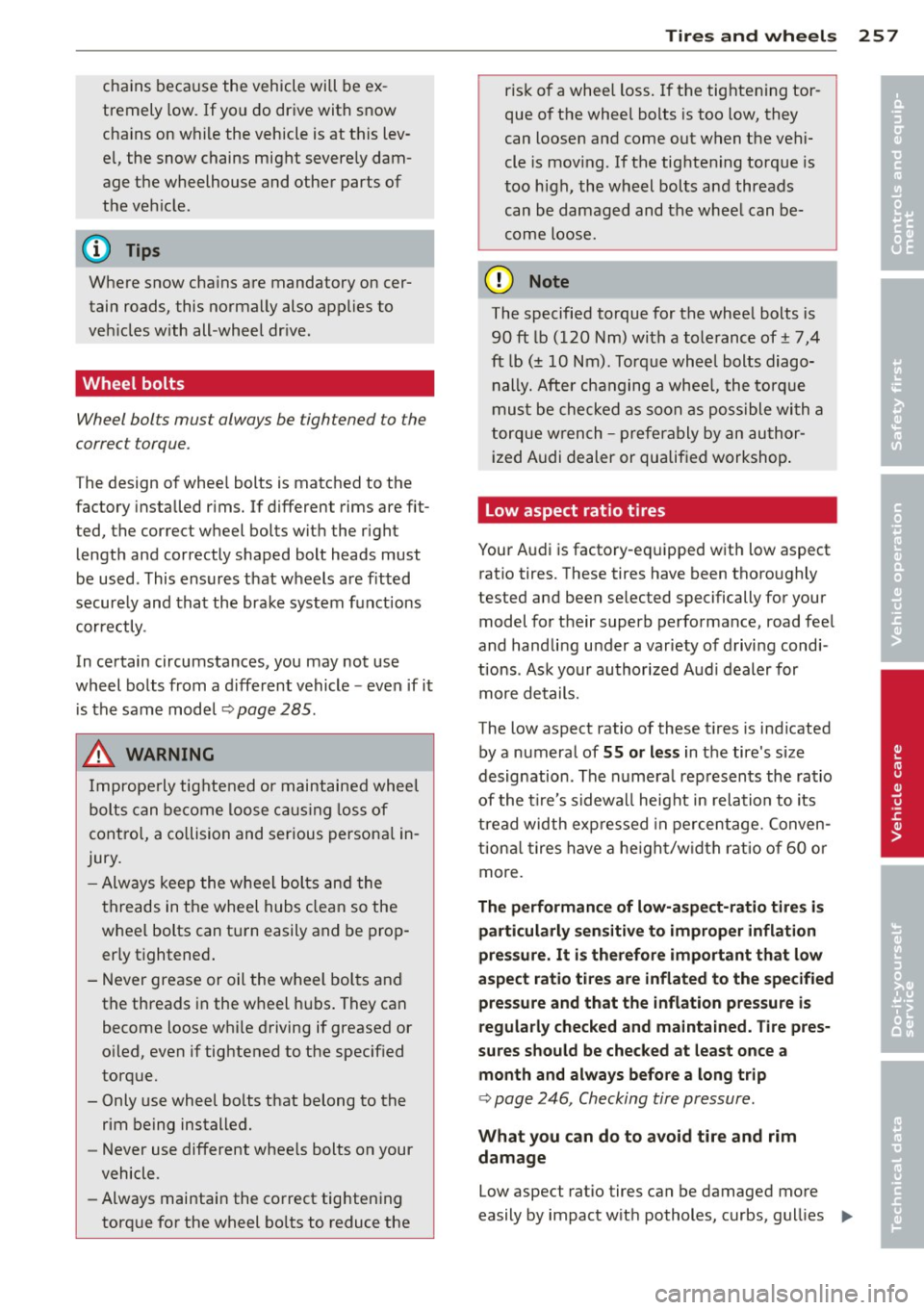
Wheel bolts
Wheel bolts mu st always be tigh tened to the
correc t torque .
The design of whee l bolts is matched to the
factory in sta lled r ims. If different rims are fit
ted, the correct wheel bolts with the right
length and correctly shaped bolt heads must
be used . This ensures that wheels are f itted
secure ly and that the brake system f unctions
correctly .
In certain circumstances, you may not use
wheel bolts from a d iffe rent vehicle -even if it
i s the same mode l
¢page 285.
A WARNING
Imprope rly tig hte ned or maintained whee l
bolts can be come loose causin g loss of
contro l, a co llision and serious persona l in
jury .
- Alw ays keep the w heel bolts and the
th reads in the wheel hubs clea n so the
wheel bolts can turn easily and be prop
er ly tightened .
- Never grease or oil the wheel bo lts and
the threads in the w heel h ubs. They can
become loose while driving if greased or
o iled, even if tightened to the specif ied
torque.
- Only use wheel bolts that belong to the rim being installed.
- Never use different whee ls bolts on your
vehicle .
- Always maintain the co rrect tightening
torq ue for the wheel bo lts to reduce the
Tire s an d wheel s 257
risk of a wheel loss. If the tighte ning tor
que of t he wheel bolts is too low, they
can loosen and come out when the vehi
cle is mov ing . If the tighte ning torque is
too h igh, the wheel bol ts and threads
can be damaged and the whee l can be
come loose.
(I) Note
The specified torque for the whee l bolts is
90 ft lb ( 120 Nm) with a tole ranc e of± 7,4
ft lb(± 10 Nm). Torq ue whee l bolts diago
nally. Afte r cha nging a whee l, the torq ue
must be checked as soon as possible wi th a
torque w rench -prefe rably by an au thor
i z ed Audi dealer or qualif ied workshop .
Low aspect ratio tires
Your Audi is facto ry-eq uipped with low aspect
ratio tires. These tires have been thoro ughly
tested and been se lected specifically for your
model for their superb performance , road fee l
and handling under a variety of driving cond i
tions . Ask your authorized Audi dealer for
more details.
The low aspect ratio of these t ires is ind icated
by a numeral of
55 or less in the tire's size
designation . The numera l rep resents the ratio
of the t ire's sidewall height in relation to its
t read width ex pressed in perce ntage. Conven
tion al tires have a he igh t/w idth ratio of 60 or
more.
The performance of low-aspe ct-ratio tire s is
particularly sensitiv e to improper infla tion
pres sure. It is therefore important that l ow
a spect ratio tires are inflated to the specified
pre ssure and that the inflation pressure is
regularly checked and maintained. Tire pres·
sures should be checked at least once a
month and always before a long trip
¢ page 246, Checking tire pressure .
What you can do to avoid tire and rim
damage
Low aspect ratio tires can be damaged more
easily by impact w it h potholes , curbs, gul lies ..,.
•
•
Page 269 of 304
-On hard, slippery surface (such as tiles)
use a rubber mat or similar to prevent
the jack from slipping .
- To help prevent injury to yourself and
your passengers:
- Do not raise the vehicle until you are
sure the jack is securely engaged.
- Passengers must not remain in the ve
hicle when it is jacked up.
- Make sure that passengers wait in a
safe place away from the vehicle and
well away from the road and traffic.
- Make sure jack position is correct , ad
just as necessary and then continue to
raise the jack.
- Changes in temperature or load can af
fect the height of the vehicle.
(D Note
Do not lift the vehicle by the sill. Position
the vehicle jack only at the designated lift
ing points on the sill. Otherwise, your vehi
cle will be damaged.
(D Tips
The vehicle jack mode* switches off auto
matically at speeds above 6 mph (10 km/
h).
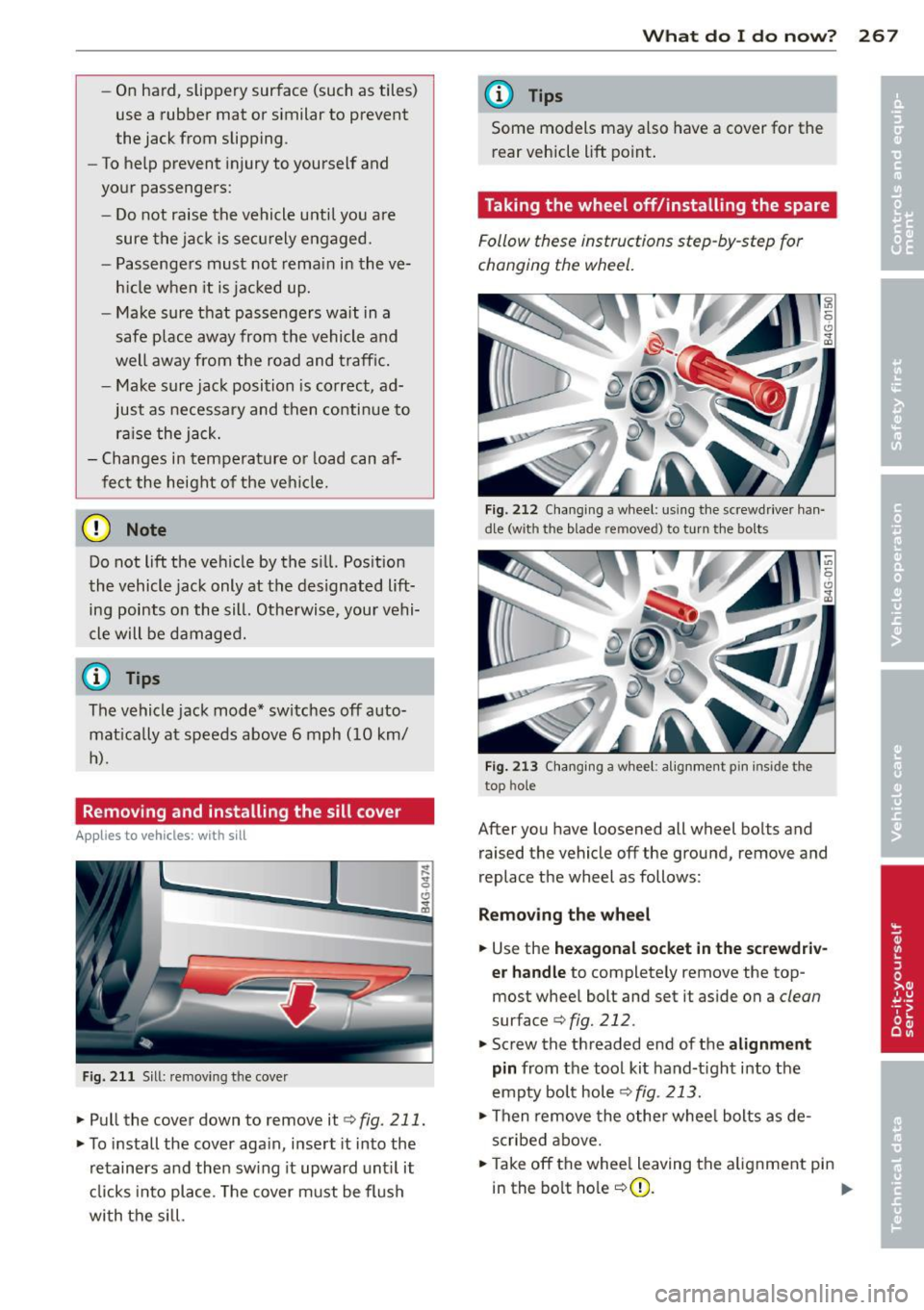
Removing and installing the sill cover
Applies to vehicles : wit h sill
Fig. 211 Sill: remov ing t he cover
.,. Pull the cover down to remove it c'> fig. 211.
.,. To install the cover again, insert it into the
retainers and then swing it upward until it
clicks into place. The cover must be flush
with the sill.
What do I do now? 267
@ Tips
Some models may also have a cover for the
rear vehicle lift point.
Taking the wheel off/installing the spare
Follow these instructions step-by-step for
changing the wheel.
Fig. 212 Changing a wheel: using the screwdrive r han
dle (w it h th e blade re m oved) to turn the bolt s
Fig. 213 Changing a wheel : alignment p in in sid e the
top hole
After you have loosened all wheel bolts and
raised the vehicle
off the ground, remove and
replace the wheel as follows :
Removing the wheel
.,. Use the hexagonal socket in the screwdriv
er handle
to completely remove the top
most wheel bolt and set it aside on a clean
surface c>fig. 212 .
.,. Screw the threaded end of the
alignment
pin
from the tool kit hand-tight into the
empty bolt hole r::;;fig . 213 .
.,. Then remove the other wheel bolts as de
scribed above .
.,. Take
off the wheel leaving the alignment pin
in the bolt hole
r::;; d). ..,.
Page 298 of 304
29 6 Index
Q
quattro
refer to All-wheel drive
198
Question What happens to unbe lted occupants? 139
Why safety be lts? . ....... .. .. .. .. . 138
R
Radiato r fan ... ........ ..... .. .. .. . 233
Radio clock .... ........ ..... .. .. .. .. 28
Ra in/light sensor
Headlights ........... ... .. .. .... .. 43
Intermittent (windshield wipers) .. .. . . 48
Senso r defective . . . . . . . . . . . . . . . . . . . . 23
Range (fuel leve l) .......... ...... .. .. 25
Reading lights ... ... .... ... ... ... .. .. 46
Rear fog lights .. .. ..... ... .. .. .... .. 43
Rear lid Emergency release . . . . . . . . . . . . . . . . . . 39
E scape hand le .................... 261
Opening and closing . ... .. .. .. .... .. 38
Rear light Defective . . . . . . . . . . . . . . . . . . . . . . . . . 23
Rear view camera
refer to Parking systems . . . . . . . 115, 116
Rear view mir ror ... ..... ... .. .. .... .. 51
Rear w indow heating (automat ic cl imate
contro l) . . . . . . . . . . . . . . . . . . . . . . . . . . . . 7 1
Rea r window heating (climate control) . . . 69
Recirculation mode (automatic climate
control) . . . . . . . . . . . . . . . . . . . . . . . . . . . . 70
Recirculation mode (climate control) . . . . 68
Refue lling . ...... ........... .. .. .. . 218
Remote control Garage door opener (HomeL ink) ... .. . 126
Unlocking and locking ... .. .. .. .... .. 35
Remote rear lid release ..... .. .. .. .. . . 38
Repair manuals ............ .. .. .. .. . 283
Repai rs
Airbag system . ....... ... .. .. .... . 163
Replacing Fu ses .. .. ............... .... .... . 270
L ight bulbs ... ........... .. .. .. .. . 273
Tires and whee ls .... ... .. .. .. .... . 252
Windshield wiper blades ... .. .. .... .. 49 Reporting Sa
fety Defects . ..... .... . .. 136
Reset button . . . . . . . . . . . . . . . . . . . . . . . . 2 7
Retractor . .. .. .. .. ... .......... .... 141
Rims Cleaning .. .... .. .. ... ..... ... .. .. 211
Roof rack ....... .................. .. 61
Load ing .... ... .................. .. 62
Roof weight ... .. ............. .... . 62
s
SAFE ......... .... ............... .. 27
Safe driving habits .............. .... 128
Safety be lt pos ition . . . . . . . . . . . . . . . . . 142
Sa fe ty be lt height adjus tment ... .. .. 144
Safety be lts worn by pregnant women . 143
Safety be lt pretensioner . . . . . . . . . . . . . . 145
Se rv ice and disposal ........... .. .. 145
Safety belt pretensioners
Pre sense ... .. .. ...... .... ... ... .
Safety be lts ..... .. .. .... .... ... .. . .
Cleaning
Danger to passengers who do not wear a 192
141
212
sa
fety belt .. .. .. ............. .... 139
Fastening ... ... . ... ... .... ... .. .. 141
Height adj ustment ................ . 144
Improperly worn ................. . 144
Not worn . .... .. ............. .... 139
Safety be lt pos ition . . . . . . . . . . . . . . . . 142
Safe ty instr uctions . . . . . . . . . . . . . . . . . 141
Securing child safety seats .. .. .. .. .. 184
Special considerations for pregnant
women . . . . . . . . . . . . . . . . . . . . . . . . . . 143
U nfastening ... ... ................ 143
Warning/ind icator light ............. 138
w . l" h arnmg 19 t . ... .. ... ....... ... .. . 17
WhyYOUMUSTwearthem .......... 138
Worn p roperly 140
Safety belt tens ioner
drive select .... .. ............. .... 100
Sa fety belt warning light .... ... .. .. .. 138
Safety comp liance sticker ........... . 280
Safety eq uipment ............... .... 128
Safety featu res for occ upant rest ra in t and
protection .. .. .. .. ... .......... .... 128
Safety gu idelines
Seat ad justment . . . . . . . . . . . . . . . . . . . . 52