service AUDI S6 2014 Owner's Manual
[x] Cancel search | Manufacturer: AUDI, Model Year: 2014, Model line: S6, Model: AUDI S6 2014Pages: 304, PDF Size: 76.32 MB
Page 207 of 304
You must drive your vehicle about 3,000 miles (5,000 kilometers) before you can properly
assess oil consumption.
This also applies to fuel consumption and en
gine output.
(D Note
- Have your vehicle maintained properly
and in accordance with the service rec
ommendations in your Warranty
& Main
tenance booklet. Lack of proper mainte
nance as well as improper use of the ve
hicle will impair the function of the
emission control system and could lead
to damage .
- Do not alter or remove any component of
the Emission Control System unless ap
proved by the manufacturer.
- Do not alter or remove any device, such
as heat shields, switches, ignition wires,
valves, which are designed to protect
your vehicle's Emission Control System
and other important vehicle compo
nents.
Fewer short trips
Fuel consumption will always be relatively
high on short trips .
.,. Try to avoid driving short distances with a
cold engine .
The engine and catalytic converter have to reach their optimal
operating temperature to
reduce fuel consumption and noxious emis
sions effectively.
Just after starting, a cold engine in a mid-size
car only achieves a fuel economy of 6 -8 miles
per gallon (30-40 l/100 km). After about a
half a mile, fuel economy climbs to 12 mpg
(20 l/100 km). After about
2.5 miles (4 km),
the engine is at its proper operating tempera
ture and fuel economy has reached a normal
level. So you can see that you should avoid
short trips whenever possible.
Driving and environment 205
The outside temperature is also critical in this
regard. Your car consumes more fuel in the
winter than in the summer.
•
•
Page 218 of 304
216 Fuel supply and filling your fuel tank
-Blend must contain not more than 1S%
MTBE.
Seasonally adjusted gasoline
Many gasoline grades are blended to perform
espec ially we ll for winter or summer driv ing.
During seasonal change-over, we suggest that
you fill up at busy gas stat ions where the sea
sonal adjustment is more likely to be made in
time.
(CT) Note
- Methanol fuels which do not meet these
requirements may cause corrosion and
damage to plastic and rubber compo
nents in the fuel system .
- Do not use fuels that fai l to meet the
specified criteria in this chapter.
- If yo u are unable to determine whether
or not a particular fuel blend meets the
specifications, ask your service station or
its fuel sup plier.
- Do not use fuel for which the contents cannot be identified.
- Fuel system damage and performance
problems resulting from the use of fuels
different from those specified are not
the respons ibility of Audi and are not
covered under the New Vehicle or the Emission Control System Warranties.
- If you experience a loss of fuel economy
or driveability and performance prob l ems due to the use of one of these fuel
blends, we recommend that you switch
to unblended fuel.
Gasoline additives
A major concern among many auto manufac
turers is carbon deposit build- up caused by
the type of gasoline you use.
A lthough gasoline grades differ from one
manufacturer to another, they have certain
things in common. All gasoline g rades contain
substances that can cause deposits to co llect
on vital engine parts, such as fuel injectors
and intake valves. Although most gasoline
brands include additives to keep engine and fuel
systems clean, they a re not equally effec
tive .
A udi recommends using TOP TIER Detergent
Gasoline. For more information on TOP TIER
Detergent Gasoline, please go to the official
website (www.toptiergas.com).
After an extended period of using inadequate
f uels, carbon deposit build-ups can rob yo ur
engine of peak performance.
(D Note
Damage or malf u nct ion due to poor fuel
quality is not covered by the Aud i New Ve
hicle Limited Warranty.
Diesel fuel
Applies to veh icles: w ith diesel engine
Always use ULSD (Ultra Low Sulfur Diesel) sul
fur content 15 ppm or less.
T he ULSD (U ltra Low Sulfur Diesel) meets the
ASTM-D-97S (grade 2).
Diesel fuel with a higher concentration than
ULSD-Diesel No. 2 ASTM 0975 and Bio-die
sel with a higher concentration than S
% like
B11, B20 or B100 are strictly prohibited.
Serv ice stat ion fue l pumps a re labeled with
the correct fuel information fo r easy recogn i
t ion by the user. If the diesel fuel pump is not
labeled ask the station operator what fue l is
being dispensed before filling up your vehicle.
Service stations offering Diesel fuel are gener
ally located on truck routes or major high
ways. Directories of Diesel fuel stations are
usually available at Diesel fuel stations.
Some states in the USA req uire permits to
purchase Diesel fuel. Check with your State
Motor Vehicle Department.
Diesel fuel may not be ava ilable outside the
USA and Canada. Be sure to check before trav-
eling to other countries . .,..
Page 230 of 304
228 Check ing and filling
current list of oils (manufacturers , brand
names etc.) that conform to Aud i oi l standard
VW 502 00 (vehicles with gasoline engine) or
VW 507 00 (vehicles with diesel engine).
C hang in g th e en gin e oil
The engine oil and o il filter must be changed
according to the m ileage (ki lomete rs) and
time inte rva ls spec ified in your vehicle's War
ranty
& Maintenance booklet . Do not exceed
these intervals - harmful deposits from old
engine o il can reduce engine performance and
can lead to expensive engine repairs .
Changing the oil at the recommended inte r
va ls is so very important because the lubricat
ing properties of oi l decrease grad ually during
norma l vehicle use. If you are not sure when
you have your oil changed, ask your author
ized Audi Service Advisor .
Under some circumstances the engine o il
should even be changed more frequently .
Change oil more often if you drive mostly
short d istances, operate the vehicle in dusty
areas or mostly under stop-and-go traffic con
d itions, or when you use your vehicle where
temperatures stay below freezing point fo r
l ong periods.
Detergent add it ives in the o il w ill make fresh
oil look dark after the eng ine has been run
n ing fo r a short time. This is no rma l and is not
a reason to change the o il more often than
recommended.
Dama ge or ma lfun cti ons du e to la ck of
maint enan ce
It is essential that you change your oil at the
recommended intervals using only engine oil
that complies with Audi oil standard
VW 502 00 (vehicles wi th gaso lin e engine) or
VW 507 00 (veh icles with diese l engine) . Yo ur
Limited New Vehicle Warranty does not cover
damage or ma lf u nctions due to failure to fol
low recommended maintenance and use re
qu irements as set forth in the A udi Owner's
Manual and War ranty
& Maintenance book let.
Your dea ler will have to deny warranty cover
age unless you present to the dealer proof in the form o
f Service or Repair Orders that all
scheduled maintenance was performed in a
t imely manner.
Engine oil consumption
The engine in your vehicle depends on on ade
quate amount of oil to lubricate and cool oil
of its moving ports.
In order to provide effective lubrication and
cooling of interna l engine components, all in
ternal combust ion engines consume a certain
amount of oil. Oil consumpt ion varies from
engine to engine and may change sign ificantly
over the life of the engine. Typically , engines
with a spec ified break- in period (see
¢ page 201) consume more oil during the
break -in pe riod t han they consume afte r o il
consumption has stabilized.
Under normal cond it ions, the rate of oil con
sumption depends on the q ua lity and viscos ity
of the oil , the RPM (revol utio ns per minute) at
which the engine is opera ted, the ambient
temperature and road conditions . Furt her fac
tors are the amount of oil dilution from water
condensation or fue l residue and the oxida
tion level of the oil. As any engine is subject to
wear as m ileage builds up, the oil consump
t ion may increase over time until replacement
of worn components may become necessary .
With a ll these variab les coming into p lay, no
standard rate of oil consumpt ion can be es
tablished or spec ified . There is no alternative
to regular and frequent checking of the o il lev
el, see
Not e.
If the yellow engine oil level warning symbol
in the instrument clus ter
II lights up, you
shou ld check the oil leve l as soon as possib le
¢
page 229 . Top off the oil at your earl iest
convenience
9 poge 229.
,&. WARNING
Before you che ck anything in the engine
compartmen t, a lways rea d and heed al l
WAR NIN GS ¢.&
in Working in the engine
comportment on page 224 .
-
Page 232 of 304
230 Check ing and filling
- The oil filler cap must be properly se
cured to prevent oil from being sprayed
on the hot engine and exhaust system
when the engine is running -fire hazard!
- If your skin has come in contact w ith the
engine oil, you must subsequently
cleanse it thoroughly.
(D Note
- Check the oil level using the MMI. If the
message
P lea se red uce oil l evel appears,
contact your author ized Audi dealer or
other qualified workshop to have excess
oil extracted if necessary.
- Aud i do es not recommend the use of o il
addit ive s. They ma y damag e the engin e
and ad versely affect yo ur New Vehicle
Warrant y.
@, For the sake of the environment
- Under no circumstances can the oil come
in contact w it h the sewage network or
the soil.
- Observe and follow lega l regulations
when disposing of empty oil containers.
Changing the engine oil
We recommend that have your oil changed by
an authorized Audi dealer or a qualified serv
ice station.
Before you check anything in the engine com
partment,
al ways read and h eed all WARN
INGS c::> &. in Working in the engine compart
ment on page 224.
The engine oil must be changed according to
the intervals spec ified in your Warranty
&
Maintenance book let . This is very important
because the lubricating prope rties of oil di
minish gradua lly dur ing normal veh icle use.
Under some c ircumstances the eng ine o il
should be changed more frequently . Change
oil more often if you drive most ly short dis
tances , operate the vehicle in dusty areas or
under predominantly stop-and-go traffic con
ditions, or have your vehicle where tempera -tu res remain below freezing for extended pe
riods.
Detergent additives in the oil will make fresh
o il look dar k after the engine has been run
ning for a sho rt time. This is normal and is not
a reason to change the oil more often than
recommended.
Because of the problem of proper disposal,
along with the specia l tools and necessary ex
pertise required, we strongly recommend that
you have your oil changed by an authorized
Aud i deale r or a qualified service station.
If you choo se to chan ge your o il yours elf ,
please note the fo llowing important informa
t ion:
A WARNING
To reduce the risk of personal injury if you
must change the eng ine oil in your vehicle
yourself:
- Wear eye protect ion.
- To reduce the risk of burns from hot en-
gine oil, let the engine cool down to the
touch.
- When removing the oil dra in p lug with
your fingers, stay as far away as possible.
Always keep your forearm parallel to the ground to help prevent hot oil from run
n ing down you r arm.
- Dra in the oil into a container designed
for this purpose, one large enough to hold at least the tota l amount of o il in
your engine.
- Engine oil is poisonous . Keep it well out
of the rea ch of children.
- Continuous contact with used eng ine o il
is harmful to your sk in . Always protect
your skin by washing oil off tho roughly
wit h soap and wate r.
(D Note
Neve r mix oil additives with you r engine
oi l. These additives can damage your en
gine and adversely affect your Audi Limit
ed New Veh icle War ranty.
Page 233 of 304
@ For the sake of the environment
-Before changing your oil, first make sure
you know where you can properly dispose
of the used o il.
- Always dispose of used engine oil proper
l y. Do not dump it on garden soi l, wood
ed areas, into open streams or down
sewage dra ins.
- Recycle used engine oil by taking it to a
used engine oil collection facility in your
area, or contact a service station .
Engine cooling system
Coolant
The engine coolant performs two functions: it
keeps the engine from overheating and it pro tects the engine from freezing in the winter.
The cooling system is sea led and generally re
q uir es lit tle atten tion .
The cooling system has been filled at the fac
tory with a pe rmanent coo lant which does not
need to be c hanged. The coolant consists of a
mixture o f spec ial ly conditioned water and the
manuf acturer 's glyco l-based cool ant ad di-
tiv e G13 antifreeze with ant icorros ion addi
tives (50% for USA models ; 60% for Canadian
mod els) . This mixture both assures the neces
sary frost protection and p rotect s metal com
ponents in the engine's coo ling system from
corrosion and scaling . It a lso raises the boil
i ng point of the coolant .
Do not reduce the concentration o f the coo l
ant in the summer by adding plain water.
The
proportion of coolant add it ive must be at
l e a st 50 % but not mor e than 60 %
to main
tain antifreeze protection and coo ling efficien
cy .
If the coolant frost protect io n is too low,
the coolant cou ld free ze and dam age the veh i
cle heating and eng ine cooling system.
For yea r-round driving, antifreeze is added at
the fac to ry for tempera tures down to:
-- 31°F( -35°C)USA
- -40 °F ( -40 °C) Canada.
Checkin g and fillin g 231
If you must add coo lant, use a mixture of wa
ter and coolant additive . Mix ing the coo lant
additive with distilled water is recommended.
_& WARNING
Before you c heck anything in the engine
compartment, always read and heed a ll
WARNINGS
c> .& in Working in the engine
comportment on page 224.
Q) Note
- Before winter sets in, have the coo lant
checked to see if the coolant additive in
your vehicle is sufficient to meet the cli mate condi tions. This is especi ally impor
tan t if you live i n a region wher e th e win
ter is ex treme ly co ld. If necessary, i n
crease t he p ropo rtion of coo lant add itive
to 60% .
- Whe n ad ding coolant additive t o yo ur
c ooling sys tem, reme mbe r:
- We recommend using on ly coolant ad
d itive G12++ or G13 (check the labe l)
fo r your vehicle . This coolant additive is
ava ilable at autho rized Aud i dea le rs .
Ot he r ty pes of antifree ze can sign ifi
cantly reduce corros io n protection. The
r es ult ing co rrosion can ca use a loss of
coolan t and serious e ng ine damage.
- Do not add any ty pe of rad iator leak seal
a nt to yo ur vehicle 's engine c oolant .
A dd ing radia tor repair fl uid may adverse
ly affect the f unction and pe rformance of
your cooling system and co uld resu lt in
damage not covered by your New Ve hicle
L imited Warranty.
-
•
•
Page 237 of 304
@ For the sake of the environment
Because of the pr oblem of proper d isposa l
of brake flu id as we ll as the special tools
requ ired and the necessary expert ise, we
recommend that you have the brake fluid
changed by your author ized Audi dealer .
Battery
General information
Under normal operating conditions, the bat
tery in your Audi does not need any mainte
nance. With
high outside temperatures or
long daily dr ives we recommend that you have
the electro lyte level checked by a service fa
cility . The electrolyte level shou ld also be
checked each time the battery is charged
¢ page 237.
Have the battery checked when you take your
ve hicle in for service . Yo u are well adv ised to
replace a battery that is older than 5 yea rs .
W ith certa in types of a irbag deployment, t he
b attery is d isconnected from the vehicle elec
tr ica l system for safety reasons¢.&.
in Re
pair, core and disposal of the airbags on
page 163.
Disconnecting the battery terminals
Some vehicle functions (power w indow regu
lators , for example) are lost if the battery ter
m inals a re d isconnected. These func tions have
to be re lea rned after the batte ry term inals a re
connected agai n. T o prevent this , the bat tery
should only be d isconnec ted from the vehicle
e lec tric al system when absolu tely necessa ry
for repairs .
Vehicles not driven for long periods
If you do not drive you r vehicle over a period
of severa l days or weeks, ele ctrical compo
nen ts are gr adually cut b ack o r swi tched off .
This redu ces energy cons umption and main
tains starting capab ility over a longer per io d
¢
page 199. Some of the co nvenience func
tions may not operate, s uch as the inte rior
lights or power seat adjustme nt. The conven-
Checkin g and fillin g 235
ience funct ions w ill be available again when
yo u sw itch on the ign ition an d start the en
gine.
Winter operation
D ur ing the w inte r mon ths, bat tery ca pa city
tends to decrease as tempera tures drop . This
is beca use more power is a lso consumed wh ile
starting, and the headlights, rear window de
fogger, etc., are used mo re often.
Avoid unnecess ary powe r consumpt ion, pa r
ticu lar ly in city traffic o r when traveling only
sho rt distances. Let yo ur authorized A udi
dealer check the capacity of the vehicle bat
tery before w inter sets in¢
page 23 7. A well
charged battery will no t on ly prevent star tin g
problems w hen the weather is cold, but w ill
also last longer .
@ Tips
If your vehicle is left standing for seve ral
weeks at extremely low temperatures, the
vehicle battery s hou ld be removed and
stored where it will not freez e. This will
p reve nt it from be ing dam aged and having
to be repl aced .
Working on the battery
Be especially careful when working on or near
the bat tery.
The battery is located in the luggage compar t
ment under the floor . B efo re you che ck any
thi ng in the luggage compartment,
read and
heed all WARNINGS
¢ .&, .
Always heed the safety warnings , when work
i ng on the veh icle batte ry or t he vehicle e lec
t rical sys tem to p reven t inju ry.
The following WARNINGS are very
important when working on the battery:
Always heed the following WARNING SYM· BO LS and safety precautions when working
on the battery .
®
Always wear eye protection.
•
•
Page 250 of 304
248 Tire s and whee ls
- Only when all tires on the vehicle are fi l
led to the correct pressure, the tire pres
sure monitoring* system can work cor rectly.
- The use of incorrect tire pressure values
can lead to accidents or other damage.
Therefore it is essential that the driver observe the specified tire pressure values
for the tires and the correct pressures for
the funct ion of the tire pressure mon itor
ing system*.
- Always inflate t ires to the recommended
and correct tire pressure before driving
off.
- Driv ing with under inflated ti res bend
more, letting them get too hot resu lting
in tread separation, sudden ti re fail ure
and loss of control.
- Excess ive speed and/overloading can
cause heat bui ld -up, sudden ti re fail ure
and loss of control.
- If the tire press ure is too low or too high,
the tires wi ll wear prematurely and the
vehicle will not hand le we ll.
- If the tire is not flat and you do not have
to change a wheel immediate ly, drive at
reduced speed to the nearest service sta
t ion to check the tire pressure and add
air as required.
Driving without va lve stem caps can cause
damage to the tire va lves. To prevent this,
always make sure that factory installed
valve stem caps on all wheels are securely mounted on the valve.
@) For the sake of the environment
Underinf lated tires will a lso increase the
fuel consumption.
Tires and vehicle load limits
There are limits to the amount of load or weight that any veh icle and any t ire ca n carry.
A veh icle that is overloaded w ill not handle
well and is more difficult to stop. Over load ing
can not on ly lead to loss of veh icle contro l, but can also damage important parts of the
vehicle and can lead to sudden tire fai lure, in
clud ing a b lowout and sudden deflation that
can cause the vehicle to crash.
Your safety and that of your passengers also depends on making sure that load limits are
not exceeded. Vehicle load includes everybody
and everything in and on the veh icle. These
load lim its are technically referred to as the
vehicle's
G ro ss Vehicl e We ight R ating
("GVWR").
The "GVWR" includes the weight of the basic
vehicle, all factory installed accessories, a full
tank of fuel, o il, coolant and other fluids plus
maximum load. The max imum load includes
the number of passengers that the vehicle is
intended to car ry ("seat ing capac ity") with an
ass umed we ight of 150 lbs (68 kg) for each
passenge r at a designated seating position
and the total weight of any luggage in the ve
hicle . If you tow a trai ler, the weight of the
trailer hitch and the tongue weight of the
loaded tra iler must be included as part of the
vehicle load.
The
G ro ss Axle We ight R ating ("GAWR") is
the maximum load that can be applied at each of the vehicle's two axles.
The Gross Vehicle Weight Rating and the Gross Axle Weight Rating are listed on the
safety comp liance sticker label located on the
driver's side B-pillar . Your Audi has 5 seat ing
pos itions, 2 in the front and 3 in the rear for
total seating capacity of 5 . Each seating posi
t ion has a safety belt
Q page 138, Safety
belts.
The fact that there is an upper limit to your
vehicle's Gross Vehicle Weight Rating means
that the total weight of whatever is being car
ried in the vehicle ( includ ing the weight of a
t ra ile r hi tch and the tongue weigh t of the
loaded tra iler) is lim ited. The more passen
gers in the vehicle or passengers who are
heavier than the standard weights assumed
mean that less weight can be carried as lug-
gage.
~
Page 252 of 304
250 Tires and wheels
and luggag e loa d cap acit y
c alcul ated in St ep 4.
6 . If your v ehi cle will b e towing
a trail er, load fro m your trail
er will b e tr ansferr ed to your
vehi cle. Con sult thi s manual
to determin e how thi s re
d uces the available cargo
and luggage lo ad capacity of
y our vehicle.
..,.Che ck the tire sidewall
(q page 251, fi g . 199) to de
termine the d esignated lo ad
rating f or a specific tire.
Tire service life
The service life of tires depends on a lot of
different things including proper installation
and balan cing, correct tire pressure and driv
ing style.
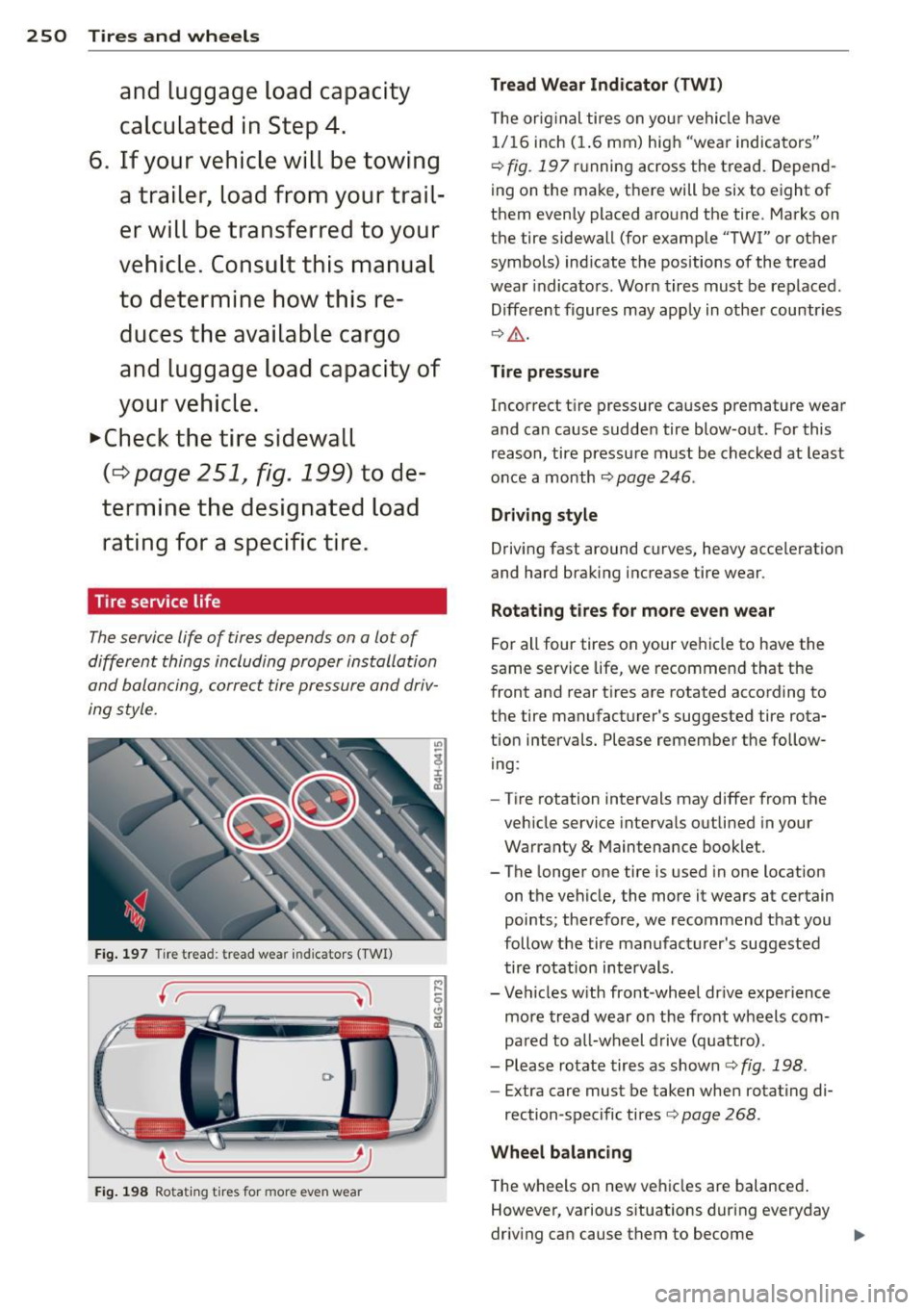
Fig. 1 97 Tire tread: trea d wea r in di cators (TWI)
Fig. 1 98 Rotat ing t ires for more even wear
Tread Wear Indicator (TWI)
The or ig inal tires on you r vehicle have
1/ 16 inch ( 1.6 mm) hig h "wear indica tors"
¢ fig. 197 ru nning across the tread . Depend
ing on the ma ke, there will be six to eight of
them even ly placed aro und the tire. Marks on
the tire sidewall (for example "TWI" or other
symbols) ind icate the positions of the tread
wear indica to rs. Wor n tires must be replaced .
Different figures may apply in other countr ies
¢ .&_ .
Tire pressure
Incorrect t ire pressure causes premature wea r
and can cause sudde n tire blow-out . For this
reason, tire pressu re must be checked at least
o nce a month
¢ page 246 .
Driving style
Driving fast around c urves , heavy accelerat ion
and hard braking increase tire wear .
Rotating tires for more even wear
F or all four tires on your ve hicle to have the
same service life, we recomme nd that the
front and rear tires are rotated accord ing to
the tire manufact urer's suggested tire rota
tion intervals. Please remembe r th e follow
i ng:
- T ire rotation intervals may differ from the
veh icle service intervals o utli ned in your
Warranty
& M ain tena nce booklet.
- The longer one tire is used in one location
on t he vehicle, the more it wears at certain
points; the refore , we recommend that you
follow the tire man ufac turer's suggested
tir e rotat ion intervals.
- Ve hicles w ith front -wheel dr ive experience
more trea d wear on the fro nt wheels com
pa red to all-wheel d rive (q uattro).
- Please rotate tires as shown ¢
fig. 198 .
-Extra care must be taken when rotating di-
rection -spec ific tires ¢
page 268 .
Wheel balancing
The wheels on new ve hicles are balanced .
However, various s ituations during everyday
driv ing can cause them to become
...
Page 270 of 304
268 What do I do no w?
P uttin g on the spare wheel
.. Lift the spare wheel and ca refully slide it
over the alignment pin to guide it in place
¢ (D .
.. Use the hexagonal socket in the screwdriver
handle to screw in and tighten all wheel
bolts
slightly.
.. Remove the alignment pin and insert and
t ighten the remaining wheel bolt slightly
l ike the rest .
.. Turn the jack handle counte r-clockw ise to
lower the vehicle unt il the jac k is fully re
leased.
.. Use the wheel bolt wrench to tighten all
wheel bolts firmly¢
page 265 . Tighten
them
crosswise, from one bolt to the (ap
proximately) opposite one, to keep the
wheel centered.
When removing or installing the wheel,
the rim could hit the brake rotor and dam
age the rotor. Work carefully and have a
second person help you .
(j) Tips
Never use the hexagonal socket in the han
dle of the screwdriver to loosen or t ighten
the wheel bolts .
- Pull the reversible blade from the screw
driver before you use the hexagonal
socket in the handle to turn the wheel bo lts.
- When mounting tires with
unid ir ec tional
tread design
make su re the tread pat
tern is pointed the right way
¢ page 268.
-The wheel bolts should be clean and easy
to tu rn . Check for d irt and corrosion on
t h e mat ing s urfaces of both the whee l
and the h ub. Remove al l dirt from these
s ur faces before remo unting the wheel.
Tires with unidirectional tread design
Tires with unidirectional tread design must be
mounted with their tread pattern pointed in the right direction .
Using a sp are t ire w ith a tre ad pattern
intended for use in a specific direction
When using a spare t ire with a tread patter n
intended for use in a spec ific d irection , please
note the following :
- The direct ion of rotation is marked by an ar
row on the side of the ti re .
- If the spare tire has to be installed in the in
correct direct ion, use the spare tire only
temporarily s ince the tire will not be able to
achieve its optim um performance cha racte r
is tic s wit h regard to aquap la ni ng, no ise and
wear .
- We recommend that you pay part icu la r at
t en tion to th is fact d uring wet wea ther and
t ha t you adjust you r speed to match road
conditions .
- Replace the fl at tir e with a new o ne an d
have it insta lled on you r vehicle as soon as
possible to resto re the handling advantages
of a u nidirectional tire .
Notes on wheel changing
Please read the information¢ page 251, New
tires and replacing tires and wheels
if you a re
going to use a spare tire which is different
from the ti res on your vehicle .
After you change a tire:
- Check the tire pre ssure on the spare imme
diately after install ation.
- Have th e whe el bolt tightening torque
c hecked with a torque wrench as soon a s
possible by your author ized Audi dealer or
a qualified service stat ion.
- With steel and alloy wheel rims, the wheel
bolt s are cor re ctl y tightened at a torque of
90 ft lb (120 Nm ).
- If you noti ce that the wheel bolts are cor
roded and diffi cult to turn while changing
a ti re , they should be replaced before you
check the t ightening torque. .,..
Page 277 of 304
@ Tips
The disc harged battery must be properly
connected to the vehicle's electrical sys
tem. When jump starting or charg ing the
battery, never connect the negative
ground cable to the battery negat ive post
because the ba ttery manager system must
be ab le to detect the battery's state of
charge. Always connect the negative
g round cab le to the negative ground pos t
of t he battery manager cont ro l unit.
Use of jumper cables
Make sure to connect the jumper coble
clomps in exactly the order described b elow!
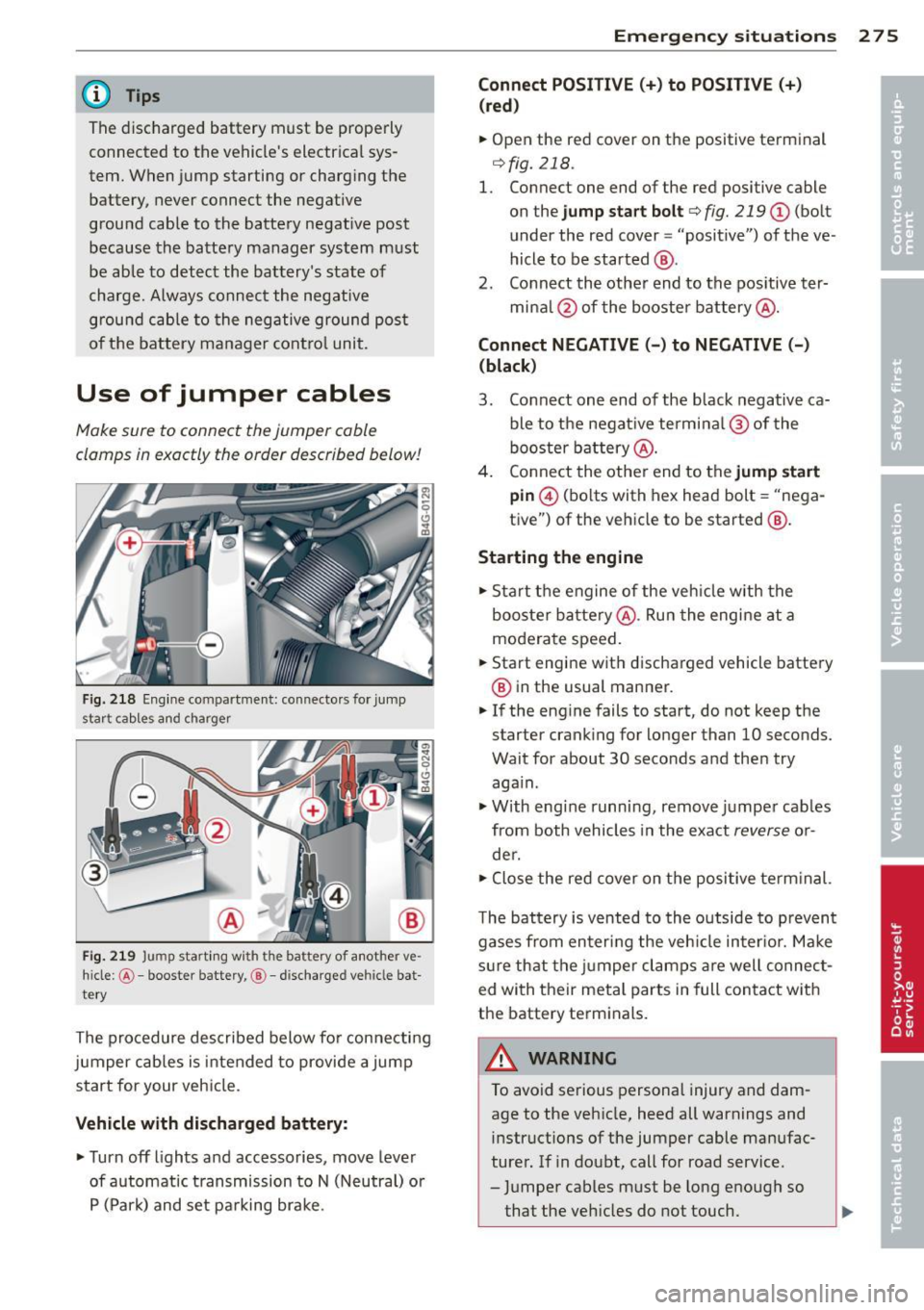
Fi g. 21 8 Eng ine co mpar tment : connecto rs for jum p
s tar t cab les and ch arg er
F ig. 219 Jump start in g w ith t he ba ttery of a not her ve ·
hi cle :
@-booster battery, ®-disc harged ve hicle bat
te ry
The procedure described below fo r connecting
jumper cables is intended to provide a jump
start for your veh icle.
Vehicle with discharged battery :
• Turnoff lights and accessories, move lever
of automatic t ransmission to N (Neutral) o r
P ( Par k) and set pa rking brake .
Emergenc y situ ation s 2 7 5
Connect POSI TIVE(+) to POSITIVE(+)
(red )
• Open the red cov er on the posit ive te rminal
¢ fig. 218 .
1. Connect one end of the red positive cable
on the jump sta rt bolt
¢ fig. 219 (D (bolt
under the red cover = "positive") of the ve
hicle to be started @.
2 . Connect th e othe r end to the pos itive ter-
mi na l@ of the booster battery @.
Connect NEGATIVE( -) to NEGATIVE(-)
(black )
3. Connect one end of the black negative ca ble to the negat ive termi na l@ of the
booster b attery @.
4. Connect the othe r end to the jump start
pin @ (bo lts w ith hex head bolt = "nega
tive") of the vehicle to be started @.
Starting the engine • Sta rt the engine of the veh icle w ith the
booste r ba tte ry @ . Ru n the engine at a
moderate speed.
• Start engine w it h discharged vehicle battery
@ in the usual manner.
• If the eng ine fails to start, do not keep the
starter c ranking for longer than 10 seconds.
Wait for about 30 seco nds a nd the n try
aga in .
• With eng ine runni ng,
remove ju mpe r cab les
from both vehicles in the exact
reverse o r
de r.
• Close the re d
cover on the positive te rm inal.
T he battery is v ented to th e outside to p rev ent
gases from en ter ing the veh icle in ter io r. Ma ke
s ur e th at the j umper clamps are well connec t
ed with their meta l parts in full con ta ct w ith
the battery term inals.
,8. WARNING
To avoid se rious personal injury and dam
age to the veh icle, heed all warnings and
instructions of the jumper cable man ufac
ture r. If in doubt, call for road service .
- Ju mpe r cables m ust be long enough so
that the veh icles d o not touch.
-